After Pentecost | Saturday 07 Nov 2026: Psalm 78:1-7; Joshua 20:1-9; Matthew 24:1-14 ~ All nations will hear the Good News of the Kingdom.

After Pentecost | Saturday 07 Nov 2026

+ In the name of the Father, and the Son, and the Holy Spirit. Amen

Opening prayer:

Grant us, Lord,
not to be anxious about earthly things,
but to love things heavenly; and even now,
as we live among things that are passing away,
to hold fast to those that shall endure;
through Jesus Christ our Lord,
who lives and reigns with you and the Holy Spirit,
one God, for ever and ever. Amen.

“What sign will signal your return
and the end of the world?”
(Matthew 24:14)

__________

Psalms: Psalm 78  | Poor Bishop Hooper

o people listen incline your ear
to the mysteries to the teaching here
things that we have heard, things that we have known
parables our fathers told oh no we won’t hide them
we’ll let the children hear

he divided the sea and let them pass through it
made the waters stand there as a heap
in the day he lead by cloud, but with fire in the night
he split the rock for water so they could drink
he opened up the skies the very doors of heaven
poured the bread of angels there to eat
by his very might on the wind he fulfilled every hungering

in spite of all of this they sinned they sinned
in spite of all of this they rebelled again
in spite of all of this they sinned they sinned

he had made the river blood sent the swarms to devour
he gave the crops to beasts the harvest of their labor
the hail destroyed the vine the flocks by lighted sky
amidst the thundercloud
he let loose his anger by a company of angels
and when the path was made from death he wouldn’t save
struck down the firstborn first fruits of egypt’s strength
then he lead his people out

in spite of all of this they sinned they sinned
in spite of all of this they rebelled again
in spite of all of this they sinned they sinned

so full of wrath God rose
against his own laid low
the young men and the strong they fell
he delivered up his glory
into fire all consuming
the women had no marriage song
the priests fell by the sword
the widows they made no lament
but then the lord

full of compassion
his anger was restrained
yet full of compassion
he remembered them again
yet full of compassion
with a pure heart and skillful hand
yet full of compassion
he remembered them again

__________

OT Reading: Joshua 20 (NLT)

The Cities of Refuge

20:1 The Lord said to Joshua, “Now tell the Israelites to designate the cities of refuge, as I instructed Moses. Anyone who kills another person accidentally and unintentionally can run to one of these cities; they will be places of refuge from relatives seeking revenge for the person who was killed.

20:4 “Upon reaching one of these cities, the one who caused the death will appear before the elders at the city gate and present his case. They must allow him to enter the city and give him a place to live among them. If the relatives of the victim come to avenge the killing, the leaders must not release the slayer to them, for he killed the other person unintentionally and without previous hostility. But the slayer must stay in that city and be tried by the local assembly, which will render a judgment. And he must continue to live in that city until the death of the high priest who was in office at the time of the accident. After that, he is free to return to his own home in the town from which he fled.”

20:7 The following cities were designated as cities of refuge: Kedesh of Galilee, in the hill country of Naphtali; Shechem, in the hill country of Ephraim; and Kiriath-arba (that is, Hebron), in the hill country of Judah. On the east side of the Jordan River, across from Jericho, the following cities were designated: Bezer, in the wilderness plain of the tribe of Reuben; Ramoth in Gilead, in the territory of the tribe of Gad; and Golan in Bashan, in the land of the tribe of Manasseh. These cities were set apart for all the Israelites as well as the foreigners living among them. Anyone who accidentally killed another person could take refuge in one of these cities. In this way, they could escape being killed in revenge prior to standing trial before the local assembly.

__________

O Lord My Rock and My Redeemer | Bob Kauflin | 2025 Shepherd’s Conference at Grace Community Church

__________

NT Reading: Matthew 24:1-14 (NLT)

Jesus Speaks about the Future

24:1 As Jesus was leaving the Temple grounds, his disciples pointed out to him the various Temple buildings. But he responded, “Do you see all these buildings? I tell you the truth, they will be completely demolished. Not one stone will be left on top of another!”

+ Later, Jesus sat on the Mount of Olives. His disciples came to him privately and said, “Tell us, when will all this happen? What sign will signal your return and the end of the world?”

24:4 Jesus told them, “Don’t let anyone mislead you, for many will come in my name, claiming, ‘I am the Messiah.’ They will deceive many. And you will hear of wars and threats of wars, but don’t panic. Yes, these things must take place, but the end won’t follow immediately. Nation will go to war against nation, and kingdom against kingdom. There will be famines and earthquakes in many parts of the world. But all this is only the first of the birth pains, with more to come.

24:9 “Then you will be arrested, persecuted, and killed. You will be hated all over the world because you are my followers. And many will turn away from me and betray and hate each other. And many false prophets will appear and will deceive many people. Sin will be rampant everywhere, and the love of many will grow cold. But the one who endures to the end will be saved. And the Good News about the Kingdom will be preached throughout the whole world, so that all nations will hear it; and then the end will come.

__________

Go Ye Into All the World | Eugene Butler | Virtual Choir

__________

Prayer: ACNA | BCP 2019

Almighty God our Savior, you desire that none should perish, and you have taught us through your Son that there is great joy in heaven over every sinner who repents: Grant that our hearts may ache for a lost and broken world. May your Holy Spirit work through our words, deeds, and prayers, that the lost may be found and the dead made alive, and that all your redeemed may rejoice around your throne; through Jesus Christ our Lord. Amen.

O God, our heavenly Father: Pour out your Spirit on your Church, that we may fulfill Christ’s command to preach the Gospel to all people. Send forth laborers into your harvest; defend them in all dangers and temptations; and hasten the time when the fullness of the Gentiles shall be gathered in, and faithful Israel shall be saved; through your Son Jesus Christ our Lord. Amen.

O God, you have made of one blood all the peoples of the earth: Grant that people everywhere may seek after you and find you; bring the nations into your fold; pour out your Spirit upon all flesh; and hasten the coming of your kingdom; through Jesus Christ our Lord. Amen.

Closing: FaithandWorship.com | John Birch

May Christ, who has opened the kingdom of heaven,
bring us to reign with him in glory.

+ In the Name of the Father, and the Son, and the Holy Spirit. Amen.

Morning Reading: Tue, 23 Jan – Joshua 16-20 ~ inheritance: to be claimed and taken

Morning Reading

+ In the name of the Father, and the Son, and the Holy Spirit. Amen!

Opening – (Northumbria Community)

One thing I have asked of the Lord, this is what I seek: that I may dwell in the house of the Lord all the days of my life; to behold the beauty of the Lord and to seek Him in His temple.

Praise to You, Lord Jesus Christ, King of endless glory.

Please Read: Joshua 16-20 (NLT) – click here

Reading Excerpts

The Land Given to Ephraim and West Manasseh

Joshua 16 & 17 (NLT) – The allotment for the descendants of Joseph extended from the Jordan River near Jericho, east of the springs of Jericho, through the wilderness and into the hill country of Bethel. From Bethel (that is, Luz) it ran over to Ataroth in the territory of the Arkites. Then it descended westward to the territory of the Japhletites as far as Lower Beth-horon, then to Gezer and over to the Mediterranean Sea.

This was the homeland allocated to the families of Joseph’s sons, Manasseh and Ephraim.

+ The Land Given to Ephraim – The following territory was given to the clans of the tribe of Ephraim. The boundary of their homeland began at Ataroth-addar in the east… then on to the Mediterranean Sea. From Micmethath on the north, the boundary curved eastward… [and] turned southward… touched Jericho, and ended at the Jordan River. From Tappuah the boundary extended westward, following the Kanah Ravine to the Mediterranean Sea. This is the homeland allocated to the clans of the tribe of Ephraim.

In addition, some towns with their surrounding villages in the territory allocated to the half-tribe of Manasseh were set aside for the tribe of Ephraim. They did not drive the Canaanites out of Gezer, however, so the people of Gezer live as slaves among the people of Ephraim to this day.

+ The Land Given to West Manasseh – The next allotment of land was given to the half-tribe of Manasseh, the descendants of Joseph’s older son. Makir, the firstborn son of Manasseh, was the father of Gilead. Because his descendants were experienced soldiers, the regions of Gilead and Bashan on the east side of the Jordan had already been given to them. So the allotment on the west side of the Jordan was for the remaining families within the clans of the tribe of Manasseh: Abiezer, Helek, Asriel, Shechem, Hepher, and Shemida. These clans represent the male descendants of Manasseh son of Joseph….

Manasseh’s total allocation came to ten parcels of land, in addition to the land of Gilead and Bashan across the Jordan River, because the female descendants of Manasseh received a grant of land along with the male descendants. (The land of Gilead was given to the rest of the male descendants of Manasseh.)

… The following towns within the territory of Issachar and Asher, however, were given to Manasseh: Beth-shan, Ibleam, Dor (that is, Naphoth-dor), Endor, Taanach, and Megiddo, each with their surrounding settlements. But the descendants of Manasseh were unable to occupy these towns because the Canaanites were determined to stay in that region. Later, however, when the Israelites became strong enough, they forced the Canaanites to work as slaves. But they did not drive them out of the land.

The descendants of Joseph came to Joshua and asked, “Why have you given us only one portion of land as our homeland when the Lord has blessed us with so many people?”

Joshua replied, “If there are so many of you, and if the hill country of Ephraim is not large enough for you, clear out land for yourselves in the forest where the Perizzites and Rephaites live.”

The descendants of Joseph responded, “It’s true that the hill country is not large enough for us. But all the Canaanites in the lowlands have iron chariots, both those in Beth-shan and its surrounding settlements and those in the valley of Jezreel. They are too strong for us.”

Then Joshua said to the tribes of Ephraim and Manasseh, the descendants of Joseph, “Since you are so large and strong, you will be given more than one portion. The forests of the hill country will be yours as well. Clear as much of the land as you wish, and take possession of its farthest corners. And you will drive out the Canaanites from the valleys, too, even though they are strong and have iron chariots.”

The Allotments of the Remaining Land

Joshua 18 & 19 (NLT) – Now that the land was under Israelite control, the entire community of Israel gathered at Shiloh and set up the Tabernacle. But there remained seven tribes who had not yet been allotted their grants of land.

Then Joshua asked them, “How long are you going to wait before taking possession of the remaining land the Lord, the God of your ancestors, has given to you? Select three men from each tribe, and I will send them out to explore the land and map it out. They will then return to me with a written report of their proposed divisions of their new homeland. Let them divide the land into seven sections, excluding Judah’s territory in the south and Joseph’s territory in the north. And when you record the seven divisions of the land and bring them to me, I will cast sacred lots in the presence of the Lord our God to assign land to each tribe.

“The Levites, however, will not receive any allotment of land. Their role as priests of the Lord is their allotment. And the tribes of Gad, Reuben, and the half-tribe of Manasseh won’t receive any more land, for they have already received their grant of land, which Moses, the servant of the Lord, gave them on the east side of the Jordan River.”

As the men started on their way to map out the land, Joshua commanded them, “Go and explore the land and write a description of it. Then return to me, and I will assign the land to the tribes by casting sacred lots here in the presence of the Lord at Shiloh.” The men did as they were told and mapped the entire territory into seven sections, listing the towns in each section. They made a written record and then returned to Joshua in the camp at Shiloh. And there at Shiloh, Joshua cast sacred lots in the presence of the Lord to determine which tribe should have each section.

+ The Land Given to Benjamin – The first allotment of land went to the clans of the tribe of Benjamin. It lay between the territory assigned to the tribes of Judah and Joseph….

These were the towns given to the clans of the tribe of Benjamin. Jericho, Beth-hoglah, Emek-keziz, Beth-arabah, Zemaraim, Bethel, Avvim, Parah, Ophrah, Kephar-ammoni, Ophni, and Geba—twelve towns with their surrounding villages. Also Gibeon, Ramah, Beeroth, Mizpah, Kephirah, Mozah, Rekem, Irpeel, Taralah, Zela, Haeleph, the Jebusite town (that is, Jerusalem), Gibeah, and Kiriath-jearim—fourteen towns with their surrounding villages.

This was the homeland allocated to the clans of the tribe of Benjamin.

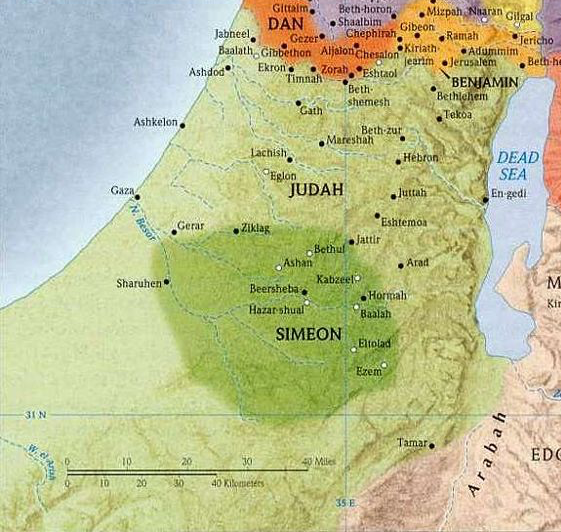
+ The Land Given to Simeon – The second allotment of land went to the clans of the tribe of Simeon. Their homeland was surrounded by Judah’s territory. Simeon’s homeland included Beersheba… — [in all,] thirteen towns with their surrounding villages. It also included Ain, Rimmon, Ether, and Ashan—four towns with their villages, including all the surrounding villages as far south as Baalath-beer (also known as Ramah of the Negev).

This was the homeland allocated to the clans of the tribe of Simeon. Their allocation of land came from part of what had been given to Judah because Judah’s territory was too large for them. So the tribe of Simeon received an allocation within the territory of Judah.

+ The Land Given to Zebulun – The third allotment of land went to the clans of the tribe of Zebulun…. The towns in these areas included Kattath, Nahalal, Shimron, Idalah, and Bethlehem—twelve towns with their surrounding villages.

The homeland allocated to the clans of the tribe of Zebulun included these towns and their surrounding villages.

+ The Land Given to Issachar – The fourth allotment of land went to the clans of the tribe of Issachar.

Its boundaries included the following towns: Jezreel…. The boundary also touched Tabor… and ending at the Jordan River—sixteen towns with their surrounding villages.

The homeland allocated to the clans of the tribe of Issachar included these towns and their surrounding villages.

+ The Land Given to Asher – The fifth allotment of land went to the clans of the tribe of Asher…. The boundary on the west touched Carmel… then it turned east… and ran as far as Zebulun in the valley of Iphtah-el…. It then continued north… as far as Greater Sidon. Then the boundary turned toward Ramah and the fortress of Tyre, where it turned toward Hosah and came to the Mediterranean Sea. The territory also included… —twenty-two towns with their surrounding villages.

The homeland allocated to the clans of the tribe of Asher included these towns and their surrounding villages.

+ The Land Given to Naphtali – The sixth allotment of land went to the clans of the tribe of Naphtali.

Its boundary ran from Heleph… ending at the Jordan River. The western boundary… touched the border of Zebulun in the south, the border of Asher on the west, and the Jordan River on the east. The fortified towns included in this territory were… Hazor… —nineteen towns with their surrounding villages.

The homeland allocated to the clans of the tribe of Naphtali included these towns and their surrounding villages.

+ The Land Given to Dan – The seventh allotment of land went to the clans of the tribe of Dan.

The land allocated as their homeland included the following towns: … Elon, Timnah, Ekron… and the territory across from Joppa.

But the tribe of Dan had trouble taking possession of their land, so they attacked the town of Laish. They captured it, slaughtered its people, and settled there. They renamed the town Dan after their ancestor.

The homeland allocated to the clans of the tribe of Dan included these towns and their surrounding villages.

+ The Land Given to Joshua – After all the land was divided among the tribes, the Israelites gave a piece of land to Joshua as his allocation. For the Lord had said he could have any town he wanted. He chose Timnath-serah in the hill country of Ephraim. He rebuilt the town and lived there.

These are the territories that Eleazar the priest, Joshua son of Nun, and the tribal leaders allocated as grants of land to the tribes of Israel by casting sacred lots in the presence of the Lord at the entrance of the Tabernacle at Shiloh. So the division of the land was completed.

The Cities of Refuge

Joshua 20 (NLT) – The Lord said to Joshua, “Now tell the Israelites to designate the cities of refuge, as I instructed Moses. Anyone who kills another person accidentally and unintentionally can run to one of these cities; they will be places of refuge from relatives seeking revenge for the person who was killed.

“Upon reaching one of these cities, the one who caused the death will appear before the elders at the city gate and present his case. They must allow him to enter the city and give him a place to live among them. If the relatives of the victim come to avenge the killing, the leaders must not release the slayer to them, for he killed the other person unintentionally and without previous hostility. But the slayer must stay in that city and be tried by the local assembly, which will render a judgment. And he must continue to live in that city until the death of the high priest who was in office at the time of the accident. After that, he is free to return to his own home in the town from which he fled.”

The following cities were designated as cities of refuge: Kedesh of Galilee, in the hill country of Naphtali; Shechem, in the hill country of Ephraim; and Kiriath-arba (that is, Hebron), in the hill country of Judah. On the east side of the Jordan River, across from Jericho, the following cities were designated: Bezer, in the wilderness plain of the tribe of Reuben; Ramoth in Gilead, in the territory of the tribe of Gad; and Golan in Bashan, in the land of the tribe of Manasseh. These cities were set apart for all the Israelites as well as the foreigners living among them. Anyone who accidentally killed another person could take refuge in one of these cities. In this way, they could escape being killed in revenge prior to standing trial before the local assembly.
__________

“He Is Our God” – Prayers of the Saints Live


__________

Blessing – (Northumbrian Community)

May the peace of the Lord Christ go with you, wherever He may send you. May He guide you through the wilderness, protect you through the storm. May He bring you home rejoicing at the wonders He has shown you. May He bring you home rejoicing once again into our doors.
__________

+ In the name of the Father, and the Son, and the Holy Spirit. Amen!