
Morning Prayer: 11 Sept – Revelation 4:1-11 ~ a glimpse of heaven

Morning Prayer

+ In the name of the Father and of the Son, and of the Holy Spirit. Amen

Opening sentences

God, come to my assistance. Lord, make haste to help me.

One thing I have asked of the Lord, this is what I seek: that I may dwell in the house of the Lord all the days of my life; to behold the beauty of the Lord and to seek Him in His temple.

Glory to the Father and to the Son, and to the Holy Spirit: as it was in the beginning, is now, and will be for ever. Amen.

Revelation 4:1-11 (ESV) – to be read aloud
heavens-gate

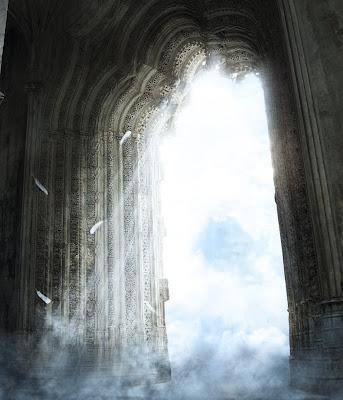
After this I looked, and behold, a door standing open in heaven! And the first voice, which I had heard speaking to me like a trumpet, said, “Come up here, and I will show you what must take place after this.” At once I was in the Spirit, and behold, a throne stood in heaven, with one seated on the throne. And he who sat there had the appearance of jasper and carnelian, and around the throne was a rainbow that had the appearance of an emerald. Around the throne were twenty-four thrones, and seated on the thrones were twenty-four elders, clothed in white garments, with golden crowns on their heads. From the throne came flashes of lightning, and rumblings and peals of thunder, and before the throne were burning seven torches of fire, which are the seven spirits of God, and before the throne there was as it were a sea of glass, like crystal.

And around the throne, on each side of the throne, are four living creatures, full of eyes in front and behind: the first living creature like a lion, the second living creature like an ox, the third living creature with the face of a man, and the fourth living creature like an eagle in flight. And the four living creatures, each of them with six wings, are full of eyes all around and within, and day and night they never cease to say,

“Holy, holy, holy, is the Lord God Almighty, who was and is and is to come!”

And whenever the living creatures give glory and honor and thanks to him who is seated on the throne, who lives forever and ever, the twenty-four elders fall down before him who is seated on the throne and worship him who lives forever and ever. They cast their crowns before the throne, saying,

“Worthy are you, our Lord and God, to receive glory and honor and power, for you created all things, and by your will they existed and were created.”

Reflection

THE SECOND VISION – THE HEAVENLY THRONE

Summary: The first part of the vision has as its central focus the heavenly throne on which is seated one who, in keeping with Jewish tradition, is not described apart from the splendor that surrounds him…. For John to be granted such a vision of the heavenly scene was a remarkable gift to the lonely Seer on Patmos. A vision of the adoring hosts in heaven and their joyous acknowledgement of his role as sovereign creator prepared John to serve as a faithful messenger of all that he was about to see in subsequent visions. Nowhere in the literature of heavenly visions will one find a more inspiring presentation of the God who reigns supreme over all. (Mounce, p.118)

The Revelation proper begins with the ultimate and eternal fact of God enthroned and ruling the universe. However fearful or uncrontrolled the forces of evil on earth may seem to be, they cannot annul or eclipse the greater fact that behind the scenes God is on his throne governing the universe. (Ladd, p.70)

Worship


__________


__________

Canticle

Christ, as a light – illumine and guide me.
Christ, as a shield – overshadow me.
Christ under me; Christ over me; Christ beside me – on my left and my right.
This day be within and without me, lowly and meek, yet all-powerful.
Be in the heart of each to whom I speak; in the mouth of each who speaks unto me.
This day be within and without me, lowly and meek, yet all-powerful.
Christ as a light; Christ as a shield; Christ beside me – on my left and my right.

Blessing

May the peace of the Lord Christ go with you, wherever He may send you.
May He guide you through the wilderness, protect you through the storm.
May He bring you home rejoicing at the wonders He has shown you.
May He bring you home rejoicing once again into our doors.

+ In the name of the Father, and of the Son, and of the Holy Spirit. Amen
_____________________________________

Peanut Gallery: In September, we will begin reading through the Book of Revelation (ESV). Our purpose will be devotional, i.e. to discover the word of blessing that God has for us in these troubled times… to find hope and help for our daily lives.

This will not be a Bible Study per se: we will not attempt to unravel the “mysteries” of Revelation… that is far beyond our abilities and is not our interest here. However, so as not to get too far afield, we will rely on three study resources: primary – A Commentary on the Revelation of John (George Elton Ladd); supplemental Revelation (Leon Morris) and  The Book of Revelation (Robert H. Mounce).

The general format for Morning Prayer is adapted from the Northumbrian Community‘s Daily Office, as found in Celtic Daily Prayer (see online resources here.) On Sundays, we’ll return to the USCCB readings (see online resources here) and various liturgical resources in order to reflect the Church’s worship and concerns throughout the world. Photo illustrations and music videos, available online, are included as they illustrate or illuminate the readings. I will try to give credit and link to sources as best I can.

Morning Prayer: 10 Sept – Revelation 3:14-22 ~ Laodicea: open the door

Morning Prayer

+ In the name of the Father and of the Son, and of the Holy Spirit. Amen

Opening sentences

God, come to my assistance. Lord, make haste to help me.

One thing I have asked of the Lord, this is what I seek: that I may dwell in the house of the Lord all the days of my life; to behold the beauty of the Lord and to seek Him in His temple.

Glory to the Father and to the Son, and to the Holy Spirit: as it was in the beginning, is now, and will be for ever. Amen.

Revelation 3:14-22 (ESV) – to be read aloud

“And to the angel of the church in Laodicea write: ‘The words of the Amen, the faithful and true witness, the beginning of God’s creation.

Jesus knocking

“‘I know your works: you are neither cold nor hot. Would that you were either cold or hot! So, because you are lukewarm, and neither hot nor cold, I will spit you out of my mouth. For you say, I am rich, I have prospered, and I need nothing, not realizing that you are wretched, pitiable, poor, blind, and naked. I counsel you to buy from me gold refined by fire, so that you may be rich, and white garments so that you may clothe yourself and the shame of your nakedness may not be seen, and salve to anoint your eyes, so that you may see.

“‘Those whom I love, I reprove and discipline, so be zealous and repent. Behold, I stand at the door and knock. If anyone hears my voice and opens the door, I will come in to him and eat with him, and he with me.

“‘The one who conquers, I will grant him to sit with me on my throne, as I also conquered and sat down with my Father on his throne. He who has an ear, let him hear what the Spirit says to the churches.’”

Reflection

THE FIRST VISION – THE SEVEN LETTERS

To the church in Laodicea

Summary: The church in Laodicea posed a special problem. Their self-confidence had blinded them to the fact that they were “poor and naked.” Assurance that they had it all together had resulted in lukewarmness that made Christ want to spit them out of his mouth. They were counseled to buy from him spiritual wealth, the white robes of righteousness and clear vision into spiritual matters. He stands at the heart’s door of each believer and knocks, requesting permission to enter and share the blessings and joy of personal fellowship. Christ promises to each overcomer the privilege of sitting with him on his throne. (Mounce, p.106)

Christ: The titles of Christ… stress his faithfulness, his reliability and his trustworthiness. These stand in sharp contrast with the unfaithfulness of the Christians in Laodicea…. Christ is the “source and origin” of creation… for Christ is eternal. (Morris, p.81; Ladd, p.65)

The problem in Laodicea: Laodicea was on of the richest commercial centers in the world, so that we have here a picture of the church in an affluent society….. Their coolness was a denial of all that Christ stands for. (Morris, p.80, 82) Church members were simply indifferent, nominal, complacent…. However, the church is not entirely beyond hope of recovery. The strong language – spew you out of my mouth – is designed to rouse the church from her spiritual indifference. (Ladd, p.65)

The remedy in Christ: The deficiency – “poor, blind, and naked” – has a threefold remedy in Christ: (1) real spiritual wealth, (2) real spiritual sight, and (3) real spiritual honor (purity and sincerity). In spite of their sad plight, Christ does not love them any less than the others. His attitude toward the church was not punitive but disciplinary and corrective. (Ladd, p.67)

The call to repentance: A decisive (zealous) act of repentance is required in order to restore the Laodiceans relationship with Christ. Christ summons the members of a lifeless, complacent church to spiritual life. Even though the church is in a sad and deplorable state, Christ still stands at the door of the heart of each individual seeking admission…. Like any new convert, the Laodiceans must respond to the appeal of Christ and open the life to his coming. (Ladd, p.67)

The reward in Christ: The response of Christ to the opened door is that he enters and joins in table fellowship…. The shared meal was a symbol of affection, of confidence, of intimacy… it was a promise of the most intimate fellowship possible…. The promise of sitting with Christ on his throne… looks forward to the ultimate victory of the saints…. The important fact is that Christ is already enthroned. His messianic reign… has already begun, even though it is visible only to the eye of faith. (Ladd, p.68)

Here is a message for every church which faces persecution: the assurance that their evil plight is only temporary; that even though human experience may seem to contradict it, Christ is already enthroned as Lord and King; and that his kingly rule will soon put all his enemies under his feet…. The promise in each of the seven letters to the conqueror is addressed to all disciples of Christ, with the expectation that all faithful disciples will overcome. (Ladd, p.69)

Prayer

Risen and exalted Christ, our Lord and King – Come into our hearts today, renew us and remake us in Your image so that we are pleasing to You. Forgive us our complacency and self-satisfaction and create in us a holy unrest with our affluent, Western lifestyles. Thank you for not giving up on us.

Holy Spirit – Give us spiritual eyes to see our poverty… our nakedness… our blindness. Gently lead us into the Truth about our own condition and that of the world around us. Give us broken hearts – even the heart of Christ – for the broken lives, the broken people and the broken churches around us. Give us a spirit of grace and truth as we offer them hospitality and invite them to enter into a new relationship with You.

Heavenly Father – You made us to walk with You: to know You, to love You, to serve You. You are the Ruler of heaven and earth. Fill us with a proper sense of awe and wonder as we humble ourselves before You. We would be faithful and true to You – the one and only God – Father, Son and Spirit. Amen.
__________


__________

Canticle

Christ, as a light – illumine and guide me.
Christ, as a shield – overshadow me.
Christ under me; Christ over me; Christ beside me – on my left and my right.
This day be within and without me, lowly and meek, yet all-powerful.
Be in the heart of each to whom I speak; in the mouth of each who speaks unto me.
This day be within and without me, lowly and meek, yet all-powerful.
Christ as a light; Christ as a shield; Christ beside me – on my left and my right.

Blessing

May the peace of the Lord Christ go with you, wherever He may send you.
May He guide you through the wilderness, protect you through the storm.
May He bring you home rejoicing at the wonders He has shown you.
May He bring you home rejoicing once again into our doors.

+ In the name of the Father, and of the Son, and of the Holy Spirit. Amen
_____________________________________

Peanut Gallery: In September, we will begin reading through the Book of Revelation (ESV). Our purpose will be devotional, i.e. to discover the word of blessing that God has for us in these troubled times… to find hope and help for our daily lives.

This will not be a Bible Study per se: we will not attempt to unravel the “mysteries” of Revelation… that is far beyond our abilities and is not our interest here. However, so as not to get too far afield, we will rely on three study resources: primary – A Commentary on the Revelation of John (George Elton Ladd); supplemental Revelation (Leon Morris) and  The Book of Revelation (Robert H. Mounce).

The general format for Morning Prayer is adapted from the Northumbrian Community‘s Daily Office, as found in Celtic Daily Prayer (see online resources here.) On Sundays, we’ll return to the USCCB readings (see online resources here) and various liturgical resources in order to reflect the Church’s worship and concerns throughout the world. Photo illustrations and music videos, available online, are included as they illustrate or illuminate the readings. I will try to give credit and link to sources as best I can.

9 Things You Should Know About Independence Day and The Declaration of Independence – Reblog

Re-Blog: The Gospel CoalitionJoe Carter

July 4, 2014 [is] America’s 238th Independence Day, the day Americans celebrate our Declaration of Independence from Great Britain. Here are nine things you should know about America’s founding document and the day set aside for its commemoration.

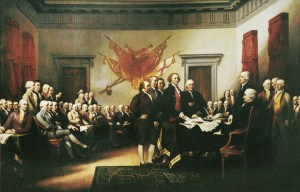
John Trumbull's famous painting is often identified as a depiction of the signing of the Declaration, but it actually shows the drafting committee presenting its work to the Congress.
John Trumbull’s famous painting is often identified as a depiction of the signing of the Declaration, but it actually shows the drafting committee presenting its work to the Congress.

1. July 4, 1776 is the day that we celebrate Independence Day even though it wasn’t the day the Continental Congress decided to declare independence (they did that on July 2, 1776), the day we started the American Revolution (that had happened back in April 1775), the date on which the Declaration was delivered to Great Britain (that didn’t happen until November 1776), or the date it was signed (that was August 2, 1776).

2. The first Independence Day was celebrated on July 8, 1776 (although the Declaration was approved on July 4, 1776, it was not made public until July 8), but for the first two decades after the Declaration was written, people didn’t celebrate it much on any date. One party, the Democratic-Republicans, admired Jefferson and the Declaration. But the other party, the Federalists, thought the Declaration was too French and too anti-British, which went against their current policies.

3. After the War of 1812, the Federalist party began to come apart and the new parties of the 1820s and 1830s all considered themselves inheritors of Jefferson and the Democratic-Republicans. Printed copies of the Declaration began to circulate again, all with the date July 4, 1776, listed at the top. Celebrations of the Fourth of July became more common as the years went on and in 1870, almost a hundred years after the Declaration was written, Congress first declared July 4 to be a national holiday as part of a bill to officially recognize several holidays, including Christmas. Further legislation about national holidays, including July 4, was passed in 1938 and 1941.

4. Benjamin Franklin, John Adams, Thomas Jefferson, Roger Sherman, and Robert R. Livingston comprised the Committee of Five that drafted the Declaration. Jefferson, regarded as the strongest and most eloquent writer, wrote most of the document. After Jefferson wrote his first draft, the other members of the Declaration committee and the Continental Congress made 86 changes, including shortening the overall length by more than a fourth and removing language condemning the British promotion of the slave trade (which Jefferson had included even though he himself was a slave owner).

5. The signed copy of the Declaration is the official, but not the original, document. The approved Declaration was printed on July 5th and a copy was attached to the “rough journal of the Continental Congress for July 4th.” These printed copies, bearing only the names of John Hancock, President, and Charles Thomson, secretary, were distributed to state assemblies, conventions, committees of safety, and commanding officers of the Continental troops. On July 19th, Congress ordered that the Declaration be engrossed on parchment with a new title, “the unanimous declaration of the thirteen united states of America,” and “that the same, when engrossed, be signed by every member of Congress.” Engrossing is the process of copying an official document in a large hand.

6. Thomas Jefferson and John Adams, the only two presidents to sign the document, both died on the Fourth of July in 1826, the fiftieth anniversary of the adoption of the Declaration. Adam’s last words have been reported as “Thomas Jefferson survives.” He did not know that Jefferson had died only a few hours before. James Monroe, the last president who was a Founding Father, also died on July 4 in 1831. Calvin Coolidge, the 30th President, was born on July 4, 1872, and, so far, is the only President to have been born on Independence Day.

7. John Hancock, the President of the Continental Congress at the time, was the first and only person to sign the Declaration on July 4, 1776 (he signed it in the presence of just one man, Charles Thomson, the secretary of Congress). According to legend, the founding father signed his name bigger than everyone else’s because he wanted to make sure “fat old King George” could read it without his spectacles. But the truth is that Hancock had a large blank space and didn’t realize the other men would write their names smaller. Today, the term “John Hancock” has become synonymous with a person’s signature.

8. The 56 signers of the Declaration did not sign on July 4, 1776, nor were they in the same room at the same time on the original Independence Day. The official signing event took place on August 2, 1776 when 50 men signed the document. Several months passed before all 56 signatures were in place. The last man to sign, Thomas McKean, did so in January of 1777, seven months after the document was approved by Congress. Robert R. Livingston, one of the five original drafters, never signed it at all since he believed it was too soon to declare independence.

9. Unlike the U.S. Constitution, which makes no reference to God, the Declaration has three references to a deity. The document also makes two references that tie natural law to God. (Although Thomas Jefferson was a Deist, as a young apprentice lawyer he had studied the work of Henry de Bracton, an English jurist and natural law proponent. Bracton has been referred to as the “father of common law” and is said to have “succeeded in formulating a truly Christian philosophy of law”).