
Morning Reading: Tue, 06 Feb – Judges 1-6 ~ Partial Conquest Has Consequences

Morning Reading

+ In the name of the Father, and the Son, and the Holy Spirit. Amen!

Opening – (Northumbria Community)

One thing I have asked of the Lord, this is what I seek: that I may dwell in the house of the Lord all the days of my life; to behold the beauty of the Lord and to seek Him in His temple.

Praise to You, Lord Jesus Christ, King of endless glory.

Please Read:Judges 1-6 (NLT) – click here

Reading Excerpts

Judah and Simeon Conquer the Land

Judges 1 (NLT)

After the death of Joshua, the Israelites asked the Lord, “Which tribe should go first to attack the Canaanites?”

The Lord answered, “Judah, for I have given them victory over the land.”

+ Victory over Canaanites and Perizzites – The men of Judah said to their relatives from the tribe of Simeon, “Join with us to fight against the Canaanites living in the territory allotted to us. Then we will help you conquer your territory.” So the men of Simeon went with Judah.

When the men of Judah attacked, the Lord gave them victory over the Canaanites and Perizzites, and they killed 10,000 enemy warriors at the town of Bezek. While at Bezek they encountered King Adoni-bezek and fought against him, and the Canaanites and Perizzites were defeated. Adoni-bezek escaped, but the Israelites soon captured him and cut off his thumbs and big toes.

Adoni-bezek said, “I once had seventy kings with their thumbs and big toes cut off, eating scraps from under my table. Now God has paid me back for what I did to them.” They took him to Jerusalem, and he died there.
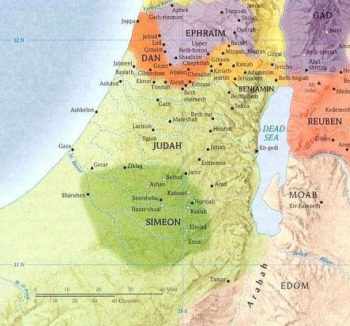
+ Victory over Jerusalem and Hebron – The men of Judah attacked Jerusalem and captured it, killing all its people and setting the city on fire. Then they went down to fight the Canaanites living in the hill country, the Negev, and the western foothills. Judah marched against the Canaanites in Hebron (formerly called Kiriath-arba), defeating the forces of Sheshai, Ahiman, and Talmai.

+ Victory over Debir – From there they went to fight against the people living in the town of Debir (formerly called Kiriath-sepher). Caleb said, “I will give my daughter Acsah in marriage to the one who attacks and captures Kiriath-sepher.” Othniel, the son of Caleb’s younger brother, Kenaz, was the one who conquered it, so Acsah became Othniel’s wife.

When Acsah married Othniel, she urged him to ask her father for a field. As she got down off her donkey, Caleb asked her, “What’s the matter?”

She said, “Let me have another gift. You have already given me land in the Negev; now please give me springs of water, too.” So Caleb gave her the upper and lower springs.

When the tribe of Judah left Jericho—the city of palms—the Kenites, who were descendants of Moses’ father-in-law, traveled with them into the wilderness of Judah. They settled among the people there, near the town of Arad in the Negev.

+ Victory over Zephath – Then Judah joined with Simeon to fight against the Canaanites living in Zephath, and they completely destroyed the town. So the town was named Hormah. In addition, Judah captured the towns of Gaza, Ashkelon, and Ekron, along with their surrounding territories.

Israel Fails to Conquer the Land

+ Caleb succeeds in Hebron – The Lord was with the people of Judah, and they took possession of the hill country. But they failed to drive out the people living in the plains, who had iron chariots. The town of Hebron was given to Caleb as Moses had promised. And Caleb drove out the people living there, who were descendants of the three sons of Anak.

+ Benjamin fails in Jerusalem – The tribe of Benjamin, however, failed to drive out the Jebusites, who were living in Jerusalem. So to this day the Jebusites live in Jerusalem among the people of Benjamin.

+ Manasseh succeeds in Bethel – The descendants of Joseph attacked the town of Bethel, and the Lord was with them. They sent men to scout out Bethel (formerly known as Luz). They confronted a man coming out of the town and said to him, “Show us a way into the town, and we will have mercy on you.” So he showed them a way in, and they killed everyone in the town except that man and his family. Later the man moved to the land of the Hittites, where he built a town. He named it Luz, which is its name to this day.

+ Manasseh fails in Beth-shan / Megiddo area – The tribe of Manasseh failed to drive out the people living in Beth-shan, Taanach, Dor, Ibleam, Megiddo, and all their surrounding settlements, because the Canaanites were determined to stay in that region. When the Israelites grew stronger, they forced the Canaanites to work as slaves, but they never did drive them completely out of the land.

+ Ephraim assimilates in Gezer – The tribe of Ephraim failed to drive out the Canaanites living in Gezer, so the Canaanites continued to live there among them.

+ Zebulun’s temporary fail in Kitron / Nahalol – The tribe of Zebulun failed to drive out the residents of Kitron and Nahalol, so the Canaanites continued to live among them. But the Canaanites were forced to work as slaves for the people of Zebulun.

+ Asher assimilates in Acco / Sidon area – The tribe of Asher failed to drive out the residents of Acco, Sidon, Ahlab, Aczib, Helbah, Aphik, and Rehob. Instead, the people of Asher moved in among the Canaanites, who controlled the land, for they failed to drive them out.

+ Naphtali’s temporary fail in Beth-shemesh and Beth-anath – Likewise, the tribe of Naphtali failed to drive out the residents of Beth-shemesh and Beth-anath. Instead, they moved in among the Canaanites, who controlled the land. Nevertheless, the people of Beth-shemesh and Beth-anath were forced to work as slaves for the people of Naphtali.

+ Dan’s temporary fail with Amorites – As for the tribe of Dan, the Amorites forced them back into the hill country and would not let them come down into the plains. The Amorites were determined to stay in Mount Heres, Aijalon, and Shaalbim, but when the descendants of Joseph became stronger, they forced the Amorites to work as slaves. The boundary of the Amorites ran from Scorpion Pass to Sela and continued upward from there.

The Lord’s Messenger Confronts Israel’s Disobedience

Judges 2 (NLT)

thorn in your side+ Constant thorns and temptations – The angel of the Lord went up from Gilgal to Bokim and said to the Israelites, “I brought you out of Egypt into this land that I swore to give your ancestors, and I said I would never break my covenant with you. For your part, you were not to make any covenants with the people living in this land; instead, you were to destroy their altars. But you disobeyed my command. Why did you do this? So now I declare that I will no longer drive out the people living in your land. They will be thorns in your sides, and their gods will be a constant temptation to you.”

+ Bokim: Israelites wept loudly – When the angel of the Lord finished speaking to all the Israelites, the people wept loudly. So they called the place Bokim (which means “weeping”), and they offered sacrifices there to the Lord.

The Death of Joshua

After Joshua sent the people away, each of the tribes left to take possession of the land allotted to them. And the Israelites served the Lord throughout the lifetime of Joshua and the leaders who outlived him—those who had seen all the great things the Lord had done for Israel.

Joshua son of Nun, the servant of the Lord, died at the age of 110. They buried him in the land he had been allocated, at Timnath-serah in the hill country of Ephraim, north of Mount Gaash.

Israel’s Generational Disobedience

After that generation died, another generation grew up who did not acknowledge the Lord or remember the mighty things he had done for Israel.

+ God’s retribution – The Israelites did evil in the Lord’s sight and served the images of Baal. They abandoned the Lord, the God of their ancestors, who had brought them out of Egypt. They went after other gods, worshiping the gods of the people around them. And they angered the Lord. They abandoned the Lord to serve Baal and the images of Ashtoreth. This made the Lord burn with anger against Israel, so he handed them over to raiders who stole their possessions. He turned them over to their enemies all around, and they were no longer able to resist them. Every time Israel went out to battle, the Lord fought against them, causing them to be defeated, just as he had warned. And the people were in great distress.

The Judges: Israel’s Cycle of Rebellion and Rescue

Then the Lord raised up judges to rescue the Israelites from their attackers. Yet Israel did not listen to the judges but prostituted themselves by worshiping other gods. How quickly they turned away from the path of their ancestors, who had walked in obedience to the Lord’s commands.

+ God’s pity for Israel – Whenever the Lord raised up a judge over Israel, he was with that judge and rescued the people from their enemies throughout the judge’s lifetime. For the Lord took pity on his people, who were burdened by oppression and suffering. But when the judge died, the people returned to their corrupt ways, behaving worse than those who had lived before them. They went after other gods, serving and worshiping them. And they refused to give up their evil practices and stubborn ways.

+ God’s anger against Israel – So the Lord burned with anger against Israel. He said, “Because these people have violated my covenant, which I made with their ancestors, and have ignored my commands, I will no longer drive out the nations that Joshua left unconquered when he died. I did this to test Israel—to see whether or not they would follow the ways of the Lord as their ancestors did.” That is why the Lord left those nations in place. He did not quickly drive them out or allow Joshua to conquer them all.

The Nations Left in Canaan

Judges 3 (NLT)

+ Warfare: testing and training – These are the nations that the Lord left in the land to test those Israelites who had not experienced the wars of Canaan. He did this to teach warfare to generations of Israelites who had no experience in battle. These are the nations: the Philistines (those living under the five Philistine rulers), all the Canaanites, the Sidonians, and the Hivites living in the mountains of Lebanon from Mount Baal-hermon to Lebo-hamath. These people were left to test the Israelites—to see whether they would obey the commands the Lord had given to their ancestors through Moses.

+ Israelites serve other gods – So the people of Israel lived among the Canaanites, Hittites, Amorites, Perizzites, Hivites, and Jebusites, and they intermarried with them. Israelite sons married their daughters, and Israelite daughters were given in marriage to their sons. And the Israelites served their gods.

Othniel Becomes Israel’s Judge

The Israelites did evil in the Lord’s sight. They forgot about the Lord their God, and they served the images of Baal and the Asherah poles. Then the Lord burned with anger against Israel, and he turned them over to King Cushan-rishathaim of Aram-naharaim. And the Israelites served Cushan-rishathaim for eight years.

But when the people of Israel cried out to the Lord for help, the Lord raised up a rescuer to save them. His name was Othniel, the son of Caleb’s younger brother, Kenaz. The Spirit of the Lord came upon him, and he became Israel’s judge. He went to war against King Cushan-rishathaim of Aram, and the Lord gave Othniel victory over him. So there was peace in the land for forty years. Then Othniel son of Kenaz died.

Ehud Becomes Israel’s Judge

Once again the Israelites did evil in the Lord’s sight, and the Lord gave King Eglon of Moab control over Israel because of their evil. Eglon enlisted the Ammonites and Amalekites as allies, and then he went out and defeated Israel, taking possession of Jericho, the city of palms. And the Israelites served Eglon of Moab for eighteen years.

But when the people of Israel cried out to the Lord for help, the Lord again raised up a rescuer to save them. His name was Ehud son of Gera, a left-handed man of the tribe of Benjamin. The Israelites sent Ehud to deliver their tribute money to King Eglon of Moab. So Ehud made a double-edged dagger that was about a foot long, and he strapped it to his right thigh, keeping it hidden under his clothing. He brought the tribute money to Eglon, who was very fat.

After delivering the payment, Ehud started home with those who had helped carry the tribute. But when Ehud reached the stone idols near Gilgal, he turned back. He came to Eglon and said, “I have a secret message for you.”

So the king commanded his servants, “Be quiet!” and he sent them all out of the room.

Ehud walked over to Eglon, who was sitting alone in a cool upstairs room. And Ehud said, “I have a message from God for you!” As King Eglon rose from his seat, Ehud reached with his left hand, pulled out the dagger strapped to his right thigh, and plunged it into the king’s belly. The dagger went so deep that the handle disappeared beneath the king’s fat. So Ehud did not pull out the dagger, and the king’s bowels emptied. Then Ehud closed and locked the doors of the room and escaped down the latrine.

After Ehud was gone, the king’s servants returned and found the doors to the upstairs room locked. They thought he might be using the latrine in the room, so they waited. But when the king didn’t come out after a long delay, they became concerned and got a key. And when they opened the doors, they found their master dead on the floor.

While the servants were waiting, Ehud escaped, passing the stone idols on his way to Seirah. When he arrived in the hill country of Ephraim, Ehud sounded a call to arms. Then he led a band of Israelites down from the hills.

“Follow me,” he said, “for the Lord has given you victory over Moab your enemy.” So they followed him. And the Israelites took control of the shallow crossings of the Jordan River across from Moab, preventing anyone from crossing.

They attacked the Moabites and killed about 10,000 of their strongest and most able-bodied warriors. Not one of them escaped. So Moab was conquered by Israel that day, and there was peace in the land for eighty years.

Shamgar Becomes Israel’s Judge

After Ehud, Shamgar son of Anath rescued Israel. He once killed 600 Philistines with an ox goad.

Deborah Becomes Israel’s Judge

Judges 4 (NLT)

After Ehud’s death, the Israelites again did evil in the Lord’s sight. So the Lord turned them over to King Jabin of Hazor, a Canaanite king. The commander of his army was Sisera, who lived in Harosheth-haggoyim. Sisera, who had 900 iron chariots, ruthlessly oppressed the Israelites for twenty years. Then the people of Israel cried out to the Lord for help.

+ Deborah prophesies victory – Deborah, the wife of Lappidoth, was a prophet who was judging Israel at that time. She would sit under the Palm of Deborah, between Ramah and Bethel in the hill country of Ephraim, and the Israelites would go to her for judgment. One day she sent for Barak son of Abinoam, who lived in Kedesh in the land of Naphtali. She said to him, “This is what the Lord, the God of Israel, commands you: Call out 10,000 warriors from the tribes of Naphtali and Zebulun at Mount Tabor. And I will call out Sisera, commander of Jabin’s army, along with his chariots and warriors, to the Kishon River. There I will give you victory over him.”

Barak told her, “I will go, but only if you go with me.”

“Very well,” she replied, “I will go with you. But you will receive no honor in this venture, for the Lord’s victory over Sisera will be at the hands of a woman.” So Deborah went with Barak to Kedesh. At Kedesh, Barak called together the tribes of Zebulun and Naphtali, and 10,000 warriors went up with him. Deborah also went with him.

Now Heber the Kenite, a descendant of Moses’ brother-in-law Hobab, had moved away from the other members of his tribe and pitched his tent by the oak of Zaanannim near Kedesh.

When Sisera was told that Barak son of Abinoam had gone up to Mount Tabor, he called for all 900 of his iron chariots and all of his warriors, and they marched from Harosheth-haggoyim to the Kishon River.

+ God gives the victory – Then Deborah said to Barak, “Get ready! This is the day the Lord will give you victory over Sisera, for the Lord is marching ahead of you.” So Barak led his 10,000 warriors down the slopes of Mount Tabor into battle. When Barak attacked, the Lord threw Sisera and all his chariots and warriors into a panic. Sisera leaped down from his chariot and escaped on foot. Then Barak chased the chariots and the enemy army all the way to Harosheth-haggoyim, killing all of Sisera’s warriors. Not a single one was left alive.

+ Sisera escapes – Meanwhile, Sisera ran to the tent of Jael, the wife of Heber the Kenite, because Heber’s family was on friendly terms with King Jabin of Hazor. Jael went out to meet Sisera and said to him, “Come into my tent, sir. Come in. Don’t be afraid.” So he went into her tent, and she covered him with a blanket.

“Please give me some water,” he said. “I’m thirsty.” So she gave him some milk from a leather bag and covered him again.

“Stand at the door of the tent,” he told her. “If anybody comes and asks you if there is anyone here, say no.”

+ Jael kills Sisera – But when Sisera fell asleep from exhaustion, Jael quietly crept up to him with a hammer and tent peg in her hand. Then she drove the tent peg through his temple and into the ground, and so he died.

When Barak came looking for Sisera, Jael went out to meet him. She said, “Come, and I will show you the man you are looking for.” So he followed her into the tent and found Sisera lying there dead, with the tent peg through his temple.

So on that day Israel saw God defeat Jabin, the Canaanite king. And from that time on Israel became stronger and stronger against King Jabin until they finally destroyed him.

The Song of Deborah

Judges 5 (KJV)

The Song of Deborah (Laurence Olivier)

Gideon Becomes Israel’s Judge

Judges 6 (NLT)

The Israelites did evil in the Lord’s sight. So the Lord handed them over to the Midianites for seven years. The Midianites were so cruel that the Israelites made hiding places for themselves in the mountains, caves, and strongholds. Whenever the Israelites planted their crops, marauders from Midian, Amalek, and the people of the east would attack Israel, camping in the land and destroying crops as far away as Gaza. They left the Israelites with nothing to eat, taking all the sheep, goats, cattle, and donkeys. These enemy hordes, coming with their livestock and tents, were as thick as locusts; they arrived on droves of camels too numerous to count. And they stayed until the land was stripped bare. So Israel was reduced to starvation by the Midianites. Then the Israelites cried out to the Lord for help.

+ Prophet sent to Israel – When they cried out to the Lord because of Midian, the Lord sent a prophet to the Israelites. He said, “This is what the Lord, the God of Israel, says: I brought you up out of slavery in Egypt. I rescued you from the Egyptians and from all who oppressed you. I drove out your enemies and gave you their land. I told you, ‘I am the Lord your God. You must not worship the gods of the Amorites, in whose land you now live.’ But you have not listened to me.”

+ Gideon chosen by God – Then the angel of the Lord came and sat beneath the great tree at Ophrah, which belonged to Joash of the clan of Abiezer. Gideon son of Joash was threshing wheat at the bottom of a winepress to hide the grain from the Midianites. The angel of the Lord appeared to him and said, “Mighty hero, the Lord is with you!”

“Sir,” Gideon replied, “if the Lord is with us, why has all this happened to us? And where are all the miracles our ancestors told us about? Didn’t they say, ‘The Lord brought us up out of Egypt’? But now the Lord has abandoned us and handed us over to the Midianites.”

+ Go rescue Israel – Then the Lord turned to him and said, “Go with the strength you have, and rescue Israel from the Midianites. I am sending you!”

“But Lord,” Gideon replied, “how can I rescue Israel? My clan is the weakest in the whole tribe of Manasseh, and I am the least in my entire family!”

+ I will be with you – The Lord said to him, “I will be with you. And you will destroy the Midianites as if you were fighting against one man.”

Gideon replied, “If you are truly going to help me, show me a sign to prove that it is really the Lord speaking to me. Don’t go away until I come back and bring my offering to you.”

He answered, “I will stay here until you return.”

Gideon hurried home. He cooked a young goat, and with a basket of flour he baked some bread without yeast. Then, carrying the meat in a basket and the broth in a pot, he brought them out and presented them to the angel, who was under the great tree.

The angel of God said to him, “Place the meat and the unleavened bread on this rock, and pour the broth over it.” And Gideon did as he was told. Then the angel of the Lord touched the meat and bread with the tip of the staff in his hand, and fire flamed up from the rock and consumed all he had brought. And the angel of the Lord disappeared.

When Gideon realized that it was the angel of the Lord, he cried out, “Oh, Sovereign Lord, I’m doomed! I have seen the angel of the Lord face to face!”

+ An altar named Yahweh-Shalom – “It is all right,” the Lord replied. “Do not be afraid. You will not die.” And Gideon built an altar to the Lord there and named it Yahweh-Shalom (which means “the Lord is peace”). The altar remains in Ophrah in the land of the clan of Abiezer to this day.

Gideon Destroys Father’s Altar to Baal

+ Test of faith – That night the Lord said to Gideon, “Take the second bull from your father’s herd, the one that is seven years old. Pull down your father’s altar to Baal, and cut down the Asherah pole standing beside it. Then build an altar to the Lord your God here on this hilltop sanctuary, laying the stones carefully. Sacrifice the bull as a burnt offering on the altar, using as fuel the wood of the Asherah pole you cut down.”

So Gideon took ten of his servants and did as the Lord had commanded. But he did it at night because he was afraid of the other members of his father’s household and the people of the town.
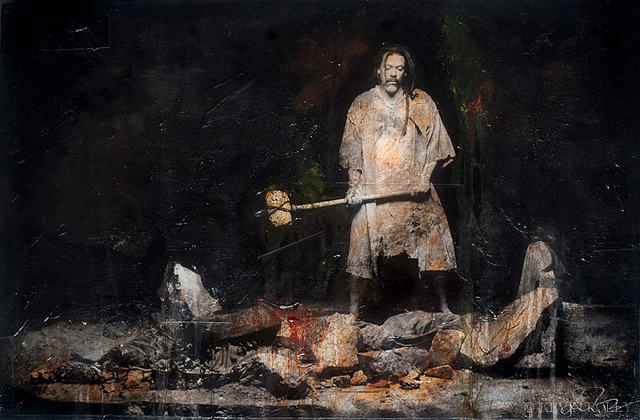
Early the next morning, as the people of the town began to stir, someone discovered that the altar of Baal had been broken down and that the Asherah pole beside it had been cut down. In their place a new altar had been built, and on it were the remains of the bull that had been sacrificed. The people said to each other, “Who did this?” And after asking around and making a careful search, they learned that it was Gideon, the son of Joash.

“Bring out your son,” the men of the town demanded of Joash. “He must die for destroying the altar of Baal and for cutting down the Asherah pole.”

+ Gideon named Jerub-baal – But Joash shouted to the mob that confronted him, “Why are you defending Baal? Will you argue his case? Whoever pleads his case will be put to death by morning! If Baal truly is a god, let him defend himself and destroy the one who broke down his altar!” From then on Gideon was called Jerub-baal, which means “Let Baal defend himself,” because he broke down Baal’s altar.

Gideon Asks for a Sign

+ Gideon clothed with power – Soon afterward the armies of Midian, Amalek, and the people of the east formed an alliance against Israel and crossed the Jordan, camping in the valley of Jezreel. Then the Spirit of the Lord clothed Gideon with power. He blew a ram’s horn as a call to arms, and the men of the clan of Abiezer came to him. He also sent messengers throughout Manasseh, Asher, Zebulun, and Naphtali, summoning their warriors, and all of them responded.

+ The sign of the fleece – Then Gideon said to God, “If you are truly going to use me to rescue Israel as you promised, prove it to me in this way. I will put a wool fleece on the threshing floor tonight. If the fleece is wet with dew in the morning but the ground is dry, then I will know that you are going to help me rescue Israel as you promised.” And that is just what happened. When Gideon got up early the next morning, he squeezed the fleece and wrung out a whole bowlful of water.

+ The promise of victory – Then Gideon said to God, “Please don’t be angry with me, but let me make one more request. Let me use the fleece for one more test. This time let the fleece remain dry while the ground around it is wet with dew.” So that night God did as Gideon asked. The fleece was dry in the morning, but the ground was covered with dew.
__________

Blessing – (Northumbrian Community)

May the peace of the Lord Christ go with you, wherever He may send you. May He guide you through the wilderness, protect you through the storm. May He bring you home rejoicing at the wonders He has shown you. May He bring you home rejoicing once again into our doors.
__________

+ In the name of the Father, and the Son, and the Holy Spirit. Amen!

Daily Reading: 06 May – The Story of Ruth – Ruth 1–4 ~ redeemed

Friday of Sixth Week of Easter

+ In the name of the Father, and the Son, and the Holy Spirit. Amen!
“Each day the Lord pours his unfailing love upon me, and through each night I sing his songs, praying to God who gives me life.” (Psalm 42:8)

E100:6.e The Judges: 

The Story of Ruth – Ruth 1–4 (NLT)

Elimelech Moves His Family to Moab

Ruth 1  In the days when the judges ruled in Israel, a severe famine came upon the land. So a man from Bethlehem in Judah left his home and went to live in the country of Moab, taking his wife and two sons with him. 2 The man’s name was Elimelech, and his wife was Naomi. Their two sons were Mahlon and Kilion. They were Ephrathites from Bethlehem in the land of Judah. And when they reached Moab, they settled there.

3 Then Elimelech died, and Naomi was left with her two sons. 4 The two sons married Moabite women. One married a woman named Orpah, and the other a woman named Ruth. But about ten years later, 5 both Mahlon and Kilion died. This left Naomi alone, without her two sons or her husband.

Naomi and Ruth Return

6 Then Naomi heard in Moab that the Lord had blessed his people in Judah by giving them good crops again. So Naomi and her daughters-in-law got ready to leave Moab to return to her homeland. 7 With her two daughters-in-law she set out from the place where she had been living, and they took the road that would lead them back to Judah.

8 But on the way, Naomi said to her two daughters-in-law, “Go back to your mothers’ homes. And may the Lord reward you for your kindness to your husbands and to me. 9 May the Lord bless you with the security of another marriage.” Then she kissed them good-bye, and they all broke down and wept.

10 “No,” they said. “We want to go with you to your people.”

Naomi entreating Ruth and Orpah to return to the land of Moab by William Blake, 1795
Naomi entreating Ruth and Orpah to return to the land of Moab
by William Blake, 1795

11 But Naomi replied, “Why should you go on with me? Can I still give birth to other sons who could grow up to be your husbands? 12 No, my daughters, return to your parents’ homes, for I am too old to marry again. And even if it were possible, and I were to get married tonight and bear sons, then what? 13 Would you wait for them to grow up and refuse to marry someone else? No, of course not, my daughters! Things are far more bitter for me than for you, because the Lord himself has raised his fist against me.”

14 And again they wept together, and Orpah kissed her mother-in-law good-bye. But Ruth clung tightly to Naomi. 15 “Look,” Naomi said to her, “your sister-in-law has gone back to her people and to her gods. You should do the same.”

16 But Ruth replied, “Don’t ask me to leave you and turn back. Wherever you go, I will go; wherever you live, I will live. Your people will be my people, and your God will be my God. 17 Wherever you die, I will die, and there I will be buried. May the Lord punish me severely if I allow anything but death to separate us!” 18 When Naomi saw that Ruth was determined to go with her, she said nothing more.

19 So the two of them continued on their journey. When they came to Bethlehem, the entire town was excited by their arrival. “Is it really Naomi?” the women asked.

20 “Don’t call me Naomi,” she responded. “Instead, call me Mara, for the Almighty has made life very bitter for me. 21 I went away full, but the Lord has brought me home empty. Why call me Naomi when the Lord has caused me to suffer and the Almighty has sent such tragedy upon me?”

22 So Naomi returned from Moab, accompanied by her daughter-in-law Ruth, the young Moabite woman. They arrived in Bethlehem in late spring, at the beginning of the barley harvest.

Ruth Works in Boaz’s Field

Ruth 2  Now there was a wealthy and influential man in Bethlehem named Boaz, who was a relative of Naomi’s husband, Elimelech.

2 One day Ruth the Moabite said to Naomi, “Let me go out into the harvest fields to pick up the stalks of grain left behind by anyone who is kind enough to let me do it.”

Naomi replied, “All right, my daughter, go ahead.” 3 So Ruth went out to gather grain behind the harvesters. And as it happened, she found herself working in a field that belonged to Boaz, the relative of her father-in-law, Elimelech.

4 While she was there, Boaz arrived from Bethlehem and greeted the harvesters. “The Lord be with you!” he said.

“The Lord bless you!” the harvesters replied.

5 Then Boaz asked his foreman, “Who is that young woman over there? Who does she belong to?”

6 And the foreman replied, “She is the young woman from Moab who came back with Naomi. 7 She asked me this morning if she could gather grain behind the harvesters. She has been hard at work ever since, except for a few minutes’ rest in the shelter.”

8 Boaz went over and said to Ruth, “Listen, my daughter. Stay right here with us when you gather grain; don’t go to any other fields. Stay right behind the young women working in my field. 9 See which part of the field they are harvesting, and then follow them. I have warned the young men not to treat you roughly. And when you are thirsty, help yourself to the water they have drawn from the well.”

10 Ruth fell at his feet and thanked him warmly. “What have I done to deserve such kindness?” she asked. “I am only a foreigner.”

11 “Yes, I know,” Boaz replied. “But I also know about everything you have done for your mother-in-law since the death of your husband. I have heard how you left your father and mother and your own land to live here among complete strangers. 12 May the Lord, the God of Israel, under whose wings you have come to take refuge, reward you fully for what you have done.”

13 “I hope I continue to please you, sir,” she replied. “You have comforted me by speaking so kindly to me, even though I am not one of your workers.”

14 At mealtime Boaz called to her, “Come over here, and help yourself to some food. You can dip your bread in the sour wine.” So she sat with his harvesters, and Boaz gave her some roasted grain to eat. She ate all she wanted and still had some left over.

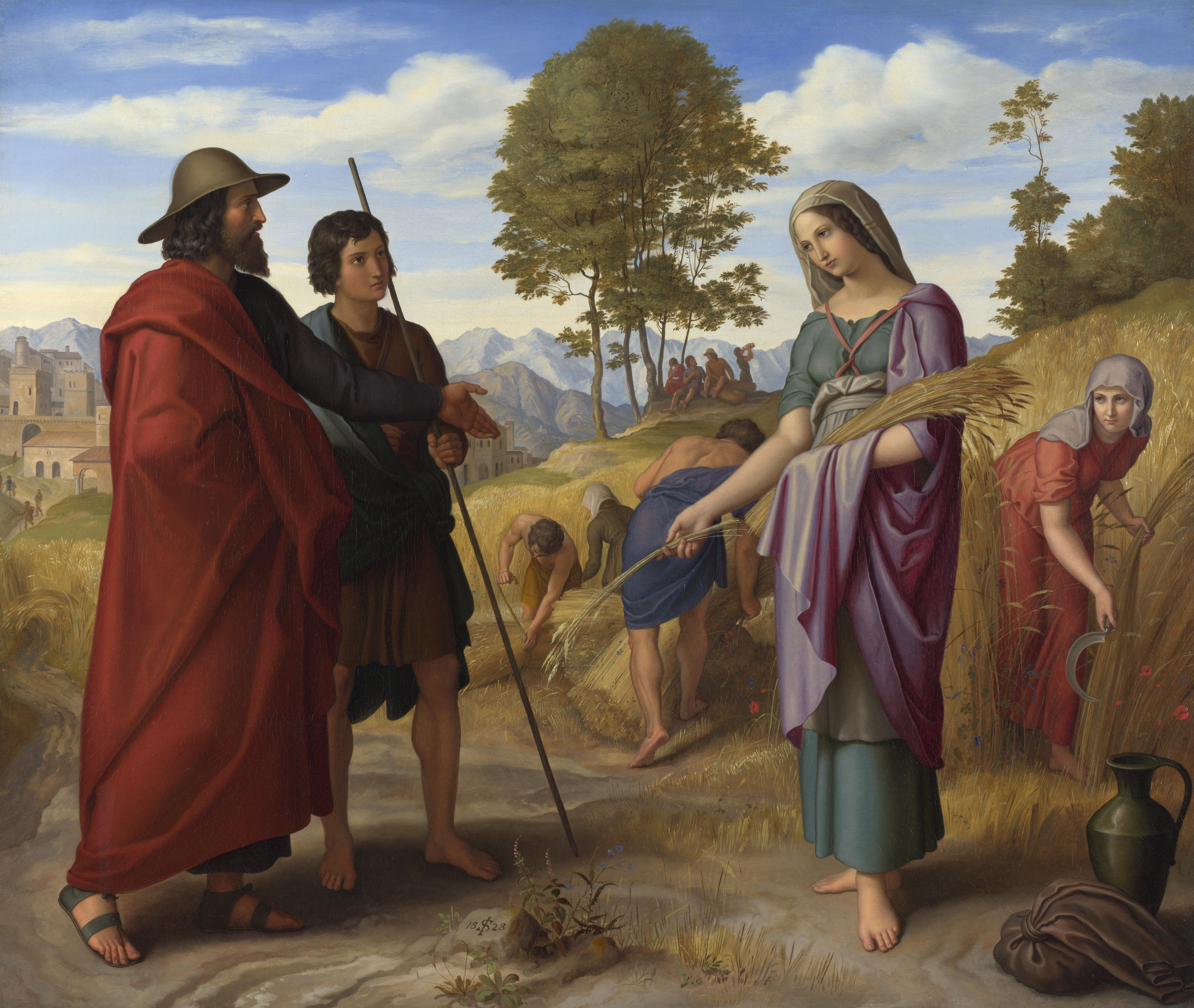
"Ruth in Boaz's Field" Julius Schnorr von Carolsfeld, 1828 National Gallery, London
“Ruth in Boaz’s Field”
Julius Schnorr von Carolsfeld, 1828
National Gallery, London

15 When Ruth went back to work again, Boaz ordered his young men, “Let her gather grain right among the sheaves without stopping her. 16 And pull out some heads of barley from the bundles and drop them on purpose for her. Let her pick them up, and don’t give her a hard time!”

17 So Ruth gathered barley there all day, and when she beat out the grain that evening, it filled an entire basket. 18 She carried it back into town and showed it to her mother-in-law. Ruth also gave her the roasted grain that was left over from her meal.

19 “Where did you gather all this grain today?” Naomi asked. “Where did you work? May the Lord bless the one who helped you!”

So Ruth told her mother-in-law about the man in whose field she had worked. She said, “The man I worked with today is named Boaz.”

20 “May the Lord bless him!” Naomi told her daughter-in-law. “He is showing his kindness to us as well as to your dead husband. That man is one of our closest relatives, one of our family redeemers.”

21 Then Ruth said, “What’s more, Boaz even told me to come back and stay with his harvesters until the entire harvest is completed.”

22 “Good!” Naomi exclaimed. “Do as he said, my daughter. Stay with his young women right through the whole harvest. You might be harassed in other fields, but you’ll be safe with him.”

23 So Ruth worked alongside the women in Boaz’s fields and gathered grain with them until the end of the barley harvest. Then she continued working with them through the wheat harvest in early summer. And all the while she lived with her mother-in-law.

Ruth at the Threshing Floor

Ruth 3  One day Naomi said to Ruth, “My daughter, it’s time that I found a permanent home for you, so that you will be provided for. 2 Boaz is a close relative of ours, and he’s been very kind by letting you gather grain with his young women. Tonight he will be winnowing barley at the threshing floor. 3 Now do as I tell you—take a bath and put on perfume and dress in your nicest clothes. Then go to the threshing floor, but don’t let Boaz see you until he has finished eating and drinking. 4 Be sure to notice where he lies down; then go and uncover his feet and lie down there. He will tell you what to do.”

5 “I will do everything you say,” Ruth replied. 6 So she went down to the threshing floor that night and followed the instructions of her mother-in-law.

7 After Boaz had finished eating and drinking and was in good spirits, he lay down at the far end of the pile of grain and went to sleep. Then Ruth came quietly, uncovered his feet, and lay down. 8 Around midnight Boaz suddenly woke up and turned over. He was surprised to find a woman lying at his feet! 9 “Who are you?” he asked.

“I am your servant Ruth,” she replied. “Spread the corner of your covering over me, for you are my family redeemer.”

Boaz and Ruth Charles Lock Eastlake (1793–1865) Shipley Art Gallery, UK
Boaz and Ruth
Charles Lock Eastlake (1793–1865)
Shipley Art Gallery, UK

10 “The Lord bless you, my daughter!” Boaz exclaimed. “You are showing even more family loyalty now than you did before, for you have not gone after a younger man, whether rich or poor. 11 Now don’t worry about a thing, my daughter. I will do what is necessary, for everyone in town knows you are a virtuous woman. 12 But while it’s true that I am one of your family redeemers, there is another man who is more closely related to you than I am. 13 Stay here tonight, and in the morning I will talk to him. If he is willing to redeem you, very well. Let him marry you. But if he is not willing, then as surely as the Lord lives, I will redeem you myself! Now lie down here until morning.”

14 So Ruth lay at Boaz’s feet until the morning, but she got up before it was light enough for people to recognize each other. For Boaz had said, “No one must know that a woman was here at the threshing floor.” 15 Then Boaz said to her, “Bring your cloak and spread it out.” He measured six scoops of barley into the cloak and placed it on her back. Then he returned to the town.

16 When Ruth went back to her mother-in-law, Naomi asked, “What happened, my daughter?”

Ruth told Naomi everything Boaz had done for her, 17 and she added, “He gave me these six scoops of barley and said, ‘Don’t go back to your mother-in-law empty-handed.’”

18 Then Naomi said to her, “Just be patient, my daughter, until we hear what happens. The man won’t rest until he has settled things today.”

Boaz Marries Ruth

Ruth 4  Boaz went to the town gate and took a seat there. Just then the family redeemer he had mentioned came by, so Boaz called out to him, “Come over here and sit down, friend. I want to talk to you.” So they sat down together. 2 Then Boaz called ten leaders from the town and asked them to sit as witnesses. 3 And Boaz said to the family redeemer, “You know Naomi, who came back from Moab. She is selling the land that belonged to our relative Elimelech. 4 I thought I should speak to you about it so that you can redeem it if you wish. If you want the land, then buy it here in the presence of these witnesses. But if you don’t want it, let me know right away, because I am next in line to redeem it after you.”

The man replied, “All right, I’ll redeem it.”

5 Then Boaz told him, “Of course, your purchase of the land from Naomi also requires that you marry Ruth, the Moabite widow. That way she can have children who will carry on her husband’s name and keep the land in the family.”

6 “Then I can’t redeem it,” the family redeemer replied, “because this might endanger my own estate. You redeem the land; I cannot do it.”

7 Now in those days it was the custom in Israel for anyone transferring a right of purchase to remove his sandal and hand it to the other party. This publicly validated the transaction. 8 So the other family redeemer drew off his sandal as he said to Boaz, “You buy the land.”

9 Then Boaz said to the elders and to the crowd standing around, “You are witnesses that today I have bought from Naomi all the property of Elimelech, Kilion, and Mahlon. 10 And with the land I have acquired Ruth, the Moabite widow of Mahlon, to be my wife. This way she can have a son to carry on the family name of her dead husband and to inherit the family property here in his hometown. You are all witnesses today.”

11 Then the elders and all the people standing in the gate replied, “We are witnesses! May the Lord make this woman who is coming into your home like Rachel and Leah, from whom all the nation of Israel descended! May you prosper in Ephrathah and be famous in Bethlehem. 12 And may the Lord give you descendants by this young woman who will be like those of our ancestor Perez, the son of Tamar and Judah.”

The Descendants of Boaz

Ruth, Naomi and Obed, by Simeon Solomon (1840-1905), Private Collection
Ruth, Naomi and Obed,
by Simeon Solomon (1840-1905),
Private Collection

13 So Boaz took Ruth into his home, and she became his wife. When he slept with her, the Lord enabled her to become pregnant, and she gave birth to a son. 14 Then the women of the town said to Naomi, “Praise the Lord, who has now provided a redeemer for your family! May this child be famous in Israel. 15 May he restore your youth and care for you in your old age. For he is the son of your daughter-in-law who loves you and has been better to you than seven sons!”

16 Naomi took the baby and cuddled him to her breast. And she cared for him as if he were her own. 17 The neighbor women said, “Now at last Naomi has a son again!” And they named him Obed. He became the father of Jesse and the grandfather of David.

18 This is the genealogical record of their ancestor Perez:

Perez was the father of Hezron. 19 Hezron was the father of Ram. Ram was the father of Amminadab. 20 Amminadab was the father of Nahshon. Nahshon was the father of Salmon. 21 Salmon was the father of Boaz. Boaz was the father of Obed. 22 Obed was the father of Jesse. Jesse was the father of David.

“There Is A Redeemer” – Robin Mark

Prayer

Gracious and merciful God, your loving-kindness is better than life itself. Thank you for redeeming my life from the pit and adopting me into your family. Please continue the good work you have already begun in me:

+ May your love overflow in me more and more.
+ May I continue to grow in knowledge and understanding.
+ May I order my life around those things that really matter to you.
+ May I live a pure and blameless life through the power of your Spirit at work in me.
+ May I always be filled with the righteous character produced in my life by Jesus Christ.

I ask this in the name of Jesus Christ, your Son and my Redeemer, who lives and reigns with you and the Holy Spirit, one God forever and ever. Amen.

Closing Sentence

“(May) Christ dwell in your hearts through faith—that you, being rooted and grounded in love, may have strength to comprehend with all the saints what is the breadth and length and height and depth, and to know the love of Christ that surpasses knowledge, that you may be filled with all the fullness of God.” (Ephesians 3:17-19)

+ In the name of the Father, and the Son, and the Holy Spirit. Amen!

Daily Reading: 05 May – Samson Defeats the Philistines – Judges 13–16 ~ in spite of himself

Thursday of Sixth Week of Easter

+ In the name of the Father, and the Son, and the Holy Spirit. Amen!

Pride goes before destruction, and haughtiness before a fall. – Proverbs 16:18 (NLT)

E100:6.d The Judges:

Samson Defeats the Philistines – Judges 13–16 (NLT)

The Birth of Samson

Judges 13  Again the Israelites did evil in the Lord’s sight, so the Lord handed them over to the Philistines, who oppressed them for forty years.

2 In those days a man named Manoah from the tribe of Dan lived in the town of Zorah. His wife was unable to become pregnant, and they had no children. 3 The angel of the Lord appeared to Manoah’s wife and said, “Even though you have been unable to have children, you will soon become pregnant and give birth to a son. 4 So be careful; you must not drink wine or any other alcoholic drink nor eat any forbidden food. 5 You will become pregnant and give birth to a son, and his hair must never be cut. For he will be dedicated to God as a Nazirite from birth. He will begin to rescue Israel from the Philistines.”

6 The woman ran and told her husband, “A man of God appeared to me! He looked like one of God’s angels, terrifying to see. I didn’t ask where he was from, and he didn’t tell me his name. 7 But he told me, ‘You will become pregnant and give birth to a son. You must not drink wine or any other alcoholic drink nor eat any forbidden food. For your son will be dedicated to God as a Nazirite from the moment of his birth until the day of his death.’”

8 Then Manoah prayed to the Lord, saying, “Lord, please let the man of God come back to us again and give us more instructions about this son who is to be born.”

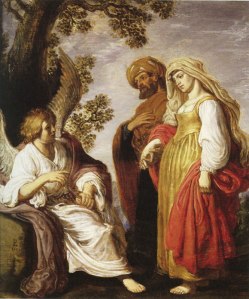
The Angel with Manoah and His Wife Pieter Lastman, 1617 Collection of Alfred and Isabel Bader, Milwaukee
The Angel with Manoah and His Wife
Pieter Lastman, 1617
Collection of Alfred and Isabel Bader, Milwaukee

9 God answered Manoah’s prayer, and the angel of God appeared once again to his wife as she was sitting in the field. But her husband, Manoah, was not with her. 10 So she quickly ran and told her husband, “The man who appeared to me the other day is here again!”

11 Manoah ran back with his wife and asked, “Are you the man who spoke to my wife the other day?”

“Yes,” he replied, “I am.”

12 So Manoah asked him, “When your words come true, what kind of rules should govern the boy’s life and work?”

13 The angel of the Lord replied, “Be sure your wife follows the instructions I gave her. 14 She must not eat grapes or raisins, drink wine or any other alcoholic drink, or eat any forbidden food.”

15 Then Manoah said to the angel of the Lord, “Please stay here until we can prepare a young goat for you to eat.”

16 “I will stay,” the angel of the Lord replied, “but I will not eat anything. However, you may prepare a burnt offering as a sacrifice to the Lord.” (Manoah didn’t realize it was the angel of the Lord.)

17 Then Manoah asked the angel of the Lord, “What is your name? For when all this comes true, we want to honor you.”

18 “Why do you ask my name?” the angel of the Lord replied. “It is too wonderful for you to understand.”

19 Then Manoah took a young goat and a grain offering and offered it on a rock as a sacrifice to the Lord. And as Manoah and his wife watched, the Lord did an amazing thing. 20 As the flames from the altar shot up toward the sky, the angel of the Lord ascended in the fire. When Manoah and his wife saw this, they fell with their faces to the ground.

21 The angel did not appear again to Manoah and his wife. Manoah finally realized it was the angel of the Lord, 22 and he said to his wife, “We will certainly die, for we have seen God!”

23 But his wife said, “If the Lord were going to kill us, he wouldn’t have accepted our burnt offering and grain offering. He wouldn’t have appeared to us and told us this wonderful thing and done these miracles.”

24 When her son was born, she named him Samson. And the Lord blessed him as he grew up. 25 And the Spirit of the Lord began to stir him while he lived in Mahaneh-dan, which is located between the towns of Zorah and Eshtaol.

Samson’s Riddle

Judges 14  One day when Samson was in Timnah, one of the Philistine women caught his eye. 2 When he returned home, he told his father and mother, “A young Philistine woman in Timnah caught my eye. I want to marry her. Get her for me.”

3 His father and mother objected. “Isn’t there even one woman in our tribe or among all the Israelites you could marry?” they asked. “Why must you go to the pagan Philistines to find a wife?”

But Samson told his father, “Get her for me! She looks good to me.” 4 His father and mother didn’t realize the Lord was at work in this, creating an opportunity to work against the Philistines, who ruled over Israel at that time.

Samson and the Lion (Sansón y el león), Luca Giordano, 1695-1696 Museo Nacional del Prado, Madrid
Samson and the Lion (Sansón y el león),
Luca Giordano, 1695-1696
Museo Nacional del Prado, Madrid

5 As Samson and his parents were going down to Timnah, a young lion suddenly attacked Samson near the vineyards of Timnah. 6 At that moment the Spirit of the Lord came powerfully upon him, and he ripped the lion’s jaws apart with his bare hands. He did it as easily as if it were a young goat. But he didn’t tell his father or mother about it. 7 When Samson arrived in Timnah, he talked with the woman and was very pleased with her.

8 Later, when he returned to Timnah for the wedding, he turned off the path to look at the carcass of the lion. And he found that a swarm of bees had made some honey in the carcass. 9 He scooped some of the honey into his hands and ate it along the way. He also gave some to his father and mother, and they ate it. But he didn’t tell them he had taken the honey from the carcass of the lion.

10 As his father was making final arrangements for the marriage, Samson threw a party at Timnah, as was the custom for elite young men. 11 When the bride’s parents saw him, they selected thirty young men from the town to be his companions.

12 Samson said to them, “Let me tell you a riddle. If you solve my riddle during these seven days of the celebration, I will give you thirty fine linen robes and thirty sets of festive clothing. 13 But if you can’t solve it, then you must give me thirty fine linen robes and thirty sets of festive clothing.”

“All right,” they agreed, “let’s hear your riddle.”

14 So he said:

“Out of the one who eats came something to eat;
out of the strong came something sweet.”

Three days later they were still trying to figure it out. 15 On the fourth day they said to Samson’s wife, “Entice your husband to explain the riddle for us, or we will burn down your father’s house with you in it. Did you invite us to this party just to make us poor?”

16 So Samson’s wife came to him in tears and said, “You don’t love me; you hate me! You have given my people a riddle, but you haven’t told me the answer.”

“I haven’t even given the answer to my father or mother,” he replied. “Why should I tell you?” 17 So she cried whenever she was with him and kept it up for the rest of the celebration. At last, on the seventh day he told her the answer because she was tormenting him with her nagging. Then she explained the riddle to the young men.

18 So before sunset of the seventh day, the men of the town came to Samson with their answer:

“What is sweeter than honey?
What is stronger than a lion?”

Samson replied, “If you hadn’t plowed with my heifer, you wouldn’t have solved my riddle!”

19 Then the Spirit of the Lord came powerfully upon him. He went down to the town of Ashkelon, killed thirty men, took their belongings, and gave their clothing to the men who had solved his riddle. But Samson was furious about what had happened, and he went back home to live with his father and mother. 20 So his wife was given in marriage to the man who had been Samson’s best man at the wedding.

Samson’s Vengeance on the Philistines

Judges 15  Later on, during the wheat harvest, Samson took a young goat as a present to his wife. He said, “I’m going into my wife’s room to sleep with her,” but her father wouldn’t let him in.

2 “I truly thought you must hate her,” her father explained, “so I gave her in marriage to your best man. But look, her younger sister is even more beautiful than she is. Marry her instead.”

3 Samson said, “This time I cannot be blamed for everything I am going to do to you Philistines.” 4 Then he went out and caught 300 foxes. He tied their tails together in pairs, and he fastened a torch to each pair of tails. 5 Then he lit the torches and let the foxes run through the grain fields of the Philistines. He burned all their grain to the ground, including the sheaves and the uncut grain. He also destroyed their vineyards and olive groves.

6 “Who did this?” the Philistines demanded.

“Samson,” was the reply, “because his father-in-law from Timnah gave Samson’s wife to be married to his best man.” So the Philistines went and got the woman and her father and burned them to death.

7 “Because you did this,” Samson vowed, “I won’t rest until I take my revenge on you!” 8 So he attacked the Philistines with great fury and killed many of them. Then he went to live in a cave in the rock of Etam.

9 The Philistines retaliated by setting up camp in Judah and spreading out near the town of Lehi. 10 The men of Judah asked the Philistines, “Why are you attacking us?”

The Philistines replied, “We’ve come to capture Samson. We’ve come to pay him back for what he did to us.”

11 So 3,000 men of Judah went down to get Samson at the cave in the rock of Etam. They said to Samson, “Don’t you realize the Philistines rule over us? What are you doing to us?”

But Samson replied, “I only did to them what they did to me.”

12 But the men of Judah told him, “We have come to tie you up and hand you over to the Philistines.”

Sansón masacra a los filisteos Orazio Riminaldi, 1625 Museum of Grenoble
Sansón masacra a los filisteos
Orazio Riminaldi, 1625
Museum of Grenoble

“All right,” Samson said. “But promise that you won’t kill me yourselves.”

13 “We will only tie you up and hand you over to the Philistines,” they replied. “We won’t kill you.” So they tied him up with two new ropes and brought him up from the rock.

14 As Samson arrived at Lehi, the Philistines came shouting in triumph. But the Spirit of the Lord came powerfully upon Samson, and he snapped the ropes on his arms as if they were burnt strands of flax, and they fell from his wrists. 15 Then he found the jawbone of a recently killed donkey. He picked it up and killed 1,000 Philistines with it. 16 Then Samson said,

“With the jawbone of a donkey,
I’ve piled them in heaps!
With the jawbone of a donkey,
I’ve killed a thousand men!”

17 When he finished his boasting, he threw away the jawbone; and the place was named Jawbone Hill.

18 Samson was now very thirsty, and he cried out to the Lord, “You have accomplished this great victory by the strength of your servant. Must I now die of thirst and fall into the hands of these pagans?” 19 So God caused water to gush out of a hollow in the ground at Lehi, and Samson was revived as he drank. Then he named that place “The Spring of the One Who Cried Out,” and it is still in Lehi to this day.

20 Samson judged Israel for twenty years during the period when the Philistines dominated the land.

Samson Carries Away Gaza’s Gates

Judges 16  One day Samson went to the Philistine town of Gaza and spent the night with a prostitute. 2 Word soon spread that Samson was there, so the men of Gaza gathered together and waited all night at the town gates. They kept quiet during the night, saying to themselves, “When the light of morning comes, we will kill him.”

3 But Samson stayed in bed only until midnight. Then he got up, took hold of the doors of the town gate, including the two posts, and lifted them up, bar and all. He put them on his shoulders and carried them all the way to the top of the hill across from Hebron.

Samson and Delilah

4 Some time later Samson fell in love with a woman named Delilah, who lived in the valley of Sorek. 5 The rulers of the Philistines went to her and said, “Entice Samson to tell you what makes him so strong and how he can be overpowered and tied up securely. Then each of us will give you 1,100 pieces of silver.”

6 So Delilah said to Samson, “Please tell me what makes you so strong and what it would take to tie you up securely.”

7 Samson replied, “If I were tied up with seven new bowstrings that have not yet been dried, I would become as weak as anyone else.”

8 So the Philistine rulers brought Delilah seven new bowstrings, and she tied Samson up with them. 9 She had hidden some men in one of the inner rooms of her house, and she cried out, “Samson! The Philistines have come to capture you!” But Samson snapped the bowstrings as a piece of string snaps when it is burned by a fire. So the secret of his strength was not discovered.

10 Afterward Delilah said to him, “You’ve been making fun of me and telling me lies! Now please tell me how you can be tied up securely.”

11 Samson replied, “If I were tied up with brand-new ropes that had never been used, I would become as weak as anyone else.”

12 So Delilah took new ropes and tied him up with them. The men were hiding in the inner room as before, and again Delilah cried out, “Samson! The Philistines have come to capture you!” But again Samson snapped the ropes from his arms as if they were thread.

13 Then Delilah said, “You’ve been making fun of me and telling me lies! Now tell me how you can be tied up securely.”

Samson replied, “If you were to weave the seven braids of my hair into the fabric on your loom and tighten it with the loom shuttle, I would become as weak as anyone else.”

So while he slept, Delilah wove the seven braids of his hair into the fabric. 14 Then she tightened it with the loom shuttle. Again she cried out, “Samson! The Philistines have come to capture you!” But Samson woke up, pulled back the loom shuttle, and yanked his hair away from the loom and the fabric.

15 Then Delilah pouted, “How can you tell me, ‘I love you,’ when you don’t share your secrets with me? You’ve made fun of me three times now, and you still haven’t told me what makes you so strong!” 16 She tormented him with her nagging day after day until he was sick to death of it.

The Blinding of Samson Rembrandt, 1636
The Blinding of Samson
Rembrandt, 1636

17 Finally, Samson shared his secret with her. “My hair has never been cut,” he confessed, “for I was dedicated to God as a Nazirite from birth. If my head were shaved, my strength would leave me, and I would become as weak as anyone else.”

18 Delilah realized he had finally told her the truth, so she sent for the Philistine rulers. “Come back one more time,” she said, “for he has finally told me his secret.” So the Philistine rulers returned with the money in their hands. 19 Delilah lulled Samson to sleep with his head in her lap, and then she called in a man to shave off the seven locks of his hair. In this way she began to bring him down, and his strength left him.

20 Then she cried out, “Samson! The Philistines have come to capture you!”

When he woke up, he thought, “I will do as before and shake myself free.” But he didn’t realize the Lord had left him.

21 So the Philistines captured him and gouged out his eyes. They took him to Gaza, where he was bound with bronze chains and forced to grind grain in the prison.

22 But before long, his hair began to grow back.

Samson’s Final Victory

23 The Philistine rulers held a great festival, offering sacrifices and praising their god, Dagon. They said, “Our god has given us victory over our enemy Samson!”

24 When the people saw him, they praised their god, saying, “Our god has delivered our enemy to us! The one who killed so many of us is now in our power!”

25 Half drunk by now, the people demanded, “Bring out Samson so he can amuse us!” So he was brought from the prison to amuse them, and they had him stand between the pillars supporting the roof.

samson_blinded

26 Samson said to the young servant who was leading him by the hand, “Place my hands against the pillars that hold up the temple. I want to rest against them.” 27 Now the temple was completely filled with people. All the Philistine rulers were there, and there were about 3,000 men and women on the roof who were watching as Samson amused them.

28 Then Samson prayed to the Lord, “Sovereign Lord, remember me again. O God, please strengthen me just one more time. With one blow let me pay back the Philistines for the loss of my two eyes.” 29 Then Samson put his hands on the two center pillars that held up the temple. Pushing against them with both hands, 30 he prayed, “Let me die with the Philistines.” And the temple crashed down on the Philistine rulers and all the people. So he killed more people when he died than he had during his entire lifetime.

31 Later his brothers and other relatives went down to get his body. They took him back home and buried him between Zorah and Eshtaol, where his father, Manoah, was buried. Samson had judged Israel for twenty years.

“Humble Thyself In The Sight Of The Lord” – Acappella

Prayer

Lord, help me to keep my pride in check. I want to be proud, first of all, of my relationship with You. Amen.

Closing Sentence

The Lord bless us, and keep us from all evil, and bring us to everlasting life.

+ In the name of the Father, and the Son, and the Holy Spirit. Amen!
Daily Reading: 04 May – Gideon Defeats The Midianites – Judges 6–7 ~ a few good men

Wednesday of Sixth Week of Easter

+ In the name of the Father, and the Son, and the Holy Spirit. Amen!

“Go with the strength you have…. I am sending you!” (Judges 6:14)

E100:6.c The Judges:

Gideon Defeats The Midianites – Judges 6–7 (NLT)

Gideon Becomes Israel’s Judge

Judges 6  The Israelites did evil in the Lord’s sight. So the Lord handed them over to the Midianites for seven years. 2 The Midianites were so cruel that the Israelites made hiding places for themselves in the mountains, caves, and strongholds. 3 Whenever the Israelites planted their crops, marauders from Midian, Amalek, and the people of the east would attack Israel, 4 camping in the land and destroying crops as far away as Gaza. They left the Israelites with nothing to eat, taking all the sheep, goats, cattle, and donkeys. 5 These enemy hordes, coming with their livestock and tents, were as thick as locusts; they arrived on droves of camels too numerous to count. And they stayed until the land was stripped bare. 6 So Israel was reduced to starvation by the Midianites. Then the Israelites cried out to the Lord for help.

7 When they cried out to the Lord because of Midian, 8 the Lord sent a prophet to the Israelites. He said, “This is what the Lord, the God of Israel, says: I brought you up out of slavery in Egypt. 9 I rescued you from the Egyptians and from all who oppressed you. I drove out your enemies and gave you their land. 10 I told you, ‘I am the Lord your God. You must not worship the gods of the Amorites, in whose land you now live.’ But you have not listened to me.”

11 Then the angel of the Lord came and sat beneath the great tree at Ophrah, which belonged to Joash of the clan of Abiezer. Gideon son of Joash was threshing wheat at the bottom of a winepress to hide the grain from the Midianites. 12 The angel of the Lord appeared to him and said, “Mighty hero, the Lord is with you!”

13 “Sir,” Gideon replied, “if the Lord is with us, why has all this happened to us? And where are all the miracles our ancestors told us about? Didn’t they say, ‘The Lord brought us up out of Egypt’? But now the Lord has abandoned us and handed us over to the Midianites.”

The Angel of the Lord appears unto Gideon Ferdinand Bol, 1640 Museum Catharijneconvent, Utrecht
The Angel of the Lord appears unto Gideon
Ferdinand Bol, 1640
Museum Catharijneconvent, Utrecht

14 Then the Lord turned to him and said, “Go with the strength you have, and rescue Israel from the Midianites. I am sending you!”

15 “But Lord,” Gideon replied, “how can I rescue Israel? My clan is the weakest in the whole tribe of Manasseh, and I am the least in my entire family!”

16 The Lord said to him, “I will be with you. And you will destroy the Midianites as if you were fighting against one man.”

17 Gideon replied, “If you are truly going to help me, show me a sign to prove that it is really the Lord speaking to me. 18 Don’t go away until I come back and bring my offering to you.”

He answered, “I will stay here until you return.”

19 Gideon hurried home. He cooked a young goat, and with a basket of flour he baked some bread without yeast. Then, carrying the meat in a basket and the broth in a pot, he brought them out and presented them to the angel, who was under the great tree.

20 The angel of God said to him, “Place the meat and the unleavened bread on this rock, and pour the broth over it.” And Gideon did as he was told. 21 Then the angel of the Lord touched the meat and bread with the tip of the staff in his hand, and fire flamed up from the rock and consumed all he had brought. And the angel of the Lord disappeared.

22 When Gideon realized that it was the angel of the Lord, he cried out, “Oh, Sovereign Lord, I’m doomed! I have seen the angel of the Lord face to face!”

23 “It is all right,” the Lord replied. “Do not be afraid. You will not die.” 24 And Gideon built an altar to the Lord there and named it Yahweh-Shalom (which means “the Lord is peace”). The altar remains in Ophrah in the land of the clan of Abiezer to this day.

25 That night the Lord said to Gideon, “Take the second bull from your father’s herd, the one that is seven years old. Pull down your father’s altar to Baal, and cut down the Asherah pole standing beside it. 26 Then build an altar to the Lord your God here on this hilltop sanctuary, laying the stones carefully. Sacrifice the bull as a burnt offering on the altar, using as fuel the wood of the Asherah pole you cut down.”

"Altars by Night" (Gideon Destroys His Father's Altar to Ba'al) by Kevin Rolly
“Altars by Night”
(Gideon Destroys His Father’s Altar to Ba’al)
by Kevin Rolly

27 So Gideon took ten of his servants and did as the Lord had commanded. But he did it at night because he was afraid of the other members of his father’s household and the people of the town.

28 Early the next morning, as the people of the town began to stir, someone discovered that the altar of Baal had been broken down and that the Asherah pole beside it had been cut down. In their place a new altar had been built, and on it were the remains of the bull that had been sacrificed. 29 The people said to each other, “Who did this?” And after asking around and making a careful search, they learned that it was Gideon, the son of Joash.

30 “Bring out your son,” the men of the town demanded of Joash. “He must die for destroying the altar of Baal and for cutting down the Asherah pole.”

31 But Joash shouted to the mob that confronted him, “Why are you defending Baal? Will you argue his case? Whoever pleads his case will be put to death by morning! If Baal truly is a god, let him defend himself and destroy the one who broke down his altar!” 32 From then on Gideon was called Jerub-baal, which means “Let Baal defend himself,” because he broke down Baal’s altar.

Gideon Asks for a Sign

33 Soon afterward the armies of Midian, Amalek, and the people of the east formed an alliance against Israel and crossed the Jordan, camping in the valley of Jezreel. 34 Then the Spirit of the Lord clothed Gideon with power. He blew a ram’s horn as a call to arms, and the men of the clan of Abiezer came to him. 35 He also sent messengers throughout Manasseh, Asher, Zebulun, and Naphtali, summoning their warriors, and all of them responded.

Gideon Lays out a Fleece to Receive a Sign from God

36 Then Gideon said to God, “If you are truly going to use me to rescue Israel as you promised, 37 prove it to me in this way. I will put a wool fleece on the threshing floor tonight. If the fleece is wet with dew in the morning but the ground is dry, then I will know that you are going to help me rescue Israel as you promised.” 38 And that is just what happened. When Gideon got up early the next morning, he squeezed the fleece and wrung out a whole bowlful of water.

39 Then Gideon said to God, “Please don’t be angry with me, but let me make one more request. Let me use the fleece for one more test. This time let the fleece remain dry while the ground around it is wet with dew.” 40 So that night God did as Gideon asked. The fleece was dry in the morning, but the ground was covered with dew.

Gideon Defeats the Midianites

Judges 7  So Jerub-baal (that is, Gideon) and his army got up early and went as far as the spring of Harod. The armies of Midian were camped north of them in the valley near the hill of Moreh. 2 The Lord said to Gideon, “You have too many warriors with you. If I let all of you fight the Midianites, the Israelites will boast to me that they saved themselves by their own strength. 3 Therefore, tell the people, ‘Whoever is timid or afraid may leave this mountain and go home.’” So 22,000 of them went home, leaving only 10,000 who were willing to fight.

4 But the Lord told Gideon, “There are still too many! Bring them down to the spring, and I will test them to determine who will go with you and who will not.” 5 When Gideon took his warriors down to the water, the Lord told him, “Divide the men into two groups. In one group put all those who cup water in their hands and lap it up with their tongues like dogs. In the other group put all those who kneel down and drink with their mouths in the stream.” 6 Only 300 of the men drank from their hands. All the others got down on their knees and drank with their mouths in the stream.

Gideons 300

7 The Lord told Gideon, “With these 300 men I will rescue you and give you victory over the Midianites. Send all the others home.” 8 So Gideon collected the provisions and rams’ horns of the other warriors and sent them home. But he kept the 300 men with him.

The Midianite camp was in the valley just below Gideon. 9 That night the Lord said, “Get up! Go down into the Midianite camp, for I have given you victory over them! 10 But if you are afraid to attack, go down to the camp with your servant Purah. 11 Listen to what the Midianites are saying, and you will be greatly encouraged. Then you will be eager to attack.”

So Gideon took Purah and went down to the edge of the enemy camp. 12 The armies of Midian, Amalek, and the people of the east had settled in the valley like a swarm of locusts. Their camels were like grains of sand on the seashore—too many to count! 13 Gideon crept up just as a man was telling his companion about a dream. The man said, “I had this dream, and in my dream a loaf of barley bread came tumbling down into the Midianite camp. It hit a tent, turned it over, and knocked it flat!”

14 His companion answered, “Your dream can mean only one thing—God has given Gideon son of Joash, the Israelite, victory over Midian and all its allies!”

15 When Gideon heard the dream and its interpretation, he bowed in worship before the Lord. Then he returned to the Israelite camp and shouted, “Get up! For the Lord has given you victory over the Midianite hordes!” 16 He divided the 300 men into three groups and gave each man a ram’s horn and a clay jar with a torch in it.

17 Then he said to them, “Keep your eyes on me. When I come to the edge of the camp, do just as I do. 18 As soon as I and those with me blow the rams’ horns, blow your horns, too, all around the entire camp, and shout, ‘For the Lord and for Gideon!’”

Battle of Gideon Against the Midianites Nicolas Poussin, 1625-1626 Vatican Museum Pinacoteca, Vatican
Battle of Gideon Against the Midianites
Nicolas Poussin, 1625-1626
Vatican Museum Pinacoteca, Vatican

19 It was just after midnight, after the changing of the guard, when Gideon and the 100 men with him reached the edge of the Midianite camp. Suddenly, they blew the rams’ horns and broke their clay jars. 20 Then all three groups blew their horns and broke their jars. They held the blazing torches in their left hands and the horns in their right hands, and they all shouted, “A sword for the Lord and for Gideon!”

21 Each man stood at his position around the camp and watched as all the Midianites rushed around in a panic, shouting as they ran to escape. 22 When the 300 Israelites blew their rams’ horns, the Lord caused the warriors in the camp to fight against each other with their swords. Those who were not killed fled to places as far away as Beth-shittah near Zererah and to the border of Abel-meholah near Tabbath.

23 Then Gideon sent for the warriors of Naphtali, Asher, and Manasseh, who joined in chasing the army of Midian. 24 Gideon also sent messengers throughout the hill country of Ephraim, saying, “Come down to attack the Midianites. Cut them off at the shallow crossings of the Jordan River at Beth-barah.”

So all the men of Ephraim did as they were told. 25 They captured Oreb and Zeeb, the two Midianite commanders, killing Oreb at the rock of Oreb, and Zeeb at the winepress of Zeeb. And they continued to chase the Midianites. Afterward the Israelites brought the heads of Oreb and Zeeb to Gideon, who was by the Jordan River.

“The Battle Belongs To The Lord” – John Michael Talbot

Prayer (Prayer for Courage and Confidence)

Messiah, King of Kings and Lord of Lords: you know what’s hidden in our hearts. You know our thoughts and our motives, you know when we are weak and feel discouraged. Hear us, Lord, as we come before you today. We ask that you give us courage, strength and confidence to face the trials and temptations that lay ahead.

We give our lives today to you, Oh Father, just take control and guide us along the way. There are times we may think that we do not have the strength to defeat the enemy as he attacks us in our daily lives. Restore our courage and faith in you, Oh King of Heaven. Help us to be confident both in ourselves as well as in You, for we know we will mount up on wings like eagles and sore high with You on the throne.

And even as we ask for confidence, Lord, help us to remain humble in all that we do. Give us the courage to face our fears, to stand up for ourselves, to fight for what we believe in, to bless others and to minister your Word. Let the fire that burns within us touch the lives of others and manifest your love and grace to all.

In Jesus’ Holy Name, Amen!

Closing Sentence

A final word: Be strong in the Lord and in his mighty power. Put on all of God’s armor so that you will be able to stand firm against all strategies of the devil. (Ephesians 6:10-11)

+ In the name of the Father, and the Son, and the Holy Spirit. Amen!

Daily Reading: 03 May – Deborah Leads Israel – Judges 4–5 ~ “a mother for Israel”

Tuesday of Sixth Week of Easter

+ In the name of the Father, and the Son, and the Holy Spirit. Amen!

Fill Zion with songs of your praise, Lord, and let the stories of your great deeds be told. Alleluia.

E100:6.b The Judges:

Deborah Leads Israel – Judges 4–5 (NLT)

Deborah Becomes Israel’s Judge

Judges 4  After Ehud’s death, the Israelites again did evil in the Lord’s sight. 2 So the Lord turned them over to King Jabin of Hazor, a Canaanite king. The commander of his army was Sisera, who lived in Harosheth-haggoyim. 3 Sisera, who had 900 iron chariots, ruthlessly oppressed the Israelites for twenty years. Then the people of Israel cried out to the Lord for help.

"Deborah" Charles Zacharie Landelle, (1821-1908) Private Collection
“Deborah”
Charles Zacharie Landelle, (1821-1908)
Private Collection

4 Deborah, the wife of Lappidoth, was a prophet who was judging Israel at that time. 5 She would sit under the Palm of Deborah, between Ramah and Bethel in the hill country of Ephraim, and the Israelites would go to her for judgment. 6 One day she sent for Barak son of Abinoam, who lived in Kedesh in the land of Naphtali. She said to him, “This is what the Lord, the God of Israel, commands you: Call out 10,000 warriors from the tribes of Naphtali and Zebulun at Mount Tabor. 7 And I will call out Sisera, commander of Jabin’s army, along with his chariots and warriors, to the Kishon River. There I will give you victory over him.”

8 Barak told her, “I will go, but only if you go with me.”

9 “Very well,” she replied, “I will go with you. But you will receive no honor in this venture, for the Lord’s victory over Sisera will be at the hands of a woman.” So Deborah went with Barak to Kedesh. 10 At Kedesh, Barak called together the tribes of Zebulun and Naphtali, and 10,000 warriors went up with him. Deborah also went with him.

11 Now Heber the Kenite, a descendant of Moses’ brother-in-law Hobab, had moved away from the other members of his tribe and pitched his tent by the oak of Zaanannim near Kedesh.

12 When Sisera was told that Barak son of Abinoam had gone up to Mount Tabor, 13 he called for all 900 of his iron chariots and all of his warriors, and they marched from Harosheth-haggoyim to the Kishon River.

14 Then Deborah said to Barak, “Get ready! This is the day the Lord will give you victory over Sisera, for the Lord is marching ahead of you.” So Barak led his 10,000 warriors down the slopes of Mount Tabor into battle. 15 When Barak attacked, the Lord threw Sisera and all his chariots and warriors into a panic. Sisera leaped down from his chariot and escaped on foot. 16 Then Barak chased the chariots and the enemy army all the way to Harosheth-haggoyim, killing all of Sisera’s warriors. Not a single one was left alive.

Jael, Deborah and Barak Salomon de Bray, 1635 Museum Catharijneconvent, Utrecht
Jael, Deborah and Barak
Salomon de Bray, 1635
Museum Catharijneconvent, Utrecht

17 Meanwhile, Sisera ran to the tent of Jael, the wife of Heber the Kenite, because Heber’s family was on friendly terms with King Jabin of Hazor. 18 Jael went out to meet Sisera and said to him, “Come into my tent, sir. Come in. Don’t be afraid.” So he went into her tent, and she covered him with a blanket.

19 “Please give me some water,” he said. “I’m thirsty.” So she gave him some milk from a leather bag and covered him again.

20 “Stand at the door of the tent,” he told her. “If anybody comes and asks you if there is anyone here, say no.”

21 But when Sisera fell asleep from exhaustion, Jael quietly crept up to him with a hammer and tent peg in her hand. Then she drove the tent peg through his temple and into the ground, and so he died.

22 When Barak came looking for Sisera, Jael went out to meet him. She said, “Come, and I will show you the man you are looking for.” So he followed her into the tent and found Sisera lying there dead, with the tent peg through his temple.

23 So on that day Israel saw God defeat Jabin, the Canaanite king. 24 And from that time on Israel became stronger and stronger against King Jabin until they finally destroyed him.

The Song of Deborah

Judges 5  On that day Deborah and Barak son of Abinoam sang this song:

2 “Israel’s leaders took charge, and the people gladly followed. Praise the Lord!

3 “Listen, you kings! Pay attention, you mighty rulers! For I will sing to the Lord. I will make music to the Lord, the God of Israel.

4 “Lord, when you set out from Seir and marched across the fields of Edom, the earth trembled, and the cloudy skies poured down rain. 5 The mountains quaked in the presence of the Lord, the God of Mount Sinai—in the presence of the Lord, the God of Israel.

6 “In the days of Shamgar son of Anath, and in the days of Jael, people avoided the main roads, and travelers stayed on winding pathways. 7 There were few people left in the villages of Israel—until Deborah arose as a mother for Israel. 8 When Israel chose new gods, war erupted at the city gates. Yet not a shield or spear could be seen among forty thousand warriors in Israel! 9 My heart is with the commanders of Israel, with those who volunteered for war. Praise the Lord!

10 “Consider this, you who ride on fine donkeys, you who sit on fancy saddle blankets, and you who walk along the road. 11 Listen to the village musicians gathered at the watering holes. They recount the righteous victories of the Lord and the victories of his villagers in Israel. Then the people of the Lord marched down to the city gates.

12 “Wake up, Deborah, wake up! Wake up, wake up, and sing a song! Arise, Barak! Lead your captives away, son of Abinoam!

13 “Down from Tabor marched the few against the nobles. The people of the Lord marched down against mighty warriors. 14 They came down from Ephraim—a land that once belonged to the Amalekites; they followed you, Benjamin, with your troops. From Makir the commanders marched down; from Zebulun came those who carry a commander’s staff. 15 The princes of Issachar were with Deborah and Barak. They followed Barak, rushing into the valley. But in the tribe of Reuben there was great indecision. 16 Why did you sit at home among the sheepfolds—to hear the shepherds whistle for their flocks? Yes, in the tribe of Reuben there was great indecision. 17 Gilead remained east of the Jordan. And why did Dan stay home? Asher sat unmoved at the seashore, remaining in his harbors. 18 But Zebulun risked his life, as did Naphtali, on the heights of the battlefield.

The Defeat of Sisera Luca Giordano, c. 1692 Museo del Prado, Madrid
The Defeat of Sisera
Luca Giordano, c. 1692
Museo del Prado, Madrid

19 “The kings of Canaan came and fought, at Taanach near Megiddo’s springs, but they carried off no silver treasures. 20 The stars fought from heaven. The stars in their orbits fought against Sisera. 21 The Kishon River swept them away—that ancient torrent, the Kishon. March on with courage, my soul! 22 Then the horses’ hooves hammered the ground, the galloping, galloping of Sisera’s mighty steeds.

23 ‘Let the people of Meroz be cursed,’ said the angel of the Lord. ‘Let them be utterly cursed, because they did not come to help the Lord—to help the Lord against the mighty warriors.’

24 “Most blessed among women is Jael, the wife of Heber the Kenite. May she be blessed above all women who live in tents. 25 Sisera asked for water, and she gave him milk. In a bowl fit for nobles, she brought him yogurt. 26 Then with her left hand she reached for a tent peg, and with her right hand for the workman’s hammer. She struck Sisera with the hammer, crushing his head. With a shattering blow, she pierced his temples. 27 He sank, he fell, he lay still at her feet. And where he sank, there he died.

28 “From the window Sisera’s mother looked out. Through the window she watched for his return, saying, ‘Why is his chariot so long in coming? Why don’t we hear the sound of chariot wheels?’

29 “Her wise women answer, and she repeats these words to herself: 30 ‘They must be dividing the captured plunder—with a woman or two for every man. There will be colorful robes for Sisera, and colorful, embroidered robes for me. Yes, the plunder will include colorful robes embroidered on both sides.’

31 “Lord, may all your enemies die like Sisera! But may those who love you rise like the sun in all its power!”

Then there was peace in the land for forty years.

“The Song of Deborah” – (Laurence Olivier)

Prayer

Glory be to the Father and to the Son and to the Holy Spirit, as it was in the beginning, is now, and ever shall be, world without end. Amen.

Closing Sentence

The Lord bless us, and keep us from all evil, and bring us to everlasting life.

+ In the name of the Father, and the Son, and the Holy Spirit. Amen!