9 Things You Should Know about the Story of Noah – The Gospel Coalition Blog

9 Things You Should Know about the Story of Noah

Darren’s Aronofksy’s new film Noah, which opens in theaters tomorrow, has been criticized for not being faithful to the biblical narrative. But how much of the story do most people remember?

image

Here are nine things you should know about the story of Noah:

1. The story of Noah is told is chiastic parallelism (or chiasmus), a figure of speech in which the order of the terms in the first of two parallel clauses is reversed in the second. If you assign the letters A and B to the first appearance of the key words or phrases and A’ and B’ to their subsequent appearance, they follow what is commonly referred to as an A-B-B-A pattern.

A chiasm in the story of Noah and the flood (Genesis 6.10-9.19):

A   Noah (10a)
B      Shem, Ham, and Japheth (10b)
C         Ark to be built (14-16)
D            Flood announced (17)
E               Covenant with Noah (18-20)
F                  Food in the Ark (21)
G                   Command to enter the Ark (7.1-3)
H                      7 days waiting for flood (4-5)
I                         7 days waiting for flood (7-10)
J                            Entry to ark (11-15)
K                             Yahweh shuts Noah in (16)
L                                40 days flood (17a)
M                                 Waters increase (17b-18)
N                                     Mountains covered (18-20)
O                                        150 days waters prevail (21-24)
P                                       GOD REMEMBERS NOAH (8.1)
O’                                       150 days waters abate (3)
N’                                    Mountain tops become visible (4-5)
M’                                Waters abate (6)
L’                             40 days (end of) (6a)
K’                            Noah opens window of ark (6b)
J’                           Raven and dove leave ark (7-9)
I’                        7 days waiting for waters to subside (10-11)
H’                    7 days waiting for waters to subside (12-13)
G’                 Command to leave the ark (15-17)
F’                Food outside the ark (9.1-4)
E’             Covenant with all flesh (8-10)
D’          No flood in future (11-17)
C’        Ark (18a)
B’      Shem, Ham, Japheth (18b)
A’  Noah (19)

2. Based on 18 inches to a cubit, the total cubic volume of Noah’s ark would have been 1,518,000 cubic feet, the equivalent to 250 single-deck railroad stock cars. Since the average stock car can carry 80 180 lb. sheep or to 160 50 lb. sheep per deck (2.5 – 5 sq ft per animal), it’s estimated the ark could carry 20,000-40,000 sheep size animals.

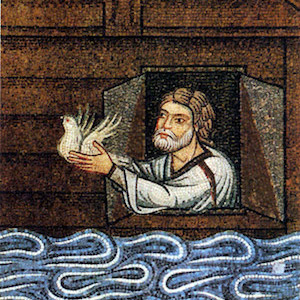
3. From Ancient Near Eastern records to nautical practices as recent as the 19th century, sailors the world over used doves, ravens, and other birds to help them find and navigate toward land. A raven will fly directly toward land, so it’s line of flight can be used as a guide. Doves have a limited ability for sustained flight, so they can be used to determine the location of a landing site. As long as the dove returns, no landing site is in close range.

4. Noah and his family were on the ark for a total of 370 days. Noah’s first recorded act on leaving the ark is building an altar to the Lord (Gen. 8:20).

5. The Bible says the ark came to rest on the mountains of Ararat (a mountain range in Turkey) but does not specify which mountain.

6. Noah became the first drunk recorded in Scripture, resulting in family troubles. (Genesis 9:20-26).

7. The only time Noah is recorded as speaking is when he curses his grandson Canaan and blesses his sons Shem and Japeth. At all other points in his story, God does the talking and Noah does the listening.

8. At 950 years of age, Noah had the third longest life recorded in the Bible (after Methuselah (969) and Jared (962)).

9. Besides the book of Genesis, Noah is also mentioned in eight other books of the Bible (1st Chronicles 1:4, Isaiah 54:9, Ezekiel 14:14; 20, Matthew 24:37-38, Luke 3:36, 17:26-27, Hebrews 11:7, 1 Peter 3:20, and 2 Peter 2:5) as well as in the Book of Enoch (10:1-3) and the Qur’an (Sura 71).


Report: The Bible in American Life – Reblog (The Gospel Coalition)

Report: The Bible in American Life

by Scotty Smith, thegospelcoalition.org ~ March 6th 2014

image

The Story: Surveys have found that nearly eight  in ten Americans regard the Bible as either the literal word of God or as inspired by God. At the same time, other surveys have revealed—and recent books have analyzed—surprising gaps in Americans’ biblical literacy. These discrepancies reveal American Christians’ complex relationship to their scripture, a subject that is widely acknowledged but rarely investigated. To understand that paradox, the Center for the Study of Religion and American Culture conducted the first large-scale investigation of the Bible in American life.

The Background: “The Bible in American Life” is a national study by the Center for the Study of Religion and American Culture. The purpose of the study is to understand better how Americans use the Bible in their personal daily lives and how other influences, including religious communities and the Internet, shape individuals’ use of scripture. The project, according to its researchers, was driven by the recognition that, though the Bible has been central to Christian practice throughout American history, many important questions remain unanswered in scholarship, including how people have read the Bible for themselves outside of worship, how denominational and parachurch publications have influenced interpretation and application, and how clergy and congregations have influenced individual understandings of scripture.

The Takeaways: Some of the more interesting findings from the report include:

• There is a 50/50 split among Americans who read any form of scripture in the past year and those who did not. Among those who did, women outnumber men, older people outnumber younger people, and Southerners exceed those from other regions of the
country.

• Among those who read any form of scripture in the past year, 95% named the Bible as the scripture they read. All told, this means that 48% of Americans read the Bible at some point in the past year. Most of those people read at least monthly, and a substantial number — 9% of all Americans — read the Bible daily.

• Despite the proliferation of Bible translations, the King James Version is the top choice — and by a wide margin—of Bible readers.

• The strongest correlation with Bible reading is race, with African Americans reading the Bible at considerably higher rates than others.

• Half of those who read the Bible in the past year also committed scripture to memory. About two-thirds of congregations in America hold events for children to memorize verses from the Bible.

• Among Bible readers, about half had a favorite book, verse, or story. Psalm 23, which begins, “The Lord is my shepherd…” was cited most often, followed by John 3:16.

• Bible readers consult scripture for personal prayer and devotion three times more than to learn about culture war issues such as abortion, homosexuality, war, or poverty.

• There are clear differences among Bible readers consulting scripture for specific reasons. Age, income, and education are key factors.

• Those reading the Bible frequently consult it on culture war issues more than two times the rate as those who read it less frequently.

• Less than half of those who read the Bible in the past year sought help in understanding it. Among those who did, clergy were their top source; the Internet was the least cited source.

• Among Bible readers, 31% read it on the Internet and 22% use e-devices.

• Bible reading differences among religious traditions followed predictably the historic divides between Protestants and Catholics, and between white conservative and white moderate/liberal Protestants. However, reading practices defy some stereotypes about certain groups.
__________
For the full report: click here.

Lenten Culture | First Things – Reblog

Lenten Culture | First Thoughts | Blogs | First Things.

LENTEN CULTURE

“The historical development of Lent corresponded to the construction of a Christian culture and thus the redemption of cultural life. It formed part of the message that upon entering the faith, the individual entered into an alternative way of existing in the world in which time was understood differently. The patterns of one’s existence now corresponded to a new narrative about the history of the world as one of creation and redemption in and through Jesus Christ.”

ON LENT, GLOBAL CULTURE, AND COSMIC SALVATION by Dale M. Coulter

lent

As my wife and I pulled up to a fast-food restaurant one year during Lent, our daughter quickly noticed a sign advertising vegetarian options. Given that she had decided to join the millions of Christians fasting during Lent, she was all too happy to know that market forces were at work acknowledging this aspect of Christian culture. At that moment her young faith became more than a private commitment. It became a public expression as she identified with a practice that Christians have engaged in for well over a thousand years.

The approach of Lent serves as a reminder to Christians of a common culture that they share. It reminds Christians that, in the language of the Martyrdom of Polycarp, they are members of a “God-fearing and God-loving race.” Of course, the actual practice of Lent varies, being adapted differently by diverse forms of Christianity with elements being added or subtracted given time and place. The Sunday before Lent has been called Transfiguration Sunday, Shrove Sunday, and Forgiveness or Cheesefare Sunday, to name a few. Such diversity attests to the rich local expression in Christianity, setting a precedent for the need to honor local culture in the celebration of a global inheritance.

The historical development of Lent corresponded to the construction of a Christian culture and thus the redemption of cultural life. It formed part of the message that upon entering the faith, the individual entered into an alternative way of existing in the world in which time was understood differently. The patterns of one’s existence now corresponded to a new narrative about the history of the world as one of creation and redemption in and through Jesus Christ. This is the link between the fasting and prayer that catechumens engaged in prior to undergoing baptism, confirmation, and first Eucharist and the incorporation of those practices into a Lenten season as part of the movement toward Easter.

As a cultural practice, then, Lent concerns the ongoing mission of the churches. Sometimes pastors or priests will talk about Lent as part of an individual’s ongoing conversion, because the person enters a prolonged period of heightened spiritual awareness in which acts of repentance and acts of mercy form the preparation for Easter celebration. While this may personalize Lent, the global culture that it communicates relates more to cosmic salvation and the mission to bring all of life under the authority of Christ. It may be that the importance of Lent resides in its reminder of the continuing mission to transform culture by the creation of new cultural forms of life that attest to the arrival of a new race of people.

It is for this reason that I have a strong sympathy for the first act of reform by Ulrich Zwingli in 1522, when he bore witness as priest to the eating of sausages during Lent. It was important to say at that time that the church’s rituals could not be linked in such a direct fashion to the salvation of the soul without putting a weight on the individual that was more than he or she could bear. The yoke of Christ resists such connections, which is why Zwingli referred to these practices as “matters of indifference” with respect to conscience.

Zwingli and his compatriots, however, went too far in their zeal to place as much distance as possible between personal salvation and ritual. The effect was an iconoclasm that destroyed a culture. It would have been better to shift the theological location of these rituals from the salvation of the person to the culture of the church and the way that culture is a manifestation of cosmic redemption. In other words, a shift from soteriology to eschatology.

The nature of the Lenten season in relation to Easter fits well within an eschatological framework since Christians relive a movement from the dust of creation to the deifying nature of resurrection. It is indeed within this cosmic setting that Christians bear witness to the drama of creation, fall, and redemption. Lent is a cultural inheritance that reminds Christians they are part of a great “race” composed of many tribes and tongues. It is also about redeeming cultures by catching them up in a drama that sets the local within a cosmic story.

This may also be a way to resolve the tension over a “matter of indifference” in early Christianity: the eating of food sacrificed to idols. There is a question about how to resolve Paul’s more lax approach to eating food sacrificed to idols and the Book of Revelation’s and the Didache’s more strident interpretation. The difference lies between a pre-Neronian period when the Temple remained and a post-Neronian period in which Christians and Jews were compelled by events to understand just how hostile Rome could be. In the face of such hostility, Christian participation in civic life threatened the integrity of Christian identity. Thus the need to bear witness to the dawn of a new age and new way of living.

Paul’s point that this testimony to Christian identity should be kept out of issues surrounding salvation and firmly planted in the soil of creation harmonizes with the emphasis on the renewal of creation in the Book of Revelation. Christians should not abstain from eating food sacrificed to idols as a means of securing their personal union with Christ, but they should abstain as a matter of bearing witness to the life to come and its renewal of creation. This is a Christian way of affirming a deeply Jewish principle: all food is a gift from God. Since it is God’s gift food should not be used as a weapon either by Christians to destroy the weaker consciences of their fellow believers or by the state to compel Christians to engage in certain cultural activities deemed to be necessary for citizenship.

Just like Lent, the practice of eating or not eating food sacrificed to idols was a way of reminding Christians about their identity as a new people and the continuing mission to bear witness to a cosmic event, the dawning of a new age. It also spoke powerfully to the transformation of Roman civic life, for Christians decided that they were unwilling to pay the cultural price of admission into the global economy at the time. They were happy to transact business and live moral lives as citizens, but not at the expense of their new identity. Receiving the sign of the cross with ash on Ash Wednesday marks Christians as belonging to a people with a cultural identity that honors the local without sacrificing the global—indeed, catholic—nature of that identity.

Saving Rock and Roll | God is a “Wild Old Dog” | First Things Reblog

Saving Rock and Roll | Web Exclusives | First Things.
__________

Peanut Gallery: I doubt if this music will show up any time soon in your local church, but the imagery is riveting and the tune haunting. Stephen Webb places Patty Griffin’s song “Wild Old Dog” within a framework of faith. And it’s given me a lot to think about as I approach the Lenten season.

I’ve included a YouTube version with words below so that you can judge for yourself. I’d love to hear your comments.
__________

SAVING ROCK AND ROLL

by Stephen H. Webb;

Rock and roll has a rebellious sound. I write that hesitantly, because there is really no such thing as rock and roll, in terms of having a permanent nature or ongoing essence. Speed, loudness, and distorted acoustical effects do not a musical genre make. Rock is a mishmash of various musical traditions — Gospel, blues, jazz, folk, country, swing — rather than a tradition of its own. When bands began using string instruments in the late sixties, for example, they changed the way most people hear classical music, and classical music, to the extent that it is still culturally relevant, has had to adapt accordingly. Even calling rock rebellious is a dated description. Like a vampire, rock needs fresh blood to survive, and it leaves its victims forever altered by draining their lifeblood. But what will happen when all music becomes, to one degree or another, rockified? Can rock be, musically speaking, everything and still be rock and roll?

Monopolies have no competitors, but there is a competing brand to rebellious rock, and that is contemporary Christian music. Once derided not just by traditionalist Christians but also by rock devotees, Christian rock has come of age. Precisely because it tries to sound different from the rock mainstream, much of it is as good as or better than secular rock — although it is still tightly segregated, like Christian fiction, from the mainstream markets.

patty griffin

If I were a trend-spotter, I would wager that secular rock will increasingly look to its Christian rival for new infusions of creativity and power. Take, for example, Patty Griffin’s “Wild Old Dog,” an intensely meditative song that gains in theological power with each new hearing. It begins:

God is a wild old dog

Someone left out on the highway

I seen him running by me

He don’t belong to no one now.

The song tells the story of a family that pulls over on the side of a highway in order to abandon their mangy and nearly blind old dog. When they set out for the ride, one of the family members tries to kick him into the car, but “He just climbed on in just like he knew.” He is a willing victim. Indeed, his destiny is to have his broken bones crushed and whittled down to nothing.

The pathos in this song is heavy, but it is redeemed from its own melodrama by the soaring quality of Griffin’s voice. She can be uplifting even when the words are driving you down, while the gracefulness of her singing sounds utterly forlorn. I know nothing about Griffin’s religious beliefs, but she has written a great religious song that begs to be interpreted theologically.

When the dog is let go, to the surprise of the singer and against all expectation, he tears “off runnin’ like we set him free.” The dog is not running away from the family, nor is he blindly running around, with no direction. In fact, with bad hips and knees, it is a miracle that he is running at all. It is uncertain what this does to the singer’s faith. The dog disappears right in front of her and leaves her thinking about how

Sometimes a heart can turn to dust

Get whittled down to nothing

Broken down and crushed.

The dog’s fate deeply wounds the singer, and this song is her attempt at healing.

But what about the dog, who is, after all, identified with God? The dog never loses his dignity. In fact, his sudden running seems to be telling the family that it is all right that they have kicked him out. The dog is old, but by embracing the wildness they have forced on him, he takes away the consequences of their cruelty. The dog is not just any kind of God, but the God who died to set us free.

We live in a world where sound has become a salvific commodity. Plugging in is how many people escape the drudgery of the ordinary and everyday. Favorite songs provide three minutes of transcendence. Nevertheless, rock is so ubiquitous that it is in danger of becoming musical wallpaper, with one style looking like another and none looking all that interesting, which leaves you wanting to tear them all down just to see the wall again.

Music lets us hear ideas that can be hard to grasp on an abstract or conceptual level. Griffin’s voice in this song, for example, makes the sadness of her words come alive in a way that expands our theological senses. We can hear in her voice the sound of the loss she is describing. More specifically, we can hear in her song the hard truth that Jesus Christ was never more like us than when we abandoned him.

Griffin is not Christian rock. But secular rock will increasingly look like Griffin, or it should. The future of rock is either to suffer a slow cultural death or be saved by more satisfying sounds by rebelling against its original rebellion and becoming more explicitly spiritual. Even if I am wrong about that prediction, the possibility that the best popular music can carry rich theological themes is something to celebrate.

Stephen H. Webb is a columnist for First Things. He is the author of Jesus Christ, Eternal God and, forthcoming, Mormon Christianity. His book on Bob Dylan is Dylan Redeemed.
__________

God is a wild old dog, / Someone left out on the highway. / I seen him running by me, / He don’t belong to noone now.

They dropped him out on 93. / Mange was setting in on his hips and on his knees. / Between the highways runnin north and south / They pulled on over and put him out

Willie said he was old and goin blind. / Momma told me how she didn’t mind. / When Willie kicked him with his shoe, / He just climbed on in just like he knew

God is a wild old dog / Someone left out on the highway / I seen him runnin by me / He don’t belong to noone now

It’s lonely on the highway / Sometimes a heart can turn to dust / Get whittled down to nothin / Broken down and crushed / In with the bones of wild old dogs / Wild old dogs

They dropped him out on 93 / Tall grass was waving there just like the sea / He tore off runnin like we set him free / Just disappeared right in front of me

God is a wild old dog / Someone left out on the highway / I seen him runnin by me / He don’t belong to noone now / He don’t belong to noone now.

A Love Story: in two parts ~ by M. Connor – Reblog

Peanut Gallery: Please read the full story of this courageous woman – both the happy ending and the false start that preceded it.

Both are reblogged below for your convenience.
___________

Today IS My Wedding Day! (June 3, 2013) – reblogged from The Gospel Coalition

wedding-hands

God’s timing could not be more perfect. His grace saved me from making the biggest mistake of my life. Although I was living with the man I thought I would marry and our wedding was basically planned, I began to see that God promised much more for a relationship than I was setting myself up for in marrying a non-believer. At the point I called off our wedding, I had no idea if I would ever actually get married, but I was truly content being loved by the Lord.

Then, on the very day that I was supposed to marry someone else, the next chapter of my life began to unfold. While I was out of town visiting my best friend and trying to take my mind off things, I ran into a guy I had met at a church function a couple of months earlier. Through our initial communication, I was able to get a few important questions answered: he had a heart for God, he was around my age, and he was single.

The courting took off from there, and as our connection began to deepen through many lengthy conversations, I realized that he truly understood the Lord’s call to be a spiritual leader. Months went by as we continued to visit, meet one another’s families, and get to know each other on a deeper level. From our obsession with neatness to our feisty personalities (two areas where we constantly seek God’s grace), we were as compatible as any two people could be. Eventually he told me he loved me, and we knew we had to figure out a way to interweave our lives.

Then came a major roadblock. Although we had agreed to be celibate before marriage, my colored past of sexual sin had to be confronted. When he finally got up the courage to ask about it, I laid it all out there. Before I had a relationship with Jesus, I believed one of the world’s unfortunate lies: that I had to have sex with a guy if I was ever going to find someone to marry me. What I hadn’t planned for was the soul-tearing damage of layered sexual experiences that yielded a slew of disappointments. Over time, I became a severely damaged and broken soul.

Reading Sex and the Soul of a Woman by Paula Rinehart gave me hope to believe that God would follow through on his promises. “The freedom that comes from [the awareness of Jesus’ love] makes real love at the right time with the right man such a beautiful possibility,” she writes. “When the soil of your heart is primed to receive love, the courting dance is a clean and beautiful thing.”

And for me, it truly was. Through the healing redemption of the cross, I was set free and forgiven for my transgressions. Now this man who was trying to love me had to do the same. And since he had made the personal commitment to wait until marriage, it was an even tougher pill to swallow. But it was a perfect stage for God to reveal his grace. And he did.

Greater Meaning

When I think back to how our relationship began, I can see how the Lord was guarding my heart. His hand was at work—not only in the miraculous way he healed my heart, but also in how he brought true love into my life. Through this experience, I truly realized the depth of his love and began to trust in his ultimate plan for my life rather than my own. And through this suffering I was able to see things in new and different ways, learning to rely on him all the more.

During the time I was single, I got more involved in my church by joining the women’s ministry team, volunteering at Sunday service, and hosting a book club at my house, which afforded many opportunities to share my story. The more I shared, the more opportunities there were to help others struggling emotionally and relationally. In short, my story opened the door to meaningful conversations with people who had lost hope: single women who couldn’t seem to find love, people who were married to unbelievers, and those who were struggling to make their relationships work. At that point, it became clear that my suffering had much greater meaning. Through these interactions, others saw the possibility of another road—that healing and restoration were available to them through the grace of God and obedience to Christ.

Clothed with Joy

Today, by the grace of God, we join together as man and wife. Although I couldn’t see it at the time, and I wasn’t sure if I ever would, I never doubted that the Lord had a greater purpose and was at work through it all. We still have no idea what’s coming next (literally, we’re not even sure where we’re going to live), but we trust that God has a plan for us. And as we pick up our crosses and follow him, it will surely be revealed.

You have turned my mourning into joyful dancing. You have taken away my clothes of mourning and clothed me with joy, that I might sing praises to you and not be silent. O Lord my God, I will give you thanks forever!
Psalm 30:11-12

M. Connor can be reached via email at mconnor0526@gmail.com. Her previous article, Today Was Supposed to Be My Wedding Day, was published on May 26, 2012.
__________

Today Was Supposed to Be My Wedding Day

May 26, 2012. It was supposed to be a momentous occasion—the day I would walk down the aisle in my mother’s lace wedding gown, peonies in hand, best friend at my side, family and friends looking on with joy. It was supposed to be the day I started a new chapter, the day my dreams would be fulfilled. Little did I know, God had other plans.

BrideWe met in the winter of 2010—me and God, that is. He always had his eye on me, but I barely even knew who he was. Once I began spending time with him, our relationship blossomed into something special. He cared for me and loved me like no other. He filled a huge void in my heart.

That’s how I came to know God. It’s also how I came to know the man I thought I would marry.

The relationship started out like many others, following cultural expectations rather than God’s design. Dating, sex, spending the night, meeting the parents, integrating the pets (him, a dog; me, two cats). After 10 months, on a snowy Sunday evening in front of the place we first met, he asked me to marry him. It was romantic indeed. Even strangers passing by yelled congratulations from their car windows.

I was excited to be engaged—to finally be moving toward marriage—but something never felt quite right. I sensed a resistance in my heart, like I wasn’t totally sure about something. But he was a good guy—the right age, handsome, fun, easy-going, from a decent family. What more could a girl want?

So I moved forward. Even though I had just bought my own home, I gave it up and moved in with him on a spring day in early March. Everyone has to make sacrifices for love, I reasoned. That’s where we’re going to end up anyway. Why not start now? At first, it was exciting and felt like the right thing to do. But a different story soon emerged.

After just a few months of living together, God shook things up. I accepted an awesome job opportunity in another state, so we left behind the house we just finished renovating and drove across the country (pets in tow) to set up our life far from home, family, friends, and church.

Shortly after we settled, a friend from work recommended we try out a small new Presbyterian church in the area. I was a tad leery, as I had recently been baptized in a non-denominational church, but I agreed to check it out. I immediately loved it and felt like this could be my church home. On my second visit, I filled out a visitor card, which asked a few questions about how I wanted to get involved. Did I want to join a life group? Be part of a ministry team? Have coffee with the pastor? Coffee sounded good. I checked the box.

Later that week, the pastor emailed me, asking when I wanted to get together. What a great opportunity to get to know him and learn more about the church, I thought. Maybe he would even be willing to officiate our wedding in a few months. High hopes turned to frustration when I mentioned the possibility to my fiancé. “Coffee? With a pastor?” he asked. “Heck, no. That’s just too weird.”

After weeks of my coercing, praying, hoping, and begging, he finally obliged. But we continued to fight about it—all the way to the front door of the pastor’s house. Regardless, I enjoyed myself and looked forward to hanging out with the pastor and his wife again soon. I could see them being our friends—a couple who would help guide our marriage and bring us closer to God.

Before we could marry, the church asked us to complete a series of counseling sessions, so we set up time to meet with our new pastor. He recommended we start reading the book When Sinners Say I Do by Dave Harvey. I ordered it online, along with Tim and Kathy Keller’s book The Meaning of Marriage. And in my determination to be the very best Christian wife I could be, I also ordered a copy of Carolyn Mahaney’s Feminine Appeal. I thought these books would help us get ready for one of the biggest steps we would ever take.

Help they did, but in a way I didn’t expect. As I started reading Harvey’s book, the first chapter stopped me dead in my tracks. He explained that faith is the most important part of a marriage. Faith? Really? Even though I was now a Christian, I had never considered this point before. Harvey explains that faith is like the first button on a shirt—if you get that wrong, nothing else will line up right.

I began considering how this idea played out in the episode at the pastor’s house, not to mention the weekly task of begging my fiancé to go to church, trying to convince him to join a Bible study, and asking him to remember to pray before dinner. Is it supposed to be this difficult?

No, it’s not, I learned from Harvey, Keller, and my pastor. I began to realize that just as my thinking had been flawed about sex as a prerequisite for love, I also had the wrong idea about the most important traits in a marriage. As I kept reading and talking to other Christians, no one said it was a good idea for me to marry someone with a different worldview. In other words, I had come to love Jesus and make my decisions based on him; my fiancé had not. That discrepancy became poison in our relationship—barely noticeable at first but eventually corrupting nearly every aspect of our lives. As I grew closer to God, I grew further from wanting to marry someone who did not have a relationship with him.

Keller’s teaching on Ephesians 5 helped clarify what I was discovering. Ephesians 5:25-27 says:

Husbands, love your wives, just as Christ loved the church and gave himself up for her to make her holy, cleansing her by the washing with water through the word, and to present her to himself as a radiant church, without stain or wrinkle or any other blemish, but holy and blameless.

Thankfully, the Holy Spirit spoke to me on a weekday in early January when my friend opened the Bible to this passage and showed me the truth. I came to understand that God intends for marriage to mimic Jesus’ selfless love for his people. I was awestruck. My husband is supposed to lead me closer to God? I immediately broke down crying. I kept digging, trying to understand how I got so far off base. “He’s a good man,” I argued. “Yes, but is he a Christian? Does he know Jesus?” people asked me in response. “But if I leave him, won’t I be going against what God says, by not loving the unbeliever?” Surprisingly, no. I was not yet married. I had not made a covenant with him before God. I was not bound to him. As much as it would hurt to say goodbye, I knew this was not the relationship God intended for me. He promises much more, and I wasn’t going to find it in a marriage with an unbeliever.

As this devastating realization sunk in, we began the process of disentangling our lives. And within a few weeks, my ex-fiancé headed back to his home with his belongings, including the dog I had come to love and all of my hopes and dreams for a lifetime of happiness together. We both knew he had to find God on his own terms, in his own way.

Who could have guessed that simply checking a box on a church form would eventually end in heartbreak, financial loss, and unwanted singleness? Difficult and sad as it was, God was there every step of the way. He was there in the simple way it ended, despite our lives being intertwined in nearly every way. He was there in the support and love our family and friends provided. He was there to give me a sense of peace that transcended all understanding. Left to myself, previous breakups had knocked me down to my lowest points in life. But this time, with more riding on the relationship than ever before, I was truly okay. I suppose obedience to God made the difference. As much as it hurts, God is always there to pick up the pieces.

Marriage and family are still the two things I want most in life, but I know that they’re in God’s control—not mine. Before I knew God, I tried to control my relational life by making poor decisions and sacrifices that brought little reward. Now, I find fulfillment in God. He is my rock, the one who deserves my love and attention. While it is a daily struggle to trust him with the things I care about so deeply, he has proven that he’s looking out for me. I leave my future in his hands.

Editors’ note: Read the follow-up article from M. Connor, “Today IS My Wedding Day!”