One thing I have asked of the Lord, this is what I seek: that I may dwell in the house of the Lord all the days of my life; to behold the beauty of the Lord and to seek Him in His temple.
Praise to You, Lord Jesus Christ, King of endless glory.
Reading: Job 27-28 (NLT)
Job’s Final Speech
Job 27 (NLT)
Job continued speaking:
+ My conscience is clear – “I vow by the living God, who has taken away my rights, by the Almighty who has embittered my soul—As long as I live, while I have breath from God, my lips will speak no evil, and my tongue will speak no lies. I will never concede that you are right; I will defend my integrity until I die. I will maintain my innocence without wavering. My conscience is clear for as long as I live.
+ The godless are hopeless – “May my enemy be punished like the wicked, my adversary like those who do evil. For what hope do the godless have when God cuts them off and takes away their life? Will God listen to their cry when trouble comes upon them? Can they take delight in the Almighty? Can they call to God at any time? I will teach you about God’s power. I will not conceal anything concerning the Almighty. But you have seen all this, yet you say all these useless things to me.
+ The wicked are terrified – “This is what the wicked will receive from God; this is their inheritance from the Almighty. They may have many children, but the children will die in war or starve to death. Those who survive will die of a plague, and not even their widows will mourn them.
“Evil people may have piles of money and may store away mounds of clothing. But the righteous will wear that clothing, and the innocent will divide that money. The wicked build houses as fragile as a spider’s web, as flimsy as a shelter made of branches. The wicked go to bed rich but wake to find that all their wealth is gone. Terror overwhelms them like a flood, and they are blown away in the storms of the night. The east wind carries them away, and they are gone. It sweeps them away. It whirls down on them without mercy. They struggle to flee from its power. But everyone jeers at them and mocks them.
Job Speaks of Wisdom and Understanding
Job 28 (NLT)
+ People have knowledge – “People know where to mine silver and how to refine gold. They know where to dig iron from the earth and how to smelt copper from rock. They know how to shine light in the darkness and explore the farthest regions of the earth as they search in the dark for ore. They sink a mine shaft into the earth far from where anyone lives. They descend on ropes, swinging back and forth. Food is grown on the earth above, but down below, the earth is melted as by fire. Here the rocks contain precious lapis lazuli, and the dust contains gold. These are treasures no bird of prey can see, no falcon’s eye observe. No wild animal has walked upon these treasures; no lion has ever set his paw there. People know how to tear apart flinty rocks and overturn the roots of mountains. They cut tunnels in the rocks and uncover precious stones. They dam up the trickling streams and bring to light the hidden treasures.
+ People don’t have wisdom – “But do people know where to find wisdom? Where can they find understanding? No one knows where to find it, for it is not found among the living. ‘It is not here,’ says the ocean. ‘Nor is it here,’ says the sea. It cannot be bought with gold. It cannot be purchased with silver. It’s worth more than all the gold of Ophir, greater than precious onyx or lapis lazuli. Wisdom is more valuable than gold and crystal. It cannot be purchased with jewels mounted in fine gold. Coral and jasper are worthless in trying to get it. The price of wisdom is far above rubies. Precious peridot from Ethiopia cannot be exchanged for it. It’s worth more than the purest gold.
+ People don’t know where to find wisdom – “But do people know where to find wisdom? Where can they find understanding? It is hidden from the eyes of all humanity. Even the sharp-eyed birds in the sky cannot discover it. Destruction and Death say, ‘We’ve heard only rumors of where wisdom can be found.’
+ God alone is the source of wisdom – “God alone understands the way to wisdom; he knows where it can be found, for he looks throughout the whole earth and sees everything under the heavens. He decided how hard the winds should blow and how much rain should fall. He made the laws for the rain and laid out a path for the lightning. Then he saw wisdom and evaluated it. He set it in place and examined it thoroughly. And this is what he says to all humanity:
‘The fear of the Lord is true wisdom; to forsake evil is real understanding.’”
Reading: 1 Corinthians 1:18-19 (NLT)
The message of the cross is foolish to those who are headed for destruction! But we who are being saved know it is the very power of God. As the Scriptures say,
“I will destroy the wisdom of the wise and discard the intelligence of the intelligent.”
May the peace of the Lord Christ go with you, wherever He may send you. May He guide you through the wilderness, protect you through the storm. May He bring you home rejoicing at the wonders He has shown you. May He bring you home rejoicing once again into our doors.
__________
+ In the name of the Father, and the Son, and the Holy Spirit. Amen!
One thing I have asked of the Lord, this is what I seek: that I may dwell in the house of the Lord all the days of my life; to behold the beauty of the Lord and to seek Him in His temple.
Praise to You, Lord Jesus Christ, King of endless glory.
Reading: 1 Samuel 11-15 (NLT)
[Nahash, king of the Ammonites, had been grievously oppressing the people of Gad and Reuben who lived east of the Jordan River. He gouged out the right eye of each of the Israelites living there, and he didn’t allow anyone to come and rescue them. In fact, of all the Israelites east of the Jordan, there wasn’t a single one whose right eye Nahash had not gouged out. But there were 7,000 men who had escaped from the Ammonites, and they had settled in Jabesh-gilead.]
Saul Defeats the Ammonites
1 Samuel 11 (NLT)
About a month later, King Nahash of Ammon led his army against the Israelite town of Jabesh-gilead. But all the citizens of Jabesh asked for peace. “Make a treaty with us, and we will be your servants,” they pleaded.
+ Nahash intent on disgracing Israel – All right,” Nahash said, “but only on one condition. I will gouge out the right eye of every one of you as a disgrace to all Israel!”
“Give us seven days to send messengers throughout Israel!” replied the elders of Jabesh. “If no one comes to save us, we will agree to your terms.”
When the messengers came to Gibeah of Saul and told the people about their plight, everyone broke into tears. Saul had been plowing a field with his oxen, and when he returned to town, he asked, “What’s the matter? Why is everyone crying?” So they told him about the message from Jabesh.
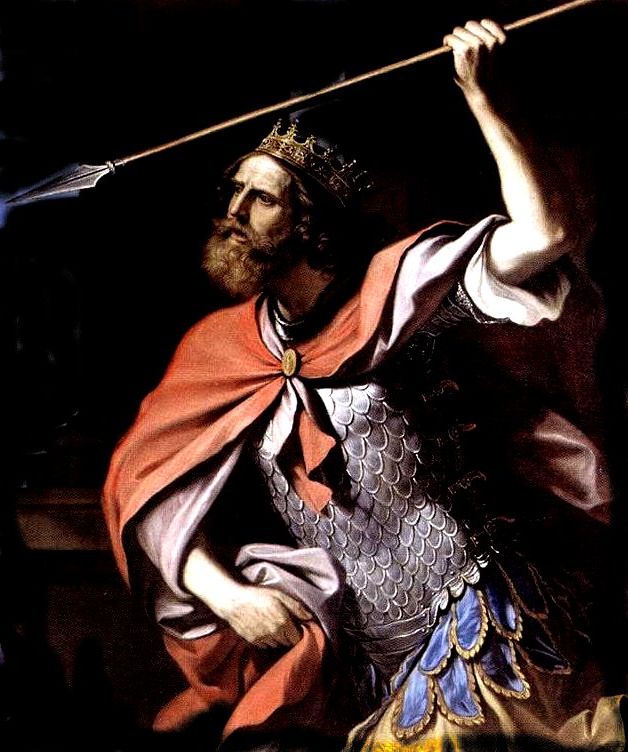
+ God arouses Saul’s anger – Then the Spirit of God came powerfully upon Saul, and he became very angry. He took two oxen and cut them into pieces and sent the messengers to carry them throughout Israel with this message: “This is what will happen to the oxen of anyone who refuses to follow Saul and Samuel into battle!” And the Lord made the people afraid of Saul’s anger, and all of them came out together as one. When Saul mobilized them at Bezek, he found that there were 300,000 men from Israel and 30,000 men from Judah.
So Saul sent the messengers back to Jabesh-gilead to say, “We will rescue you by noontime tomorrow!” There was great joy throughout the town when that message arrived!
+ Saul slaughters the Ammonites – The men of Jabesh then told their enemies, “Tomorrow we will come out to you, and you can do to us whatever you wish.” But before dawn the next morning, Saul arrived, having divided his army into three detachments. He launched a surprise attack against the Ammonites and slaughtered them the whole morning. The remnant of their army was so badly scattered that no two of them were left together.
Then the people exclaimed to Samuel, “Now where are those men who said, ‘Why should Saul rule over us?’ Bring them here, and we will kill them!”
But Saul replied, “No one will be executed today, for today the Lord has rescued Israel!”
+ Saul made king of Israel – Then Samuel said to the people, “Come, let us all go to Gilgal to renew the kingdom.” So they all went to Gilgal, and in a solemn ceremony before the Lord they made Saul king. Then they offered peace offerings to the Lord, and Saul and all the Israelites were filled with joy.
Samuel’s Farewell Address
1 Samuel 12 (NLT)
+ Your king is now your leader – Then Samuel addressed all Israel: “I have done as you asked and given you a king. Your king is now your leader. I stand here before you—an old, gray-haired man—and my sons serve you. I have served as your leader from the time I was a boy to this very day. Now testify against me in the presence of the Lord and before his anointed one. Whose ox or donkey have I stolen? Have I ever cheated any of you? Have I ever oppressed you? Have I ever taken a bribe and perverted justice? Tell me and I will make right whatever I have done wrong.”
“No,” they replied, “you have never cheated or oppressed us, and you have never taken even a single bribe.”
+ My hands are clean – “The Lord and his anointed one are my witnesses today,” Samuel declared, “that my hands are clean.”
“Yes, he is a witness,” they replied.
+ Remember what God has done for you – “It was the Lord who appointed Moses and Aaron,” Samuel continued. “He brought your ancestors out of the land of Egypt. Now stand here quietly before the Lord as I remind you of all the great things the Lord has done for you and your ancestors.
“When the Israelites were in Egypt and cried out to the Lord, he sent Moses and Aaron to rescue them from Egypt and to bring them into this land. But the people soon forgot about the Lord their God, so he handed them over to Sisera, the commander of Hazor’s army, and also to the Philistines and to the king of Moab, who fought against them.
“Then they cried to the Lord again and confessed, ‘We have sinned by turning away from the Lord and worshiping the images of Baal and Ashtoreth. But we will worship you and you alone if you will rescue us from our enemies.’ Then the Lord sent Gideon, Bedan, Jephthah, and Samuel to save you, and you lived in safety.
+ Now God has given you the king you requested – “But when you were afraid of Nahash, the king of Ammon, you came to me and said that you wanted a king to reign over you, even though the Lord your God was already your king. All right, here is the king you have chosen. You asked for him, and the Lord has granted your request.
+ Still you must fear, worship, and obey God – “Now if you fear and worship the Lord and listen to his voice, and if you do not rebel against the Lord’s commands, then both you and your king will show that you recognize the Lord as your God. But if you rebel against the Lord’s commands and refuse to listen to him, then his hand will be as heavy upon you as it was upon your ancestors.
+ Samuel asks God for a show of power – “Now stand here and see the great thing the Lord is about to do. You know that it does not rain at this time of the year during the wheat harvest. I will ask the Lord to send thunder and rain today. Then you will realize how wicked you have been in asking the Lord for a king!”
So Samuel called to the Lord, and the Lord sent thunder and rain that day. And all the people were terrified of the Lord and of Samuel. “Pray to the Lord your God for us, or we will die!” they all said to Samuel. “For now we have added to our sins by asking for a king.”
+ Worship God with all your heart – “Don’t be afraid,” Samuel reassured them. “You have certainly done wrong, but make sure now that you worship the Lord with all your heart, and don’t turn your back on him. Don’t go back to worshiping worthless idols that cannot help or rescue you—they are totally useless! The Lord will not abandon his people, because that would dishonor his great name. For it has pleased the Lord to make you his very own people.
+ Follow my example and serve God – “As for me, I will certainly not sin against the Lord by ending my prayers for you. And I will continue to teach you what is good and right. But be sure to fear the Lord and faithfully serve him. Think of all the wonderful things he has done for you. But if you continue to sin, you and your king will be swept away.”
Continued War with Philistia
1 Samuel 13 (NLT)
Saul was thirty years old when he became king, and he reigned for forty-two years.
+ Saul’s special forces – Saul selected 3,000 special troops from the army of Israel and sent the rest of the men home. He took 2,000 of the chosen men with him to Micmash and the hill country of Bethel. The other 1,000 went with Saul’s son Jonathan to Gibeah in the land of Benjamin.
+ Jonathan’s success – Soon after this, Jonathan attacked and defeated the garrison of Philistines at Geba. The news spread quickly among the Philistines. So Saul blew the ram’s horn throughout the land, saying, “Hebrews, hear this! Rise up in revolt!” All Israel heard the news that Saul had destroyed the Philistine garrison at Geba and that the Philistines now hated the Israelites more than ever. So the entire Israelite army was summoned to join Saul at Gilgal.
+ Philistines mobilize – The Philistines mustered a mighty army of 3,000 chariots, 6,000 charioteers, and as many warriors as the grains of sand on the seashore! They camped at Micmash east of Beth-aven. The men of Israel saw what a tight spot they were in; and because they were hard pressed by the enemy, they tried to hide in caves, thickets, rocks, holes, and cisterns. Some of them crossed the Jordan River and escaped into the land of Gad and Gilead.
Saul’s Disobedience and Samuel’s Rebuke
+ Saul’s fearful forces – Meanwhile, Saul stayed at Gilgal, and his men were trembling with fear. Saul waited there seven days for Samuel, as Samuel had instructed him earlier, but Samuel still didn’t come. Saul realized that his troops were rapidly slipping away. So he demanded, “Bring me the burnt offering and the peace offerings!” And Saul sacrificed the burnt offering himself.
+ Saul’s foolishness – Just as Saul was finishing with the burnt offering, Samuel arrived. Saul went out to meet and welcome him, but Samuel said, “What is this you have done?”
Saul replied, “I saw my men scattering from me, and you didn’t arrive when you said you would, and the Philistines are at Micmash ready for battle. So I said, ‘The Philistines are ready to march against us at Gilgal, and I haven’t even asked for the Lord’s help!’ So I felt compelled to offer the burnt offering myself before you came.”
+ Samuel’s prophecy – “How foolish!” Samuel exclaimed. “You have not kept the command the Lord your God gave you. Had you kept it, the Lord would have established your kingdom over Israel forever. But now your kingdom must end, for the Lord has sought out a man after his own heart. The Lord has already appointed him to be the leader of his people, because you have not kept the Lord’s command.”
Israel’s Military Disadvantage
+ Numbers – Samuel then left Gilgal and went on his way, but the rest of the troops went with Saul to meet the army. They went up from Gilgal to Gibeah in the land of Benjamin. When Saul counted the men who were still with him, he found only 600 were left! Saul and Jonathan and the troops with them were staying at Geba in the land of Benjamin. The Philistines set up their camp at Micmash. Three raiding parties soon left the camp of the Philistines. One went north toward Ophrah in the land of Shual, another went west to Beth-horon, and the third moved toward the border above the valley of Zeboim near the wilderness.
+ Weapons – There were no blacksmiths in the land of Israel in those days. The Philistines wouldn’t allow them for fear they would make swords and spears for the Hebrews. So whenever the Israelites needed to sharpen their plowshares, picks, axes, or sickles, they had to take them to a Philistine blacksmith. The charges were as follows: a quarter of an ounce of silver for sharpening a plowshare or a pick, and an eighth of an ounce for sharpening an ax or making the point of an ox goad. So on the day of the battle none of the people of Israel had a sword or spear, except for Saul and Jonathan.
+ Position – The pass at Micmash had meanwhile been secured by a contingent of the Philistine army.
Jonathan’s Daring Plan
1 Samuel 14 (NLT)
One day Jonathan said to his armor bearer, “Come on, let’s go over to where the Philistines have their outpost.” But Jonathan did not tell his father what he was doing.
Meanwhile, Saul and his 600 men were camped on the outskirts of Gibeah, around the pomegranate tree at Migron. Among Saul’s men was Ahijah the priest, who was wearing the ephod, the priestly vest. Ahijah was the son of Ichabod’s brother Ahitub, son of Phinehas, son of Eli, the priest of the Lord who had served at Shiloh.
+ Jonathan’s infiltration plan – No one realized that Jonathan had left the Israelite camp. To reach the Philistine outpost, Jonathan had to go down between two rocky cliffs that were called Bozez and Seneh. The cliff on the north was in front of Micmash, and the one on the south was in front of Geba. “Let’s go across to the outpost of those pagans,” Jonathan said to his armor bearer. “Perhaps the Lord will help us, for nothing can hinder the Lord. He can win a battle whether he has many warriors or only a few!”
“Do what you think is best,” the armor bearer replied. “I’m with you completely, whatever you decide.”
+ Jonathan seeks a sign – “All right, then,” Jonathan told him. “We will cross over and let them see us. If they say to us, ‘Stay where you are or we’ll kill you,’ then we will stop and not go up to them. But if they say, ‘Come on up and fight,’ then we will go up. That will be the Lord’s sign that he will help us defeat them.”
When the Philistines saw them coming, they shouted, “Look! The Hebrews are crawling out of their holes!” Then the men from the outpost shouted to Jonathan, “Come on up here, and we’ll teach you a lesson!”
“Come on, climb right behind me,” Jonathan said to his armor bearer, “for the Lord will help us defeat them!”
+ Jonathan destroys the outpost – So they climbed up using both hands and feet, and the Philistines fell before Jonathan, and his armor bearer killed those who came behind them. They killed some twenty men in all, and their bodies were scattered over about half an acre.
+ God causes panic – Suddenly, panic broke out in the Philistine army, both in the camp and in the field, including even the outposts and raiding parties. And just then an earthquake struck, and everyone was terrified.
Israel Defeats the Philistines
Saul’s lookouts in Gibeah of Benjamin saw a strange sight—the vast army of Philistines began to melt away in every direction. “Call the roll and find out who’s missing,” Saul ordered. And when they checked, they found that Jonathan and his armor bearer were gone.
Then Saul shouted to Ahijah, “Bring the ephod here!” For at that time Ahijah was wearing the ephod in front of the Israelites. But while Saul was talking to the priest, the confusion in the Philistine camp grew louder and louder. So Saul said to the priest, “Never mind; let’s get going!”
+ God saved Israel – Then Saul and all his men rushed out to the battle and found the Philistines killing each other. There was terrible confusion everywhere. Even the Hebrews who had previously gone over to the Philistine army revolted and joined in with Saul, Jonathan, and the rest of the Israelites. Likewise, the men of Israel who were hiding in the hill country of Ephraim joined the chase when they saw the Philistines running away. So the Lord saved Israel that day, and the battle continued to rage even beyond Beth-aven.
Saul’s Foolish Oath
+ The foolish oath – Now the men of Israel were pressed to exhaustion that day, because Saul had placed them under an oath, saying, “Let a curse fall on anyone who eats before evening—before I have full revenge on my enemies.” So no one ate anything all day, even though they had all found honeycomb on the ground in the forest. They didn’t dare touch the honey because they all feared the oath they had taken.
+ Unwittingly broken – But Jonathan had not heard his father’s command, and he dipped the end of his stick into a piece of honeycomb and ate the honey. After he had eaten it, he felt refreshed. But one of the men saw him and said, “Your father made the army take a strict oath that anyone who eats food today will be cursed. That is why everyone is weary and faint.”
+ Jonathan’s assessment – “My father has made trouble for us all!” Jonathan exclaimed. “A command like that only hurts us. See how refreshed I am now that I have eaten this little bit of honey. If the men had been allowed to eat freely from the food they found among our enemies, think how many more Philistines we could have killed!”
+ Famished and faint – They chased and killed the Philistines all day from Micmash to Aijalon, growing more and more faint. That evening they rushed for the battle plunder and butchered the sheep, goats, cattle, and calves, but they ate them without draining the blood. Someone reported to Saul, “Look, the men are sinning against the Lord by eating meat that still has blood in it.”
“That is very wrong,” Saul said. “Find a large stone and roll it over here. Then go out among the troops and tell them, ‘Bring the cattle, sheep, and goats here to me. Kill them here, and drain the blood before you eat them. Do not sin against the Lord by eating meat with the blood still in it.’”
+ Saul’s belated sacrifice – So that night all the troops brought their animals and slaughtered them there. Then Saul built an altar to the Lord; it was the first of the altars he built to the Lord.
Then Saul said, “Let’s chase the Philistines all night and plunder them until sunrise. Let’s destroy every last one of them.”
His men replied, “We’ll do whatever you think is best.”
But the priest said, “Let’s ask God first.”
+ God is silent – So Saul asked God, “Should we go after the Philistines? Will you help us defeat them?” But God made no reply that day.
+ Saul repeats his oath – Then Saul said to the leaders, “Something’s wrong! I want all my army commanders to come here. We must find out what sin was committed today. I vow by the name of the Lord who rescued Israel that the sinner will surely die, even if it is my own son Jonathan!” But no one would tell him what the trouble was.
Then Saul said, “Jonathan and I will stand over here, and all of you stand over there.”
And the people responded to Saul, “Whatever you think is best.”
+ God speaks by lot – Then Saul prayed, “O Lord, God of Israel, please show us who is guilty and who is innocent.” Then they cast sacred lots, and Jonathan and Saul were chosen as the guilty ones, and the people were declared innocent.
Then Saul said, “Now cast lots again and choose between me and Jonathan.” And Jonathan was shown to be the guilty one.
“Tell me what you have done,” Saul demanded of Jonathan.
+ Truth revealed – “I tasted a little honey,” Jonathan admitted. “It was only a little bit on the end of my stick. Does that deserve death?”
+ Saul foolishness compounded – “Yes, Jonathan,” Saul said, “you must die! May God strike me and even kill me if you do not die for this.”
+ Jonathan rescued – But the people broke in and said to Saul, “Jonathan has won this great victory for Israel. Should he die? Far from it! As surely as the Lord lives, not one hair on his head will be touched, for God helped him do a great deed today.” So the people rescued Jonathan, and he was not put to death.
Then Saul called back the army from chasing the Philistines, and the Philistines returned home.
Saul’s Military Successes
Now when Saul had secured his grasp on Israel’s throne, he fought against his enemies in every direction—against Moab, Ammon, Edom, the kings of Zobah, and the Philistines. And wherever he turned, he was victorious. He performed great deeds and conquered the Amalekites, saving Israel from all those who had plundered them.
+ Saul’s family – Saul’s sons included Jonathan, Ishbosheth, and Malkishua. He also had two daughters: Merab, who was older, and Michal. Saul’s wife was Ahinoam, the daughter of Ahimaaz. The commander of Saul’s army was Abner, the son of Saul’s uncle Ner. Saul’s father, Kish, and Abner’s father, Ner, were both sons of Abiel.
+ Samuel’s prophecy fulfilled – The Israelites fought constantly with the Philistines throughout Saul’s lifetime. So whenever Saul observed a young man who was brave and strong, he drafted him into his army.
Saul Defeats the Amalekites
1 Samuel 15 (NLT)
One day Samuel said to Saul, “It was the Lord who told me to anoint you as king of his people, Israel. Now listen to this message from the Lord! This is what the Lord of Heaven’s Armies has declared: I have decided to settle accounts with the nation of Amalek for opposing Israel when they came from Egypt. Now go and completely destroy the entire Amalekite nation—men, women, children, babies, cattle, sheep, goats, camels, and donkeys.”
+ Saul defeats the Amalekites – So Saul mobilized his army at Telaim. There were 200,000 soldiers from Israel and 10,000 men from Judah. Then Saul and his army went to a town of the Amalekites and lay in wait in the valley. Saul sent this warning to the Kenites: “Move away from where the Amalekites live, or you will die with them. For you showed kindness to all the people of Israel when they came up from Egypt.” So the Kenites packed up and left.
+ Saul disobeys God – Then Saul slaughtered the Amalekites from Havilah all the way to Shur, east of Egypt. He captured Agag, the Amalekite king, but completely destroyed everyone else. Saul and his men spared Agag’s life and kept the best of the sheep and goats, the cattle, the fat calves, and the lambs—everything, in fact, that appealed to them. They destroyed only what was worthless or of poor quality.
The Lord Rejects Saul
Then the Lord said to Samuel, “I am sorry that I ever made Saul king, for he has not been loyal to me and has refused to obey my command.” Samuel was so deeply moved when he heard this that he cried out to the Lord all night.
Early the next morning Samuel went to find Saul. Someone told him, “Saul went to the town of Carmel to set up a monument to himself; then he went on to Gilgal.”
When Samuel finally found him, Saul greeted him cheerfully. “May the Lord bless you,” he said. “I have carried out the Lord’s command!”
“Then what is all the bleating of sheep and goats and the lowing of cattle I hear?” Samuel demanded.
“It’s true that the army spared the best of the sheep, goats, and cattle,” Saul admitted. “But they are going to sacrifice them to the Lord your God. We have destroyed everything else.”
Then Samuel said to Saul, “Stop! Listen to what the Lord told me last night!”
“What did he tell you?” Saul asked.
And Samuel told him, “Although you may think little of yourself, are you not the leader of the tribes of Israel? The Lord has anointed you king of Israel. And the Lord sent you on a mission and told you, ‘Go and completely destroy the sinners, the Amalekites, until they are all dead.’ Why haven’t you obeyed the Lord? Why did you rush for the plunder and do what was evil in the Lord’s sight?”
“But I did obey the Lord,” Saul insisted. “I carried out the mission he gave me. I brought back King Agag, but I destroyed everyone else. Then my troops brought in the best of the sheep, goats, cattle, and plunder to sacrifice to the Lord your God in Gilgal.”
But Samuel replied,
“What is more pleasing to the Lord: your burnt offerings and sacrifices or your obedience to his voice? Listen! Obedience is better than sacrifice, and submission is better than offering the fat of rams. Rebellion is as sinful as witchcraft, and stubbornness as bad as worshiping idols. So because you have rejected the command of the Lord,
he has rejected you as king.”
Saul Pleads for Forgiveness
+ I was afraid of the people – Then Saul admitted to Samuel, “Yes, I have sinned. I have disobeyed your instructions and the Lord’s command, for I was afraid of the people and did what they demanded. But now, please forgive my sin and come back with me so that I may worship the Lord.”
But Samuel replied, “I will not go back with you! Since you have rejected the Lord’s command, he has rejected you as king of Israel.”
+ God has rejected you – As Samuel turned to go, Saul tried to hold him back and tore the hem of his robe. And Samuel said to him, “The Lord has torn the kingdom of Israel from you today and has given it to someone else—one who is better than you. And he who is the Glory of Israel will not lie, nor will he change his mind, for he is not human that he should change his mind!”
+ Small consolation – Then Saul pleaded again, “I know I have sinned. But please, at least honor me before the elders of my people and before Israel by coming back with me so that I may worship the Lord your God.” So Samuel finally agreed and went back with him, and Saul worshiped the Lord.
Samuel Executes King Agag
Then Samuel said, “Bring King Agag to me.” Agag arrived full of hope, for he thought, “Surely the worst is over, and I have been spared!” But Samuel said, “As your sword has killed the sons of many mothers, now your mother will be childless.” And Samuel cut Agag to pieces before the Lord at Gilgal.
Then Samuel went home to Ramah, and Saul returned to his house at Gibeah of Saul. Samuel never went to meet with Saul again, but he mourned constantly for him. And the Lord was sorry he had ever made Saul king of Israel.
__________
May the peace of the Lord Christ go with you, wherever He may send you. May He guide you through the wilderness, protect you through the storm. May He bring you home rejoicing at the wonders He has shown you. May He bring you home rejoicing once again into our doors.
__________
+ In the name of the Father, and the Son, and the Holy Spirit. Amen!
One thing I have asked of the Lord, this is what I seek: that I may dwell in the house of the Lord all the days of my life; to behold the beauty of the Lord and to seek Him in His temple.
Praise to You, Lord Jesus Christ, King of endless glory.
Reading: Genesis 48-50 (NLT)
Jacob Blesses Ephraim and Manasseh
Genesis 48 (NLT)
One day not long after this, word came to Joseph, “Your father is failing rapidly.” So Joseph went to visit his father, and he took with him his two sons, Manasseh and Ephraim.
When Joseph arrived, Jacob was told, “Your son Joseph has come to see you.” So Jacob gathered his strength and sat up in his bed.
+ God’s promise to Jacob – Jacob said to Joseph, “God Almighty appeared to me at Luz in the land of Canaan and blessed me. He said to me, ‘I will make you fruitful, and I will multiply your descendants. I will make you a multitude of nations. And I will give this land of Canaan to your descendants after you as an everlasting possession.’
+ Jacob claims Ephraim and Manasseh – “Now I am claiming as my own sons these two boys of yours, Ephraim and Manasseh, who were born here in the land of Egypt before I arrived. They will be my sons, just as Reuben and Simeon are. But any children born to you in the future will be your own, and they will inherit land within the territories of their brothers Ephraim and Manasseh.
“Long ago, as I was returning from Paddan-aram, Rachel died in the land of Canaan. We were still on the way, some distance from Ephrath (that is, Bethlehem). So with great sorrow I buried her there beside the road to Ephrath.”
Then Jacob looked over at the two boys. “Are these your sons?” he asked.
“Yes,” Joseph told him, “these are the sons God has given me here in Egypt.”
And Jacob said, “Bring them closer to me, so I can bless them.”
Jacob was half blind because of his age and could hardly see. So Joseph brought the boys close to him, and Jacob kissed and embraced them. Then Jacob said to Joseph, “I never thought I would see your face again, but now God has let me see your children, too!”
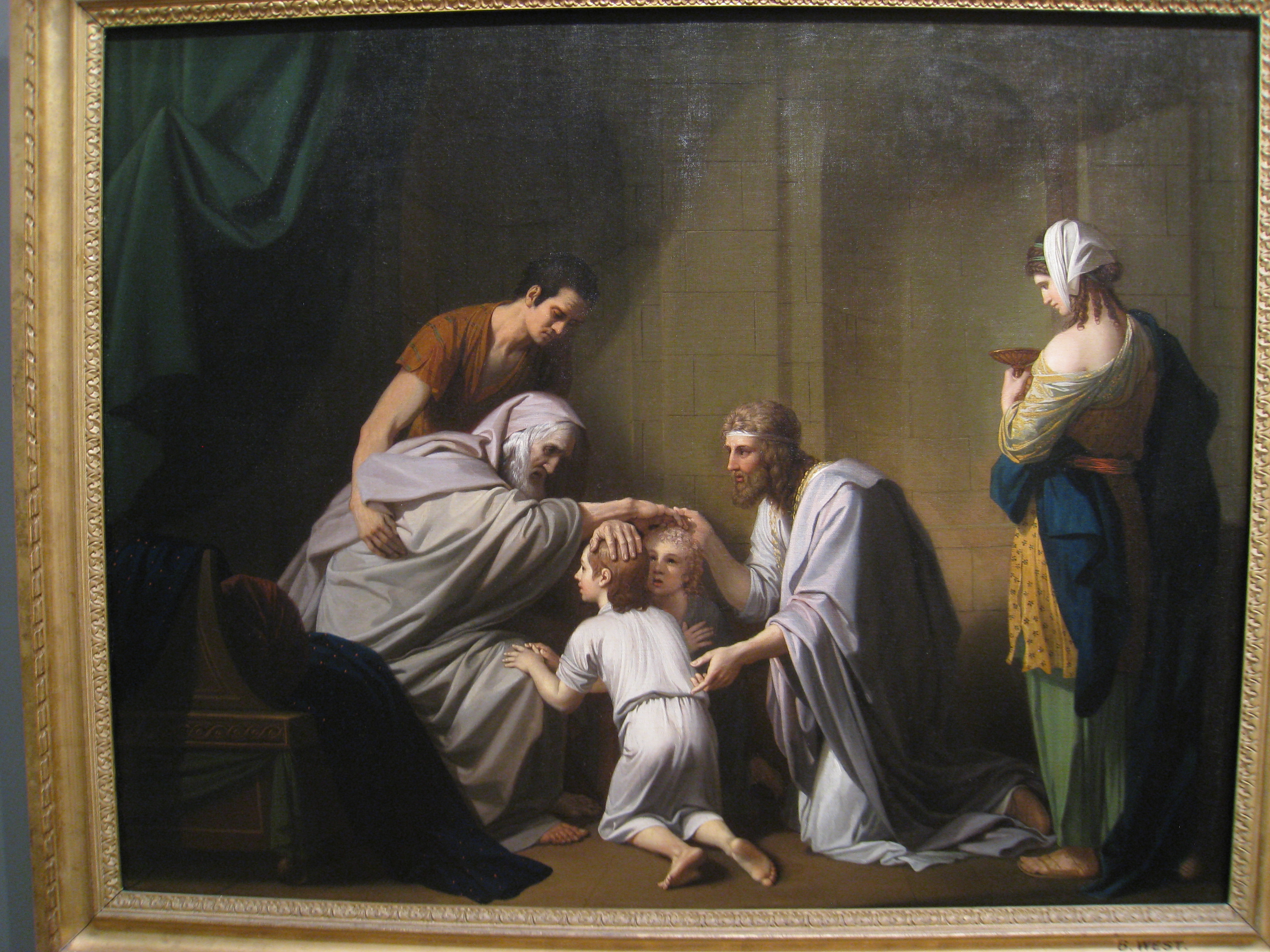
+ Jacob’s crossed blessing – Joseph moved the boys, who were at their grandfather’s knees, and he bowed with his face to the ground. Then he positioned the boys in front of Jacob. With his right hand he directed Ephraim toward Jacob’s left hand, and with his left hand he put Manasseh at Jacob’s right hand. But Jacob crossed his arms as he reached out to lay his hands on the boys’ heads. He put his right hand on the head of Ephraim, though he was the younger boy, and his left hand on the head of Manasseh, though he was the firstborn. Then he blessed Joseph and said,
“May the God before whom my grandfather Abraham and my father, Isaac, walked—the God who has been my shepherd all my life, to this very day, the Angel who has redeemed me from all harm—may he bless these boys. May they preserve my name and the names of Abraham and Isaac. And may their descendants multiply greatly throughout the earth.”
But Joseph was upset when he saw that his father placed his right hand on Ephraim’s head. So Joseph lifted it to move it from Ephraim’s head to Manasseh’s head. “No, my father,” he said. “This one is the firstborn. Put your right hand on his head.”
But his father refused. “I know, my son; I know,” he replied. “Manasseh will also become a great people, but his younger brother will become even greater. And his descendants will become a multitude of nations.”
+ Jacob’s blessing unchanged– So Jacob blessed the boys that day with this blessing: “The people of Israel will use your names when they give a blessing. They will say, ‘May God make you as prosperous as Ephraim and Manasseh.’” In this way, Jacob put Ephraim ahead of Manasseh.
Then Jacob said to Joseph, “Look, I am about to die, but God will be with you and will take you back to Canaan, the land of your ancestors. And beyond what I have given your brothers, I am giving you an extra portion of the land that I took from the Amorites with my sword and bow.”
Jacob’s Last Words to His Sons
Genesis 49 (NLT)
+ Jacob’s prophetic word – Then Jacob called together all his sons and said, “Gather around me, and I will tell you what will happen to each of you in the days to come.
“Come and listen, you sons of Jacob; listen to Israel, your father.
+ “Reuben, you are my firstborn, my strength, the child of my vigorous youth. You are first in rank and first in power. But you are as unruly as a flood, and you will be first no longer. For you went to bed with my wife; you defiled my marriage couch.
+ “Simeon and Levi are two of a kind; their weapons are instruments of violence. May I never join in their meetings; may I never be a party to their plans. For in their anger they murdered men, and they crippled oxen just for sport. A curse on their anger, for it is fierce; a curse on their wrath, for it is cruel. I will scatter them among the descendants of Jacob; I will disperse them throughout Israel.
+ “Judah, your brothers will praise you. You will grasp your enemies by the neck. All your relatives will bow before you. Judah, my son, is a young lion that has finished eating its prey. Like a lion he crouches and lies down; like a lioness—who dares to rouse him? The scepter will not depart from Judah, nor the ruler’s staff from his descendants, until the coming of the one to whom it belongs, the one whom all nations will honor. He ties his foal to a grapevine, the colt of his donkey to a choice vine. He washes his clothes in wine, his robes in the blood of grapes. His eyes are darker than wine, and his teeth are whiter than milk.
+ “Zebulun will settle by the seashore and will be a harbor for ships; his borders will extend to Sidon.
+ “Issachar is a sturdy donkey, resting between two saddlepacks. When he sees how good the countryside is and how pleasant the land, he will bend his shoulder to the load and submit himself to hard labor.
+ “Dan will govern his people, like any other tribe in Israel. Dan will be a snake beside the road, a poisonous viper along the path that bites the horse’s hooves so its rider is thrown off. I trust in you for salvation, O Lord!
+ “Gad will be attacked by marauding bands, but he will attack them when they retreat.
+ “Asher will dine on rich foods and produce food fit for kings.
+ “Naphtali is a doe set free that bears beautiful fawns.
+ “Joseph is the foal of a wild donkey, the foal of a wild donkey at a spring—one of the wild donkeys on the ridge. Archers attacked him savagely; they shot at him and harassed him. But his bow remained taut, and his arms were strengthened by the hands of the Mighty One of Jacob, by the Shepherd, the Rock of Israel. May the God of your father help you; may the Almighty bless you with the blessings of the heavens above, and blessings of the watery depths below, and blessings of the breasts and womb. May my fatherly blessings on you surpass the blessings of my ancestors, reaching to the heights of the eternal hills. May these blessings rest on the head of Joseph, who is a prince among his brothers.
+ “Benjamin is a ravenous wolf, devouring his enemies in the morning and dividing his plunder in the evening.”
These are the twelve tribes of Israel, and this is what their father said as he told his sons good-bye. He blessed each one with an appropriate message.
Jacob’s Death and Burial
Then Jacob instructed them, “Soon I will die and join my ancestors. Bury me with my father and grandfather in the cave in the field of Ephron the Hittite. This is the cave in the field of Machpelah, near Mamre in Canaan, that Abraham bought from Ephron the Hittite as a permanent burial site. There Abraham and his wife Sarah are buried. There Isaac and his wife, Rebekah, are buried. And there I buried Leah. It is the plot of land and the cave that my grandfather Abraham bought from the Hittites.”
When Jacob had finished this charge to his sons, he drew his feet into the bed, breathed his last, and joined his ancestors in death.
Genesis 50 (NLT)
+ Jacob mourned in Egypt – Joseph threw himself on his father and wept over him and kissed him. Then Joseph told the physicians who served him to embalm his father’s body; so Jacob was embalmed. The embalming process took the usual forty days. And the Egyptians mourned his death for seventy days.
When the period of mourning was over, Joseph approached Pharaoh’s advisers and said, “Please do me this favor and speak to Pharaoh on my behalf. Tell him that my father made me swear an oath. He said to me, ‘Listen, I am about to die. Take my body back to the land of Canaan, and bury me in the tomb I prepared for myself.’ So please allow me to go and bury my father. After his burial, I will return without delay.”
+ Jacob’s cortège – Pharaoh agreed to Joseph’s request. “Go and bury your father, as he made you promise,” he said. So Joseph went up to bury his father. He was accompanied by all of Pharaoh’s officials, all the senior members of Pharaoh’s household, and all the senior officers of Egypt. Joseph also took his entire household and his brothers and their households. But they left their little children and flocks and herds in the land of Goshen. A great number of chariots and charioteers accompanied Joseph.
+ Jacob mourned in Canaan – When they arrived at the threshing floor of Atad, near the Jordan River, they held a very great and solemn memorial service, with a seven-day period of mourning for Joseph’s father. The local residents, the Canaanites, watched them mourning at the threshing floor of Atad. Then they renamed that place (which is near the Jordan) Abel-mizraim, for they said, “This is a place of deep mourning for these Egyptians.”
+ Jacob buried in Canaan – So Jacob’s sons did as he had commanded them. They carried his body to the land of Canaan and buried him in the cave in the field of Machpelah, near Mamre. This is the cave that Abraham had bought as a permanent burial site from Ephron the Hittite.
Joseph Reassures His Brothers
+ Fear – After burying Jacob, Joseph returned to Egypt with his brothers and all who had accompanied him to his father’s burial. But now that their father was dead, Joseph’s brothers became fearful. “Now Joseph will show his anger and pay us back for all the wrong we did to him,” they said.
+ Repentance – So they sent this message to Joseph: “Before your father died, he instructed us to say to you: ‘Please forgive your brothers for the great wrong they did to you—for their sin in treating you so cruelly.’ So we, the servants of the God of your father, beg you to forgive our sin.” When Joseph received the message, he broke down and wept. Then his brothers came and threw themselves down before Joseph. “Look, we are your slaves!” they said.
+ God used it for good – But Joseph replied, “Don’t be afraid of me. Am I God, that I can punish you? You intended to harm me, but God intended it all for good. He brought me to this position so I could save the lives of many people. No, don’t be afraid. I will continue to take care of you and your children.” So he reassured them by speaking kindly to them.
The Death of Joseph
So Joseph and his brothers and their families continued to live in Egypt. Joseph lived to the age of 110. He lived to see three generations of descendants of his son Ephraim, and he lived to see the birth of the children of Manasseh’s son Makir, whom he claimed as his own.
+ God will lead you out of Egypt – “Soon I will die,” Joseph told his brothers, “but God will surely come to help you and lead you out of this land of Egypt. He will bring you back to the land he solemnly promised to give to Abraham, to Isaac, and to Jacob.”
+ Take my remains with you – Then Joseph made the sons of Israel swear an oath, and he said, “When God comes to help you and lead you back, you must take my bones with you.” So Joseph died at the age of 110. The Egyptians embalmed him, and his body was placed in a coffin in Egypt.
__________
May the peace of the Lord Christ go with you, wherever He may send you. May He guide you through the wilderness, protect you through the storm. May He bring you home rejoicing at the wonders He has shown you. May He bring you home rejoicing once again into our doors.
__________
+ In the name of the Father, and the Son, and the Holy Spirit. Amen!
+ In the name of the Father, and the Son, and the Holy Spirit. Amen!
Opening
“Rejoice, O people of Zion! Shout in triumph, O people of Jerusalem! Look, your king is coming to you. He is righteous and victorious, yet he is humble, riding on a donkey—riding on a donkey’s colt.” (Zechariah 9:9)
Blessed is he who comes in the name of the Lord; peace in heaven; glory in the highest heavens.
__________
“Hosanna” – Hillsong
__________
Gospel Reading: Mark 11:1-11 (NLT)
As Jesus and his disciples approached Jerusalem, they came to the towns of Bethphage and Bethany on the Mount of Olives. Jesus sent two of them on ahead. “Go into that village over there,” he told them. “As soon as you enter it, you will see a young donkey tied there that no one has ever ridden. Untie it and bring it here. If anyone asks, ‘What are you doing?’ just say, ‘The Lord needs it and will return it soon.’”
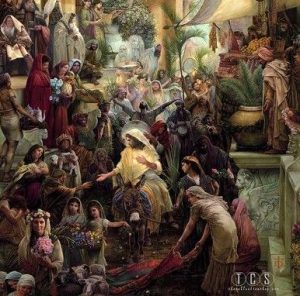
The two disciples left and found the colt standing in the street, tied outside the front door. As they were untying it, some bystanders demanded, “What are you doing, untying that colt?” They said what Jesus had told them to say, and they were permitted to take it. Then they brought the colt to Jesus and threw their garments over it, and he sat on it.
Many in the crowd spread their garments on the road ahead of him, and others spread leafy branches they had cut in the fields. Jesus was in the center of the procession, and the people all around him were shouting,
“Praise God! Blessings on the one who comes in the name of the Lord! Blessings on the coming Kingdom of our ancestor David! Praise God in highest heaven!”
So Jesus came to Jerusalem and went into the Temple. After looking around carefully at everything, he left because it was late in the afternoon. Then he returned to Bethany with the twelve disciples.
Gospel Reading: Mark 15:1-39 (NLT)
Very early in the morning the leading priests, the elders, and the teachers of religious law—the entire high council—met to discuss their next step. They bound Jesus, led him away, and took him to Pilate, the Roman governor.
Pilate asked Jesus, “Are you the king of the Jews?”
Jesus replied, “You have said it.”
Then the leading priests kept accusing him of many crimes, and Pilate asked him, “Aren’t you going to answer them? What about all these charges they are bringing against you?” But Jesus said nothing, much to Pilate’s surprise.
Now it was the governor’s custom each year during the Passover celebration to release one prisoner—anyone the people requested. One of the prisoners at that time was Barabbas, a revolutionary who had committed murder in an uprising. The crowd went to Pilate and asked him to release a prisoner as usual.
“Would you like me to release to you this ‘King of the Jews’?” Pilate asked. (For he realized by now that the leading priests had arrested Jesus out of envy.) But at this point the leading priests stirred up the crowd to demand the release of Barabbas instead of Jesus. Pilate asked them, “Then what should I do with this man you call the king of the Jews?”
They shouted back, “Crucify him!”
“Why?” Pilate demanded. “What crime has he committed?”
But the mob roared even louder, “Crucify him!”
So to pacify the crowd, Pilate released Barabbas to them. He ordered Jesus flogged with a lead-tipped whip, then turned him over to the Roman soldiers to be crucified.
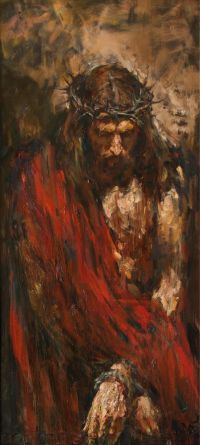
The soldiers took Jesus into the courtyard of the governor’s headquarters (called the Praetorium) and called out the entire regiment. They dressed him in a purple robe, and they wove thorn branches into a crown and put it on his head. Then they saluted him and taunted, “Hail! King of the Jews!” And they struck him on the head with a reed stick, spit on him, and dropped to their knees in mock worship. When they were finally tired of mocking him, they took off the purple robe and put his own clothes on him again. Then they led him away to be crucified.
A passerby named Simon, who was from Cyrene, was coming in from the countryside just then, and the soldiers forced him to carry Jesus’ cross. (Simon was the father of Alexander and Rufus.) And they brought Jesus to a place called Golgotha (which means “Place of the Skull”). They offered him wine drugged with myrrh, but he refused it.
Then the soldiers nailed him to the cross. They divided his clothes and threw dice to decide who would get each piece. It was nine o’clock in the morning when they crucified him. A sign announced the charge against him. It read, “The King of the Jews.” Two revolutionaries were crucified with him, one on his right and one on his left.
The people passing by shouted abuse, shaking their heads in mockery. “Ha! Look at you now!” they yelled at him. “You said you were going to destroy the Temple and rebuild it in three days. Well then, save yourself and come down from the cross!”
The leading priests and teachers of religious law also mocked Jesus. “He saved others,” they scoffed, “but he can’t save himself! Let this Messiah, this King of Israel, come down from the cross so we can see it and believe him!” Even the men who were crucified with Jesus ridiculed him.
At noon, darkness fell across the whole land until three o’clock. Then at three o’clock Jesus called out with a loud voice, “Eloi, Eloi, lema sabachthani?” which means “My God, my God, why have you abandoned me?”
Some of the bystanders misunderstood and thought he was calling for the prophet Elijah. One of them ran and filled a sponge with sour wine, holding it up to him on a reed stick so he could drink. “Wait!” he said. “Let’s see whether Elijah comes to take him down!”
Then Jesus uttered another loud cry and breathed his last. And the curtain in the sanctuary of the Temple was torn in two, from top to bottom.
When the Roman officer who stood facing him saw how he had died, he exclaimed, “This man truly was the Son of God!”
__________
Prayers of Intercession:
Gracious God: As we journey this week with Christ from His joyous reception through His death and resurrection, have mercy on us and show us the way of the cross. We pray especially –
+ For the Church and its leaders around the world, that we may be strengthened to take up our cross, follow in His way, and share in His redeeming work…. Lord, have mercy
+ For our own Church family, that we may empty ourselves of pride and privilege as Christ did, serving in unselfish love…. Lord, have mercy
+ For all who are preparing for Baptism, that You will lead them through dying and rising to New Life in Christ…. Lord, have mercy.
+ For peace throughout the world and an end to violence, that we may respond to all who cry out for food, justice, dignity and peace…. Lord, have mercy.
+ For all who endure shame or threat, and for the weary and all who suffer, that we may be bearers of Your strength and hope…. Lord, have mercy.
+ For those who have died in Christ, that they may rest in Christ and be raised triumphantly into His endless glory…. Lord, have mercy.
Blessed are you, O Lord our God, who sent your Son among us to bear the pain and grief of all. Hear our prayers for all those in need in every place and give us courage and grace to follow His example of obedient love, to walk in the way of the cross, and to share in His glorious resurrection, that we may live in the power of His Spirit, now and forever. Amen.
__________
“Jesus remember me” – Taizé
__________
Blessing – Jude 24-25
“Now to him who is able to keep you from stumbling and to present you blameless before the presence of his glory with great joy, to the only God, our Savior, through Jesus Christ our Lord, be glory, majesty, dominion, and authority, before all time and now and forever. Amen.”
__________
+ In the name of the Father, and the Son, and the Holy Spirit. Amen!
One thing I have asked of the Lord, this is what I seek: that I may dwell in the house of the Lord all the days of my life; to behold the beauty of the Lord and to seek Him in His temple.
Praise to You, Lord Jesus Christ, King of endless glory.
Reading: 1 Corinthians 7-8 (NLT)
Instruction on Marriage
1 Corinthians 7 (NLT)
+ Sex in marriage – Now regarding the questions you asked in your letter. Yes, it is good to abstain from sexual relations. But because there is so much sexual immorality, each man should have his own wife, and each woman should have her own husband.
+ Mutual fulfillment – The husband should fulfill his wife’s sexual needs, and the wife should fulfill her husband’s needs. The wife gives authority over her body to her husband, and the husband gives authority over his body to his wife.
+ Mutual agreement – Do not deprive each other of sexual relations, unless you both agree to refrain from sexual intimacy for a limited time so you can give yourselves more completely to prayer. Afterward, you should come together again so that Satan won’t be able to tempt you because of your lack of self-control. I say this as a concession, not as a command. But I wish everyone were single, just as I am. Yet each person has a special gift from God, of one kind or another.
+ Singleness is not for everyone – So I say to those who aren’t married and to widows—it’s better to stay unmarried, just as I am. But if they can’t control themselves, they should go ahead and marry. It’s better to marry than to burn with lust.
+ Marriage is forever – But for those who are married, I have a command that comes not from me, but from the Lord. A wife must not leave her husband. But if she does leave him, let her remain single or else be reconciled to him. And the husband must not leave his wife.
+ Believers bring holiness to marriage – Now, I will speak to the rest of you, though I do not have a direct command from the Lord. If a fellow believer has a wife who is not a believer and she is willing to continue living with him, he must not leave her. And if a believing woman has a husband who is not a believer and he is willing to continue living with her, she must not leave him. For the believing wife brings holiness to her marriage, and the believing husband brings holiness to his marriage. Otherwise, your children would not be holy, but now they are holy. (But if the husband or wife who isn’t a believer insists on leaving, let them go. In such cases the believing husband or wife is no longer bound to the other, for God has called you to live in peace.) Don’t you wives realize that your husbands might be saved because of you? And don’t you husbands realize that your wives might be saved because of you?
+ Remain as you are – Each of you should continue to live in whatever situation the Lord has placed you, and remain as you were when God first called you. This is my rule for all the churches. For instance, a man who was circumcised before he became a believer should not try to reverse it. And the man who was uncircumcised when he became a believer should not be circumcised now. For it makes no difference whether or not a man has been circumcised. The important thing is to keep God’s commandments.
+ Remember, God paid a high price for you – Yes, each of you should remain as you were when God called you. Are you a slave? Don’t let that worry you—but if you get a chance to be free, take it. And remember, if you were a slave when the Lord called you, you are now free in the Lord. And if you were free when the Lord called you, you are now a slave of Christ. God paid a high price for you, so don’t be enslaved by the world. Each of you, dear brothers and sisters, should remain as you were when God first called you.
+ In the present crisis – Now regarding your question about the young women who are not yet married. I do not have a command from the Lord for them. But the Lord in his mercy has given me wisdom that can be trusted, and I will share it with you. Because of the present crisis, I think it is best to remain as you are. If you have a wife, do not seek to end the marriage. If you do not have a wife, do not seek to get married. But if you do get married, it is not a sin. And if a young woman gets married, it is not a sin. However, those who get married at this time will have troubles, and I am trying to spare you those problems.
+ The remaining time is short – But let me say this, dear brothers and sisters: The time that remains is very short. So from now on, those with wives should not focus only on their marriage. Those who weep or who rejoice or who buy things should not be absorbed by their weeping or their joy or their possessions. Those who use the things of the world should not become attached to them. For this world as we know it will soon pass away.
+ The freedom to serve God – I want you to be free from the concerns of this life. An unmarried man can spend his time doing the Lord’s work and thinking how to please him. But a married man has to think about his earthly responsibilities and how to please his wife. His interests are divided. In the same way, a woman who is no longer married or has never been married can be devoted to the Lord and holy in body and in spirit. But a married woman has to think about her earthly responsibilities and how to please her husband. I am saying this for your benefit, not to place restrictions on you. I want you to do whatever will help you serve the Lord best, with as few distractions as possible.
+ Passion management– But if a man thinks that he’s treating his fiancée improperly and will inevitably give in to his passion, let him marry her as he wishes. It is not a sin. But if he has decided firmly not to marry and there is no urgency and he can control his passion, he does well not to marry. So the person who marries his fiancée does well, and the person who doesn’t marry does even better.
A wife is bound to her husband as long as he lives. If her husband dies, she is free to marry anyone she wishes, but only if he loves the Lord. But in my opinion it would be better for her to stay single, and I think I am giving you counsel from God’s Spirit when I say this.
Food Sacrificed to Idols
1 Corinthians 8 (NLT)
+ Love strengthens the church – Now regarding your question about food that has been offered to idols. Yes, we know that “we all have knowledge” about this issue. But while knowledge makes us feel important, it is love that strengthens the church. Anyone who claims to know all the answers doesn’t really know very much. But the person who loves God is the one whom God recognizes.
+ There is only one God – So, what about eating meat that has been offered to idols? Well, we all know that an idol is not really a god and that there is only one God. There may be so-called gods both in heaven and on earth, and some people actually worship many gods and many lords. But for us,
There is one God, the Father, by whom all things were created, and for whom we live. And there is one Lord, Jesus Christ, through whom all things were created, and through whom we live.
+ We can’t win God’s approval – However, not all believers know this. Some are accustomed to thinking of idols as being real, so when they eat food that has been offered to idols, they think of it as the worship of real gods, and their weak consciences are violated. It’s true that we can’t win God’s approval by what we eat. We don’t lose anything if we don’t eat it, and we don’t gain anything if we do.
+ But we can accommodate other believers – But you must be careful so that your freedom does not cause others with a weaker conscience to stumble. For if others see you—with your “superior knowledge”—eating in the temple of an idol, won’t they be encouraged to violate their conscience by eating food that has been offered to an idol? So because of your superior knowledge, a weak believer for whom Christ died will be destroyed. And when you sin against other believers by encouraging them to do something they believe is wrong, you are sinning against Christ. So if what I eat causes another believer to sin, I will never eat meat again as long as I live—for I don’t want to cause another believer to stumble.
__________
May the peace of the Lord Christ go with you, wherever He may send you. May He guide you through the wilderness, protect you through the storm. May He bring you home rejoicing at the wonders He has shown you. May He bring you home rejoicing once again into our doors.
__________
+ In the name of the Father, and the Son, and the Holy Spirit. Amen!

_(14761939436).jpg) + The godless are hopeless – “May my enemy be punished like the wicked, my adversary like those who do evil. For what hope do the godless have when God cuts them off and takes away their life? Will God listen to their cry when trouble comes upon them? Can they take delight in the Almighty? Can they call to God at any time? I will teach you about God’s power. I will not conceal anything concerning the Almighty. But you have seen all this, yet you say all these useless things to me.
+ The godless are hopeless – “May my enemy be punished like the wicked, my adversary like those who do evil. For what hope do the godless have when God cuts them off and takes away their life? Will God listen to their cry when trouble comes upon them? Can they take delight in the Almighty? Can they call to God at any time? I will teach you about God’s power. I will not conceal anything concerning the Almighty. But you have seen all this, yet you say all these useless things to me. + People don’t know where to find wisdom – “But do people know where to find wisdom? Where can they find understanding? It is hidden from the eyes of all humanity. Even the sharp-eyed birds in the sky cannot discover it. Destruction and Death say, ‘We’ve heard only rumors of where wisdom can be found.’








 The Peanut Gallery