“If Christ Is Not Raised” by Jeff Robinson – Re-blog The Gospel Coalition

If Christ Is Not Raised
by Jeff Robinson / The Gospel Coalitionsee original

emptytomb_351_285_90

As Christians who exult in the evangel, the good news of God’s redeeming love for sinners, we rightly cherish above all else the cross of Jesus Christ. Good Friday services are among the most glorious of our annual gatherings as we reflect upon that sacrifice. We delight to read and pray and sing and preach of its cosmos-shaking significance for the sons of Adam and its comprehensive liberation of a creation that has been subjected to futility.

It is beyond comprehension: Jesus died in our place. He took upon himself the Father’s wrath, which we richly deserved to bear. He kept the law of God perfectly and laid down his life voluntarily, the innocent man serving the death sentence of the criminals. By faith in the Christ who hung on that judgment tree we are declared righteous. Not guilty. Price paid. Finished. God’s enemies now seated at his banquet table.

So enthralled (rightly) are we by the cross of Christ that we can, if we’re not careful, inadvertently underplay what happened on Easter—the bodily, literal resurrection of Jesus. After all, without Easter Sunday, Good Friday is just another Friday. Jesus’s resurrection that secured our resurrection (Col 2:12). We cannot rightly call the cross good news apart from Mary Magdalene’s stupefying announcement to the disciples in John 20:18: “I have seen the Lord.”

Point of Attack

Small wonder, then, the resurrection has been the focal point of attack from atheists and theological liberals throughout the history of the church.

Jesus contended with the Sadducees whose theological distinctive was to deny the resurrection of the dead. In the Enlightenment, British empiricist David Hume virtually made a career out of attacking the validity of Christ’s resurrection. Hume, the Sadducees, and the skeptics know that if one proves false the resurrection of Christ, then the Christian faith and its supernatural power collapses like a fort built from Lincoln Logs.

So what if Christ is not raised?

PILLARS to DUST

If Christ is not raised, the consequences for a fallen world are catastrophic. The apostle Paul ponders that awful possibility in 1 Corinthians 15:12-22. If the resurrection is not true, then eight pillars that uphold the Christian faith crumble to dust. Good Friday becomes the true Black Friday. If there is some other explanation for the empty tomb, then . . .

1. Not even Christ is raised. This is the first and most obvious consequence, and it is nuclear fallout. If there is no resurrection from the dead, as Hume and the Sadducees claim, then Christ’s body was eaten by dogs or taken by thieves or secretly removed by Jesus’s disciples or there exists another naturalistic explanation for the claim by hundreds to have seen the risen Lord.

2. Preaching the gospel is useless. The good news is rendered no news. Actually, it is bad news. For apart from the resurrection, Jesus has not conquered suffering, sin, or death, and the persons of this unholy trinity will forever rule the created order as our conquerors. As the implaccable lawman Barney Fife delighted to tell crowds gathered in the streets of Mayberry, there is nothing to see here.

3. Faith in Christ is worthless. Faith in a corpse buried somewhere in the Middle East will redeem no one. If Christ did not rise from the dead, then Hebrews 11 would better be dubbed the “hall of fools” instead of the hall of faith.

4. Every witness to the resurrection and all preachers of the resurrection are deluded liars. To deny the resurrection is to make liars of the apostles and of every gospel preacher to follow in their wake. They are not simply mistaken; they are peddling a whopper of a myth. Jesus, too, is a liar, for he said, “I am the resurrection and the life.”

5. Christianity is a fairy tale.
Scripture is nothing but an outdated volume of pointless history comingled with superstition and myth. Missions and evangelism are a colossal waste of time, energy, and money. We do not spend effort and resources peddling Narnia, Middle Earth, or Pinnochio, and we should not waste our time pushing this ancient tale.

6. All of humanity remains captive to sin. Paul’s words become a damning sentence for the guilty: “The wages of sin is death.” Our world remains captive to sin, still enslaved to death. And without the resurrection, Romans 8 will never come to pass.

7. Everyone who died is in hell. There remains no sacrifice for sins, if Christ is not raised. This consequence follows from the previous one and means that every human being will face the full, unmediated wrath of God for all eternity.

8. Christians are the most foolish people on earth. Paul puts it this way: “If Christ be not raised, then we are of most men to be pitied.” Indeed. This is why the world, as Paul writes in 1 Corinthians 1, sees the cross of Christ as foolishness. If every part of the gospel is not true, then we will have spent our days pursuing a God who will not benefit us beyond the grave. Not only are we objects of pity, the skeptics around us will indeed have the final laugh. Blaise Pascal’s famous “wager” will do little to soothe us in eternity, for the dice will have fallen on snake eyes, and the serpent of the paradise will have proven the victor.

RISEN INDEED

But praise be to God, Paul continues on to the good news: we know that Christ is risen from the dead, and since he has come out of the grave, death is swallowed up in victory. Every follower of Christ, when he arrives at the chilly river outside the Celestial City, can look death square in the face and say with unconscionable joy, “O death, where is your victory? Death, where is your sting?”

Good Friday and Easter Sunday are the days of all days in human history. In all our teaching, talking, and theologizing about these events, let us remember that we cannot have the one without the other. And let us rejoice that Christ the Lord is risen!
__________

Jeff Robinson (PhD, The Southern Baptist Theological Seminary) is an editor for The Gospel Coalition. He serves as senior research assistant for the Andrew Fuller Center for Baptist Studies and adjunct professor of church history at Southern Seminary. Prior to entering ministry, he spent nearly 20 years as a newspaper journalist in Georgia, North Carolina, and Kentucky, covering various beats from politics to Major League Baseball and SEC football. He is co-author with Michael Haykin of the book To the Ends of the Earth: Calvin’s Mission Vision and Legacy. Jeff and his wife, Lisa, have four children. They live in Louisville and belong to Clifton Baptist Church. You can follow him on Twitter.


The Inevitable Misery of Living for Yourself – Re-blog / The Gospel Coalition

THE INEVITABLE MISERY of LIVING for YOURSELF
by Colin Smith and Kristen Wetherell / The Gospel Coalition

[click here for original article]

One of the barriers that holds many people back from knowing, being filled with, and being controlled by the love of Christ is the idea that true happiness can only be found if I am free to live for myself.

man with mask

Living for yourself is the default option for every person. This means that unless something happens to bring about a change. we end up living for ourselves. The Bible says this quite clearly: “All seek their own interests, not those of Jesus Christ” (Phil. 2:21).

I want you to see the absolute misery of this position.

Unhappy Boss

If you live for yourself, you make yourself both the boss and the servant. You put yourself on both sides of the ledger. You are the one who is served, and you are the one who does the serving. The demands you set are the demands you must meet. The experience of the person who lives for self is like “robbing Peter to pay Paul,” and you are always in conflict.

If you live for yourself, you will be in the strange position of beating yourself up because you are unhappy. See if any of these profiles sound familiar.

The Displeased Beauty

You look in the mirror and “self the boss” is not happy because she wants to have a more pleasing image. Though she has been woven together wonderfully by God, all she sees are the imperfections of face and body. Fashion magazines are her bible, where she goes for blueprints of how a young woman is supposed to look in the eyes of a critical and materialistic world. “Self the boss” is perpetually displeased, no matter how many hours she spends at the gym, or putting on makeup, or dressing to please the world’s tastes.

So she beats up on “self the servant” for not being pretty enough. Instead of soaking in God’s truth that she is fearfully and wonderfully made, she punishes herself with lies that say no one will ever love her. She brings to mind the fear associated with rejection from ugliness. “Self the servant” had better step up and cultivate beauty, or else she will be lost forever to a world that tramples over uninteresting people.

The Disappointed Retiree

You look at your life, and “self the boss” says he should have accomplished more. When he looks back on the past decades, all he sees are broken family relationships that have yet to be mended and years of unsatisfying work. “Self the boss” accuses him of wasting time, gifts, and money trying to be someone he never did become. He asks, Did any good come from my life?

Who’s to blame? “Self the servant” gets beaten up for not measuring up. “Self the servant” turns to drinking away the memories and holes himself up in the home. “Self the servant” resolves that his life was no contribution to anyone, so there’s no use putting forth any more effort. “Self the servant” will simply put on a mask of false contentment for the rest of his days and hope no one notices he failed.

The Frantic Executive

You consider your work achievements and bank account, and “self the boss” is never pleased. Though he is a business executive whose job is to watch over the work of others, the person he most “micro-manages” is himself. Money and approval from higher-ups determines his happiness, so if either of these is lacking “self the boss” grows even more displeased, irritated with others, and fearful of failure. When the next-door neighbor pulls into the drive with a brand new car, “self the boss” says, He looks a lot better than you. Make it your aim to match him!

“Self the servant” then throws himself into his work, trying to appease “self the boss,” make more money, buy more expensive items, and earn the good glances of others. But “self the servant” is never fully satisfied because, at the end of each day, he retires to bed no happier than when he awoke.

The Concerned Parent

You look at your children, and “self the boss” sees the opportunity for academic success, good physical health, and lifelong happiness. “Self the boss” expects perfection in her ability to guide, teach, and nurture the faith of her kids. The standard for “self the boss” is to raise children who reflect positively on all the hard work she put in for so many years.

So “self the servant” cannot understand why she grows increasingly stressed when her children make poor decisions, run into troubles with other children, or struggle in their coursework. “Self the servant” cries herself to sleep at night, wondering where she went wrong in her parenting. She’s ever more fearful for the outcome of her children, because “self the servant” has determined that their success lies in her hands.

The Hardworking Christian

You consider the fruit of your life in the past year, and “self the boss” sees good things: kindness, self-control, love. He believes that all of these have come from the many mornings spent studying the Bible, from prayer, from faithfully going to church, and from spending time with other Christians. “Self the boss” reads the checklist of good works and sees it is in good shape.

So when he realizes that the fruit of humility is missing, “self the servant” beats himself up. He then tries to understand what he must do to fix the problem: Is it more prayer? More Bible reading? More confession? “Self the servant” grows discouraged that his faith is simply not strong enough.

Unrewarded Servant and an Uncrowned King

Suppose at some point, you say to yourself, This is no good, I am living for myself and I am not happy. I’m being too hard on myself. I need to lighten up and give myself a break. So that’s what you do, but here’s the problem: You are still not happy, because while “self the servant” is off the hook, “self the boss” is no longer being served!

Living for yourself is an absolute nightmare. When you lay self out as the master, you end up being crushed as the servant. Then when you lighten up as the servant, you end up being shortchanged as the master. You cannot possibly win. And all around us is a culture that says, “Live for yourself!”

The Bible tells us that Jesus came into the world so that we can live another way: “For the love of Christ controls us, because we have concluded this: that one has died for all, therefore all have died; and he died for all, that those who live might no longer live for themselves but for him who for their sake died and was raised” (2 Cor. 5:14-15).

It is dangerous to serve an unhappy boss and even more dangerous to serve an uncrowned king. Self is a pretender to the throne of God. What will happen to self and its servants when the true King returns?
__________

Colin Smith is senior pastor of The Orchard Evangelical Free Church in the northwest suburbs of Chicago and a Council Member with The Gospel Coalition. For more resources by Colin Smith visit Unlocking the Bible, where you can request a free sample of LifeKEYS Daily devotional, listen to the radio program, or browse other gospel-centered, Christ-exalting resources. You can also follow Colin on Twitter.

_____

Kristen Wetherell is a writer, speaker and the Content Manager of Unlocking the Bible. She’s married to Brad, loves exploring new places, enjoys cooking, and writes music in her spare time. Her desire is to glorify Jesus Christ and edify believers through the written Word. Connect with Kristen at her website or on Twitter @KLWetherell.

Light into Darkness – Reblog Kathleen Nielson (TGC)

Light into Darkness
by Kathleen Nielson
December 29

See original here: thegospelcoalition.org

fall_road

Good news of great joy—that’s what the angels sang. That’s what we have been celebrating. The greatest news of the greatest joy, for all people: a Savior has come, Christ the Lord. Every Christmas season the joy of this good news flows into believers’ hearts afresh—and mixes with the current set of this world’s sorrows.

It’s a recurring “sync.” Every sorrow gets updated. In light of joy, first of all sorrow’s colors show more dark and deep.
It can jar our souls to take in the juxtapositions of the biblical story: the joy of a child’s birth surrounded by the agony of many deaths . . . Mary’s song echoing round mothers’ weeping for the baby boys Herod killed . . . farther back, Moses’s birth in the midst of the babies Pharaoh killed—and then deliverance from Egypt and through the Red Sea with all those corpses little and big left behind. In our own time we know the joy of births among family and friends and famous people celebrated against the shadowy backdrop of all those babies extracted from safe warm wombs and killed, by the millions. Unrelenting updates add deeper shadows to the landscape, as our family celebrations are lit up in part by news flashes of whole families slaughtered, of other people’s family members beheaded, of whole schools of children kidnapped, abused, or murdered, of men and boys shooting each other in the cities where we live.

Joy makes sorrow stand out starkly. This is surely meant to be; we must not let the sorrow and brokenness slide by without fierce recognition. I have one sibling, an older sister, who for years has taken great joy in training and directing children’s choirs in her church—especially at Christmas time. This year as the choirs sang she sat quietly with her walker, next to her husband who lovingly cares for her as she suffers the degenerative effects of a rare brain disease. My picture of this season’s joyful celebration includes this grievous part of the scene—and the grief of it seems accentuated by the joyful songs circling round my sister in that church.

All kinds of sorrow and death, public and private, get exposed by the joy. You who are reading know. You who lost your loved one. You who lost your baby. You with dreams deferred. You whose spouse broke the vows of marriage. You who are caught in sin you hate and can’t seem to free yourself from. We all know, in one way or another.

This is why Jesus came: to shine in the darkness. This world’s been dark with sin and sorrow since the fall. We must not close our eyes and pretend it’s light, or assume that we can make it light. Joy comes in, and sorrow heaves up to meet it. Light comes in—the light of life—and death gets exposed.

But that’s not all. Of course that’s not all. “The light shines in the darkness, and the darkness has not overcome it” (John 1:5). No, the light overcomes the dark. Joy doesn’t just expose the sorrow; it pierces it through. This is the good news of great joy: the Savior of the world came to bring the light of life, and his light will dispel all the darkness forever.

How did Jesus pierce the sin and sorrow through? This is what we need to know, to think on, in order to suffer the death all around us now on the way to life and light. How? Jesus took our sin and sorrow, man of sorrows that he was, and he was pierced himself, on the cross, in our place. Light of the world by darkness slain.

It was that piercing that pierced sin and sorrow and death, finally and fatally—because the light of the world could not be overcome. The remnants of death and darkness all around us are the violent death-throes of death, a writhing for just a little while until the full light of the risen Savior appears and banishes all the darkness finally and forever. That will be the final update. The fate of death itself is written down: it will be thrown with Satan into the lake of fire for eternity (Rev. 20:7-15).

Right now, especially with Christmas light still shining, joy shows sorrow’s colors dark and deep. Let’s not close our eyes; let’s look deep and sorrow deeply, fiercely hating and battling the sin and brokenness that started with that serpent in Eden. And then let’s look at the Savior and see how bright is the light. Let’s keep singing songs of joy about the light—let’s sing loud and all together, so that our songs enfold all the present sorrow with the hope of the full light of day. Come on, children, sing of the Savior at the top of your voices, and let your songs swirl their joy all around my sister who knows that joy deep in her. Around all of us.

The light has come, and conquered. This is the good news of great joy in the midst of present sorrow and death: Jesus came, he died, he rose, he reigns, and he is coming again.
__________

Kathleen Nielson serves as director of women’s initiatives for The Gospel Coalition.

9 Things You Should Know About Independence Day and The Declaration of Independence – Reblog

Re-Blog: The Gospel CoalitionJoe Carter

July 4, 2014 [is] America’s 238th Independence Day, the day Americans celebrate our Declaration of Independence from Great Britain. Here are nine things you should know about America’s founding document and the day set aside for its commemoration.

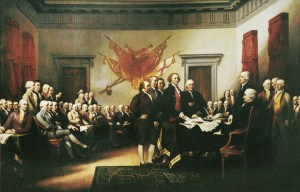
John Trumbull's famous painting is often identified as a depiction of the signing of the Declaration, but it actually shows the drafting committee presenting its work to the Congress.
John Trumbull’s famous painting is often identified as a depiction of the signing of the Declaration, but it actually shows the drafting committee presenting its work to the Congress.

1. July 4, 1776 is the day that we celebrate Independence Day even though it wasn’t the day the Continental Congress decided to declare independence (they did that on July 2, 1776), the day we started the American Revolution (that had happened back in April 1775), the date on which the Declaration was delivered to Great Britain (that didn’t happen until November 1776), or the date it was signed (that was August 2, 1776).

2. The first Independence Day was celebrated on July 8, 1776 (although the Declaration was approved on July 4, 1776, it was not made public until July 8), but for the first two decades after the Declaration was written, people didn’t celebrate it much on any date. One party, the Democratic-Republicans, admired Jefferson and the Declaration. But the other party, the Federalists, thought the Declaration was too French and too anti-British, which went against their current policies.

3. After the War of 1812, the Federalist party began to come apart and the new parties of the 1820s and 1830s all considered themselves inheritors of Jefferson and the Democratic-Republicans. Printed copies of the Declaration began to circulate again, all with the date July 4, 1776, listed at the top. Celebrations of the Fourth of July became more common as the years went on and in 1870, almost a hundred years after the Declaration was written, Congress first declared July 4 to be a national holiday as part of a bill to officially recognize several holidays, including Christmas. Further legislation about national holidays, including July 4, was passed in 1938 and 1941.

4. Benjamin Franklin, John Adams, Thomas Jefferson, Roger Sherman, and Robert R. Livingston comprised the Committee of Five that drafted the Declaration. Jefferson, regarded as the strongest and most eloquent writer, wrote most of the document. After Jefferson wrote his first draft, the other members of the Declaration committee and the Continental Congress made 86 changes, including shortening the overall length by more than a fourth and removing language condemning the British promotion of the slave trade (which Jefferson had included even though he himself was a slave owner).

5. The signed copy of the Declaration is the official, but not the original, document. The approved Declaration was printed on July 5th and a copy was attached to the “rough journal of the Continental Congress for July 4th.” These printed copies, bearing only the names of John Hancock, President, and Charles Thomson, secretary, were distributed to state assemblies, conventions, committees of safety, and commanding officers of the Continental troops. On July 19th, Congress ordered that the Declaration be engrossed on parchment with a new title, “the unanimous declaration of the thirteen united states of America,” and “that the same, when engrossed, be signed by every member of Congress.” Engrossing is the process of copying an official document in a large hand.

6. Thomas Jefferson and John Adams, the only two presidents to sign the document, both died on the Fourth of July in 1826, the fiftieth anniversary of the adoption of the Declaration. Adam’s last words have been reported as “Thomas Jefferson survives.” He did not know that Jefferson had died only a few hours before. James Monroe, the last president who was a Founding Father, also died on July 4 in 1831. Calvin Coolidge, the 30th President, was born on July 4, 1872, and, so far, is the only President to have been born on Independence Day.

7. John Hancock, the President of the Continental Congress at the time, was the first and only person to sign the Declaration on July 4, 1776 (he signed it in the presence of just one man, Charles Thomson, the secretary of Congress). According to legend, the founding father signed his name bigger than everyone else’s because he wanted to make sure “fat old King George” could read it without his spectacles. But the truth is that Hancock had a large blank space and didn’t realize the other men would write their names smaller. Today, the term “John Hancock” has become synonymous with a person’s signature.

8. The 56 signers of the Declaration did not sign on July 4, 1776, nor were they in the same room at the same time on the original Independence Day. The official signing event took place on August 2, 1776 when 50 men signed the document. Several months passed before all 56 signatures were in place. The last man to sign, Thomas McKean, did so in January of 1777, seven months after the document was approved by Congress. Robert R. Livingston, one of the five original drafters, never signed it at all since he believed it was too soon to declare independence.

9. Unlike the U.S. Constitution, which makes no reference to God, the Declaration has three references to a deity. The document also makes two references that tie natural law to God. (Although Thomas Jefferson was a Deist, as a young apprentice lawyer he had studied the work of Henry de Bracton, an English jurist and natural law proponent. Bracton has been referred to as the “father of common law” and is said to have “succeeded in formulating a truly Christian philosophy of law”).