
Morning Prayer: 28 August – Romans 9:19-29 ~ I Am Who I Am

Reading through Romans

+ In the name of the Father, and of the Son, and of the Holy Spirit. Amen.

Opening sentence

Praise to You, Lord Jesus Christ, King of endless glory. You have the words of eternal life, and we have believed and have come to know that You are the Holy One of God.
__________

A reading from Romans: Romans 9:19-29 (NLT)

Well then, you might say, “Why does God blame people for not responding? Haven’t they simply done what he makes them do?”

arguing-with-god

No, don’t say that. Who are you, a mere human being, to argue with God? Should the thing that was created say to the one who created it, “Why have you made me like this?” When a potter makes jars out of clay, doesn’t he have a right to use the same lump of clay to make one jar for decoration and another to throw garbage into? In the same way, even though God has the right to show his anger and his power, he is very patient with those on whom his anger falls, who are destined for destruction. He does this to make the riches of his glory shine even brighter on those to whom he shows mercy, who were prepared in advance for glory. And we are among those whom he selected, both from the Jews and from the Gentiles.

Concerning the Gentiles, God says in the prophecy of Hosea, “Those who were not my people, I will now call my people. And I will love those whom I did not love before.”

And, “Then, at the place where they were told, ‘You are not my people,’ there they will be called ‘children of the living God.’”

And concerning Israel, Isaiah the prophet cried out, “Though the people of Israel are as numerous as the sand of the seashore, only a remnant will be saved. For the Lord will carry out his sentence upon the earth quickly and with finality.”

And Isaiah said the same thing in another place: “If the Lord of Heaven’s Armies had not spared a few of our children, we would have been wiped out like Sodom, destroyed like Gomorrah.”
__________

Reflection: Romans 9:19-29 (John Stott, The Message of Romans: God’s Good News for the World)

The plan of God for Jews and Gentiles: (Romans 9–11)

The dominant theme [of these three chapters] is Jewish unbelief, together with the problems which it raised…. Each chapter handles a different aspect of God’s relation to Israel, past, present and future:

  1. Israel’s fall (9: 1– 33): God’s purpose of election
  2. Israel’s fault (10: 1– 21): God’s dismay over her disobedience
  3. Israel’s future (11: 1– 32): God’s long-term design
  4. Doxology (11: 33– 36): God’s wisdom and generosity

Israel’s fall: God’s purpose of election (9:1–33)

Question 3: Why does God still blame us? (19–29).

Is it fair of God to hold us accountable to him, when he makes the decisions? To this question Paul makes three responses, all of which concern who God is. Most of our problems arise and seem insoluble because our image of God is distorted.

First, God has the right of a potter over his clay (20–21).

Paul is not censuring someone who asks sincerely perplexed questions, but rather someone who ‘quarrels’ with God, who talks back (20) or answers back (RSV). Such a person manifests a reprehensible spirit of rebellion against God, a refusal to let God be God and acknowledge his or her true status as creature and sinner.

Paul’s emphasis in this paragraph is that as the potter has the right to shape his clay into vessels for different purposes, so God has the right to deal with fallen humanity according to both his wrath and his mercy, as he has argued in verses 10–18.

‘In the sovereignty here asserted,’ writes Hodge, ‘it is God as moral governor, and not God as creator, who is brought to view.’

It is nowhere suggested that God has the right to ‘create sinful beings in order to punish them’, but rather that he has the right to ‘deal with sinful beings according to his good pleasure’, either to pardon or to punish them.

Secondly, God reveals himself as he is (22– 23).

God’s freedom to show mercy to some and to harden others is fully compatible with his justice…. We must allow God to be God, not only in renouncing every presumptuous desire to challenge him (20– 21), but also in assuming that his actions are without exception in harmony with his nature. For God is always self-consistent and never self-contradictory.

It is because [God] is who he is that he does what he does. And although this does not solve the ultimate mystery why he prepares some people in advance for glory and allows others to prepare themselves for destruction, yet both are revelations of God, of his patience and wrath in judgment and above all of his glory and mercy in salvation.

Thirdly, God foretold these things in Scripture (24– 29).

By bringing the Hosea and Isaiah texts together, Paul provides Old Testament warrant for his vision. On the one hand, God has called us, he writes, not only from the Jews but also from the Gentiles (24). So there is a fundamental Jewish-Gentile solidarity in God’s new society. On the other hand, Paul is conscious of the serious imbalance between the size of the Gentile participation and the size of the Jewish participation in the redeemed community.

As Hosea prophesied, multitudes of Gentiles, formerly disenfranchised, have now been welcomed as the people of God. As Isaiah prophesied, however, the Jewish membership was only a remnant of the nation, so small in fact as to constitute not the inclusion of Israel but its exclusion, not its acceptance but its ‘rejection’ (11: 15).

Jesus himself had foretold this situation, when he said: ‘I say to you that many will come from the east and the west, and will take their places at the feast with Abraham, Isaac and Jacob in the kingdom of heaven. But the subjects of the kingdom will be thrown outside.…’
__________

The Great I Am


__________

Canticle

Christ, as a light illumine and guide me. Christ, as a shield overshadow me. Christ under me; Christ over me; Christ beside me on my left and my right. This day be within and without me, lowly and meek, yet all-powerful. Be in the heart of each to whom I speak; in the mouth of each who speaks unto me. This day be within and without me, lowly and meek, yet all-powerful. Christ as a light; Christ as a shield; Christ beside me on my left and my right.

Blessing

May the peace of the Lord Christ go with you, wherever He may send you. May He guide you through the wilderness, protect you through the storm. May He bring you home rejoicing at the wonders He has shown you. May He bring you home rejoicing once again into our doors.

+ In the name of the Father, and of the Son, and of the Holy Spirit. Amen

Morning Prayer: 27 August – Romans 9:14-18 ~ God’s justice and mercy

Reading through Romans

+ In the name of the Father, and of the Son, and of the Holy Spirit. Amen.

Opening sentence

Praise to You, Lord Jesus Christ, King of endless glory. You have the words of eternal life, and we have believed and have come to know that You are the Holy One of God.
__________

A reading from Romans: Romans 9:14-18 (NLT)

forgive

Are we saying, then, that God was unfair? Of course not! For God said to Moses, “I will show mercy to anyone I choose, and I will show compassion to anyone I choose.”

So it is God who decides to show mercy. We can neither choose it nor work for it.

For the Scriptures say that God told Pharaoh, “I have appointed you for the very purpose of displaying my power in you and to spread my fame throughout the earth.” So you see, God chooses to show mercy to some, and he chooses to harden the hearts of others so they refuse to listen.
__________

Reflection: Romans 9:14-18 (John Stott, The Message of Romans: God’s Good News for the World)

The plan of God for Jews and Gentiles: (Romans 9–11)

The dominant theme [of these three chapters] is Jewish unbelief, together with the problems which it raised…. Each chapter handles a different aspect of God’s relation to Israel, past, present and future:

  1. Israel’s fall (9: 1– 33): God’s purpose of election
  2. Israel’s fault (10: 1– 21): God’s dismay over her disobedience
  3. Israel’s future (11: 1– 32): God’s long-term design
  4. Doxology (11: 33– 36): God’s wisdom and generosity

Israel’s fall: God’s purpose of election (9:1–33)

Question 2: Is God unjust? (14–1-18).

To choose some for salvation and pass by others looks like a breach of elementary justice. Is it?

Paul’s way of defending God’s justice is to proclaim his mercy. It sounds like a complete non sequitur. But it is not. It simply indicates that the question itself is misconceived, because the basis on which God deals savingly with sinners is not justice but mercy. For salvation does not  …depend on man’s desire or effort, that is, on anything we want or strive for, but on God’s mercy.

Dr Leon Morris rightly comments: ‘Neither here nor anywhere else is God said to harden anyone who had not first hardened himself.’

God’s hardening of [Pharaoh] was a judicial act, abandoning him to his own stubbornness, much as God’s wrath against the ungodly is expressed by ‘giving them over’ to their own depravity (1: 24, 26, 28)….

God is not unjust. The fact is… that all human beings are sinful and guilty in God’s sight, so that nobody deserves to be saved. If therefore God hardens some, he is not being unjust, for that is what their sin deserves. If, on the other hand, he has compassion on some, he is not being unjust, for he is dealing with them in mercy. The wonder is not that some are saved and others not, but that anybody is saved at all. For we deserve nothing at God’s hand but judgment. If we receive what we deserve (which is judgment), or if we receive what we do not deserve (which is mercy), in neither case is God unjust.

If therefore anybody is lost, the blame is theirs, but if anybody is saved, the credit is God’s. This antinomy contains a mystery which our present knowledge cannot solve; but it is consistent with Scripture, history and experience.
__________

Have Mercy on Me

I am a sinner; You’re blameless, Lord / My sins against You can’t be ignored / They will be punished, I know they must / Your law demands it, for You are just

If You would count / Everything that I’ve done wrong / Who could stand? / But there’s forgiveness with You, God

Have mercy on me, have mercy on me / A broken and a contrite heart / You won’t turn away / Have mercy on me, have mercy on me / Because of Your steadfast love

Father of mercy, You gave Your Son / To make atonement for wrongs I have done / What You required, Jesus fulfilled / I don’t deserve it — I never will
__________

Canticle

Christ, as a light illumine and guide me. Christ, as a shield overshadow me. Christ under me; Christ over me; Christ beside me on my left and my right. This day be within and without me, lowly and meek, yet all-powerful. Be in the heart of each to whom I speak; in the mouth of each who speaks unto me. This day be within and without me, lowly and meek, yet all-powerful. Christ as a light; Christ as a shield; Christ beside me on my left and my right.

Blessing

May the peace of the Lord Christ go with you, wherever He may send you. May He guide you through the wilderness, protect you through the storm. May He bring you home rejoicing at the wonders He has shown you. May He bring you home rejoicing once again into our doors.

+ In the name of the Father, and of the Son, and of the Holy Spirit. Amen
Morning Prayer: 26 August – Romans 9:6-13 ~ the Israel within Israel

Reading through Romans

+ In the name of the Father, and of the Son, and of the Holy Spirit. Amen.

Opening sentence

Praise to You, Lord Jesus Christ, King of endless glory. You have the words of eternal life, and we have believed and have come to know that You are the Holy One of God.
__________

A reading from Romans: Romans 9:6-13 (NLT)

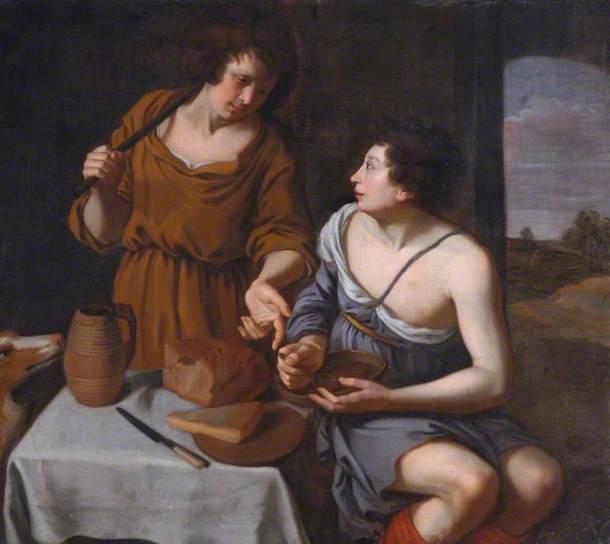
Well then, has God failed to fulfill his promise to Israel? No, for not all who are born into the nation of Israel are truly members of God’s people! Being descendants of Abraham doesn’t make them truly Abraham’s children. For the Scriptures say, “Isaac is the son through whom your descendants will be counted,” though Abraham had other children, too. This means that Abraham’s physical descendants are not necessarily children of God. Only the children of the promise are considered to be Abraham’s children. For God had promised, “I will return about this time next year, and Sarah will have a son.”

“Esau Selling His Birthright to Jacob”
by Dutch School (c.1620)
Collection: Durham University , UK

This son was our ancestor Isaac. When he married Rebekah, she gave birth to twins. But before they were born, before they had done anything good or bad, she received a message from God. (This message shows that God chooses people according to his own purposes; he calls people, but not according to their good or bad works.) She was told, “Your older son will serve your younger son.” In the words of the Scriptures, “I loved Jacob, but I rejected Esau.”
__________

Reflection: Romans 9:6-13 (John Stott, The Message of Romans: God’s Good News for the World)

The plan of God for Jews and Gentiles: (Romans 9–11)

The dominant theme [of these three chapters] is Jewish unbelief, together with the problems which it raised…. Each chapter handles a different aspect of God’s relation to Israel, past, present and future:

  1. Israel’s fall (9: 1– 33): God’s purpose of election
  2. Israel’s fault (10: 1– 21): God’s dismay over her disobedience
  3. Israel’s future (11: 1– 32): God’s long-term design
  4. Doxology (11: 33– 36): God’s wisdom and generosity

Israel’s fall: God’s purpose of election (9:1–33)

Question 1: Has God’s promise failed? (6– 13).

Israel had failed, or literally ‘fallen’. For God had promised to bless them, but they had forfeited his blessing through unbelief. Israel’s failure was her own failure, however; it was not due to the failure of God’s word. For not all who are descended from Israel are Israel (6b).

There have always been two Israels, those physically descended from Israel (Jacob) on the one hand, and his spiritual progeny on the other; and God’s promise was addressed to the latter, who had received it. The apostle has already made this distinction earlier in his letter between those who were Jews outwardly, whose circumcision was in the body, and those who were Jews inwardly, who had received a circumcision of the heart by the Spirit.
_____

Esau forfeited his birthright because of his own worldliness and lost his rightful blessing because of his brother’s deceit, so that human responsibility was interwoven with divine sovereignty in their story. We should also recall that the rejected brothers, Ishmael and Esau, were both circumcised, and therefore in some sense they too were members of God’s covenant, and were both promised lesser blessings. Nevertheless, both stories illustrate the same key truth of ‘God’s purpose according to election’. So God’s promise did not fail; but it was fulfilled only in the Israel within Israel.
__________


__________

Canticle

Christ, as a light illumine and guide me. Christ, as a shield overshadow me. Christ under me; Christ over me; Christ beside me on my left and my right. This day be within and without me, lowly and meek, yet all-powerful. Be in the heart of each to whom I speak; in the mouth of each who speaks unto me. This day be within and without me, lowly and meek, yet all-powerful. Christ as a light; Christ as a shield; Christ beside me on my left and my right.

Blessing

May the peace of the Lord Christ go with you, wherever He may send you. May He guide you through the wilderness, protect you through the storm. May He bring you home rejoicing at the wonders He has shown you. May He bring you home rejoicing once again into our doors.

+ In the name of the Father, and of the Son, and of the Holy Spirit. Amen
Morning Prayer: 25 August – Romans 9:1-5 ~ anguish for Israel

Reading through Romans

+ In the name of the Father, and of the Son, and of the Holy Spirit. Amen.

Opening sentence

Praise to You, Lord Jesus Christ, King of endless glory. You have the words of eternal life, and we have believed and have come to know that You are the Holy One of God.
__________

A reading from Romans: Romans 9:1-5 (NLT)

sadness-grief-jesus-christ

With Christ as my witness, I speak with utter truthfulness. My conscience and the Holy Spirit confirm it. My heart is filled with bitter sorrow and unending grief for my people, my Jewish brothers and sisters. I would be willing to be forever cursed — cut off from Christ! — if that would save them. They are the people of Israel, chosen to be God’s adopted children. God revealed his glory to them. He made covenants with them and gave them his law. He gave them the privilege of worshiping him and receiving his wonderful promises. Abraham, Isaac, and Jacob are their ancestors, and Christ himself was an Israelite as far as his human nature is concerned. And he is God, the one who rules over everything and is worthy of eternal praise! Amen.
__________

Reflection: Romans 9:1-5 (John Stott, The Message of Romans: God’s Good News for the World)

The plan of God for Jews and Gentiles: (Romans 9–11)

The dominant theme [of these three chapters] is Jewish unbelief, together with the problems which it raised…. Each chapter handles a different aspect of God’s relation to Israel, past, present and future:

  1. Israel’s fall (9: 1– 33): God’s purpose of election
  2. Israel’s fault (10: 1– 21): God’s dismay over her disobedience
  3. Israel’s future (11: 1– 32): God’s long-term design
  4. Doxology (11: 33– 36): God’s wisdom and generosity

Israel’s fall: God’s purpose of election (9: 1– 33)

Summary: Romans 9:1-5 – Paul begins by confessing that Jewish unbelief causes him not only anguish of heart (1– 3), but also perplexity of mind as he asks himself how the people of Israel with their eight unique privileges could have rejected their own Messiah (4– 5). How can their apostasy be explained?

Luther comments: ‘It seems incredible that a man would desire to be damned, in order that the damned might be saved.’

The privileges of Israel:

  • theirs is the adoption as sons
  • theirs is the divine glory, namely the visible splendour of God
  • theirs are the covenants… with Abraham along with its multiple renewals
  • theirs is the receiving of the law, the unique revelation of God’s will
  • theirs is the temple worship
  • theirs are the promises relating to the coming of the Messiah as God’s prophet, priest and king
  • theirs are the patriarchs, not only Abraham, Isaac and Jacob, but also the progenitors of the twelve tribes
  • from them is traced the human ancestry of Christ

Calvin justly comments: ‘If he honored the whole human race when he connected himself with it by sharing our nature, much more did he honor the Jews, with whom he desired to have a close bond of affinity.’

One would think that Israel, favored with these eight blessings, prepared and educated for centuries for the arrival of her Messiah, would recognize and welcome him when he came. How then can one reconcile Israel’s privileges with her prejudices?
__________


__________

Canticle

Christ, as a light illumine and guide me. Christ, as a shield overshadow me. Christ under me; Christ over me; Christ beside me on my left and my right. This day be within and without me, lowly and meek, yet all-powerful. Be in the heart of each to whom I speak; in the mouth of each who speaks unto me. This day be within and without me, lowly and meek, yet all-powerful. Christ as a light; Christ as a shield; Christ beside me on my left and my right.

Blessing

May the peace of the Lord Christ go with you, wherever He may send you. May He guide you through the wilderness, protect you through the storm. May He bring you home rejoicing at the wonders He has shown you. May He bring you home rejoicing once again into our doors.

+ In the name of the Father, and of the Son, and of the Holy Spirit. Amen
Morning Prayer: 24 August – Romans 8:35-39 ~ God’s love: 5 unanswerable questions (Q 5)

Reading through Romans

+ In the name of the Father, and of the Son, and of the Holy Spirit. Amen.

Opening sentence

Praise to You, Lord Jesus Christ, King of endless glory. You have the words of eternal life, and we have believed and have come to know that You are the Holy One of God.
__________

A reading from Romans: Romans 8:35-39 (NLT)

Can anything ever separate us from Christ’s love? Does it mean he no longer loves us if we have trouble or calamity, or are persecuted, or hungry, or destitute, or in danger, or threatened with death? (As the Scriptures say, “For your sake we are killed every day; we are being slaughtered like sheep.”) No, despite all these things, overwhelming victory is ours through Christ, who loved us.

And I am convinced that nothing can ever separate us from God’s love. Neither death nor life, neither angels nor demons, neither our fears for today nor our worries about tomorrow — not even the powers of hell can separate us from God’s love. No power in the sky above or in the earth below—indeed, nothing in all creation will ever be able to separate us from the love of God that is revealed in Christ Jesus our Lord.
__________

Reflection: Romans 8:35-39 (John Stott, The Message of Romoans: God’s Good News for the World)

God’s Spirit in God’s children (8:1–39)

The Christian life is essentially life in the Spirit, that is to say, a life which is animated, sustained, directed and enriched by the Holy Spirit. Without the Holy Spirit true Christian discipleship would be inconceivable, indeed impossible.

(vs 28–39) The steadfastness of God’s love

The eternal security of God’s people, on account of the eternal unchangeability of God’s purpose, …is itself due to the eternal steadfastness of God’s love.

(vs 31–39) Five unanswerable questions

Question 5: Who shall separate us from the love of Christ? (35a).

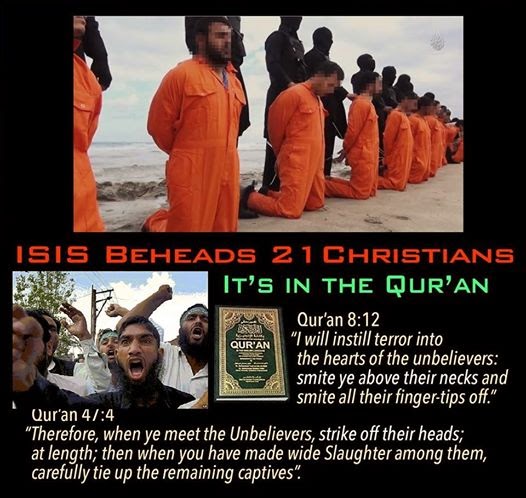
Paul brings forward a sample list of adversities and adversaries that might be thought of as coming between us and Christ’s love. He mentions seven possibilities (35b). He begins with trouble, hardship and persecution, which together seem to denote the pressures and distresses caused by an ungodly and hostile world. He goes on to famine or nakedness, the lack of adequate food and clothing…. Paul concludes his list with danger or sword, meaning perhaps the risk of death on the one hand and the experience of it on the other…. A willingness for martyrdom is certainly the final test of Christian faith and faithfulness.

ISIS Video shows 21 Egyptian Christians Beheaded by IS

Those of us who have never had to suffer physically for Christ should perhaps read verses 35–39 alongside verses 35–39 of Hebrews 11, which list unnamed people of faith who were tortured, jeered at, flogged, chained, stoned, and even sawn in half. Faced with such heroism, there is no place for glibness or complacency. Nevertheless, can pain, misery and loss separate Christ’s people from his love? No! On the contrary, far from alienating us from him, in all these things (even while we are enduring them) Paul dares to claim that we are more than conquerors. For we not only bear them with fortitude but triumph over them, and so ‘are winning a most glorious victory’ through him who loved us (37).

Everything in creation is under the control of God the Creator and of Jesus Christ the Lord. That is why nothing will be able to separate us from the love of God that is in Christ Jesus our Lord (39b).

Paul’s five questions are not arbitrary. They are all about the kind of God we believe in. Together they affirm that absolutely nothing can frustrate God’s purpose (since he is for us), or quench his generosity (since he has not spared his Son), or accuse or condemn his elect (since he has justified them through Christ), or sunder us from his love (since he has revealed it in Christ).
__________


__________

Canticle

Christ, as a light illumine and guide me. Christ, as a shield overshadow me. Christ under me; Christ over me; Christ beside me on my left and my right. This day be within and without me, lowly and meek, yet all-powerful. Be in the heart of each to whom I speak; in the mouth of each who speaks unto me. This day be within and without me, lowly and meek, yet all-powerful. Christ as a light; Christ as a shield; Christ beside me on my left and my right.

Blessing

May the peace of the Lord Christ go with you, wherever He may send you. May He guide you through the wilderness, protect you through the storm. May He bring you home rejoicing at the wonders He has shown you. May He bring you home rejoicing once again into our doors.

+ In the name of the Father, and of the Son, and of the Holy Spirit. Amen