+ In the name of the Father, and of the Son, and of the Holy Spirit. Amen.
Opening sentence
Praise to You, Lord Jesus Christ, King of endless glory. You have the words of eternal life, and we have believed and have come to know that You are the Holy One of God.
__________
A reading from Romans: Romans 6:15-16 (NLT)
Well then, since God’s grace has set us free from the law, does that mean we can go on sinning? Of course not! Don’t you realize that you become the slave of whatever you choose to obey? You can be a slave to sin, which leads to death, or you can choose to obey God, which leads to righteous living.
__________
God’s grace not only forgives sins, but also delivers us from sinning. For grace does more than justify: it also sanctifies. It unites us to Christ (1– 14), and it initiates us into a new slavery to righteousness (15– 23).
b. Enslaved to God, or understanding our conversion (15–23)
What Paul does in the second half of Romans 6 is to draw out the logic of our conversion, as in the first half he has drawn out the logic of our baptism…. Since through baptism we were united to Christ, and in consequence are dead to sin and alive to God, how can we possibly live in sin? Since through conversion we offered ourselves to God to be his slaves, and in consequence are committed to obedience, how can we possibly claim freedom to sin?
(vs 16) The principle: self-surrender leads to slavery
Self-surrender leads inevitably to slavery, whether we thus become slaves to sin, which leads to death, or to obedience, which leads to righteousness (16b)….
Conversion is an act of self-surrender; self-surrender leads inevitably to slavery; and slavery demands a total, radical, exclusive obedience. For no-one can be the slave of two masters, as Jesus said.
Once we have offered ourselves to him as his slaves, we are permanently and unconditionally at his disposal. There is no possibility of going back on this. Having chosen our master, we have no further choice but to obey him.
__________
__________
Canticle
Christ, as a light illumine and guide me. Christ, as a shield overshadow me. Christ under me; Christ over me; Christ beside me on my left and my right. This day be within and without me, lowly and meek, yet all-powerful. Be in the heart of each to whom I speak; in the mouth of each who speaks unto me. This day be within and without me, lowly and meek, yet all-powerful. Christ as a light; Christ as a shield; Christ beside me on my left and my right.
Blessing
May the peace of the Lord Christ go with you, wherever He may send you. May He guide you through the wilderness, protect you through the storm. May He bring you home rejoicing at the wonders He has shown you. May He bring you home rejoicing once again into our doors.
+ In the name of the Father, and of the Son, and of the Holy Spirit. Amen
+ In the name of the Father, and of the Son, and of the Holy Spirit. Amen.
Opening sentence
Praise to You, Lord Jesus Christ, King of endless glory. You have the words of eternal life, and we have believed and have come to know that You are the Holy One of God.
__________
A reading from Romans: Romans 6:14 (NLT)
Sin is no longer your master, for you no longer live under the requirements of the law. Instead, you live under the freedom of God’s grace.
__________
God’s grace not only forgives sins, but also delivers us from sinning. For grace does more than justify: it also sanctifies. It unites us to Christ (1– 14), and it initiates us into a new slavery to righteousness (15– 23).
a. United to Christ – understanding our baptism (1–14)
(vs 14) Sin will not be our master
Law and grace are the opposing principles of the old and the new orders, of Adam and of Christ. To be under law is to accept the obligation to keep it and so to come under its curse or condemnation. To be under grace is to acknowledge our dependence on the work of Christ for salvation, and so to be justified rather than condemned, and thus set free.
For ‘those who know themselves freed from condemnation are free to resist sin’s usurped power with new strength and boldness’. Grace lays upon us the responsibility of holiness.
This was William Tyndale’s thought concluding his Prologue on … Romans (1526):
Now go to, reader … Remember that Christ made not this atonement, that thou shouldest anger God again; neither died he for thy sins, that thou shouldest live still in them; neither cleansed he thee, that thou shouldest return (as a swine) unto thine old puddle again; but that thou shouldest be a new creature and live a new life after the will of God and not of the flesh.
__________
__________
Canticle
Christ, as a light illumine and guide me. Christ, as a shield overshadow me. Christ under me; Christ over me; Christ beside me on my left and my right. This day be within and without me, lowly and meek, yet all-powerful. Be in the heart of each to whom I speak; in the mouth of each who speaks unto me. This day be within and without me, lowly and meek, yet all-powerful. Christ as a light; Christ as a shield; Christ beside me on my left and my right.
Blessing
May the peace of the Lord Christ go with you, wherever He may send you. May He guide you through the wilderness, protect you through the storm. May He bring you home rejoicing at the wonders He has shown you. May He bring you home rejoicing once again into our doors.
+ In the name of the Father, and of the Son, and of the Holy Spirit. Amen
+ In the name of the Father, and of the Son, and of the Holy Spirit. Amen.
Opening sentence
Praise to You, Lord Jesus Christ, King of endless glory. You have the words of eternal life, and we have believed and have come to know that You are the Holy One of God.
__________
A reading from Romans: Romans 6:12-13 (NLT)
Do not let sin control the way you live; do not give in to sinful desires. Do not let any part of your body become an instrument of evil to serve sin. Instead, give yourselves completely to God, for you were dead, but now you have new life. So use your whole body as an instrument to do what is right for the glory of God.
__________
God’s grace not only forgives sins, but also delivers us from sinning. For grace does more than justify: it also sanctifies. It unites us to Christ (1– 14), and it initiates us into a new slavery to righteousness (15– 23).
a. United to Christ – understanding our baptism (1–14)
(vs 12-13) We must therefore offer ourselves to God
Paul calls us to rise up in rebellion against sin. ‘Precisely because we are “free from sin”, we have to fight against it….’
Instead of giving in to sin, letting it rule over our bodies and surrendering them to its service, Paul now exhorts us to the positive alternative: rather offer yourselves to God (13b). The command not to offer ourselves to sin… indicates that we must not go on doing it. The exhortation to offer ourselves to God… may not be a call for a once-for-all surrender, but it at least suggests ‘deliberate and decisive commitment’.
As with the negative prohibitions, so with the positive commands, Paul looks beyond a general self-offering to the presentation of the parts (again both members and faculties) of our bodies to God, this time as instruments (or weapons) of righteousness (13c). And the ground on which these exhortations are based is that we have been brought from death to life (13b). The logic is clear. Since we have died to sin, it is inconceivable that we should let sin reign in us or offer ourselves to it. Since we are alive to God, it is only appropriate that we should offer ourselves and our faculties to him.
This theme of life and death, or rather death and life, runs right through this section. Christ died and rose. We have died and risen with him. We must therefore regard ourselves as dead to sin and alive to God. And, as those who are alive from death, we must offer ourselves to his service.
__________
Prayer of St. Francis
__________
Canticle
Christ, as a light illumine and guide me. Christ, as a shield overshadow me. Christ under me; Christ over me; Christ beside me on my left and my right. This day be within and without me, lowly and meek, yet all-powerful. Be in the heart of each to whom I speak; in the mouth of each who speaks unto me. This day be within and without me, lowly and meek, yet all-powerful. Christ as a light; Christ as a shield; Christ beside me on my left and my right.
Blessing
May the peace of the Lord Christ go with you, wherever He may send you. May He guide you through the wilderness, protect you through the storm. May He bring you home rejoicing at the wonders He has shown you. May He bring you home rejoicing once again into our doors.
+ In the name of the Father, and of the Son, and of the Holy Spirit. Amen
+ In the name of the Father, and of the Son, and of the Holy Spirit. Amen.
Opening sentence
Praise to You, Lord Jesus Christ, King of endless glory. You have the words of eternal life, and we have believed and have come to know that You are the Holy One of God.
__________
A reading from Romans: Romans 6:6-11 (NLT)
We know that our old sinful selves were crucified with Christ so that sin might lose its power in our lives. We are no longer slaves to sin. For when we died with Christ we were set free from the power of sin.
And since we died with Christ, we know we will also live with him. We are sure of this because Christ was raised from the dead, and he will never die again. Death no longer has any power over him. When he died, he died once to break the power of sin. But now that he lives, he lives for the glory of God.
So you also should consider yourselves to be dead to the power of sin and alive to God through Christ Jesus.
__________
God’s grace not only forgives sins, but also delivers us from sinning. For grace does more than justify: it also sanctifies. It unites us to Christ (1– 14), and it initiates us into a new slavery to righteousness (15– 23).
a. United to Christ – understanding our baptism (1–14)
(vs 6-7) Our former self was crucified with Christ in order that we might be freed from sin’s slavery.
The New Testament speaks of crucifixion in relation to holiness in two distinct ways. The first is our death to sin through identification with Christ; the second is our death to self through imitation of Christ. On the one hand, we have been crucified with Christ. But on the other we have crucified (decisively repudiated ) our sinful nature with all its desires, so that every day we renew this attitude by taking up our cross and following Christ to crucifixion.
We deserved to die for our sins. And in fact we did die, though not in our own person, but in the person of Jesus Christ our substitute, who died in our place, and with whom we have been united by faith and baptism. And by union with the same Christ we have risen again. So the old life of sin is finished, because we died to it, and the new life of justified sinners has begun. Our death and resurrection with Christ render it inconceivable that we should go back. It is in this sense that our sinful self has been deprived of power and we have been set free.
(vs 8-10) Both the death and the resurrection of Jesus were decisive events: he died to sin once for all, but he lives continuously unto God.
The guarantee of the continuing nature of our new life, beginning now and lasting for ever, is to be found in Christ’s resurrection…. Death no longer has mastery over him (9b). Having been delivered from its tyranny, he has passed beyond its jurisdiction for ever. As the glorified Lord himself declares: ‘I am the Living One; I was dead, and behold I am alive for ever and ever!’
Our Christian discipleship, which, by our union with Christ, begins with a once-for-all death to sin… continues with an unending life of service to God.
(vs 11) We must realize that we are now what Christ is, namely ‘dead to sin but alive to God’.
The major secret of holy living is in the mind. It is in knowing (6) that our former self was crucified with Christ, in knowing (3) that baptism into Christ is baptism into his death and resurrection, and in considering (11, RSV) that through Christ we are dead to sin and alive to God.
We are to recall, to ponder, to grasp, to register these truths until they are so integral to our mindset that a return to the old life is unthinkable…. For our union with Jesus Christ has severed us from the old life and committed us to the new. Our baptism stands between the two like a door between two rooms, closing on the one and opening into the other. We have died, and we have risen. How can we possibly live again in what we have died to?
__________
Come Alive (Dry Bones)
Through the eyes of men it seems / There’s so much we have lost / As we look down the road / Where all the prodigals have walked / And one by one / The enemy has whispered lies / And led them off as slaves
But we know that you are God / Yours is the victory / We know there is more to come / That we may not yet see / So with the faith you’ve given us / We’ll step into the valley unafraid, yeah
As we call out to dry bones / Come alive, come alive / And we call out to dead hearts / Come alive, come alive / Up out of the ashes / Let us see an army rise / We call out to dry bones, come alive
Oh God of endless mercy / God of unrelenting love / Rescue every daughter / Bring us back the wayward son / By your spirit breathe upon them / And show that you alone can save / You alone can save
As we call out to dry bones / Come alive, come alive / And we call out to dead hearts / Come alive, come alive / Come up out of the ashes / Let us see an army rise / We call out to dry bones come alive
So breathe, oh breath of God / Now breathe, oh breath of God / Breathe, oh breath of God / Now breathe / Breathe, oh breath of God / Now breathe, oh breath of God / Breathe, oh breath of God, now breathe
As we call out to dry bones / Come alive, come alive / And we call out to dead hearts / Come alive, come alive / Come up out of the ashes / Let us see an army rise / We call out to dry bones come alive, yeah / We call out to dry bones, come alive
__________
Canticle
Christ, as a light illumine and guide me. Christ, as a shield overshadow me. Christ under me; Christ over me; Christ beside me on my left and my right. This day be within and without me, lowly and meek, yet all-powerful. Be in the heart of each to whom I speak; in the mouth of each who speaks unto me. This day be within and without me, lowly and meek, yet all-powerful. Christ as a light; Christ as a shield; Christ beside me on my left and my right.
Blessing
May the peace of the Lord Christ go with you, wherever He may send you. May He guide you through the wilderness, protect you through the storm. May He bring you home rejoicing at the wonders He has shown you. May He bring you home rejoicing once again into our doors.
+ In the name of the Father, and of the Son, and of the Holy Spirit. Amen
+ In the name of the Father, and of the Son, and of the Holy Spirit. Amen.
Opening sentence
Praise to You, Lord Jesus Christ, King of endless glory. You have the words of eternal life, and we have believed and have come to know that You are the Holy One of God.
__________
A reading from Romans: Romans 6:1-5 (NLT)
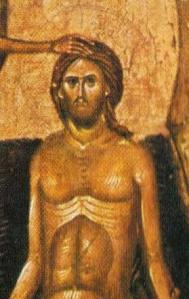
icon – Christ being baptized.
Well then, should we keep on sinning so that God can show us more and more of his wonderful grace? Of course not! Since we have died to sin, how can we continue to live in it? Or have you forgotten that when we were joined with Christ Jesus in baptism, we joined him in his death? For we died and were buried with Christ by baptism. And just as Christ was raised from the dead by the glorious power of the Father, now we also may live new lives.
Since we have been united with him in his death, we will also be raised to life as he was.
__________
Paul’s answer to his critics is that God’s grace not only forgives sins, but also delivers us from sinning. For grace does more than justify: it also sanctifies. It unites us to Christ (1– 14), and it initiates us into a new slavery to righteousness (15– 23).
a. United to Christ, or the logic of our baptism (1– 14)
(vs 2) We died to sin. This is the foundation fact of Paul’s thesis. How can we live in what we have died to?
What is true of Christ is equally true of Christians who are united to Christ. We too have ‘died to sin’, in the sense that through union with Christ we may be said to have borne its penalty…. The New Testament tells us not only that Christ died instead of us, as our substitute, so that we will never need to die for our sins, but also that he died for us, as our representative, so that we may be said to have died in and through him…. That is, by being united to him, his death became our death.
(vs 3) The way in which we have died to sin is that our baptism united us with Christ in his death.
Baptism signifies our union with Christ, especially with Christ crucified and risen…. So union with Christ by faith, which is invisibly effected by the Holy Spirit, is visibly signified and sealed by baptism. The essential point Paul is making is that being a Christian involves a personal, vital identification with Jesus Christ, and that this union with him is dramatically set forth in our baptism.
(vs 4-5) Having shared in Christ’s death, God wants us also to share in his resurrection life.
These verses allude to the pictorial symbolism of baptism…. Sanday and Headlam put it graphically: ‘That plunge beneath the running waters was like a death; the moment’s pause while they swept on overhead was like a burial ; the standing erect once more in air and sunlight was a species of resurrection.’ It is far from certain whether the first baptisms were by total immersion… but the symbolic truth of dying to the old life and rising to the new remains, whatever mode of baptism is used.
‘In other words,’ wrote C. J. Vaughan, ‘our baptism was a sort of funeral.’ A funeral, yes, and a resurrection from the grave as well. For by faith inwardly and baptism outwardly we have been united with Christ in his death and resurrection, and have thus come to share in their blessings.
__________
__________
Canticle
Christ, as a light illumine and guide me. Christ, as a shield overshadow me. Christ under me; Christ over me; Christ beside me on my left and my right. This day be within and without me, lowly and meek, yet all-powerful. Be in the heart of each to whom I speak; in the mouth of each who speaks unto me. This day be within and without me, lowly and meek, yet all-powerful. Christ as a light; Christ as a shield; Christ beside me on my left and my right.
Blessing
May the peace of the Lord Christ go with you, wherever He may send you. May He guide you through the wilderness, protect you through the storm. May He bring you home rejoicing at the wonders He has shown you. May He bring you home rejoicing once again into our doors.
+ In the name of the Father, and of the Son, and of the Holy Spirit. Amen





 The Peanut Gallery