Morning Reading: Fri, 09 Feb – Matthew 14-16 ~ needy people need Jesus

Morning Reading

+ In the name of the Father, and the Son, and the Holy Spirit. Amen!

Opening – (Northumbria Community)

One thing I have asked of the Lord, this is what I seek: that I may dwell in the house of the Lord all the days of my life; to behold the beauty of the Lord and to seek Him in His temple.

Praise to You, Lord Jesus Christ, King of endless glory.

Reading: Matthew 14-16 (NLT)

The Death of John the Baptist

Matthew 14 (NLT)

When Herod Antipas, the ruler of Galilee, heard about Jesus, he said to his advisers, “This must be John the Baptist raised from the dead! That is why he can do such miracles.”

For Herod had arrested and imprisoned John as a favor to his wife Herodias (the former wife of Herod’s brother Philip). John had been telling Herod, “It is against God’s law for you to marry her.” Herod wanted to kill John, but he was afraid of a riot, because all the people believed John was a prophet.

But at a birthday party for Herod, Herodias’s daughter performed a dance that greatly pleased him, so he promised with a vow to give her anything she wanted. At her mother’s urging, the girl said, “I want the head of John the Baptist on a tray!” Then the king regretted what he had said; but because of the vow he had made in front of his guests, he issued the necessary orders. So John was beheaded in the prison, and his head was brought on a tray and given to the girl, who took it to her mother. Later, John’s disciples came for his body and buried it. Then they went and told Jesus what had happened.

Jesus Feeds Five Thousand

+ Jesus heals the sick – As soon as Jesus heard the news, he left in a boat to a remote area to be alone. But the crowds heard where he was headed and followed on foot from many towns. Jesus saw the huge crowd as he stepped from the boat, and he had compassion on them and healed their sick.

That evening the disciples came to him and said, “This is a remote place, and it’s already getting late. Send the crowds away so they can go to the villages and buy food for themselves.”

But Jesus said, “That isn’t necessary—you feed them.”

“But we have only five loaves of bread and two fish!” they answered.

“Bring them here,” he said. Then he told the people to sit down on the grass. Jesus took the five loaves and two fish, looked up toward heaven, and blessed them. Then, breaking the loaves into pieces, he gave the bread to the disciples, who distributed it to the people. They all ate as much as they wanted, and afterward, the disciples picked up twelve baskets of leftovers. About 5,000 men were fed that day, in addition to all the women and children!

Jesus Walks on Water

Immediately after this, Jesus insisted that his disciples get back into the boat and cross to the other side of the lake, while he sent the people home. After sending them home, he went up into the hills by himself to pray. Night fell while he was there alone.

Meanwhile, the disciples were in trouble far away from land, for a strong wind had risen, and they were fighting heavy waves. About three o’clock in the morning Jesus came toward them, walking on the water. When the disciples saw him walking on the water, they were terrified. In their fear, they cried out, “It’s a ghost!”

But Jesus spoke to them at once. “Don’t be afraid,” he said. “Take courage. I am here!”

Then Peter called to him, “Lord, if it’s really you, tell me to come to you, walking on the water.”

“Yes, come,” Jesus said.

So Peter went over the side of the boat and walked on the water toward Jesus. But when he saw the strong wind and the waves, he was terrified and began to sink. “Save me, Lord!” he shouted.

Jesus immediately reached out and grabbed him. “You have so little faith,” Jesus said. “Why did you doubt me?”

When they climbed back into the boat, the wind stopped. Then the disciples worshiped him. “You really are the Son of God!” they exclaimed.

+ Jesus heals the sick – After they had crossed the lake, they landed at Gennesaret. When the people recognized Jesus, the news of his arrival spread quickly throughout the whole area, and soon people were bringing all their sick to be healed. They begged him to let the sick touch at least the fringe of his robe, and all who touched him were healed.

Jesus Teaches about Inner Purity

Matthew 15 (NLT)

Some Pharisees and teachers of religious law now arrived from Jerusalem to see Jesus. They asked him, “Why do your disciples disobey our age-old tradition? For they ignore our tradition of ceremonial hand washing before they eat.”

Jesus replied, “And why do you, by your traditions, violate the direct commandments of God? For instance, God says, ‘Honor your father and mother,’ and ‘Anyone who speaks disrespectfully of father or mother must be put to death.’ But you say it is all right for people to say to their parents, ‘Sorry, I can’t help you. For I have vowed to give to God what I would have given to you.’ In this way, you say they don’t need to honor their parents. And so you cancel the word of God for the sake of your own tradition. You hypocrites! Isaiah was right when he prophesied about you, for he wrote,

‘These people honor me with their lips, but their hearts are far from me. Their worship is a farce, for they teach man-made ideas as commands from God.’”

Then Jesus called to the crowd to come and hear. “Listen,” he said, “and try to understand. It’s not what goes into your mouth that defiles you; you are defiled by the words that come out of your mouth.”

Then the disciples came to him and asked, “Do you realize you offended the Pharisees by what you just said?”

Jesus replied, “Every plant not planted by my heavenly Father will be uprooted, so ignore them. They are blind guides leading the blind, and if one blind person guides another, they will both fall into a ditch.”

Then Peter said to Jesus, “Explain to us the parable that says people aren’t defiled by what they eat.”

“Don’t you understand yet?” Jesus asked. “Anything you eat passes through the stomach and then goes into the sewer. But the words you speak come from the heart—that’s what defiles you. For from the heart come evil thoughts, murder, adultery, all sexual immorality, theft, lying, and slander. These are what defile you. Eating with unwashed hands will never defile you.”

The Faith of a Gentile Woman

Then Jesus left Galilee and went north to the region of Tyre and Sidon. A Gentile woman who lived there came to him, pleading, “Have mercy on me, O Lord, Son of David! For my daughter is possessed by a demon that torments her severely.”

But Jesus gave her no reply, not even a word. Then his disciples urged him to send her away. “Tell her to go away,” they said. “She is bothering us with all her begging.”

Then Jesus said to the woman, “I was sent only to help God’s lost sheep—the people of Israel.”

But she came and worshiped him, pleading again, “Lord, help me!”

Jesus responded, “It isn’t right to take food from the children and throw it to the dogs.”

She replied, “That’s true, Lord, but even dogs are allowed to eat the scraps that fall beneath their masters’ table.”

“Dear woman,” Jesus said to her, “your faith is great. Your request is granted.” And her daughter was instantly healed.

Jesus Heals Many People

Jesus returned to the Sea of Galilee and climbed a hill and sat down. A vast crowd brought to him people who were lame, blind, crippled, those who couldn’t speak, and many others. They laid them before Jesus, and he healed them all. The crowd was amazed! Those who hadn’t been able to speak were talking, the crippled were made well, the lame were walking, and the blind could see again! And they praised the God of Israel.

Jesus Feeds Four Thousand

Then Jesus called his disciples and told them, “I feel sorry for these people. They have been here with me for three days, and they have nothing left to eat. I don’t want to send them away hungry, or they will faint along the way.”

The disciples replied, “Where would we get enough food here in the wilderness for such a huge crowd?”

Jesus asked, “How much bread do you have?”

They replied, “Seven loaves, and a few small fish.”

So Jesus told all the people to sit down on the ground. Then he took the seven loaves and the fish, thanked God for them, and broke them into pieces. He gave them to the disciples, who distributed the food to the crowd.

They all ate as much as they wanted. Afterward, the disciples picked up seven large baskets of leftover food. There were 4,000 men who were fed that day, in addition to all the women and children. Then Jesus sent the people home, and he got into a boat and crossed over to the region of Magadan.

Leaders Demand a Miraculous Sign

Matthew 16 (NLT)

One day the Pharisees and Sadducees came to test Jesus, demanding that he show them a miraculous sign from heaven to prove his authority.

He replied, “You know the saying, ‘Red sky at night means fair weather tomorrow; red sky in the morning means foul weather all day.’ You know how to interpret the weather signs in the sky, but you don’t know how to interpret the signs of the times! Only an evil, adulterous generation would demand a miraculous sign, but the only sign I will give them is the sign of the prophet Jonah.” Then Jesus left them and went away.

Yeast of the Pharisees and Sadducees

Later, after they crossed to the other side of the lake, the disciples discovered they had forgotten to bring any bread. “Watch out!” Jesus warned them. “Beware of the yeast of the Pharisees and Sadducees.”

At this they began to argue with each other because they hadn’t brought any bread. Jesus knew what they were saying, so he said, “You have so little faith! Why are you arguing with each other about having no bread? Don’t you understand even yet? Don’t you remember the 5,000 I fed with five loaves, and the baskets of leftovers you picked up? Or the 4,000 I fed with seven loaves, and the large baskets of leftovers you picked up? Why can’t you understand that I’m not talking about bread? So again I say, ‘Beware of the yeast of the Pharisees and Sadducees.’”

Then at last they understood that he wasn’t speaking about the yeast in bread, but about the deceptive teaching of the Pharisees and Sadducees.

Peter’s Declaration of Faith

When Jesus came to the region of Caesarea Philippi, he asked his disciples, “Who do people say that the Son of Man is?”

“Well,” they replied, “some say John the Baptist, some say Elijah, and others say Jeremiah or one of the other prophets.”

Then he asked them, “But who do you say I am?”

Simon Peter answered, “You are the Messiah, the Son of the living God.”

Jesus replied, “You are blessed, Simon son of John, because my Father in heaven has revealed this to you. You did not learn this from any human being. Now I say to you that you are Peter (which means ‘rock’), and upon this rock I will build my church, and all the powers of hell will not conquer it. And I will give you the keys of the Kingdom of Heaven. Whatever you forbid on earth will be forbidden in heaven, and whatever you permit on earth will be permitted in heaven.”

Then he sternly warned the disciples not to tell anyone that he was the Messiah.

Jesus Predicts His Death

From then on Jesus began to tell his disciples plainly that it was necessary for him to go to Jerusalem, and that he would suffer many terrible things at the hands of the elders, the leading priests, and the teachers of religious law. He would be killed, but on the third day he would be raised from the dead.

+ Peter’s dangerous trap – But Peter took him aside and began to reprimand him for saying such things. “Heaven forbid, Lord,” he said. “This will never happen to you!”

Jesus turned to Peter and said, “Get away from me, Satan! You are a dangerous trap to me. You are seeing things merely from a human point of view, not from God’s.”

+ Take up your cross – Then Jesus said to his disciples, “If any of you wants to be my follower, you must give up your own way, take up your cross, and follow me. If you try to hang on to your life, you will lose it. But if you give up your life for my sake, you will save it. And what do you benefit if you gain the whole world but lose your own soul? Is anything worth more than your soul? For the Son of Man will come with his angels in the glory of his Father and will judge all people according to their deeds. And I tell you the truth, some standing here right now will not die before they see the Son of Man coming in his Kingdom.”

__________

“In Need” – Praise and Harmony


__________

Blessing – (Northumbrian Community)

May the peace of the Lord Christ go with you, wherever He may send you. May He guide you through the wilderness, protect you through the storm. May He bring you home rejoicing at the wonders He has shown you. May He bring you home rejoicing once again into our doors.
__________

+ In the name of the Father, and the Son, and the Holy Spirit. Amen!

Morning Reading: Thu, 08 Feb – Isaiah 34-39 ~ The Highway of Holiness

Morning Reading

+ In the name of the Father, and the Son, and the Holy Spirit. Amen!

Opening – (Northumbria Community)

One thing I have asked of the Lord, this is what I seek: that I may dwell in the house of the Lord all the days of my life; to behold the beauty of the Lord and to seek Him in His temple.

Praise to You, Lord Jesus Christ, King of endless glory.

Please Read: Isaiah 34-39 (NLT) – click here

Reading Excerpts

The Lord’s Fury Against the Nations

Isaiah 34 (NLT)

Come here and listen, O nations of the earth. Let the world and everything in it hear my words. For the Lord is enraged against the nations. His fury is against all their armies. He will completely destroy them, dooming them to slaughter….  The heavens above will melt away and disappear like a rolled-up scroll. The stars will fall from the sky like withered leaves from a grapevine, or shriveled figs from a fig tree.

+ Edom: marked for destruction – And when my sword has finished its work in the heavens, it will fall upon Edom, the nation I have marked for destruction….

For it is the day of the Lord’s revenge, the year when Edom will be paid back for all it did to Israel…. This judgment on Edom will never end; the smoke of its burning will rise forever. The land will lie deserted from generation to generation. No one will live there anymore…. For God will measure that land carefully; he will measure it for chaos and destruction.

+ Edom: the Land of Nothing – It will be called the Land of Nothing, and all its nobles will soon be gone. Thorns will overrun its palaces; nettles and thistles will grow in its forts. The ruins will become a haunt for jackals and a home for owls. Desert animals will mingle there with hyenas, their howls filling the night….

Search the book of the Lord, and see what he will do. Not one of these birds and animals will be missing, and none will lack a mate, for the Lord has promised this. His Spirit will make it all come true. He has surveyed and divided the land and deeded it over to those creatures. They will possess it forever, from generation to generation.

Hope for Israel’s Restoration

Isaiah 35 (NLT)

Even the wilderness and desert will be glad in those days. The wasteland will rejoice and blossom with spring crocuses. Yes, there will be an abundance of flowers and singing and joy! The deserts will become as green as the mountains of Lebanon, as lovely as Mount Carmel or the plain of Sharon. There the Lord will display his glory, the splendor of our God.

+ The Lord is coming to save  you – With this news, strengthen those who have tired hands, and encourage those who have weak knees. Say to those with fearful hearts, “Be strong, and do not fear, for your God is coming to destroy your enemies. He is coming to save you.”

And when he comes, he will open the eyes of the blind and unplug the ears of the deaf. The lame will leap like a deer, and those who cannot speak will sing for joy! Springs will gush forth in the wilderness, and streams will water the wasteland. The parched ground will become a pool, and springs of water will satisfy the thirsty land. Marsh grass and reeds and rushes will flourish where desert jackals once lived.

+ The Highway of Holiness – And a great road will go through that once deserted land. It will be named the Highway of Holiness. Evil-minded people will never travel on it. It will be only for those who walk in God’s ways; fools will never walk there. Lions will not lurk along its course, nor any other ferocious beasts. There will be no other dangers.

Only the redeemed will walk on it. Those who have been ransomed by the Lord will return. They will enter Jerusalem singing, crowned with everlasting joy. Sorrow and mourning will disappear, and they will be filled with joy and gladness.

Assyria Invades Judah

Isaiah 36 (NLT)

In the fourteenth year of King Hezekiah’s reign, King Sennacherib of Assyria came to attack the fortified towns of Judah and conquered them. Then the king of Assyria sent his chief of staff from Lachish with a huge army to confront King Hezekiah in Jerusalem. The Assyrians took up a position beside the aqueduct that feeds water into the upper pool, near the road leading to the field where cloth is washed.

These are the officials who went out to meet with them: Eliakim son of Hilkiah, the palace administrator; Shebna the court secretary; and Joah son of Asaph, the royal historian.

Assyria Threatens Jerusalem

Then the Assyrian king’s chief of staff told them to give this message to Hezekiah:

+ What are you trusting in? – “This is what the great king of Assyria says: What are you trusting in that makes you so confident? Do you think that mere words can substitute for military skill and strength? Who are you counting on, that you have rebelled against me? On Egypt? If you lean on Egypt, it will be like a reed that splinters beneath your weight and pierces your hand. Pharaoh, the king of Egypt, is completely unreliable!

“But perhaps you will say to me, ‘We are trusting in the Lord our God!’ But isn’t he the one who was insulted by Hezekiah? Didn’t Hezekiah tear down his shrines and altars and make everyone in Judah and Jerusalem worship only at the altar here in Jerusalem?

+ Let’s make a deal – “I’ll tell you what! Strike a bargain with my master, the king of Assyria. I will give you 2,000 horses if you can find that many men to ride on them! With your tiny army, how can you think of challenging even the weakest contingent of my master’s troops, even with the help of Egypt’s chariots and charioteers? What’s more, do you think we have invaded your land without the Lord’s direction? The Lord himself told us, ‘Attack this land and destroy it!’”

Then Eliakim, Shebna, and Joah said to the Assyrian chief of staff, “Please speak to us in Aramaic, for we understand it well. Don’t speak in Hebrew, for the people on the wall will hear.”

+ Everyone will suffer under a siege – But Sennacherib’s chief of staff replied, “Do you think my master sent this message only to you and your master? He wants all the people to hear it, for when we put this city under siege, they will suffer along with you. They will be so hungry and thirsty that they will eat their own dung and drink their own urine.”

+ Don’t let Hezekiah fool you – Then the chief of staff stood and shouted in Hebrew to the people on the wall, “Listen to this message from the great king of Assyria! This is what the king says: Don’t let Hezekiah deceive you. He will never be able to rescue you. Don’t let him fool you into trusting in the Lord by saying, ‘The Lord will surely rescue us. This city will never fall into the hands of the Assyrian king!’

+ Your freedom for peace – “Don’t listen to Hezekiah! These are the terms the king of Assyria is offering: Make peace with me—open the gates and come out. Then each of you can continue eating from your own grapevine and fig tree and drinking from your own well. Then I will arrange to take you to another land like this one—a land of grain and new wine, bread and vineyards.

+ No god can rescue you – “Don’t let Hezekiah mislead you by saying, ‘The Lord will rescue us!’ Have the gods of any other nations ever saved their people from the king of Assyria? What happened to the gods of Hamath and Arpad? And what about the gods of Sepharvaim? Did any god rescue Samaria from my power? What god of any nation has ever been able to save its people from my power? So what makes you think that the Lord can rescue Jerusalem from me?”

But the people were silent and did not utter a word because Hezekiah had commanded them, “Do not answer him.”

Then Eliakim son of Hilkiah, the palace administrator; Shebna the court secretary; and Joah son of Asaph, the royal historian, went back to Hezekiah. They tore their clothes in despair, and they went in to see the king and told him what the Assyrian chief of staff had said.

Hezekiah Seeks the Lord’s Help

Isaiah 37 (NLT)

+ A day of trouble and insults – When King Hezekiah heard their report, he tore his clothes and put on burlap and went into the Temple of the Lord. And he sent Eliakim the palace administrator, Shebna the court secretary, and the leading priests, all dressed in burlap, to the prophet Isaiah son of Amoz. They told him, “This is what King Hezekiah says: Today is a day of trouble, insults, and disgrace. It is like when a child is ready to be born, but the mother has no strength to deliver the baby. But perhaps the Lord your God has heard the Assyrian chief of staff, sent by the king to defy the living God, and will punish him for his words. Oh, pray for those of us who are left!”

+ Isaiah: I will move against him – After King Hezekiah’s officials delivered the king’s message to Isaiah, the prophet replied, “Say to your master, ‘This is what the Lord says: Do not be disturbed by this blasphemous speech against me from the Assyrian king’s messengers. Listen! I myself will move against him, and the king will receive a message that he is needed at home. So he will return to his land, where I will have him killed with a sword.’”

Meanwhile, the Assyrian chief of staff left Jerusalem and went to consult the king of Assyria, who had left Lachish and was attacking Libnah.

Soon afterward King Sennacherib received word that King Tirhakah of Ethiopia was leading an army to fight against him. Before leaving to meet the attack, he sent messengers back to Hezekiah in Jerusalem with this message:

+ Sennacherib: your God is helpless – “This message is for King Hezekiah of Judah. Don’t let your God, in whom you trust, deceive you with promises that Jerusalem will not be captured by the king of Assyria. You know perfectly well what the kings of Assyria have done wherever they have gone. They have completely destroyed everyone who stood in their way! Why should you be any different? Have the gods of other nations rescued them—such nations as Gozan, Haran, Rezeph, and the people of Eden who were in Tel-assar? My predecessors destroyed them all! What happened to the king of Hamath and the king of Arpad? What happened to the kings of Sepharvaim, Hena, and Ivvah?”

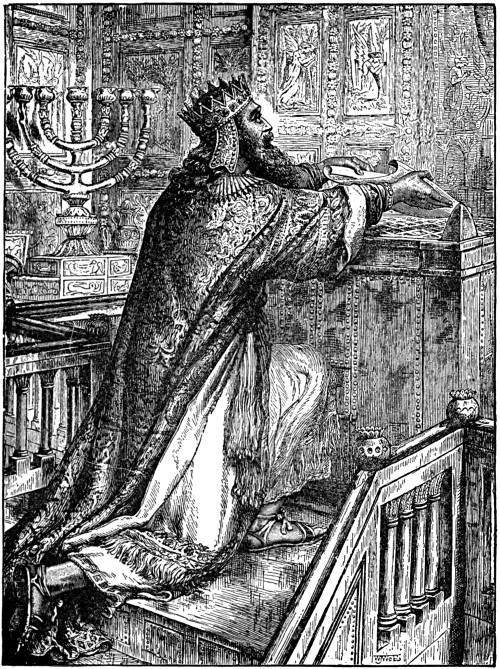
+ Hezekiah: Lord save us – After Hezekiah received the letter from the messengers and read it, he went up to the Lord’s Temple and spread it out before the Lord. And Hezekiah prayed this prayer before the Lord: “O Lord of Heaven’s Armies, God of Israel, you are enthroned between the mighty cherubim! You alone are God of all the kingdoms of the earth. You alone created the heavens and the earth. Bend down, O Lord, and listen! Open your eyes, O Lord, and see! Listen to Sennacherib’s words of defiance against the living God.

+ For your name’s sake – “It is true, Lord, that the kings of Assyria have destroyed all these nations. And they have thrown the gods of these nations into the fire and burned them. But of course the Assyrians could destroy them! They were not gods at all—only idols of wood and stone shaped by human hands. Now, O Lord our God, rescue us from his power; then all the kingdoms of the earth will know that you alone, O Lord, are God.”

Isaiah Prophesies Judah’s Deliverance

Then Isaiah son of Amoz sent this message to Hezekiah: “This is what the Lord, the God of Israel, says: Because you prayed about King Sennacherib of Assyria, the Lord has spoken this word against him:

“The virgin daughter of Zion despises you and laughs at you. The daughter of Jerusalem shakes her head in derision as you flee.

+ Isaiah to Sennacherib: you have defied the Holy One if Israel – “Whom have you been defying and ridiculing? Against whom did you raise your voice? At whom did you look with such haughty eyes? It was the Holy One of Israel! By your messengers you have defied the Lord. You have said, ‘With my many chariots I have conquered the highest mountains—yes, the remotest peaks of Lebanon. I have cut down its tallest cedars and its finest cypress trees. I have reached its farthest heights and explored its deepest forests. I have dug wells in many foreign lands and refreshed myself with their water. With the sole of my foot, I stopped up all the rivers of Egypt!’

+ Isaiah to Sennacherib : all according to my plan – “But have you not heard? I decided this long ago. Long ago I planned it, and now I am making it happen. I planned for you to crush fortified cities into heaps of rubble. That is why their people have so little power and are so frightened and confused. They are as weak as grass, as easily trampled as tender green shoots. They are like grass sprouting on a housetop, scorched before it can grow lush and tall.

+ Isaiah to Sennacherib: I know your arrogance – “But I know you well—where you stay and when you come and go. I know the way you have raged against me. And because of your raging against me and your arrogance, which I have heard for myself, I will put my hook in your nose and my bit in your mouth. I will make you return by the same road on which you came.”

Then Isaiah said to Hezekiah, “Here is the proof that what I say is true:

+ Isaiah to Hezekiah: you will survive the siege – “This year you will eat only what grows up by itself, and next year you will eat what springs up from that. But in the third year you will plant crops and harvest them; you will tend vineyards and eat their fruit. And you who are left in Judah, who have escaped the ravages of the siege, will put roots down in your own soil and grow up and flourish.

For a remnant of my people will spread out from Jerusalem, a group of survivors from Mount Zion. The passionate commitment of the Lord of Heaven’s Armies will make this happen!

“And this is what the Lord says about the king of Assyria:

+ I will defend and protect Jerusalem – “‘His armies will not enter Jerusalem. They will not even shoot an arrow at it. They will not march outside its gates with their shields nor build banks of earth against its walls. The king will return to his own country by the same road on which he came. He will not enter this city,’ says the Lord. ‘For my own honor and for the sake of my servant David, I will defend this city and protect it.’”

That night the angel of the Lord went out to the Assyrian camp and killed 185,000 Assyrian soldiers. When the surviving Assyrians woke up the next morning, they found corpses everywhere. Then King Sennacherib of Assyria broke camp and returned to his own land. He went home to his capital of Nineveh and stayed there.

One day while he was worshiping in the temple of his god Nisroch, his sons Adrammelech and Sharezer killed him with their swords. They then escaped to the land of Ararat, and another son, Esarhaddon, became the next king of Assyria.

Hezekiah’s Sickness and Recovery

Isaiah 38 (NLT)

+ Isaiah: Set your affairs in order – About that time Hezekiah became deathly ill, and the prophet Isaiah son of Amoz went to visit him. He gave the king this message: “This is what the Lord says: ‘Set your affairs in order, for you are going to die. You will not recover from this illness.’”

When Hezekiah heard this, he turned his face to the wall and prayed to the Lord, “Remember, O Lord, how I have always been faithful to you and have served you single-mindedly, always doing what pleases you.” Then he broke down and wept bitterly.

+ God: I’ll give you fifteen more years – Then this message came to Isaiah from the Lord: “Go back to Hezekiah and tell him, ‘This is what the Lord, the God of your ancestor David, says: I have heard your prayer and seen your tears. I will add fifteen years to your life, and I will rescue you and this city from the king of Assyria. Yes, I will defend this city.

“‘And this is the sign from the Lord to prove that he will do as he promised: I will cause the sun’s shadow to move ten steps backward on the sundial of Ahaz!’” So the shadow on the sundial moved backward ten steps.

Hezekiah’s Poem of Praise

When King Hezekiah was well again, he wrote this poem:

I said, “In the prime of my life, must I now enter the place of the dead? Am I to be robbed of the rest of my years?”

+ Help me! – I said, “Never again will I see the Lord God while still in the land of the living. Never again will I see my friends or be with those who live in this world. My life has been blown away like a shepherd’s tent in a storm. It has been cut short, as when a weaver cuts cloth from a loom. Suddenly, my life was over. I waited patiently all night, but I was torn apart as though by lions. Suddenly, my life was over. Delirious, I chattered like a swallow or a crane, and then I moaned like a mourning dove. My eyes grew tired of looking to heaven for help. I am in trouble, Lord. Help me!”

+ Your discipline is good – But what could I say? For he himself sent this sickness. Now I will walk humbly throughout my years because of this anguish I have felt. Lord, your discipline is good, for it leads to life and health. You restore my health and allow me to live! Yes, this anguish was good for me, for you have rescued me from death and forgiven all my sins.

+ Only the living can praise you – For the dead cannot praise you; they cannot raise their voices in praise. Those who go down to the grave can no longer hope in your faithfulness. Only the living can praise you as I do today. Each generation tells of your faithfulness to the next. Think of it—the Lord is ready to heal me! I will sing his praises with instruments every day of my life in the Temple of the Lord.

Isaiah had said to Hezekiah’s servants, “Make an ointment from figs and spread it over the boil, and Hezekiah will recover.”

And Hezekiah had asked, “What sign will prove that I will go to the Temple of the Lord?”

Isaiah Prophesies the Babylonian Captivity

Isaiah 39 (NLT)

Soon after this, Merodach-baladan son of Baladan, king of Babylon, sent Hezekiah his best wishes and a gift. He had heard that Hezekiah had been very sick and that he had recovered. Hezekiah was delighted with the Babylonian envoys and showed them everything in his treasure-houses—the silver, the gold, the spices, and the aromatic oils. He also took them to see his armory and showed them everything in his royal treasuries! There was nothing in his palace or kingdom that Hezekiah did not show them.

Then Isaiah the prophet went to King Hezekiah and asked him, “What did those men want? Where were they from?”

Hezekiah replied, “They came from the distant land of Babylon.”

“What did they see in your palace?” asked Isaiah.

“They saw everything,” Hezekiah replied. “I showed them everything I own—all my royal treasuries.”

Then Isaiah said to Hezekiah, “Listen to this message from the Lord of Heaven’s Armies: ‘The time is coming when everything in your palace—all the treasures stored up by your ancestors until now—will be carried off to Babylon. Nothing will be left,’ says the Lord. ‘Some of your very own sons will be taken away into exile. They will become eunuchs who will serve in the palace of Babylon’s king.’”

Then Hezekiah said to Isaiah, “This message you have given me from the Lord is good.” For the king was thinking, “At least there will be peace and security during my lifetime.”
__________

“Therefore The Redeemed of The Lord” – Depoch Church (NAC Indonesia)

Therefore the redeemed of the Lord shall return, And come with singing unto Zion; And everlasting joy shall be upon their head.

They shall obtain gladness and joy; And sorrow and mourning shall flee away.

__________

Blessing – (Northumbrian Community)

May the peace of the Lord Christ go with you, wherever He may send you. May He guide you through the wilderness, protect you through the storm. May He bring you home rejoicing at the wonders He has shown you. May He bring you home rejoicing once again into our doors.
__________

+ In the name of the Father, and the Son, and the Holy Spirit. Amen!

Morning Reading: Wed, 07 Feb – Job 13-14 ~ helpless and hopeless

Morning Reading

+ In the name of the Father, and the Son, and the Holy Spirit. Amen!

Opening – (Northumbria Community)

One thing I have asked of the Lord, this is what I seek: that I may dwell in the house of the Lord all the days of my life; to behold the beauty of the Lord and to seek Him in His temple.

Praise to You, Lord Jesus Christ, King of endless glory.

Reading: Job 13-14 (NLT)

Job Wants to Argue His Case with God

Job 13 (NLT)

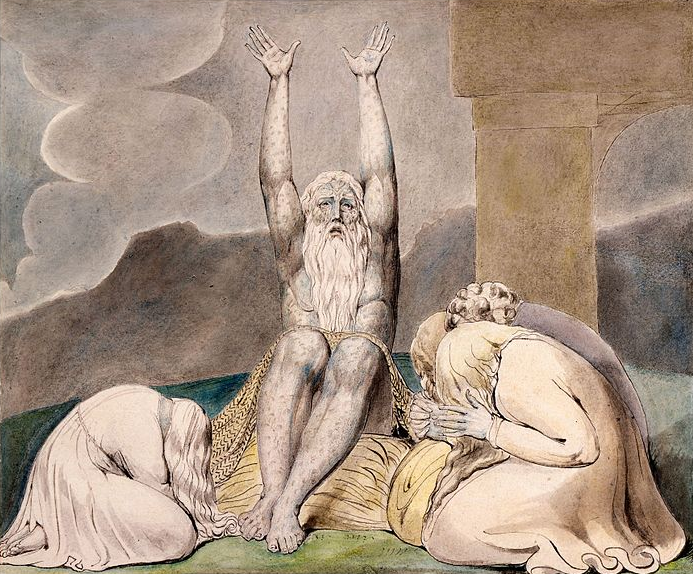
“Look, I have seen all this with my own eyes and heard it with my own ears, and now I understand. I know as much as you do. You are no better than I am. As for me, I would speak directly to the Almighty. I want to argue my case with God himself.

+ You’re just worthless quacks – “As for you, you smear me with lies. As physicians, you are worthless quacks. If only you could be silent! That’s the wisest thing you could do. Listen to my charge; pay attention to my arguments.

+ Your platitudes are worthless – “Are you defending God with lies? Do you make your dishonest arguments for his sake? Will you slant your testimony in his favor? Will you argue God’s case for him? What will happen when he finds out what you are doing? Can you fool him as easily as you fool people? No, you will be in trouble with him if you secretly slant your testimony in his favor. Doesn’t his majesty terrify you? Doesn’t your fear of him overwhelm you? Your platitudes are as valuable as ashes. Your defense is as fragile as a clay pot.

+ My case is with God, not you – “Be silent now and leave me alone. Let me speak, and I will face the consequences. Why should I put myself in mortal danger and take my life in my own hands? God might kill me, but I have no other hope. I am going to argue my case with him. But this is what will save me—I am not godless. If I were, I could not stand before him.

+ I will prove my innocence – “Listen closely to what I am about to say. Hear me out. I have prepared my case; I will be proved innocent. Who can argue with me  over this? And if you prove me wrong, I will remain silent and die.

Job Asks God to Answer Him

“O God, grant me these two things, and then I will be able to face you. Remove your heavy hand from me, and don’t terrify me with your awesome presence. Now summon me, and I will answer! Or let me speak to you, and you reply. Tell me, what have I done wrong? Show me my rebellion and my sin. Why do you turn away from me? Why do you treat me as your enemy? Would you terrify a leaf blown by the wind? Would you chase dry straw?

“You write bitter accusations against me and bring up all the sins of my youth. You put my feet in stocks. You examine all my paths. You trace all my footprints. I waste away like rotting wood, like a moth-eaten coat.

Job 14 (NLT)

+ Our frail lives are in your hands – “How frail is humanity! How short is life, how full of trouble! We blossom like a flower and then wither. Like a passing shadow, we quickly disappear. Must you keep an eye on such a frail creature and demand an accounting from me? Who can bring purity out of an impure person? No one! You have decided the length of our lives. You know how many months we will live, and we are not given a minute longer. So leave us alone and let us rest! We are like hired hands, so let us finish our work in peace.

“Even a tree has more hope! If it is cut down, it will sprout again and grow new branches. Though its roots have grown old in the earth and its stump decays, at the scent of water it will bud and sprout again like a new seedling.

+ Hopeless when we die – “But when people die, their strength is gone. They breathe their last, and then where are they? As water evaporates from a lake and a river disappears in drought, people are laid to rest and do not rise again. Until the heavens are no more, they will not wake up nor be roused from their sleep.

+ Can the dead live again? – “I wish you would hide me in the grave and forget me there until your anger has passed. But mark your calendar to think of me again! Can the dead live again? If so, this would give me hope through all my years of struggle, and I would eagerly await the release of death. You would call and I would answer, and you would yearn for me, your handiwork. For then you would guard my steps, instead of watching for my sins. My sins would be sealed in a pouch, and you would cover my guilt.

+ You destroy people’s hope – “But instead, as mountains fall and crumble and as rocks fall from a cliff, as water wears away the stones and floods wash away the soil, so you destroy people’s hope. You always overpower them, and they pass from the scene. You disfigure them in death and send them away. They never know if their children grow up in honor or sink to insignificance. They suffer painfully; their life is full of trouble.”
__________

“You Are My Peace” – Housefires


__________

Blessing – (Northumbrian Community)

May the peace of the Lord Christ go with you, wherever He may send you. May He guide you through the wilderness, protect you through the storm. May He bring you home rejoicing at the wonders He has shown you. May He bring you home rejoicing once again into our doors.
__________

+ In the name of the Father, and the Son, and the Holy Spirit. Amen!

Morning Reading: Tue, 06 Feb – Judges 1-6 ~ Partial Conquest Has Consequences

Morning Reading

+ In the name of the Father, and the Son, and the Holy Spirit. Amen!

Opening – (Northumbria Community)

One thing I have asked of the Lord, this is what I seek: that I may dwell in the house of the Lord all the days of my life; to behold the beauty of the Lord and to seek Him in His temple.

Praise to You, Lord Jesus Christ, King of endless glory.

Please Read:Judges 1-6 (NLT) – click here

Reading Excerpts

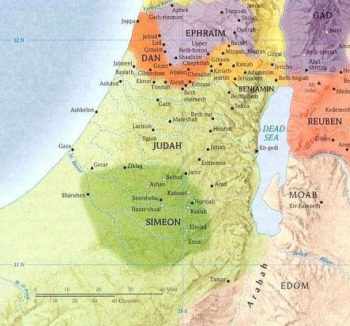
Judah and Simeon Conquer the Land

Judges 1 (NLT)

After the death of Joshua, the Israelites asked the Lord, “Which tribe should go first to attack the Canaanites?”

The Lord answered, “Judah, for I have given them victory over the land.”

+ Victory over Canaanites and Perizzites – The men of Judah said to their relatives from the tribe of Simeon, “Join with us to fight against the Canaanites living in the territory allotted to us. Then we will help you conquer your territory.” So the men of Simeon went with Judah.

When the men of Judah attacked, the Lord gave them victory over the Canaanites and Perizzites, and they killed 10,000 enemy warriors at the town of Bezek. While at Bezek they encountered King Adoni-bezek and fought against him, and the Canaanites and Perizzites were defeated. Adoni-bezek escaped, but the Israelites soon captured him and cut off his thumbs and big toes.

Adoni-bezek said, “I once had seventy kings with their thumbs and big toes cut off, eating scraps from under my table. Now God has paid me back for what I did to them.” They took him to Jerusalem, and he died there.

+ Victory over Jerusalem and Hebron – The men of Judah attacked Jerusalem and captured it, killing all its people and setting the city on fire. Then they went down to fight the Canaanites living in the hill country, the Negev, and the western foothills. Judah marched against the Canaanites in Hebron (formerly called Kiriath-arba), defeating the forces of Sheshai, Ahiman, and Talmai.

+ Victory over Debir – From there they went to fight against the people living in the town of Debir (formerly called Kiriath-sepher). Caleb said, “I will give my daughter Acsah in marriage to the one who attacks and captures Kiriath-sepher.” Othniel, the son of Caleb’s younger brother, Kenaz, was the one who conquered it, so Acsah became Othniel’s wife.

When Acsah married Othniel, she urged him to ask her father for a field. As she got down off her donkey, Caleb asked her, “What’s the matter?”

She said, “Let me have another gift. You have already given me land in the Negev; now please give me springs of water, too.” So Caleb gave her the upper and lower springs.

When the tribe of Judah left Jericho—the city of palms—the Kenites, who were descendants of Moses’ father-in-law, traveled with them into the wilderness of Judah. They settled among the people there, near the town of Arad in the Negev.

+ Victory over Zephath – Then Judah joined with Simeon to fight against the Canaanites living in Zephath, and they completely destroyed the town. So the town was named Hormah. In addition, Judah captured the towns of Gaza, Ashkelon, and Ekron, along with their surrounding territories.

Israel Fails to Conquer the Land

+ Caleb succeeds in Hebron – The Lord was with the people of Judah, and they took possession of the hill country. But they failed to drive out the people living in the plains, who had iron chariots. The town of Hebron was given to Caleb as Moses had promised. And Caleb drove out the people living there, who were descendants of the three sons of Anak.

+ Benjamin fails in Jerusalem – The tribe of Benjamin, however, failed to drive out the Jebusites, who were living in Jerusalem. So to this day the Jebusites live in Jerusalem among the people of Benjamin.

+ Manasseh succeeds in Bethel – The descendants of Joseph attacked the town of Bethel, and the Lord was with them. They sent men to scout out Bethel (formerly known as Luz). They confronted a man coming out of the town and said to him, “Show us a way into the town, and we will have mercy on you.” So he showed them a way in, and they killed everyone in the town except that man and his family. Later the man moved to the land of the Hittites, where he built a town. He named it Luz, which is its name to this day.

+ Manasseh fails in Beth-shan / Megiddo area – The tribe of Manasseh failed to drive out the people living in Beth-shan, Taanach, Dor, Ibleam, Megiddo, and all their surrounding settlements, because the Canaanites were determined to stay in that region. When the Israelites grew stronger, they forced the Canaanites to work as slaves, but they never did drive them completely out of the land.

+ Ephraim assimilates in Gezer – The tribe of Ephraim failed to drive out the Canaanites living in Gezer, so the Canaanites continued to live there among them.

+ Zebulun’s temporary fail in Kitron / Nahalol – The tribe of Zebulun failed to drive out the residents of Kitron and Nahalol, so the Canaanites continued to live among them. But the Canaanites were forced to work as slaves for the people of Zebulun.

+ Asher assimilates in Acco / Sidon area – The tribe of Asher failed to drive out the residents of Acco, Sidon, Ahlab, Aczib, Helbah, Aphik, and Rehob. Instead, the people of Asher moved in among the Canaanites, who controlled the land, for they failed to drive them out.

+ Naphtali’s temporary fail in Beth-shemesh and Beth-anath – Likewise, the tribe of Naphtali failed to drive out the residents of Beth-shemesh and Beth-anath. Instead, they moved in among the Canaanites, who controlled the land. Nevertheless, the people of Beth-shemesh and Beth-anath were forced to work as slaves for the people of Naphtali.

+ Dan’s temporary fail with Amorites – As for the tribe of Dan, the Amorites forced them back into the hill country and would not let them come down into the plains. The Amorites were determined to stay in Mount Heres, Aijalon, and Shaalbim, but when the descendants of Joseph became stronger, they forced the Amorites to work as slaves. The boundary of the Amorites ran from Scorpion Pass to Sela and continued upward from there.

The Lord’s Messenger Confronts Israel’s Disobedience

Judges 2 (NLT)

thorn in your side+ Constant thorns and temptations – The angel of the Lord went up from Gilgal to Bokim and said to the Israelites, “I brought you out of Egypt into this land that I swore to give your ancestors, and I said I would never break my covenant with you. For your part, you were not to make any covenants with the people living in this land; instead, you were to destroy their altars. But you disobeyed my command. Why did you do this? So now I declare that I will no longer drive out the people living in your land. They will be thorns in your sides, and their gods will be a constant temptation to you.”

+ Bokim: Israelites wept loudly – When the angel of the Lord finished speaking to all the Israelites, the people wept loudly. So they called the place Bokim (which means “weeping”), and they offered sacrifices there to the Lord.

The Death of Joshua

After Joshua sent the people away, each of the tribes left to take possession of the land allotted to them. And the Israelites served the Lord throughout the lifetime of Joshua and the leaders who outlived him—those who had seen all the great things the Lord had done for Israel.

Joshua son of Nun, the servant of the Lord, died at the age of 110. They buried him in the land he had been allocated, at Timnath-serah in the hill country of Ephraim, north of Mount Gaash.

Israel’s Generational Disobedience

After that generation died, another generation grew up who did not acknowledge the Lord or remember the mighty things he had done for Israel.

+ God’s retribution – The Israelites did evil in the Lord’s sight and served the images of Baal. They abandoned the Lord, the God of their ancestors, who had brought them out of Egypt. They went after other gods, worshiping the gods of the people around them. And they angered the Lord. They abandoned the Lord to serve Baal and the images of Ashtoreth. This made the Lord burn with anger against Israel, so he handed them over to raiders who stole their possessions. He turned them over to their enemies all around, and they were no longer able to resist them. Every time Israel went out to battle, the Lord fought against them, causing them to be defeated, just as he had warned. And the people were in great distress.

The Judges: Israel’s Cycle of Rebellion and Rescue

Then the Lord raised up judges to rescue the Israelites from their attackers. Yet Israel did not listen to the judges but prostituted themselves by worshiping other gods. How quickly they turned away from the path of their ancestors, who had walked in obedience to the Lord’s commands.

+ God’s pity for Israel – Whenever the Lord raised up a judge over Israel, he was with that judge and rescued the people from their enemies throughout the judge’s lifetime. For the Lord took pity on his people, who were burdened by oppression and suffering. But when the judge died, the people returned to their corrupt ways, behaving worse than those who had lived before them. They went after other gods, serving and worshiping them. And they refused to give up their evil practices and stubborn ways.

+ God’s anger against Israel – So the Lord burned with anger against Israel. He said, “Because these people have violated my covenant, which I made with their ancestors, and have ignored my commands, I will no longer drive out the nations that Joshua left unconquered when he died. I did this to test Israel—to see whether or not they would follow the ways of the Lord as their ancestors did.” That is why the Lord left those nations in place. He did not quickly drive them out or allow Joshua to conquer them all.

The Nations Left in Canaan

Judges 3 (NLT)

+ Warfare: testing and training – These are the nations that the Lord left in the land to test those Israelites who had not experienced the wars of Canaan. He did this to teach warfare to generations of Israelites who had no experience in battle. These are the nations: the Philistines (those living under the five Philistine rulers), all the Canaanites, the Sidonians, and the Hivites living in the mountains of Lebanon from Mount Baal-hermon to Lebo-hamath. These people were left to test the Israelites—to see whether they would obey the commands the Lord had given to their ancestors through Moses.

+ Israelites serve other gods – So the people of Israel lived among the Canaanites, Hittites, Amorites, Perizzites, Hivites, and Jebusites, and they intermarried with them. Israelite sons married their daughters, and Israelite daughters were given in marriage to their sons. And the Israelites served their gods.

Othniel Becomes Israel’s Judge

The Israelites did evil in the Lord’s sight. They forgot about the Lord their God, and they served the images of Baal and the Asherah poles. Then the Lord burned with anger against Israel, and he turned them over to King Cushan-rishathaim of Aram-naharaim. And the Israelites served Cushan-rishathaim for eight years.

But when the people of Israel cried out to the Lord for help, the Lord raised up a rescuer to save them. His name was Othniel, the son of Caleb’s younger brother, Kenaz. The Spirit of the Lord came upon him, and he became Israel’s judge. He went to war against King Cushan-rishathaim of Aram, and the Lord gave Othniel victory over him. So there was peace in the land for forty years. Then Othniel son of Kenaz died.

Ehud Becomes Israel’s Judge

Once again the Israelites did evil in the Lord’s sight, and the Lord gave King Eglon of Moab control over Israel because of their evil. Eglon enlisted the Ammonites and Amalekites as allies, and then he went out and defeated Israel, taking possession of Jericho, the city of palms. And the Israelites served Eglon of Moab for eighteen years.

But when the people of Israel cried out to the Lord for help, the Lord again raised up a rescuer to save them. His name was Ehud son of Gera, a left-handed man of the tribe of Benjamin. The Israelites sent Ehud to deliver their tribute money to King Eglon of Moab. So Ehud made a double-edged dagger that was about a foot long, and he strapped it to his right thigh, keeping it hidden under his clothing. He brought the tribute money to Eglon, who was very fat.

After delivering the payment, Ehud started home with those who had helped carry the tribute. But when Ehud reached the stone idols near Gilgal, he turned back. He came to Eglon and said, “I have a secret message for you.”

So the king commanded his servants, “Be quiet!” and he sent them all out of the room.

Ehud walked over to Eglon, who was sitting alone in a cool upstairs room. And Ehud said, “I have a message from God for you!” As King Eglon rose from his seat, Ehud reached with his left hand, pulled out the dagger strapped to his right thigh, and plunged it into the king’s belly. The dagger went so deep that the handle disappeared beneath the king’s fat. So Ehud did not pull out the dagger, and the king’s bowels emptied. Then Ehud closed and locked the doors of the room and escaped down the latrine.

After Ehud was gone, the king’s servants returned and found the doors to the upstairs room locked. They thought he might be using the latrine in the room, so they waited. But when the king didn’t come out after a long delay, they became concerned and got a key. And when they opened the doors, they found their master dead on the floor.

While the servants were waiting, Ehud escaped, passing the stone idols on his way to Seirah. When he arrived in the hill country of Ephraim, Ehud sounded a call to arms. Then he led a band of Israelites down from the hills.

“Follow me,” he said, “for the Lord has given you victory over Moab your enemy.” So they followed him. And the Israelites took control of the shallow crossings of the Jordan River across from Moab, preventing anyone from crossing.

They attacked the Moabites and killed about 10,000 of their strongest and most able-bodied warriors. Not one of them escaped. So Moab was conquered by Israel that day, and there was peace in the land for eighty years.

Shamgar Becomes Israel’s Judge

After Ehud, Shamgar son of Anath rescued Israel. He once killed 600 Philistines with an ox goad.

Deborah Becomes Israel’s Judge

Judges 4 (NLT)

After Ehud’s death, the Israelites again did evil in the Lord’s sight. So the Lord turned them over to King Jabin of Hazor, a Canaanite king. The commander of his army was Sisera, who lived in Harosheth-haggoyim. Sisera, who had 900 iron chariots, ruthlessly oppressed the Israelites for twenty years. Then the people of Israel cried out to the Lord for help.

+ Deborah prophesies victory – Deborah, the wife of Lappidoth, was a prophet who was judging Israel at that time. She would sit under the Palm of Deborah, between Ramah and Bethel in the hill country of Ephraim, and the Israelites would go to her for judgment. One day she sent for Barak son of Abinoam, who lived in Kedesh in the land of Naphtali. She said to him, “This is what the Lord, the God of Israel, commands you: Call out 10,000 warriors from the tribes of Naphtali and Zebulun at Mount Tabor. And I will call out Sisera, commander of Jabin’s army, along with his chariots and warriors, to the Kishon River. There I will give you victory over him.”

Barak told her, “I will go, but only if you go with me.”

“Very well,” she replied, “I will go with you. But you will receive no honor in this venture, for the Lord’s victory over Sisera will be at the hands of a woman.” So Deborah went with Barak to Kedesh. At Kedesh, Barak called together the tribes of Zebulun and Naphtali, and 10,000 warriors went up with him. Deborah also went with him.

Now Heber the Kenite, a descendant of Moses’ brother-in-law Hobab, had moved away from the other members of his tribe and pitched his tent by the oak of Zaanannim near Kedesh.

When Sisera was told that Barak son of Abinoam had gone up to Mount Tabor, he called for all 900 of his iron chariots and all of his warriors, and they marched from Harosheth-haggoyim to the Kishon River.

+ God gives the victory – Then Deborah said to Barak, “Get ready! This is the day the Lord will give you victory over Sisera, for the Lord is marching ahead of you.” So Barak led his 10,000 warriors down the slopes of Mount Tabor into battle. When Barak attacked, the Lord threw Sisera and all his chariots and warriors into a panic. Sisera leaped down from his chariot and escaped on foot. Then Barak chased the chariots and the enemy army all the way to Harosheth-haggoyim, killing all of Sisera’s warriors. Not a single one was left alive.

+ Sisera escapes – Meanwhile, Sisera ran to the tent of Jael, the wife of Heber the Kenite, because Heber’s family was on friendly terms with King Jabin of Hazor. Jael went out to meet Sisera and said to him, “Come into my tent, sir. Come in. Don’t be afraid.” So he went into her tent, and she covered him with a blanket.

“Please give me some water,” he said. “I’m thirsty.” So she gave him some milk from a leather bag and covered him again.

“Stand at the door of the tent,” he told her. “If anybody comes and asks you if there is anyone here, say no.”

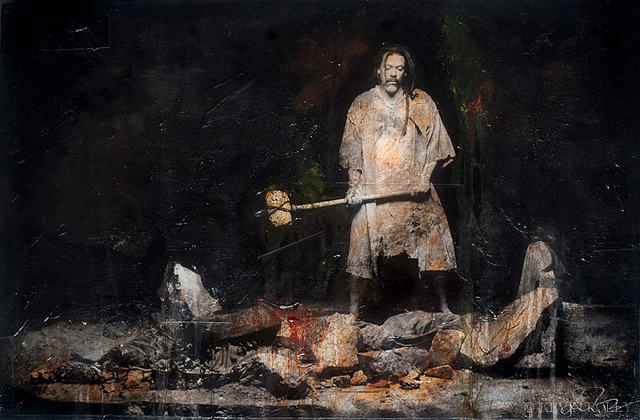
+ Jael kills Sisera – But when Sisera fell asleep from exhaustion, Jael quietly crept up to him with a hammer and tent peg in her hand. Then she drove the tent peg through his temple and into the ground, and so he died.

When Barak came looking for Sisera, Jael went out to meet him. She said, “Come, and I will show you the man you are looking for.” So he followed her into the tent and found Sisera lying there dead, with the tent peg through his temple.

So on that day Israel saw God defeat Jabin, the Canaanite king. And from that time on Israel became stronger and stronger against King Jabin until they finally destroyed him.

The Song of Deborah

Judges 5 (KJV)

The Song of Deborah (Laurence Olivier)

Gideon Becomes Israel’s Judge

Judges 6 (NLT)

The Israelites did evil in the Lord’s sight. So the Lord handed them over to the Midianites for seven years. The Midianites were so cruel that the Israelites made hiding places for themselves in the mountains, caves, and strongholds. Whenever the Israelites planted their crops, marauders from Midian, Amalek, and the people of the east would attack Israel, camping in the land and destroying crops as far away as Gaza. They left the Israelites with nothing to eat, taking all the sheep, goats, cattle, and donkeys. These enemy hordes, coming with their livestock and tents, were as thick as locusts; they arrived on droves of camels too numerous to count. And they stayed until the land was stripped bare. So Israel was reduced to starvation by the Midianites. Then the Israelites cried out to the Lord for help.

+ Prophet sent to Israel – When they cried out to the Lord because of Midian, the Lord sent a prophet to the Israelites. He said, “This is what the Lord, the God of Israel, says: I brought you up out of slavery in Egypt. I rescued you from the Egyptians and from all who oppressed you. I drove out your enemies and gave you their land. I told you, ‘I am the Lord your God. You must not worship the gods of the Amorites, in whose land you now live.’ But you have not listened to me.”

+ Gideon chosen by God – Then the angel of the Lord came and sat beneath the great tree at Ophrah, which belonged to Joash of the clan of Abiezer. Gideon son of Joash was threshing wheat at the bottom of a winepress to hide the grain from the Midianites. The angel of the Lord appeared to him and said, “Mighty hero, the Lord is with you!”

“Sir,” Gideon replied, “if the Lord is with us, why has all this happened to us? And where are all the miracles our ancestors told us about? Didn’t they say, ‘The Lord brought us up out of Egypt’? But now the Lord has abandoned us and handed us over to the Midianites.”

+ Go rescue Israel – Then the Lord turned to him and said, “Go with the strength you have, and rescue Israel from the Midianites. I am sending you!”

“But Lord,” Gideon replied, “how can I rescue Israel? My clan is the weakest in the whole tribe of Manasseh, and I am the least in my entire family!”

+ I will be with you – The Lord said to him, “I will be with you. And you will destroy the Midianites as if you were fighting against one man.”

Gideon replied, “If you are truly going to help me, show me a sign to prove that it is really the Lord speaking to me. Don’t go away until I come back and bring my offering to you.”

He answered, “I will stay here until you return.”

Gideon hurried home. He cooked a young goat, and with a basket of flour he baked some bread without yeast. Then, carrying the meat in a basket and the broth in a pot, he brought them out and presented them to the angel, who was under the great tree.

The angel of God said to him, “Place the meat and the unleavened bread on this rock, and pour the broth over it.” And Gideon did as he was told. Then the angel of the Lord touched the meat and bread with the tip of the staff in his hand, and fire flamed up from the rock and consumed all he had brought. And the angel of the Lord disappeared.

When Gideon realized that it was the angel of the Lord, he cried out, “Oh, Sovereign Lord, I’m doomed! I have seen the angel of the Lord face to face!”

+ An altar named Yahweh-Shalom – “It is all right,” the Lord replied. “Do not be afraid. You will not die.” And Gideon built an altar to the Lord there and named it Yahweh-Shalom (which means “the Lord is peace”). The altar remains in Ophrah in the land of the clan of Abiezer to this day.

Gideon Destroys Father’s Altar to Baal

+ Test of faith – That night the Lord said to Gideon, “Take the second bull from your father’s herd, the one that is seven years old. Pull down your father’s altar to Baal, and cut down the Asherah pole standing beside it. Then build an altar to the Lord your God here on this hilltop sanctuary, laying the stones carefully. Sacrifice the bull as a burnt offering on the altar, using as fuel the wood of the Asherah pole you cut down.”

So Gideon took ten of his servants and did as the Lord had commanded. But he did it at night because he was afraid of the other members of his father’s household and the people of the town.

Early the next morning, as the people of the town began to stir, someone discovered that the altar of Baal had been broken down and that the Asherah pole beside it had been cut down. In their place a new altar had been built, and on it were the remains of the bull that had been sacrificed. The people said to each other, “Who did this?” And after asking around and making a careful search, they learned that it was Gideon, the son of Joash.

“Bring out your son,” the men of the town demanded of Joash. “He must die for destroying the altar of Baal and for cutting down the Asherah pole.”

+ Gideon named Jerub-baal – But Joash shouted to the mob that confronted him, “Why are you defending Baal? Will you argue his case? Whoever pleads his case will be put to death by morning! If Baal truly is a god, let him defend himself and destroy the one who broke down his altar!” From then on Gideon was called Jerub-baal, which means “Let Baal defend himself,” because he broke down Baal’s altar.

Gideon Asks for a Sign

+ Gideon clothed with power – Soon afterward the armies of Midian, Amalek, and the people of the east formed an alliance against Israel and crossed the Jordan, camping in the valley of Jezreel. Then the Spirit of the Lord clothed Gideon with power. He blew a ram’s horn as a call to arms, and the men of the clan of Abiezer came to him. He also sent messengers throughout Manasseh, Asher, Zebulun, and Naphtali, summoning their warriors, and all of them responded.

+ The sign of the fleece – Then Gideon said to God, “If you are truly going to use me to rescue Israel as you promised, prove it to me in this way. I will put a wool fleece on the threshing floor tonight. If the fleece is wet with dew in the morning but the ground is dry, then I will know that you are going to help me rescue Israel as you promised.” And that is just what happened. When Gideon got up early the next morning, he squeezed the fleece and wrung out a whole bowlful of water.

+ The promise of victory – Then Gideon said to God, “Please don’t be angry with me, but let me make one more request. Let me use the fleece for one more test. This time let the fleece remain dry while the ground around it is wet with dew.” So that night God did as Gideon asked. The fleece was dry in the morning, but the ground was covered with dew.
__________

Blessing – (Northumbrian Community)

May the peace of the Lord Christ go with you, wherever He may send you. May He guide you through the wilderness, protect you through the storm. May He bring you home rejoicing at the wonders He has shown you. May He bring you home rejoicing once again into our doors.
__________

+ In the name of the Father, and the Son, and the Holy Spirit. Amen!

Morning Reading: Mon, 05 Feb – Genesis 20-23 ~ The Test

Morning Reading

+ In the name of the Father, and the Son, and the Holy Spirit. Amen!

Opening – (Northumbria Community)

One thing I have asked of the Lord, this is what I seek: that I may dwell in the house of the Lord all the days of my life; to behold the beauty of the Lord and to seek Him in His temple.

Praise to You, Lord Jesus Christ, King of endless glory.

Reading: Genesis 20-23 (NLT)

Abraham Deceives Abimelech

Genesis 20 (NLT)

+ Abraham’s duplicity – Abraham moved south to the Negev and lived for a while between Kadesh and Shur, and then he moved on to Gerar. While living there as a foreigner, Abraham introduced his wife, Sarah, by saying, “She is my sister.” So King Abimelech of Gerar sent for Sarah and had her brought to him at his palace.

+ God intervenes – But that night God came to Abimelech in a dream and told him, “You are a dead man, for that woman you have taken is already married!”

But Abimelech had not slept with her yet, so he said, “Lord, will you destroy an innocent nation? Didn’t Abraham tell me, ‘She is my sister’? And she herself said, ‘Yes, he is my brother.’ I acted in complete innocence! My hands are clean.”

In the dream God responded, “Yes, I know you are innocent. That’s why I kept you from sinning against me, and why I did not let you touch her. Now return the woman to her husband, and he will pray for you, for he is a prophet. Then you will live. But if you don’t return her to him, you can be sure that you and all your people will die.”

+ Abraham is confronted – Abimelech got up early the next morning and quickly called all his servants together. When he told them what had happened, his men were terrified. Then Abimelech called for Abraham. “What have you done to us?” he demanded. “What crime have I committed that deserves treatment like this, making me and my kingdom guilty of this great sin? No one should ever do what you have done! Whatever possessed you to do such a thing?”

+ Abraham’s confession – Abraham replied, “I thought, ‘This is a godless place. They will want my wife and will kill me to get her.’ And she really is my sister, for we both have the same father, but different mothers. And I married her. When God called me to leave my father’s home and to travel from place to place, I told her, ‘Do me a favor. Wherever we go, tell the people that I am your brother.’”

+ Abimelech’s restitution – Then Abimelech took some of his sheep and goats, cattle, and male and female servants, and he presented them to Abraham. He also returned his wife, Sarah, to him. Then Abimelech said, “Look over my land and choose any place where you would like to live.” And he said to Sarah, “Look, I am giving your ‘brother’ 1,000 pieces of silver in the presence of all these witnesses. This is to compensate you for any wrong I may have done to you. This will settle any claim against me, and your reputation is cleared.”

+ God uses deception for good – Then Abraham prayed to God, and God healed Abimelech, his wife, and his female servants, so they could have children. For the Lord had caused all the women to be infertile because of what happened with Abraham’s wife, Sarah.

The Birth of Isaac

Genesis 21 (NLT)

+ God keeps his word – The Lord kept his word and did for Sarah exactly what he had promised. She became pregnant, and she gave birth to a son for Abraham in his old age. This happened at just the time God had said it would. And Abraham named their son Isaac. Eight days after Isaac was born, Abraham circumcised him as God had commanded. Abraham was 100 years old when Isaac was born.

And Sarah declared, “God has brought me laughter. All who hear about this will laugh with me. Who would have said to Abraham that Sarah would nurse a baby? Yet I have given Abraham a son in his old age!”

Hagar and Ishmael Are Sent Away

+ A house divided – When Isaac grew up and was about to be weaned, Abraham prepared a huge feast to celebrate the occasion. But Sarah saw Ishmael—the son of Abraham and her Egyptian servant Hagar—making fun of her son, Isaac. So she turned to Abraham and demanded, “Get rid of that slave woman and her son. He is not going to share the inheritance with my son, Isaac. I won’t have it!”

+Isaac: child of the promise  – This upset Abraham very much because Ishmael was his son. But God told Abraham, “Do not be upset over the boy and your servant. Do whatever Sarah tells you, for Isaac is the son through whom your descendants will be counted. But I will also make a nation of the descendants of Hagar’s son because he is your son, too.”

+ Hagar’s expulsion – So Abraham got up early the next morning, prepared food and a container of water, and strapped them on Hagar’s shoulders. Then he sent her away with their son, and she wandered aimlessly in the wilderness of Beersheba.

When the water was gone, she put the boy in the shade of a bush. Then she went and sat down by herself about a hundred yards away. “I don’t want to watch the boy die,” she said, as she burst into tears.

+ God provides for Hagar – But God heard the boy crying, and the angel of God called to Hagar from heaven, “Hagar, what’s wrong? Do not be afraid! God has heard the boy crying as he lies there. Go to him and comfort him, for I will make a great nation from his descendants.”

Then God opened Hagar’s eyes, and she saw a well full of water. She quickly filled her water container and gave the boy a drink.

And God was with the boy as he grew up in the wilderness. He became a skillful archer, and he settled in the wilderness of Paran. His mother arranged for him to marry a woman from the land of Egypt.

Abraham’s Covenant with Abimelech

+ Loyalty pact – About this time, Abimelech came with Phicol, his army commander, to visit Abraham. “God is obviously with you, helping you in everything you do,” Abimelech said. “Swear to me in God’s name that you will never deceive me, my children, or any of my descendants. I have been loyal to you, so now swear that you will be loyal to me and to this country where you are living as a foreigner.”

Abraham replied, “Yes, I swear to it!” Then Abraham complained to Abimelech about a well that Abimelech’s servants had taken by force from Abraham’s servants.

“This is the first I’ve heard of it,” Abimelech answered. “I have no idea who is responsible. You have never complained about this before.”

+ The covenant at Beersheba – Abraham then gave some of his sheep, goats, and cattle to Abimelech, and they made a treaty. But Abraham also took seven additional female lambs and set them off by themselves. Abimelech asked, “Why have you set these seven apart from the others?”

Abraham replied, “Please accept these seven lambs to show your agreement that I dug this well.” Then he named the place Beersheba (which means “well of the oath”), because that was where they had sworn the oath.

+ Abraham lives as a foreigner – After making their covenant at Beersheba, Abimelech left with Phicol, the commander of his army, and they returned home to the land of the Philistines. Then Abraham planted a tamarisk tree at Beersheba, and there he worshiped the Lord, the Eternal God. And Abraham lived as a foreigner in Philistine country for a long time.

God Tests Abraham’s Faith

Genesis 22 (NLT)

Some time later, God tested Abraham’s faith. “Abraham!” God called.

“Yes,” he replied. “Here I am.”

+ The Test: Sacrifice your son – “Take your son, your only son—yes, Isaac, whom you love so much—and go to the land of Moriah. Go and sacrifice him as a burnt offering on one of the mountains, which I will show you.”

The next morning Abraham got up early. He saddled his donkey and took two of his servants with him, along with his son, Isaac. Then he chopped wood for a fire for a burnt offering and set out for the place God had told him about. On the third day of their journey, Abraham looked up and saw the place in the distance. “Stay here with the donkey,” Abraham told the servants. “The boy and I will travel a little farther. We will worship there, and then we will come right back.”

+ Isaac: Where is the sacrifice? – So Abraham placed the wood for the burnt offering on Isaac’s shoulders, while he himself carried the fire and the knife. As the two of them walked on together, Isaac turned to Abraham and said, “Father?”

“Yes, my son?” Abraham replied.

“We have the fire and the wood,” the boy said, “but where is the sheep for the burnt offering?”

+ Abraham: God will provide – “God will provide a sheep for the burnt offering, my son,” Abraham answered. And they both walked on together.

When they arrived at the place where God had told him to go, Abraham built an altar and arranged the wood on it. Then he tied his son, Isaac, and laid him on the altar on top of the wood. And Abraham picked up the knife to kill his son as a sacrifice. At that moment the angel of the Lord called to him from heaven, “Abraham! Abraham!”

“Yes,” Abraham replied. “Here I am!”

+ Stop: you passed – “Don’t lay a hand on the boy!” the angel said. “Do not hurt him in any way, for now I know that you truly fear God. You have not withheld from me even your son, your only son.”

+ God provides the sacrifice – Then Abraham looked up and saw a ram caught by its horns in a thicket. So he took the ram and sacrificed it as a burnt offering in place of his son. Abraham named the place Yahweh-Yireh (which means “the Lord will provide”). To this day, people still use that name as a proverb: “On the mountain of the Lord it will be provided.”

+ Covenant of blessing confirmed – Then the angel of the Lord called again to Abraham from heaven. “This is what the Lord says: Because you have obeyed me and have not withheld even your son, your only son, I swear by my own name that I will certainly bless you. I will multiply your descendants beyond number, like the stars in the sky and the sand on the seashore. Your descendants will conquer the cities of their enemies. And through your descendants all the nations of the earth will be blessed—all because you have obeyed me.”

Then they returned to the servants and traveled back to Beersheba, where Abraham continued to live.

Soon after this, Abraham heard that Milcah, his brother Nahor’s wife, had borne Nahor eight sons. The oldest was named Uz, the next oldest was Buz, followed by Kemuel (the ancestor of the Arameans), Kesed, Hazo, Pildash, Jidlaph, and Bethuel. (Bethuel became the father of Rebekah.) In addition to these eight sons from Milcah, Nahor had four other children from his concubine Reumah. Their names were Tebah, Gaham, Tahash, and Maacah.

The Burial of Sarah

Genesis 23 (NLT)

When Sarah was 127 years old, she died at Kiriath-arba (now called Hebron) in the land of Canaan. There Abraham mourned and wept for her.

Then, leaving her body, he said to the Hittite elders, “Here I am, a stranger and a foreigner among you. Please sell me a piece of land so I can give my wife a proper burial.”

The Hittites replied to Abraham, “Listen, my lord, you are an honored prince among us. Choose the finest of our tombs and bury her there. No one here will refuse to help you in this way.”

Then Abraham bowed low before the Hittites and said, “Since you are willing to help me in this way, be so kind as to ask Ephron son of Zohar to let me buy his cave at Machpelah, down at the end of his field. I will pay the full price in the presence of witnesses, so I will have a permanent burial place for my family.”

Ephron was sitting there among the others, and he answered Abraham as the others listened, speaking publicly before all the Hittite elders of the town. “No, my lord,” he said to Abraham, “please listen to me. I will give you the field and the cave. Here in the presence of my people, I give it to you. Go and bury your dead.”

Abraham again bowed low before the citizens of the land, and he replied to Ephron as everyone listened. “No, listen to me. I will buy it from you. Let me pay the full price for the field so I can bury my dead there.”

Ephron answered Abraham, “My lord, please listen to me. The land is worth 400 pieces of silver, but what is that between friends? Go ahead and bury your dead.”

So Abraham agreed to Ephron’s price and paid the amount he had suggested—400 pieces of silver, weighed according to the market standard. The Hittite elders witnessed the transaction.

So Abraham bought the plot of land belonging to Ephron at Machpelah, near Mamre. This included the field itself, the cave that was in it, and all the surrounding trees. It was transferred to Abraham as his permanent possession in the presence of the Hittite elders at the city gate. Then Abraham buried his wife, Sarah, there in Canaan, in the cave of Machpelah, near Mamre (also called Hebron). So the field and the cave were transferred from the Hittites to Abraham for use as a permanent burial place.
__________

“More Than Enough (God Is Working)” – Brooklyn Tabernacle Choir


__________

Blessing – (Northumbrian Community)

May the peace of the Lord Christ go with you, wherever He may send you. May He guide you through the wilderness, protect you through the storm. May He bring you home rejoicing at the wonders He has shown you. May He bring you home rejoicing once again into our doors.
__________

+ In the name of the Father, and the Son, and the Holy Spirit. Amen!