One thing I have asked of the Lord, this is what I seek: that I may dwell in the house of the Lord all the days of my life; to behold the beauty of the Lord and to seek Him in His temple.
Praise to You, Lord Jesus Christ, King of endless glory.
Reading: Mark 1-2 (NLT)
John the Baptist Prepares the Way
Mark 1 (NLT)
This is the Good News about Jesus the Messiah, the Son of God. It began just as the prophet Isaiah had written:
“Look, I am sending my messenger ahead of you, and he will prepare your way. He is a voice shouting in the wilderness, ‘Prepare the way for the Lord’s coming! Clear the road for him!’”
This messenger was John the Baptist. He was in the wilderness and preached that people should be baptized to show that they had repented of their sins and turned to God to be forgiven. All of Judea, including all the people of Jerusalem, went out to see and hear John. And when they confessed their sins, he baptized them in the Jordan River. His clothes were woven from coarse camel hair, and he wore a leather belt around his waist. For food he ate locusts and wild honey.
John announced: “Someone is coming soon who is greater than I am—so much greater that I’m not even worthy to stoop down like a slave and untie the straps of his sandals. I baptize you with water, but he will baptize you with the Holy Spirit!”
The Baptism and Temptation of Jesus
One day Jesus came from Nazareth in Galilee, and John baptized him in the Jordan River. As Jesus came up out of the water, he saw the heavens splitting apart and the Holy Spirit descending on him like a dove. And a voice from heaven said, “You are my dearly loved Son, and you bring me great joy.”
The Spirit then compelled Jesus to go into the wilderness, where he was tempted by Satan for forty days. He was out among the wild animals, and angels took care of him.
Later on, after John was arrested, Jesus went into Galilee, where he preached God’s Good News. “The time promised by God has come at last!” he announced. “The Kingdom of God is near! Repent of your sins and believe the Good News!”
The First Disciples
One day as Jesus was walking along the shore of the Sea of Galilee, he saw Simon and his brother Andrew throwing a net into the water, for they fished for a living. Jesus called out to them, “Come, follow me, and I will show you how to fish for people!” And they left their nets at once and followed him.
A little farther up the shore Jesus saw Zebedee’s sons, James and John, in a boat repairing their nets. He called them at once, and they also followed him, leaving their father, Zebedee, in the boat with the hired men.
Jesus Casts Out an Evil Spirit
Jesus and his companions went to the town of Capernaum. When the Sabbath day came, he went into the synagogue and began to teach. The people were amazed at his teaching, for he taught with real authority—quite unlike the teachers of religious law.
Suddenly, a man in the synagogue who was possessed by an evil spirit cried out, “Why are you interfering with us, Jesus of Nazareth? Have you come to destroy us? I know who you are—the Holy One of God!”
But Jesus reprimanded him. “Be quiet! Come out of the man,” he ordered. At that, the evil spirit screamed, threw the man into a convulsion, and then came out of him.
Amazement gripped the audience, and they began to discuss what had happened. “What sort of new teaching is this?” they asked excitedly. “It has such authority! Even evil spirits obey his orders!” The news about Jesus spread quickly throughout the entire region of Galilee.
Jesus Heals Many People
After Jesus left the synagogue with James and John, they went to Simon and Andrew’s home. Now Simon’s mother-in-law was sick in bed with a high fever. They told Jesus about her right away. So he went to her bedside, took her by the hand, and helped her sit up. Then the fever left her, and she prepared a meal for them.
That evening after sunset, many sick and demon-possessed people were brought to Jesus. The whole town gathered at the door to watch. So Jesus healed many people who were sick with various diseases, and he cast out many demons. But because the demons knew who he was, he did not allow them to speak.
Jesus Preaches in Galilee
Before daybreak the next morning, Jesus got up and went out to an isolated place to pray. Later Simon and the others went out to find him. When they found him, they said, “Everyone is looking for you.”
But Jesus replied, “We must go on to other towns as well, and I will preach to them, too. That is why I came.” So he traveled throughout the region of Galilee, preaching in the synagogues and casting out demons.
Jesus Heals a Man with Leprosy
A man with leprosy came and knelt in front of Jesus, begging to be healed. “If you are willing, you can heal me and make me clean,” he said.
Moved with compassion, Jesus reached out and touched him. “I am willing,” he said. “Be healed!” Instantly the leprosy disappeared, and the man was healed. Then Jesus sent him on his way with a stern warning: “Don’t tell anyone about this. Instead, go to the priest and let him examine you. Take along the offering required in the law of Moses for those who have been healed of leprosy. This will be a public testimony that you have been cleansed.”
But the man went and spread the word, proclaiming to everyone what had happened. As a result, large crowds soon surrounded Jesus, and he couldn’t publicly enter a town anywhere. He had to stay out in the secluded places, but people from everywhere kept coming to him.
Jesus Heals a Paralyzed Man
Mark 2 (NLT)
When Jesus returned to Capernaum several days later, the news spread quickly that he was back home. Soon the house where he was staying was so packed with visitors that there was no more room, even outside the door. While he was preaching God’s word to them, four men arrived carrying a paralyzed man on a mat. They couldn’t bring him to Jesus because of the crowd, so they dug a hole through the roof above his head. Then they lowered the man on his mat, right down in front of Jesus. Seeing their faith, Jesus said to the paralyzed man, “My child, your sins are forgiven.”
But some of the teachers of religious law who were sitting there thought to themselves, “What is he saying? This is blasphemy! Only God can forgive sins!”
Jesus knew immediately what they were thinking, so he asked them, “Why do you question this in your hearts? Is it easier to say to the paralyzed man ‘Your sins are forgiven,’ or ‘Stand up, pick up your mat, and walk’? So I will prove to you that the Son of Man has the authority on earth to forgive sins.” Then Jesus turned to the paralyzed man and said, “Stand up, pick up your mat, and go home!”
And the man jumped up, grabbed his mat, and walked out through the stunned onlookers. They were all amazed and praised God, exclaiming, “We’ve never seen anything like this before!”
Jesus Calls Levi (Matthew)
Then Jesus went out to the lakeshore again and taught the crowds that were coming to him. As he walked along, he saw Levi son of Alphaeus sitting at his tax collector’s booth. “Follow me and be my disciple,” Jesus said to him. So Levi got up and followed him.
Later, Levi invited Jesus and his disciples to his home as dinner guests, along with many tax collectors and other disreputable sinners. (There were many people of this kind among Jesus’ followers.) But when the teachers of religious law who were Pharisees saw him eating with tax collectors and other sinners, they asked his disciples, “Why does he eat with such scum?”
When Jesus heard this, he told them, “Healthy people don’t need a doctor—sick people do. I have come to call not those who think they are righteous, but those who know they are sinners.”
A Discussion about Fasting
Once when John’s disciples and the Pharisees were fasting, some people came to Jesus and asked, “Why don’t your disciples fast like John’s disciples and the Pharisees do?”
Jesus replied, “Do wedding guests fast while celebrating with the groom? Of course not. They can’t fast while the groom is with them. But someday the groom will be taken away from them, and then they will fast.
“Besides, who would patch old clothing with new cloth? For the new patch would shrink and rip away from the old cloth, leaving an even bigger tear than before.
“And no one puts new wine into old wineskins. For the wine would burst the wineskins, and the wine and the skins would both be lost. New wine calls for new wineskins.”
A Discussion about the Sabbath
One Sabbath day as Jesus was walking through some grainfields, his disciples began breaking off heads of grain to eat. But the Pharisees said to Jesus, “Look, why are they breaking the law by harvesting grain on the Sabbath?”
Jesus said to them, “Haven’t you ever read in the Scriptures what David did when he and his companions were hungry? He went into the house of God (during the days when Abiathar was high priest) and broke the law by eating the sacred loaves of bread that only the priests are allowed to eat. He also gave some to his companions.”
Then Jesus said to them, “The Sabbath was made to meet the needs of people, and not people to meet the requirements of the Sabbath. So the Son of Man is Lord, even over the Sabbath!”
__________
May the peace of the Lord Christ go with you, wherever He may send you. May He guide you through the wilderness, protect you through the storm. May He bring you home rejoicing at the wonders He has shown you. May He bring you home rejoicing once again into our doors.
__________
+ In the name of the Father, and the Son, and the Holy Spirit. Amen!
One thing I have asked of the Lord, this is what I seek: that I may dwell in the house of the Lord all the days of my life; to behold the beauty of the Lord and to seek Him in His temple.
Praise to You, Lord Jesus Christ, King of endless glory.
Reading: Isaiah 62-66 (NLT)
Isaiah’s Prayer for Jerusalem
Isaiah 62
+ My heart yearns for Jerusalem – Because I love Zion, I will not keep still. Because my heart yearns for Jerusalem, I cannot remain silent. I will not stop praying for her until her righteousness shines like the dawn, and her salvation blazes like a burning torch.
The nations will see your righteousness. World leaders will be blinded by your glory. And you will be given a new name by the Lord’s own mouth. The Lord will hold you in his hand for all to see—a splendid crown in the hand of God.
+ The Bride of God – Never again will you be called “The Forsaken City” or “The Desolate Land.” Your new name will be “The City of God’s Delight” and “The Bride of God,” for the Lord delights in you and will claim you as his bride. Your children will commit themselves to you, O Jerusalem, just as a young man commits himself to his bride. Then God will rejoice over you as a bridegroom rejoices over his bride.
+ Watchmen who pray – O Jerusalem, I have posted watchmen on your walls; they will pray day and night, continually. Take no rest, all you who pray to the Lord. Give the Lord no rest until he completes his work, until he makes Jerusalem the pride of the earth. The Lord has sworn to Jerusalem by his own strength: “I will never again hand you over to your enemies. Never again will foreign warriors come and take away your grain and new wine. You raised the grain, and you will eat it, praising the Lord. Within the courtyards of the Temple, you yourselves will drink the wine you have pressed.”
+ Prepare the way of return – Go out through the gates! Prepare the highway for my people to return! Smooth out the road; pull out the boulders; raise a flag for all the nations to see.
The Lord has sent this message to every land: “Tell the people of Israel, ‘Look, your Savior is coming. See, he brings his reward with him as he comes.’”
They will be called “The Holy People” and “The People Redeemed by the Lord.” And Jerusalem will be known as “The Desirable Place” and “The City No Longer Forsaken.”
Judgment against the Lord’s Enemies
Isaiah 63 (NLT)
Who is this who comes from Edom, from the city of Bozrah, with his clothing stained red? Who is this in royal robes, marching in his great strength?
“It is I, the Lord, announcing your salvation! It is I, the Lord, who has the power to save!”
Why are your clothes so red, as if you have been treading out grapes?
“I have been treading the winepress alone; no one was there to help me. In my anger I have trampled my enemies as if they were grapes. In my fury I have trampled my foes. Their blood has stained my clothes. For the time has come for me to avenge my people, to ransom them from their oppressors. I was amazed to see that no one intervened to help the oppressed. So I myself stepped in to save them with my strong arm, and my wrath sustained me. I crushed the nations in my anger and made them stagger and fall to the ground, spilling their blood upon the earth.”
Praise for Deliverance
I will tell of the Lord’s unfailing love. I will praise the Lord for all he has done. I will rejoice in his great goodness to Israel, which he has granted according to his mercy and love. He said, “They are my very own people. Surely they will not betray me again.” And he became their Savior.
In all their suffering he also suffered, and he personally rescued them.
In his love and mercy he redeemed them.
He lifted them up and carried them through all the years.
But they rebelled against him and grieved his Holy Spirit. So he became their enemy and fought against them.
Then they remembered those days of old when Moses led his people out of Egypt. They cried out,
“Where is the one who brought Israel through the sea, with Moses as their shepherd?
Where is the one who sent his Holy Spirit to be among his people?
Where is the one whose power was displayed when Moses lifted up his hand—the one who divided the sea before them, making himself famous forever?
Where is the one who led them through the bottom of the sea? They were like fine stallions racing through the desert, never stumbling. As with cattle going down into a peaceful valley, the Spirit of the Lord gave them rest. You led your people, Lord, and gained a magnificent reputation.”
Prayer for Mercy and Pardon
+ You are our Redeemer – Lord, look down from heaven; look from your holy, glorious home, and see us. Where is the passion and the might you used to show on our behalf? Where are your mercy and compassion now? Surely you are still our Father! Even if Abraham and Jacob would disown us, Lord, you would still be our Father. You are our Redeemer from ages past.
+ Return and help us – Lord, why have you allowed us to turn from your path? Why have you given us stubborn hearts so we no longer fear you? Return and help us, for we are your servants, the tribes that are your special possession. How briefly your holy people possessed your holy place, and now our enemies have destroyed it. Sometimes it seems as though we never belonged to you, as though we had never been known as your people.
Isaiah 64 (NLT)
+ Make the nations tremble – Oh, that you would burst from the heavens and come down! How the mountains would quake in your presence! As fire causes wood to burn and water to boil, your coming would make the nations tremble. Then your enemies would learn the reason for your fame! When you came down long ago, you did awesome deeds beyond our highest expectations. And oh, how the mountains quaked!
+ There is no God like you – For since the world began, no ear has heard and no eye has seen a God like you, who works for those who wait for him! You welcome those who gladly do good, who follow godly ways. But you have been very angry with us, for we are not godly. We are constant sinners; how can people like us be saved?
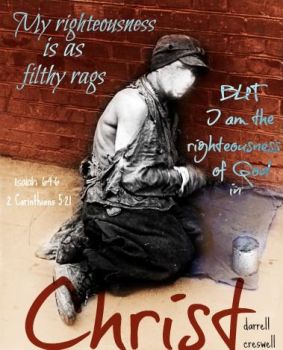
+ You have turned away from us – We are all infected and impure with sin. When we display our righteous deeds, they are nothing but filthy rags. Like autumn leaves, we wither and fall, and our sins sweep us away like the wind. Yet no one calls on your name or pleads with you for mercy. Therefore, you have turned away from us and turned us over to our sins.
+ Still, we are your people – And yet, O Lord, you are our Father. We are the clay, and you are the potter. We all are formed by your hand. Don’t be so angry with us, Lord. Please don’t remember our sins forever. Look at us, we pray, and see that we are all your people.
+ But we are in ruins – Your holy cities are destroyed. Zion is a wilderness; yes, Jerusalem is a desolate ruin. The holy and beautiful Temple where our ancestors praised you has been burned down, and all the things of beauty are destroyed. After all this, Lord, must you still refuse to help us? Will you continue to be silent and punish us?
Judgment and Final Salvation
Isaiah 65 (NLT)
The Lord says,
+ I was ready and waiting – “I was ready to respond, but no one asked for help. I was ready to be found, but no one was looking for me. I said, ‘Here I am, here I am!’ to a nation that did not call on my name. All day long I opened my arms to a rebellious people. But they follow their own evil paths and their own crooked schemes.
+ But you stink – All day long they insult me to my face by worshiping idols in their sacred gardens. They burn incense on pagan altars. At night they go out among the graves, worshiping the dead. They eat the flesh of pigs and make stews with other forbidden foods. Yet they say to each other, ‘Don’t come too close or you will defile me! I am holier than you!’ These people are a stench in my nostrils, an acrid smell that never goes away.
+ I will repay you – “Look, my decree is written out in front of me: I will not stand silent; I will repay them in full! Yes, I will repay them—both for their own sins and for those of their ancestors,” says the Lord. “For they also burned incense on the mountains and insulted me on the hills. I will pay them back in full!
+ But, I will preserve a remnant – “But I will not destroy them all,” says the Lord. “For just as good grapes are found among a cluster of bad ones (and someone will say, ‘Don’t throw them all away—some of those grapes are good!’), so I will not destroy all Israel. For I still have true servants there. I will preserve a remnant of the people of Israel and of Judah to possess my land. Those I choose will inherit it, and my servants will live there. The plain of Sharon will again be filled with flocks for my people who have searched for me, and the valley of Achor will be a place to pasture herds.
+ The rest are destined for the sword – “But because the rest of you have forsaken the Lord and have forgotten his Temple, and because you have prepared feasts to honor the god of Fate and have offered mixed wine to the god of Destiny, now I will ‘destine’ you for the sword. All of you will bow down before the executioner. For when I called, you did not answer. When I spoke, you did not listen. You deliberately sinned—before my very eyes—and chose to do what you know I despise.”
Therefore, this is what the Sovereign Lord says:
“My servants will eat, but you will starve.
My servants will drink, but you will be thirsty.
My servants will rejoice, but you will be sad and ashamed.
My servants will sing for joy, but you will cry in sorrow and despair.
Your name will be a curse word among my people, for the Sovereign Lord will destroy you and will call his true servants by another name. All who invoke a blessing or take an oath will do so by the God of truth. For I will put aside my anger and forget the evil of earlier days.
+ I will rejoice over a new Jerusalem – “Look! I am creating new heavens and a new earth, and no one will even think about the old ones anymore. Be glad; rejoice forever in my creation! And look! I will create Jerusalem as a place of happiness. Her people will be a source of joy. I will rejoice over Jerusalem and delight in my people. And the sound of weeping and crying will be heard in it no more.
“No longer will babies die when only a few days old.
No longer will adults die before they have lived a full life.
No longer will people be considered old at one hundred! Only the cursed will die that young!
+ Long life – In those days people will live in the houses they build and eat the fruit of their own vineyards. Unlike the past, invaders will not take their houses and confiscate their vineyards. For my people will live as long as trees, and my chosen ones will have time to enjoy their hard-won gains.
+ Blessed life– They will not work in vain, and their children will not be doomed to misfortune. For they are people blessed by the Lord, and their children, too, will be blessed.
+ Answered prayer – I will answer them before they even call to me. While they are still talking about their needs, I will go ahead and answer their prayers!
+ Peace – The wolf and the lamb will feed together. The lion will eat hay like a cow. But the snakes will eat dust. In those days no one will be hurt or destroyed on my holy mountain. I, the Lord, have spoken!”
Isaiah 66 (NLT)
This is what the Lord says:
“Heaven is my throne, and the earth is my footstool. Could you build me a temple as good as that? Could you build me such a resting place? My hands have made both heaven and earth; they and everything in them are mine. I, the Lord, have spoken!
+ Blessing and curse – “I will bless those who have humble and contrite hearts, who tremble at my word. But those who choose their own ways—delighting in their detestable sins—will not have their offerings accepted.
When such people sacrifice a bull, it is no more acceptable than a human sacrifice.
When they sacrifice a lamb, it’s as though they had sacrificed a dog!
When they bring an offering of grain, they might as well offer the blood of a pig.
When they burn frankincense, it’s as if they had blessed an idol.
I will send them great trouble—all the things they feared.
For when I called, they did not answer. When I spoke, they did not listen. They deliberately sinned before my very eyes and chose to do what they know I despise.”
+ Vengeance – Hear this message from the Lord, all you who tremble at his words: “Your own people hate you and throw you out for being loyal to my name. ‘Let the Lord be honored!’ they scoff. ‘Be joyful in him!’ But they will be put to shame. What is all the commotion in the city? What is that terrible noise from the Temple? It is the voice of the Lord taking vengeance against his enemies.
+ Birth of a new nation – “Before the birth pains even begin, Jerusalem gives birth to a son. Who has ever seen anything as strange as this? Who ever heard of such a thing? Has a nation ever been born in a single day? Has a country ever come forth in a mere moment? But by the time Jerusalem’s birth pains begin, her children will be born. Would I ever bring this nation to the point of birth and then not deliver it?” asks the Lord. “No! I would never keep this nation from being born,” says your God.
+ Rejoice and be glad – “Rejoice with Jerusalem! Be glad with her, all you who love her and all you who mourn for her. Drink deeply of her glory even as an infant drinks at its mother’s comforting breasts.”
+ Peace and prosperity – This is what the Lord says: “I will give Jerusalem a river of peace and prosperity. The wealth of the nations will flow to her. Her children will be nursed at her breasts, carried in her arms, and held on her lap. I will comfort you there in Jerusalem as a mother comforts her child.”
+ The Lord is coming – When you see these things, your heart will rejoice. You will flourish like the grass! Everyone will see the Lord’s hand of blessing on his servants—and his anger against his enemies. See, the Lord is coming with fire, and his swift chariots roar like a whirlwind. He will bring punishment with the fury of his anger and the flaming fire of his hot rebuke. The Lord will punish the world by fire and by his sword. He will judge the earth, and many will be killed by him.
“Those who ‘consecrate’ and ‘purify’ themselves in a sacred garden with its idol in the center—feasting on pork and rats and other detestable meats—will come to a terrible end,” says the Lord.
+ All nations will see my glory – “I can see what they are doing, and I know what they are thinking. So I will gather all nations and peoples together, and they will see my glory. I will perform a sign among them. And I will send those who survive to be messengers to the nations—to Tarshish, to the Libyans and Lydians (who are famous as archers), to Tubal and Greece, and to all the lands beyond the sea that have not heard of my fame or seen my glory. There they will declare my glory to the nations. They will bring the remnant of your people back from every nation. They will bring them to my holy mountain in Jerusalem as an offering to the Lord. They will ride on horses, in chariots and wagons, and on mules and camels,” says the Lord. “And I will appoint some of them to be my priests and Levites. I, the Lord, have spoken!
+ You will always be my people – “As surely as my new heavens and earth will remain, so will you always be my people, with a name that will never disappear,” says the Lord. “All humanity will come to worship me from week to week and from month to month. And as they go out, they will see the dead bodies of those who have rebelled against me. For the worms that devour them will never die, and the fire that burns them will never go out. All who pass by will view them with utter horror.”
__________
“Home” – Sam Tsui & The YMCA Jerusalem Youth Chorus
May the peace of the Lord Christ go with you, wherever He may send you. May He guide you through the wilderness, protect you through the storm. May He bring you home rejoicing at the wonders He has shown you. May He bring you home rejoicing once again into our doors.
__________
+ In the name of the Father, and the Son, and the Holy Spirit. Amen!
One thing I have asked of the Lord, this is what I seek: that I may dwell in the house of the Lord all the days of my life; to behold the beauty of the Lord and to seek Him in His temple.
Praise to You, Lord Jesus Christ, King of endless glory.
Reading: Job 23-24 (NLT)
Job’s Complaint
Job 23 (NLT)
Then Job spoke again:
+ I can’t find God – “My complaint today is still a bitter one, and I try hard not to groan aloud. If only I knew where to find God, I would go to his court. I would lay out my case and present my arguments. Then I would listen to his reply and understand what he says to me. Would he use his great power to argue with me? No, he would give me a fair hearing. Honest people can reason with him, so I would be forever acquitted by my judge. I go east, but he is not there. I go west, but I cannot find him. I do not see him in the north, for he is hidden. I look to the south, but he is concealed.
+ God is testing me – “But he knows where I am going. And when he tests me, I will come out as pure as gold. For I have stayed on God’s paths; I have followed his ways and not turned aside. I have not departed from his commands, but have treasured his words more than daily food. But once he has made his decision, who can change his mind? Whatever he wants to do, he does. So he will do to me whatever he has planned. He controls my destiny. No wonder I am so terrified in his presence. When I think of it, terror grips me. God has made me sick at heart; the Almighty has terrified me. Darkness is all around me; thick, impenetrable darkness is everywhere.
Job’s Cry for Justice
Job 24 (NLT)
+ The godly wait in vain – “Why doesn’t the Almighty bring the wicked to judgment? Why must the godly wait for him in vain?
Evil people steal land by moving the boundary markers.
They steal livestock and put them in their own pastures.
They take the orphan’s donkey and demand the widow’s ox as security for a loan.
The poor are pushed off the path; the needy must hide together for safety.
Like wild donkeys in the wilderness, the poor must spend all their time looking for food, searching even in the desert for food for their children.
They harvest a field they do not own, and they glean in the vineyards of the wicked.
All night they lie naked in the cold, without clothing or covering.
They are soaked by mountain showers, and they huddle against the rocks for want of a home.
+ The poor are ignored – “The wicked snatch a widow’s child from her breast, taking the baby as security for a loan.
The poor must go about naked, without any clothing.
They harvest food for others while they themselves are starving.
They press out olive oil without being allowed to taste it, and they tread in the winepress as they suffer from thirst.
The groans of the dying rise from the city, and the wounded cry for help, yet God ignores their moaning.
+ The wicked are allied with darkness – “Wicked people rebel against the light. They refuse to acknowledge its ways or stay in its paths.
The murderer rises in the early dawn to kill the poor and needy; at night he is a thief.
The adulterer waits for the twilight, saying, ‘No one will see me then.’ He hides his face so no one will know him.
Thieves break into houses at night and sleep in the daytime. They are not acquainted with the light. The black night is their morning. They ally themselves with the terrors of the darkness.
+ The wicked live in fear – “But they disappear like foam down a river. Everything they own is cursed, and they are afraid to enter their own vineyards. The grave consumes sinners just as drought and heat consume snow. Their own mothers will forget them. Maggots will find them sweet to eat. No one will remember them. Wicked people are broken like a tree in the storm. They cheat the woman who has no son to help her. They refuse to help the needy widow.
+ God will judge – “God, in his power, drags away the rich. They may rise high, but they have no assurance of life. They may be allowed to live in security, but God is always watching them. And though they are great now, in a moment they will be gone like all others, cut off like heads of grain. Can anyone claim otherwise? Who can prove me wrong?”
__________
May the peace of the Lord Christ go with you, wherever He may send you. May He guide you through the wilderness, protect you through the storm. May He bring you home rejoicing at the wonders He has shown you. May He bring you home rejoicing once again into our doors.
__________
+ In the name of the Father, and the Son, and the Holy Spirit. Amen!
One thing I have asked of the Lord, this is what I seek: that I may dwell in the house of the Lord all the days of my life; to behold the beauty of the Lord and to seek Him in His temple.
Praise to You, Lord Jesus Christ, King of endless glory.
Reading: 1 Samuel 1-5 (NLT)
Elkanah and His Family
1 Samuel 1 (NLT)
There was a man named Elkanah who lived in Ramah in the region of Zuph in the hill country of Ephraim. He was the son of Jeroham, son of Elihu, son of Tohu, son of Zuph, of Ephraim. Elkanah had two wives, Hannah and Peninnah. Peninnah had children, but Hannah did not.
+ Hannah’s tribulation – Each year Elkanah would travel to Shiloh to worship and sacrifice to the Lord of Heaven’s Armies at the Tabernacle. The priests of the Lord at that time were the two sons of Eli—Hophni and Phinehas. On the days Elkanah presented his sacrifice, he would give portions of the meat to Peninnah and each of her children. And though he loved Hannah, he would give her only one choice portion because the Lord had given her no children. So Peninnah would taunt Hannah and make fun of her because the Lord had kept her from having children. Year after year it was the same—Peninnah would taunt Hannah as they went to the Tabernacle. Each time, Hannah would be reduced to tears and would not even eat.
“Why are you crying, Hannah?” Elkanah would ask. “Why aren’t you eating? Why be downhearted just because you have no children? You have me—isn’t that better than having ten sons?”
Hannah’s Prayer for a Son
+ Hannah’s vow – Once after a sacrificial meal at Shiloh, Hannah got up and went to pray. Eli the priest was sitting at his customary place beside the entrance of the Tabernacle. Hannah was in deep anguish, crying bitterly as she prayed to the Lord. And she made this vow: “O Lord of Heaven’s Armies, if you will look upon my sorrow and answer my prayer and give me a son, then I will give him back to you. He will be yours for his entire lifetime, and as a sign that he has been dedicated to the Lord, his hair will never be cut.”
As she was praying to the Lord, Eli watched her. Seeing her lips moving but hearing no sound, he thought she had been drinking. “Must you come here drunk?” he demanded. “Throw away your wine!”
“Oh no, sir!” she replied. “I haven’t been drinking wine or anything stronger. But I am very discouraged, and I was pouring out my heart to the Lord. Don’t think I am a wicked woman! For I have been praying out of great anguish and sorrow.”
+ Eli’s blessing – “In that case,” Eli said, “go in peace! May the God of Israel grant the request you have asked of him.”
“Oh, thank you, sir!” she exclaimed. Then she went back and began to eat again, and she was no longer sad.
Samuel’s Birth and Dedication
The entire family got up early the next morning and went to worship the Lord once more. Then they returned home to Ramah. When Elkanah slept with Hannah, the Lord remembered her plea, and in due time she gave birth to a son. She named him Samuel, for she said, “I asked the Lord for him.”
+ Hannah holds on to Samuel – The next year Elkanah and his family went on their annual trip to offer a sacrifice to the Lord and to keep his vow. But Hannah did not go. She told her husband, “Wait until the boy is weaned. Then I will take him to the Tabernacle and leave him there with the Lord permanently.”
“Whatever you think is best,” Elkanah agreed. “Stay here for now, and may the Lord help you keep your promise.” So she stayed home and nursed the boy until he was weaned.
+ Hannah fulfills her vow – When the child was weaned, Hannah took him to the Tabernacle in Shiloh. They brought along a three-year-old bull for the sacrifice and a basket of flour and some wine. After sacrificing the bull, they brought the boy to Eli. “Sir, do you remember me?” Hannah asked. “I am the very woman who stood here several years ago praying to the Lord. I asked the Lord to give me this boy, and he has granted my request. Now I am giving him to the Lord, and he will belong to the Lord his whole life.” And they worshiped the Lord there.
Hannah’s Prayer of Praise
1 Samuel 2 (NLT)
Then Hannah prayed:
“My heart rejoices in the Lord! The Lord has made me strong. Now I have an answer for my enemies; I rejoice because you rescued me. No one is holy like the Lord! There is no one besides you; there is no Rock like our God.
“Stop acting so proud and haughty! Don’t speak with such arrogance! For the Lord is a God who knows what you have done; he will judge your actions.
The bow of the mighty is now broken, and those who stumbled are now strong.
Those who were well fed are now starving, and those who were starving are now full.
The childless woman now has seven children, and the woman with many children wastes away.
The Lord gives both death and life; he brings some down to the grave but raises others up.
The Lord makes some poor and others rich; he brings some down and lifts others up.
He lifts the poor from the dust and the needy from the garbage dump. He sets them among princes, placing them in seats of honor.
For all the earth is the Lord’s, and he has set the world in order.
“He will protect his faithful ones, but the wicked will disappear in darkness. No one will succeed by strength alone. Those who fight against the Lord will be shattered. He thunders against them from heaven; the Lord judges throughout the earth. He gives power to his king; he increases the strength of his anointed one.”
Then Elkanah returned home to Ramah without Samuel. And the boy served the Lord by assisting Eli the priest.
Eli’s Wicked Sons
+ Disrespect for God – Now the sons of Eli were scoundrels who had no respect for the Lord or for their duties as priests. Whenever anyone offered a sacrifice, Eli’s sons would send over a servant with a three-pronged fork. While the meat of the sacrificed animal was still boiling, the servant would stick the fork into the pot and demand that whatever it brought up be given to Eli’s sons. All the Israelites who came to worship at Shiloh were treated this way. Sometimes the servant would come even before the animal’s fat had been burned on the altar. He would demand raw meat before it had been boiled so that it could be used for roasting.
+ Contempt for offerings – The man offering the sacrifice might reply, “Take as much as you want, but the fat must be burned first.” Then the servant would demand, “No, give it to me now, or I’ll take it by force.” So the sin of these young men was very serious in the Lord’s sight, for they treated the Lord’s offerings with contempt.
+ But Samuel served God – But Samuel, though he was only a boy, served the Lord. He wore a linen garment like that of a priest. Each year his mother made a small coat for him and brought it to him when she came with her husband for the sacrifice. Before they returned home, Eli would bless Elkanah and his wife and say, “May the Lord give you other children to take the place of this one she gave to the Lord.” And the Lord blessed Hannah, and she conceived and gave birth to three sons and two daughters. Meanwhile, Samuel grew up in the presence of the Lord.
+ Refuse discipline – Now Eli was very old, but he was aware of what his sons were doing to the people of Israel. He knew, for instance, that his sons were seducing the young women who assisted at the entrance of the Tabernacle. Eli said to them, “I have been hearing reports from all the people about the wicked things you are doing. Why do you keep sinning? You must stop, my sons! The reports I hear among the Lord’s people are not good. If someone sins against another person, God can mediate for the guilty party. But if someone sins against the Lord, who can intercede?” But Eli’s sons wouldn’t listen to their father, for the Lord was already planning to put them to death.
+ But Samuel grew in God’s favor – Meanwhile, the boy Samuel grew taller and grew in favor with the Lord and with the people.
A Warning for Eli’s Family
+ It’s a matter of honor – One day a man of God came to Eli and gave him this message from the Lord: “I revealed myself to your ancestors when they were Pharaoh’s slaves in Egypt. I chose your ancestor Aaron from among all the tribes of Israel to be my priest, to offer sacrifices on my altar, to burn incense, and to wear the priestly vest as he served me. And I assigned the sacrificial offerings to you priests. So why do you scorn my sacrifices and offerings? Why do you give your sons more honor than you give me—for you and they have become fat from the best offerings of my people Israel!
+ Dishonor and death – “Therefore, the Lord, the God of Israel, says: I promised that your branch of the tribe of Levi would always be my priests. But I will honor those who honor me, and I will despise those who think lightly of me. The time is coming when I will put an end to your family, so it will no longer serve as my priests. All the members of your family will die before their time. None will reach old age. You will watch with envy as I pour out prosperity on the people of Israel. But no members of your family will ever live out their days. The few not cut off from serving at my altar will survive, but only so their eyes can go blind and their hearts break, and their children will die a violent death. And to prove that what I have said will come true, I will cause your two sons, Hophni and Phinehas, to die on the same day!
+ Honor and reward – “Then I will raise up a faithful priest who will serve me and do what I desire. I will establish his family, and they will be priests to my anointed kings forever. Then all of your surviving family will bow before him, begging for money and food. ‘Please,’ they will say, ‘give us jobs among the priests so we will have enough to eat.’”
The Lord Speaks to Samuel
1 Samuel 3 (NLT)
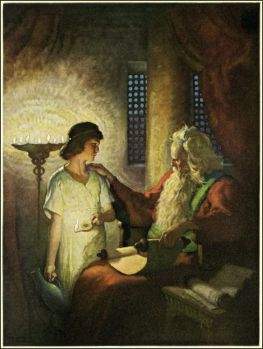
Meanwhile, the boy Samuel served the Lord by assisting Eli. Now in those days messages from the Lord were very rare, and visions were quite uncommon.
One night Eli, who was almost blind by now, had gone to bed. The lamp of God had not yet gone out, and Samuel was sleeping in the Tabernacle near the Ark of God. Suddenly the Lord called out, “Samuel!”
“Yes?” Samuel replied. “What is it?” He got up and ran to Eli. “Here I am. Did you call me?”
“I didn’t call you,” Eli replied. “Go back to bed.” So he did.
Then the Lord called out again, “Samuel!”
Again Samuel got up and went to Eli. “Here I am. Did you call me?”
“I didn’t call you, my son,” Eli said. “Go back to bed.”
Samuel did not yet know the Lord because he had never had a message from the Lord before. So the Lord called a third time, and once more Samuel got up and went to Eli. “Here I am. Did you call me?”
Then Eli realized it was the Lord who was calling the boy. So he said to Samuel, “Go and lie down again, and if someone calls again, say, ‘Speak, Lord, your servant is listening.’” So Samuel went back to bed.
And the Lord came and called as before, “Samuel! Samuel!”
And Samuel replied, “Speak, your servant is listening.”
Then the Lord said to Samuel, “I am about to do a shocking thing in Israel. I am going to carry out all my threats against Eli and his family, from beginning to end. I have warned him that judgment is coming upon his family forever, because his sons are blaspheming God and he hasn’t disciplined them. So I have vowed that the sins of Eli and his sons will never be forgiven by sacrifices or offerings.”
Samuel Speaks for the Lord
Samuel stayed in bed until morning, then got up and opened the doors of the Tabernacle as usual. He was afraid to tell Eli what the Lord had said to him. But Eli called out to him, “Samuel, my son.”
“Here I am,” Samuel replied.
“What did the Lord say to you? Tell me everything. And may God strike you and even kill you if you hide anything from me!” So Samuel told Eli everything; he didn’t hold anything back. “It is the Lord’s will,” Eli replied. “Let him do what he thinks best.”
As Samuel grew up, the Lord was with him, and everything Samuel said proved to be reliable. And all Israel, from Dan in the north to Beersheba in the south, knew that Samuel was confirmed as a prophet of the Lord. The Lord continued to appear at Shiloh and gave messages to Samuel there at the Tabernacle.
1 Samuel 4 (NLT) And Samuel’s words went out to all the people of Israel.
The Philistines Capture the Ark
+ Israel’s defeat – At that time Israel was at war with the Philistines. The Israelite army was camped near Ebenezer, and the Philistines were at Aphek. The Philistines attacked and defeated the army of Israel, killing 4,000 men. After the battle was over, the troops retreated to their camp, and the elders of Israel asked, “Why did the Lord allow us to be defeated by the Philistines?” Then they said, “Let’s bring the Ark of the Covenant of the Lord from Shiloh. If we carry it into battle with us, it will save us from our enemies.”
So they sent men to Shiloh to bring the Ark of the Covenant of the Lord of Heaven’s Armies, who is enthroned between the cherubim. Hophni and Phinehas, the sons of Eli, were also there with the Ark of the Covenant of God. When all the Israelites saw the Ark of the Covenant of the Lord coming into the camp, their shout of joy was so loud it made the ground shake!
+ Philistine’s desperation – “What’s going on?” the Philistines asked. “What’s all the shouting about in the Hebrew camp?” When they were told it was because the Ark of the Lord had arrived, they panicked. “The gods have come into their camp!” they cried. “This is a disaster! We have never had to face anything like this before! Help! Who can save us from these mighty gods of Israel? They are the same gods who destroyed the Egyptians with plagues when Israel was in the wilderness. Fight as never before, Philistines! If you don’t, we will become the Hebrews’ slaves just as they have been ours! Stand up like men and fight!”
+ Prophecy fulfilled – So the Philistines fought desperately, and Israel was defeated again. The slaughter was great; 30,000 Israelite soldiers died that day. The survivors turned and fled to their tents. The Ark of God was captured, and Hophni and Phinehas, the two sons of Eli, were killed.
The Death of Eli
+ Eli’s foreboding – A man from the tribe of Benjamin ran from the battlefield and arrived at Shiloh later that same day. He had torn his clothes and put dust on his head to show his grief. Eli was waiting beside the road to hear the news of the battle, for his heart trembled for the safety of the Ark of God. When the messenger arrived and told what had happened, an outcry resounded throughout the town.
“What is all the noise about?” Eli asked.
The messenger rushed over to Eli, who was ninety-eight years old and blind. He said to Eli, “I have just come from the battlefield—I was there this very day.”
“What happened, my son?” Eli demanded.
+ Disaster report – “Israel has been defeated by the Philistines,” the messenger replied. “The people have been slaughtered, and your two sons, Hophni and Phinehas, were also killed. And the Ark of God has been captured.”
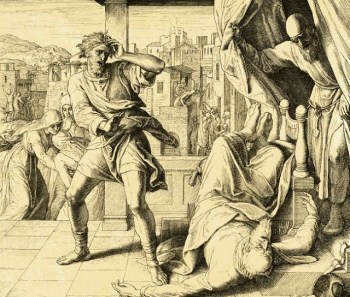
When the messenger mentioned what had happened to the Ark of God, Eli fell backward from his seat beside the gate. He broke his neck and died, for he was old and overweight. He had been Israel’s judge for forty years.
Eli’s daughter-in-law, the wife of Phinehas, was pregnant and near her time of delivery. When she heard that the Ark of God had been captured and that her father-in-law and husband were dead, she went into labor and gave birth. She died in childbirth, but before she passed away the midwives tried to encourage her. “Don’t be afraid,” they said. “You have a baby boy!” But she did not answer or pay attention to them.
+ A child named Ichabod – She named the child Ichabod (which means “Where is the glory?”), for she said, “Israel’s glory is gone.” She named him this because the Ark of God had been captured and because her father-in-law and husband were dead. Then she said, “The glory has departed from Israel, for the Ark of God has been captured.”
The Ark in Philistia
1 Samuel 5 (NLT)
+ Dagon broken – After the Philistines captured the Ark of God, they took it from the battleground at Ebenezer to the town of Ashdod. They carried the Ark of God into the temple of Dagon and placed it beside an idol of Dagon. But when the citizens of Ashdod went to see it the next morning, Dagon had fallen with his face to the ground in front of the Ark of the Lord! So they took Dagon and put him in his place again. But the next morning the same thing happened—Dagon had fallen face down before the Ark of the Lord again. This time his head and hands had broken off and were lying in the doorway. Only the trunk of his body was left intact. That is why to this day neither the priests of Dagon nor anyone who enters the temple of Dagon in Ashdod will step on its threshold.
+ Ashdod plagued – Then the Lord’s heavy hand struck the people of Ashdod and the nearby villages with a plague of tumors. When the people realized what was happening, they cried out, “We can’t keep the Ark of the God of Israel here any longer! He is against us! We will all be destroyed along with Dagon, our god.” So they called together the rulers of the Philistine towns and asked, “What should we do with the Ark of the God of Israel?”
+ Gath panics – The rulers discussed it and replied, “Move it to the town of Gath.” So they moved the Ark of the God of Israel to Gath. But when the Ark arrived at Gath, the Lord’s heavy hand fell on its men, young and old; he struck them with a plague of tumors, and there was a great panic.
+ Ekron punts – So they sent the Ark of God to the town of Ekron, but when the people of Ekron saw it coming they cried out, “They are bringing the Ark of the God of Israel here to kill us, too!” The people summoned the Philistine rulers again and begged them, “Please send the Ark of the God of Israel back to its own country, or it will kill us all.” For the deadly plague from God had already begun, and great fear was sweeping across the town. Those who didn’t die were afflicted with tumors; and the cry from the town rose to heaven.
__________
May the peace of the Lord Christ go with you, wherever He may send you. May He guide you through the wilderness, protect you through the storm. May He bring you home rejoicing at the wonders He has shown you. May He bring you home rejoicing once again into our doors.
__________
+ In the name of the Father, and the Son, and the Holy Spirit. Amen!
One thing I have asked of the Lord, this is what I seek: that I may dwell in the house of the Lord all the days of my life; to behold the beauty of the Lord and to seek Him in His temple.
Praise to You, Lord Jesus Christ, King of endless glory.
Reading: Genesis 40-43 (NLT)
Joseph Interprets Two Dreams
Genesis 40 (NLT)
Some time later, Pharaoh’s chief cup-bearer and chief baker offended their royal master. Pharaoh became angry with these two officials, and he put them in the prison where Joseph was, in the palace of the captain of the guard. They remained in prison for quite some time, and the captain of the guard assigned them to Joseph, who looked after them.
+ First dream – While they were in prison, Pharaoh’s cup-bearer and baker each had a dream one night, and each dream had its own meaning. When Joseph saw them the next morning, he noticed that they both looked upset. “Why do you look so worried today?” he asked them.
And they replied, “We both had dreams last night, but no one can tell us what they mean.”
“Interpreting dreams is God’s business,” Joseph replied. “Go ahead and tell me your dreams.”
So the chief cup-bearer told Joseph his dream first. “In my dream,” he said, “I saw a grapevine in front of me. The vine had three branches that began to bud and blossom, and soon it produced clusters of ripe grapes. I was holding Pharaoh’s wine cup in my hand, so I took a cluster of grapes and squeezed the juice into the cup. Then I placed the cup in Pharaoh’s hand.”
+ Good news for the cup-bearer – “This is what the dream means,” Joseph said. “The three branches represent three days. Within three days Pharaoh will lift you up and restore you to your position as his chief cup-bearer. And please remember me and do me a favor when things go well for you. Mention me to Pharaoh, so he might let me out of this place. For I was kidnapped from my homeland, the land of the Hebrews, and now I’m here in prison, but I did nothing to deserve it.”
+ Second dream – When the chief baker saw that Joseph had given the first dream such a positive interpretation, he said to Joseph, “I had a dream, too. In my dream there were three baskets of white pastries stacked on my head. The top basket contained all kinds of pastries for Pharaoh, but the birds came and ate them from the basket on my head.”
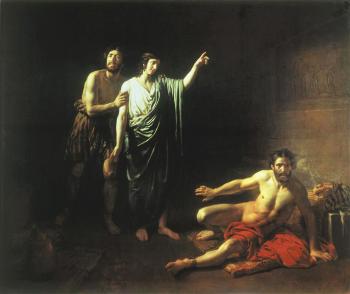
+ Bad news for the baker – “This is what the dream means,” Joseph told him. “The three baskets also represent three days. Three days from now Pharaoh will lift you up and impale your body on a pole. Then birds will come and peck away at your flesh.”
+ Joseph: out of sight, out of mind – Pharaoh’s birthday came three days later, and he prepared a banquet for all his officials and staff. He summoned his chief cup-bearer and chief baker to join the other officials. He then restored the chief cup-bearer to his former position, so he could again hand Pharaoh his cup. But Pharaoh impaled the chief baker, just as Joseph had predicted when he interpreted his dream. Pharaoh’s chief cup-bearer, however, forgot all about Joseph, never giving him another thought.
Pharaoh’s Dreams
Genesis 41 (NLT)
+ First dream – Two full years later, Pharaoh dreamed that he was standing on the bank of the Nile River. In his dream he saw seven fat, healthy cows come up out of the river and begin grazing in the marsh grass. Then he saw seven more cows come up behind them from the Nile, but these were scrawny and thin. These cows stood beside the fat cows on the riverbank. Then the scrawny, thin cows ate the seven healthy, fat cows! At this point in the dream, Pharaoh woke up.
+ Second dream – But he fell asleep again and had a second dream. This time he saw seven heads of grain, plump and beautiful, growing on a single stalk. Then seven more heads of grain appeared, but these were shriveled and withered by the east wind. And these thin heads swallowed up the seven plump, well-formed heads! Then Pharaoh woke up again and realized it was a dream.
The next morning Pharaoh was very disturbed by the dreams. So he called for all the magicians and wise men of Egypt. When Pharaoh told them his dreams, not one of them could tell him what they meant.
+ Joseph recalled – Finally, the king’s chief cup-bearer spoke up. “Today I have been reminded of my failure,” he told Pharaoh. “Some time ago, you were angry with the chief baker and me, and you imprisoned us in the palace of the captain of the guard. One night the chief baker and I each had a dream, and each dream had its own meaning. There was a young Hebrew man with us in the prison who was a slave of the captain of the guard. We told him our dreams, and he told us what each of our dreams meant. And everything happened just as he had predicted. I was restored to my position as cup-bearer, and the chief baker was executed and impaled on a pole.”
Pharaoh sent for Joseph at once, and he was quickly brought from the prison. After he shaved and changed his clothes, he went in and stood before Pharaoh. Then Pharaoh said to Joseph, “I had a dream last night, and no one here can tell me what it means. But I have heard that when you hear about a dream you can interpret it.”
“It is beyond my power to do this,” Joseph replied. “But God can tell you what it means and set you at ease.”
+ Dreams retold – So Pharaoh told Joseph his dream. “In my dream,” he said, “I was standing on the bank of the Nile River, and I saw seven fat, healthy cows come up out of the river and begin grazing in the marsh grass. But then I saw seven sick-looking cows, scrawny and thin, come up after them. I’ve never seen such sorry-looking animals in all the land of Egypt. These thin, scrawny cows ate the seven fat cows. But afterward you wouldn’t have known it, for they were still as thin and scrawny as before! Then I woke up.
“In my dream I also saw seven heads of grain, full and beautiful, growing on a single stalk. Then seven more heads of grain appeared, but these were blighted, shriveled, and withered by the east wind. And the shriveled heads swallowed the seven healthy heads. I told these dreams to the magicians, but no one could tell me what they mean.”
+ God’s warning to Pharaoh – Joseph responded, “Both of Pharaoh’s dreams mean the same thing. God is telling Pharaoh in advance what he is about to do. The seven healthy cows and the seven healthy heads of grain both represent seven years of prosperity. The seven thin, scrawny cows that came up later and the seven thin heads of grain, withered by the east wind, represent seven years of famine.
+ Prosperity followed by famine – “This will happen just as I have described it, for God has revealed to Pharaoh in advance what he is about to do. The next seven years will be a period of great prosperity throughout the land of Egypt. But afterward there will be seven years of famine so great that all the prosperity will be forgotten in Egypt. Famine will destroy the land. This famine will be so severe that even the memory of the good years will be erased. As for having two similar dreams, it means that these events have been decreed by God, and he will soon make them happen.
+ Plan ahead – “Therefore, Pharaoh should find an intelligent and wise man and put him in charge of the entire land of Egypt. Then Pharaoh should appoint supervisors over the land and let them collect one-fifth of all the crops during the seven good years. Have them gather all the food produced in the good years that are just ahead and bring it to Pharaoh’s storehouses. Store it away, and guard it so there will be food in the cities. That way there will be enough to eat when the seven years of famine come to the land of Egypt. Otherwise this famine will destroy the land.”
Joseph Made Ruler of Egypt
Joseph’s suggestions were well received by Pharaoh and his officials. So Pharaoh asked his officials, “Can we find anyone else like this man so obviously filled with the spirit of God?” Then Pharaoh said to Joseph, “Since God has revealed the meaning of the dreams to you, clearly no one else is as intelligent or wise as you are. You will be in charge of my court, and all my people will take orders from you. Only I, sitting on my throne, will have a rank higher than yours.”
Pharaoh said to Joseph, “I hereby put you in charge of the entire land of Egypt.” Then Pharaoh removed his signet ring from his hand and placed it on Joseph’s finger. He dressed him in fine linen clothing and hung a gold chain around his neck. Then he had Joseph ride in the chariot reserved for his second-in-command. And wherever Joseph went, the command was shouted, “Kneel down!” So Pharaoh put Joseph in charge of all Egypt. And Pharaoh said to him, “I am Pharaoh, but no one will lift a hand or foot in the entire land of Egypt without your approval.”
+ New name and wife – Then Pharaoh gave Joseph a new Egyptian name, Zaphenath-paneah. He also gave him a wife, whose name was Asenath. She was the daughter of Potiphera, the priest of On. So Joseph took charge of the entire land of Egypt. He was thirty years old when he began serving in the court of Pharaoh, the king of Egypt. And when Joseph left Pharaoh’s presence, he inspected the entire land of Egypt.
+ Seven years of plenty – As predicted, for seven years the land produced bumper crops. During those years, Joseph gathered all the crops grown in Egypt and stored the grain from the surrounding fields in the cities. He piled up huge amounts of grain like sand on the seashore. Finally, he stopped keeping records because there was too much to measure.
+ Joseph’s two sons – During this time, before the first of the famine years, two sons were born to Joseph and his wife, Asenath, the daughter of Potiphera, the priest of On. Joseph named his older son Manasseh, for he said, “God has made me forget all my troubles and everyone in my father’s family.” Joseph named his second son Ephraim, for he said, “God has made me fruitful in this land of my grief.”
+ Seven years of famine – At last the seven years of bumper crops throughout the land of Egypt came to an end. Then the seven years of famine began, just as Joseph had predicted. The famine also struck all the surrounding countries, but throughout Egypt there was plenty of food. Eventually, however, the famine spread throughout the land of Egypt as well. And when the people cried out to Pharaoh for food, he told them, “Go to Joseph, and do whatever he tells you.” So with severe famine everywhere, Joseph opened up the storehouses and distributed grain to the Egyptians, for the famine was severe throughout the land of Egypt. And people from all around came to Egypt to buy grain from Joseph because the famine was severe throughout the world.
Joseph’s Brothers Go to Egypt
Genesis 42 (NLT)
When Jacob heard that grain was available in Egypt, he said to his sons, “Why are you standing around looking at one another? I have heard there is grain in Egypt. Go down there, and buy enough grain to keep us alive. Otherwise we’ll die.”
So Joseph’s ten older brothers went down to Egypt to buy grain. But Jacob wouldn’t let Joseph’s younger brother, Benjamin, go with them, for fear some harm might come to him. So Jacob’s sons arrived in Egypt along with others to buy food, for the famine was in Canaan as well.
+ Joseph recognizes his brothers – Since Joseph was governor of all Egypt and in charge of selling grain to all the people, it was to him that his brothers came. When they arrived, they bowed before him with their faces to the ground. Joseph recognized his brothers instantly, but he pretended to be a stranger and spoke harshly to them. “Where are you from?” he demanded.
“From the land of Canaan,” they replied. “We have come to buy food.”
+ Joseph remembers his dreams – Although Joseph recognized his brothers, they didn’t recognize him. And he remembered the dreams he’d had about them many years before. He said to them, “You are spies! You have come to see how vulnerable our land has become.”
“No, my lord!” they exclaimed. “Your servants have simply come to buy food. We are all brothers—members of the same family. We are honest men, sir! We are not spies!”
“Yes, you are!” Joseph insisted. “You have come to see how vulnerable our land has become.”
“Sir,” they said, “there are actually twelve of us. We, your servants, are all brothers, sons of a man living in the land of Canaan. Our youngest brother is back there with our father right now, and one of our brothers is no longer with us.”
+ Joseph tests his brothers – But Joseph insisted, “As I said, you are spies! This is how I will test your story. I swear by the life of Pharaoh that you will never leave Egypt unless your youngest brother comes here! One of you must go and get your brother. I’ll keep the rest of you here in prison. Then we’ll find out whether or not your story is true. By the life of Pharaoh, if it turns out that you don’t have a younger brother, then I’ll know you are spies.”
So Joseph put them all in prison for three days. On the third day Joseph said to them, “I am a God-fearing man. If you do as I say, you will live. If you really are honest men, choose one of your brothers to remain in prison. The rest of you may go home with grain for your starving families. But you must bring your youngest brother back to me. This will prove that you are telling the truth, and you will not die.” To this they agreed.
+ Joseph’s brothers lament – Speaking among themselves, they said, “Clearly we are being punished because of what we did to Joseph long ago. We saw his anguish when he pleaded for his life, but we wouldn’t listen. That’s why we’re in this trouble.”
“Didn’t I tell you not to sin against the boy?” Reuben asked. “But you wouldn’t listen. And now we have to answer for his blood!”
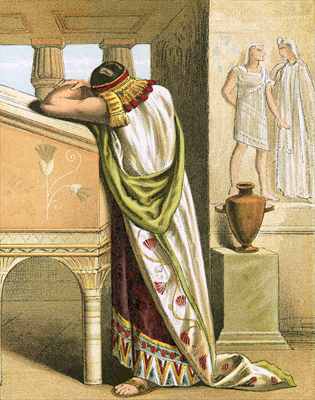
+ Simeon taken as surety – Of course, they didn’t know that Joseph understood them, for he had been speaking to them through an interpreter. Now he turned away from them and began to weep. When he regained his composure, he spoke to them again. Then he chose Simeon from among them and had him tied up right before their eyes.
+ Joseph’s brothers return home – Joseph then ordered his servants to fill the men’s sacks with grain, but he also gave secret instructions to return each brother’s payment at the top of his sack. He also gave them supplies for their journey home. So the brothers loaded their donkeys with the grain and headed for home.
+ Joseph’s largesse – But when they stopped for the night and one of them opened his sack to get grain for his donkey, he found his money in the top of his sack. “Look!” he exclaimed to his brothers. “My money has been returned; it’s here in my sack!” Then their hearts sank. Trembling, they said to each other, “What has God done to us?”
+ Brothers report to Jacob – When the brothers came to their father, Jacob, in the land of Canaan, they told him everything that had happened to them. “The man who is governor of the land spoke very harshly to us,” they told him. “He accused us of being spies scouting the land. But we said, ‘We are honest men, not spies. We are twelve brothers, sons of one father. One brother is no longer with us, and the youngest is at home with our father in the land of Canaan.’
“Then the man who is governor of the land told us, ‘This is how I will find out if you are honest men. Leave one of your brothers here with me, and take grain for your starving families and go on home. But you must bring your youngest brother back to me. Then I will know you are honest men and not spies. Then I will give you back your brother, and you may trade freely in the land.’”
+ Jacob’s alarm – As they emptied out their sacks, there in each man’s sack was the bag of money he had paid for the grain! The brothers and their father were terrified when they saw the bags of money. Jacob exclaimed, “You are robbing me of my children! Joseph is gone! Simeon is gone! And now you want to take Benjamin, too. Everything is going against me!”
Then Reuben said to his father, “You may kill my two sons if I don’t bring Benjamin back to you. I’ll be responsible for him, and I promise to bring him back.”
+ Jacob laments – But Jacob replied, “My son will not go down with you. His brother Joseph is dead, and he is all I have left. If anything should happen to him on your journey, you would send this grieving, white-haired man to his grave.”
The Brothers Return to Egypt
Genesis 43 (NLT)
But the famine continued to ravage the land of Canaan. When the grain they had brought from Egypt was almost gone, Jacob said to his sons, “Go back and buy us a little more food.”
+ Jacob’s dilemma – But Judah said, “The man was serious when he warned us, ‘You won’t see my face again unless your brother is with you.’ If you send Benjamin with us, we will go down and buy more food. But if you don’t let Benjamin go, we won’t go either. Remember, the man said, ‘You won’t see my face again unless your brother is with you.’”
“Why were you so cruel to me?” Jacob moaned. “Why did you tell him you had another brother?”
“The man kept asking us questions about our family,” they replied. “He asked, ‘Is your father still alive? Do you have another brother?’ So we answered his questions. How could we know he would say, ‘Bring your brother down here’?”
Judah said to his father, “Send the boy with me, and we will be on our way. Otherwise we will all die of starvation—and not only we, but you and our little ones. I personally guarantee his safety. You may hold me responsible if I don’t bring him back to you. Then let me bear the blame forever. If we hadn’t wasted all this time, we could have gone and returned twice by now.”
+ Jacob relies on God’s mercy – So their father, Jacob, finally said to them, “If it can’t be avoided, then at least do this. Pack your bags with the best products of this land. Take them down to the man as gifts—balm, honey, gum, aromatic resin, pistachio nuts, and almonds. Also take double the money that was put back in your sacks, as it was probably someone’s mistake. Then take your brother, and go back to the man. May God Almighty give you mercy as you go before the man, so that he will release Simeon and let Benjamin return. But if I must lose my children, so be it.”
+ Return to Egypt – So the men packed Jacob’s gifts and double the money and headed off with Benjamin. They finally arrived in Egypt and presented themselves to Joseph. When Joseph saw Benjamin with them, he said to the manager of his household, “These men will eat with me this noon. Take them inside the palace. Then go slaughter an animal, and prepare a big feast.” So the man did as Joseph told him and took them into Joseph’s palace.
The brothers were terrified when they saw that they were being taken into Joseph’s house. “It’s because of the money someone put in our sacks last time we were here,” they said. “He plans to pretend that we stole it. Then he will seize us, make us slaves, and take our donkeys.”
A Feast at Joseph’s Palace
+ Fears abound – The brothers approached the manager of Joseph’s household and spoke to him at the entrance to the palace. “Sir,” they said, “we came to Egypt once before to buy food. But as we were returning home, we stopped for the night and opened our sacks. Then we discovered that each man’s money—the exact amount paid—was in the top of his sack! Here it is; we have brought it back with us. We also have additional money to buy more food. We have no idea who put our money in our sacks.”
+ Fears relieved – “Relax. Don’t be afraid,” the household manager told them. “Your God, the God of your father, must have put this treasure into your sacks. I know I received your payment.” Then he released Simeon and brought him out to them.
The manager then led the men into Joseph’s palace. He gave them water to wash their feet and provided food for their donkeys. They were told they would be eating there, so they prepared their gifts for Joseph’s arrival at noon.
+ Gifts proffered – When Joseph came home, they gave him the gifts they had brought him, then bowed low to the ground before him. After greeting them, he asked, “How is your father, the old man you spoke about? Is he still alive?”
“Yes,” they replied. “Our father, your servant, is alive and well.” And they bowed low again.
+ Benjamin introduced – Then Joseph looked at his brother Benjamin, the son of his own mother. “Is this your youngest brother, the one you told me about?” Joseph asked. “May God be gracious to you, my son.” Then Joseph hurried from the room because he was overcome with emotion for his brother. He went into his private room, where he broke down and wept. After washing his face, he came back out, keeping himself under control. Then he ordered, “Bring out the food!”
+ The feast – The waiters served Joseph at his own table, and his brothers were served at a separate table. The Egyptians who ate with Joseph sat at their own table, because Egyptians despise Hebrews and refuse to eat with them. Joseph told each of his brothers where to sit, and to their amazement, he seated them according to age, from oldest to youngest. And Joseph filled their plates with food from his own table, giving Benjamin five times as much as he gave the others. So they feasted and drank freely with him.
__________
May the peace of the Lord Christ go with you, wherever He may send you. May He guide you through the wilderness, protect you through the storm. May He bring you home rejoicing at the wonders He has shown you. May He bring you home rejoicing once again into our doors.
__________
+ In the name of the Father, and the Son, and the Holy Spirit. Amen!

 This is the Good News about Jesus the Messiah, the Son of God. It began just as the prophet Isaiah had written:
 The Spirit then compelled Jesus to go into the wilderness, where he was tempted by Satan for forty days. He was out among the wild animals, and angels took care of him.
 Amazement gripped the audience, and they began to discuss what had happened. “What sort of new teaching is this?” they asked excitedly. “It has such authority! Even evil spirits obey his orders!” The news about Jesus spread quickly throughout the entire region of Galilee.
 Moved with compassion, Jesus reached out and touched him. “I am willing,” he said. “Be healed!” Instantly the leprosy disappeared, and the man was healed. Then Jesus sent him on his way with a stern warning: “Don’t tell anyone about this. Instead, go to the priest and let him examine you. Take along the offering required in the law of Moses for those who have been healed of leprosy. This will be a public testimony that you have been cleansed.”
 But some of the teachers of religious law who were sitting there thought to themselves, “What is he saying? This is blasphemy! Only God can forgive sins!”
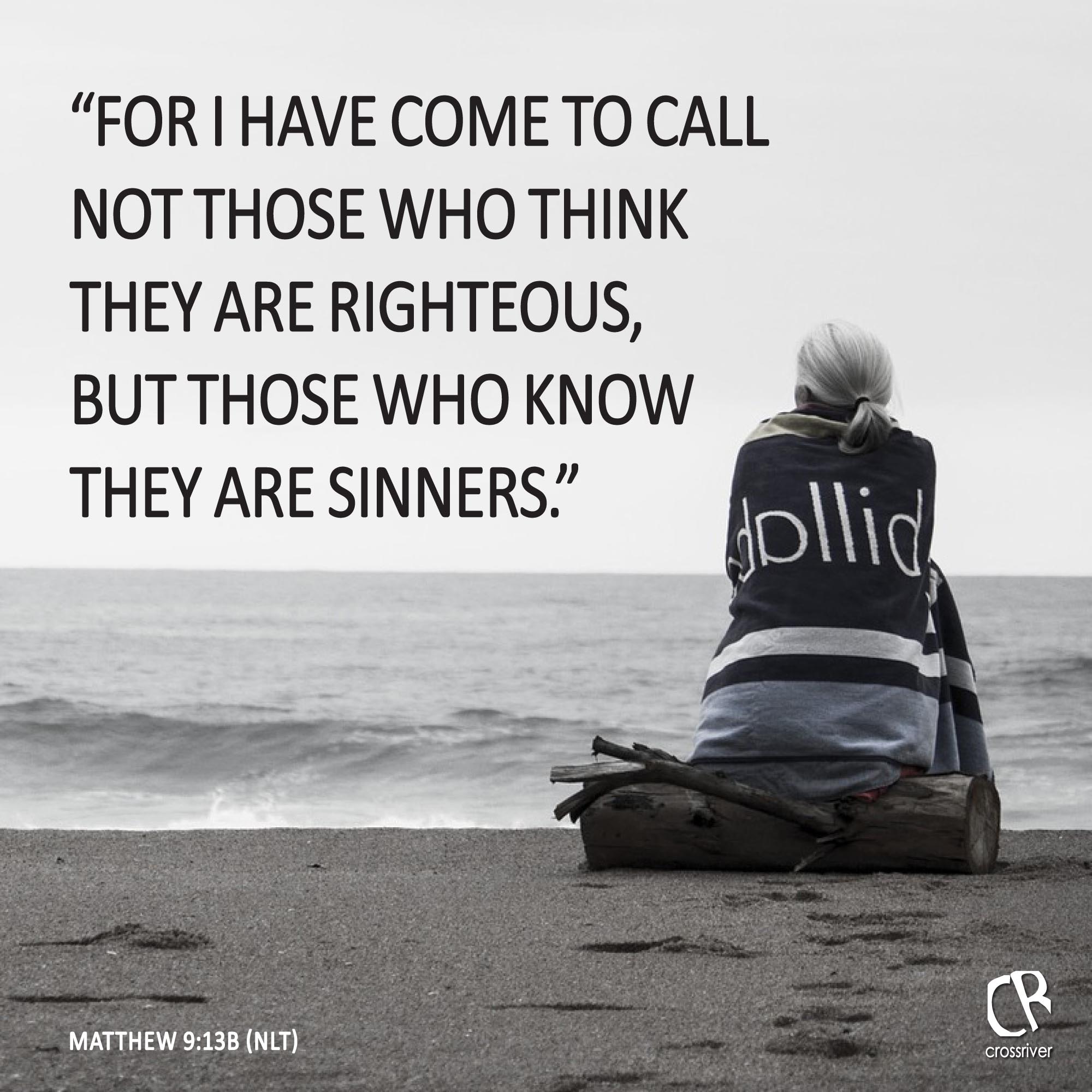 When Jesus heard this, he told them, “Healthy people don’t need a doctor—sick people do. I have come to call not those who think they are righteous, but those who know they are sinners.”






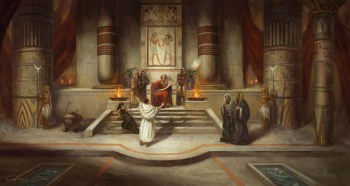 Pharaoh sent for Joseph at once, and he was quickly brought from the prison. After he shaved and changed his clothes, he went in and stood before Pharaoh. Then Pharaoh said to Joseph, “I had a dream last night, and no one here can tell me what it means. But I have heard that when you hear about a dream you can interpret it.”


 The Peanut Gallery