One thing I have asked of the Lord, this is what I seek: that I may dwell in the house of the Lord all the days of my life; to behold the beauty of the Lord and to seek Him in His temple.
Praise to You, Lord Jesus Christ, King of endless glory.
Reading: Job 37-38 (NLT)
Elihu continues
Job 37 (NLT)
+ God’s power is displayed in storms– “My heart pounds as I think of this. It trembles within me. Listen carefully to the thunder of God’s voice as it rolls from his mouth. It rolls across the heavens, and his lightning flashes in every direction. Then comes the roaring of the thunder—the tremendous voice of his majesty. He does not restrain it when he speaks. God’s voice is glorious in the thunder. We can’t even imagine the greatness of his power.
+ God’s power is displayed in nature – “He directs the snow to fall on the earth and tells the rain to pour down. Then everyone stops working so they can watch his power. The wild animals take cover and stay inside their dens. The stormy wind comes from its chamber, and the driving winds bring the cold. God’s breath sends the ice, freezing wide expanses of water. He loads the clouds with moisture, and they flash with his lightning. The clouds churn about at his direction. They do whatever he commands throughout the earth. He makes these things happen either to punish people or to show his unfailing love.
+ God’s power is displayed in miracles – “Pay attention to this, Job. Stop and consider the wonderful miracles of God! Do you know how God controls the storm and causes the lightning to flash from his clouds? Do you understand how he moves the clouds with wonderful perfection and skill? When you are sweltering in your clothes and the south wind dies down and everything is still, he makes the skies reflect the heat like a bronze mirror. Can you do that?
+ We cannot imagine the power of God – “So teach the rest of us what to say to God. We are too ignorant to make our own arguments. Should God be notified that I want to speak? Can people even speak when they are confused? We cannot look at the sun, for it shines brightly in the sky when the wind clears away the clouds. So also, golden splendor comes from the mountain of God. He is clothed in dazzling splendor. We cannot imagine the power of the Almighty; but even though he is just and righteous, he does not destroy us. No wonder people everywhere fear him. All who are wise show him reverence.”
The Lord Challenges Job
Job 38 (NLT)
Then the Lord answered Job from the whirlwind:
+ Brace yourself – “Who is this that questions my wisdom with such ignorant words? Brace yourself like a man, because I have some questions for you, and you must answer them.
+ Where were you at Creation? – “Where were you when I laid the foundations of the earth? Tell me, if you know so much. Who determined its dimensions and stretched out the surveying line? What supports its foundations, and who laid its cornerstone as the morning stars sang together and all the angels shouted for joy?
+ Who set shoreline boundaries? – “Who kept the sea inside its boundaries as it burst from the womb, and as I clothed it with clouds and wrapped it in thick darkness? For I locked it behind barred gates, limiting its shores. I said, ‘This far and no farther will you come. Here your proud waves must stop!’
+ Who causes the sun to rise? – “Have you ever commanded the morning to appear and caused the dawn to rise in the east? Have you made daylight spread to the ends of the earth, to bring an end to the night’s wickedness? As the light approaches, the earth takes shape like clay pressed beneath a seal; it is robed in brilliant colors. The light disturbs the wicked and stops the arm that is raised in violence.
+ Who made the depths of the earth? – “Have you explored the springs from which the seas come? Have you explored their depths? Do you know where the gates of death are located? Have you seen the gates of utter gloom? Do you realize the extent of the earth? Tell me about it if you know!
+ Who made light and darkness? – “Where does light come from, and where does darkness go? Can you take each to its home? Do you know how to get there? But of course you know all this! For you were born before it was all created, and you are so very experienced!
+ Who makes snow and hail? – “Have you visited the storehouses of the snow or seen the storehouses of hail? (I have reserved them as weapons for the time of trouble, for the day of battle and war.) Where is the path to the source of light? Where is the home of the east wind?
+ Who sends rain and makes grass? – “Who created a channel for the torrents of rain? Who laid out the path for the lightning? Who makes the rain fall on barren land, in a desert where no one lives? Who sends rain to satisfy the parched ground and make the tender grass spring up?
+ Who makes ice and frost? – “Does the rain have a father? Who gives birth to the dew? Who is the mother of the ice? Who gives birth to the frost from the heavens? For the water turns to ice as hard as rock, and the surface of the water freezes.
+ Who moves the stars? – “Can you direct the movement of the stars—binding the cluster of the Pleiades or loosening the cords of Orion? Can you direct the constellations through the seasons or guide the Bear with her cubs across the heavens? Do you know the laws of the universe? Can you use them to regulate the earth?
+ Who gives intuition and instinct? – “Can you shout to the clouds and make it rain? Can you make lightning appear and cause it to strike as you direct? Who gives intuition to the heart and instinct to the mind? Who is wise enough to count all the clouds? Who can tilt the water jars of heaven when the parched ground is dry and the soil has hardened into clods?
+ Who provides food for young animals? – “Can you stalk prey for a lioness and satisfy the young lions’ appetites as they lie in their dens or crouch in the thicket? Who provides food for the ravens when their young cry out to God and wander about in hunger?
__________
May the peace of the Lord Christ go with you, wherever He may send you. May He guide you through the wilderness, protect you through the storm. May He bring you home rejoicing at the wonders He has shown you. May He bring you home rejoicing once again into our doors.
__________
+ In the name of the Father, and the Son, and the Holy Spirit. Amen!
One thing I have asked of the Lord, this is what I seek: that I may dwell in the house of the Lord all the days of my life; to behold the beauty of the Lord and to seek Him in His temple.
Praise to You, Lord Jesus Christ, King of endless glory.
Reading: 2 Samuel 5-9 (NLT)
David Becomes King of All Israel
2 Samuel 5 (NLT)
Then all the tribes of Israel went to David at Hebron and told him, “We are your own flesh and blood. In the past, when Saul was our king, you were the one who really led the forces of Israel. And the Lord told you, ‘You will be the shepherd of my people Israel. You will be Israel’s leader.’”
So there at Hebron, King David made a covenant before the Lord with all the elders of Israel. And they anointed him king of Israel.
David was thirty years old when he began to reign, and he reigned forty years in all. He had reigned over Judah from Hebron for seven years and six months, and from Jerusalem he reigned over all Israel and Judah for thirty-three years.
David Captures Jerusalem
David then led his men to Jerusalem to fight against the Jebusites, the original inhabitants of the land who were living there. The Jebusites taunted David, saying, “You’ll never get in here! Even the blind and lame could keep you out!” For the Jebusites thought they were safe. But David captured the fortress of Zion, which is now called the City of David.
On the day of the attack, David said to his troops, “I hate those ‘lame’ and ‘blind’ Jebusites. Whoever attacks them should strike by going into the city through the water tunnel.” That is the origin of the saying, “The blind and the lame may not enter the house.”
So David made the fortress his home, and he called it the City of David. He extended the city, starting at the supporting terraces and working inward. And David became more and more powerful, because the Lord God of Heaven’s Armies was with him.
Then King Hiram of Tyre sent messengers to David, along with cedar timber and carpenters and stonemasons, and they built David a palace. And David realized that the Lord had confirmed him as king over Israel and had blessed his kingdom for the sake of his people Israel.
After moving from Hebron to Jerusalem, David married more concubines and wives, and they had more sons and daughters. These are the names of David’s sons who were born in Jerusalem: Shammua, Shobab, Nathan, Solomon, Ibhar, Elishua, Nepheg, Japhia, Elishama, Eliada, and Eliphelet.
David Conquers the Philistines
When the Philistines heard that David had been anointed king of Israel, they mobilized all their forces to capture him. But David was told they were coming, so he went into the stronghold. The Philistines arrived and spread out across the valley of Rephaim. So David asked the Lord, “Should I go out to fight the Philistines? Will you hand them over to me?”
The Lord replied to David, “Yes, go ahead. I will certainly hand them over to you.”
So David went to Baal-perazim and defeated the Philistines there. “The Lord did it!” David exclaimed. “He burst through my enemies like a raging flood!” So he named that place Baal-perazim (which means “the Lord who bursts through”). The Philistines had abandoned their idols there, so David and his men confiscated them.
But after a while the Philistines returned and again spread out across the valley of Rephaim. And again David asked the Lord what to do. “Do not attack them straight on,” the Lord replied. “Instead, circle around behind and attack them near the poplar trees. When you hear a sound like marching feet in the tops of the poplar trees, be on the alert! That will be the signal that the Lord is moving ahead of you to strike down the Philistine army.” So David did what the Lord commanded, and he struck down the Philistines all the way from Gibeon to Gezer.
Moving the Ark to Jerusalem
2 Samuel 6 (NLT)
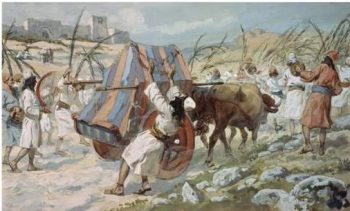
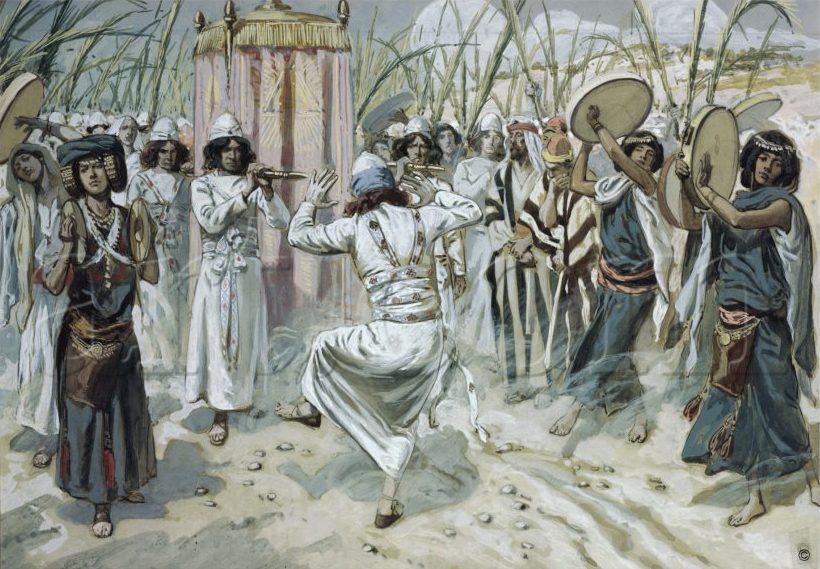
Then David again gathered all the elite troops in Israel, 30,000 in all. He led them to Baalah of Judah to bring back the Ark of God, which bears the name of the Lord of Heaven’s Armies, who is enthroned between the cherubim. They placed the Ark of God on a new cart and brought it from Abinadab’s house, which was on a hill. Uzzah and Ahio, Abinadab’s sons, were guiding the cart that carried the Ark of God. Ahio walked in front of the Ark. David and all the people of Israel were celebrating before the Lord, singing songs and playing all kinds of musical instruments—lyres, harps, tambourines, castanets, and cymbals.
But when they arrived at the threshing floor of Nacon, the oxen stumbled, and Uzzah reached out his hand and steadied the Ark of God. Then the Lord’s anger was aroused against Uzzah, and God struck him dead because of this. So Uzzah died right there beside the Ark of God.
David was angry because the Lord’s anger had burst out against Uzzah. He named that place Perez-uzzah (which means “to burst out against Uzzah”), as it is still called today.
David was now afraid of the Lord, and he asked, “How can I ever bring the Ark of the Lord back into my care?” So David decided not to move the Ark of the Lord into the City of David. Instead, he took it to the house of Obed-edom of Gath. The Ark of the Lord remained there in Obed-edom’s house for three months, and the Lord blessed Obed-edom and his entire household.
Then King David was told, “The Lord has blessed Obed-edom’s household and everything he has because of the Ark of God.” David went there and brought the Ark of God from the house of Obed-edom to the City of David with a great celebration. After the men who were carrying the Ark of the Lord had gone six steps, David sacrificed a bull and a fattened calf. And David danced before the Lord with all his might, wearing a priestly garment. So David and all the people of Israel brought up the Ark of the Lord with shouts of joy and the blowing of rams’ horns.
Michal’s Contempt for David
But as the Ark of the Lord entered the City of David, Michal, the daughter of Saul, looked down from her window. When she saw King David leaping and dancing before the Lord, she was filled with contempt for him.
They brought the Ark of the Lord and set it in its place inside the special tent David had prepared for it. And David sacrificed burnt offerings and peace offerings to the Lord. When he had finished his sacrifices, David blessed the people in the name of the Lord of Heaven’s Armies. Then he gave to every Israelite man and woman in the crowd a loaf of bread, a cake of dates, and a cake of raisins. Then all the people returned to their homes.
When David returned home to bless his own family, Michal, the daughter of Saul, came out to meet him. She said in disgust, “How distinguished the king of Israel looked today, shamelessly exposing himself to the servant girls like any vulgar person might do!”
David retorted to Michal, “I was dancing before the Lord, who chose me above your father and all his family! He appointed me as the leader of Israel, the people of the Lord, so I celebrate before the Lord. Yes, and I am willing to look even more foolish than this, even to be humiliated in my own eyes! But those servant girls you mentioned will indeed think I am distinguished!” So Michal, the daughter of Saul, remained childless throughout her entire life.
The Lord’s Covenant Promise to David
2 Samuel 7 (NLT)
When King David was settled in his palace and the Lord had given him rest from all the surrounding enemies, the king summoned Nathan the prophet. “Look,” David said, “I am living in a beautiful cedar palace, but the Ark of God is out there in a tent!”
Nathan replied to the king, “Go ahead and do whatever you have in mind, for the Lord is with you.”
But that same night the Lord said to Nathan,
“Go and tell my servant David, ‘This is what the Lord has declared: Are you the one to build a house for me to live in? I have never lived in a house, from the day I brought the Israelites out of Egypt until this very day. I have always moved from one place to another with a tent and a Tabernacle as my dwelling. Yet no matter where I have gone with the Israelites, I have never once complained to Israel’s tribal leaders, the shepherds of my people Israel. I have never asked them, “Why haven’t you built me a beautiful cedar house?”’
“Now go and say to my servant David, ‘This is what the Lord of Heaven’s Armies has declared: I took you from tending sheep in the pasture and selected you to be the leader of my people Israel. I have been with you wherever you have gone, and I have destroyed all your enemies before your eyes.
Now I will make your name as famous as anyone who has ever lived on the earth!
And I will provide a homeland for my people Israel, planting them in a secure place where they will never be disturbed. Evil nations won’t oppress them as they’ve done in the past, starting from the time I appointed judges to rule my people Israel.
And I will give you rest from all your enemies.
“‘Furthermore, the Lord declares that he will make a house for you—a dynasty of kings! For when you die and are buried with your ancestors, I will raise up one of your descendants, your own offspring, and I will make his kingdom strong. He is the one who will build a house—a temple—for my name. And I will secure his royal throne forever. I will be his father, and he will be my son. If he sins, I will correct and discipline him with the rod, like any father would do. But my favor will not be taken from him as I took it from Saul, whom I removed from your sight.
Your house and your kingdom will continue before me for all time, and your throne will be secure forever.’”
So Nathan went back to David and told him everything the Lord had said in this vision.
David’s Prayer of Thanks
Then King David went in and sat before the Lord and prayed,
“Who am I, O Sovereign Lord, and what is my family, that you have brought me this far? And now, Sovereign Lord, in addition to everything else, you speak of giving your servant a lasting dynasty! Do you deal with everyone this way, O Sovereign Lord?
“What more can I say to you? You know what your servant is really like, Sovereign Lord. Because of your promise and according to your will, you have done all these great things and have made them known to your servant.
“How great you are, O Sovereign Lord! There is no one like you. We have never even heard of another God like you! What other nation on earth is like your people Israel? What other nation, O God, have you redeemed from slavery to be your own people? You made a great name for yourself when you redeemed your people from Egypt. You performed awesome miracles and drove out the nations and gods that stood in their way. You made Israel your very own people forever, and you, O Lord, became their God.
“And now, O Lord God, I am your servant; do as you have promised concerning me and my family. Confirm it as a promise that will last forever. And may your name be honored forever so that everyone will say, ‘The Lord of Heaven’s Armies is God over Israel!’ And may the house of your servant David continue before you forever.
“O Lord of Heaven’s Armies, God of Israel, I have been bold enough to pray this prayer to you because you have revealed all this to your servant, saying, ‘I will build a house for you—a dynasty of kings!’ For you are God, O Sovereign Lord. Your words are truth, and you have promised these good things to your servant. And now, may it please you to bless the house of your servant, so that it may continue forever before you. For you have spoken, and when you grant a blessing to your servant, O Sovereign Lord, it is an eternal blessing!”
David’s Military Victories
2 Samuel 8 (NLT)
After this, David defeated and subdued the Philistines by conquering Gath, their largest town. David also conquered the land of Moab. He made the people lie down on the ground in a row, and he measured them off in groups with a length of rope. He measured off two groups to be executed for every one group to be spared. The Moabites who were spared became David’s subjects and paid him tribute money.
David also destroyed the forces of Hadadezer son of Rehob, king of Zobah, when Hadadezer marched out to strengthen his control along the Euphrates River. David captured 1,000 chariots, 7,000 charioteers, and 20,000 foot soldiers. He crippled all the chariot horses except enough for 100 chariots.
When Arameans from Damascus arrived to help King Hadadezer, David killed 22,000 of them. Then he placed several army garrisons in Damascus, the Aramean capital, and the Arameans became David’s subjects and paid him tribute money. So the Lord made David victorious wherever he went.
David brought the gold shields of Hadadezer’s officers to Jerusalem, along with a large amount of bronze from Hadadezer’s towns of Tebah and Berothai.
When King Toi of Hamath heard that David had destroyed the entire army of Hadadezer, he sent his son Joram to congratulate King David for his successful campaign. Hadadezer and Toi had been enemies and were often at war. Joram presented David with many gifts of silver, gold, and bronze.
King David dedicated all these gifts to the Lord, as he did with the silver and gold from the other nations he had defeated— from Edom, Moab, Ammon, Philistia, and Amalek—and from Hadadezer son of Rehob, king of Zobah.
So David became even more famous when he returned from destroying 18,000 Edomites in the Valley of Salt. He placed army garrisons throughout Edom, and all the Edomites became David’s subjects. In fact, the Lord made David victorious wherever he went.
So David reigned over all Israel and did what was just and right for all his people. Joab son of Zeruiah was commander of the army. Jehoshaphat son of Ahilud was the royal historian. Zadok son of Ahitub and Ahimelech son of Abiathar were the priests. Seraiah was the court secretary. Benaiah son of Jehoiada was captain of the king’s bodyguard. And David’s sons served as priestly leaders.
David’s Kindness to Mephibosheth
2 Samuel 9 (NLT)
One day David asked, “Is anyone in Saul’s family still alive—anyone to whom I can show kindness for Jonathan’s sake?” He summoned a man named Ziba, who had been one of Saul’s servants. “Are you Ziba?” the king asked.
“Yes sir, I am,” Ziba replied.
The king then asked him, “Is anyone still alive from Saul’s family? If so, I want to show God’s kindness to them.”
Ziba replied, “Yes, one of Jonathan’s sons is still alive. He is crippled in both feet.”
“Where is he?” the king asked.
“In Lo-debar,” Ziba told him, “at the home of Makir son of Ammiel.”
So David sent for him and brought him from Makir’s home. His name was Mephibosheth; he was Jonathan’s son and Saul’s grandson. When he came to David, he bowed low to the ground in deep respect. David said, “Greetings, Mephibosheth.”
Mephibosheth replied, “I am your servant.”
“Don’t be afraid!” David said. “I intend to show kindness to you because of my promise to your father, Jonathan. I will give you all the property that once belonged to your grandfather Saul, and you will eat here with me at the king’s table!”
Mephibosheth bowed respectfully and exclaimed, “Who is your servant, that you should show such kindness to a dead dog like me?”
Then the king summoned Saul’s servant Ziba and said, “I have given your master’s grandson everything that belonged to Saul and his family. You and your sons and servants are to farm the land for him to produce food for your master’s household. But Mephibosheth, your master’s grandson, will eat here at my table.” (Ziba had fifteen sons and twenty servants.)
Ziba replied, “Yes, my lord the king; I am your servant, and I will do all that you have commanded.” And from that time on, Mephibosheth ate regularly at David’s table, like one of the king’s own sons.
Mephibosheth had a young son named Mica. From then on, all the members of Ziba’s household were Mephibosheth’s servants. And Mephibosheth, who was crippled in both feet, lived in Jerusalem and ate regularly at the king’s table.
__________
May the peace of the Lord Christ go with you, wherever He may send you. May He guide you through the wilderness, protect you through the storm. May He bring you home rejoicing at the wonders He has shown you. May He bring you home rejoicing once again into our doors.
__________
+ In the name of the Father, and the Son, and the Holy Spirit. Amen!
One thing I have asked of the Lord, this is what I seek: that I may dwell in the house of the Lord all the days of my life; to behold the beauty of the Lord and to seek Him in His temple.
Praise to You, Lord Jesus Christ, King of endless glory.
Reading: Exodus 17-20 (NLT)
Water from the Rock
Exodus 17 (NLT)
At the Lord’s command, the whole community of Israel left the wilderness of Sin and moved from place to place. Eventually they camped at Rephidim, but there was no water there for the people to drink. So once more the people complained against Moses. “Give us water to drink!” they demanded.
“Quiet!” Moses replied. “Why are you complaining against me? And why are you testing the Lord?”
+ Israelites complain – But tormented by thirst, they continued to argue with Moses. “Why did you bring us out of Egypt? Are you trying to kill us, our children, and our livestock with thirst?”
+ Moses prays – Then Moses cried out to the Lord, “What should I do with these people? They are ready to stone me!”
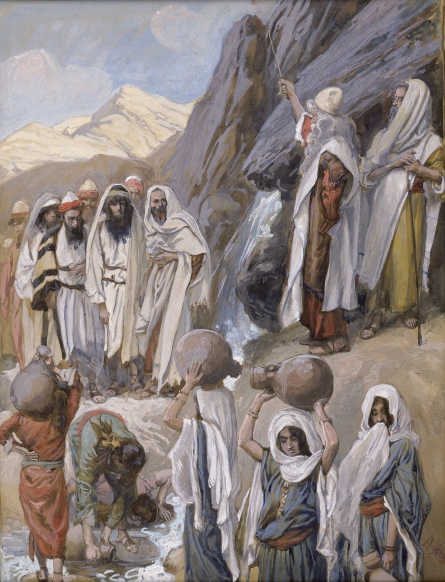
+ God supplies – The Lord said to Moses, “Walk out in front of the people. Take your staff, the one you used when you struck the water of the Nile, and call some of the elders of Israel to join you. I will stand before you on the rock at Mount Sinai. Strike the rock, and water will come gushing out. Then the people will be able to drink.” So Moses struck the rock as he was told, and water gushed out as the elders looked on.
+ God tested – Moses named the place Massah (which means “test”) and Meribah (which means “arguing”) because the people of Israel argued with Moses and tested the Lord by saying, “Is the Lord here with us or not?”
Israel Defeats the Amalekites
While the people of Israel were still at Rephidim, the warriors of Amalek attacked them. Moses commanded Joshua, “Choose some men to go out and fight the army of Amalek for us. Tomorrow, I will stand at the top of the hill, holding the staff of God in my hand.”
+ Moses prays / Joshua fights – So Joshua did what Moses had commanded and fought the army of Amalek. Meanwhile, Moses, Aaron, and Hur climbed to the top of a nearby hill. As long as Moses held up the staff in his hand, the Israelites had the advantage. But whenever he dropped his hand, the Amalekites gained the advantage. Moses’ arms soon became so tired he could no longer hold them up. So Aaron and Hur found a stone for him to sit on. Then they stood on each side of Moses, holding up his hands. So his hands held steady until sunset. As a result, Joshua overwhelmed the army of Amalek in battle.
+ God wins – After the victory, the Lord instructed Moses, “Write this down on a scroll as a permanent reminder, and read it aloud to Joshua: I will erase the memory of Amalek from under heaven.” Moses built an altar there and named it Yahweh-Nissi (which means “the Lord is my banner”). He said, “They have raised their fist against the Lord’s throne, so now the Lord will be at war with Amalek generation after generation.”
Jethro’s Visit to Moses
Exodus 18 (NLT)
Moses’ father-in-law, Jethro, the priest of Midian, heard about everything God had done for Moses and his people, the Israelites. He heard especially about how the Lord had rescued them from Egypt.
+ Moses’ family reunion – Earlier, Moses had sent his wife, Zipporah, and his two sons back to Jethro, who had taken them in. (Moses’ first son was named Gershom, for Moses had said when the boy was born, “I have been a foreigner in a foreign land.” His second son was named Eliezer, for Moses had said, “The God of my ancestors was my helper; he rescued me from the sword of Pharaoh.”) Jethro, Moses’ father-in-law, now came to visit Moses in the wilderness. He brought Moses’ wife and two sons with him, and they arrived while Moses and the people were camped near the mountain of God. Jethro had sent a message to Moses, saying, “I, Jethro, your father-in-law, am coming to see you with your wife and your two sons.”
So Moses went out to meet his father-in-law. He bowed low and kissed him. They asked about each other’s welfare and then went into Moses’ tent. Moses told his father-in-law everything the Lord had done to Pharaoh and Egypt on behalf of Israel. He also told about all the hardships they had experienced along the way and how the Lord had rescued his people from all their troubles. Jethro was delighted when he heard about all the good things the Lord had done for Israel as he rescued them from the hand of the Egyptians.
+ Jethro’s praise and worship – “Praise the Lord,” Jethro said, “for he has rescued you from the Egyptians and from Pharaoh. Yes, he has rescued Israel from the powerful hand of Egypt! I know now that the Lord is greater than all other gods, because he rescued his people from the oppression of the proud Egyptians.”
Then Jethro, Moses’ father-in-law, brought a burnt offering and sacrifices to God. Aaron and all the elders of Israel came out and joined him in a sacrificial meal in God’s presence.
Jethro’s Wise Advice
The next day, Moses took his seat to hear the people’s disputes against each other. They waited before him from morning till evening.
When Moses’ father-in-law saw all that Moses was doing for the people, he asked, “What are you really accomplishing here? Why are you trying to do all this alone while everyone stands around you from morning till evening?”
Moses replied, “Because the people come to me to get a ruling from God. When a dispute arises, they come to me, and I am the one who settles the case between the quarreling parties. I inform the people of God’s decrees and give them his instructions.”
“This is not good!” Moses’ father-in-law exclaimed. “You’re going to wear yourself out—and the people, too. This job is too heavy a burden for you to handle all by yourself. Now listen to me, and let me give you a word of advice, and may God be with you. You should continue to be the people’s representative before God, bringing their disputes to him. Teach them God’s decrees, and give them his instructions. Show them how to conduct their lives. But select from all the people some capable, honest men who fear God and hate bribes. Appoint them as leaders over groups of one thousand, one hundred, fifty, and ten. They should always be available to solve the people’s common disputes, but have them bring the major cases to you. Let the leaders decide the smaller matters themselves. They will help you carry the load, making the task easier for you. If you follow this advice, and if God commands you to do so, then you will be able to endure the pressures, and all these people will go home in peace.”
Moses listened to his father-in-law’s advice and followed his suggestions. He chose capable men from all over Israel and appointed them as leaders over the people. He put them in charge of groups of one thousand, one hundred, fifty, and ten. These men were always available to solve the people’s common disputes. They brought the major cases to Moses, but they took care of the smaller matters themselves.
Soon after this, Moses said good-bye to his father-in-law, who returned to his own land.
The Lord Reveals Himself at Sinai
Exodus 19 (NLT)
Exactly two months after the Israelites left Egypt, they arrived in the wilderness of Sinai. After breaking camp at Rephidim, they came to the wilderness of Sinai and set up camp there at the base of Mount Sinai.
+ Covenant promise – Then Moses climbed the mountain to appear before God. The Lord called to him from the mountain and said, “Give these instructions to the family of Jacob; announce it to the descendants of Israel: ‘You have seen what I did to the Egyptians. You know how I carried you on eagles’ wings and brought you to myself. Now if you will obey me and keep my covenant, you will be my own special treasure from among all the peoples on earth; for all the earth belongs to me. And you will be my kingdom of priests, my holy nation.’ This is the message you must give to the people of Israel.”
+ Covenant agreement – So Moses returned from the mountain and called together the elders of the people and told them everything the Lord had commanded him. And all the people responded together, “We will do everything the Lord has commanded.” So Moses brought the people’s answer back to the Lord.
+ Covenant signs and wonders – Then the Lord said to Moses, “I will come to you in a thick cloud, Moses, so the people themselves can hear me when I speak with you. Then they will always trust you.”
+ Consecration and boundaries – Moses told the Lord what the people had said. Then the Lord told Moses, “Go down and prepare the people for my arrival. Consecrate them today and tomorrow, and have them wash their clothing. Be sure they are ready on the third day, for on that day the Lord will come down on Mount Sinai as all the people watch. Mark off a boundary all around the mountain. Warn the people, ‘Be careful! Do not go up on the mountain or even touch its boundaries. Anyone who touches the mountain will certainly be put to death. No hand may touch the person or animal that crosses the boundary; instead, stone them or shoot them with arrows. They must be put to death.’ However, when the ram’s horn sounds a long blast, then the people may go up on the mountain.”
So Moses went down to the people. He consecrated them for worship, and they washed their clothes. He told them, “Get ready for the third day, and until then abstain from having sexual intercourse.”
+ Sinai theophany – On the morning of the third day, thunder roared and lightning flashed, and a dense cloud came down on the mountain. There was a long, loud blast from a ram’s horn, and all the people trembled. Moses led them out from the camp to meet with God, and they stood at the foot of the mountain. All of Mount Sinai was covered with smoke because the Lord had descended on it in the form of fire. The smoke billowed into the sky like smoke from a brick kiln, and the whole mountain shook violently. As the blast of the ram’s horn grew louder and louder, Moses spoke, and God thundered his reply. The Lord came down on the top of Mount Sinai and called Moses to the top of the mountain. So Moses climbed the mountain.
Then the Lord told Moses, “Go back down and warn the people not to break through the boundaries to see the Lord, or they will die. Even the priests who regularly come near to the Lord must purify themselves so that the Lord does not break out and destroy them.”
“But Lord,” Moses protested, “the people cannot come up to Mount Sinai. You already warned us. You told me, ‘Mark off a boundary all around the mountain to set it apart as holy.’”
But the Lord said, “Go down and bring Aaron back up with you. In the meantime, do not let the priests or the people break through to approach the Lord, or he will break out and destroy them.”
So Moses went down to the people and told them what the Lord had said.
Ten Commandments for the Covenant Community
Exodus 20 (NLT)
Then God gave the people all these instructions:
“I am the Lord your God, who rescued you from the land of Egypt, the place of your slavery.
“You must not have any other god but me.
“You must not make for yourself an idol of any kind or an image of anything in the heavens or on the earth or in the sea. You must not bow down to them or worship them, for I, the Lord your God, am a jealous God who will not tolerate your affection for any other gods. I lay the sins of the parents upon their children; the entire family is affected—even children in the third and fourth generations of those who reject me. But I lavish unfailing love for a thousand generations on those who love me and obey my commands.
“You must not misuse the name of the Lord your God. The Lord will not let you go unpunished if you misuse his name.
“Remember to observe the Sabbath day by keeping it holy. You have six days each week for your ordinary work, but the seventh day is a Sabbath day of rest dedicated to the Lord your God. On that day no one in your household may do any work. This includes you, your sons and daughters, your male and female servants, your livestock, and any foreigners living among you. For in six days the Lord made the heavens, the earth, the sea, and everything in them; but on the seventh day he rested. That is why the Lord blessed the Sabbath day and set it apart as holy.
“Honor your father and mother. Then you will live a long, full life in the land the Lord your God is giving you.
“You must not murder.
“You must not commit adultery.
“You must not steal.
“You must not testify falsely against your neighbor.
“You must not covet your neighbor’s house. You must not covet your neighbor’s wife, male or female servant, ox or donkey, or anything else that belongs to your neighbor.”
When the people heard the thunder and the loud blast of the ram’s horn, and when they saw the flashes of lightning and the smoke billowing from the mountain, they stood at a distance, trembling with fear.
And they said to Moses, “You speak to us, and we will listen. But don’t let God speak directly to us, or we will die!”
“Don’t be afraid,” Moses answered them, “for God has come in this way to test you, and so that your fear of him will keep you from sinning!”
As the people stood in the distance, Moses approached the dark cloud where God was.
Proper Use of Altars
And the Lord said to Moses, “Say this to the people of Israel: You saw for yourselves that I spoke to you from heaven. Remember, you must not make any idols of silver or gold to rival me.
“Build for me an altar made of earth, and offer your sacrifices to me—your burnt offerings and peace offerings, your sheep and goats, and your cattle. Build my altar wherever I cause my name to be remembered, and I will come to you and bless you. If you use stones to build my altar, use only natural, uncut stones. Do not shape the stones with a tool, for that would make the altar unfit for holy use. And do not approach my altar by going up steps. If you do, someone might look up under your clothing and see your nakedness.
__________
May the peace of the Lord Christ go with you, wherever He may send you. May He guide you through the wilderness, protect you through the storm. May He bring you home rejoicing at the wonders He has shown you. May He bring you home rejoicing once again into our doors.
__________
+ In the name of the Father, and the Son, and the Holy Spirit. Amen!
One thing I have asked of the Lord, this is what I seek: that I may dwell in the house of the Lord all the days of my life; to behold the beauty of the Lord and to seek Him in His temple.
Praise to You, Lord Jesus Christ, King of endless glory.
Reading: 2 Corinthians 1-3 (NLT)
Greetings from Paul
2 Corinthians 1 (NLT)
This letter is from Paul, chosen by the will of God to be an apostle of Christ Jesus, and from our brother Timothy.
I am writing to God’s church in Corinth and to all of his holy people throughout Greece.
May God our Father and the Lord Jesus Christ give you grace and peace.
God Offers Comfort to All
All praise to God, the Father of our Lord Jesus Christ. God is our merciful Father and the source of all comfort. He comforts us in all our troubles so that we can comfort others. When they are troubled, we will be able to give them the same comfort God has given us. For the more we suffer for Christ, the more God will shower us with his comfort through Christ. Even when we are weighed down with troubles, it is for your comfort and salvation! For when we ourselves are comforted, we will certainly comfort you. Then you can patiently endure the same things we suffer. We are confident that as you share in our sufferings, you will also share in the comfort God gives us.
We think you ought to know, dear brothers and sisters, about the trouble we went through in the province of Asia. We were crushed and overwhelmed beyond our ability to endure, and we thought we would never live through it. In fact, we expected to die. But as a result, we stopped relying on ourselves and learned to rely only on God, who raises the dead. And he did rescue us from mortal danger, and he will rescue us again. We have placed our confidence in him, and he will continue to rescue us. And you are helping us by praying for us. Then many people will give thanks because God has graciously answered so many prayers for our safety.
Paul’s Change of Plans
We can say with confidence and a clear conscience that we have lived with a God-given holiness and sincerity in all our dealings. We have depended on God’s grace, not on our own human wisdom. That is how we have conducted ourselves before the world, and especially toward you. Our letters have been straightforward, and there is nothing written between the lines and nothing you can’t understand. I hope someday you will fully understand us, even if you don’t understand us now. Then on the day when the Lord Jesus returns, you will be proud of us in the same way we are proud of you.
Since I was so sure of your understanding and trust, I wanted to give you a double blessing by visiting you twice— first on my way to Macedonia and again when I returned from Macedonia. Then you could send me on my way to Judea.
You may be asking why I changed my plan. Do you think I make my plans carelessly? Do you think I am like people of the world who say “Yes” when they really mean “No”? As surely as God is faithful, our word to you does not waver between “Yes” and “No.” For Jesus Christ, the Son of God, does not waver between “Yes” and “No.” He is the one whom Silas, Timothy, and I preached to you, and as God’s ultimate “Yes,” he always does what he says. For all of God’s promises have been fulfilled in Christ with a resounding “Yes!” And through Christ, our “Amen” (which means “Yes”) ascends to God for his glory.
It is God who enables us, along with you, to stand firm for Christ. He has commissioned us, and he has identified us as his own by placing the Holy Spirit in our hearts as the first installment that guarantees everything he has promised us.
Now I call upon God as my witness that I am telling the truth. The reason I didn’t return to Corinth was to spare you from a severe rebuke. But that does not mean we want to dominate you by telling you how to put your faith into practice. We want to work together with you so you will be full of joy, for it is by your own faith that you stand firm.
2 Corinthians 2 (NLT)
So I decided that I would not bring you grief with another painful visit. For if I cause you grief, who will make me glad? Certainly not someone I have grieved. That is why I wrote to you as I did, so that when I do come, I won’t be grieved by the very ones who ought to give me the greatest joy. Surely you all know that my joy comes from your being joyful. I wrote that letter in great anguish, with a troubled heart and many tears. I didn’t want to grieve you, but I wanted to let you know how much love I have for you.
Forgiveness for the Sinner
I am not overstating it when I say that the man who caused all the trouble hurt all of you more than he hurt me. Most of you opposed him, and that was punishment enough. Now, however, it is time to forgive and comfort him. Otherwise he may be overcome by discouragement. So I urge you now to reaffirm your love for him.
I wrote to you as I did to test you and see if you would fully comply with my instructions. When you forgive this man, I forgive him, too. And when I forgive whatever needs to be forgiven, I do so with Christ’s authority for your benefit, so that Satan will not outsmart us. For we are familiar with his evil schemes.
When I came to the city of Troas to preach the Good News of Christ, the Lord opened a door of opportunity for me. But I had no peace of mind because my dear brother Titus hadn’t yet arrived with a report from you. So I said good-bye and went on to Macedonia to find him.
Ministers of the New Covenant
But thank God! He has made us his captives and continues to lead us along in Christ’s triumphal procession. Now he uses us to spread the knowledge of Christ everywhere, like a sweet perfume. Our lives are a Christ-like fragrance rising up to God. But this fragrance is perceived differently by those who are being saved and by those who are perishing. To those who are perishing, we are a dreadful smell of death and doom. But to those who are being saved, we are a life-giving perfume. And who is adequate for such a task as this?
You see, we are not like the many hucksters who preach for personal profit. We preach the word of God with sincerity and with Christ’s authority, knowing that God is watching us.
2 Corinthians 3 (NLT)
Are we beginning to praise ourselves again? Are we like others, who need to bring you letters of recommendation, or who ask you to write such letters on their behalf? Surely not! The only letter of recommendation we need is you yourselves. Your lives are a letter written in our hearts; everyone can read it and recognize our good work among you. Clearly, you are a letter from Christ showing the result of our ministry among you. This “letter” is written not with pen and ink, but with the Spirit of the living God. It is carved not on tablets of stone, but on human hearts.
We are confident of all this because of our great trust in God through Christ. It is not that we think we are qualified to do anything on our own. Our qualification comes from God. He has enabled us to be ministers of his new covenant. This is a covenant not of written laws, but of the Spirit. The old written covenant ends in death; but under the new covenant, the Spirit gives life.
The Glory of the New Covenant
The old way, with laws etched in stone, led to death, though it began with such glory that the people of Israel could not bear to look at Moses’ face. For his face shone with the glory of God, even though the brightness was already fading away. Shouldn’t we expect far greater glory under the new way, now that the Holy Spirit is giving life? If the old way, which brings condemnation, was glorious, how much more glorious is the new way, which makes us right with God! In fact, that first glory was not glorious at all compared with the overwhelming glory of the new way. So if the old way, which has been replaced, was glorious, how much more glorious is the new, which remains forever!
Since this new way gives us such confidence, we can be very bold. We are not like Moses, who put a veil over his face so the people of Israel would not see the glory, even though it was destined to fade away. But the people’s minds were hardened, and to this day whenever the old covenant is being read, the same veil covers their minds so they cannot understand the truth. And this veil can be removed only by believing in Christ. Yes, even today when they read Moses’ writings, their hearts are covered with that veil, and they do not understand.
But whenever someone turns to the Lord, the veil is taken away. For the Lord is the Spirit, and wherever the Spirit of the Lord is, there is freedom. So all of us who have had that veil removed can see and reflect the glory of the Lord. And the Lord—who is the Spirit—makes us more and more like him as we are changed into his glorious image.
__________
May the peace of the Lord Christ go with you, wherever He may send you. May He guide you through the wilderness, protect you through the storm. May He bring you home rejoicing at the wonders He has shown you. May He bring you home rejoicing once again into our doors.
__________
+ In the name of the Father, and the Son, and the Holy Spirit. Amen!
One thing I have asked of the Lord, this is what I seek: that I may dwell in the house of the Lord all the days of my life; to behold the beauty of the Lord and to seek Him in His temple.
Praise to You, Lord Jesus Christ, King of endless glory.
Reading: Mark 13-14 (NLT)
Jesus Speaks about the Future
Mark 13 (NLT)
As Jesus was leaving the Temple that day, one of his disciples said, “Teacher, look at these magnificent buildings! Look at the impressive stones in the walls.”
Jesus replied, “Yes, look at these great buildings. But they will be completely demolished. Not one stone will be left on top of another!”
Later, Jesus sat on the Mount of Olives across the valley from the Temple. Peter, James, John, and Andrew came to him privately and asked him, “Tell us, when will all this happen? What sign will show us that these things are about to be fulfilled?”
Jesus replied, “Don’t let anyone mislead you, for many will come in my name, claiming, ‘I am the Messiah.’ They will deceive many. And you will hear of wars and threats of wars, but don’t panic. Yes, these things must take place, but the end won’t follow immediately. Nation will go to war against nation, and kingdom against kingdom. There will be earthquakes in many parts of the world, as well as famines. But this is only the first of the birth pains, with more to come.
“When these things begin to happen, watch out! You will be handed over to the local councils and beaten in the synagogues. You will stand trial before governors and kings because you are my followers. But this will be your opportunity to tell them about me. For the Good News must first be preached to all nations. But when you are arrested and stand trial, don’t worry in advance about what to say. Just say what God tells you at that time, for it is not you who will be speaking, but the Holy Spirit.
“A brother will betray his brother to death, a father will betray his own child, and children will rebel against their parents and cause them to be killed. And everyone will hate you because you are my followers. But the one who endures to the end will be saved.
“The day is coming when you will see the sacrilegious object that causes desecration standing where he should not be.” (Reader, pay attention!) “Then those in Judea must flee to the hills. A person out on the deck of a roof must not go down into the house to pack. A person out in the field must not return even to get a coat. How terrible it will be for pregnant women and for nursing mothers in those days. And pray that your flight will not be in winter. For there will be greater anguish in those days than at any time since God created the world. And it will never be so great again. In fact, unless the Lord shortens that time of calamity, not a single person will survive. But for the sake of his chosen ones he has shortened those days.
“Then if anyone tells you, ‘Look, here is the Messiah,’ or ‘There he is,’ don’t believe it. For false messiahs and false prophets will rise up and perform signs and wonders so as to deceive, if possible, even God’s chosen ones. Watch out! I have warned you about this ahead of time!
“At that time, after the anguish of those days, the sun will be darkened, the moon will give no light, the stars will fall from the sky, and the powers in the heavens will be shaken. Then everyone will see the Son of Man coming on the clouds with great power and glory. And he will send out his angels to gather his chosen ones from all over the world—from the farthest ends of the earth and heaven.
“Now learn a lesson from the fig tree. When its branches bud and its leaves begin to sprout, you know that summer is near. In the same way, when you see all these things taking place, you can know that his return is very near, right at the door. I tell you the truth, this generation will not pass from the scene before all these things take place. Heaven and earth will disappear, but my words will never disappear.
“However, no one knows the day or hour when these things will happen, not even the angels in heaven or the Son himself. Only the Father knows. And since you don’t know when that time will come, be on guard! Stay alert!
“The coming of the Son of Man can be illustrated by the story of a man going on a long trip. When he left home, he gave each of his slaves instructions about the work they were to do, and he told the gatekeeper to watch for his return. You, too, must keep watch! For you don’t know when the master of the household will return—in the evening, at midnight, before dawn, or at daybreak. Don’t let him find you sleeping when he arrives without warning. I say to you what I say to everyone: Watch for him!”
Jesus Anointed at Bethany
Mark 14 (NLT)
It was now two days before Passover and the Festival of Unleavened Bread. The leading priests and the teachers of religious law were still looking for an opportunity to capture Jesus secretly and kill him. “But not during the Passover celebration,” they agreed, “or the people may riot.”
Meanwhile, Jesus was in Bethany at the home of Simon, a man who had previously had leprosy. While he was eating, a woman came in with a beautiful alabaster jar of expensive perfume made from essence of nard. She broke open the jar and poured the perfume over his head.
Some of those at the table were indignant. “Why waste such expensive perfume?” they asked. “It could have been sold for a year’s wages and the money given to the poor!” So they scolded her harshly.
But Jesus replied, “Leave her alone. Why criticize her for doing such a good thing to me? You will always have the poor among you, and you can help them whenever you want to. But you will not always have me. She has done what she could and has anointed my body for burial ahead of time. I tell you the truth, wherever the Good News is preached throughout the world, this woman’s deed will be remembered and discussed.”
Judas Agrees to Betray Jesus
Then Judas Iscariot, one of the twelve disciples, went to the leading priests to arrange to betray Jesus to them. They were delighted when they heard why he had come, and they promised to give him money. So he began looking for an opportunity to betray Jesus.
The Last Supper
On the first day of the Festival of Unleavened Bread, when the Passover lamb is sacrificed, Jesus’ disciples asked him, “Where do you want us to go to prepare the Passover meal for you?”
So Jesus sent two of them into Jerusalem with these instructions: “As you go into the city, a man carrying a pitcher of water will meet you. Follow him. At the house he enters, say to the owner, ‘The Teacher asks: Where is the guest room where I can eat the Passover meal with my disciples?’ He will take you upstairs to a large room that is already set up. That is where you should prepare our meal.” So the two disciples went into the city and found everything just as Jesus had said, and they prepared the Passover meal there.
In the evening Jesus arrived with the Twelve. As they were at the table eating, Jesus said, “I tell you the truth, one of you eating with me here will betray me.”
Greatly distressed, each one asked in turn, “Am I the one?”
He replied, “It is one of you twelve who is eating from this bowl with me. For the Son of Man must die, as the Scriptures declared long ago. But how terrible it will be for the one who betrays him. It would be far better for that man if he had never been born!”
As they were eating, Jesus took some bread and blessed it. Then he broke it in pieces and gave it to the disciples, saying, “Take it, for this is my body.”
And he took a cup of wine and gave thanks to God for it. He gave it to them, and they all drank from it. And he said to them, “This is my blood, which confirms the covenant between God and his people. It is poured out as a sacrifice for many. I tell you the truth, I will not drink wine again until the day I drink it new in the Kingdom of God.”
Then they sang a hymn and went out to the Mount of Olives.
Jesus Predicts Peter’s Denial
On the way, Jesus told them, “All of you will desert me. For the Scriptures say,
‘God will strike the Shepherd, and the sheep will be scattered.’
But after I am raised from the dead, I will go ahead of you to Galilee and meet you there.”
Peter said to him, “Even if everyone else deserts you, I never will.”
Jesus replied, “I tell you the truth, Peter—this very night, before the rooster crows twice, you will deny three times that you even know me.”
“No!” Peter declared emphatically. “Even if I have to die with you, I will never deny you!” And all the others vowed the same.
Jesus Prays in Gethsemane
They went to the olive grove called Gethsemane, and Jesus said, “Sit here while I go and pray.” He took Peter, James, and John with him, and he became deeply troubled and distressed. He told them, “My soul is crushed with grief to the point of death. Stay here and keep watch with me.”
He went on a little farther and fell to the ground. He prayed that, if it were possible, the awful hour awaiting him might pass him by. “Abba, Father,” he cried out, “everything is possible for you. Please take this cup of suffering away from me. Yet I want your will to be done, not mine.”
Then he returned and found the disciples asleep. He said to Peter, “Simon, are you asleep? Couldn’t you watch with me even one hour? Keep watch and pray, so that you will not give in to temptation. For the spirit is willing, but the body is weak.”
Then Jesus left them again and prayed the same prayer as before. When he returned to them again, he found them sleeping, for they couldn’t keep their eyes open. And they didn’t know what to say.
When he returned to them the third time, he said, “Go ahead and sleep. Have your rest. But no—the time has come. The Son of Man is betrayed into the hands of sinners. Up, let’s be going. Look, my betrayer is here!”
Jesus Is Betrayed and Arrested
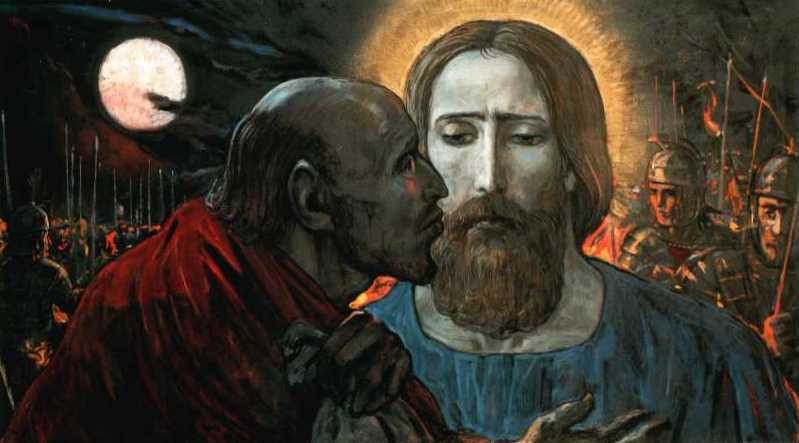
And immediately, even as Jesus said this, Judas, one of the twelve disciples, arrived with a crowd of men armed with swords and clubs. They had been sent by the leading priests, the teachers of religious law, and the elders. The traitor, Judas, had given them a prearranged signal: “You will know which one to arrest when I greet him with a kiss. Then you can take him away under guard.” As soon as they arrived, Judas walked up to Jesus. “Rabbi!” he exclaimed, and gave him the kiss.
Then the others grabbed Jesus and arrested him. But one of the men with Jesus pulled out his sword and struck the high priest’s slave, slashing off his ear.
Jesus asked them, “Am I some dangerous revolutionary, that you come with swords and clubs to arrest me? Why didn’t you arrest me in the Temple? I was there among you teaching every day. But these things are happening to fulfill what the Scriptures say about me.”
Then all his disciples deserted him and ran away. One young man following behind was clothed only in a long linen shirt. When the mob tried to grab him, he slipped out of his shirt and ran away naked.
Jesus before the Council
They took Jesus to the high priest’s home where the leading priests, the elders, and the teachers of religious law had gathered. Meanwhile, Peter followed him at a distance and went right into the high priest’s courtyard. There he sat with the guards, warming himself by the fire.
Inside, the leading priests and the entire high council were trying to find evidence against Jesus, so they could put him to death. But they couldn’t find any. Many false witnesses spoke against him, but they contradicted each other. Finally, some men stood up and gave this false testimony: “We heard him say, ‘I will destroy this Temple made with human hands, and in three days I will build another, made without human hands.’” But even then they didn’t get their stories straight!
Then the high priest stood up before the others and asked Jesus, “Well, aren’t you going to answer these charges? What do you have to say for yourself?” But Jesus was silent and made no reply. Then the high priest asked him, “Are you the Messiah, the Son of the Blessed One?”
Jesus said, “I am. And you will see the Son of Man seated in the place of power at God’s right hand and coming on the clouds of heaven.”
Then the high priest tore his clothing to show his horror and said, “Why do we need other witnesses? You have all heard his blasphemy. What is your verdict?”
“Guilty!” they all cried. “He deserves to die!”
Then some of them began to spit at him, and they blindfolded him and beat him with their fists. “Prophesy to us,” they jeered. And the guards slapped him as they took him away.
Peter Denies Jesus
Meanwhile, Peter was in the courtyard below. One of the servant girls who worked for the high priest came by and noticed Peter warming himself at the fire. She looked at him closely and said, “You were one of those with Jesus of Nazareth.”
But Peter denied it. “I don’t know what you’re talking about,” he said, and he went out into the entryway. Just then, a rooster crowed.
When the servant girl saw him standing there, she began telling the others, “This man is definitely one of them!” But Peter denied it again.
A little later some of the other bystanders confronted Peter and said, “You must be one of them, because you are a Galilean.”
Peter swore, “A curse on me if I’m lying—I don’t know this man you’re talking about!” And immediately the rooster crowed the second time.
Suddenly, Jesus’ words flashed through Peter’s mind: “Before the rooster crows twice, you will deny three times that you even know me.” And he broke down and wept.
__________
“O the Deep, Deep Love of Jesus” – Hereford Cathedral Choir
May the peace of the Lord Christ go with you, wherever He may send you. May He guide you through the wilderness, protect you through the storm. May He bring you home rejoicing at the wonders He has shown you. May He bring you home rejoicing once again into our doors.
__________
+ In the name of the Father, and the Son, and the Holy Spirit. Amen!

 + God’s power is displayed in miracles – “Pay attention to this, Job. Stop and consider the wonderful miracles of God! Do you know how God controls the storm and causes the lightning to flash from his clouds? Do you understand how he moves the clouds with wonderful perfection and skill? When you are sweltering in your clothes and the south wind dies down and everything is still, he makes the skies reflect the heat like a bronze mirror. Can you do that?
 + Who made the depths of the earth? – “Have you explored the springs from which the seas come? Have you explored their depths? Do you know where the gates of death are located? Have you seen the gates of utter gloom? Do you realize the extent of the earth? Tell me about it if you know!











.jpg)




 The Peanut Gallery