
Good Friday, 30 Mar – John 18:1—19:42 ~ obedient to the point of death

Good Friday of the Lord’s Passion

+ In the name of the Father, and the Son, and the Holy Spirit. Amen!

Opening Sentences

Almighty God, we pray you graciously to behold this your family, for whom our Lord Jesus Christ was willing to be betrayed, and given into the hands of sinners, and to suffer death upon the cross. Amen.
__________

Reading: John 18:1—19:42 (NLT)

Jesus Is Betrayed and Arrested

After saying these things, Jesus crossed the Kidron Valley with his disciples and entered a grove of olive trees. Judas, the betrayer, knew this place, because Jesus had often gone there with his disciples. The leading priests and Pharisees had given Judas a contingent of Roman soldiers and Temple guards to accompany him. Now with blazing torches, lanterns, and weapons, they arrived at the olive grove.

Jesus fully realized all that was going to happen to him, so he stepped forward to meet them. “Who are you looking for?” he asked.

“Jesus the Nazarene,” they replied.

“I am he,” Jesus said. (Judas, who betrayed him, was standing with them.) As Jesus said “I am he,” they all drew back and fell to the ground! Once more he asked them, “Who are you looking for?”

And again they replied, “Jesus the Nazarene.”

“I told you that I am he,” Jesus said. “And since I am the one you want, let these others go.” He did this to fulfill his own statement: “I did not lose a single one of those you have given me.”

Then Simon Peter drew a sword and slashed off the right ear of Malchus, the high priest’s slave. But Jesus said to Peter, “Put your sword back into its sheath. Shall I not drink from the cup of suffering the Father has given me?”

Jesus at the High Priest’s House

So the soldiers, their commanding officer, and the Temple guards arrested Jesus and tied him up. First they took him to Annas, since he was the father-in-law of Caiaphas, the high priest at that time. Caiaphas was the one who had told the other Jewish leaders, “It’s better that one man should die for the people.”

Peter’s First Denial

Simon Peter followed Jesus, as did another of the disciples. That other disciple was acquainted with the high priest, so he was allowed to enter the high priest’s courtyard with Jesus. Peter had to stay outside the gate. Then the disciple who knew the high priest spoke to the woman watching at the gate, and she let Peter in. The woman asked Peter, “You’re not one of that man’s disciples, are you?”

“No,” he said, “I am not.”

Because it was cold, the household servants and the guards had made a charcoal fire. They stood around it, warming themselves, and Peter stood with them, warming himself.

The High Priest Questions Jesus

Inside, the high priest began asking Jesus about his followers and what he had been teaching them. Jesus replied, “Everyone knows what I teach. I have preached regularly in the synagogues and the Temple, where the people gather. I have not spoken in secret. Why are you asking me this question? Ask those who heard me. They know what I said.”

Then one of the Temple guards standing nearby slapped Jesus across the face. “Is that the way to answer the high priest?” he demanded.

Jesus replied, “If I said anything wrong, you must prove it. But if I’m speaking the truth, why are you beating me?”

Then Annas bound Jesus and sent him to Caiaphas, the high priest.

Peter’s Second and Third Denials

Meanwhile, as Simon Peter was standing by the fire warming himself, they asked him again, “You’re not one of his disciples, are you?”

He denied it, saying, “No, I am not.”

But one of the household slaves of the high priest, a relative of the man whose ear Peter had cut off, asked, “Didn’t I see you out there in the olive grove with Jesus?” Again Peter denied it. And immediately a rooster crowed.

Jesus’ Trial before Pilate

Jesus’ trial before Caiaphas ended in the early hours of the morning. Then he was taken to the headquarters of the Roman governor. His accusers didn’t go inside because it would defile them, and they wouldn’t be allowed to celebrate the Passover. So Pilate, the governor, went out to them and asked, “What is your charge against this man?”

“We wouldn’t have handed him over to you if he weren’t a criminal!” they retorted.

“Then take him away and judge him by your own law,” Pilate told them.

“Only the Romans are permitted to execute someone,” the Jewish leaders replied. (This fulfilled Jesus’ prediction about the way he would die.

Then Pilate went back into his headquarters and called for Jesus to be brought to him. “Are you the king of the Jews?” he asked him.

Jesus replied, “Is this your own question, or did others tell you about me?”

“Am I a Jew?” Pilate retorted. “Your own people and their leading priests brought you to me for trial. Why? What have you done?”

Jesus answered, “My Kingdom is not an earthly kingdom. If it were, my followers would fight to keep me from being handed over to the Jewish leaders. But my Kingdom is not of this world.”

Pilate said, “So you are a king?”

Jesus responded, “You say I am a king. Actually, I was born and came into the world to testify to the truth. All who love the truth recognize that what I say is true.”

“What is truth?” Pilate asked. Then he went out again to the people and told them, “He is not guilty of any crime. But you have a custom of asking me to release one prisoner each year at Passover. Would you like me to release this ‘King of the Jews’?”

But they shouted back, “No! Not this man. We want Barabbas!” (Barabbas was a revolutionary.)

Jesus Sentenced to Death

Then Pilate had Jesus flogged with a lead-tipped whip. The soldiers wove a crown of thorns and put it on his head, and they put a purple robe on him. “Hail! King of the Jews!” they mocked, as they slapped him across the face.

Pilate went outside again and said to the people, “I am going to bring him out to you now, but understand clearly that I find him not guilty.” Then Jesus came out wearing the crown of thorns and the purple robe. And Pilate said, “Look, here is the man!”

When they saw him, the leading priests and Temple guards began shouting, “Crucify him! Crucify him!”

“Take him yourselves and crucify him,” Pilate said. “I find him not guilty.”

The Jewish leaders replied, “By our law he ought to die because he called himself the Son of God.”

When Pilate heard this, he was more frightened than ever. He took Jesus back into the headquarters again and asked him, “Where are you from?” But Jesus gave no answer. “Why don’t you talk to me?” Pilate demanded. “Don’t you realize that I have the power to release you or crucify you?”

Then Jesus said, “You would have no power over me at all unless it were given to you from above. So the one who handed me over to you has the greater sin.”

Then Pilate tried to release him, but the Jewish leaders shouted, “If you release this man, you are no ‘friend of Caesar.’ Anyone who declares himself a king is a rebel against Caesar.”

When they said this, Pilate brought Jesus out to them again. Then Pilate sat down on the judgment seat on the platform that is called the Stone Pavement (in Hebrew, Gabbatha). It was now about noon on the day of preparation for the Passover. And Pilate said to the people, “Look, here is your king!”

“Away with him,” they yelled. “Away with him! Crucify him!”

“What? Crucify your king?” Pilate asked.

“We have no king but Caesar,” the leading priests shouted back.

Then Pilate turned Jesus over to them to be crucified.

The Crucifixion

So they took Jesus away. Carrying the cross by himself, he went to the place called Place of the Skull (in Hebrew, Golgotha). There they nailed him to the cross. Two others were crucified with him, one on either side, with Jesus between them. And Pilate posted a sign on the cross that read, “Jesus of Nazareth, the King of the Jews.” The place where Jesus was crucified was near the city, and the sign was written in Hebrew, Latin, and Greek, so that many people could read it.

Then the leading priests objected and said to Pilate, “Change it from ‘The King of the Jews’ to ‘He said, I am King of the Jews.’”

Pilate replied, “No, what I have written, I have written.”

When the soldiers had crucified Jesus, they divided his clothes among the four of them. They also took his robe, but it was seamless, woven in one piece from top to bottom. So they said, “Rather than tearing it apart, let’s throw dice for it.” This fulfilled the Scripture that says, “They divided my garments among themselves and threw dice for my clothing.” So that is what they did.

Standing near the cross were Jesus’ mother, and his mother’s sister, Mary (the wife of Clopas), and Mary Magdalene. When Jesus saw his mother standing there beside the disciple he loved, he said to her, “Dear woman, here is your son.” And he said to this disciple, “Here is your mother.” And from then on this disciple took her into his home.

The Death of Jesus

Jesus knew that his mission was now finished, and to fulfill Scripture he said, “I am thirsty.” A jar of sour wine was sitting there, so they soaked a sponge in it, put it on a hyssop branch, and held it up to his lips. When Jesus had tasted it, he said, “It is finished!” Then he bowed his head and gave up his spirit.

It was the day of preparation, and the Jewish leaders didn’t want the bodies hanging there the next day, which was the Sabbath (and a very special Sabbath, because it was Passover week). So they asked Pilate to hasten their deaths by ordering that their legs be broken. Then their bodies could be taken down. So the soldiers came and broke the legs of the two men crucified with Jesus. But when they came to Jesus, they saw that he was already dead, so they didn’t break his legs. One of the soldiers, however, pierced his side with a spear, and immediately blood and water flowed out. (This report is from an eyewitness giving an accurate account. He speaks the truth so that you also may continue to believe. These things happened in fulfillment of the Scriptures that say, “Not one of his bones will be broken,” and “They will look on the one they pierced.”

The Burial of Jesus

Afterward Joseph of Arimathea, who had been a secret disciple of Jesus (because he feared the Jewish leaders), asked Pilate for permission to take down Jesus’ body. When Pilate gave permission, Joseph came and took the body away. With him came Nicodemus, the man who had come to Jesus at night. He brought about seventy-five pounds of perfumed ointment made from myrrh and aloes. Following Jewish burial custom, they wrapped Jesus’ body with the spices in long sheets of linen cloth. The place of crucifixion was near a garden, where there was a new tomb, never used before. And so, because it was the day of preparation for the Jewish Passover and since the tomb was close at hand, they laid Jesus there.
__________

Prayer:

Christ, our Redeemer, you suffered for us, was buried, and rose from the dead – have mercy on us.

+ Lord and master, for us you became obedient even to death; keep us faithful to the Father’s will in the darkness of our lives.
+ Jesus, our life, by dying on the cross you destroyed hell and death; grant that we may die with you and rise with you in glory.
+ Christ, our king, you were the scorn of the people, a worm not a man; teach us to tread your path of humility.
+ Jesus, our Savior, you laid down your life for your friends; let us love one another as you have loved us.
+ Jesus, our hope, you stretched out your hands on the cross to embrace all ages of men; gather all God’s scattered children into the kingdom of salvation.

Be mindful, Lord God, of this your family, for whose sake our Lord Jesus Christ, when betrayed, did not hesitate to yield himself into his enemies’ hands and undergo the agony of the cross. Amen.
__________

The Power Of The Cross – Keith & Kristyn Getty, Stuart Townend


__________

Blessing

Those who belong to Christ Jesus have nailed the passions and desires of their sinful nature to his cross and crucified them there. – Galatians 5:24

+ In the name of the Father, and the Son, and the Holy Spirit. Amen!

Good Friday, 14 Apr – John 18:1—19:42 ~ obedient to the point of death

Good Friday of the Lord’s Passion

+ In the name of the Father, and the Son, and the Holy Spirit. Amen!

Opening Sentences

Almighty God, we pray you graciously to behold this your family, for whom our Lord Jesus Christ was willing to be betrayed, and given into the hands of sinners, and to suffer death upon the cross. Amen.
__________

Reading: John 18:1—19:42 (NLT)

Jesus Is Betrayed and Arrested

After saying these things, Jesus crossed the Kidron Valley with his disciples and entered a grove of olive trees. Judas, the betrayer, knew this place, because Jesus had often gone there with his disciples. The leading priests and Pharisees had given Judas a contingent of Roman soldiers and Temple guards to accompany him. Now with blazing torches, lanterns, and weapons, they arrived at the olive grove.

Jesus fully realized all that was going to happen to him, so he stepped forward to meet them. “Who are you looking for?” he asked.

“Jesus the Nazarene,” they replied.

“I am he,” Jesus said. (Judas, who betrayed him, was standing with them.) As Jesus said “I am he,” they all drew back and fell to the ground! Once more he asked them, “Who are you looking for?”

And again they replied, “Jesus the Nazarene.”

“I told you that I am he,” Jesus said. “And since I am the one you want, let these others go.” He did this to fulfill his own statement: “I did not lose a single one of those you have given me.”

Then Simon Peter drew a sword and slashed off the right ear of Malchus, the high priest’s slave. But Jesus said to Peter, “Put your sword back into its sheath. Shall I not drink from the cup of suffering the Father has given me?”

Jesus at the High Priest’s House

So the soldiers, their commanding officer, and the Temple guards arrested Jesus and tied him up. First they took him to Annas, since he was the father-in-law of Caiaphas, the high priest at that time. Caiaphas was the one who had told the other Jewish leaders, “It’s better that one man should die for the people.”

Peter’s First Denial

Simon Peter followed Jesus, as did another of the disciples. That other disciple was acquainted with the high priest, so he was allowed to enter the high priest’s courtyard with Jesus. Peter had to stay outside the gate. Then the disciple who knew the high priest spoke to the woman watching at the gate, and she let Peter in. The woman asked Peter, “You’re not one of that man’s disciples, are you?”

“No,” he said, “I am not.”

Because it was cold, the household servants and the guards had made a charcoal fire. They stood around it, warming themselves, and Peter stood with them, warming himself.

The High Priest Questions Jesus

Inside, the high priest began asking Jesus about his followers and what he had been teaching them. Jesus replied, “Everyone knows what I teach. I have preached regularly in the synagogues and the Temple, where the people gather. I have not spoken in secret. Why are you asking me this question? Ask those who heard me. They know what I said.”

Then one of the Temple guards standing nearby slapped Jesus across the face. “Is that the way to answer the high priest?” he demanded.

Jesus replied, “If I said anything wrong, you must prove it. But if I’m speaking the truth, why are you beating me?”

Then Annas bound Jesus and sent him to Caiaphas, the high priest.

Peter’s Second and Third Denials

Meanwhile, as Simon Peter was standing by the fire warming himself, they asked him again, “You’re not one of his disciples, are you?”

He denied it, saying, “No, I am not.”

But one of the household slaves of the high priest, a relative of the man whose ear Peter had cut off, asked, “Didn’t I see you out there in the olive grove with Jesus?” Again Peter denied it. And immediately a rooster crowed.

Jesus’ Trial before Pilate

Jesus’ trial before Caiaphas ended in the early hours of the morning. Then he was taken to the headquarters of the Roman governor. His accusers didn’t go inside because it would defile them, and they wouldn’t be allowed to celebrate the Passover. So Pilate, the governor, went out to them and asked, “What is your charge against this man?”

“We wouldn’t have handed him over to you if he weren’t a criminal!” they retorted.

“Then take him away and judge him by your own law,” Pilate told them.

“Only the Romans are permitted to execute someone,” the Jewish leaders replied. (This fulfilled Jesus’ prediction about the way he would die.

Then Pilate went back into his headquarters and called for Jesus to be brought to him. “Are you the king of the Jews?” he asked him.

Jesus replied, “Is this your own question, or did others tell you about me?”

“Am I a Jew?” Pilate retorted. “Your own people and their leading priests brought you to me for trial. Why? What have you done?”

Jesus answered, “My Kingdom is not an earthly kingdom. If it were, my followers would fight to keep me from being handed over to the Jewish leaders. But my Kingdom is not of this world.”

Pilate said, “So you are a king?”

Jesus responded, “You say I am a king. Actually, I was born and came into the world to testify to the truth. All who love the truth recognize that what I say is true.”

“What is truth?” Pilate asked. Then he went out again to the people and told them, “He is not guilty of any crime. But you have a custom of asking me to release one prisoner each year at Passover. Would you like me to release this ‘King of the Jews’?”

But they shouted back, “No! Not this man. We want Barabbas!” (Barabbas was a revolutionary.)

Jesus Sentenced to Death

Then Pilate had Jesus flogged with a lead-tipped whip. The soldiers wove a crown of thorns and put it on his head, and they put a purple robe on him. “Hail! King of the Jews!” they mocked, as they slapped him across the face.

Pilate went outside again and said to the people, “I am going to bring him out to you now, but understand clearly that I find him not guilty.” Then Jesus came out wearing the crown of thorns and the purple robe. And Pilate said, “Look, here is the man!”

When they saw him, the leading priests and Temple guards began shouting, “Crucify him! Crucify him!”

“Take him yourselves and crucify him,” Pilate said. “I find him not guilty.”

The Jewish leaders replied, “By our law he ought to die because he called himself the Son of God.”

When Pilate heard this, he was more frightened than ever. He took Jesus back into the headquarters again and asked him, “Where are you from?” But Jesus gave no answer. “Why don’t you talk to me?” Pilate demanded. “Don’t you realize that I have the power to release you or crucify you?”

Then Jesus said, “You would have no power over me at all unless it were given to you from above. So the one who handed me over to you has the greater sin.”

Then Pilate tried to release him, but the Jewish leaders shouted, “If you release this man, you are no ‘friend of Caesar.’ Anyone who declares himself a king is a rebel against Caesar.”

When they said this, Pilate brought Jesus out to them again. Then Pilate sat down on the judgment seat on the platform that is called the Stone Pavement (in Hebrew, Gabbatha). It was now about noon on the day of preparation for the Passover. And Pilate said to the people, “Look, here is your king!”

“Away with him,” they yelled. “Away with him! Crucify him!”

“What? Crucify your king?” Pilate asked.

“We have no king but Caesar,” the leading priests shouted back.

Then Pilate turned Jesus over to them to be crucified.

The Crucifixion

So they took Jesus away. Carrying the cross by himself, he went to the place called Place of the Skull (in Hebrew, Golgotha). There they nailed him to the cross. Two others were crucified with him, one on either side, with Jesus between them. And Pilate posted a sign on the cross that read, “Jesus of Nazareth, the King of the Jews.” The place where Jesus was crucified was near the city, and the sign was written in Hebrew, Latin, and Greek, so that many people could read it.

Then the leading priests objected and said to Pilate, “Change it from ‘The King of the Jews’ to ‘He said, I am King of the Jews.’”

Pilate replied, “No, what I have written, I have written.”

When the soldiers had crucified Jesus, they divided his clothes among the four of them. They also took his robe, but it was seamless, woven in one piece from top to bottom. So they said, “Rather than tearing it apart, let’s throw dice for it.” This fulfilled the Scripture that says, “They divided my garments among themselves and threw dice for my clothing.” So that is what they did.

Standing near the cross were Jesus’ mother, and his mother’s sister, Mary (the wife of Clopas), and Mary Magdalene. When Jesus saw his mother standing there beside the disciple he loved, he said to her, “Dear woman, here is your son.” And he said to this disciple, “Here is your mother.” And from then on this disciple took her into his home.

The Death of Jesus

Jesus knew that his mission was now finished, and to fulfill Scripture he said, “I am thirsty.” A jar of sour wine was sitting there, so they soaked a sponge in it, put it on a hyssop branch, and held it up to his lips. When Jesus had tasted it, he said, “It is finished!” Then he bowed his head and gave up his spirit.

It was the day of preparation, and the Jewish leaders didn’t want the bodies hanging there the next day, which was the Sabbath (and a very special Sabbath, because it was Passover week). So they asked Pilate to hasten their deaths by ordering that their legs be broken. Then their bodies could be taken down. So the soldiers came and broke the legs of the two men crucified with Jesus. But when they came to Jesus, they saw that he was already dead, so they didn’t break his legs. One of the soldiers, however, pierced his side with a spear, and immediately blood and water flowed out. (This report is from an eyewitness giving an accurate account. He speaks the truth so that you also may continue to believe. These things happened in fulfillment of the Scriptures that say, “Not one of his bones will be broken,” and “They will look on the one they pierced.”

The Burial of Jesus

Afterward Joseph of Arimathea, who had been a secret disciple of Jesus (because he feared the Jewish leaders), asked Pilate for permission to take down Jesus’ body. When Pilate gave permission, Joseph came and took the body away. With him came Nicodemus, the man who had come to Jesus at night. He brought about seventy-five pounds of perfumed ointment made from myrrh and aloes. Following Jewish burial custom, they wrapped Jesus’ body with the spices in long sheets of linen cloth. The place of crucifixion was near a garden, where there was a new tomb, never used before. And so, because it was the day of preparation for the Jewish Passover and since the tomb was close at hand, they laid Jesus there.
__________

Prayer:

Christ, our Redeemer, you suffered for us, was buried, and rose from the dead – have mercy on us.

+ Lord and master, for us you became obedient even to death; keep us faithful to the Father’s will in the darkness of our lives.
+ Jesus, our life, by dying on the cross you destroyed hell and death; grant that we may die with you and rise with you in glory.
+ Christ, our king, you were the scorn of the people, a worm not a man; teach us to tread your path of humility.
+ Jesus, our Savior, you laid down your life for your friends; let us love one another as you have loved us.
+ Jesus, our hope, you stretched out your hands on the cross to embrace all ages of men; gather all God’s scattered children into the kingdom of salvation.

Be mindful, Lord God, of this your family, for whose sake our Lord Jesus Christ, when betrayed, did not hesitate to yield himself into his enemies’ hands and undergo the agony of the cross. Amen.
__________

The Power Of The Cross – Keith & Kristyn Getty, Stuart Townend


__________

Blessing

Those who belong to Christ Jesus have nailed the passions and desires of their sinful nature to his cross and crucified them there. – Galatians 5:24

+ In the name of the Father, and the Son, and the Holy Spirit. Amen!
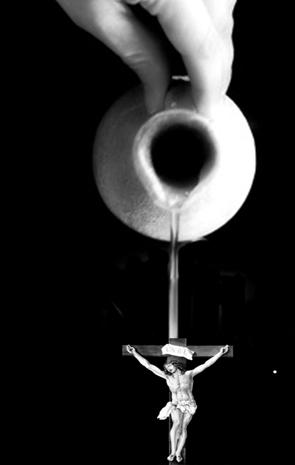
Palm Sunday, 20 March: Isaiah 50:4-7; Psalm 22; Philippians 2:6-11; Luke 23:1-49 ~ humble obedience

Palm Sunday

A week from now we will be celebrating Easter. But before we reach that feast, we must recall the suffering and death of the Lord, both today and on Good Friday.

+ In the Name of the Father, and the Son, and the Holy Spirit. Amen.

Opening Prayer:

O God of eternal glory, you anointed Jesus, your servant, to bear our sins, to encourage the weary, to raise up and restore the fallen. Keep before our eyes the splendour of the paschal mystery of Christ, and, by our sharing in the passion and resurrection, seal our lives with the victorious sign of his obedience and exaltation. We ask this through Christ, our Savior, who lives and reigns with you in the unity of the Holy Spirit, holy and mighty God for ever and ever. Amen.
__________

“Israel: Jerusalem: Palm Sunday Parade” – AP


__________

A Reading from the Old Testament: Isaiah 50:4-7 (NLT)
[Describes someone under attack… applied to the sufferings of Jesus.]

Jesus stone face

The Sovereign Lord has given me his words of wisdom, so that I know how to comfort the weary. Morning by morning he wakens me and opens my understanding to his will. The Sovereign Lord has spoken to me, and I have listened. I have not rebelled or turned away. I offered my back to those who beat me and my cheeks to those who pulled out my beard. I did not hide my face from mockery and spitting.

Because the Sovereign Lord helps me, I will not be disgraced. Therefore, I have set my face like a stone, determined to do his will. And I know that I will not be put to shame.
__________

Psalm: “My God, My God, Why (Psalm 22)” – The Psalm Project


__________

A Reading from the Letters: Philippians 2:6-11 (NLT)
[An ancient hymn to Christ, reminding us that Jesus achieved glory through suffering.]

Kenosis

Though he was God, he did not think of equality with God as something to cling to. Instead, he gave up his divine privileges; he took the humble position of a slave and was born as a human being. When he appeared in human form, he humbled himself in obedience to God and died a criminal’s death on a cross.

Therefore, God elevated him to the place of highest honor and gave him the name above all other names, that at the name of Jesus every knee should bow, in heaven and on earth and under the earth, and every tongue declare that Jesus Christ is Lord, to the glory of God the Father.
__________

A Reading from the Gospels: Luke 23:1-49 (NLT)
[ In Luke’s account of the passion, we view the sufferings of Jesus through the eyes of Peter, and Simon of Cyrene, and the good thief.]

Jesus’ Trial before Pilate

Then the entire council took Jesus to Pilate, the Roman governor. They began to state their case: “This man has been leading our people astray by telling them not to pay their taxes to the Roman government and by claiming he is the Messiah, a king.”

So Pilate asked him, “Are you the king of the Jews?”

Jesus replied, “You have said it.”

Pilate turned to the leading priests and to the crowd and said, “I find nothing wrong with this man!”

Jesus and Pontius Pilate (Ecce homo!) By Antonio Ciseri (1821–1891). Date: painted in 1871.
Jesus and Pontius Pilate (Ecce homo!)
By Antonio Ciseri (1821–1891). Date: painted in 1871.

Then they became insistent. “But he is causing riots by his teaching wherever he goes—all over Judea, from Galilee to Jerusalem!”

“Oh, is he a Galilean?” Pilate asked. When they said that he was, Pilate sent him to Herod Antipas, because Galilee was under Herod’s jurisdiction, and Herod happened to be in Jerusalem at the time.

Herod was delighted at the opportunity to see Jesus, because he had heard about him and had been hoping for a long time to see him perform a miracle. He asked Jesus question after question, but Jesus refused to answer. Meanwhile, the leading priests and the teachers of religious law stood there shouting their accusations. Then Herod and his soldiers began mocking and ridiculing Jesus. Finally, they put a royal robe on him and sent him back to Pilate. (Herod and Pilate, who had been enemies before, became friends that day.)

Then Pilate called together the leading priests and other religious leaders, along with the people, and he announced his verdict. “You brought this man to me, accusing him of leading a revolt. I have examined him thoroughly on this point in your presence and find him innocent. Herod came to the same conclusion and sent him back to us. Nothing this man has done calls for the death penalty. So I will have him flogged, and then I will release him.”

Then a mighty roar rose from the crowd, and with one voice they shouted, “Kill him, and release Barabbas to us!” (Barabbas was in prison for taking part in an insurrection in Jerusalem against the government, and for murder.) Pilate argued with them, because he wanted to release Jesus. But they kept shouting, “Crucify him! Crucify him!”

For the third time he demanded, “Why? What crime has he committed? I have found no reason to sentence him to death. So I will have him flogged, and then I will release him.”

But the mob shouted louder and louder, demanding that Jesus be crucified, and their voices prevailed. So Pilate sentenced Jesus to die as they demanded. As they had requested, he released Barabbas, the man in prison for insurrection and murder. But he turned Jesus over to them to do as they wished.

The Crucifixion

As they led Jesus away, a man named Simon, who was from Cyrene, happened to be coming in from the countryside. The soldiers seized him and put the cross on him and made him carry it behind Jesus. A large crowd trailed behind, including many grief-stricken women. But Jesus turned and said to them, “Daughters of Jerusalem, don’t weep for me, but weep for yourselves and for your children. For the days are coming when they will say, ‘Fortunate indeed are the women who are childless, the wombs that have not borne a child and the breasts that have never nursed.’ People will beg the mountains, ‘Fall on us,’ and plead with the hills, ‘Bury us.’ For if these things are done when the tree is green, what will happen when it is dry?”

"The Crucifixion" by Antonio Ciseri
“The Crucifixion”
by Antonio Ciseri

Two others, both criminals, were led out to be executed with him. When they came to a place called The Skull, they nailed him to the cross. And the criminals were also crucified—one on his right and one on his left.

Jesus said, “Father, forgive them, for they don’t know what they are doing.” And the soldiers gambled for his clothes by throwing dice.

The crowd watched and the leaders scoffed. “He saved others,” they said, “let him save himself if he is really God’s Messiah, the Chosen One.” The soldiers mocked him, too, by offering him a drink of sour wine. They called out to him, “If you are the King of the Jews, save yourself!” A sign was fastened above him with these words: “This is the King of the Jews.”

One of the criminals hanging beside him scoffed, “So you’re the Messiah, are you? Prove it by saving yourself—and us, too, while you’re at it!”

But the other criminal protested, “Don’t you fear God even when you have been sentenced to die? We deserve to die for our crimes, but this man hasn’t done anything wrong.” Then he said, “Jesus, remember me when you come into your Kingdom.”

And Jesus replied, “I assure you, today you will be with me in paradise.”

The Death of Jesus

By this time it was about noon, and darkness fell across the whole land until three o’clock. The light from the sun was gone. And suddenly, the curtain in the sanctuary of the Temple was torn down the middle. Then Jesus shouted, “Father, I entrust my spirit into your hands!” And with those words he breathed his last.

When the Roman officer overseeing the execution saw what had happened, he worshiped God and said, “Surely this man was innocent.” And when all the crowd that came to see the crucifixion saw what had happened, they went home in deep sorrow. But Jesus’ friends, including the women who had followed him from Galilee, stood at a distance watching.
__________

Hymn: “Beneath the Cross” – Keith and Kristyn Getty


__________

Intercessions:

Gracious God, our strength and our salvation, make haste to help us.

+ That all Christians may mark Holy Week with deep faith and awesome wonder…. Lord, hear us.
+ That the Jewish people, our brothers and sisters, may continue in faith and love…. Lord, hear us.
+ That the city of Jerusalem may become a place of peace and reconciliation…. Lord, hear us.
+ That those who suffer for Christ, may be inspired by him…. Lord, hear us.
+ That the dispossessed from the Middle East may find safe havens while waiting to return home…. Lord, hear us.
+ That all who suffer, at home or in hospital, may feel your presence close to them…. Lord, hear us.
+ That all those who have gone before us in faith, may journey through the valley of death to resurrection…. Lord, hear us.

God of compassion, in the death and resurrection of Jesus you show your love for us: hear our petitions, and grant them, through Christ our Lord. Amen.
__________

Hymn: “At the cross (love ran red)” – Chris Tomlin

Benediction:

For his Spirit joins with our spirit to affirm that we are God’s children. And since we are his children, we are his heirs. In fact, together with Christ we are heirs of God’s glory. But if we are to share his glory, we must also share his suffering. Yet what we suffer now is nothing compared to the glory he will reveal to us later.” (Romans 8:16-18)

+ In the Name of the Father, and the Son, and the Holy Spirit. Amen