
Morning Prayer: 01 October – Romans 16:21-24 ~ additional messages

Reading through Romans

+ In the name of the Father, and of the Son, and of the Holy Spirit. Amen.

Opening sentence

Praise to You, Lord Jesus Christ, King of endless glory. You have the words of eternal life, and we have believed and have come to know that You are the Holy One of God.
__________

Romans 16:21-24 NLT

“Erastus, Olympus, Rhodion, Sosipater, Quartus and Tertius (Menologion of Basil II)” by Anonymous

Timothy, my fellow worker, sends you his greetings, as do Lucius, Jason, and Sosipater, my fellow Jews.

I, Tertius, the one writing this letter for Paul, send my greetings, too, as one of the Lord’s followers.

Gaius says hello to you. He is my host and also serves as host to the whole church. Erastus, the city treasurer, sends you his greetings, and so does our brother Quartus.
__________

Reflection: Romans 16:21-24 (John Stott, The Message of Romans: God’s Good News for the World)

Conclusion: The providence of God in the ministry of Paul (Romans 15:14–16:27)

Paul takes the Roman church into his confidence about the salient characteristics of his ministry… giving us insight into the outworking of God’s providence in his life and work.

Paul’s messages (21-24)

Paul now passes on messages from eight named people, who are with him in Corinth. He begins with one extremely well-known name, followed by three apparently unknown ones.

His fellow worker, Timothy: if anybody deserved to be called Paul’s ‘fellow-worker’, that person was Timothy. For the last eight years Timothy had been Paul’s constant traveling companion and had undertaken several special missions at Paul’s request. The apostle evidently had a warm affection for his young assistant. Having led him to Christ, he regarded him as his son in the faith. He was now in Corinth, about to set sail for Jerusalem with the offering from the Greek churches.

His fellow countrymen: we cannot for certain identify any of them….

His scribe: to whom Paul has been dictating this letter, writes his own greeting….
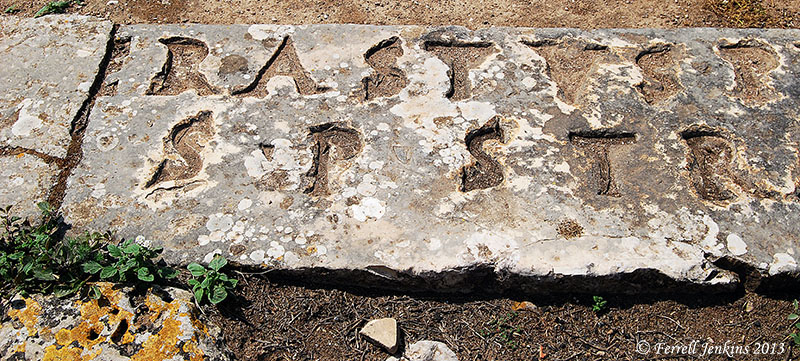
The name Erastus in the inscription near the Corinth theater. Photo by Ferrell Jenkins.

His host in Corinth, Gaius: it would be natural to identify him with the Corinthian whom Paul had baptized. Some scholars have further suggested that his full Roman name was Gaius Titius Justus, in which case he had a large house next to the synagogue, into which he had welcomed Paul after the Jews had rejected his gospel. It is then understandable that Paul would again be his house guest, and that the church would also meet in his home.

Two further people: Erastus, who is the city’s director of public works… and our brother Quartus (nothing is known of him). Erastus, on the other hand, seems to have been a responsible local government official. Perhaps he was the aedile, the magistrate in charge of public works, whose name is still clearly legible in a first-century Latin inscription on a marble pavement close to the ruins of old Corinth.
__________

“We Are Called”

__________

Canticle

Christ, as a light illumine and guide me. Christ, as a shield overshadow me. Christ under me; Christ over me; Christ beside me on my left and my right. This day be within and without me, lowly and meek, yet all-powerful. Be in the heart of each to whom I speak; in the mouth of each who speaks unto me. This day be within and without me, lowly and meek, yet all-powerful. Christ as a light; Christ as a shield; Christ beside me on my left and my right.

Blessing

May the peace of the Lord Christ go with you, wherever He may send you. May He guide you through the wilderness, protect you through the storm. May He bring you home rejoicing at the wonders He has shown you. May He bring you home rejoicing once again into our doors.

+ In the name of the Father, and of the Son, and of the Holy Spirit. Amen

Morning Prayer: 30 September – Romans 16:17-20 ~ vigilance, separation, discernment

Reading through Romans Continue reading “Morning Prayer: 30 September – Romans 16:17-20 ~ vigilance, separation, discernment” →

Morning Prayer: 29 September – Romans 16:3-16 ~ greetings

Reading through Romans

+ In the name of the Father, and of the Son, and of the Holy Spirit. Amen.

Opening sentence

Praise to You, Lord Jesus Christ, King of endless glory. You have the words of eternal life, and we have believed and have come to know that You are the Holy One of God.
__________

A reading from Romans: Romans 16:3-16 (NLT)

aquila-and-priscilla 1
Priscilla and Aquila

Give my greetings to Priscilla and Aquila, my co-workers in the ministry of Christ Jesus. In fact, they once risked their lives for me. I am thankful to them, and so are all the Gentile churches. Also give my greetings to the church that meets in their home.

Greet my dear friend Epenetus. He was the first person from the province of Asia to become a follower of Christ. Give my greetings to Mary, who has worked so hard for your benefit. Greet Andronicus and Junia, my fellow Jews, who were in prison with me. They are highly respected among the apostles and became followers of Christ before I did. Greet Ampliatus, my dear friend in the Lord. Greet Urbanus, our co-worker in Christ, and my dear friend Stachys.

Greet Apelles, a good man whom Christ approves. And give my greetings to the believers from the household of Aristobulus. Greet Herodion, my fellow Jew. Greet the Lord’s people from the household of Narcissus. Give my greetings to Tryphena and Tryphosa, the Lord’s workers, and to dear Persis, who has worked so hard for the Lord. Greet Rufus, whom the Lord picked out to be his very own; and also his dear mother, who has been a mother to me.

christians greet each other

Give my greetings to Asyncritus, Phlegon, Hermes, Patrobas, Hermas, and the brothers and sisters who meet with them. Give my greetings to Philologus, Julia, Nereus and his sister, and to Olympas and all the believers who meet with them. Greet each other with a sacred kiss. All the churches of Christ send you their greetings.
__________

Reflection: Romans 16:3-16 (John Stott, The Message of Romans: God’s Good News for the World)

Conclusion: The providence of God in the ministry of Paul (Romans 15:14–16:27)

Paul takes the Roman church into his confidence about the salient characteristics of his ministry… giving us insight into the outworking of God’s providence in his life and work.

His commendation and greetings (Romans 16:1–16)

‘I think’, wrote Chrysostom, ‘that many even of those who have the appearance of being extremely good men, hasten over this part of the epistle as superfluous …Yet’, he went on, ‘the gold founders’ people are careful even about the little fragments …it is possible even from bare names to find a great treasure.’

2. Many greetings (3-16)
Paul sends greetings to twenty -six individuals, twenty-four of whom he names, adding in most cases an appreciative personal reference…. Reflecting on the names and circumstances of the people Paul greets, one is particularly impressed by the unity and diversity of the church to which they belonged.

a. The diversity of the church

The most interesting and instructive aspect of church diversity in Rome is that of gender. Nine out of the twenty-six persons greeted are women…. Paul evidently thinks highly of them all.

The prominent place occupied by women in Paul’s entourage shows that he was not at all the male chauvinist of popular fantasy.

b. The unity of the church

Alongside the Roman church’s diversity in race, rank and sex, it experienced a profound unity which transcended its differences.

The toleration of ethnic division in the Roman house churches would be entirely incompatible with Paul’s sustained argument in chapters 14 –15, and with its climax…. Such an arrangement would contradict the church’s unity in diversity.

Heterogeneity is of the essence of the church, since it is the one and only community in the world in which Christ has broken down all dividing walls.
_____

Paul concludes his list of individual greetings with two universals.

The first is that, although only a few of them have been greeted by name, they must all greet one another with a holy kiss… a visible and tangible gesture, although what form the ‘kiss’ should take will vary according to culture…. Paul’s second universal follows: all the churches of Christ send greetings… writing representitavely.
__________

“One Bread, One Body”


__________

Canticle

Christ, as a light illumine and guide me. Christ, as a shield overshadow me. Christ under me; Christ over me; Christ beside me on my left and my right. This day be within and without me, lowly and meek, yet all-powerful. Be in the heart of each to whom I speak; in the mouth of each who speaks unto me. This day be within and without me, lowly and meek, yet all-powerful. Christ as a light; Christ as a shield; Christ beside me on my left and my right.

Blessing

May the peace of the Lord Christ go with you, wherever He may send you. May He guide you through the wilderness, protect you through the storm. May He bring you home rejoicing at the wonders He has shown you. May He bring you home rejoicing once again into our doors.

+ In the name of the Father, and of the Son, and of the Holy Spirit. Amen

Morning Prayer: 28 September – Romans 16:1-2 ~ welcome Phoebe

Reading through Romans

+ In the name of the Father, and of the Son, and of the Holy Spirit. Amen.

Opening sentence

Praise to You, Lord Jesus Christ, King of endless glory. You have the words of eternal life, and we have believed and have come to know that You are the Holy One of God.
__________

A reading from Romans: Romans 16:1-2 (NLT)

Phoebe (1st century) was a deaconess of the Church at Cenchreae, the port of Corinth.

I commend to you our sister Phoebe, who is a deacon in the church in Cenchrea. Welcome her in the Lord as one who is worthy of honor among God’s people. Help her in whatever she needs, for she has been helpful to many, and especially to me.
__________

Reflection: Romans 16:1-2 (John Stott, The Message of Romans: God’s Good News for the World)

Conclusion: The providence of God in the ministry of Paul (Romans 15:14–16:27)

Paul takes the Roman church into his confidence about the salient characteristics of his ministry… giving us insight into the outworking of God’s providence in his life and work.

His commendation and greetings (Romans 16:1–16)

‘I think’, wrote Chrysostom, ‘that many even of those who have the appearance of being extremely good men, hasten over this part of the epistle as superfluous …Yet’, he went on, ‘the gold founders’ people are careful even about the little fragments …it is possible even from bare names to find a great treasure.’

1. A commendation (1–2)

It seems very likely that Phoebe was entrusted with the responsible task of carrying Paul’s letter to its destination in Rome, although other business was apparently taking her to the city as well, perhaps commerce or ‘quite probably a law suit’. So she needed a ‘letter of commendation’ to take with her, which would introduce her to the Christians in Rome. Such letters were common in the ancient world, and necessary to protect people from charlatans. They are several times mentioned in the New Testament.

In his testimonial for Phoebe Paul asks the Roman church both to receive her, giving her a worthy Christian welcome and hospitality, and to give her any help she may need, as a stranger in the capital city, presumably in connection with her other business. Before and after these requests Paul supplies some information about Phoebe, ‘so placing on each side of the needs of this blessed woman’, writes Chrysostom, ‘her praises’. Indeed, he goes on, ‘see how many ways he takes to give her dignity’.

First, he calls her our sister, ‘and it is no slight thing to be called the sister of Paul’.

Secondly, he acknowledges her as a servant (‘minister’, REB; or ‘deaconess’, RSV and NIV) of the church in Cenchrea, which was Corinth’s eastern port at the head of the Saronic Gulf.

Thirdly, she has been a great help to many people, including Paul…. Phoebe was evidently a woman of means, who had used her wealth to support the church and the apostle.
__________

“Come to the Banquet” – by Fay White


__________

Canticle

Christ, as a light illumine and guide me. Christ, as a shield overshadow me. Christ under me; Christ over me; Christ beside me on my left and my right. This day be within and without me, lowly and meek, yet all-powerful. Be in the heart of each to whom I speak; in the mouth of each who speaks unto me. This day be within and without me, lowly and meek, yet all-powerful. Christ as a light; Christ as a shield; Christ beside me on my left and my right.

Blessing

May the peace of the Lord Christ go with you, wherever He may send you. May He guide you through the wilderness, protect you through the storm. May He bring you home rejoicing at the wonders He has shown you. May He bring you home rejoicing once again into our doors.

+ In the name of the Father, and of the Son, and of the Holy Spirit. Amen

Morning Prayer: 26 September – Romans 15:30-33 ~ praying God’s will

Reading through Romans

+ In the name of the Father, and of the Son, and of the Holy Spirit. Amen.

Opening sentence

Praise to You, Lord Jesus Christ, King of endless glory. You have the words of eternal life, and we have believed and have come to know that You are the Holy One of God.
__________

A reading from Romans: Romans 15:30-33 (NLT)

Dear brothers and sisters, I urge you in the name of our Lord Jesus Christ to join in my struggle by praying to God for me. Do this because of your love for me, given to you by the Holy Spirit. Pray that I will be rescued from those in Judea who refuse to obey God. Pray also that the believers there will be willing to accept the donation I am taking to Jerusalem. Then, by the will of God, I will be able to come to you with a joyful heart, and we will be an encouragement to each other.

And now may God, who gives us his peace, be with you all. Amen.
__________

Reflection: Romans 15:30-33 (John Stott, The Message of Romans: God’s Good News for the World)

Conclusion: The providence of God in the ministry of Paul (Romans 15:14–16:27)

Paul takes the Roman church into his confidence about the salient characteristics of his ministry… giving us insight into the outworking of God’s providence in his life and work.

struggle-prayer

Prayer as a struggle (Romans 15:30-33)

Paul refers to prayer as a struggle: our need to wrestle with the principalities and powers of darkness; and/or an activity demanding great exertion, a struggle in fact with ourselves, in which we seek to align ourselves with God’s will.

Paul’s reference to the will of God in relation to prayer is very significant…. His use of this qualifying clause throws light on both the purpose and the character of prayer, on why and how Christians should pray.

The purpose of prayer is emphatically not to bend God’s will to ours, but rather to align our will to his. The promise that our prayers will be answered is conditional on our asking ‘according to his will’. Consequently every prayer we pray should be a variation on the theme, ‘Your will be done.’

What about the character of prayer? Is praying… ‘if it be your will’ a cop-out and incompatible with faith? In response, we need to distinguish between the general and the particular will of God. Since God has revealed his general will for all his people in Scripture (e.g. that we should control ourselves and become like Christ), we should indeed pray with definiteness and assurance about these things. But God’s particular will for each of us (e.g. regarding a life work and a life partner) has not been revealed in Scripture, so that, in praying for guidance, it is right to add ‘by God’s will’.

Jesus-praying-2

If Jesus himself did this in the garden of Gethsemane (‘Not my will, but yours be done’), and if Paul did it twice in his letter to the Romans, we should do it too. It is not unbelief, but a proper humility.

Prayer is an essential Christian activity, and it is good to ask people to pray for us and with us, as Paul did. But there is nothing automatic about prayer. Praying is not like using a coin-operated machine or a cash dispenser. The struggle involved in prayer lies in the process of coming to discern God’s will and to desire it above everything else. Then God will work things out providentially according to his will, for which we have prayed.
__________

“Let Your Kingdom Come” – Brooklyn Tabernacle Choir


__________

Canticle

Christ, as a light illumine and guide me. Christ, as a shield overshadow me. Christ under me; Christ over me; Christ beside me on my left and my right. This day be within and without me, lowly and meek, yet all-powerful. Be in the heart of each to whom I speak; in the mouth of each who speaks unto me. This day be within and without me, lowly and meek, yet all-powerful. Christ as a light; Christ as a shield; Christ beside me on my left and my right.

Blessing

May the peace of the Lord Christ go with you, wherever He may send you. May He guide you through the wilderness, protect you through the storm. May He bring you home rejoicing at the wonders He has shown you. May He bring you home rejoicing once again into our doors.

+ In the name of the Father, and of the Son, and of the Holy Spirit. Amen