PLEASE PRAY: The most common request of persecuted Christians is “PRAY FOR US.” One of the ways we answer their request is through participation in the International Day of Prayer for the Persecuted Church (IDOP), which we observe on the first Sunday of each November. Our goal is simple: We want EVERY CHURCH to “Remember them that are in bonds …” on IDOP Sunday (Heb. 13:3).
Liena and her family turned down offers of asylum in Western countries after civil war broke out in Syria. They knew the cost that might be required, but they chose to remain as witnesses to their Muslim neighbors and as an encouragement to other Christians.
Liena was a dedicated Christian, faithful wife and mother of two. In her prayers, she asked God to use her to reach more people. And then God asked her to make one more commitment.
Watch the dramatic testimony of Liena’s Prayer, as she struggles with the difficult decision of how much she can offer God.
You may never pray the same again.
IRAQ: PRAYER FOR IRAQ
VOM received these prayer points from a church in the Kurdistan region of Iraq, with whom VOM is partnering to help Christians in Iraq. Please join with your brothers and sisters in the Middle East to pray for the region. For security reasons, we have removed the name of the church.
That we would reach the community and meet its spiritual as well as physical needs.
That the Church would experience an unprecedented presence of the Holy Spirit throughout this crisis to change the region, country and Middle East.
That individuals and the Church would experience our Almighty God’s unity and power, open heavens, and rivers flowing from the Holy Spirit to give us one shared Vision.
That God would grant us favor in the government’s eyes, to acquire permission for establishing a school.
That God would send workers for his Kingdom, as many of our services and relief deliveries have been delayed due to a shortage of workers.
That God would grant us wisdom in handling the Internally Displaced People (IDP) projects, and strength to those who work with them directly.
That God would send confusion and disagreement to those in the IS group, to stop them from inflicting more violence to the region, and that their hidden cells would be uncovered by local authorities.
That God would save misled young people from IS and judge the leaders who are aware and yet still misleading youth with their evil desires and ideologies.
That all ISIS’ financial resources would be cut off.
That God would comfort and encourage the Yezidi people amidst their heartbreaking genocide; that the Lord would reveal Himself to them with dreams and visions; that he would burden missionaries to serve among the remaining Yezidis.
That God would encourage the believers who fled from Mosul, that they’d be strong in Him, be bold to witness and never lose hope in Him.
That God would raise up faithful leaders in the Central Government who fear God rather than men of power and use their authority for justice.
That God would give wisdom to the Kurdistan Regional Government, to manage the crisis, to defend the region faithfully, and that they would realize that God raised them up to serve Him at this time – that He would reveal Himself to them.
That the church would pray with one heart: “Thy Kingdom come, thy will be done, in Heaven as well as in Kurdistan.”
That God would send visitations to the Shi’a in central and south Iraq, to heal their hearts and release them from idolatry.
Thank you for reading this far… and for praying for persecuted Christians around the world. May God bless you.
“It would indeed be awful to think,” Rabbi Jonathan Sacks said, “that the West might remain silent as violence rages purely out of a failure to recognize that Christians can be victimized, or out of a reluctance to cast aspersions on certain brands of Islam. It would make this the first genocide in history to be tolerated out of social awkwardness.”
__________
Iraqi Christians are being forced to flee Mosul or be put to death. It’s the start of a campaign of genocide. Leave with nothing or die.
Many colleges and universities open the new academic year with a special assembly or convocation that is generally an upbeat occasion of welcome and new beginnings. The Catholic University of America held such an event several days ago, and it included, appropriately enough, a beautiful mass led by Washington’s Cardinal Donald W. Wuerl. The music was sublime and the liturgy well ordered. Dr. John Garvey, the president of CUA, was presented with an award by the Archdiocese of Washington. It was an altogether appropriate and uplifting event. But just before the dismissal, the tone was changed as Cardinal Wuerl, speaking without notes, delivered this admonition with a sense of urgency:
We hear so much today of the word solidarity. It has become a part of our vocabulary in the past twenty or thirty years. Today our solidarity with brothers and sisters of our faith, and of other faiths, in a part of the world where there is clearly an effort to eliminate them is something that we simply cannot in conscience ignore. Often we are asked: “How was it possible that in human history atrocities occur?” They occur for two reasons: because there are those prepared to commit them, and then there are those who remain silent. And the actions in Iraq and in Syria today are happening to women, children, men—their displacement not the least. Things happening to them is something that we really are not free to ignore, and sometimes all we have to raise is our voice. . . .
I ask myself: Where are these voices? Where the voices of parliaments and congresses? Where are the voices of campuses? Where are the voices of community leaders? . . . Why a silence?
Kirsten PwersFrank Wolf
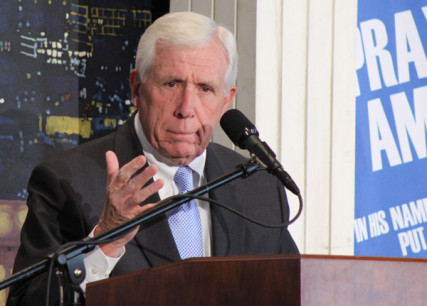
Until quite recently, there were a few—though just a few—who did speak out about the atrocities against Christians and other religious minorities carried out by the Islamic State of Iraq and Syria (ISIS). Back in July, columnist Kirsten Powers referred to the religicide of Christianity in the Middle East: “Iraq’s Christians are begging the world for help. Is anybody listening?” she asked. And there was the estimable Frank Wolf, a member of the House of Representatives from Virginia, who came to the House floor on seven consecutive legislative days to protest the “convert or be killed” policy of Muslim militants in the Middle East. He called on President Obama to take five steps that could have made a difference in that dire situation, none of them involving additional funding or American “boots on the ground.” The response from the leader of the free world, seemingly oblivious to the problem, was an ungolden silence.
Two events in August prompted a growing number of religious and political leaders to begin to speak. One was the onslaught against the Yazidi people, including the abduction and rape of hundreds of Yazidi women and girls, and the stranding of tens of thousands of others on the craggy heights of Mount Sinjar—a humanitarian crisis that prompted limited U. S. airstrikes against ISIS. The other event was a 4-minute, 40-second video depicting the beheading of American journalist James Foley, a devout Catholic, who was brutally put to death at the hands of a jihadist-export from Great Britain. This gruesome video was flashed around the world on YouTube before it was taken down. Last week the serial beheadings continued with the taped execution of 31-year-old Steven Sotloff, a Jewish journalist from Miami and the grandson of Holocaust survivors. Today, we live with another ISIS threat: This time, the promised murder of a British hostage.
“Crimes against humanity” is a euphemism for the wanton killing and horrendous acts of evil being committed in the name of God in the region of the world that gave birth to Judaism, Christianity, and Islam. And yet it is not difficult to see why many thoughtful people are reluctant to encourage yet another military occupation in the region. Twenty-five years of the off-and-on Bush-Obama land wars in Asia have not made the streets of Baghdad safe, nor brought peace between Israel and her neighbors, nor eradicated the virulence of religious violence. ISIS itself was spawned in part through America’s ambivalent connivance in the recent (and ongoing) sectarian wars in Syria where some 200,000 people have been killed and more than 6.5 million others internally displaced or exiled. Libya is yet another country where the quick-fix use of force without a sustainable strategy has not alleviated but rather increased human suffering.
And yet—and yet—there are times in human history when persons of faith cannot play neutral or simply stand by on the sidelines. There are times when they are compelled by conscience to call evil by name and speak out against it with conviction. And they must do this not merely out of a concern for their own personal or national self-protection but precisely as persons of faith—in the name of decency and love and of all that is human and humane. Today is such a time.
Pope Francis
The sentiments expressed by Cardinal Wuerl have been taken up in recent days by many of the world’s religious leaders. Pope Francis has offered to undertake a personal peace mission to northern Iraq. Pastor Rick Warren spoke to the crisis from Rwanda, a country where, in the course of just three months in 1994, genocide left one million Rwandans dead and one million children orphaned—while most of the world looked the other way. Warren said that there were lessons from Rwanda for the crisis in the Middle East. He encouraged African pastors to pray for the persecuted Christians in Iraq and Syria.
Rabbi Jonathan Sacks has called radical political Islam the “face of tyranny” today and has compared the suffering of Christians in the Middle East with violence against Jews in the past. “It would indeed be awful to think,” he said, “that the West might remain silent as violence rages purely out of a failure to recognize that Christians can be victimized, or out of a reluctance to cast aspersions on certain brands of Islam. It would make this the first genocide in history to be tolerated out of social awkwardness.” Some Muslim leaders have also felt it their duty to speak out, including Shawki Ibrahim Abdel-Karim Allam, the Grand Mufti of Egypt. He has said that ISIS is a danger to Islam and has accused it of violating “all the Islamic values, the higher objectives of Islamic law as well as universal values shared by all mankind.”
The Church of England has demanded that the British government offers sanctuary to thousands of Christians fleeing jihadists in northern Iraq, warning that ignoring their plight would constitute a “betrayal of Britain’s moral and historical obligations”.
Justin Welby, the Archbishop of Canterbury, has called for “solidarity of prayer and love” with the Christians in Iraq. “Ever since the war to end all wars ended in 1918, humankind has been saying ‘never again,’ then we wring our hands as genocide unfolds in some distant corner. But what is happening right now in northern Iraq is off the scale of human horror. In a globalized world where even distant nations are our ‘neighbor,’ we cannot allow these atrocities to be unleashed with impunity. . . . We cry to God for peace and justice and security throughout the world, and especially for Christians and other minority groups suffering so deeply in northern Iraq.”
Perhaps no one has done more to alert the world of the atrocities carried out in Iraq and Syria than Canon Andrew White, the Vicar of St. George’s Cathedral in Baghdad. In his 2013 book, Father, Forgive, he wrote:
The sad fact is, religion is very much tied up with violence. As Archbishop William Temple said during the II World War, ‘When religion goes wrong, it goes very wrong.’ The apostle John, recording the words of Jesus in his gospel wrote, ‘the time is coming when anyone who kills you will think they are offering a service to God. They will do such things because they have not known the Father or me’ (John 16:2-3). This is what we have witnessed in our time.
In the midst of such distress, Canon White carries on a ministry of reconciliation and hope among the dwindling number of Christians who still remain in the region. “Here our people have nothing, most have lost everything, yet the presence of Jesus is so real. We talk about love all the time and in love we see the beginning of reconciliation.”
Cardinal Wuerl was right: Atrocities happen because there are those who commit them, and those who simply remain silent. Dietrich Bonhoeffer, whose own life ended on the gallows, knew this very well. “Silence in the face of evil,” he said, “is evil itself. God will not hold us guiltless. Not to speak is to speak. Not to act is to act.”
Timothy George is dean of Beeson Divinity School of Samford University and general editor of the Reformation Commentary on Scripture. His email address is tfgeorge@samford.edu.
“Syrian rebels have reportedly taken control of an historic Christian village near Damascus. Rebel forces led by al Qaeda-linked jihadists captured the Christian village of Maaloula, situated in the mountains just north of Damascus. The village is also known as one of the few places in the world where residents still speak Aramaic, which some scholars say is the language Jesus spoke.”
+ In the name of the Father, and of the Son, and of the Holy Spirit. Amen
Opening sentence
One thing I have asked of the Lord, this is what I seek: that I may dwell in the house of the Lord all the days of my life; to behold the beauty of the Lord and to seek Him in His temple.
Morning readings
Psalm 143:8 ESV:
Let me hear in the morning of your steadfast love, for in you I trust. Make me know the way I should go, for to you I lift up my soul.
1 Kings 18:43 ESV:
And he said to his servant, “Go up now, look toward the sea.” And he went up and looked and said, “There is nothing.” And he said, “Go again,” seven times.
Luke 14:10-11 ESV:
But when you are invited, go and sit in the lowest place, so that when your host comes he may say to you, ‘Friend, move up higher.’ Then you will be honored in the presence of all who sit at table with you. For everyone who exalts himself will be humbled, and he who humbles himself will be exalted.”
Reflection:
How many times a day do I say, ‘Why am I here? What here can stir my gifts to growth? What task of greatness awaits me that I have long neglected? Have I missed Your voice, O God? Here I am: send me! Please!’
‘I have prepared a place for you,’ says the Lord, ‘that is for you, and only you, to fill. First of all, come to My table, and ask that you might serve, looking even for the lowest tasks. When the work of service is done, then you may look for your own place at table. But do not seek the most important place in case it is reserved for someone else. The place I have appointed is where you will be happiest.’
Prayer:
Take me often from the tumult of things into Thy presence. There show me what I am, and what I am supposed to be. Then hide me from Thy tears.
O King and Saviour, what is Thy gift to me? And do I use it to Thy pleasing?
+ May the will of God be done in me, the law of God be kept by me, my evil will controlled by me, speedy repentance made by me, temptation sternly shunned by me, blessed death welcomed by me, angels’ music heard by me, God’s highest praises sung by me.
Christ, You are the Truth; You are the light. You are the Keeper of the treasure I seek so blindly.
+ My soul’s desire is to see the face of God and to rest in His house. My soul’s desire is to study the Scriptures and to learn the ways of God. My soul’s desire is to be freed from all fear and sadness, and to share Christ’s risen life. My soul’s desire is to imitate my King, and to sing His purposes always. My soul’s desire is to enter the gates of heaven and to gaze upon the light that shines forever.
Dear Lord, You alone know what my soul truly desires, and You alone can satisfy those desires. Shape my desires to fit your perfect will for me. Amen.
Song
Christ, as a light… illumine and guide me. Christ, as a shield… overshadow me. Christ under me; Christ over me; Christ beside me on my left and my right.
This day be within and without me, lowly and meek, yet all-powerful. Be in the heart of each to whom I speak; in the mouth of each who speaks unto me. This day be within and without me, lowly and meek, yet all-powerful.
Christ as a light; Christ as a shield; Christ beside me on my left and my right.
Blessing
May the peace of the Lord Christ go with you, wherever He may send you. May He guide you through the wilderness, protect you through the storm. May He bring you home rejoicing at the wonders He has shown you. May He bring you home rejoicing once again into our doors.
+ In the name of the Father, and of the Son, and of the Holy Spirit. Amen
The website and prayer book are rich in prayer resources and I commend them to you. For our purpose here, I will limit my selections to the Morning Prayer resources.
+ In the name of the Father, and of the Son, and of the Holy Spirit. Amen
Opening sentences
Lord Jesus – To whom shall we go? You have the words of eternal life, and we have believed and have come to know that You are the Holy One of God.
Morning readings
Psalm 25:17 ESV:
The troubles of my heart are enlarged; bring me out of my distresses.
Isaiah 40:28-31 ESV:
Have you not known? Have you not heard? The Lord is the everlasting God, the Creator of the ends of the earth. He does not faint or grow weary; his understanding is unsearchable. He gives power to the faint, and to him who has no might he increases strength.
Even youths shall faint and be weary, and young men shall fall exhausted; but they who wait for the Lord shall renew their strength; they shall mount up with wings like eagles; they shall run and not be weary; they shall walk and not faint.
2 Timothy 4:10-11 ESV:
For Demas, in love with this present world, has deserted me and gone to Thessalonica. Crescens has gone to Galatia, Titus to Dalmatia. Luke alone is with me. Get Mark and bring him with you, for he is very useful to me for ministry.
Reflection:
O Holy Christ, bless me with Your presence when my days are weary and my friends are few.
Intercessions:
Mighty and Everlasting God, Maker of heaven and earth, Comfortor of all… especially those who are in trouble and great distress this day – look with favor upon Your people. We think particularly of those who are suffering great persecution because of their faith in Your Son Jesus Christ:
+ For the victims and families of those affected by the killings and mayhem in the Westgate shopping center in Nairobi, Kenya… we pray to the Lord
+ For the victims and families affected by the suicide-bomber massacre at All Saints Church in Peshawar, Pakistan… we pray to the Lord
+ For the victims and families of Christians murdered and displaced in the Syrian civil war… we pray to the Lord
+ For the victims and families of Coptic Christians targeted for revenge in Egypt… we pray to the Lord
+ For the Christians around the world who are being murdered, raped, plundered, abducted, forcibly converted to Islam, or otherwise oppressed by Muslims… we pray to the Lord
+ For all of our brothers and sisters in Christ around the world who are imprisoned because of their faith… we think especially of those in North Korea and Iran… we pray to the Lord
Give power to the faint and strength to the weak… breathe life into those who are exhausted… speak a word of hope and encouragement to those who feel abandoned… and comfort all who are suffering great loss this day. We ask it in Jesus’ name. Amen.
SongChrist Be in My Waking
Blessing
May the peace of the Lord Christ go with you, wherever He may send you. May He guide you through the wilderness, protect you through the storm. May He bring you home rejoicing at the wonders He has shown you. May He bring you home rejoicing once again into our doors.
+ In the name of the Father, and of the Son, and of the Holy Spirit. Amen
The website and prayer book are rich in prayer resources and I commend them to you. For our purpose here, I will limit my selections to the Morning Prayer resources.





 The Peanut Gallery