
Morning Prayer: 16 Sept – Revelation 6:3-8 ~ expect troubles

Morning Prayer

+ In the name of the Father and of the Son, and of the Holy Spirit. Amen

Opening sentences

Lord, open my lips and my mouth will proclaim your praise.

I arise today, through God’s strength to pilot me:
God’s might to uphold me, God’s wisdom to guide me,
God’s eye to look before me, God’s ear to hear me,
God’s word to speak for me, God’s hand to guard me,
God’s way to lie before me, God’s shield to protect me,
God’s host to secure me:
against snares of devils, against temptations of vices,
against inclinations of nature, against everyone who shall wish me ill,
afar and anear, alone and in a crowd.

Revelation 6:3-8 (ESV) – to be read aloud
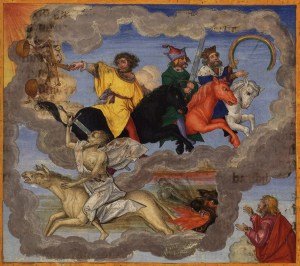
The Four Horsemen of the Apocalypse  from the Ottheinrich-Bibel (ca.1530-1532) illustrated by Matthias Gerung, Bayerische Staatsbibliothek
The Four Horsemen of the Apocalypse
from the Ottheinrich-Bibel (ca.1530-1532) illustrated by Matthias Gerung, Bayerische Staatsbibliothek

When he opened the second seal, I heard the second living creature say, “Come!” And out came another horse, bright red. Its rider was permitted to take peace from the earth, so that people should slay one another, and he was given a great sword.

When he opened the third seal, I heard the third living creature say, “Come!” And I looked, and behold, a black horse! And its rider had a pair of scales in his hand. And I heard what seemed to be a voice in the midst of the four living creatures, saying, “A quart of wheat for a denarius, and three quarts of barley for a denarius, and do not harm the oil and wine!”

When he opened the fourth seal, I heard the voice of the fourth living creature say, “Come!” And I looked, and behold, a pale horse! And its rider’s name was Death, and Hades followed him. And they were given authority over a fourth of the earth, to kill with sword and with famine and with pestilence and by wild beasts of the earth.

Reflection

Overview: The significance of the second, third, and fourth horsemen is not in doubt. The second is war, the third is scarcity, the fourth is death in the form of pestilence and violence. (Ladd, p.97)

THE SECOND VISION – THE SEVEN SEALS

The Second Seal (6:3-4)

The red horse and rider is a symbol of warfare and bloodshed…. The great Pax Romana gave to the Mediterranean world several centuries of peace which the western world has never since experienced. However, it was a peace based on force, and the might of Rome was everywhere represented by the presence of her legions. In principle, warfare and conquest were the dominant policy and will remain so until the return of the Lord. (Ladd, p.100)

The Third Seal (6:5-6)

The black horse and rider carrying a set of scales represents scarcity…. The black horse represents a condition of dire want, but not of acute famine conditions. This is a situation which belongs… to the beginning of the great woes. (Ladd, p.101)

The Fourth Seal (6:7-8)

The pale horse represents death from famine, pestilence, and wild beasts…. Death by the sword differs from the plague of the second horseman, war, in that it can include all kinds of violent deaths by the sword, such as murder, as well as war…. The inclusion of famine… suggests that this plague… while similar to scarcity… is more intense. However, it is still of limited scope, for this rider is given power only over a fourth of the earth. (Ladd, p.101)
__________

Mid toil and tribulation, and tumult of her war, she waits the consummation of peace forevermore: till with the vision glorious her longing eyes are blest, and the great church victorious shall be the church at rest.
__________

Canticle

Christ, as a light – illumine and guide me.
Christ, as a shield – overshadow me.
Christ under me; Christ over me; Christ beside me – on my left and my right.
This day be within and without me, lowly and meek, yet all-powerful.
Be in the heart of each to whom I speak; in the mouth of each who speaks unto me.
This day be within and without me, lowly and meek, yet all-powerful.
Christ as a light; Christ as a shield; Christ beside me – on my left and my right.

Blessing

May the peace of the Lord Christ go with you, wherever He may send you.
May He guide you through the wilderness, protect you through the storm.
May He bring you home rejoicing at the wonders He has shown you.
May He bring you home rejoicing once again into our doors.

+ In the name of the Father, and of the Son, and of the Holy Spirit. Amen
_____________________________________

Peanut Gallery: In September, we will begin reading through the Book of Revelation (ESV). Our purpose will be devotional, i.e. to discover the word of blessing that God has for us in these troubled times… to find hope and help for our daily lives.

This will not be a Bible Study per se: we will not attempt to unravel the “mysteries” of Revelation… that is far beyond our abilities and is not our interest here. However, so as not to get too far afield, we will rely on three study resources: primary – A Commentary on the Revelation of John (George Elton Ladd); supplemental Revelation (Leon Morris) and  The Book of Revelation (Robert H. Mounce).

The general format for Morning Prayer is adapted from the Northumbrian Community‘s Daily Office, as found in Celtic Daily Prayer (see online resources here.) On Sundays, we’ll return to the USCCB readings (see online resources here) and various liturgical resources in order to reflect the Church’s worship and concerns throughout the world. Photo illustrations and music videos, available online, are included as they illustrate or illuminate the readings. I will try to give credit and link to sources as best I can.

Morning Prayer, 03 Mar – John 11:38-44 ~ You raise me up

Morning Prayer

+ In the name of the Father, and of the Son, and of the Holy Spirit. Amen

Opening sentences – Brigid of Kildare (c. 450-523)

Peace be here in the Name of the King of life; the peace of Christ above all peace, the Lord’s blessing over you.

Child of my heart, the joy of God be in thy face, joy to all who see thee.

The circle of God around thee, angels of God shielding thee.

Joy of night and day be thine; joy of sun and moon be thine; joy of men and women be thine.

Each land and sea thou goest, each land and sea thou goest, be every season happy for thee; be every season bright for thee; be every season glad for thee.

Be thine the compassing of the God of life; be thine the compassing of the Christ of love; be thine the compassing of the Spirit of grace: to befriend thee and aid thee, thou beloved child of my heart.

Morning readings

John 11:38-44 ESV:

'The Raising of Lazarus' Duccio di Buoninsegna (1310–11) Kimbell Art Museum
‘The Raising of Lazarus’
Duccio di Buoninsegna (1310–11)
Kimbell Art Museum

Then Jesus, deeply moved again, came to the tomb. It was a cave, and a stone lay against it. Jesus said, “Take away the stone.”

Martha, the sister of the dead man, said to him, “Lord, by this time there will be an odor, for he has been dead four days.”

Jesus said to her, “Did I not tell you that if you believed you would see the glory of God?” So they took away the stone.

And Jesus lifted up his eyes and said, “Father, I thank you that you have heard me. I knew that you always hear me, but I said this on account of the people standing around, that they may believe that you sent me.” When he had said these things, he cried out with a loud voice, “Lazarus, come out.”

The man who had died came out, his hands and feet bound with linen strips, and his face wrapped with a cloth.

Jesus said to them, “Unbind him, and let him go.”

Reflections:

bodily resurrection

Martha’s objection that there would be a stench due to decomposition highlights the greatness of this sign. Jesus is raising someone who should already have begun to decay. There is no indication in the story that Lazarus comes out bearing marks of decay. Here we see a revelation of Jesus’ power and authority as the agent of creation. He does not just bring the person back to life by reuniting soul and body, he also restores the body itself.

Not only is the raising of Lazarus a sign of Jesus’ identity and authority as life-giver, it also reflects the reality of the resurrection of the body. God is able to restore physical bodies after decay. The analogy is not complete, since Lazarus is not raised as an imperishable, spiritual body, as will be the case at the resurrection of the dead. But there is a continuity between the spiritual body and the physical body: it is a bodily resurrection. The overcoming of corruption in the raising of Lazarus thus provides, in part, a sign of the future resurrection.

God the Father

Here is the most powerful sign of Jesus’ power and authority, but it does not point to him except as evidence that he is doing what he sees the Father doing. He is here to glorify God, not himself.

This dependency upon the Father is further emphasized in Jesus’ prayer. Indeed, for Christians, God is now known primarily as the Father of Jesus. Our language for God as Father has its source in Jesus’ own revelation of God. It is his relationship with God that a Christian enters into and thus comes to know God as Jesus knows him, within the limitations of our human nature.

God the Son

Jesus vocalizes his prayer for the sake of the crowd – it is not enough for people to be impressed with Jesus. They must believe in him as the one sent from God. It is precisely because Jesus is sent from God and does as God directs him that he is heard by God. The Father as the sender is primary. Jesus is not a wonderworker who is able to get God to do what he wants him to do. He is the obedient Son sent by the Father to do the Father’s will. The Father’s will and the Son’s petition coincide exactly.

In saying the purpose of this prayer is that they might believe, Jesus is again acting with divine graciousness and mercy. Such belief brings eternal life. Thus, this miracle is not just for the sake of Lazarus and his sisters, who already do have such faith and the life it brings, but for others that they may have life. The miracle reveals Jesus as the life-giver sent from the Father, and one receives life from him as one has faith in him.

Word of life

Jesus could have healed Lazarus when he was still sick with a word of command, even across the miles. But now he utters a mightier word across a much greater distance — that between the living and the dead. The Word through whom all was made here speaks forth life. Those standing around were given tasks to do, such as taking away the stone and unbinding Lazarus. The physical contact helped drive home the reality of what was happening. But for Jesus, his work is his word.

Jesus’ command – “Take off the grave clothes and let him go” – is a cry of victory. The grave has been defeated and liberty achieved – it is a great sign of the life that is stronger than death, which those who believe in Jesus share. And it is a graphic sign of Jesus’ own power and authority.

This story speaks to all Christians bound by the fear of death and, on another level, bound by various sins. The Christian is in union with the one who himself is resurrection and life. As Christ offers freedom from the power of sin, so faith in Christ as resurrection and life brings freedom from the fear of death.

The IVP New Testament Commentary Series

__________

__________

Canticle:

Christ, as a light… illumine and guide me. Christ, as a shield… overshadow me. Christ under me; Christ over me; Christ beside me on my left and my right.

This day be within and without me, lowly and meek, yet all-powerful. Be in the heart of each to whom I speak; in the mouth of each who speaks unto me. This day be within and without me, lowly and meek, yet all-powerful.

Christ as a light; Christ as a shield; Christ beside me on my left and my right.

Blessing

May the peace of the Lord Christ go with you, wherever He may send you. May He guide you through the wilderness, protect you through the storm. May He bring you home rejoicing at the wonders He has shown you. May He bring you home rejoicing once again into our doors.

+ In the name of the Father, and of the Son, and of the Holy Spirit. Amen

_____________________________________

Peanut Gallery: A brief word of explanation – the general format for Morning Prayer is adapted from the Northumbrian Community‘s Daily Office, as found in Celtic Daily Prayer (see online resources here.) The Scripture readings are primarily from the Gospel of John, with the intent to complete the reading by Easter. Other Scriptures which illuminate the Gospel of John will be included along the way.

Reflections from various saints will be included as their memorial days occur during the calendar year.

On Sundays, I’ll return to the USCCB readings (see online resources here) and various liturgical resources in order to reflect the Church’s worship and concerns throughout the world.

Photo illustrations and music videos, available online, are included as they illustrate or illuminate the readings. I will try to give credit and link to sources as best I can.

Morning Prayer, 01 Mar – John 11:28-37 ~ run to Jesus

Morning Prayer

+ In the name of the Father, and of the Son, and of the Holy Spirit. Amen

Opening sentences – Brigid of Kildare (c. 450-523)

Peace be here in the Name of the King of life; the peace of Christ above all peace, the Lord’s blessing over you.

May all be welcomed here as the Christ-child at the stable: in simplicity and joy, and may the smile of the Son of Peace be found here whenever the door is opened.

Morning readings

John 11:28-37 ESV:

jesus wept

When [Martha] had said this, she went and called her sister Mary, saying in private, “The Teacher is here and is calling for you.” And when she heard it, she rose quickly and went to him. Now Jesus had not yet come into the village, but was still in the place where Martha had met him. When the Jews who were with her in the house, consoling her, saw Mary rise quickly and go out, they followed her, supposing that she was going to the tomb to weep there.

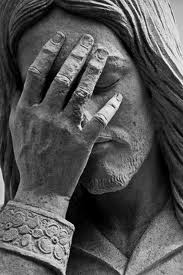
Now when Mary came to where Jesus was and saw him, she fell at his feet, saying to him, “Lord, if you had been here, my brother would not have died.” When Jesus saw her weeping, and the Jews who had come with her also weeping, he was deeply moved in his spirit and greatly troubled. And he said, “Where have you laid him?” They said to him, “Lord, come and see.” Jesus wept.

So the Jews said, “See how he loved him!” But some of them said, “Could not he who opened the eyes of the blind man also have kept this man from dying?”

Reflections:

Mary runs to Jesus, as had Martha, showing their great attachment to Jesus, which reciprocated his love for them. In coming to Jesus in the midst of suffering the sisters provide a model for all believers.

The wailing of Mary and those with her provokes a strong emotional reaction in Jesus – translated literally, “became angry in spirit and very agitated.” Jesus’ anger is most likely directed at death itself, the pain and sadness it causes, and the reign of terror it exercises. In a Gospel in which life is one of the primary themes, death is clearly the great enemy.

The mourners invitation to “come and see” where Lazarus has been buried wrings Jesus’ heart. He is not in anguish over the death of Lazarus, but rather saddened by the pain and sadness they feel. He is weeping with those who weep because he loves them.

The grief caused by death is one facet of death’s evil that caused Jesus’ anger. He is angry at death and saddened at grief. In both cases the reason is the same, namely, Jesus’ love for his friends. The love of God for us and his wrath toward that which corrupts and destroys us are two sides of a single coin.

The IVP New Testament Commentary Series

__________


__________

Canticle:

Christ, as a light… illumine and guide me. Christ, as a shield… overshadow me. Christ under me; Christ over me; Christ beside me on my left and my right.

This day be within and without me, lowly and meek, yet all-powerful. Be in the heart of each to whom I speak; in the mouth of each who speaks unto me. This day be within and without me, lowly and meek, yet all-powerful.

Christ as a light; Christ as a shield; Christ beside me on my left and my right.

Blessing

May the peace of the Lord Christ go with you, wherever He may send you. May He guide you through the wilderness, protect you through the storm. May He bring you home rejoicing at the wonders He has shown you. May He bring you home rejoicing once again into our doors.

+ In the name of the Father, and of the Son, and of the Holy Spirit. Amen

_____________________________________

Peanut Gallery: A brief word of explanation – the general format for Morning Prayer is adapted from the Northumbrian Community‘s Daily Office, as found in Celtic Daily Prayer (see online resources here.) The Scripture readings are primarily from the Gospel of John, with the intent to complete the reading by Easter. Other Scriptures which illuminate the Gospel of John will be included along the way.

Reflections from various saints will be included as their memorial days occur during the calendar year.

On Sundays, I’ll return to the USCCB readings (see online resources here) and various liturgical resources in order to reflect the Church’s worship and concerns throughout the world.

Photo illustrations and music videos, available online, are included as they illustrate or illuminate the readings. I will try to give credit and link to sources as best I can.
Morning Prayer, 28 Feb – John 11:17-27 ~ yes Lord

Morning Prayer

+ In the name of the Father, and of the Son, and of the Holy Spirit. Amen

Opening sentences – Brigid of Kildare (c. 450-523)

Peace be here in the Name of the King of life; the peace of Christ above all peace, the Lord’s blessing over you.

May God the Father be the guardian of this place and bring His peace, that fear may find no entry here. May Christ be a chosen companion and friend. May loneliness be banished. May the Spirit bring lightness and laughter, and be the comforter of tears. Courage be at each going out; rest be present at each return; each day, each night, each going out and each returning.

Morning readings

John 11:17-27 ESV:

Resurrection-and-Life

Now when Jesus came, he found that Lazarus had already been in the tomb four days. Bethany was near Jerusalem, about two miles off, and many of the Jews had come to Martha and Mary to console them concerning their brother. So when Martha heard that Jesus was coming, she went and met him, but Mary remained seated in the house.

Martha said to Jesus, “Lord, if you had been here, my brother would not have died. But even now I know that whatever you ask from God, God will give you.”

Jesus said to her, “Your brother will rise again.”

Martha said to him, “I know that he will rise again in the resurrection on the last day.”

Jesus said to her, “I am the resurrection and the life. Whoever believes in me, though he die, yet shall he live, and everyone who lives and believes in me shall never die. Do you believe this?”

She said to him, “Yes, Lord; I believe that you are the Christ, the Son of God, who is coming into the world.”

Reflections:

if only

Martha’s lament recaps her grief over the loss of her brother and her trust in Jesus as a friend and healer. Her belief that Jesus’ prayers are answered picks up on the truth of Jesus’ dependence upon the Father.

even now

Martha believes that it is never too late for Jesus to do something because of his special relationship with the Father.

She continues to believe in Jesus even though Lazarus’ death seems to call into question the messengers’ report that Jesus had said, This sickness will not end in death. Moreover, even though Jesus has delayed coming to help, she continues to believe that Jesus is the agent of the gracious God — despite the fact that this graciousness was not present to heal her brother.

Her trust in God’s love for one that Christ clearly loved is not shaken.

The IVP New Testament Commentary Series

__________

__________

the resurrection

Martha has expressed her faith in her brother’s future resurrection and Jesus responds by challenging her with a deeper revelation of himself: “I am the resurrection and the life. He who believes in me will live, even though he dies; and whoever lives and believes in me will never die.”

Jesus’ own identity spans the gap between the already and the not yet: “The resurrection because the life” (Augustine). The life Jesus is talking about even encompasses the resurrection life of the world to come. In the raising of Lazarus, we have a revelation of Jesus’ authority and his identity as life-giver because he is life itself. Jesus’ role goes far beyond our earthly existence.

the life

Jesus’ claim is mind-boggling. He says it is faith in him that brings one back to life at the resurrection at the last day. But then he goes even further. “I am the life”: and whoever lives and believes in me will never die. The life that comes through believing in Jesus is not interrupted by physical death.

The very nature of the life of the believer is one that death cannot destroy since the believer is in union with Jesus who is the Life. By taking humanity into Himself He has revealed the permanence of man’s individuality and being. But this permanence can be found only in union with Him. Thus two main thoughts are laid down: Life (resurrection) is present, and this Life is in a Person.

yes Lord

Martha’s faith is genuine and solid, for it is in Jesus himself. She is not grasping all that he is saying about himself, but she is sticking with him and confessing as much as she knows, which is what faith is all about. As the events of the raising of Lazarus unfold Jesus will instruct her in what he has just claimed, thus bringing her step by step in her knowledge of who he is and what he is offering so she may respond in faith.

This example of patient progress in our Lord’s dealing with Martha should be a great encouragement to those of us who are not always quick on the uptake when it comes to God’s revelation of himself to us.

The IVP New Testament Commentary Series

__________


__________

Canticle:

Christ, as a light… illumine and guide me. Christ, as a shield… overshadow me. Christ under me; Christ over me; Christ beside me on my left and my right.

This day be within and without me, lowly and meek, yet all-powerful. Be in the heart of each to whom I speak; in the mouth of each who speaks unto me. This day be within and without me, lowly and meek, yet all-powerful.

Christ as a light; Christ as a shield; Christ beside me on my left and my right.

Blessing

May the peace of the Lord Christ go with you, wherever He may send you. May He guide you through the wilderness, protect you through the storm. May He bring you home rejoicing at the wonders He has shown you. May He bring you home rejoicing once again into our doors.

+ In the name of the Father, and of the Son, and of the Holy Spirit. Amen

_____________________________________

Peanut Gallery: A brief word of explanation – the general format for Morning Prayer is adapted from the Northumbrian Community‘s Daily Office, as found in Celtic Daily Prayer (see online resources here.) The Scripture readings are primarily from the Gospel of John, with the intent to complete the reading by Easter. Other Scriptures which illuminate the Gospel of John will be included along the way.

Reflections from various saints will be included as their memorial days occur during the calendar year.

On Sundays, I’ll return to the USCCB readings (see online resources here) and various liturgical resources in order to reflect the Church’s worship and concerns throughout the world.

Photo illustrations and music videos, available online, are included as they illustrate or illuminate the readings. I will try to give credit and link to sources as best I can.

Morning Prayer, 27 Feb – John 11:1-16 ~ holy delay

Morning Prayer

+ In the name of the Father, and of the Son, and of the Holy Spirit. Amen

Opening sentences – Brigid of Kildare (c. 450-523)

I would welcome the poor and honour them. I would welcome the sick in the presence of angels and ask God to bless and embrace us all.

Seeing a stranger approach, I would put food in the eating place, music in the listening place, and look with joy for the blessing of God, who often comes to my home in the blessing of a stranger.

We call upon the Sacred Three to save, shield and surround this house, this home, this day, this night, and every night.

Morning readings

John 11:1-16 ESV:

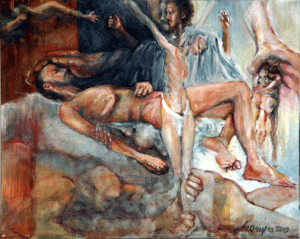
"Lazarus" by Carol L. Douglas
“Lazarus”
by Carol L. Douglas

Now a certain man was ill, Lazarus of Bethany, the village of Mary and her sister Martha. It was Mary who anointed the Lord with ointment and wiped his feet with her hair, whose brother Lazarus was ill. So the sisters sent to him, saying, “Lord, he whom you love is ill.”

But when Jesus heard it he said, “This illness does not lead to death. It is for the glory of God, so that the Son of God may be glorified through it.”

Now Jesus loved Martha and her sister and Lazarus. So, when he heard that Lazarus was ill, he stayed two days longer in the place where he was. Then after this he said to the disciples, “Let us go to Judea again.”

The disciples said to him, “Rabbi, the Jews were just now seeking to stone you, and are you going there again?”

Jesus answered, “Are there not twelve hours in the day? If anyone walks in the day, he does not stumble, because he sees the light of this world. But if anyone walks in the night, he stumbles, because the light is not in him.”

After saying these things, he said to them, “Our friend Lazarus has fallen asleep, but I go to awaken him.”

The disciples said to him, “Lord, if he has fallen asleep, he will recover.”

Now Jesus had spoken of his death, but they thought that he meant taking rest in sleep. Then Jesus told them plainly, “Lazarus has died, and for your sake I am glad that I was not there, so that you may believe. But let us go to him.”

So Thomas, called the Twin, said to his fellow disciples, “Let us also go, that we may die with him.”

Reflections:

their need

The sisters present their need to Jesus but do not dictate how he should respond; their submission and humility allow God’s will to be done in a seemingly impossible situation – they are trusting in Jesus’ love for them and their brother.

God’s glory

In all that Jesus does we see the glory of God, for we see God’s love and life-giving power. Now, in the raising of Lazarus, we will have the most spectacular manifestation of this glory. God is the one who brings life to the dead out of his love for those in such need.

This is the heart of the Gospel. God’s glory is thus seen in his victory over death — indeed, it is “possible only through death — first the death of Lazarus, and then the death of Jesus himself!”

holy delay

Jesus behaves in an especially shocking manner – he delays for two days. Jesus’ activity is scandalous – his love does not feel like love but it is love, and it is for the best in their lives. His delay leads to a greater blessing.

Jesus has no doubt that he could have cured Lazarus if he had been there, but something even more helpful for the disciples’ faith is now going to take place.

light of day

Jesus uses the imagery of light to put his return to Judea into perspective. In the natural realm one is able to walk without stumbling while there is light, and there is light for a set period of time. One need not worry about stumbling while it is day.

The point is that they need not worry about what will happen to them for they have the Light of the World with them, for with him they are able to get on with the work of the Father. They should stick with Jesus even when he seems to lead them into danger, for no matter what happens it will work out for the best, even as Lazarus’s illness will work for the glory of God.

faith on the move

Faith is a progressive thing, for here Jesus is talking to those who have believed in him already, and yet he says this miracle is so that you may believe. Faith must be exercised in the face of each new revelation, and each new revelation is taking the disciples nearer to the ultimate revelation in the most extremely scandalous event, the cross — the ultimate revelation of God’s light and life and love and thus the ultimate manifestation of God that faith must grasp hold of.

As God reveals more of himself and his ways to us we must likewise have a faith that both grasps firmly onto him as he is revealed in Jesus and also is able to be stretched and deepened. Faith enables us to rest in God, but God himself also keeps us on the move as we continue to grow closer to him for ever.

The IVP New Testament Commentary Series

__________


__________

Canticle:

Christ, as a light… illumine and guide me. Christ, as a shield… overshadow me. Christ under me; Christ over me; Christ beside me on my left and my right.

This day be within and without me, lowly and meek, yet all-powerful. Be in the heart of each to whom I speak; in the mouth of each who speaks unto me. This day be within and without me, lowly and meek, yet all-powerful.

Christ as a light; Christ as a shield; Christ beside me on my left and my right.

Blessing

May the peace of the Lord Christ go with you, wherever He may send you. May He guide you through the wilderness, protect you through the storm. May He bring you home rejoicing at the wonders He has shown you. May He bring you home rejoicing once again into our doors.

+ In the name of the Father, and of the Son, and of the Holy Spirit. Amen

_____________________________________

Peanut Gallery: A brief word of explanation – the general format for Morning Prayer is adapted from the Northumbrian Community‘s Daily Office, as found in Celtic Daily Prayer (see online resources here.) The Scripture readings are primarily from the Gospel of John, with the intent to complete the reading by Easter. Other Scriptures which illuminate the Gospel of John will be included along the way.

Reflections from various saints will be included as their memorial days occur during the calendar year.

On Sundays, I’ll return to the USCCB readings (see online resources here) and various liturgical resources in order to reflect the Church’s worship and concerns throughout the world.

Photo illustrations and music videos, available online, are included as they illustrate or illuminate the readings. I will try to give credit and link to sources as best I can.