Morning Reading: Fri, 29 Dec – Acts 27-28 ~ In Rome, Paul boldly proclaimed the Kingdom of God and the Lord Jesus Christ.

Morning Reading

+ In the name of the Father, and the Son, and the Holy Spirit. Amen!

Opening – (Northumbria Community)

One thing I have asked of the Lord, this is what I seek: that I may dwell in the house of the Lord all the days of my life; to behold the beauty of the Lord and to seek Him in His temple.

Praise to You, Lord Jesus Christ, King of endless glory.

Morning Reading: Acts 27-28 (NLT)

Paul Sails for Rome

Acts 27:1-12 (NLT) – When the time came, we set sail for Italy. Paul and several other prisoners were placed in the custody of a Roman officer named Julius, a captain of the Imperial Regiment. Aristarchus, a Macedonian from Thessalonica, was also with us. We left on a ship whose home port was Adramyttium on the northwest coast of the province of Asia; it was scheduled to make several stops at ports along the coast of the province.

The next day when we docked at Sidon, Julius was very kind to Paul and let him go ashore to visit with friends so they could provide for his needs. Putting out to sea from there, we encountered strong headwinds that made it difficult to keep the ship on course, so we sailed north of Cyprus between the island and the mainland. Keeping to the open sea, we passed along the coast of Cilicia and Pamphylia, landing at Myra, in the province of Lycia. There the commanding officer found an Egyptian ship from Alexandria that was bound for Italy, and he put us on board.
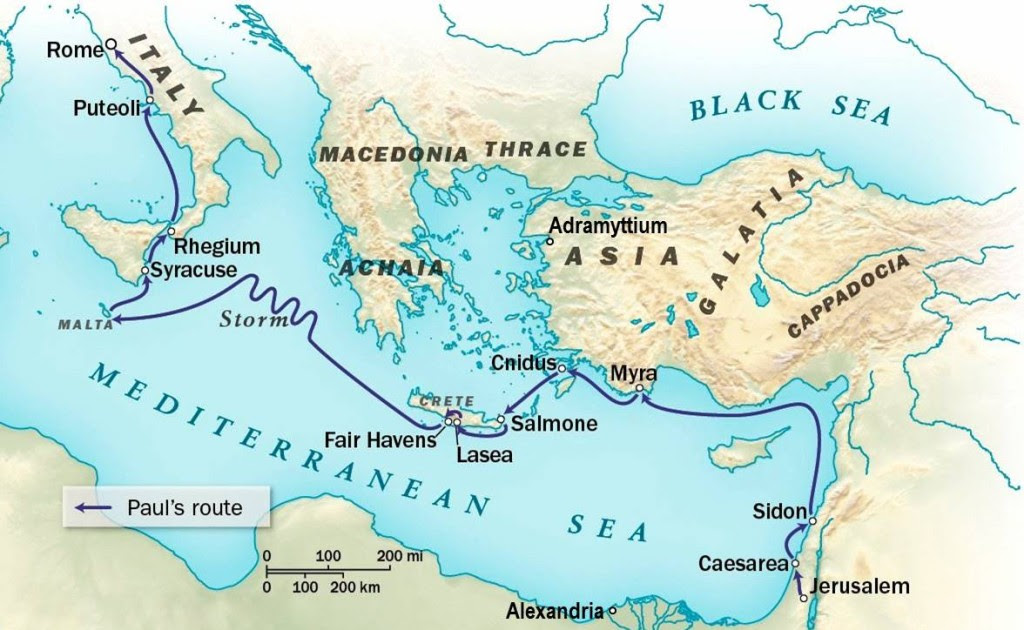
We had several days of slow sailing, and after great difficulty we finally neared Cnidus. But the wind was against us, so we sailed across to Crete and along the sheltered coast of the island, past the cape of Salmone. We struggled along the coast with great difficulty and finally arrived at Fair Havens, near the town of Lasea. We had lost a lot of time. The weather was becoming dangerous for sea travel because it was so late in the fall, and Paul spoke to the ship’s officers about it.

“Men,” he said, “I believe there is trouble ahead if we go on—shipwreck, loss of cargo, and danger to our lives as well.” But the officer in charge of the prisoners listened more to the ship’s captain and the owner than to Paul. And since Fair Havens was an exposed harbor—a poor place to spend the winter—most of the crew wanted to go on to Phoenix, farther up the coast of Crete, and spend the winter there. Phoenix was a good harbor with only a southwest and northwest exposure.

The Storm at Sea

Acts 27:13-26 (NLT) – When a light wind began blowing from the south, the sailors thought they could make it. So they pulled up anchor and sailed close to the shore of Crete. But the weather changed abruptly, and a wind of typhoon strength (called a “northeaster”) burst across the island and blew us out to sea. The sailors couldn’t turn the ship into the wind, so they gave up and let it run before the gale.

We sailed along the sheltered side of a small island named Cauda, where with great difficulty we hoisted aboard the lifeboat being towed behind us. Then the sailors bound ropes around the hull of the ship to strengthen it. They were afraid of being driven across to the sandbars of Syrtis off the African coast, so they lowered the sea anchor to slow the ship and were driven before the wind.
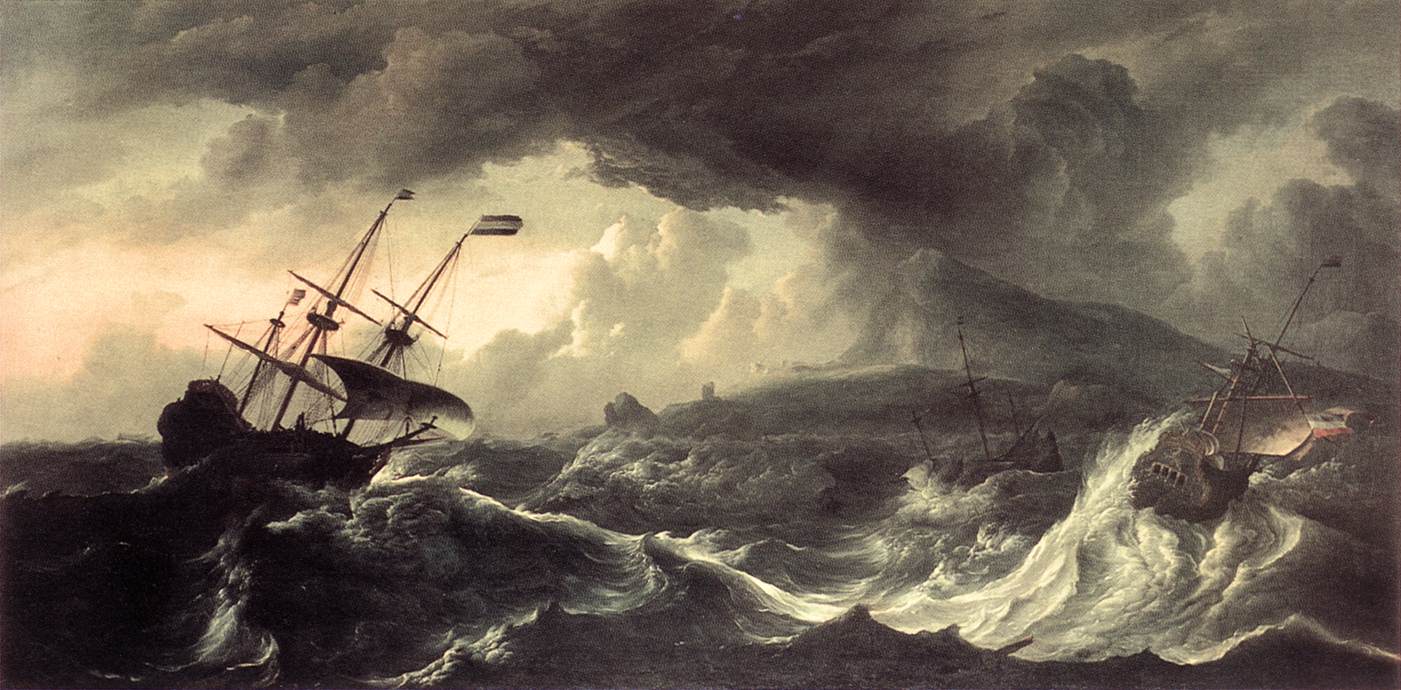
The next day, as gale-force winds continued to batter the ship, the crew began throwing the cargo overboard. The following day they even took some of the ship’s gear and threw it overboard. The terrible storm raged for many days, blotting out the sun and the stars, until at last all hope was gone.

No one had eaten for a long time. Finally, Paul called the crew together and said, “Men, you should have listened to me in the first place and not left Crete. You would have avoided all this damage and loss. But take courage! None of you will lose your lives, even though the ship will go down. For last night an angel of the God to whom I belong and whom I serve stood beside me, and he said, ‘Don’t be afraid, Paul, for you will surely stand trial before Caesar! What’s more, God in his goodness has granted safety to everyone sailing with you.’ So take courage! For I believe God. It will be just as he said. But we will be shipwrecked on an island.”

The Shipwreck

Acts 27:27-44 (NLT) – About midnight on the fourteenth night of the storm, as we were being driven across the Sea of Adria, the sailors sensed land was near. They dropped a weighted line and found that the water was 120 feet deep. But a little later they measured again and found it was only 90 feet deep. At this rate they were afraid we would soon be driven against the rocks along the shore, so they threw out four anchors from the back of the ship and prayed for daylight.

Then the sailors tried to abandon the ship; they lowered the lifeboat as though they were going to put out anchors from the front of the ship. But Paul said to the commanding officer and the soldiers, “You will all die unless the sailors stay aboard.” So the soldiers cut the ropes to the lifeboat and let it drift away.

Just as day was dawning, Paul urged everyone to eat. “You have been so worried that you haven’t touched food for two weeks,” he said. “Please eat something now for your own good. For not a hair of your heads will perish.” Then he took some bread, gave thanks to God before them all, and broke off a piece and ate it. Then everyone was encouraged and began to eat— all 276 of us who were on board. After eating, the crew lightened the ship further by throwing the cargo of wheat overboard.

When morning dawned, they didn’t recognize the coastline, but they saw a bay with a beach and wondered if they could get to shore by running the ship aground. So they cut off the anchors and left them in the sea. Then they lowered the rudders, raised the foresail, and headed toward shore. But they hit a shoal and ran the ship aground too soon. The bow of the ship stuck fast, while the stern was repeatedly smashed by the force of the waves and began to break apart.

The soldiers wanted to kill the prisoners to make sure they didn’t swim ashore and escape. But the commanding officer wanted to spare Paul, so he didn’t let them carry out their plan. Then he ordered all who could swim to jump overboard first and make for land. The others held on to planks or debris from the broken ship. So everyone escaped safely to shore.

Paul on the Island of Malta

Acts 28:1-10 (NLT) –  Once we were safe on shore, we learned that we were on the island of Malta. The people of the island were very kind to us. It was cold and rainy, so they built a fire on the shore to welcome us.

As Paul gathered an armful of sticks and was laying them on the fire, a poisonous snake, driven out by the heat, bit him on the hand. The people of the island saw it hanging from his hand and said to each other, “A murderer, no doubt! Though he escaped the sea, justice will not permit him to live.” But Paul shook off the snake into the fire and was unharmed. The people waited for him to swell up or suddenly drop dead. But when they had waited a long time and saw that he wasn’t harmed, they changed their minds and decided he was a god.

Near the shore where we landed was an estate belonging to Publius, the chief official of the island. He welcomed us and treated us kindly for three days. As it happened, Publius’s father was ill with fever and dysentery. Paul went in and prayed for him, and laying his hands on him, he healed him. Then all the other sick people on the island came and were healed. As a result we were showered with honors, and when the time came to sail, people supplied us with everything we would need for the trip.

Paul Arrives at Rome

Acts 28:11-16 (NLT) –  It was three months after the shipwreck that we set sail on another ship that had wintered at the island—an Alexandrian ship with the twin gods as its figurehead. Our first stop was Syracuse, where we stayed three days. From there we sailed across to Rhegium. A day later a south wind began blowing, so the following day we sailed up the coast to Puteoli. There we found some believers, who invited us to spend a week with them. And so we came to Rome.

The brothers and sisters in Rome had heard we were coming, and they came to meet us at the Forum on the Appian Way. Others joined us at The Three Taverns. When Paul saw them, he was encouraged and thanked God.

When we arrived in Rome, Paul was permitted to have his own private lodging, though he was guarded by a soldier.

Paul Preaches at Rome under Guard

Acts 28:17-31 (NLT) –  Three days after Paul’s arrival, he called together the local Jewish leaders. He said to them, “Brothers, I was arrested in Jerusalem and handed over to the Roman government, even though I had done nothing against our people or the customs of our ancestors. The Romans tried me and wanted to release me, because they found no cause for the death sentence. But when the Jewish leaders protested the decision, I felt it necessary to appeal to Caesar, even though I had no desire to press charges against my own people. I asked you to come here today so we could get acquainted and so I could explain to you that I am bound with this chain because I believe that the hope of Israel—the Messiah—has already come.”

They replied, “We have had no letters from Judea or reports against you from anyone who has come here. But we want to hear what you believe, for the only thing we know about this movement is that it is denounced everywhere.”

So a time was set, and on that day a large number of people came to Paul’s lodging. He explained and testified about the Kingdom of God and tried to persuade them about Jesus from the Scriptures. Using the law of Moses and the books of the prophets, he spoke to them from morning until evening. Some were persuaded by the things he said, but others did not believe. And after they had argued back and forth among themselves, they left with this final word from Paul: “The Holy Spirit was right when he said to your ancestors through Isaiah the prophet,

‘Go and say to this people: When you hear what I say, you will not understand. When you see what I do, you will not comprehend. For the hearts of these people are hardened, and their ears cannot hear, and they have closed their eyes—so their eyes cannot see, and their ears cannot hear, and their hearts cannot understand, and they cannot turn to me and let me heal them.’

So I want you to know that this salvation from God has also been offered to the Gentiles, and they will accept it.”

For the next two years, Paul lived in Rome at his own expense. He welcomed all who visited him, boldly proclaiming the Kingdom of God and teaching about the Lord Jesus Christ. And no one tried to stop him.
__________

“Baby Boy” – for King & Country


__________

Blessing – (Northumbrian Community)

May the peace of the Lord Christ go with you, wherever He may send you. May He guide you through the wilderness, protect you through the storm. May He bring you home rejoicing at the wonders He has shown you. May He bring you home rejoicing once again into our doors.
__________

+ In the name of the Father, and the Son, and the Holy Spirit. Amen!

Morning Reading: Thu, 28 Dec – Revelation 21-22 ~ The Beginning & The End

Morning Reading

+ In the name of the Father, and the Son, and the Holy Spirit. Amen!

Opening – (Northumbria Community)

One thing I have asked of the Lord, this is what I seek: that I may dwell in the house of the Lord all the days of my life; to behold the beauty of the Lord and to seek Him in His temple.

Praise to You, Lord Jesus Christ, King of endless glory.

Reading in Full: Revelation 21-22 (NLT)

The New Heaven and Earth

Revelation 21 (NLT) – Then I saw a new heaven and a new earth, for the old heaven and the old earth had disappeared. And the sea was also gone. And I saw the holy city, the new Jerusalem, coming down from God out of heaven like a bride beautifully dressed for her husband.

I heard a loud shout from the throne, saying, “Look, God’s home is now among his people! He will live with them, and they will be his people. God himself will be with them. He will wipe every tear from their eyes, and there will be no more death or sorrow or crying or pain. All these things are gone forever.”

And the one sitting on the throne said, “Look, I am making everything new!” And then he said to me, “Write this down, for what I tell you is trustworthy and true.” And he also said, “It is finished! I am the Alpha and the Omega—the Beginning and the End. To all who are thirsty I will give freely from the springs of the water of life. All who are victorious will inherit all these blessings, and I will be their God, and they will be my children.

“But cowards, unbelievers, the corrupt, murderers, the immoral, those who practice witchcraft, idol worshipers, and all liars—their fate is in the fiery lake of burning sulfur. This is the second death.”

The New Jerusalem

Then one of the seven angels who held the seven bowls containing the seven last plagues came and said to me, “Come with me! I will show you the bride, the wife of the Lamb.”

So he took me in the Spirit to a great, high mountain, and he showed me the holy city, Jerusalem, descending out of heaven from God. It shone with the glory of God and sparkled like a precious stone—like jasper as clear as crystal. The city wall was broad and high, with twelve gates guarded by twelve angels. And the names of the twelve tribes of Israel were written on the gates. There were three gates on each side—east, north, south, and west. The wall of the city had twelve foundation stones, and on them were written the names of the twelve apostles of the Lamb.

The angel who talked to me held in his hand a gold measuring stick to measure the city, its gates, and its wall. When he measured it, he found it was a square, as wide as it was long. In fact, its length and width and height were each 1,400 miles. Then he measured the walls and found them to be 216 feet thick (according to the human standard used by the angel).

The wall was made of jasper, and the city was pure gold, as clear as glass. The wall of the city was built on foundation stones inlaid with twelve precious stones: the first was jasper, the second sapphire, the third agate, the fourth emerald, the fifth onyx, the sixth carnelian, the seventh chrysolite, the eighth beryl, the ninth topaz, the tenth chrysoprase, the eleventh jacinth, the twelfth amethyst.

The twelve gates were made of pearls—each gate from a single pearl! And the main street was pure gold, as clear as glass.

The Glory of God and The Light of the Lamb

I saw no temple in the city, for the Lord God Almighty and the Lamb are its temple. And the city has no need of sun or moon, for the glory of God illuminates the city, and the Lamb is its light. The nations will walk in its light, and the kings of the world will enter the city in all their glory. Its gates will never be closed at the end of day because there is no night there. And all the nations will bring their glory and honor into the city. Nothing evil will be allowed to enter, nor anyone who practices shameful idolatry and dishonesty—but only those whose names are written in the Lamb’s Book of Life.

Revelation 22 (NLT) – Then the angel showed me a river with the water of life, clear as crystal, flowing from the throne of God and of the Lamb. It flowed down the center of the main street. On each side of the river grew a tree of life, bearing twelve crops of fruit, with a fresh crop each month. The leaves were used for medicine to heal the nations.

No longer will there be a curse upon anything. For the throne of God and of the Lamb will be there, and his servants will worship him. And they will see his face, and his name will be written on their foreheads. And there will be no night there—no need for lamps or sun—for the Lord God will shine on them. And they will reign forever and ever.

Then the angel said to me, “Everything you have heard and seen is trustworthy and true. The Lord God, who inspires his prophets, has sent his angel to tell his servants what will happen soon.”

Jesus Is Coming

“Look, I am coming soon! Blessed are those who obey the words of prophecy written in this book.”

I, John, am the one who heard and saw all these things. And when I heard and saw them, I fell down to worship at the feet of the angel who showed them to me. But he said, “No, don’t worship me. I am a servant of God, just like you and your brothers the prophets, as well as all who obey what is written in this book. Worship only God!”

Then he instructed me, “Do not seal up the prophetic words in this book, for the time is near. Let the one who is doing harm continue to do harm; let the one who is vile continue to be vile; let the one who is righteous continue to live righteously; let the one who is holy continue to be holy.”

“Look, I am coming soon, bringing my reward with me to repay all people according to their deeds. I am the Alpha and the Omega, the First and the Last, the Beginning and the End.”

Blessed are those who wash their robes. They will be permitted to enter through the gates of the city and eat the fruit from the tree of life. Outside the city are the dogs—the sorcerers, the sexually immoral, the murderers, the idol worshipers, and all who love to live a lie.

“I, Jesus, have sent my angel to give you this message for the churches. I am both the source of David and the heir to his throne. I am the bright morning star.”

The Spirit and the bride say, “Come.” Let anyone who hears this say, “Come.” Let anyone who is thirsty come. Let anyone who desires drink freely from the water of life. And I solemnly declare to everyone who hears the words of prophecy written in this book: If anyone adds anything to what is written here, God will add to that person the plagues described in this book. And if anyone removes any of the words from this book of prophecy, God will remove that person’s share in the tree of life and in the holy city that are described in this book.

He who is the faithful witness to all these things says, “Yes, I am coming soon!”

Amen! Come, Lord Jesus!

May the grace of the Lord Jesus be with God’s holy people.
__________

” Light Of The World” – Lauren Daigle


__________

Blessing – (Northumbrian Community)

May the peace of the Lord Christ go with you, wherever He may send you. May He guide you through the wilderness, protect you through the storm. May He bring you home rejoicing at the wonders He has shown you. May He bring you home rejoicing once again into our doors.
__________

+ In the name of the Father, and the Son, and the Holy Spirit. Amen!

Morning Reading: Wed, 27 Dec – Song of Solomon 7-8 ~ wait until the time is right

Morning Reading

+ In the name of the Father, and the Son, and the Holy Spirit. Amen!

Opening – (Northumbria Community)

One thing I have asked of the Lord, this is what I seek: that I may dwell in the house of the Lord all the days of my life; to behold the beauty of the Lord and to seek Him in His temple.

Praise to You, Lord Jesus Christ, King of endless glory.

Please Read: Song of Solomon 7-8 (NLT) – click here

Reading Excerpts

Song of Solomon 7 (NLT)

Young man: …Oh, how beautiful you are! How pleasing, my love, how full of delights!….

Young Woman: …I am my lover’s, and he claims me as his own….

Song of Solomon 8 (NLT)

Young Woman: … Promise me, O women of Jerusalem, not to awaken love until the time is right…. Place me like a seal over your heart, like a seal on your arm. For love is as strong as death, its jealousy as enduring as the grave. Love flashes like fire, the brightest kind of flame. Many waters cannot quench love, nor can rivers drown it….
__________

“A Baby Changes Everything” – Faith Hill


__________

Blessing – (Northumbrian Community)

May the peace of the Lord Christ go with you, wherever He may send you. May He guide you through the wilderness, protect you through the storm. May He bring you home rejoicing at the wonders He has shown you. May He bring you home rejoicing once again into our doors.
__________

+ In the name of the Father, and the Son, and the Holy Spirit. Amen!
Morning Reading: Tue, 26 Dec – Esther 6-10 ~ Purim: sorrow turned into joy

Morning Reading

+ In the name of the Father, and the Son, and the Holy Spirit. Amen!

Opening – (Northumbria Community)

One thing I have asked of the Lord, this is what I seek: that I may dwell in the house of the Lord all the days of my life; to behold the beauty of the Lord and to seek Him in His temple.

Praise to You, Lord Jesus Christ, King of endless glory.

Reading in Full: Esther 6-10 (NLT)

The King Honors Mordecai

Esther 6 (NLT) – That night the king had trouble sleeping, so he ordered an attendant to bring the book of the history of his reign so it could be read to him. In those records he discovered an account of how Mordecai had exposed the plot of Bigthana and Teresh, two of the eunuchs who guarded the door to the king’s private quarters. They had plotted to assassinate King Xerxes.

“What reward or recognition did we ever give Mordecai for this?” the king asked.

His attendants replied, “Nothing has been done for him.”

“Who is that in the outer court?” the king inquired. As it happened, Haman had just arrived in the outer court of the palace to ask the king to impale Mordecai on the pole he had prepared.

So the attendants replied to the king, “Haman is out in the court.”

“Bring him in,” the king ordered. So Haman came in, and the king said, “What should I do to honor a man who truly pleases me?”

Haman thought to himself, “Whom would the king wish to honor more than me?” So he replied, “If the king wishes to honor someone, he should bring out one of the king’s own royal robes, as well as a horse that the king himself has ridden—one with a royal emblem on its head. Let the robes and the horse be handed over to one of the king’s most noble officials. And let him see that the man whom the king wishes to honor is dressed in the king’s robes and led through the city square on the king’s horse. Have the official shout as they go, ‘This is what the king does for someone he wishes to honor!’”

“Excellent!” the king said to Haman. “Quick! Take the robes and my horse, and do just as you have said for Mordecai the Jew, who sits at the gate of the palace. Leave out nothing you have suggested!”

So Haman took the robes and put them on Mordecai, placed him on the king’s own horse, and led him through the city square, shouting, “This is what the king does for someone he wishes to honor!” Afterward Mordecai returned to the palace gate, but Haman hurried home dejected and completely humiliated.

When Haman told his wife, Zeresh, and all his friends what had happened, his wise advisers and his wife said, “Since Mordecai—this man who has humiliated you—is of Jewish birth, you will never succeed in your plans against him. It will be fatal to continue opposing him.”

While they were still talking, the king’s eunuchs arrived and quickly took Haman to the banquet Esther had prepared.

The King Executes Haman

Esther 7 (NLT) – So the king and Haman went to Queen Esther’s banquet. On this second occasion, while they were drinking wine, the king again said to Esther, “Tell me what you want, Queen Esther. What is your request? I will give it to you, even if it is half the kingdom!”

Queen Esther replied, “If I have found favor with the king, and if it pleases the king to grant my request, I ask that my life and the lives of my people will be spared. For my people and I have been sold to those who would kill, slaughter, and annihilate us. If we had merely been sold as slaves, I could remain quiet, for that would be too trivial a matter to warrant disturbing the king.”

“Who would do such a thing?” King Xerxes demanded. “Who would be so presumptuous as to touch you?”

Esther replied, “This wicked Haman is our adversary and our enemy.” Haman grew pale with fright before the king and queen. Then the king jumped to his feet in a rage and went out into the palace garden.

Haman, however, stayed behind to plead for his life with Queen Esther, for he knew that the king intended to kill him. In despair he fell on the couch where Queen Esther was reclining, just as the king was returning from the palace garden.

The king exclaimed, “Will he even assault the queen right here in the palace, before my very eyes?” And as soon as the king spoke, his attendants covered Haman’s face, signaling his doom.

Then Harbona, one of the king’s eunuchs, said, “Haman has set up a sharpened pole that stands seventy-five feet tall in his own courtyard. He intended to use it to impale Mordecai, the man who saved the king from assassination.”

“Then impale Haman on it!” the king ordered. So they impaled Haman on the pole he had set up for Mordecai, and the king’s anger subsided.

A Decree to Help the Jews

Esther 8 (NLT) – On that same day King Xerxes gave the property of Haman, the enemy of the Jews, to Queen Esther. Then Mordecai was brought before the king, for Esther had told the king how they were related. The king took off his signet ring—which he had taken back from Haman—and gave it to Mordecai. And Esther appointed Mordecai to be in charge of Haman’s property.

Then Esther went again before the king, falling down at his feet and begging him with tears to stop the evil plot devised by Haman the Agagite against the Jews. Again the king held out the gold scepter to Esther. So she rose and stood before him.

Esther said, “If it please the king, and if I have found favor with him, and if he thinks it is right, and if I am pleasing to him, let there be a decree that reverses the orders of Haman son of Hammedatha the Agagite, who ordered that Jews throughout all the king’s provinces should be destroyed. For how can I endure to see my people and my family slaughtered and destroyed?”

Then King Xerxes said to Queen Esther and Mordecai the Jew, “I have given Esther the property of Haman, and he has been impaled on a pole because he tried to destroy the Jews. Now go ahead and send a message to the Jews in the king’s name, telling them whatever you want, and seal it with the king’s signet ring. But remember that whatever has already been written in the king’s name and sealed with his signet ring can never be revoked.”

So on June 25 the king’s secretaries were summoned, and a decree was written exactly as Mordecai dictated. It was sent to the Jews and to the highest officers, the governors, and the nobles of all the 127 provinces stretching from India to Ethiopia. The decree was written in the scripts and languages of all the peoples of the empire, including that of the Jews. The decree was written in the name of King Xerxes and sealed with the king’s signet ring. Mordecai sent the dispatches by swift messengers, who rode fast horses especially bred for the king’s service.

The king’s decree gave the Jews in every city authority to unite to defend their lives. They were allowed to kill, slaughter, and annihilate anyone of any nationality or province who might attack them or their children and wives, and to take the property of their enemies. The day chosen for this event throughout all the provinces of King Xerxes was March 7 of the next year.

A copy of this decree was to be issued as law in every province and proclaimed to all peoples, so that the Jews would be ready to take revenge on their enemies on the appointed day. So urged on by the king’s command, the messengers rode out swiftly on fast horses bred for the king’s service. The same decree was also proclaimed in the fortress of Susa.

Then Mordecai left the king’s presence, wearing the royal robe of blue and white, the great crown of gold, and an outer cloak of fine linen and purple. And the people of Susa celebrated the new decree. The Jews were filled with joy and gladness and were honored everywhere. In every province and city, wherever the king’s decree arrived, the Jews rejoiced and had a great celebration and declared a public festival and holiday. And many of the people of the land became Jews themselves, for they feared what the Jews might do to them.

The Victory of the Jews

Esther 9 (NLT) – So on March 7 the two decrees of the king were put into effect. On that day, the enemies of the Jews had hoped to overpower them, but quite the opposite happened. It was the Jews who overpowered their enemies. The Jews gathered in their cities throughout all the king’s provinces to attack anyone who tried to harm them. But no one could make a stand against them, for everyone was afraid of them. And all the nobles of the provinces, the highest officers, the governors, and the royal officials helped the Jews for fear of Mordecai. For Mordecai had been promoted in the king’s palace, and his fame spread throughout all the provinces as he became more and more powerful.

So the Jews went ahead on the appointed day and struck down their enemies with the sword. They killed and annihilated their enemies and did as they pleased with those who hated them. In the fortress of Susa itself, the Jews killed 500 men. They also killed Parshandatha, Dalphon, Aspatha, Poratha, Adalia, Aridatha, Parmashta, Arisai, Aridai, and Vaizatha— the ten sons of Haman son of Hammedatha, the enemy of the Jews. But they did not take any plunder.

That very day, when the king was informed of the number of people killed in the fortress of Susa, he called for Queen Esther. He said, “The Jews have killed 500 men in the fortress of Susa alone, as well as Haman’s ten sons. If they have done that here, what has happened in the rest of the provinces? But now, what more do you want? It will be granted to you; tell me and I will do it.”

Esther responded, “If it please the king, give the Jews in Susa permission to do again tomorrow as they have done today, and let the bodies of Haman’s ten sons be impaled on a pole.”

So the king agreed, and the decree was announced in Susa. And they impaled the bodies of Haman’s ten sons. Then the Jews at Susa gathered together on March 8 and killed 300 more men, and again they took no plunder.

Meanwhile, the other Jews throughout the king’s provinces had gathered together to defend their lives. They gained relief from all their enemies, killing 75,000 of those who hated them. But they did not take any plunder. This was done throughout the provinces on March 7, and on March 8 they rested, celebrating their victory with a day of feasting and gladness. (The Jews at Susa killed their enemies on March 7 and again on March 8, then rested on March 9, making that their day of feasting and gladness.) So to this day, rural Jews living in remote villages celebrate an annual festival and holiday on the appointed day in late winter, when they rejoice and send gifts of food to each other.

The Festival of Purim

Mordecai recorded these events and sent letters to the Jews near and far, throughout all the provinces of King Xerxes, calling on them to celebrate an annual festival on these two days. He told them to celebrate these days with feasting and gladness and by giving gifts of food to each other and presents to the poor. This would commemorate a time when the Jews gained relief from their enemies, when their sorrow was turned into gladness and their mourning into joy.

So the Jews accepted Mordecai’s proposal and adopted this annual custom. Haman son of Hammedatha the Agagite, the enemy of the Jews, had plotted to crush and destroy them on the date determined by casting lots (the lots were called purim). But when Esther came before the king, he issued a decree causing Haman’s evil plot to backfire, and Haman and his sons were impaled on a sharpened pole. That is why this celebration is called Purim, because it is the ancient word for casting lots.

So because of Mordecai’s letter and because of what they had experienced, the Jews throughout the realm agreed to inaugurate this tradition and to pass it on to their descendants and to all who became Jews. They declared they would never fail to celebrate these two prescribed days at the appointed time each year. These days would be remembered and kept from generation to generation and celebrated by every family throughout the provinces and cities of the empire. This Festival of Purim would never cease to be celebrated among the Jews, nor would the memory of what happened ever die out among their descendants.

Then Queen Esther, the daughter of Abihail, along with Mordecai the Jew, wrote another letter putting the queen’s full authority behind Mordecai’s letter to establish the Festival of Purim. Letters wishing peace and security were sent to the Jews throughout the 127 provinces of the empire of Xerxes. These letters established the Festival of Purim—an annual celebration of these days at the appointed time, decreed by both Mordecai the Jew and Queen Esther. (The people decided to observe this festival, just as they had decided for themselves and their descendants to establish the times of fasting and mourning.) So the command of Esther confirmed the practices of Purim, and it was all written down in the records.

The Greatness of Xerxes and Mordecai

Esther 10 (NLT) – King Xerxes imposed a tribute throughout his empire, even to the distant coastlands. His great achievements and the full account of the greatness of Mordecai, whom the king had promoted, are recorded in The Book of the History of the Kings of Media and Persia. Mordecai the Jew became the prime minister, with authority next to that of King Xerxes himself. He was very great among the Jews, who held him in high esteem, because he continued to work for the good of his people and to speak up for the welfare of all their descendants.
__________

“God Rest Ye Merry Gentlemen” -Pentatonix


__________

Blessing – (Northumbrian Community)

May the peace of the Lord Christ go with you, wherever He may send you. May He guide you through the wilderness, protect you through the storm. May He bring you home rejoicing at the wonders He has shown you. May He bring you home rejoicing once again into our doors.
__________

+ In the name of the Father, and the Son, and the Holy Spirit. Amen!

Evening Reading: Mon, 25 Dec – Deuteronomy 32-34 ~ These instructions are your life!

Evening Reading

+ In the name of the Father, and the Son, and the Holy Spirit. Amen!

Opening – (Northumbria Community)

One thing I have asked of the Lord, this is what I seek: that I may dwell in the house of the Lord all the days of my life; to behold the beauty of the Lord and to seek Him in His temple.

Praise to You, Lord Jesus Christ, King of endless glory.

Please Read: Deuteronomy 32-34 (NLT) – click here

Reading Excerpts

Deuteronomy 32 (NLT) – “Listen, O heavens, and I will speak! Hear, O earth, the words that I say! Let my teaching fall on you like rain; let my speech settle like dew. Let my words fall like rain on tender grass, like gentle showers on young plants.

“I will proclaim the name of the Lord; how glorious is our God! He is the Rock; his deeds are perfect. Everything he does is just and fair. He is a faithful God who does no wrong; how just and upright he is!….

“When the Most High assigned lands to the nations, when he divided up the human race, he established the boundaries of the peoples according to the number in his heavenly court.

“For the people of Israel belong to the Lord; Jacob is his special possession….

“But Israel soon became fat and unruly; the people grew heavy, plump, and stuffed! Then they abandoned the God who had made them; they made light of the Rock of their salvation. They stirred up his jealousy by worshiping foreign gods; they provoked his fury with detestable deeds….

“The Lord saw this and drew back, provoked to anger by his own sons and daughters. He said, ‘I will abandon them; then see what becomes of them. For they are a twisted generation, children without integrity….

“I would have annihilated them, wiping out even the memory of them. But I feared the taunt of Israel’s enemy, who might misunderstand and say, “Our own power has triumphed! The Lord had nothing to do with this!”’….

“Rejoice with him, you heavens, and let all of God’s angels worship him. Rejoice with his people, you Gentiles, and let all the angels be strengthened in him. For he will avenge the blood of his children; he will take revenge against his enemies. He will repay those who hate him and cleanse his people’s land.”

So Moses came with Joshua son of Nun and recited all the words of this song to the people.

When Moses had finished reciting all these words to the people of Israel, he added: “Take to heart all the words of warning I have given you today. Pass them on as a command to your children so they will obey every word of these instructions. These instructions are not empty words—they are your life! By obeying them you will enjoy a long life in the land you will occupy when you cross the Jordan River.”….

Moses Blesses the People

Deuteronomy 33 (NLT) – This is the blessing that Moses, the man of God, gave to the people of Israel before his death:

“The Lord came from Mount Sinai and dawned upon us from Mount Seir; he shone forth from Mount Paran and came from Meribah-kadesh with flaming fire at his right hand. Indeed, he loves his people; all his holy ones are in his hands. They follow in his steps and accept his teaching…. The Lord became king in Israel—when the leaders of the people assembled, when the tribes of Israel gathered as one.”….

“There is no one like the God of Israel. He rides across the heavens to help you, across the skies in majestic splendor. The eternal God is your refuge, and his everlasting arms are under you. He drives out the enemy before you; he cries out, ‘Destroy them!’ So Israel will live in safety, prosperous Jacob in security, in a land of grain and new wine, while the heavens drop down dew.

“How blessed you are, O Israel! Who else is like you, a people saved by the Lord? He is your protecting shield and your triumphant sword! Your enemies will cringe before you, and you will stomp on their backs!”

The Death of Moses

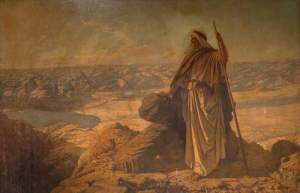
Deuteronomy 34 (NLT)Then Moses went up to Mount Nebo from the plains of Moab and climbed Pisgah Peak, which is across from Jericho. And the Lord showed him the whole land, from Gilead as far as Dan; all the land of Naphtali; the land of Ephraim and Manasseh; all the land of Judah, extending to the Mediterranean Sea; the Negev; the Jordan Valley with Jericho—the city of palms—as far as Zoar. Then the Lord said to Moses, “This is the land I promised on oath to Abraham, Isaac, and Jacob when I said, ‘I will give it to your descendants.’ I have now allowed you to see it with your own eyes, but you will not enter the land.”

So Moses, the servant of the Lord, died there in the land of Moab, just as the Lord had said. The Lord buried him in a valley near Beth-peor in Moab, but to this day no one knows the exact place. Moses was 120 years old when he died, yet his eyesight was clear, and he was as strong as ever. The people of Israel mourned for Moses on the plains of Moab for thirty days, until the customary period of mourning was over.

Now Joshua son of Nun was full of the spirit of wisdom, for Moses had laid his hands on him. So the people of Israel obeyed him, doing just as the Lord had commanded Moses.

There has never been another prophet in Israel like Moses, whom the Lord knew face to face. The Lord sent him to perform all the miraculous signs and wonders in the land of Egypt against Pharaoh, and all his servants, and his entire land. With mighty power, Moses performed terrifying acts in the sight of all Israel.
__________

“Of the Father’s Love Begotten” – traditional a capella chior


__________

Blessing – (Northumbrian Community)

May the peace of the Lord Christ go with you, wherever He may send you. May He guide you through the wilderness, protect you through the storm. May He bring you home rejoicing at the wonders He has shown you. May He bring you home rejoicing once again into our doors.
__________

+ In the name of the Father, and the Son, and the Holy Spirit. Amen!