Morning Prayer: 17 September – Romans 13:8-10 ~ on neighbor-love

Reading through Romans

+ In the name of the Father, and of the Son, and of the Holy Spirit. Amen.

Opening sentence

Praise to You, Lord Jesus Christ, King of endless glory. You have the words of eternal life, and we have believed and have come to know that You are the Holy One of God.
__________

A reading from Romans: Romans 13:8-10 (NLT)

love_they_neighbor

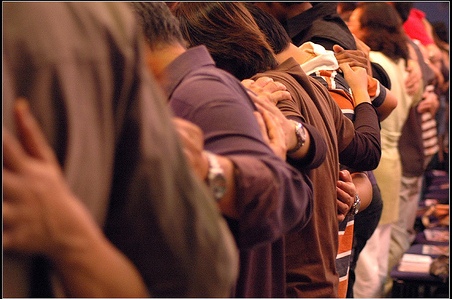
Owe nothing to anyone — except for your obligation to love one another. If you love your neighbor, you will fulfill the requirements of God’s law. For the commandments say, “You must not commit adultery. You must not murder. You must not steal. You must not covet.” These — and other such commandments — are summed up in this one commandment: “Love your neighbor as yourself.” Love does no wrong to others, so love fulfills the requirements of God’s law.
__________

Reflection: Romans 13:8-10 (John Stott, The Message of Romans: God’s Good News for the World)

The will of God for changed relationships: (Romans 12:1–15:13)

All believers, irrespective of their ethnic origin, are brothers and sisters in the one international family of God, and so all have precisely the same vocation to be the holy, committed, humble, loving and conscientious people of God.

(Romans 13:8-10) Our relationship to the law: neighbor-love as its fulfillment

Three affirmations:

1. Love is an unpaid debt

There is one debt which will always remain outstanding, because we can never pay it, and that is our duty to love. We can never stop loving somebody and say, ‘I have loved enough.’  … we must love our neighbor, as Scripture commands, even though we will always fall short of the love required of us; ‘that perpetual debt of love’(JBP) will remain.

2. Love is the fulfillment of the law

Law and love are often thought to be incompatible. And there are significant differences between them, law being often negative (‘you shall not’) and love positive, law relating to particular sins and love being a comprehensive principle…. Love cannot manage on its own without an objective moral standard. That is why Paul wrote not that ‘love is the end of law’ but that ‘love is the fulfillment of the law’. For love and law need each other. Love needs law for its direction, while law needs love for its inspiration.

3. Love does no harm to its neighbor

Why does love sum up all the commandments? Because love does no harm to its neighbor (10a). Certainly the last five sins forbidden in the Ten Commandments harm people. Murder robs them of their life, adultery of their home and honor, theft of their property, and false witness of their good name, while covetousness robs society of the ideals of simplicity and contentment. All these do harm to the neighbor, whereas it is the essence of love to seek and to serve our neighbor’s highest good.

If then we truly love our neighbors, we will seek their good, not their harm, and we will thereby fulfill the law, even though we will never completely discharge our debt.
__________

“Love One Another”


__________

Canticle

Christ, as a light illumine and guide me. Christ, as a shield overshadow me. Christ under me; Christ over me; Christ beside me on my left and my right. This day be within and without me, lowly and meek, yet all-powerful. Be in the heart of each to whom I speak; in the mouth of each who speaks unto me. This day be within and without me, lowly and meek, yet all-powerful. Christ as a light; Christ as a shield; Christ beside me on my left and my right.

Blessing

May the peace of the Lord Christ go with you, wherever He may send you. May He guide you through the wilderness, protect you through the storm. May He bring you home rejoicing at the wonders He has shown you. May He bring you home rejoicing once again into our doors.

+ In the name of the Father, and of the Son, and of the Holy Spirit. Amen

Morning Prayer: 16 September – Romans 13:1-7 ~ conscientious citizenship

Reading through Romans

+ In the name of the Father, and of the Son, and of the Holy Spirit. Amen.

Opening sentence

Praise to You, Lord Jesus Christ, King of endless glory. You have the words of eternal life, and we have believed and have come to know that You are the Holy One of God.
__________

A reading from Romans: Romans 13:1-7 (NLT)

one nation under God

Everyone must submit to governing authorities. For all authority comes from God, and those in positions of authority have been placed there by God. So anyone who rebels against authority is rebelling against what God has instituted, and they will be punished. For the authorities do not strike fear in people who are doing right, but in those who are doing wrong. Would you like to live without fear of the authorities? Do what is right, and they will honor you. The authorities are God’s servants, sent for your good. But if you are doing wrong, of course you should be afraid, for they have the power to punish you. They are God’s servants, sent for the very purpose of punishing those who do what is wrong. So you must submit to them, not only to avoid punishment, but also to keep a clear conscience.

Pay your taxes, too, for these same reasons. For government workers need to be paid. They are serving God in what they do. Give to everyone what you owe them: Pay your taxes and government fees to those who collect them, and give respect and honor to those who are in authority.
__________

Reflection: Romans 13:1-7 (John Stott, The Message of Romans: God’s Good News for the World)

The will of God for changed relationships: (Romans 12:1–15:13)

All believers, irrespective of their ethnic origin, are brothers and sisters in the one international family of God, and so all have precisely the same vocation to be the holy, committed, humble, loving and conscientious people of God.

(Romans 13:1-7) Our relationship to the state: conscientious citizenship

Relations between church and state have been notoriously controversial throughout the Christian centuries…. Church and state have different roles, and Christians have duties to both.

The authority of the state (Romans 13:1-3)

Rowan County Clerk Kim Davis listens to a customer following her office's refusal to issue marriage licenses at the Rowan County Courthouse in Morehead, Ky., Tuesday, Sept. 1, 2015. Although her appeal to the U.S. Supreme Court was denied, Davis still refuses to issue marriage licenses. (AP Photo/Timothy D. Easley)
Rowan County Clerk Kim Davis listens to a customer following her office’s refusal to issue marriage licenses at the Rowan County Courthouse in Morehead, Ky., Tuesday, Sept. 1, 2015. Although her appeal to the U.S. Supreme Court was denied, Davis still refuses to issue marriage licenses. (AP Photo/Timothy D. Easley)

The state is a divine institution with divine authority. Christians are not anarchists or subversives…. Granted that the authority of rulers is derived from God, what happens if they abuse it, if they reverse their God-given duty, commending those who do evil and punishing those who do good? Does the requirement to submit still stand in such a morally perverse situation? No. The principle is clear. We are to submit right up to the point where obedience to the state would entail disobedience to God…. Whenever laws are enacted which contradict God’s law, civil disobedience becomes a Christian duty.
_____

Revelation 13 is a satanic parody of Romans 13. Yet both are true. ‘According as the State remains within its limits or transgresses them, the Christian will describe it as the Servant of God or as the instrument of the Devil.’ We are to submit to the state’s God-given authority, but it has been given for particular and not totalitarian purposes. ‘The gospel is equally hostile to tyranny and anarchy.’
_____

The ministry of the state (Romans 13:4–7)

The restraint and punishment of evil are universally recognized as primary responsibilities of the state. What is the distinction between the role of the state and that of the individual? Individuals are to live according to love rather than justice, whereas the state operates according to justice rather than love.

The role of the state is also to promote and reward goodness. Yet this positive function of the state is much neglected today. The state tends to be better at punishing than at rewarding, better at enforcing the law than at fostering virtue and service.
_____

In summary: Paul gives us in these verses a very positive concept of the state. In consequence Christians, who recognize that the state’s authority and ministry come from God, will do more than tolerate it as if it were a necessary evil. Conscientious Christian citizens will submit to its authority, honor its representatives, pay its taxes and pray for its welfare. They will also encourage the state to fulfill its God-appointed role and, in so far as they have opportunity, actively participate in its work.
__________

“Battle Hymn Of The Republic”


__________

Canticle

Christ, as a light illumine and guide me. Christ, as a shield overshadow me. Christ under me; Christ over me; Christ beside me on my left and my right. This day be within and without me, lowly and meek, yet all-powerful. Be in the heart of each to whom I speak; in the mouth of each who speaks unto me. This day be within and without me, lowly and meek, yet all-powerful. Christ as a light; Christ as a shield; Christ beside me on my left and my right.

Blessing

May the peace of the Lord Christ go with you, wherever He may send you. May He guide you through the wilderness, protect you through the storm. May He bring you home rejoicing at the wonders He has shown you. May He bring you home rejoicing once again into our doors.

+ In the name of the Father, and of the Son, and of the Holy Spirit. Amen

Morning Prayer: 15 September – Romans 12:17-21 ~ on conquering evil

Reading through Romans

+ In the name of the Father, and of the Son, and of the Holy Spirit. Amen.

Opening sentence

Praise to You, Lord Jesus Christ, King of endless glory. You have the words of eternal life, and we have believed and have come to know that You are the Holy One of God.
__________

A reading from Romans: Romans 12:17-21 (NLT)

kingsford-charcoal

Never pay back evil with more evil. Do things in such a way that everyone can see you are honorable. Do all that you can to live in peace with everyone.

Dear friends, never take revenge. Leave that to the righteous anger of God. For the Scriptures say, “I will take revenge; I will pay them back,” says the Lord.

Instead, “If your enemies are hungry, feed them. If they are thirsty, give them something to drink. In doing this, you will heap burning coals of shame on their heads.”

Don’t let evil conquer you, but conquer evil by doing good.
__________

Reflection: Romans 12:17-21 (John Stott, The Message of Romans: God’s Good News for the World)

The will of God for changed relationships: (Romans 12:1– 15: 13)

Now all believers, irrespective of their ethnic origin, are brothers and sisters in the one international family of God, and so all have precisely the same vocation to be the holy, committed, humble, loving and conscientious people of God…. God’s grace, far from encouraging or condoning sin, is the spring and foundation of righteous conduct.

(Romans 12:17-21) Our relationship to our enemies: not retaliation but service

How should Christians respond to evildoers?

1. ‘Do not curse’ (14)… but bless.  There is no better way to express our positive wishes for our enemies’ welfare than to turn them into prayer and into action.

2. ‘Do not repay anyone evil for evil’ (17)… but do what is right and live at peace. To refuse to repay evil is to refuse to inflame a quarrel. But this is not enough. We have also to take the initiative in positive peacemaking, even if, as the two qualifications indicate (‘ if it is possible’ and ‘as far as it depends on you’), this is not always possible. For sometimes other people either are not willing to live at peace with us, or lay down a condition for reconciliation which would involve an unacceptable moral compromise.

Christianity_Anno2_86

3. ‘Do not take revenge’ (19)… but leave this to God.  The very two activities which are prohibited to us (retaliation and punishment) are now said to belong to God. The reason the repayment or judging of evil is forbidden to us is not that it is wrong in itself (for evil deserves to be punished and should be), but that it is God’s prerogative, not ours. We are to ‘leave it to the wrath of God’, which is expressed now through the state’s administration of justice, since the magistrate is ‘God’s servant, an agent of wrath to bring punishment on the wrongdoer’(13: 4), and which will be finally expressed on ‘the day of God’s wrath, when his righteous judgment will be revealed’(2: 5).

4. ‘Do not be overcome by evil’ (21)… but serve enemies and overcome evil with good.  Our personal responsibility is to love and serve our enemy according to his needs, and genuinely to seek his highest good. The coals of fire this may heap on him are intended to heal, not to hurt, to win, not to alienate, in fact, to shame him into repentance.

Thus Paul draws a vital distinction between the duty of private citizens to love and serve the evildoer, and the duty of public servants, as official agents of God’s wrath, to bring him to trial and, if convicted, to punish him. Far from being incompatible with each other, both principles are seen operating in Jesus at the cross. On the one hand, ‘when they hurled their insults at him, he did not retaliate’. On the other, ‘he entrusted himself to him who judges justly’, in confidence that God’s justice would prevail.
__________

“Love Your Enemies”


__________

Canticle

Christ, as a light illumine and guide me. Christ, as a shield overshadow me. Christ under me; Christ over me; Christ beside me on my left and my right. This day be within and without me, lowly and meek, yet all-powerful. Be in the heart of each to whom I speak; in the mouth of each who speaks unto me. This day be within and without me, lowly and meek, yet all-powerful. Christ as a light; Christ as a shield; Christ beside me on my left and my right.

Blessing

May the peace of the Lord Christ go with you, wherever He may send you. May He guide you through the wilderness, protect you through the storm. May He bring you home rejoicing at the wonders He has shown you. May He bring you home rejoicing once again into our doors.

+ In the name of the Father, and of the Son, and of the Holy Spirit. Amen

Morning Prayer: 14 September – Romans 12:9-16 ~ love in the family

Reading through Romans

+ In the name of the Father, and of the Son, and of the Holy Spirit. Amen.

Opening sentence

Praise to You, Lord Jesus Christ, King of endless glory. You have the words of eternal life, and we have believed and have come to know that You are the Holy One of God.
__________

A reading from Romans: Romans 12:9-16 (NLT)

Unity8

Don’t just pretend to love others. Really love them. Hate what is wrong. Hold tightly to what is good. Love each other with genuine affection, and take delight in honoring each other. Never be lazy, but work hard and serve the Lord enthusiastically. Rejoice in our confident hope. Be patient in trouble, and keep on praying. When God’s people are in need, be ready to help them. Always be eager to practice hospitality.

Bless those who persecute you. Don’t curse them; pray that God will bless them. Be happy with those who are happy, and weep with those who weep. Live in harmony with each other. Don’t be too proud to enjoy the company of ordinary people. And don’t think you know it all!
__________

Reflection: Romans 12:9-16 (John Stott, The Message of Romans: God’s Good News for the World)

The will of God for changed relationships: (Romans 12:1– 15: 13)

Now all believers, irrespective of their ethnic origin, are brothers and sisters in the one international family of God, and so all have precisely the same vocation to be the holy, committed, humble, loving and conscientious people of God…. God’s grace, far from encouraging or condoning sin, is the spring and foundation of righteous conduct.

(Romans 12:9-16) Our relationship to one another: love in the family of God

Paul’s recipe for love in the family of God has twelve components.

1. Sincerity – ‘without hypocrisy’…. Love and hypocrisy exclude one another. ‘If love is the sum of virtue, and hypocrisy the epitome of vice,’ wrote John Murray, ‘what a contradiction to bring these together!’

2. Discernment – ‘loathing of evil’, while ‘clinging to what is good’…. Love is so passionately devoted to the beloved object that it hates every evil which is incompatible with his or her highest welfare.

3. Affection – ‘typically, love of parent for child’…. applied originally to blood relationships in the human family, but Paul reapplies them to the tender, warm affection which should unite the members of the family of God.

4. Honor – ‘esteem others more highly than yourself’… or ‘outdo one another in showing honor’. In either case we are to accord to each other the highest possible honor.

5. Enthusiasm – not to ‘be lazy’ in zeal,… be ‘aglow with the Spirit’. The picture is not so much of a glowing lamp as of a boiling, bubbling pot…. Practical commitment to serving ‘the Lord’ will keep zeal rooted in reality.

6. Patience – ‘joyful in hope’, ‘patient in affliction’, ‘faithful in prayer’…. Our confident Christian expectation of the Lord’s return and the glory to follow… is the source of abiding joy. But it also calls for patience, as meanwhile we endure tribulation and persevere in prayer.

7. Generosity – ‘share in people’s needs and sufferings’, or ‘share out our resources with them.’ In the early Jerusalem church… they shared their possessions with those more needy than themselves.

8. Hospitality – ‘pursue’ hospitality. Origen commented: ‘We are not just to receive the stranger when he comes to us, but actually to inquire after, and look carefully for, strangers, to pursue them and search them out everywhere, lest perchance somewhere they may sit in the streets or lie without a roof over their heads.’

9. Good will – ‘bless’ those who curse us, ‘pray’ for them and ‘do good’ to them. There is no better way to express our positive wishes for our enemies’ welfare than to turn them into prayer and into action….  The call to bless [our persecutors] is a necessary challenge to Christian love.

10. Sympathy – Love never stands aloof from other people’s joys or pains. Love identifies with them, sings with them and suffers with them. Love enters deeply into their experiences and their emotions, their laughter and their tears, and feels solidarity with them, whatever their mood.

11. Harmony – ‘be of the same mind’, and so ‘live in agreement with one another’…. Since Christians have a renewed mind, it should also be a common mind, sharing the same basic convictions and concerns. Without this common mind we cannot live or work together in harmony.

12. Humility –  Be willing to associate with people of low position…. As JB puts it, ‘Never be condescending, but make real friends with the poor.’

What a comprehensive picture of Christian love Paul gives us! Love is sincere, discerning, affectionate and respectful. It is both enthusiastic and patient, both generous and hospitable, both benevolent and sympathetic. It is marked by both harmony and humility. Christian churches would be happier communities if we all loved one another like that.
__________

“For The Lost & Lonely”

For the lost and lonely / For the hopeless outcast / You have come for me / You have come for us all / For the victim and the villain / The judge and the accuser / To the right and wrong / You have come for us all

For you have come / In grace and love, / Acceptance and with peace / For you have come / With mercy for our tears / Embracing all our fears

For the poor and homeless / The refugee and orphan, / For the rich and poor / You have come for us all / For the proud and righteous, / For the strong and mighty / Those who have no need / You still come for us all.

For you have come / In grace and love, / Acceptance and with peace / For you have come / With mercy for our tears / Embracing all our fears
__________

Canticle

Christ, as a light illumine and guide me. Christ, as a shield overshadow me. Christ under me; Christ over me; Christ beside me on my left and my right. This day be within and without me, lowly and meek, yet all-powerful. Be in the heart of each to whom I speak; in the mouth of each who speaks unto me. This day be within and without me, lowly and meek, yet all-powerful. Christ as a light; Christ as a shield; Christ beside me on my left and my right.

Blessing

May the peace of the Lord Christ go with you, wherever He may send you. May He guide you through the wilderness, protect you through the storm. May He bring you home rejoicing at the wonders He has shown you. May He bring you home rejoicing once again into our doors.

+ In the name of the Father, and of the Son, and of the Holy Spirit. Amen
Morning Prayer: 12 September – Romans 12:3-8 ~ an honest evaluation

Reading through Romans

+ In the name of the Father, and of the Son, and of the Holy Spirit. Amen.

Opening sentence

Praise to You, Lord Jesus Christ, King of endless glory. You have the words of eternal life, and we have believed and have come to know that You are the Holy One of God.
__________

A reading from Romans: Romans 12:3-8 (NLT)

lying

Because of the privilege and authority God has given me, I give each of you this warning: Don’t think you are better than you really are. Be honest in your evaluation of yourselves, measuring yourselves by the faith God has given us. Just as our bodies have many parts and each part has a special function, so it is with Christ’s body. We are many parts of one body, and we all belong to each other.

In his grace, God has given us different gifts for doing certain things well. So if God has given you the ability to prophesy, speak out with as much faith as God has given you. If your gift is serving others, serve them well. If you are a teacher, teach well. If your gift is to encourage others, be encouraging. If it is giving, give generously. If God has given you leadership ability, take the responsibility seriously. And if you have a gift for showing kindness to others, do it gladly.
__________

Reflection: Romans 12:3-8 (John Stott, The Message of Romans: God’s Good News for the World)

The will of God for changed relationships: (Romans 12: 1– 15: 13)

Now all believers, irrespective of their ethnic origin, are brothers and sisters in the one international family of God, and so all have precisely the same vocation to be the holy, committed, humble, loving and conscientious people of God…. God’s grace, far from encouraging or condoning sin, is the spring and foundation of righteous conduct.

(Romans 12:3–8) Our relationship to ourselves: thinking soberly about our gifts

Our renewed mind, which is capable of discerning and approving God’s will, must also be active in evaluating ourselves, our identity and our gifts. For we need to know who we are, and to have an accurate, balanced and above all sober self-image. A renewed mind is a humble mind like Christ’s.
_____

Crucifix of St. Catherine of Siena Church  in Portage, MI.
Crucifix of St. Catherine of Siena Church
in Portage, MI.

In thinking about ourselves we must avoid both too high an estimate of ourselves and (Paul might have added) too low an estimate. Instead, and positively, we are to develop a sober judgment. How? First by reference to our faith, and secondly by reference to our gifts.

  1.  God’s gospel: saving faith in Christ crucified…. Only this gospel of the cross, indeed only ‘Christ himself in whom God’s judgment and mercy are revealed’, can enable us to measure ourselves soberly.
  2.  God’s gifts: we are dependent on one another, and the one-anotherness of the Christian fellowship is enhanced by the diversity of our gifts. The recognition that God is the giver of the gifts is indispensable if we are to ‘form a sober estimate’ (REB) of ourselves.

Just as God’s grace had made Paul an apostle (3), so his grace bestows different gifts  on other members of Christ’s body. Paul proceeds to give his readers a sample of seven gifts, which he urges them to exercise conscientiously for the common good. He divides them into two categories, which might be called ‘speaking gifts’ (prophesying, teaching and encouraging) and ‘service gifts’ (serving, contributing, leading and showing mercy).
__________

“By God’s Grace”


__________

Canticle

Christ, as a light illumine and guide me. Christ, as a shield overshadow me. Christ under me; Christ over me; Christ beside me on my left and my right. This day be within and without me, lowly and meek, yet all-powerful. Be in the heart of each to whom I speak; in the mouth of each who speaks unto me. This day be within and without me, lowly and meek, yet all-powerful. Christ as a light; Christ as a shield; Christ beside me on my left and my right.

Blessing

May the peace of the Lord Christ go with you, wherever He may send you. May He guide you through the wilderness, protect you through the storm. May He bring you home rejoicing at the wonders He has shown you. May He bring you home rejoicing once again into our doors.

+ In the name of the Father, and of the Son, and of the Holy Spirit. Amen