
Morning Prayer: 23 September – Romans 15:1-13 ~ accept each other

Reading through Romans

+ In the name of the Father, and of the Son, and of the Holy Spirit. Amen.

Opening sentence

Praise to You, Lord Jesus Christ, King of endless glory. You have the words of eternal life, and we have believed and have come to know that You are the Holy One of God.
__________

A reading from Romans: Romans 15:1-13 (NLT)

We who are strong must be considerate of those who are sensitive about things like this. We must not just please ourselves. We should help others do what is right and build them up in the Lord. For even Christ didn’t live to please himself. As the Scriptures say, “The insults of those who insult you, O God, have fallen on me.”

Such things were written in the Scriptures long ago to teach us. And the Scriptures give us hope and encouragement as we wait patiently for God’s promises to be fulfilled.

May God, who gives this patience and encouragement, help you live in complete harmony with each other, as is fitting for followers of Christ Jesus. Then all of you can join together with one voice, giving praise and glory to God, the Father of our Lord Jesus Christ.

image

Therefore, accept each other just as Christ has accepted you so that God will be given glory.

Remember that Christ came as a servant to the Jews to show that God is true to the promises he made to their ancestors. He also came so that the Gentiles might give glory to God for his mercies to them.

That is what the psalmist meant when he wrote: “For this, I will praise you among the Gentiles; I will sing praises to your name.” And in another place it is written, “Rejoice with his people, you Gentiles.” And yet again, “Praise the Lord , all you Gentiles. Praise him, all you people of the earth.” And in another place Isaiah said, “The heir to David’s throne will come, and he will rule over the Gentiles. They will place their hope on him.”

I pray that God, the source of hope, will fill you completely with joy and peace because you trust in him. Then you will overflow with confident hope through the power of the Holy Spirit.
__________

Reflection: Romans 14:13b-23 (John Stott, The Message of Romans: God’s Good News for the World)

The will of God for changed relationships: (Romans 12:1–15:13)

All believers, irrespective of their ethnic origin, are brothers and sisters in the one international family of God, and so all have precisely the same vocation to be the holy, committed, humble, loving and conscientious people of God.

(Romans 14:1-15:13) Our relationship to the weak: welcoming, and not despising, judging or offending them

If we are trying to picture a weaker brother or sister, we must not envisage a vulnerable Christian easily overcome by temptation, but a sensitive Christian full of indecision and scruples. What the weak lack is not strength of self-control but liberty of conscience.

2. The negative consequences (Romans 14:2–15:13)

c. Do not please yourselves (15:1–13)

What is [the strong] Christian’s responsibility towards the weak? 1. Bear with the weak’s failings; 2. not please themselves; and 3. build up the weak. Edification is a constructive alternative to demolition.

Why should we please our neighbour and not ourselves?

(i) Because Christ did not please himself (3–4)

This simple statement ‘sums up with eloquent reticence both the meaning of the incarnation and the character of Christ’s earthly life’.

(ii) Because Christ is the way to united worship (5–6)

Christian unity is unity in Christ; the person of Jesus Christ himself is the focus of our unity; and therefore the more we agree with him and about him, the more we will agree with one another… so that with one heart and mouth you may glorify the God and Father of our Lord Jesus Christ.

(iii) Because Christ accepted you (7)

The weak brother is to be accepted for God has accepted him, and the members are to welcome each other just as Christ accepted you. Moreover, Christ’s acceptance of us was also in order to bring praise to God. The entire credit for the welcome we have received goes to him who took the initiative through Christ to reconcile us to himself and to each other.

(iv) Because Christ has become a servant (8–13)

Then Christ’s role as the servant of the Jews, that is, as the Jewish Messiah, is seen to have two parallel purposes, first to confirm the promises made to the patriarchs and secondly to incorporate the Gentiles as well.

Paul concludes this section of his letter with a benediction: May the God of hope fill you with all joy and peace as you trust in him (13a).
__________

“In Christ Alone”


__________

Canticle

Christ, as a light illumine and guide me. Christ, as a shield overshadow me. Christ under me; Christ over me; Christ beside me on my left and my right. This day be within and without me, lowly and meek, yet all-powerful. Be in the heart of each to whom I speak; in the mouth of each who speaks unto me. This day be within and without me, lowly and meek, yet all-powerful. Christ as a light; Christ as a shield; Christ beside me on my left and my right.

Blessing

May the peace of the Lord Christ go with you, wherever He may send you. May He guide you through the wilderness, protect you through the storm. May He bring you home rejoicing at the wonders He has shown you. May He bring you home rejoicing once again into our doors.

+ In the name of the Father, and of the Son, and of the Holy Spirit. Amen
Morning Prayer: 22 September – Romans 14:13b-23 ~ the Kingdom trumps food

Reading through Romans

+ In the name of the Father, and of the Son, and of the Holy Spirit. Amen.

Opening sentence

Praise to You, Lord Jesus Christ, King of endless glory. You have the words of eternal life, and we have believed and have come to know that You are the Holy One of God.
__________

A reading from Romans: Romans 14:13-23 (NLT)

So let’s stop condemning each other. Decide instead to live in such a way that you will not cause another believer to stumble and fall.

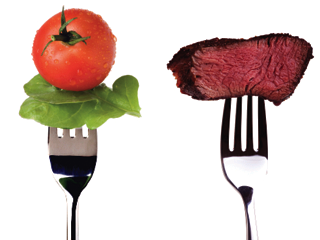
veg vs meat

I know and am convinced on the authority of the Lord Jesus that no food, in and of itself, is wrong to eat. But if someone believes it is wrong, then for that person it is wrong. And if another believer is distressed by what you eat, you are not acting in love if you eat it. Don’t let your eating ruin someone for whom Christ died. Then you will not be criticized for doing something you believe is good. For the Kingdom of God is not a matter of what we eat or drink, but of living a life of goodness and peace and joy in the Holy Spirit. If you serve Christ with this attitude, you will please God, and others will approve of you, too. So then, let us aim for harmony in the church and try to build each other up.

Don’t tear apart the work of God over what you eat. Remember, all foods are acceptable, but it is wrong to eat something if it makes another person stumble. It is better not to eat meat or drink wine or do anything else if it might cause another believer to stumble. You may believe there’s nothing wrong with what you are doing, but keep it between yourself and God. Blessed are those who don’t feel guilty for doing something they have decided is right. But if you have doubts about whether or not you should eat something, you are sinning if you go ahead and do it. For you are not following your convictions. If you do anything you believe is not right, you are sinning.
__________

Reflection: Romans 14:13b-23 (John Stott, The Message of Romans: God’s Good News for the World)

The will of God for changed relationships: (Romans 12:1–15:13)

All believers, irrespective of their ethnic origin, are brothers and sisters in the one international family of God, and so all have precisely the same vocation to be the holy, committed, humble, loving and conscientious people of God.

(Romans 14:1-15:13) Our relationship to the weak: welcoming, and not despising, judging or offending them

If we are trying to picture a weaker brother or sister, we must not envisage a vulnerable Christian easily overcome by temptation, but a sensitive Christian full of indecision and scruples. What the weak lack is not strength of self-control but liberty of conscience.

2. The negative consequences (Romans 14:2–15:13)

(b) Do not offend or destroy the weaker person (14:13b-23)

Two additional theological foundations:

(i) Welcome him because he is your brother for whom Christ died (14–16)

If your brother is distressed (feels grief and even pain) because of what you eat, not only because he sees you doing something of which he disapproves, but because he is induced to follow your example against his conscience, you are no longer acting in love, no longer walking the path of love. For love never disregards weak consciences. Love limits its own liberty out of respect for them.

Paul’s warning is that the strong who mislead the weak to go against their consciences will seriously damage their Christian discipleship. He urges the strong against causing such injury to the weak. Do not allow what you consider good (i.e. the liberty you have found in Christ) to be spoken of as evil, because you flaunt it to the detriment of the weak.

(ii) Welcome him because the kingdom of God is more important than food (17–21)

The kingdom of God is not a matter of eating and drinking, but of righteousness, peace and joy in the Holy Spirit…. Our responsibility is to seek to build up the fellowship, not to tear it down. And in particular we must not tear it down for the sake of food.

So it would be evil for the strong to use their liberty to harm the weak. Alternatively, it would be good for the strong (Paul drives the argument to its logical conclusion) to eat no meat and drink no wine, that is, to become vegetarians and total abstainers, and to go to any other extreme of renunciation, if that were necessary to serve the welfare of the weak.

Paul concludes (22–23) by drawing a distinction between belief and action, that is, between private conviction and public behavior.

There is no need either to parade your [private] views or to impose them on other people. As for public behavior, there are two options: 1. The strong Christian is blessed because his conscience approves of his eating everything, so that he can follow his conscience without any guilt feelings. 2. The weak Christian who is plagued with misgivings because his conscience gives him vacillating signals, is condemned if he eats, because his eating is not from faith; and everything that does not come from faith… is sin.
__________

“Let Your Kingdom Come” – Sovereign Grace


__________

Canticle

Christ, as a light illumine and guide me. Christ, as a shield overshadow me. Christ under me; Christ over me; Christ beside me on my left and my right. This day be within and without me, lowly and meek, yet all-powerful. Be in the heart of each to whom I speak; in the mouth of each who speaks unto me. This day be within and without me, lowly and meek, yet all-powerful. Christ as a light; Christ as a shield; Christ beside me on my left and my right.

Blessing

May the peace of the Lord Christ go with you, wherever He may send you. May He guide you through the wilderness, protect you through the storm. May He bring you home rejoicing at the wonders He has shown you. May He bring you home rejoicing once again into our doors.

+ In the name of the Father, and of the Son, and of the Holy Spirit. Amen

Morning Prayer: 21 September – Romans 14:2–13a ~ stop criticizing each other

Reading through Romans

+ In the name of the Father, and of the Son, and of the Holy Spirit. Amen.

Opening sentence

Praise to You, Lord Jesus Christ, King of endless glory. You have the words of eternal life, and we have believed and have come to know that You are the Holy One of God.
__________

A reading from Romans: Romans 14:2–13a (NLT)

girl-covered-eye

For instance, one person believes it’s all right to eat anything. But another believer with a sensitive conscience will eat only vegetables. Those who feel free to eat anything must not look down on those who don’t. And those who don’t eat certain foods must not condemn those who do, for God has accepted them. Who are you to condemn someone else’s servants? Their own master will judge whether they stand or fall. And with the Lord’s help, they will stand and receive his approval.

In the same way, some think one day is more holy than another day, while others think every day is alike. You should each be fully convinced that whichever day you choose is acceptable. Those who worship the Lord on a special day do it to honor him. Those who eat any kind of food do so to honor the Lord, since they give thanks to God before eating. And those who refuse to eat certain foods also want to please the Lord and give thanks to God. For we don’t live for ourselves or die for ourselves. If we live, it’s to honor the Lord. And if we die, it’s to honor the Lord. So whether we live or die, we belong to the Lord. Christ died and rose again for this very purpose — to be Lord both of the living and of the dead.

So why do you condemn another believer? Why do you look down on another believer? Remember, we will all stand before the judgment seat of God. For the Scriptures say, “‘As surely as I live,’ says the Lord, ‘every knee will bend to me, and every tongue will declare allegiance to God.’”

Yes, each of us will give a personal account to God. So let’s stop condemning each other.
__________

Reflection: Romans 14:2–13a (John Stott, The Message of Romans: God’s Good News for the World)

The will of God for changed relationships: (Romans 12:1–15:13)

All believers, irrespective of their ethnic origin, are brothers and sisters in the one international family of God, and so all have precisely the same vocation to be the holy, committed, humble, loving and conscientious people of God.

(Romans 14:1-15:13) Our relationship to the weak: welcoming, and not despising, judging or offending them

If we are trying to picture a weaker brother or sister, we must not envisage a vulnerable Christian easily overcome by temptation, but a sensitive Christian full of indecision and scruples. What the weak lack is not strength of self-control but liberty of conscience.

2. The negative consequences (Romans 14:2–15:13)

(a) Do not despise or condemn the weak person (14:2–13a)

Four underlying theological principles:

(i) Welcome him because God has welcomed him (2–3)

The best way to determine what our attitude to other people should be is to determine what God’s attitude to them is. This principle is better even than the golden rule. It is safe to treat others as we would like them to treat us, but it is safer still to treat them as God does.

(ii) Welcome him because Christ died and rose to be the Lord (4–9)

Jesus is Lord of heaven and earth

[Paul] lifts the very mundane question of our mutual relationships in the Christian community to the high theological level of the death, resurrection and consequent universal lordship of Jesus. Because he is our Lord, we must live for him. Because he is also the Lord of our fellow Christians, we must respect their relationship to him and mind our own business. For he died and rose to be Lord.

(iii) Welcome him because he is your brother (10a)

We are related to one another in the strongest possible way, by family ties. Whether we are thinking of the weak, with all their tedious doubts and fears, or of the strong, with all their brash assurances and freedoms, they are our brothers and sisters. When we remember this, our attitude to them becomes at once less critical and impatient, more generous and tender.

(iv) Welcome him because we will all stand before God’s judgment seat (10b–13a)

Because God is the Judge and we are among the judged, let us stop passing judgment on one another, for then we shall avoid the extreme folly of trying to usurp God’s prerogative and anticipate judgment day.
__________

“Revelation Song” – Kari Jobe


__________

Canticle

Christ, as a light illumine and guide me. Christ, as a shield overshadow me. Christ under me; Christ over me; Christ beside me on my left and my right. This day be within and without me, lowly and meek, yet all-powerful. Be in the heart of each to whom I speak; in the mouth of each who speaks unto me. This day be within and without me, lowly and meek, yet all-powerful. Christ as a light; Christ as a shield; Christ beside me on my left and my right.

Blessing

May the peace of the Lord Christ go with you, wherever He may send you. May He guide you through the wilderness, protect you through the storm. May He bring you home rejoicing at the wonders He has shown you. May He bring you home rejoicing once again into our doors.

+ In the name of the Father, and of the Son, and of the Holy Spirit. Amen

Sunday, 20 September: Wisdom 2:12, 17-20; Psalm 54:3-7; James 3:16-4:3; Mark 9:30-37 ~ on peacemaking

25th Sunday in Ordinary Time

+ In the Name of the Father, and the Son, and the Holy Spirit. Amen

Opening sentence and Prayer:

Remember the passion and death of Jesus, and rejoice in His resurrection. Jesus calls us to move beyond rivalries and conflicts, and to follow Him.
_____

O God, protector of the poor and defender of the just, in Your kingdom the last become first, the gentle are strong, and the lowly exalted. Give us wisdom from above, that we may find in Jesus the pattern of true discipleship and the grace to persevere in following Him, who lives and reigns with You in the unity of the Holy Spirit, God for ever and ever.
__________

Hymn: “I Sing The Mighty Power of God” – Fountainview Academy

I sing the mighty power of God that made the mountains rise,
that spread the flowing seas abroad and built the lofty skies.
I sing the wisdom that ordained the sun to rule the day;
the moon shines full at his command, and all the stars obey.

I sing the goodness of the Lord that filled the earth with food;
he formed the creatures with his word and then pronounced them good.
Lord, how your wonders are displayed, where’er I turn my eyes,
if I survey the ground I tread or gaze upon the skies.

There’s not a plant or flower below but makes your glories known,
and clouds arise and tempests blow by order from your throne;
while all that borrows life from you is ever in your care,
and everywhere that I can be, you, God, are present there.
__________

A Reading from the Apocrypha: Wisdom 2:12, 17-20 (NRSVACE)
[Describes the trouble the good person can endure, the same anger that led to the death of Jesus.]

‘Let us lie in wait for the righteous man, because he is inconvenient to us and opposes our actions; he reproaches us for sins against the law, and accuses us of sins against our training.
_____

Crucifix in Orthodox Chapel

Let us see if his words are true, and let us test what will happen at the end of his life; for if the righteous man is God’s child, he will help him, and will deliver him from the hand of his adversaries. Let us test him with insult and torture, so that we may find out how gentle he is, and make trial of his forbearance. Let us condemn him to a shameful death, for, according to what he says, he will be protected.’
__________

A Reading from the Psalms: Psalm 54:3-7 (NLT)

For strangers are attacking me; violent people are trying to kill me. They care nothing for God.

But God is my helper. The Lord keeps me alive! May the evil plans of my enemies be turned against them. Do as you promised and put an end to them.

I will sacrifice a voluntary offering to you; I will praise your name, O Lord, for it is good. For you have rescued me from my troubles and helped me to triumph over my enemies.
__________

“Psalm 54”


__________

A Reading from the Letters: James 3:16-4:3 (NLT)
[James challenges people to conquer the wrong desires in themselves, as a means of bringing peace.]

For wherever there is jealousy and selfish ambition, there you will find disorder and evil of every kind.

wisdom from above

But the wisdom from above is first of all pure. It is also peace loving, gentle at all times, and willing to yield to others. It is full of mercy and the fruit of good deeds. It shows no favoritism and is always sincere. And those who are peacemakers will plant seeds of peace and reap a harvest of righteousness.

What is causing the quarrels and fights among you? Don’t they come from the evil desires at war within you? You want what you don’t have, so you scheme and kill to get it. You are jealous of what others have, but you can’t get it, so you fight and wage war to take it away from them. Yet you don’t have what you want because you don’t ask God for it. And even when you ask, you don’t get it because your motives are all wrong — you want only what will give you pleasure.
__________

A Reading from the Gospels: Mark 9:30-37 (NLT)
[Jesus tells his followers about his death and resurrection, and teaches them how to be true disciples.]

Leaving that region, they traveled through Galilee. Jesus didn’t want anyone to know he was there, for he wanted to spend more time with his disciples and teach them. He said to them, “The Son of Man is going to be betrayed into the hands of his enemies. He will be killed, but three days later he will rise from the dead.” They didn’t understand what he was saying, however, and they were afraid to ask him what he meant.

premature baby in hand

After they arrived at Capernaum and settled in a house, Jesus asked his disciples, “What were you discussing out on the road?” But they didn’t answer, because they had been arguing about which of them was the greatest. He sat down, called the twelve disciples over to him, and said, “Whoever wants to be first must take last place and be the servant of everyone else.”

Then he put a little child among them. Taking the child in his arms, he said to them, “Anyone who welcomes a little child like this on my behalf welcomes me, and anyone who welcomes me welcomes not only me but also my Father who sent me.”
__________

“My Peace I Give You” (Taizé Chant)

My peace I leave you, my peace I give you / Trouble not your hearts
My peace I leave you, my peace I give you / Be not afraid
__________

Intercessions:

God is our ever-present helper in times of need: hear us now merciful Father as we come before Your throne of grace.

+ For Church Leaders as they discharge their duties around the world — that they may travel safely…. Lord, hear us.
+ For all Christians — that we may learn to put other people before ourselves…. Lord, hear us.
+ For migrants seeking safety and support – that they may receive the help they need…. Lord, hear us.
+ For peacemakers — that God may help them persevere, despite the obstacles they encounter…. Lord, hear us.
+ For the children in our communities — that they may grow in strength and wisdom…. Lord, hear us.
+ For children who have suffered from harm or abuse — that God may come to their aid and protect them from further danger…. Lord, hear us.
+ For all who have died, especially those who have died violently – that they rest in eternal peace…. Lord, hear us.

God of power and might, You uphold our lives and keep us in Your care: help us in our needs, we pray, through Christ our Lord. Amen.
__________

“Beautiful Things” – Gungor


__________

Benediction:

Now may the God of peace himself sanctify you completely, and may your whole spirit and soul and body be kept blameless at the coming of our Lord Jesus Christ. He who calls you is faithful; he will surely do it. (1 Thessalonians 5:23-24)

+ In the Name of the Father, and the Son, and the Holy Spirit. Amen

Morning Prayer: 19 September – Romans 14:1 ~ on acceptance

Reading through Romans

+ In the name of the Father, and of the Son, and of the Holy Spirit. Amen.

Opening sentence

Praise to You, Lord Jesus Christ, King of endless glory. You have the words of eternal life, and we have believed and have come to know that You are the Holy One of God.
__________

A reading from Romans: Romans 14:1 (NLT)

weak in faith

Accept other believers who are weak in faith, and don’t argue with them about what they think is right or wrong.
__________

Reflection: Romans 14:1 (John Stott, The Message of Romans: God’s Good News for the World)

The will of God for changed relationships: (Romans 12:1–15:13)

All believers, irrespective of their ethnic origin, are brothers and sisters in the one international family of God, and so all have precisely the same vocation to be the holy, committed, humble, loving and conscientious people of God.

(Romans 14:1-15:13) Our relationship to the weak: welcoming, and not despising, judging or offending them

If we are trying to picture a weaker brother or sister, we must not envisage a vulnerable Christian easily overcome by temptation, but a sensitive Christian full of indecision and scruples. What the weak lack is not strength of self-control but liberty of conscience.

The positive principle (Romans 14:1)

First, Accept him whose faith is weak (1a).

‘Acceptance’ means to welcome into one’s fellowship and into one’s heart. It implies the warmth and kindness of genuine love.

‘Acceptance’ is a popular word today, and rightly so. Theologically, God’s acceptance of us is quite a good contemporary term for justification. But we should be cautious about modern talk of ‘unconditional acceptance’, as when the concept of an ‘open church’ is canvassed, in which membership is offered to everybody, with no questions asked and no conditions laid down. For though God’s love is indeed unconditional, his acceptance of us is not, since it depends on our repentance and our faith in Jesus Christ.

Second, without passing judgment on disputable matters (1b).

Paul is saying… we must receive the weak person with a warm and genuine welcome, ‘without debate over his misgivings’ or scruples (REB), or ‘not for the purpose of getting into quarrels about opinions’ (BAGD). In other words, we are not to turn the church into a debating chamber, whose chief characteristic is argument, still less into a law court in which weak persons are put in the dock, interrogated and arraigned. The welcome we give them must include respect for their opinions.
__________

“Be Still My Soul” – Selah


__________

Canticle

Christ, as a light illumine and guide me. Christ, as a shield overshadow me. Christ under me; Christ over me; Christ beside me on my left and my right. This day be within and without me, lowly and meek, yet all-powerful. Be in the heart of each to whom I speak; in the mouth of each who speaks unto me. This day be within and without me, lowly and meek, yet all-powerful. Christ as a light; Christ as a shield; Christ beside me on my left and my right.

Blessing

May the peace of the Lord Christ go with you, wherever He may send you. May He guide you through the wilderness, protect you through the storm. May He bring you home rejoicing at the wonders He has shown you. May He bring you home rejoicing once again into our doors.

+ In the name of the Father, and of the Son, and of the Holy Spirit. Amen