Meanwhile, Saul was uttering threats with every breath and was eager to kill the Lord’s followers.
So he went to the high priest. He requested letters addressed to the synagogues in Damascus, asking for their cooperation in the arrest of any followers of the Way he found there. He wanted to bring them—both men and women—back to Jerusalem in chains.
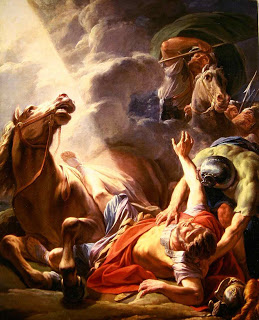
As he was approaching Damascus on this mission, a light from heaven suddenly shone down around him. He fell to the ground and heard a voice saying to him, “Saul! Saul! Why are you persecuting me?”
“Who are you, lord?” Saul asked.
And the voice replied, “I am Jesus, the one you are persecuting! Now get up and go into the city, and you will be told what you must do.”
The men with Saul stood speechless, for they heard the sound of someone’s voice but saw no one! Saul picked himself up off the ground, but when he opened his eyes he was blind.
So his companions led him by the hand to Damascus. He remained there blind for three days and did not eat or drink.
Prayer:Lord Jesus – What would it take for you change the direction of my life… especially when I thought I was doing your will in the first place? Holy Spirit – Mold me, make me, use me in whatever way you choose. Give me a willing spirit to change what I’m doing, if that’s what you want for me. Heavenly Father – May I honor you and your family in all that I do. Amen.
Is it really a Spring at all, or a frightening return of an worse Winter?
As the one year anniversary of the election of Egypt’s President Mohamed Morsi approaches, tensions are high. Tens of thousands of Islamists have begun pouring into Cairo in anticipation of anti-Morsi demonstrations planned for June 30, 2013, by opponents of the new government.
KNOXVILLE, TN (Catholic Online) – As the one year anniversary of the election of Egypt’s President Mohamed Morsi approaches, tensions are high. Tens of thousands of Islamists have begun pouring into Cairo in anticipation of anti-Morsi demonstrations planned for June 30, 2013, by opponents of the new government.
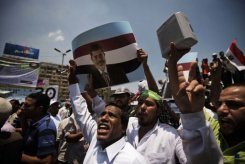
Egyptian Islamists led by the ruling Muslim Brotherhood shout slogans during a demonstration on June 21, 2013 in Cairo to mark the upcoming one year anniversary since President Mohamed Morsi's election. Tens of thousands of Islamists gathered for a show of strength ahead of planned opposition protests against Morsi, highlighting the tense political divide in the Arab world's most populous state.
According to France 24, an international news site, Islamists carrying Egyptian flags and pictures of Morsi held a demonstration on Friday, June 21. It was led by the Muslim Brotherhood, and its aim was to show that Morsi and his government had the support of the Egyptian people. But the Egyptian people are clearly divided.
Morsi was elected one year ago, after the fall of President Hosni Mubarak in February of 2011. Morsi promised to be the President of all Egyptians, including the Coptic Christian community. He said the Copts would be given full equal rights. At one point Morsi said, “I will not be biased against any son of Egypt.” But this is not what has happened.
Instead, it appears that Morsi has used every opportunity to turn Egypt into an Islamist state since he became president. This past November, President Morsi issued a declaration giving himself sweeping dictatorial-style power over the drafting of Egypt’s new constitution. The President’s actions unleashed a firestorm.
A group of judges said, “The state of law is at stake.” The Vice-President of the Supreme Constitutional Court, Tahani al-Gebali, said that Morsi was now an “illegitimate president.” And Mohamed ElBaradei, a Nobel Peace Prize winner, said, “Morsi today usurped all state powers and appointed himself Egypt’s new pharaoh.”
Protestors marched on the presidential palace in Cairo and clashed with supporters of the Muslim Brotherhood. At one point, an estimated 200,000 anti-Morsi protestors flooded into Cairo’s famous Tahrir Square.
President Morsi seemingly backed down, but the final Constitution was drafted by a committee dominated by Islamists who used the Constitution to strengthen sharia law. Sharia law highly discriminates against non-Muslims and women.
Since taking office, Morsi has also had run-ins with the national judiciary, the media and the police. More recently, Morsi appointed seven members of the Muslim Brotherhood as provincial governors. He also gave the Luxor governorship to a member of the militant Islamist group responsible for the massacre of 58 foreign tourists in 1997. These appointments led to several clashes between Morsi’s supporters and his opponents.
According to his opponents, Morsi is “giving the Islamists a monopoly over public institutions.” However, the president’s supporters claim he is merely cleaning up corrupt institutions from the days of Mubarak.
Yet, organizers of the June 30 demonstration say they have collected 15 million signatures on a petition which demands the resignation of Morsi. Nevertheless, Ahmed Aqila, a representative of the Muslim Brotherhood Freedom and Justice Party, does not believe it can happen. He said, “Those who say ‘President Morsi will be toppled on June 30’ live in an illusion they must give up.”
The Coptic Christian community has been concerned that the Morsi government is allowing Islamists to act more aggressively toward non-Muslims. Heba Morayef, a director for Regional Human Rights Watch, says that some Muslims are using more discriminatory language on television. He says, “It’s very scary because of the sudden uptick in violence, compounded by the fact that the Muslim Brotherhood has in no way tried to reign it back and has at times participated.”
For instance, a member of the Muslim Brotherhood, Safwat Hegazi, recalling demonstrations last December which turned violent, told the Copts, “You share this country with us, but there are red lines, and one red line is the legitimacy of Dr. Morsi. Whoever splashes water on that, we will spill his blood.” Hegazi has since been appointed to the National Council on Human Rights in Egypt.
Consequently, some people are nervous about the upcoming demonstration scheduled at the end of this month and with good reason. There is much at stake. Coptic Christians and women have the most to lose, but so too do all Muslims, especially more moderate and secular Muslims.
While spokesmen from both sides are rightly calling for calm, they also realize that people have a right to address the Morsi government. Although he did not officially endorse the upcoming demonstration, according to one source, Pope Tawadros II of the Coptic Orthodox Church said, “Members of Egypt’s Christian minority are free to express their opinions on the streets, just as they were to vote for whomever candidate they supported in the past presidential elections.”
That is the way it should be in a true democracy, and President Morsi knows it. After one of the demonstrations last year, he said, “I will protect for my brothers in the opposition all their rights so they can exercise their role.” Now Morsi needs to prove it. Is Egypt a true democracy or not? Will Egypt’s Coptic Christians ever share in the Arab Spring, or was it a lie? We shall find out at the end of the month.
Let us pray for the safety of our brave brethren who will be demonstrating on June 30, and for a free Egypt where all Egyptians can live in peace. They are not alone. They are merely on the front lines of a battle that is threatening to engulf Christians throughout the world.
________________
Michael Terheyden was born into a Catholic family, but that is not why he is a Catholic. He is a Catholic because he believes that truth is real, that it is beautiful and good, and that the fullness of truth is in the Catholic Church. However, he knows that God’s grace operating throughout his life is the main reason he is a Catholic. He is greatly blessed to share his faith and his life with his beautiful wife, Dorothy. They have four grown children and three grandchildren.
Even putting aside Israel’s own legitimate legal, cultural, and historical claims to disputed territories, Israeli withdrawal to those lines won’t happen now due to Israeli aversion to existential vulnerability.
Syria spirals out of control. Iran marches toward nuclear Islamageddon. So, naturally, Secretary of State John Kerry schedules yet another trip to “solve” the region’s relatively stable, if not ideal, Israel-Palestinian dispute.
Like so many in foreign policy circles, Kerry and the Obama administration know — absolutely know — the key to peace in Israel’s neighborhood: Israel’s withdrawal, with perhaps minor adjustments, from all West Bank territory conquered in 1967.
Yet history indicates that withdrawal to the pre-1967 lines, absent major changes, is arguably the single most counterproductive act imaginable for long-lasting peace. There is no greater obstacle to peace than the perpetual temptation to launch another war against Israel from such lopsided lines.
What is so sacred about the pre-1967 lines, anyway? In 1967, there was neither peace nor an independent Palestinian entity. Similar lines were part of the 1947 Partition Plan and were overrun by invading Arab armies. The pre-1967 lines were never an internationally recognized border — thanks to Arab insistence that they not be. They were merely the armistice lines of 1949, an armistice honored mostly in the breach. In 1967, Arab armies finally shredded the armistice by attacking across those lines, in spite of Israeli pleas to Jordan’s King Hussein not to do so. With new ceasefire lines in 1967 and 1973, the pre-1967 lines were rendered meaningless, having lasted all of 18 years: 1949-1967. RIP.
Even putting aside Israel’s own legitimate legal, cultural, and historical claims to disputed territories, Israeli withdrawal to those lines won’t happen now due to Israeli aversion to existential vulnerability.
We all know Israel is small, but we rarely appreciate just how tiny and exposed it is. Pre-1967 Israel is about one tenth the size of Kansas, roughly the size of New Hampshire. But even that exaggerates the practical reality of Israel’s size, as about 57% of pre-1967 Israel is made up of the sparsely inhabited Negev Desert.
Most of Israel’s population, business, industry, and technology reside in the narrow central Coastal Plain. That is a strip of land between the West Bank and the Mediterranean Sea which varies between 9 and 11 miles wide. “Start-Up Nation” Israel squeezes into that Rhode Island-sized area.
Think about that. An entire country, nine miles wide. A bicycle could easily cross it in 30 minutes — and a rocket in a matter of seconds. Nine miles is less than the distance from Barack Obama’s Chicago home to Wrigley Field. It’s the distance between Manhattan’s George Washington Bridge and Holland Tunnel. It is one and a half times around the Central Park loop.
Still hard to grasp? This photo might help:
This is the view from the West Bank hilltop settlement of Peduel, about three miles over the Green Line. In the foreground is the West Bank Arab village of Dayr Balut. In the middle ground are Tel Aviv and its surrounding neighborhoods. Behind Tel Aviv is the Mediterranean. That’s it.
The next time some radical speaks of “driving the Jews into the sea,” keep in mind how short a drive that is.
When controlled by Israel’s enemies, vulnerable, lowland Israel consistently proved too tempting to resist attacking, whether in exterminationist wars of 1948 and 1967 or in numerous cross-border terror acts in between. Yet, in 1973, when Israel was teetering in the early days of the Yom Kippur War, Jordan — no longer in control of the West Bank and its commanding heights — refrained from attacking. The “Occupation” — Israel’s administration of the West Bank — saved Israel (and countless Jordanian soldiers), whereas the past absence of occupation had invited attack. Rather than simply an “obstacle to peace,” the Occupation also serves as an obstacle to war.
To withdraw to pre-1967 borders is to risk suicide. All the diplomatic condemnations in the world won’t make Israel act so recklessly, especially when based on murky claims of “international law” invoked only in the Israel context — never, of course, involving occupations and human rights abominations by Turkey (Cyprus), Russia (Georgia, Chechnya), China (Tibet), India (Kashmir), or Syria (Lebanon).
Tellingly, even “moderate” Palestinian leaders have rejected any material adjustments to those lines, unless demanding that those lines be adjusted in the other direction — i.e., into pre-1967 Israel.
Just this week, Palestinian negotiator Saeb Erakat demanded the strategic high ground of Latrun, which overlooks Israel’s all-important Tel Aviv-Jerusalem Highway. Dare we ask why?
From Israel’s perspective, having frequently faced eradication at the hands of Arab neighbors, the peace process is like a sheep trying to make peace with a wolf: it can be done, as long as the sheep stays alert and armed and takes ample precautions. But when the wolf insists that the sheep leave its pre-1967 neck exposed, it is fair to question the wolf’s motives and decline the wolf’s terms for “peace.”
John Kerry can afford to be wrong about what he “knows” will bring Israeli-Palestinian peace. Israel can’t.
Abraham Katsman is an American attorney and political commentator living in Israel. He serves as Counsel to Republicans Abroad Israel. More of his work is available at AbeKatsman.com.
For you are all children of God through faith in Christ Jesus. And all who have been united with Christ in baptism have put on Christ, like putting on new clothes.
There is no longer Jew or Gentile, slave or free, male and female. For you are all one in Christ Jesus.
And now that you belong to Christ, you are the true children of Abraham. You are his heirs, and God’s promise to Abraham belongs to you.
Prayer: Lord Jesus – Soften the hearts of your children towards one another. May all who have been united with you in baptism, be united with one another in spirit… respecting our differences, yet encouraging one another as children and heirs of God. For your name’s sake I ask it. Amen.
The desire to turn Hagia Sophia into a mosque is not about Muslims wanting a place to pray — as of 2010, there were 3,000 active mosques in Istanbul alone. Rather, it’s about their reveling, and trying to revivify, the glory days of Islamic jihad and conquest….
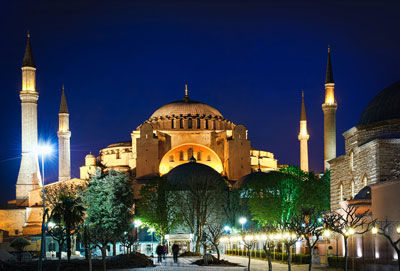
The Hagia Sophia at night.
While unrest in Turkey continues to capture attention, more subtle and more telling events concerning the Islamification of Turkey — and not just at the hands of Prime Minister Erdogan but majorities of Turks — are quietly transpiring. These include the fact that Turkey’s Hagia Sophia museum is on its way to becoming a mosque.
Why does the fate of an old building matter?
Because Hagia Sophia — Greek for “Holy Wisdom” — was for some thousand years Christianity’s greatest cathedral. Built in 537 A.D. in Constantinople, the heart of the Christian empire, it was also a stalwart symbol of defiance against an ever encroaching Islam from the east.
After parrying centuries of jihadi thrusts, Constantinople was finally sacked by Ottoman Turks in 1453. Its crosses desecrated and icons defaced, Hagia Sophia — as well as thousands of other churches — was immediately converted into a mosque, the tall minarets of Islam surrounding it in triumph.
Then, after the dissolution of the Ottoman Empire, as part of several reforms, secularist Ataturk transformed Hagia Sophia into a “neutral” museum in 1934 — a gesture of goodwill to a then-triumphant West from a then-crestfallen Turkey.
Thus the fate of this ancient building is full of portents. And according to Hurriyet Daily News, “A parliamentary commission is considering an application by citizens to turn the Hagia Sophia in Istanbul into a mosque…. A survey conducted with 401 people was attached to the application, in which more than 97 percent of interviewees requested the transformation of the ancient building into a mosque and afterwards for it to be reopened for Muslim worship.”
Even lesser known is the fact that other historic churches are currently being transformed into mosques, such as a 13th century church building — portentously also named Hagia Sophia — in Trabzon. After the Islamic conquest, it was turned into a mosque. But because of its “great historical and cultural significance” for Christians, it too, during Turkey’s secular age, was turned into a museum and its frescoes restored. Yet local authorities recently decreed that its Christian frescoes would again be covered and the church/museum turned into a mosque.
Similarly, the 5th century Studios Monastery, dedicated to St. John the Baptist, is set to become an active mosque. And the existence of the oldest functioning Christian monastery in the world, 5th century Mor Gabriel Monastery, is at risk. Inhabited today by only a few dozen Christians dedicated to learning the monastery’s teachings, the ancient Aramaic language spoken by Jesus, and the Orthodox Syriac tradition, neighboring Muslims filed a lawsuit accusing the monks of practicing “anti-Turkish activities” and of illegally occupying land which belongs to Muslim villagers. The highest appeals court in Ankara ruled in favor of the Muslim villagers, saying the land that had been part of the monastery for 1,600 years is not its property, absurdly claiming that the monastery was built over the ruins of a mosque — even though Muhammad was born 170 years after the monastery was built.
Turkey’s Christian minority, including the Orthodox Patriarch, are naturally protesting this renewed Islamic onslaught against what remains of their cultural heritage — to deaf ears.
The Muslim populace’s role in transforming once Christian sites into mosques is a reminder of all those other Turks not protesting the Islamization of Turkey, and who if anything consider Erdogan’s government too “secular.”
Their numbers are telling. In May 2012, Reuters reported that:
Thousands of devout Muslims prayed outside Turkey’s historic Hagia Sophia museum on Saturday [May 23] to protest a 1934 law that bars religious services at the former church and mosque. Worshippers shouted, “Break the chains, let Hagia Sophia Mosque open,” and “God is great” [the notorious “Allahu Akbar”] before kneeling in prayer as tourists looked on.
Turkey’s secular laws prevent Muslims and Christians from formal worship within the 6th-century monument, the world’s greatest cathedral for almost a millennium before invading Ottomans converted it into a mosque in the 15th century.
The desire to turn Hagia Sophia into a mosque is not about Muslims wanting a place to pray — as of 2010, there were 3,000 active mosques in Istanbul alone. Rather, it’s about their reveling, and trying to revivify, the glory days of Islamic jihad and conquest: Reuters added that Muslims “staged the prayers ahead of celebrations next week marking the 559th anniversary of the Ottoman Sultan Mehmet’s conquest of Byzantine Constantinople.” According to Salih Turhan, a spokesman quoted by Reuters, “As the grandchildren of Mehmet the Conqueror, seeking the re-opening Hagia Sophia as a mosque is our legitimate right.”
Sultan Mehmet was the scourge of European Christendom, whose Islamic hordes seized and ravished Constantinople, forcibly turning it Islamic. Openly idolizing him, as many Turks do, is tantamount to their saying, “We are proud of our ancestors who killed and stole the lands of European Christians.” And yet, despite such militant overtones, Turhan, whose position is echoed by many Turks, still manages to blame the West: “Keeping Hagia Sophia Mosque closed is an insult to our mostly Muslim population of 75 million. It symbolizes our ill-treatment by the West.”
So keeping a historically Christian/Western building — that was stolen by Islamic jihad — as a neutral museum is seen as “ill-treatment by the West,” even as Turks continue destroying the nation’s original Christian heritage.
And the historical revisions continue. Last May 29th, when Turks celebrated the Fall of Constantinople, Erdogan himself declared that the jihadi invasion — which saw countless Christians enslaved, raped, or slaughtered — was the true “time of enlightenment.” After showing how Erdogan got it upside down, Ralph Sidway, an Orthodox Christian author, wrote:
Erdogan and Turkey celebrate the Fall of Constantinople, and the West congratulates them. “We are continuing to write history today,” says Erdogan, and write it – or re-write it – they do, under the somnambulant gaze of craven Western leaders too ignorant, or too fearful, to challenge Islam’s claim to moral superiority, historical righteousness and eventual world domination. By their policies, posture and pronouncements, Western European nations, and the United States, are conceding the future to a rapidly re-Islamicizing Turkey, and are aiding in Islam’s stated goal of a new, global caliphate determined to conquer us, just as it conquered Constantinople 560 years ago. Every Turkish celebration of 29 May 1453 is a gauntlet flung down in challenge to the West. Each such event which goes unanswered and unchallenged by the West is another nail in the coffin of Christian culture, human rights, and free people everywhere.
Indeed, at a time when Turkey is openly reclaiming its jihadi heritage, Europeans are actively erasing their Christian heritage which for centuries kept the Islamic jihad at bay. Among other capitulations, Europeans are currently betraying church buildings to Muslims to convert to mosques and scrubbing references of the historic Turkish jihads against Europe from classroom textbooks, lest Muslim students be offended.
Meanwhile, here are neighboring Turkey’s Muslims openly praising the same jihadi warlords who brutally conquered a portion of Europe centuries ago, converting thousands of churches into mosques, even as they openly prepare to finish the job — which may not even require force, as Europe actively sells its own soul.