
The Barna Group – How Post-Christian is U.S. Society?

The Barna Group – How Post-Christian is U.S. Society?.

Based on Barna’s aggregate metric, nearly two-fifths of the nation’s adult population (37%) qualifies as post-Christian. This includes 9% of Americans who are highly post-Christian—lacking engagement in 80% or more of the measures of belief, practice or commitment. And another one-quarter is moderately post-Christian (28%), without engaging at least 60% of the factors.

Barna’s study includes a ranking of the nation’s largest 96 markets, from most to least post-Christian. The big picture is that the leading post-Christian markets are in the Northeast and in the West. The gap between the most post-Christian city (Albany, NY) and least (Shreveport, LA) is 63% to 12%, respectively. These city-by-city rankings can be found at the company’s new website www.cities.barna.org.

April 15, 2013 – The rise of the so-called “Nones”—the increasing percentage of adults who claim no religious affiliation—has been a much-discussed trend in American religion. Is the nation moving away from Christianity and other forms of conventional faith? To provide insight on this topic, Barna Group analyzed 42,855 interviews conducted in recent years, looking at 15 different measures of non-religiosity. In other words, the research explores the emerging post-Christian landscape of the nation.

Metrics of Post-Christian Culture
Currently, more than seven out of 10 adults describe themselves as “Christian” and more than six out of 10 Americans say they are “deeply spiritual.” Yet, just how deep do these labels go?

To shed light on this, the Barna team created an aggregate metric of post-Christian culture based upon 15 different measures of identity, belief and behavior. To qualify as post-Christian, individuals met 60% or more of the factors (nine or more out of 15 criteria). Highly post-Christian individuals met 80% or more of the factors (12 or more of these 15 criteria). These 15 factors are shown in the infographic below.

David Kinnaman, president and majority owner of Barna Group, explains the reasoning behind the post-Christian metric. “First, we wanted to expand the scope of secularization beyond what people call themselves. Faith-oriented self-descriptions are fine, but they are really only skin-deep in terms of understanding faith. In addition to identity, we also wanted to account for two other critical aspects of faith: belief as well as behavior.

“For decades, our research shows the variations of asking people about faith. For example, many self-described atheists also claim to pray to a deity. Long-time churchgoers often lack basic orthodox beliefs. People who effortlessly self-describe as ‘Christian’ may live like practical atheists in most other parts of their lives. Continue reading “The Barna Group – How Post-Christian is U.S. Society?”
Another perspective – “Luis Palau: New Pope Francis a Friend of Evangelicals” – reblog

Peanut Gallery: Here’s another perspective on Pope Francis – may God bless him – from The Christian Post.

Luis Palau: New Pope Francis a Friend of Evangelicals

By Anugrah Kumar , Christian Post Contributor – March 16, 2013|11:55 am

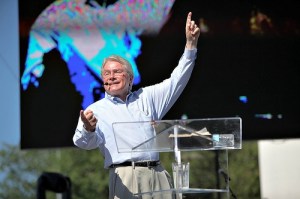
Popular evangelist Luis Palau preaches to the crowd at the Yakima Valley CityFest on Saturday, July 17, 2010 in Yakima, Washington.

Evangelist Luis Palau, who knows and has prayed together with Pope Francis on several occasions, called the new leader of the world’s 1.2 billion Catholics a friend of evangelicals who is respectful of all sides of Christianity.

“I exploded,” Palau told oregonlive.com, of his reaction after his son, Kevin Palau, president of the Luis Palau Association, shared the news that Jorge Mario Bergoglio, archbishop of Buenos Aires, was elected pope this week. “I just couldn’t believe it. In the last election, he was in the running but he told me he felt led by God to remove himself from the race. I said, ‘Maybe next time,’ and he said, ‘I’ll be too old.'”

The fiery preacher who some have called the “Latin Billy Graham,” said whenever they prayed together, Bergoglio asked him to “lay your hands on me and pray for me, that God will keep me as servant.” The new pope is respectful of all sides of Christianity, Palau said, adding the press referred to him as the “evangelical pope” in 2008.

Pope Francis
Pope Francis

Bergoglio, 76, was born in Buenos Aires, Argentina, in 1936. His father was an Italian immigrant. He’s the first pope from South America, and also the first Jesuit pope. Palau was also born in Argentina, and moved to Portland, Ore., in his mid-20s to enroll in a graduate program in Biblical studies.

“I’ve met him several times, gone to his place, we’ve talked, we’ve prayed together you know. He builds bridges to other Christian groups, like evangelical Christians, which is a high percentage in Latin America. He’s a friend. He’s a real friend,” Palau, 78, told kgw.com. Continue reading “Another perspective – “Luis Palau: New Pope Francis a Friend of Evangelicals” – reblog”

Jeff Gordon Presents: Test Drive – repost from Walter Bright

test drivePeanut Gallery: Fun Saturday moral: Make sure you know who’s driving before you get in the passenger seat. Special thanks to Walter Bright for bringing this to our attention – check out his blog here… you’ll be glad you did.

Shut up! – Muslim cleric at Al-Azhar warns: “The new pope must not attack Islam” – Re-blog Jihad Watch

Peanut Gallery: The Muslim “Vatican” is firing a warning shot over the upcoming Papal Conclave in Rome – Shut up about Muslim persecution of Christians, particularly Coptic Christians in Egypt. “Stay quiet and you’ll be OK.” Really…

Muslim persecution of the Egyptian Christians is widespread and increasing, but Al Azhar was infuriated not with that persecution, but with the Pope’s daring to notice it. He should have heeded the advice Muhammad Atta gave to the passengers on the plane he hijacked on September 11, 2001: “Stay quiet and you’ll be OK.” Except they weren’t.

Muslim/Christian dialogue typically goes like this: Christians tell the Muslims what they like about Islam. And then Muslims tell the Christians what they like about Islam.

Robert Spencer unmasks the sham in the following article – well worth the read.
___________________________________

Muslim cleric at Al-Azhar warns: “The new pope must not attack Islam” 
posted by Robert Spencer at Jihad Watch

Cairo - Islamic district - Al Azhar Mosque
Cairo – Islamic district – Al Azhar Mosque

In other words, the new pope must not speak the truth about jihad and Islamic supremacism — or else. The papacy of Benedict XVI offered numerous illustrations of this. “Muslims Seek Dialogue With Next Pope,” by Harvey Morris for the New York Times, March 1:

LONDON — As the Catholic Church’s cardinal electors gather at the Vatican to choose a new pope, Muslim leaders are urging a revival of the often troubled dialogue between the two faiths.

During the papacy of Benedict XVI, relations between the world’s two largest religions were overshadowed by remarks he made in 2006 that were widely condemned as an attack on Islam.

Not by rampant, worldwide Muslim persecution of Christians. No, that didn’t hurt relations at all. Only Benedict’s remarks were at fault. Continue reading “Shut up! – Muslim cleric at Al-Azhar warns: “The new pope must not attack Islam” – Re-blog Jihad Watch”

“Are Christians the New Jews?” – Rabbi Yitzchok Alderstein Re-Blog

Peanut Gallery: Special thanks to Rebecca Hamilton at Public Catholic for bringing this article to our attention. I have re-blogged Rabbi Alderstein’s entire article below – it’s well worth the read.

persecuted Christians

Today, Christians—especially those who take their faith most seriously—report that they feel like a scorned stepchild within general culture. They are mocked and derided, and treated as intellectual pygmies who have nothing to offer the better, more enlightened people around them.

Hamilton’s article is also worth the read “Christian Persecution: Are We the New Jews?” In it she applies Rabbi Alderstein’s analysis to the current state of the Roman Catholic Church in this critical time of change. She quotes Cardinal Ratzinger’s (Pope Benedict XVI) comments from 1969, “The church will become small”:

And so it seems certain to me that the Church is facing very hard times. The real crisis has scarcely begun. We will have to count on terrific upheavals. But I am equally certain about what will remain at the end: not the Church of the political cult, which is dead already, but the Church of faith. She may well no longer be the dominant social power to the extent that she was until recently; but she will enjoy a fresh blossoming and be seen as man’s home, where he will find life and hope beyond death. 

In an earlier post I lamented my feelings of frustration at becoming marginalized in America’s post-Christian culture. Rabbi Alderstein reminds me that Christians are not alone… and Pope Benedict XVI reminds me that God is in the midst of it all.

____________________________________

Are Christians the New Jews?

If you are fortunate enough to possess the truth, you do not compromise or sacrifice it, even if it means that you continue on only as tiny fleck of mankind.

By Rabbi Yitzchok Adlerstein, February 20, 2013

“If you want to understand us, study our story, learn of our pain.” That is what Jews told Christians who wanted to build new bridges of respect after the Holocaust. Ironically, when Christians begin listening to the story of the Jews, they are finding reflections of themselves.

Christians who listened learned of a Jewish history written in blood from ancient to modern times. When they thought of Christian martyrdom, on the other hand, they had to turn for the most part to antiquity, to early Christianity under the thumb of Roman emperors.

That has all changed. While Jews feel threatened by the massive explosion of global anti-Semitism in the last years, coupled with Iranian and Islamist calls for the genocidal destruction of all Jews, very few Jews in 2013 are dying because of their faith or their roots. Christians, on the other hand, have become the New Jews. Continue reading ““Are Christians the New Jews?” – Rabbi Yitzchok Alderstein Re-Blog”