Career Opportunities: Naval Academy Launches Cyber Ops Major – Business Insider Re-Blog

Peanut Gallery: The U.S. Naval Academy is giving new meaning to the slogan – “Join the Navy and see the world!” 

New careers for the new world order. See the full and related articles at businessinsider.com
_____________________________________

Mike HoffmanMilitary.com / Jun 11th 2013 9:44 AM

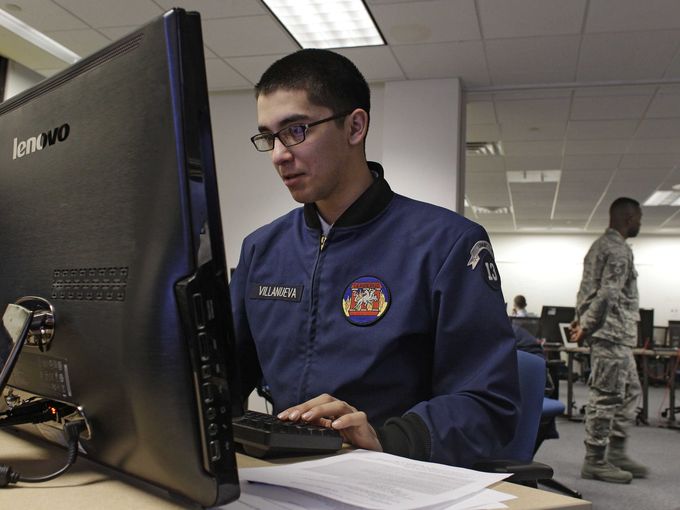
Photo by: AP/Brennan Linsley

ANNAPOLIS, Md. — This fall, the Naval Academy will become the first service academy — or university for that matter — to offer their undergraduate students the chance to major in Cyber Operations.

Pentagon leaders have established cyber security as an urgent priority to develop within the military with a focus on training leaders. The Defense Department is quick to admit it’s still trying to determine its place in protecting the nation from cyber attacks.

However, military brass has said repeatedly that the officers who will define the Pentagon’s future within cyber security will likely be the youngest set of officers to include those still in training. Cue the Naval Academy’s Class of 2016, which will be the first to have graduates with a Cyber Operations degree.

Leaders at the Naval Academy have spent five years developing the cyber classes since former Commandant Adm. Gary Roughead, who later became the chief of naval operations, challenged the academy to provide cyber classes beyond its computer science offerings.

The academy started by establishing a mandatory class that all midshipmen must take their plebe (freshman) year called Cyber 1. In their third year, midshipmen must take another mandatory course called Cyber 2, which provides more in depth instruction to include cyber policy and economics.

Naval Academy Dean and Provost Andrew T. Phillips said the goal has always been to offer a Cyber Security Studies program that went beyond writing code.“We wanted to make sure we covered the basics as well as the policies, law and economics that are associated with cyber,” Phillips said.

The Naval Academy faced a challenge in creating its Cyber Operations major at the same time the Defense Department has struggled to define its role within the realm, Phillips said.

“The services are still trying to figure out where they fit in right now so that it did make it a little harder,” Phillips said.

The service researched the many graduate-level cyber security programs that exist at university such as the University of Maryland. However, the Naval Academy’s program will be the first major at the undergraduate level.

Naval Academy leaders designed the major to continue to adapt over time much like the technology will develop and dictate changes. Many fundamentals will remain the same, but the program is also designed to ensure students stay up to date with the latest technologies, Phillips said.

“We know 30 years from now that the technology will likely be completely different but our hope is that the fundamentals remain the same and these midshipmen can fall back on those,” he said.

Students majoring in Cyber Operations will have the opportunity to complete internships over the summer with civilian software and internet companies as well as the federal agencies such as the National Security Agency, which is a 30-minute drive from the Naval Academy.

So far, about 30 students have signed up for the major. Midshipman 4th Class Molly McNamara is one such student who chose the major after taking Cyber 1 her plebe year.

McNamaara didn’t arrive at the Naval Academy completing a host of computer science classes in high school. Instead she planned to major in chemistry or pre-med.

Her familiarity with computers didn’t go too far beyond Microsoft and Facebook, she admitted. However, McNamara chose to major in Cyber Operations after learning about the wide ranging impact cyber can have on networks throughout the military and society.

Midshipman 4th Class Zachary Dannelly has a more traditional background for a student you’d expect to pick Cyber Operations as a major. He took Advanced Placement computer science in high school as well as web design classes.

He chose the major because he wants to be a part of a military field that is still being defined.

“It’s exciting to be a part of a new field. It’s almost like being the first people on submarines,” Dannelly said.

Catholic Archbishop: Wake Up! Religious Liberty at Risk in USA (CNS Re-Blog)

Peanut Gallery: Archbishop Chaput of Philadelphia issued a wake-up call to all Christians. Full text may be found here.

“[T]he latest IRS ugliness,” he wrote, “is a hint of the treatment disfavored religious groups may face in the future, if we sleep through the national discussion of religious liberty now. The day when Americans could take the Founders’ understanding of religious freedom as a given is over. We need to wake up.”

By Terence P. Jeffrey

Archbishop Charles Chaput
Archbishop Charles Chaput of Philadelphia on Ash Wednesday, Feb. 22, 2012. (AP Photo/Matt Rourke)

(CNSNews.com) – Roman Catholic Archbishop Charles J. Chaput is calling on Americans to wake up and recognize that the Founding Fathers’ vision of religious freedom is now threatened by the federal government.

“The day when Americans could take the Founders’ understanding of religious freedom as a given is over,” said the archbishop. “We need to wake up.”

Chaput, who leads the Roman Catholic Archdiocese of Philadelphia, pointed to Obamacare’s sterilization-contraception-abortifacient regulation as one example. The regulation, issued by Health and Human Services Secretary Kathleen Sebelius, requires almost all health-care plans in the United States to provide coverage for sterilizations, artificial contraceptives and abortion-inducing drugs to all women of reproductive age–even if the person or employer providing the insurance coverage and even if the female beneficiaries themselves do not want the coverage and believe it is morally wrong and violates their religious beliefs.

“[T]he HHS mandate can only be understood as a form of coercion,” the archbishop wrote in a recent column posted on the website of the Archdiocese of Philadelphia. The column is entitled, “Religious Freedom and the Need to Wake Up.

Last year, the Catholic bishops of the United States unanimously approved a statement describing the HHS regulation as an “unjust and illegal mandate.” The unanimous bishops said the regulation not only violated the religious freedom of religious institutions but also the “personal civil rights” of individual Americans who will be forced to comply with it either as employers or employees.

Archbishop Chaput noted that the bishops believe “basic medical care is a matter of social justice and human dignity.” That principal, however, does not empower the government to force Americans to violate their moral and religious convictions.

“But health care has now morphed into a religious liberty issue provoked entirely–and needlessly–by the current White House,” the archbishop wrote. “Despite a few small concessions under pressure, the administration refuses to withdraw or reasonably modify a Health and Human Services (HHS) contraceptive mandate that violates the moral and religious convictions of many individuals, private employers and religiously affiliated and inspired organizations.”

The archbishop noted that the administration’s disregard for religious liberty in the enforcement of this regulation is in line with its refusal to defend the Defense of Marriage Act and its advocacy in the Hosanna-Tabor case.

The Defense of Marriage Act says that a state cannot be forced to recognize a same-sex marriage contracted in another state and that for federal purposes marriage is between one man and one women. The Supreme Court is now considering the constitutionality of DOMA, and the administration has asked the court that the law be thrown out, arguing that opposition to same-sex marriage (which is the position of the Catholic Church and many other religious denominations) is the constitutional equivalent of racial discrimination.

In the Hosanna-Tabor case, the administration argued unsuccessfully in the Supreme Court that the government could tell a Lutheran school it must restore as a “commissioned minister” a person who violated the teachings of the Lutheran faith.

“Coupled with the White House’s refusal to uphold the 1996 Defense of Marriage Act, and its astonishing disregard for the unique nature of religious freedom displayed by its arguments in a 9-0 defeat in the 2012 Hosanna-Tabor Supreme Court decision, the HHS mandate can only be understood as a form of coercion,” wrote the archbishop.

“Access to inexpensive contraception is a problem nowhere in the United States,” he said. “The mandate is thus an ideological statement; the imposition of a preferential option for infertility. And if millions of Americans disagree with it on principle–too bad.”

The archbishop went on to observe that abortion advocates use fraudulent language in describing their position.

“The fraud at the heart of our nation’s ‘reproductive rights’ vocabulary runs very deep and very high,” he wrote. “In his April 26 remarks to the Planned Parenthood Federation of America, the president never once used the word ‘abortion,’ despite the ongoing Kermit Gosnell trial in Philadelphia and despite Planned Parenthood’s massive role in the abortion industry.”

The archbishop noted that the scandal “involving IRS targeting of ‘conservative’ organizations … also has a religious dimension.”

“But the latest IRS ugliness,” he wrote, “is a hint of the treatment disfavored religious groups may face in the future, if we sleep through the national discussion of religious liberty now. The day when Americans could take the Founders’ understanding of religious freedom as a given is over. We need to wake up.”

Homeschooling Growing Seven Times Faster than Public School Enrollment – Breitbart Re-Blog

By Dr. Susan Berry / 8 Jun 2013  – Breitbart Report

As dissatisfaction with the U.S. public school system grows, apparently so has the appeal of homeschooling. Educational researchers, in fact, are expecting a surge in the number of students educated at home by their parents over the next ten years, as more parents reject public schools.

image

A recent report in Education News states that, since 1999, the number of children who are homeschooled has increased by 75%.

Though homeschooled children represent only 4% of all school-age children nationwide, the number of children whose parents choose to educate them at home rather than a traditional academic setting is growing seven times faster than the number of children enrolling in grades K-12 every year.

As homeschooling has become increasingly popular, common myths that have long been associated with the practice of homeschooling have been debunked.

Any concerns about the quality of education children receive by their parents can be put to rest by the consistently high placement of homeschooled students on standardized assessment exams. Data demonstrates that those who are independently educated generally score between the 65th and 89th percentile on these measures, while those in traditional academic settings average at around the 50th percentile. In addition, achievement gaps between sexes, income levels, or ethnicity—all of which have plagued public schools around the country—do not exist in homeschooling environments.

According to the report: Recent studies laud homeschoolers’ academic success, noting their significantly higher ACT-Composite scores as high schoolers and higher grade point averages as college students. Yet surprisingly, the average expenditure for the education of a homeschooled child, per year, is $500 to $600, compared to an average expenditure of $10,000 per child, per year, for public school students.

The high achievement level of homeschoolers is readily recognized by recruiters from some of the best colleges in the nation. Home-educated children matriculate in colleges and attain a four-year degree at much higher rates than their counterparts from both public and private schools. Schools such as Massachusetts Institute of Technology, Harvard, Stanford, and Duke Universities all actively recruit homeschoolers.

Similarly, the common myth that homeschoolers “miss out” on so-called “socialization opportunities,” often thought to be a vital aspect of traditional academic settings, has proven to be without merit. According to the National Home Education Research Institute survey, homeschoolers tend to be more socially engaged than their peers and demonstrate “healthy social, psychological, and emotional development, and success into adulthood.”

From the report: Based on recent data, researchers such as Dr. Brian Ray (NHERI.org) “expect to observe a notable surge in the number of children being homeschooled in the next 5 to 10 years. The rise would be in terms of both absolute numbers and percentage of the K to 12 student population. This increase would be in part because…[1] a large number of those individuals who were being home educated in the 1990’s may begin to homeschool their own school-age children and [2] the continued successes of home-educated students.”

Four Words to Watch in the Immigration Debate – Re-Blog The Foundry

Four Words to Watch in the Immigration Debate – The Foundry

June 7, 2013 at 7:16 am

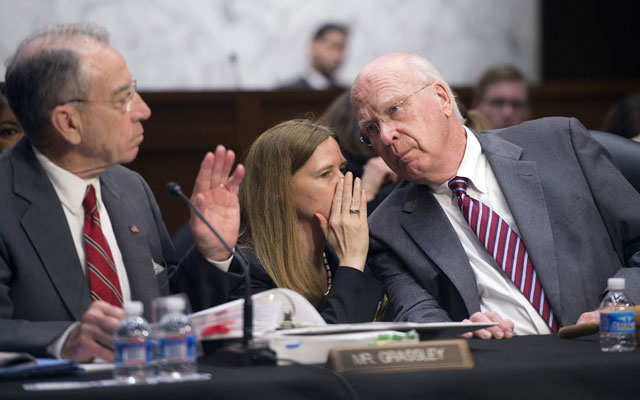
The Senate Judiciary Committee works on the immigration bill. (Photo: Tom Williams/CQ Roll Call/Newscom)

The Senate will begin debate on the Gang of Eight’s immigration proposal next week. Here are four words to watch out for as the Senators make their case—and warnings about what they might mean.

1. COST “Cost” is one word that should come up in the immigration debate, because the Gang of Eight’s amnesty proposal has a cost that is simply too high for Americans to bear. Heritage analysis found that amnesty would cost taxpayers trillions of dollars. Amnesty means that illegal immigrants become legal—and become eligible for Obamacare benefits, Social Security, welfare, and Medicare. But they won’t pay enough into the system in taxes to cover the cost of all these benefits, meaning the rest of the taxpayers will have to bear the burden. This simply isn’t fair to hard-working Americans.

2. BORDER Despite claims of security—and talk of amending the bill—the Gang of Eight immigration bill doesn’t secure the border. Instead, it “delivers nothing new—other than the promise of spending a lot more money and running up our debt.” As James Carafano, Heritage’s E. W. Richardson Fellow, explains: “Amnesty immediately creates an incentive for illegal border crossings and overstays. Thus, the bill’s strategy would drive up the cost of securing the border.”

3. AMNESTY Heritage President Jim DeMint has said that it’s a false choice for people to say that amnesty is necessary to immigration reform. Amnesty encourages more illegal immigration, and that is not what immigration reform is supposed to do. Former Attorney General Ed Meese, Heritage’s Ronald Reagan Distinguished Fellow Emeritus, reminds us that America has tried this before, and it didn’t work:

Today they call it a “roadmap to citizenship.” Ronald Reagan called it “amnesty.” And he was right. The 1986 reform did not solve our immigration problem—in fact, the population of illegal immigrants has nearly quadrupled since that “comprehensive” bill.

4. “COMPREHENSIVE” Beware the word “comprehensive.” As Meese notes above, the amnesty of 1986 was also called a “comprehensive” approach to immigration reform. It doesn’t work, and it’s not what we need. We need a separate, step-by-step approach to immigration reform. An approach that works—that the American people can trust—would start with reforming the legal immigration system and enforcing the security measures that are supposed to be in place.

Read the Morning Bell and more en español every day at Heritage Libertad.

Quick Hit: Jose Aldana, an immigrant who came to the United States in 1997 and is still working to become a citizen, explains why he opposes the Gang of Eight amnesty bill.