One thing I have asked of the Lord, this is what I seek: that I may dwell in the house of the Lord all the days of my life; to behold the beauty of the Lord and to seek Him in His temple.
Praise to You, Lord Jesus Christ, King of endless glory.
Reading: Job 41-42 (NLT)
The Lord’s Challenge Continues
Job 41 (NLT)
“Can you catch Leviathan with a hook or put a noose around its jaw? Can you tie it with a rope through the nose or pierce its jaw with a spike? Will it beg you for mercy or implore you for pity? Will it agree to work for you, to be your slave for life? Can you make it a pet like a bird, or give it to your little girls to play with? Will merchants try to buy it to sell it in their shops? Will its hide be hurt by spears or its head by a harpoon? If you lay a hand on it, you will certainly remember the battle that follows. You won’t try that again! No, it is useless to try to capture it. The hunter who attempts it will be knocked down. And since no one dares to disturb it, who then can stand up to me? Who has given me anything that I need to pay back? Everything under heaven is mine.
“I want to emphasize Leviathan’s limbs and its enormous strength and graceful form. Who can strip off its hide, and who can penetrate its double layer of armor? Who could pry open its jaws? For its teeth are terrible! The scales on its back are like rows of shields tightly sealed together. They are so close together that no air can get between them. Each scale sticks tight to the next. They interlock and cannot be penetrated.
“When it sneezes, it flashes light! Its eyes are like the red of dawn. Lightning leaps from its mouth; flames of fire flash out. Smoke streams from its nostrils like steam from a pot heated over burning rushes. Its breath would kindle coals, for flames shoot from its mouth.
“The tremendous strength in Leviathan’s neck strikes terror wherever it goes. Its flesh is hard and firm and cannot be penetrated. Its heart is hard as rock, hard as a millstone. When it rises, the mighty are afraid, gripped by terror. No sword can stop it, no spear, dart, or javelin. Iron is nothing but straw to that creature, and bronze is like rotten wood. Arrows cannot make it flee. Stones shot from a sling are like bits of grass. Clubs are like a blade of grass, and it laughs at the swish of javelins. Its belly is covered with scales as sharp as glass. It plows up the ground as it drags through the mud.
“Leviathan makes the water boil with its commotion. It stirs the depths like a pot of ointment. The water glistens in its wake, making the sea look white. Nothing on earth is its equal, no other creature so fearless. Of all the creatures, it is the proudest. It is the king of beasts.”
Job Responds to the Lord
Job 42 (NLT)
Then Job replied to the Lord:
“I know that you can do anything, and no one can stop you. You asked, ‘Who is this that questions my wisdom with such ignorance?’ It is I—and I was talking about things I knew nothing about, things far too wonderful for me. You said, ‘Listen and I will speak! I have some questions for you, and you must answer them.’ I had only heard about you before, but now I have seen you with my own eyes. I take back everything I said, and I sit in dust and ashes to show my repentance.”
Conclusion: The Lord Blesses Job
After the Lord had finished speaking to Job, he said to Eliphaz the Temanite: “I am angry with you and your two friends, for you have not spoken accurately about me, as my servant Job has. So take seven bulls and seven rams and go to my servant Job and offer a burnt offering for yourselves. My servant Job will pray for you, and I will accept his prayer on your behalf. I will not treat you as you deserve, for you have not spoken accurately about me, as my servant Job has.” So Eliphaz the Temanite, Bildad the Shuhite, and Zophar the Naamathite did as the Lord commanded them, and the Lord accepted Job’s prayer.
When Job prayed for his friends, the Lord restored his fortunes. In fact, the Lord gave him twice as much as before! Then all his brothers, sisters, and former friends came and feasted with him in his home. And they consoled him and comforted him because of all the trials the Lord had brought against him. And each of them brought him a gift of money and a gold ring.
So the Lord blessed Job in the second half of his life even more than in the beginning. For now he had 14,000 sheep, 6,000 camels, 1,000 teams of oxen, and 1,000 female donkeys. He also gave Job seven more sons and three more daughters. He named his first daughter Jemimah, the second Keziah, and the third Keren-happuch. In all the land no women were as lovely as the daughters of Job. And their father put them into his will along with their brothers.
Job lived 140 years after that, living to see four generations of his children and grandchildren. Then he died, an old man who had lived a long, full life.
__________
May the peace of the Lord Christ go with you, wherever He may send you. May He guide you through the wilderness, protect you through the storm. May He bring you home rejoicing at the wonders He has shown you. May He bring you home rejoicing once again into our doors.
__________
+ In the name of the Father, and the Son, and the Holy Spirit. Amen!
One thing I have asked of the Lord, this is what I seek: that I may dwell in the house of the Lord all the days of my life; to behold the beauty of the Lord and to seek Him in His temple.
Praise to You, Lord Jesus Christ, King of endless glory.
Reading: 2 Samuel 15-19 (NLT)
Absalom’s Rebellion
2 Samuel 15 (NLT)
+ Subversion – After this, Absalom bought a chariot and horses, and he hired fifty bodyguards to run ahead of him. He got up early every morning and went out to the gate of the city. When people brought a case to the king for judgment, Absalom would ask where in Israel they were from, and they would tell him their tribe. Then Absalom would say, “You’ve really got a strong case here! It’s too bad the king doesn’t have anyone to hear it. I wish I were the judge. Then everyone could bring their cases to me for judgment, and I would give them justice!”
When people tried to bow before him, Absalom wouldn’t let them. Instead, he took them by the hand and kissed them. Absalom did this with everyone who came to the king for judgment, and so he stole the hearts of all the people of Israel.
+ Deception – After four years, Absalom said to the king, “Let me go to Hebron to offer a sacrifice to the Lord and fulfill a vow I made to him. For while your servant was at Geshur in Aram, I promised to sacrifice to the Lord in Hebron if he would bring me back to Jerusalem.”
“All right,” the king told him. “Go and fulfill your vow.”
+ Rebellion – So Absalom went to Hebron. But while he was there, he sent secret messengers to all the tribes of Israel to stir up a rebellion against the king. “As soon as you hear the ram’s horn,” his message read, “you are to say, ‘Absalom has been crowned king in Hebron.’” He took 200 men from Jerusalem with him as guests, but they knew nothing of his intentions. While Absalom was offering the sacrifices, he sent for Ahithophel, one of David’s counselors who lived in Giloh. Soon many others also joined Absalom, and the conspiracy gained momentum.
David Escapes from Jerusalem
+ Conspiracy – A messenger soon arrived in Jerusalem to tell David, “All Israel has joined Absalom in a conspiracy against you!”
“Then we must flee at once, or it will be too late!” David urged his men. “Hurry! If we get out of the city before Absalom arrives, both we and the city of Jerusalem will be spared from disaster.”
“We are with you,” his advisers replied. “Do what you think is best.”
+ Evacuation – So the king and all his household set out at once. He left no one behind except ten of his concubines to look after the palace. The king and all his people set out on foot, pausing at the last house to let all the king’s men move past to lead the way. There were 600 men from Gath who had come with David, along with the king’s bodyguard.
Then the king turned and said to Ittai, a leader of the men from Gath, “Why are you coming with us? Go on back to King Absalom, for you are a guest in Israel, a foreigner in exile. You arrived only recently, and should I force you today to wander with us? I don’t even know where we will go. Go on back and take your kinsmen with you, and may the Lord show you his unfailing love and faithfulness.”
+ Loyalty – But Ittai said to the king, “I vow by the Lord and by your own life that I will go wherever my lord the king goes, no matter what happens—whether it means life or death.”
David replied, “All right, come with us.” So Ittai and all his men and their families went along.
+ Grief – Everyone cried loudly as the king and his followers passed by. They crossed the Kidron Valley and then went out toward the wilderness.
+ Worship – Zadok and all the Levites also came along, carrying the Ark of the Covenant of God. They set down the Ark of God, and Abiathar offered sacrifices until everyone had passed out of the city.
+ Resignation – Then the king instructed Zadok to take the Ark of God back into the city. “If the Lord sees fit,” David said, “he will bring me back to see the Ark and the Tabernacle again. But if he is through with me, then let him do what seems best to him.”
+ Report – The king also told Zadok the priest, “Look, here is my plan. You and Abiathar should return quietly to the city with your son Ahimaaz and Abiathar’s son Jonathan. I will stop at the shallows of the Jordan River and wait there for a report from you.” So Zadok and Abiathar took the Ark of God back to the city and stayed there.
+ Mourning – David walked up the road to the Mount of Olives, weeping as he went. His head was covered and his feet were bare as a sign of mourning. And the people who were with him covered their heads and wept as they climbed the hill. When someone told David that his adviser Ahithophel was now backing Absalom, David prayed, “O Lord, let Ahithophel give Absalom foolish advice!”
+ Espionage – When David reached the summit of the Mount of Olives where people worshiped God, Hushai the Arkite was waiting there for him. Hushai had torn his clothing and put dirt on his head as a sign of mourning. But David told him, “If you go with me, you will only be a burden. Return to Jerusalem and tell Absalom, ‘I will now be your adviser, O king, just as I was your father’s adviser in the past.’ Then you can frustrate and counter Ahithophel’s advice. Zadok and Abiathar, the priests, will be there. Tell them about the plans being made in the king’s palace, and they will send their sons Ahimaaz and Jonathan to tell me what is going on.”
So David’s friend Hushai returned to Jerusalem, getting there just as Absalom arrived.
David and Ziba
2 Samuel 16 (NLT)
When David had gone a little beyond the summit of the Mount of Olives, Ziba, the servant of Mephibosheth, was waiting there for him. He had two donkeys loaded with 200 loaves of bread, 100 clusters of raisins, 100 bunches of summer fruit, and a wineskin full of wine.
“What are these for?” the king asked Ziba.
Ziba replied, “The donkeys are for the king’s people to ride on, and the bread and summer fruit are for the young men to eat. The wine is for those who become exhausted in the wilderness.”
+ Ingratitude – “And where is Mephibosheth, Saul’s grandson?” the king asked him.
“He stayed in Jerusalem,” Ziba replied. “He said, ‘Today I will get back the kingdom of my grandfather Saul.’”
“In that case,” the king told Ziba, “I give you everything Mephibosheth owns.”
“I bow before you,” Ziba replied. “May I always be pleasing to you, my lord the king.”
Shimei Curses David
As King David came to Bahurim, a man came out of the village cursing them. It was Shimei son of Gera, from the same clan as Saul’s family. He threw stones at the king and the king’s officers and all the mighty warriors who surrounded him. “Get out of here, you murderer, you scoundrel!” he shouted at David. “The Lord is paying you back for all the bloodshed in Saul’s clan. You stole his throne, and now the Lord has given it to your son Absalom. At last you will taste some of your own medicine, for you are a murderer!”
“Why should this dead dog curse my lord the king?” Abishai son of Zeruiah demanded. “Let me go over and cut off his head!”
“No!” the king said. “Who asked your opinion, you sons of Zeruiah! If the Lord has told him to curse me, who are you to stop him?”
Then David said to Abishai and to all his servants, “My own son is trying to kill me. Doesn’t this relative of Saul have even more reason to do so? Leave him alone and let him curse, for the Lord has told him to do it. And perhaps the Lord will see that I am being wronged and will bless me because of these curses today.” So David and his men continued down the road, and Shimei kept pace with them on a nearby hillside, cursing and throwing stones and dirt at David.
The king and all who were with him grew weary along the way, so they rested when they reached the Jordan River.
Ahithophel Advises Absalom
Meanwhile, Absalom and all the army of Israel arrived at Jerusalem, accompanied by Ahithophel. When David’s friend Hushai the Arkite arrived, he went immediately to see Absalom. “Long live the king!” he exclaimed. “Long live the king!”
“Is this the way you treat your friend David?” Absalom asked him. “Why aren’t you with him?”
“I’m here because I belong to the man who is chosen by the Lord and by all the men of Israel,” Hushai replied. “And anyway, why shouldn’t I serve you? Just as I was your father’s adviser, now I will be your adviser!”
Then Absalom turned to Ahithophel and asked him, “What should I do next?”
+ Irreconcilable – Ahithophel told him, “Go and sleep with your father’s concubines, for he has left them here to look after the palace. Then all Israel will know that you have insulted your father beyond hope of reconciliation, and they will throw their support to you.” So they set up a tent on the palace roof where everyone could see it, and Absalom went in and had sex with his father’s concubines.
Absalom followed Ahithophel’s advice, just as David had done. For every word Ahithophel spoke seemed as wise as though it had come directly from the mouth of God.
2 Samuel 17 (NLT)
+ Plot – Now Ahithophel urged Absalom, “Let me choose 12,000 men to start out after David tonight. I will catch up with him while he is weary and discouraged. He and his troops will panic, and everyone will run away. Then I will kill only the king, and I will bring all the people back to you as a bride returns to her husband. After all, it is only one man’s life that you seek. Then you will be at peace with all the people.” This plan seemed good to Absalom and to all the elders of Israel.
Hushai Counters Ahithophel’s Advice
But then Absalom said, “Bring in Hushai the Arkite. Let’s see what he thinks about this.” When Hushai arrived, Absalom told him what Ahithophel had said. Then he asked, “What is your opinion? Should we follow Ahithophel’s advice? If not, what do you suggest?”
+ Reprieve – “Well,” Hushai replied to Absalom, “this time Ahithophel has made a mistake. You know your father and his men; they are mighty warriors. Right now they are as enraged as a mother bear who has been robbed of her cubs. And remember that your father is an experienced man of war. He won’t be spending the night among the troops. He has probably already hidden in some pit or cave. And when he comes out and attacks and a few of your men fall, there will be panic among your troops, and the word will spread that Absalom’s men are being slaughtered. Then even the bravest soldiers, though they have the heart of a lion, will be paralyzed with fear. For all Israel knows what a mighty warrior your father is and how courageous his men are.
“I recommend that you mobilize the entire army of Israel, bringing them from as far away as Dan in the north and Beersheba in the south. That way you will have an army as numerous as the sand on the seashore. And I advise that you personally lead the troops. When we find David, we’ll fall on him like dew that falls on the ground. Then neither he nor any of his men will be left alive. And if David were to escape into some town, you will have all Israel there at your command. Then we can take ropes and drag the walls of the town into the nearest valley until every stone is torn down.”
+ Reproof – Then Absalom and all the men of Israel said, “Hushai’s advice is better than Ahithophel’s.” For the Lord had determined to defeat the counsel of Ahithophel, which really was the better plan, so that he could bring disaster on Absalom!
Hushai Warns David to Escape
Hushai told Zadok and Abiathar, the priests, what Ahithophel had said to Absalom and the elders of Israel and what he himself had advised instead. “Quick!” he told them. “Find David and urge him not to stay at the shallows of the Jordan River tonight. He must go across at once into the wilderness beyond. Otherwise he will die and his entire army with him.”
+ Report – Jonathan and Ahimaaz had been staying at En-rogel so as not to be seen entering and leaving the city. Arrangements had been made for a servant girl to bring them the message they were to take to King David. But a boy spotted them at En-rogel, and he told Absalom about it. So they quickly escaped to Bahurim, where a man hid them down inside a well in his courtyard. The man’s wife put a cloth over the top of the well and scattered grain on it to dry in the sun; so no one suspected they were there.
When Absalom’s men arrived, they asked her, “Have you seen Ahimaaz and Jonathan?”
The woman replied, “They were here, but they crossed over the brook.” Absalom’s men looked for them without success and returned to Jerusalem.
+ Retreat – Then the two men crawled out of the well and hurried on to King David. “Quick!” they told him, “cross the Jordan tonight!” And they told him how Ahithophel had advised that he be captured and killed. So David and all the people with him went across the Jordan River during the night, and they were all on the other bank before dawn.
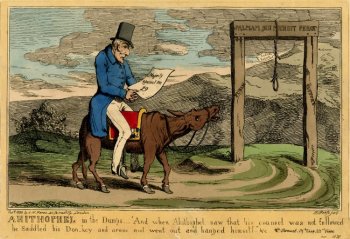
+ Rejection – When Ahithophel realized that his advice had not been followed, he saddled his donkey, went to his hometown, set his affairs in order, and hanged himself. He died there and was buried in the family tomb.
+ Absalom mobilizes – David soon arrived at Mahanaim. By now, Absalom had mobilized the entire army of Israel and was leading his troops across the Jordan River. Absalom had appointed Amasa as commander of his army, replacing Joab, who had been commander under David. (Amasa was Joab’s cousin. His father was Jether, an Ishmaelite. His mother, Abigail daughter of Nahash, was the sister of Joab’s mother, Zeruiah.) Absalom and the Israelite army set up camp in the land of Gilead.
+ David regroups – When David arrived at Mahanaim, he was warmly greeted by Shobi son of Nahash, who came from Rabbah of the Ammonites, and by Makir son of Ammiel from Lo-debar, and by Barzillai of Gilead from Rogelim. They brought sleeping mats, cooking pots, serving bowls, wheat and barley, flour and roasted grain, beans, lentils, honey, butter, sheep, goats, and cheese for David and those who were with him. For they said, “You must all be very hungry and tired and thirsty after your long march through the wilderness.”
Absalom’s Defeat and Death
2 Samuel 18 (NLT)
David now mustered the men who were with him and appointed generals and captains to lead them. He sent the troops out in three groups, placing one group under Joab, one under Joab’s brother Abishai son of Zeruiah, and one under Ittai, the man from Gath. The king told his troops, “I am going out with you.”
But his men objected strongly. “You must not go,” they urged. “If we have to turn and run—and even if half of us die—it will make no difference to Absalom’s troops; they will be looking only for you. You are worth 10,000 of us, and it is better that you stay here in the town and send help if we need it.”
“If you think that’s the best plan, I’ll do it,” the king answered. So he stood alongside the gate of the town as all the troops marched out in groups of hundreds and of thousands.
And the king gave this command to Joab, Abishai, and Ittai: “For my sake, deal gently with young Absalom.” And all the troops heard the king give this order to his commanders.
So the battle began in the forest of Ephraim, and the Israelite troops were beaten back by David’s men. There was a great slaughter that day, and 20,000 men laid down their lives. The battle raged all across the countryside, and more men died because of the forest than were killed by the sword.
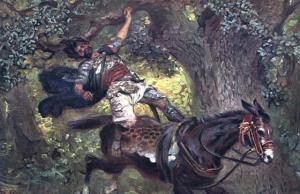
During the battle, Absalom happened to come upon some of David’s men. He tried to escape on his mule, but as he rode beneath the thick branches of a great tree, his hair got caught in the tree. His mule kept going and left him dangling in the air. One of David’s men saw what had happened and told Joab, “I saw Absalom dangling from a great tree.”
“What?” Joab demanded. “You saw him there and didn’t kill him? I would have rewarded you with ten pieces of silver and a hero’s belt!”
“I would not kill the king’s son for even a thousand pieces of silver,” the man replied to Joab. “We all heard the king say to you and Abishai and Ittai, ‘For my sake, please spare young Absalom.’ And if I had betrayed the king by killing his son—and the king would certainly find out who did it—you yourself would be the first to abandon me.”
“Enough of this nonsense,” Joab said. Then he took three daggers and plunged them into Absalom’s heart as he dangled, still alive, in the great tree. Ten of Joab’s young armor bearers then surrounded Absalom and killed him.
Then Joab blew the ram’s horn, and his men returned from chasing the army of Israel. They threw Absalom’s body into a deep pit in the forest and piled a great heap of stones over it. And all Israel fled to their homes.
During his lifetime, Absalom had built a monument to himself in the King’s Valley, for he said, “I have no son to carry on my name.” He named the monument after himself, and it is known as Absalom’s Monument to this day.
David Mourns Absalom’s Death
Then Zadok’s son Ahimaaz said, “Let me run to the king with the good news that the Lord has rescued him from his enemies.”
“No,” Joab told him, “it wouldn’t be good news to the king that his son is dead. You can be my messenger another time, but not today.”
Then Joab said to a man from Ethiopia, “Go tell the king what you have seen.” The man bowed and ran off.
But Ahimaaz continued to plead with Joab, “Whatever happens, please let me go, too.”
“Why should you go, my son?” Joab replied. “There will be no reward for your news.”
“Yes, but let me go anyway,” he begged.
Joab finally said, “All right, go ahead.” So Ahimaaz took the less demanding route by way of the plain and ran to Mahanaim ahead of the Ethiopian.
While David was sitting between the inner and outer gates of the town, the watchman climbed to the roof of the gateway by the wall. As he looked, he saw a lone man running toward them. He shouted the news down to David, and the king replied, “If he is alone, he has news.”
As the messenger came closer, the watchman saw another man running toward them. He shouted down, “Here comes another one!”
The king replied, “He also will have news.”
“The first man runs like Ahimaaz son of Zadok,” the watchman said.
“He is a good man and comes with good news,” the king replied.
Then Ahimaaz cried out to the king, “Everything is all right!” He bowed before the king with his face to the ground and said, “Praise to the Lord your God, who has handed over the rebels who dared to stand against my lord the king.”
“What about young Absalom?” the king demanded. “Is he all right?”
Ahimaaz replied, “When Joab told me to come, there was a lot of commotion. But I didn’t know what was happening.”
“Wait here,” the king told him. So Ahimaaz stepped aside.
Then the man from Ethiopia arrived and said, “I have good news for my lord the king. Today the Lord has rescued you from all those who rebelled against you.”
“What about young Absalom?” the king demanded. “Is he all right?”
And the Ethiopian replied, “May all of your enemies, my lord the king, both now and in the future, share the fate of that young man!”
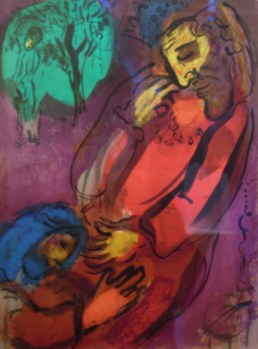
The king was overcome with emotion. He went up to the room over the gateway and burst into tears. And as he went, he cried, “O my son Absalom! My son, my son Absalom! If only I had died instead of you! O Absalom, my son, my son.”
Joab Rebukes the King
2 Samuel 19 (NLT)
Word soon reached Joab that the king was weeping and mourning for Absalom. As all the people heard of the king’s deep grief for his son, the joy of that day’s victory was turned into deep sadness. They crept back into the town that day as though they were ashamed and had deserted in battle. The king covered his face with his hands and kept on crying, “O my son Absalom! O Absalom, my son, my son!”
Then Joab went to the king’s room and said to him, “We saved your life today and the lives of your sons, your daughters, and your wives and concubines. Yet you act like this, making us feel ashamed of ourselves. You seem to love those who hate you and hate those who love you. You have made it clear today that your commanders and troops mean nothing to you. It seems that if Absalom had lived and all of us had died, you would be pleased. Now go out there and congratulate your troops, for I swear by the Lord that if you don’t go out, not a single one of them will remain here tonight. Then you will be worse off than ever before.”
So the king went out and took his seat at the town gate, and as the news spread throughout the town that he was there, everyone went to him.
Meanwhile, the Israelites who had supported Absalom fled to their homes. And throughout all the tribes of Israel there was much discussion and argument going on. The people were saying, “The king rescued us from our enemies and saved us from the Philistines, but Absalom chased him out of the country. Now Absalom, whom we anointed to rule over us, is dead. Why not ask David to come back and be our king again?”
Then King David sent Zadok and Abiathar, the priests, to say to the elders of Judah, “Why are you the last ones to welcome back the king into his palace? For I have heard that all Israel is ready. You are my relatives, my own tribe, my own flesh and blood! So why are you the last ones to welcome back the king?” And David told them to tell Amasa, “Since you are my own flesh and blood, like Joab, may God strike me and even kill me if I do not appoint you as commander of my army in his place.”
Then Amasa convinced all the men of Judah, and they responded unanimously. They sent word to the king, “Return to us, and bring back all who are with you.”
David’s Return to Jerusalem
So the king started back to Jerusalem. And when he arrived at the Jordan River, the people of Judah came to Gilgal to meet him and escort him across the river. Shimei son of Gera, the man from Bahurim in Benjamin, hurried across with the men of Judah to welcome King David. A thousand other men from the tribe of Benjamin were with him, including Ziba, the chief servant of the house of Saul, and Ziba’s fifteen sons and twenty servants. They rushed down to the Jordan to meet the king. They crossed the shallows of the Jordan to bring the king’s household across the river, helping him in every way they could.
David’s Mercy to Shimei
As the king was about to cross the river, Shimei fell down before him. “My lord the king, please forgive me,” he pleaded. “Forget the terrible thing your servant did when you left Jerusalem. May the king put it out of his mind. I know how much I sinned. That is why I have come here today, the very first person in all Israel to greet my lord the king.”
Then Abishai son of Zeruiah said, “Shimei should die, for he cursed the Lord’s anointed king!”
“Who asked your opinion, you sons of Zeruiah!” David exclaimed. “Why have you become my adversary today? This is not a day for execution, for today I am once again the king of Israel!” Then, turning to Shimei, David vowed, “Your life will be spared.”
David’s Kindness to Mephibosheth
Now Mephibosheth, Saul’s grandson, came down from Jerusalem to meet the king. He had not cared for his feet, trimmed his beard, or washed his clothes since the day the king left Jerusalem. “Why didn’t you come with me, Mephibosheth?” the king asked him.
Mephibosheth replied, “My lord the king, my servant Ziba deceived me. I told him, ‘Saddle my donkey so I can go with the king.’ For as you know I am crippled. Ziba has slandered me by saying that I refused to come. But I know that my lord the king is like an angel of God, so do what you think is best. All my relatives and I could expect only death from you, my lord, but instead you have honored me by allowing me to eat at your own table! What more can I ask?”
“You’ve said enough,” David replied. “I’ve decided that you and Ziba will divide your land equally between you.”
“Give him all of it,” Mephibosheth said. “I am content just to have you safely back again, my lord the king!”
David’s Kindness to Barzillai
Barzillai of Gilead had come down from Rogelim to escort the king across the Jordan. He was very old—eighty years of age—and very wealthy. He was the one who had provided food for the king during his stay in Mahanaim. “Come across with me and live in Jerusalem,” the king said to Barzillai. “I will take care of you there.”
“No,” he replied, “I am far too old to go with the king to Jerusalem. I am eighty years old today, and I can no longer enjoy anything. Food and wine are no longer tasty, and I cannot hear the singers as they sing. I would only be a burden to my lord the king. Just to go across the Jordan River with the king is all the honor I need! Then let me return again to die in my own town, where my father and mother are buried. But here is your servant, my son Kimham. Let him go with my lord the king and receive whatever you want to give him.”
“Good,” the king agreed. “Kimham will go with me, and I will help him in any way you would like. And I will do for you anything you want.” So all the people crossed the Jordan with the king. After David had blessed Barzillai and kissed him, Barzillai returned to his own home.
The king then crossed over to Gilgal, taking Kimham with him. All the troops of Judah and half the troops of Israel escorted the king on his way.
An Argument over the King
But all the men of Israel complained to the king, “The men of Judah stole the king and didn’t give us the honor of helping take you, your household, and all your men across the Jordan.”
The men of Judah replied, “The king is one of our own kinsmen. Why should this make you angry? We haven’t eaten any of the king’s food or received any special favors!”
“But there are ten tribes in Israel,” the others replied. “So we have ten times as much right to the king as you do. What right do you have to treat us with such contempt? Weren’t we the first to speak of bringing him back to be our king again?” The argument continued back and forth, and the men of Judah spoke even more harshly than the men of Israel.
__________
“When David Heard That Absolom Was Slain” – Thomas Tomkins
May the peace of the Lord Christ go with you, wherever He may send you. May He guide you through the wilderness, protect you through the storm. May He bring you home rejoicing at the wonders He has shown you. May He bring you home rejoicing once again into our doors.
__________
+ In the name of the Father, and the Son, and the Holy Spirit. Amen!
One thing I have asked of the Lord, this is what I seek: that I may dwell in the house of the Lord all the days of my life; to behold the beauty of the Lord and to seek Him in His temple.
Praise to You, Lord Jesus Christ, King of endless glory.
Reading: Exodus 25-28 (NLT)
Offerings for the Tabernacle
Exodus 25 (NLT)
The Lord said to Moses, “Tell the people of Israel to bring me their sacred offerings. Accept the contributions from all whose hearts are moved to offer them. Here is a list of sacred offerings you may accept from them:
gold, silver, and bronze;
blue, purple, and scarlet thread;
fine linen and goat hair for cloth;
tanned ram skins and fine goatskin leather;
acacia wood;
olive oil for the lamps;
spices for the anointing oil and the fragrant incense;
onyx stones, and other gemstones to be set in the ephod and the priest’s chestpiece.
“Have the people of Israel build me a holy sanctuary so I can live among them. You must build this Tabernacle and its furnishings exactly according to the pattern I will show you.
Plans for the Ark of the Covenant
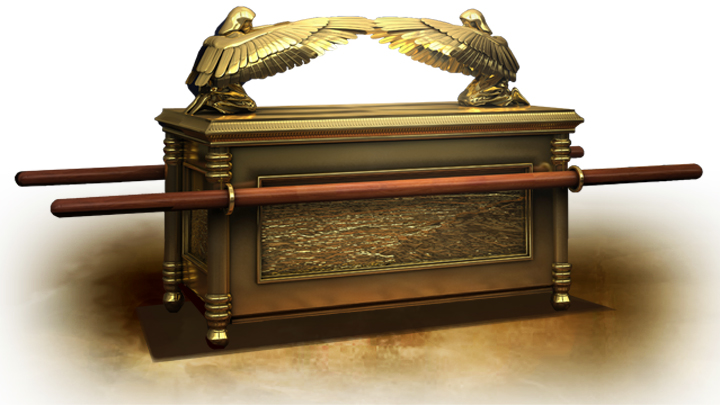
“Have the people make an Ark of acacia wood—a sacred chest 45 inches long, 27 inches wide, and 27 inches high. Overlay it inside and outside with pure gold, and run a molding of gold all around it. Cast four gold rings and attach them to its four feet, two rings on each side. Make poles from acacia wood, and overlay them with gold. Insert the poles into the rings at the sides of the Ark to carry it. These carrying poles must stay inside the rings; never remove them. When the Ark is finished, place inside it the stone tablets inscribed with the terms of the covenant, which I will give to you.
“Then make the Ark’s cover—the place of atonement—from pure gold. It must be inches long and 27 inches wide. Then make two cherubim from hammered gold, and place them on the two ends of the atonement cover. Mold the cherubim on each end of the atonement cover, making it all of one piece of gold. The cherubim will face each other and look down on the atonement cover. With their wings spread above it, they will protect it. Place inside the Ark the stone tablets inscribed with the terms of the covenant, which I will give to you. Then put the atonement cover on top of the Ark. I will meet with you there and talk to you from above the atonement cover between the gold cherubim that hover over the Ark of the Covenant. From there I will give you my commands for the people of Israel.
Plans for the Table
“Then make a table of acacia wood, 36 inches long, 18 inches wide, and 27 inches high. Overlay it with pure gold and run a gold molding around the edge. Decorate it with a 3-inch border all around, and run a gold molding along the border. Make four gold rings for the table and attach them at the four corners next to the four legs. Attach the rings near the border to hold the poles that are used to carry the table. Make these poles from acacia wood, and overlay them with gold. Make special containers of pure gold for the table—bowls, ladles, pitchers, and jars—to be used in pouring out liquid offerings. Place the Bread of the Presence on the table to remain before me at all times.
Plans for the Lampstand
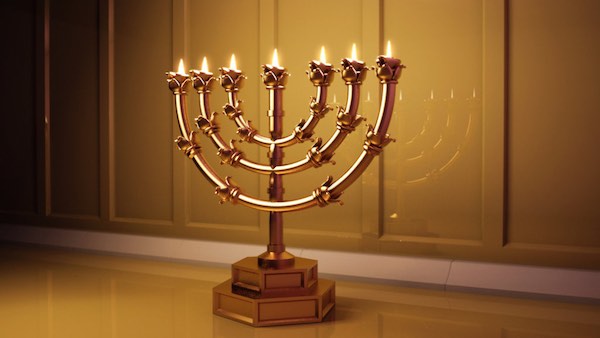
“Make a lampstand of pure, hammered gold. Make the entire lampstand and its decorations of one piece—the base, center stem, lamp cups, buds, and petals. Make it with six branches going out from the center stem, three on each side. Each of the six branches will have three lamp cups shaped like almond blossoms, complete with buds and petals. Craft the center stem of the lampstand with four lamp cups shaped like almond blossoms, complete with buds and petals. There will also be an almond bud beneath each pair of branches where the six branches extend from the center stem. The almond buds and branches must all be of one piece with the center stem, and they must be hammered from pure gold. Then make the seven lamps for the lampstand, and set them so they reflect their light forward. The lamp snuffers and trays must also be made of pure gold. You will need 75 pounds of pure gold for the lampstand and its accessories.
“Be sure that you make everything according to the pattern I have shown you here on the mountain.
Plans for the Tabernacle
Exodus 26 (NLT)
“Make the Tabernacle from ten curtains of finely woven linen. Decorate the curtains with blue, purple, and scarlet thread and with skillfully embroidered cherubim. These ten curtains must all be exactly the same size—42 feet long and 6 feet wide. Join five of these curtains together to make one long curtain, then join the other five into a second long curtain. Put loops of blue yarn along the edge of the last curtain in each set. The fifty loops along the edge of one curtain are to match the fifty loops along the edge of the other curtain. Then make fifty gold clasps and fasten the long curtains together with the clasps. In this way, the Tabernacle will be made of one continuous piece.
“Make eleven curtains of goat-hair cloth to serve as a tent covering for the Tabernacle. These eleven curtains must all be exactly the same size—45 feet long and 6 feet wide. Join five of these curtains together to make one long curtain, and join the other six into a second long curtain. Allow 3 feet of material from the second set of curtains to hang over the front of the sacred tent. Make fifty loops for one edge of each large curtain. Then make fifty bronze clasps, and fasten the loops of the long curtains with the clasps. In this way, the tent covering will be made of one continuous piece. The remaining 3 feet of this tent covering will be left to hang over the back of the Tabernacle. Allow 18 inches of remaining material to hang down over each side, so the Tabernacle is completely covered. Complete the tent covering with a protective layer of tanned ram skins and a layer of fine goatskin leather.
“For the framework of the Tabernacle, construct frames of acacia wood. Each frame must be 15 feet high and 27 inches wide, with two pegs under each frame. Make all the frames identical. Make twenty of these frames to support the curtains on the south side of the Tabernacle. Also make forty silver bases—two bases under each frame, with the pegs fitting securely into the bases. For the north side of the Tabernacle, make another twenty frames, with their forty silver bases, two bases under each frame. Make six frames for the rear—the west side of the Tabernacle— along with two additional frames to reinforce the rear corners of the Tabernacle. These corner frames will be matched at the bottom and firmly attached at the top with a single ring, forming a single corner unit. Make both of these corner units the same way. So there will be eight frames at the rear of the Tabernacle, set in sixteen silver bases—two bases under each frame.
“Make crossbars of acacia wood to link the frames, five crossbars for the north side of the Tabernacle and five for the south side. Also make five crossbars for the rear of the Tabernacle, which will face west. The middle crossbar, attached halfway up the frames, will run all the way from one end of the Tabernacle to the other. Overlay the frames with gold, and make gold rings to hold the crossbars. Overlay the crossbars with gold as well.
“Set up this Tabernacle according to the pattern you were shown on the mountain.
“For the inside of the Tabernacle, make a special curtain of finely woven linen. Decorate it with blue, purple, and scarlet thread and with skillfully embroidered cherubim. Hang this curtain on gold hooks attached to four posts of acacia wood. Overlay the posts with gold, and set them in four silver bases. Hang the inner curtain from clasps, and put the Ark of the Covenant in the room behind it. This curtain will separate the Holy Place from the Most Holy Place.
“Then put the Ark’s cover—the place of atonement—on top of the Ark of the Covenant inside the Most Holy Place. Place the table outside the inner curtain on the north side of the Tabernacle, and place the lampstand across the room on the south side.
“Make another curtain for the entrance to the sacred tent. Make it of finely woven linen and embroider it with exquisite designs, using blue, purple, and scarlet thread. Craft five posts from acacia wood. Overlay them with gold, and hang the curtain from them with gold hooks. Cast five bronze bases for the posts.
Plans for the Altar of Burnt Offering
Exodus 27 (NLT)
“Using acacia wood, construct a square altar 7 1⁄2 feet wide, 7 1⁄2 feet long, and 4 1⁄2 feet high. Make horns for each of its four corners so that the horns and altar are all one piece. Overlay the altar with bronze. Make ash buckets, shovels, basins, meat forks, and firepans, all of bronze. Make a bronze grating for it, and attach four bronze rings at its four corners. Install the grating halfway down the side of the altar, under the ledge. For carrying the altar, make poles from acacia wood, and overlay them with bronze. Insert the poles through the rings on the two sides of the altar. The altar must be hollow, made from planks. Build it just as you were shown on the mountain.
Plans for the Courtyard
“Then make the courtyard for the Tabernacle, enclosed with curtains made of finely woven linen. On the south side, make the curtains 150 feet long. They will be held up by twenty posts set securely in twenty bronze bases. Hang the curtains with silver hooks and rings. Make the curtains the same on the north side—150 feet of curtains held up by twenty posts set securely in bronze bases. Hang the curtains with silver hooks and rings. The curtains on the west end of the courtyard will be 75 feet long, supported by ten posts set into ten bases. The east end of the courtyard, the front, will also be 75 feet long. The courtyard entrance will be on the east end, flanked by two curtains. The curtain on the right side will be 22 1⁄2 feet long, supported by three posts set into three bases. The curtain on the left side will also be 22 1⁄2 feet long, supported by three posts set into three bases.
“For the entrance to the courtyard, make a curtain that is 30 feet long. Make it from finely woven linen, and decorate it with beautiful embroidery in blue, purple, and scarlet thread. Support it with four posts, each securely set in its own base. All the posts around the courtyard must have silver rings and hooks and bronze bases. So the entire courtyard will be 150 feet long and 75 feet wide, with curtain walls 7 1⁄2 feet high, made from finely woven linen. The bases for the posts will be made of bronze.
“All the articles used in the rituals of the Tabernacle, including all the tent pegs used to support the Tabernacle and the courtyard curtains, must be made of bronze.
Light for the Tabernacle
“Command the people of Israel to bring you pure oil of pressed olives for the light, to keep the lamps burning continually. The lampstand will stand in the Tabernacle, in front of the inner curtain that shields the Ark of the Covenant. Aaron and his sons must keep the lamps burning in the Lord’s presence all night. This is a permanent law for the people of Israel, and it must be observed from generation to generation.
Clothing for the Priests
Exodus 28 (NLT)
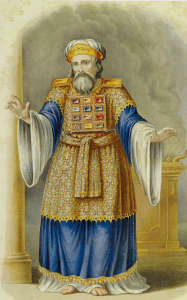
“Call for your brother, Aaron, and his sons, Nadab, Abihu, Eleazar, and Ithamar. Set them apart from the rest of the people of Israel so they may minister to me and be my priests. Make sacred garments for Aaron that are glorious and beautiful. Instruct all the skilled craftsmen whom I have filled with the spirit of wisdom. Have them make garments for Aaron that will distinguish him as a priest set apart for my service. These are the garments they are to make: a chestpiece, an ephod, a robe, a patterned tunic, a turban, and a sash. They are to make these sacred garments for your brother, Aaron, and his sons to wear when they serve me as priests. So give them fine linen cloth, gold thread, and blue, purple, and scarlet thread.
Design of the Ephod
“The craftsmen must make the ephod of finely woven linen and skillfully embroider it with gold and with blue, purple, and scarlet thread. It will consist of two pieces, front and back, joined at the shoulders with two shoulder-pieces. The decorative sash will be made of the same materials: finely woven linen embroidered with gold and with blue, purple, and scarlet thread.
“Take two onyx stones, and engrave on them the names of the tribes of Israel. Six names will be on each stone, arranged in the order of the births of the original sons of Israel. Engrave these names on the two stones in the same way a jeweler engraves a seal. Then mount the stones in settings of gold filigree. Fasten the two stones on the shoulder-pieces of the ephod as a reminder that Aaron represents the people of Israel. Aaron will carry these names on his shoulders as a constant reminder whenever he goes before the Lord. Make the settings of gold filigree, then braid two cords of pure gold and attach them to the filigree settings on the shoulders of the ephod.
Design of the Chestpiece
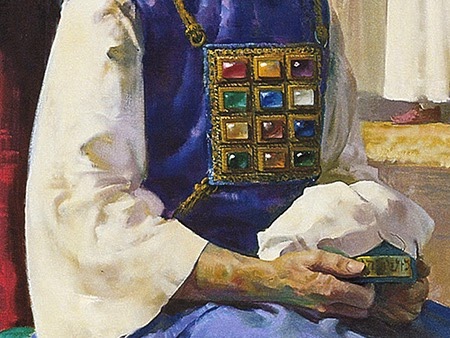
“Then, with great skill and care, make a chestpiece to be worn for seeking a decision from God. Make it to match the ephod, using finely woven linen embroidered with gold and with blue, purple, and scarlet thread. Make the chestpiece of a single piece of cloth folded to form a pouch nine inches square. Mount four rows of gemstones on it. The first row will contain a red carnelian, a pale-green peridot, and an emerald. The second row will contain a turquoise, a blue lapis lazuli, and a white moonstone. The third row will contain an orange jacinth, an agate, and a purple amethyst. The fourth row will contain a blue-green beryl, an onyx, and a green jasper. All these stones will be set in gold filigree. Each stone will represent one of the twelve sons of Israel, and the name of that tribe will be engraved on it like a seal.
“To attach the chestpiece to the ephod, make braided cords of pure gold thread. Then make two gold rings and attach them to the top corners of the chestpiece. Tie the two gold cords to the two rings on the chestpiece. Tie the other ends of the cords to the gold settings on the shoulder-pieces of the ephod. Then make two more gold rings and attach them to the inside edges of the chestpiece next to the ephod. And make two more gold rings and attach them to the front of the ephod, below the shoulder-pieces, just above the knot where the decorative sash is fastened to the ephod. Then attach the bottom rings of the chestpiece to the rings on the ephod with blue cords. This will hold the chestpiece securely to the ephod above the decorative sash.
“In this way, Aaron will carry the names of the tribes of Israel on the sacred chestpiece over his heart when he goes into the Holy Place. This will be a continual reminder that he represents the people when he comes before the Lord. Insert the Urim and Thummim into the sacred chestpiece so they will be carried over Aaron’s heart when he goes into the Lord’s presence. In this way, Aaron will always carry over his heart the objects used to determine the Lord’s will for his people whenever he goes in before the Lord.
Additional Clothing for the Priests
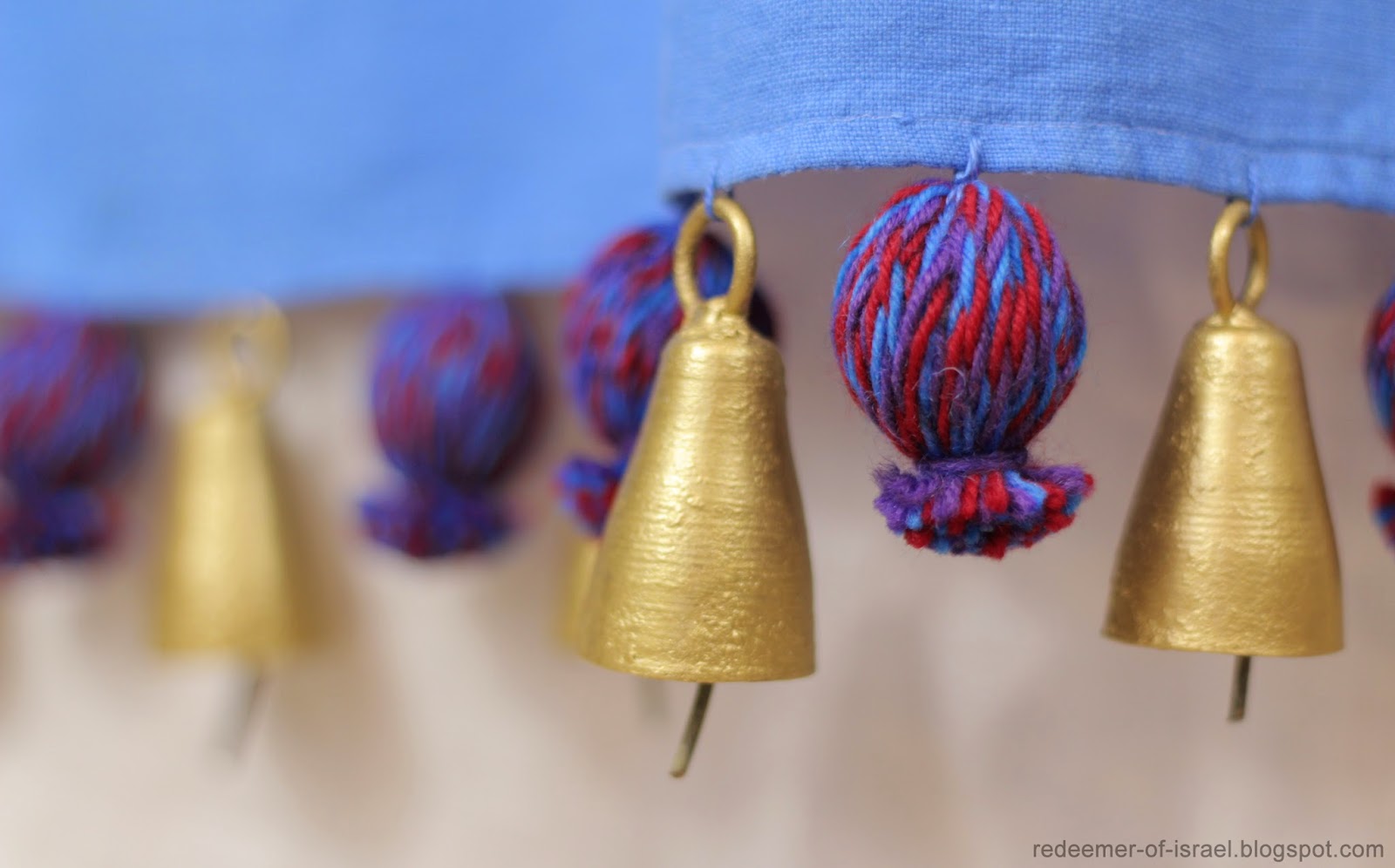
“Make the robe that is worn with the ephod from a single piece of blue cloth, with an opening for Aaron’s head in the middle of it. Reinforce the opening with a woven collar so it will not tear. Make pomegranates out of blue, purple, and scarlet yarn, and attach them to the hem of the robe, with gold bells between them. The gold bells and pomegranates are to alternate all around the hem. Aaron will wear this robe whenever he ministers before the Lord, and the bells will tinkle as he goes in and out of the Lord’s presence in the Holy Place. If he wears it, he will not die.
“Next make a medallion of pure gold, and engrave it like a seal with these words: Holy to the lord. Attach the medallion with a blue cord to the front of Aaron’s turban, where it must remain. Aaron must wear it on his forehead so he may take on himself any guilt of the people of Israel when they consecrate their sacred offerings. He must always wear it on his forehead so the Lord will accept the people.
“Weave Aaron’s patterned tunic from fine linen cloth. Fashion the turban from this linen as well. Also make a sash, and decorate it with colorful embroidery.
“For Aaron’s sons, make tunics, sashes, and special head coverings that are glorious and beautiful. Clothe your brother, Aaron, and his sons with these garments, and then anoint and ordain them. Consecrate them so they can serve as my priests. Also make linen undergarments for them, to be worn next to their bodies, reaching from their hips to their thighs. These must be worn whenever Aaron and his sons enter the Tabernacle or approach the altar in the Holy Place to perform their priestly duties. Then they will not incur guilt and die. This is a permanent law for Aaron and all his descendants after him.
__________
“Habitation” – Micah & Abby Mahoney | Heartcry of David
May the peace of the Lord Christ go with you, wherever He may send you. May He guide you through the wilderness, protect you through the storm. May He bring you home rejoicing at the wonders He has shown you. May He bring you home rejoicing once again into our doors.
__________
+ In the name of the Father, and the Son, and the Holy Spirit. Amen!
+ In the name of the Father, and the Son, and the Holy Spirit. Amen!
Opening Prayer
Father most holy, look upon this people whom you have sanctified by the dying and rising of your Son. Keep us one in love and consecrate us in your truth, that the new life you have given us may bring us to the fullness of joy. Grant this through Jesus Christ, the firstborn from the dead, who lives and reigns with you now and always in the unity of the Holy Spirit, God for ever and ever. Amen.
__________
“Holy, Holy, Holy” – Audrey Assad
__________
Gospel Reading: John 17:11-19 (NLT)
Now I am departing from the world; they are staying in this world, but I am coming to you. Holy Father, you have given me your name; now protect them by the power of your name so that they will be united just as we are. During my time here, I protected them by the power of the name you gave me. I guarded them so that not one was lost, except the one headed for destruction, as the Scriptures foretold.
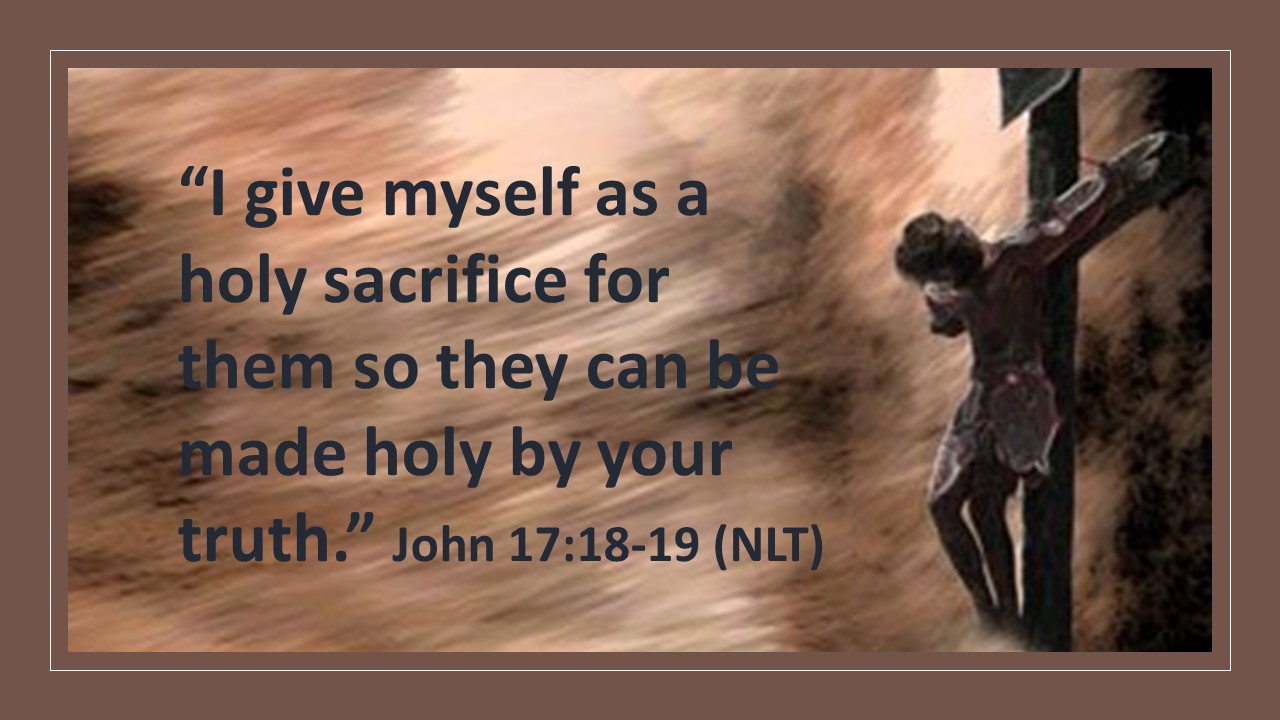
“Now I am coming to you. I told them many things while I was with them in this world so they would be filled with my joy. I have given them your word. And the world hates them because they do not belong to the world, just as I do not belong to the world. I’m not asking you to take them out of the world, but to keep them safe from the evil one. They do not belong to this world any more than I do. Make them holy by your truth; teach them your word, which is truth. Just as you sent me into the world, I am sending them into the world. And I give myself as a holy sacrifice for them so they can be made holy by your truth.
__________
Prayers of Intercession:
Lord, grant to your People the unity that your son prayed for on our behalf. Bathe us in the fire and light of your glory, and burn away the dross of our lives as we strive to be made one with you, and one with each other. Kindle in us the fire of your love, so that our lives may reflect your glory to the world and your light and life may be revealed to all people.
+ Lord, set our hearts on fire with love for you; in your mercy, hear our prayer.
Lord, we pray for the leaders of the nations, that they may serve with integrity and justice. May our leaders recognize that you are the ultimate source of their gifts, their positions and their power. And may they strive to prove worthy of the trust and confidence which has been placed in them. We praise you for the glories of nature, and the world that you have made which still holds so many wonders for those who take the time to look around them.
+ Lord, set our hearts on fire with love for you; in your mercy, hear our prayer.
Lord, who has made us one community in Christ, may the glory of your presence transform our lives. When we feel discouraged or dispirited by events in our neighborhood, may we all be filled by your Holy Spirit and transformed by your grace. Help us to find the green shoots of regeneration, and then to water and weed them so they may come to fruition in your service.
+ Lord, set our hearts on fire with love for you; in your mercy, hear our prayer.
Lord, we pray for all those who are weak or discouraged, ill or simply weary. We have confidence that you will support them and us all the day long of this difficult life, until the shadows lengthen, the evening comes, and our work in this busy world is done.
+ Lord, set our hearts on fire with love for you; in your mercy, hear our prayer.
Lord, when the fever of life is over, in your mercy grant us safe lodging, a holy rest, and peace at the last. We pray for all who have passed through death into life eternal and union with you. We pray through the grace of your son, Jesus Christ, who is alive and reigns with you in glory.
+ Lord, set our hearts on fire with love for you; in your mercy, hear our prayer.
__________
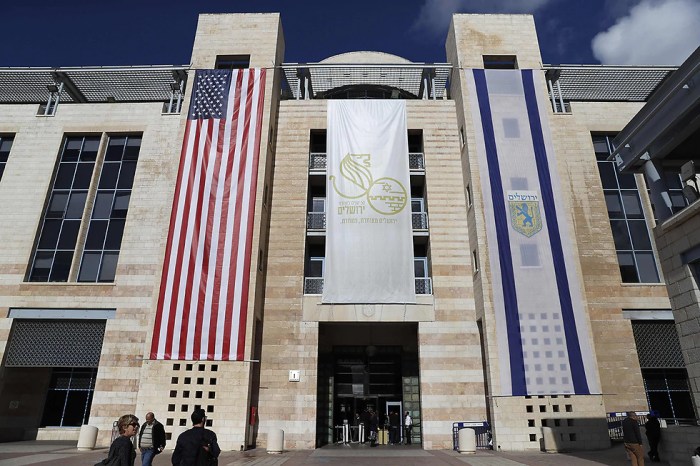
“Song of All Songs” – Jewish & Gentile artists worshiping Jesus from rooftop in Jerusalem
__________
Blessing
This is how we know that we remain in him and he in us, that he has given us of his Spirit. Whoever acknowledges that Jesus is the Son of God, God remains in him and he in God.
__________
+ In the name of the Father, and the Son, and the Holy Spirit. Amen!

 “I want to emphasize Leviathan’s limbs and its enormous strength and graceful form. Who can strip off its hide, and who can penetrate its double layer of armor? Who could pry open its jaws? For its teeth are terrible! The scales on its back are like rows of shields tightly sealed together. They are so close together that no air can get between them. Each scale sticks tight to the next. They interlock and cannot be penetrated.
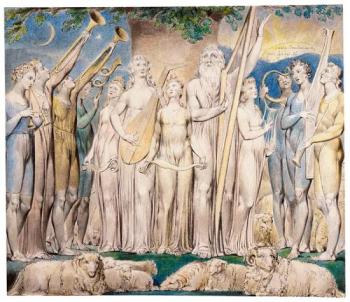 When Job prayed for his friends, the Lord restored his fortunes. In fact, the Lord gave him twice as much as before! Then all his brothers, sisters, and former friends came and feasted with him in his home. And they consoled him and comforted him because of all the trials the Lord had brought against him. And each of them brought him a gift of money and a gold ring.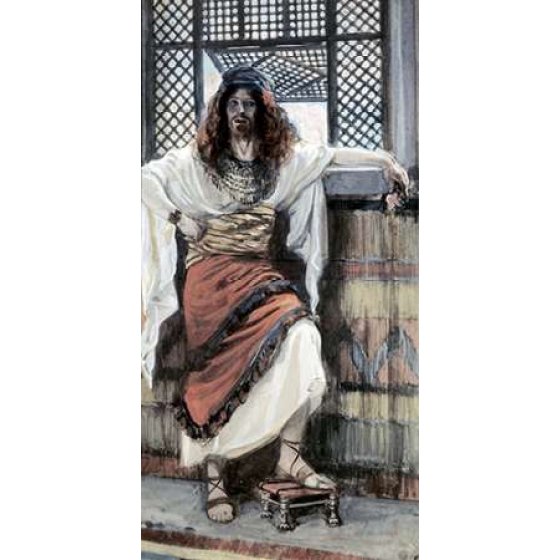







 The Peanut Gallery