One thing I have asked of the Lord, this is what I seek: that I may dwell in the house of the Lord all the days of my life; to behold the beauty of the Lord and to seek Him in His temple.
Praise to You, Lord Jesus Christ, King of endless glory.
Reading: Job 35-36 (NLT)
Elihu Reminds Job of God’s Justice
Job 35 (NLT)
Then Elihu said:
“Do you think it is right for you to claim, ‘I am righteous before God’? For you also ask, ‘What’s in it for me? What’s the use of living a righteous life?’
“I will answer you and all your friends, too. Look up into the sky, and see the clouds high above you. If you sin, how does that affect God? Even if you sin again and again, what effect will it have on him? you are good, is this some great gift to him? What could you possibly give him? No, your sins affect only people like yourself, and your good deeds also affect only humans.
“People cry out when they are oppressed. They groan beneath the power of the mighty. Yet they don’t ask, ‘Where is God my Creator, the one who gives songs in the night? Where is the one who makes us smarter than the animals and wiser than the birds of the sky?’ And when they cry out, God does not answer because of their pride. But it is wrong to say God doesn’t listen, to say the Almighty isn’t concerned. You say you can’t see him, but he will bring justice if you will only wait. You say he does not respond to sinners with anger and is not greatly concerned about wickedness. But you are talking nonsense, Job. You have spoken like a fool.”
Job 36 (NLT)
Elihu continued speaking:
“Let me go on, and I will show you the truth. For I have not finished defending God! I will present profound arguments for the righteousness of my Creator. I am telling you nothing but the truth, for I am a man of great knowledge.
“God is mighty, but he does not despise anyone! He is mighty in both power and understanding. He does not let the wicked live but gives justice to the afflicted. He never takes his eyes off the innocent, but he sets them on thrones with kings and exalts them forever. If they are bound in chains and caught up in a web of trouble, he shows them the reason. He shows them their sins of pride. He gets their attention and commands that they turn from evil.
“If they listen and obey God, they will be blessed with prosperity throughout their lives. All their years will be pleasant. But if they refuse to listen to him, they will cross over the river of death, dying from lack of understanding. For the godless are full of resentment. Even when he punishes them, they refuse to cry out to him for help. They die when they are young, after wasting their lives in immoral living. But by means of their suffering, he rescues those who suffer. For he gets their attention through adversity.
“God is leading you away from danger, Job, to a place free from distress. He is setting your table with the best food. But you are obsessed with whether the godless will be judged. Don’t worry, judgment and justice will be upheld. But watch out, or you may be seduced by wealth. Don’t let yourself be bribed into sin. Could all your wealth or all your mighty efforts keep you from distress? Do not long for the cover of night, for that is when people will be destroyed. Be on guard! Turn back from evil, for God sent this suffering to keep you from a life of evil.
Elihu Reminds Job of God’s Power
“Look, God is all-powerful. Who is a teacher like him? No one can tell him what to do, or say to him, ‘You have done wrong.’ Instead, glorify his mighty works, singing songs of praise. Everyone has seen these things, though only from a distance.
“Look, God is greater than we can understand. His years cannot be counted. He draws up the water vapor and then distills it into rain. The rain pours down from the clouds, and everyone benefits. Who can understand the spreading of the clouds and the thunder that rolls forth from heaven? See how he spreads the lightning around him and how it lights up the depths of the sea. By these mighty acts he nourishes the people, giving them food in abundance. He fills his hands with lightning bolts and hurls each at its target. The thunder announces his presence; the storm announces his indignant anger.
__________
May the peace of the Lord Christ go with you, wherever He may send you. May He guide you through the wilderness, protect you through the storm. May He bring you home rejoicing at the wonders He has shown you. May He bring you home rejoicing once again into our doors.
__________
+ In the name of the Father, and the Son, and the Holy Spirit. Amen!
One thing I have asked of the Lord, this is what I seek: that I may dwell in the house of the Lord all the days of my life; to behold the beauty of the Lord and to seek Him in His temple.
Praise to You, Lord Jesus Christ, King of endless glory.
Reading: 2 Samuel 1-4 (NLT)
David Learns of Saul’s Death
2 Samuel 1 (NLT)
+ David receives the news – After the death of Saul, David returned from his victory over the Amalekites and spent two days in Ziklag. On the third day a man arrived from Saul’s army camp. He had torn his clothes and put dirt on his head to show that he was in mourning. He fell to the ground before David in deep respect.
“Where have you come from?” David asked.
“I escaped from the Israelite camp,” the man replied.
“What happened?” David demanded. “Tell me how the battle went.”
The man replied, “Our entire army fled from the battle. Many of the men are dead, and Saul and his son Jonathan are also dead.”
“How do you know Saul and Jonathan are dead?” David demanded of the young man.
The man answered, “I happened to be on Mount Gilboa, and there was Saul leaning on his spear with the enemy chariots and charioteers closing in on him. When he turned and saw me, he cried out for me to come to him. ‘How can I help?’ I asked him.
“He responded, ‘Who are you?’
“‘I am an Amalekite,’ I told him.
“Then he begged me, ‘Come over here and put me out of my misery, for I am in terrible pain and want to die.’
“So I killed him,” the Amalekite told David, “for I knew he couldn’t live. Then I took his crown and his armband, and I have brought them here to you, my lord.”
+ David mourns the loss – David and his men tore their clothes in sorrow when they heard the news. They mourned and wept and fasted all day for Saul and his son Jonathan, and for the Lord’s army and the nation of Israel, because they had died by the sword that day.
Then David said to the young man who had brought the news, “Where are you from?”
And he replied, “I am a foreigner, an Amalekite, who lives in your land.”
“Why were you not afraid to kill the Lord’s anointed one?” David asked.
+ David kills the messenger – Then David said to one of his men, “Kill him!” So the man thrust his sword into the Amalekite and killed him. “You have condemned yourself,” David said, “for you yourself confessed that you killed the Lord’s anointed one.”
David’s Song for Saul and Jonathan
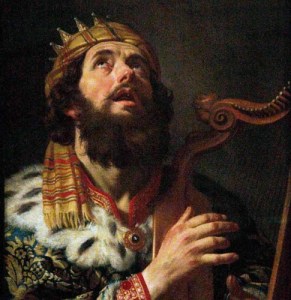
Then David composed a funeral song for Saul and Jonathan, and he commanded that it be taught to the people of Judah. It is known as the Song of the Bow, and it is recorded in The Book of Jashar.
Your pride and joy, O Israel, lies dead on the hills! Oh, how the mighty heroes have fallen! Don’t announce the news in Gath, don’t proclaim it in the streets of Ashkelon, or the daughters of the Philistines will rejoice and the pagans will laugh in triumph.
O mountains of Gilboa, let there be no dew or rain upon you, nor fruitful fields producing offerings of grain. For there the shield of the mighty heroes was defiled; the shield of Saul will no longer be anointed with oil. The bow of Jonathan was powerful, and the sword of Saul did its mighty work. They shed the blood of their enemies and pierced the bodies of mighty heroes.
How beloved and gracious were Saul and Jonathan! They were together in life and in death. They were swifter than eagles, stronger than lions. O women of Israel, weep for Saul, for he dressed you in luxurious scarlet clothing, in garments decorated with gold.
Oh, how the mighty heroes have fallen in battle! Jonathan lies dead on the hills. How I weep for you, my brother Jonathan! Oh, how much I loved you! And your love for me was deep, deeper than the love of women! Oh, how the mighty heroes have fallen! Stripped of their weapons, they lie dead.
David Anointed King of Judah
2 Samuel 2 (NLT)
+ David returns to Judah – After this, David asked the Lord, “Should I move back to one of the towns of Judah?”
“Yes,” the Lord replied.
Then David asked, “Which town should I go to?”
“To Hebron,” the Lord answered.
+ David settles in Hebron – David’s two wives were Ahinoam from Jezreel and Abigail, the widow of Nabal from Carmel. So David and his wives and his men and their families all moved to Judah, and they settled in the villages near Hebron. Then the men of Judah came to David and anointed him king over the people of Judah.
+ David requests allegiance – When David heard that the men of Jabesh-gilead had buried Saul, he sent them this message: “May the Lord bless you for being so loyal to your master Saul and giving him a decent burial. May the Lord be loyal to you in return and reward you with his unfailing love! And I, too, will reward you for what you have done. Now that Saul is dead, I ask you to be my strong and loyal subjects like the people of Judah, who have anointed me as their new king.”
Ishbosheth Proclaimed King of Israel
+ Abner allies with Saul’s son – But Abner son of Ner, the commander of Saul’s army, had already gone to Mahanaim with Saul’s son Ishbosheth. There he proclaimed Ishbosheth king over Gilead, Jezreel, Ephraim, Benjamin, the land of the Ashurites, and all the rest of Israel.
+ Two kingdoms – Ishbosheth, Saul’s son, was forty years old when he became king, and he ruled from Mahanaim for two years. Meanwhile, the people of Judah remained loyal to David. David made Hebron his capital, and he ruled as king of Judah for seven and a half years.
War between Israel and Judah
+ Troop stand off – One day Abner led Ishbosheth’s troops from Mahanaim to Gibeon. About the same time, Joab son of Zeruiah led David’s troops out and met them at the pool of Gibeon. The two groups sat down there, facing each other from opposite sides of the pool.
+ Death match – Then Abner suggested to Joab, “Let’s have a few of our warriors fight hand to hand here in front of us.”
“All right,” Joab agreed. So twelve men were chosen to fight from each side—twelve men of Benjamin representing Ishbosheth son of Saul, and twelve representing David. Each one grabbed his opponent by the hair and thrust his sword into the other’s side so that all of them died. So this place at Gibeon has been known ever since as the Field of Swords.
+ David’s troops win in battle – A fierce battle followed that day, and Abner and the men of Israel were defeated by the forces of David.
The Death of Asahel
Joab, Abishai, and Asahel—the three sons of Zeruiah—were among David’s forces that day. Asahel could run like a gazelle, and he began chasing Abner. He pursued him relentlessly, not stopping for anything. When Abner looked back and saw him coming, he called out, “Is that you, Asahel?”
“Yes, it is,” he replied.
+ Asahel chases Abner – “Go fight someone else!” Abner warned. “Take on one of the younger men, and strip him of his weapons.” But Asahel kept right on chasing Abner.
Again Abner shouted to him, “Get away from here! I don’t want to kill you. How could I ever face your brother Joab again?”
+ Abner kills Asahel – But Asahel refused to turn back, so Abner thrust the butt end of his spear through Asahel’s stomach, and the spear came out through his back. He stumbled to the ground and died there. And everyone who came by that spot stopped and stood still when they saw Asahel lying there.
+ Abner’s troops regroup – When Joab and Abishai found out what had happened, they set out after Abner. The sun was just going down as they arrived at the hill of Ammah near Giah, along the road to the wilderness of Gibeon. Abner’s troops from the tribe of Benjamin regrouped there at the top of the hill to take a stand.
+ Truce – Abner shouted down to Joab, “Must we always be killing each other? Don’t you realize that bitterness is the only result? When will you call off your men from chasing their Israelite brothers?”
Then Joab said, “God only knows what would have happened if you hadn’t spoken, for we would have chased you all night if necessary.” So Joab blew the ram’s horn, and his men stopped chasing the troops of Israel.
+ Abner retreats – All that night Abner and his men retreated through the Jordan Valley. They crossed the Jordan River, traveling all through the morning,[f] and didn’t stop until they arrived at Mahanaim.
+ Joab withdraws – Meanwhile, Joab and his men also returned home. When Joab counted his casualties, he discovered that only men were missing in addition to Asahel. But 360 of Abner’s men had been killed, all from the tribe of Benjamin. Joab and his men took Asahel’s body to Bethlehem and buried him there in his father’s tomb. Then they traveled all night and reached Hebron at daybreak.
2 Samuel 3 (NLT)
That was the beginning of a long war between those who were loyal to Saul and those loyal to David. As time passed David became stronger and stronger, while Saul’s dynasty became weaker and weaker.
David’s Sons Born in Hebron
These are the sons who were born to David in Hebron:
The oldest was Amnon, whose mother was Ahinoam from Jezreel.
The second was Daniel, whose mother was Abigail, the widow of Nabal from Carmel.
The third was Absalom, whose mother was Maacah, the daughter of Talmai, king of Geshur.
The fourth was Adonijah, whose mother was Haggith.
The fifth was Shephatiah, whose mother was Abital.
The sixth was Ithream, whose mother was Eglah, David’s wife.
These sons were all born to David in Hebron.
Abner Joins Forces with David
+ Ishbosheth’s jealousy – As the war between the house of Saul and the house of David went on, Abner became a powerful leader among those loyal to Saul. One day Ishbosheth, Saul’s son, accused Abner of sleeping with one of his father’s concubines, a woman named Rizpah, daughter of Aiah.
+ Abner’s fury – Abner was furious. “Am I some Judean dog to be kicked around like this?” he shouted. “After all I have done for your father, Saul, and his family and friends by not handing you over to David, is this my reward—that you find fault with me about this woman? May God strike me and even kill me if I don’t do everything I can to help David get what the Lord has promised him! I’m going to take Saul’s kingdom and give it to David. I will establish the throne of David over Israel as well as Judah, all the way from Dan in the north to Beersheba in the south.” Ishbosheth didn’t dare say another word because he was afraid of what Abner might do.
+ Abner’s defection – Then Abner sent messengers to David, saying, “Doesn’t the entire land belong to you? Make a solemn pact with me, and I will help turn over all of Israel to you.”
“All right,” David replied, “but I will not negotiate with you unless you bring back my wife Michal, Saul’s daughter, when you come.”
David then sent this message to Ishbosheth, Saul’s son: “Give me back my wife Michal, for I bought her with the lives of 100 Philistines.”
+ Michal’s abduction – So Ishbosheth took Michal away from her husband, Palti son of Laish. Palti followed along behind her as far as Bahurim, weeping as he went. Then Abner told him, “Go back home!” So Palti returned.
+ Abner rallies support – Meanwhile, Abner had consulted with the elders of Israel. “For some time now,” he told them, “you have wanted to make David your king. Now is the time! For the Lord has said, ‘I have chosen David to save my people Israel from the hands of the Philistines and from all their other enemies.’” Abner also spoke with the men of Benjamin. Then he went to Hebron to tell David that all the people of Israel and Benjamin had agreed to support him.
+ Abner becomes David’s emissary – When Abner and twenty of his men came to Hebron, David entertained them with a great feast. Then Abner said to David, “Let me go and call an assembly of all Israel to support my lord the king. They will make a covenant with you to make you their king, and you will rule over everything your heart desires.” So David sent Abner safely on his way.
Joab Murders Abner
But just after David had sent Abner away in safety, Joab and some of David’s troops returned from a raid, bringing much plunder with them. When Joab arrived, he was told that Abner had just been there visiting the king and had been sent away in safety.
+ Joab’s anger – Joab rushed to the king and demanded, “What have you done? What do you mean by letting Abner get away? You know perfectly well that he came to spy on you and find out everything you’re doing!”
+ Joab’s treachery – Joab then left David and sent messengers to catch up with Abner, asking him to return. They found him at the well of Sirah and brought him back, though David knew nothing about it. When Abner arrived back at Hebron, Joab took him aside at the gateway as if to speak with him privately. But then he stabbed Abner in the stomach and killed him in revenge for killing his brother Asahel.
+ David’s curse – When David heard about it, he declared, “I vow by the Lord that I and my kingdom are forever innocent of this crime against Abner son of Ner. Joab and his family are the guilty ones. May the family of Joab be cursed in every generation with a man who has open sores or leprosy or who walks on crutches or dies by the sword or begs for food!”
+ Joab’s revenge – So Joab and his brother Abishai killed Abner because Abner had killed their brother Asahel at the battle of Gibeon.
David Mourns Abner’s Death
Then David said to Joab and all those who were with him, “Tear your clothes and put on burlap. Mourn for Abner.” And King David himself walked behind the procession to the grave. They buried Abner in Hebron, and the king and all the people wept at his graveside. Then the king sang this funeral song for Abner:
“Should Abner have died as fools die? Your hands were not bound; your feet were not chained. No, you were murdered—the victim of a wicked plot.”
+ David fasts – All the people wept again for Abner. David had refused to eat anything on the day of the funeral, and now everyone begged him to eat. But David had made a vow, saying, “May God strike me and even kill me if I eat anything before sundown.”
+ David absolved -This pleased the people very much. In fact, everything the king did pleased them! So everyone in Judah and all Israel understood that David was not responsible for Abner’s murder.
+ David threatened – Then King David said to his officials, “Don’t you realize that a great commander has fallen today in Israel? And even though I am the anointed king, these two sons of Zeruiah—Joab and Abishai—are too strong for me to control. So may the Lord repay these evil men for their evil deeds.”
The Murder of Ishbosheth
2 Samuel 4 (NLT)
+ Paralyzed with fear – When Ishbosheth, Saul’s son, heard about Abner’s death at Hebron, he lost all courage, and all Israel became paralyzed with fear. Now there were two brothers, Baanah and Recab, who were captains of Ishbosheth’s raiding parties. They were sons of Rimmon, a member of the tribe of Benjamin who lived in Beeroth. The town of Beeroth is now part of Benjamin’s territory because the original people of Beeroth fled to Gittaim, where they still live as foreigners.
+ Mephibosheth hidden – (Saul’s son Jonathan had a son named Mephibosheth, who was crippled as a child. He was five years old when the report came from Jezreel that Saul and Jonathan had been killed in battle. When the child’s nurse heard the news, she picked him up and fled. But as she hurried away, she dropped him, and he became crippled.)
+ Ishbosheth murdered – One day Recab and Baanah, the sons of Rimmon from Beeroth, went to Ishbosheth’s house around noon as he was taking his midday rest. The doorkeeper, who had been sifting wheat, became drowsy and fell asleep. So Recab and Baanah slipped past her. They went into the house and found Ishbosheth sleeping on his bed. They struck and killed him and cut off his head. Then, taking his head with them, they fled across the Jordan Valley through the night. When they arrived at Hebron, they presented Ishbosheth’s head to David. “Look!” they exclaimed to the king. “Here is the head of Ishbosheth, the son of your enemy Saul who tried to kill you. Today the Lord has given my lord the king revenge on Saul and his entire family!”
+ Murderers executed – But David said to Recab and Baanah, “The Lord, who saves me from all my enemies, is my witness. Someone once told me, ‘Saul is dead,’ thinking he was bringing me good news. But I seized him and killed him at Ziklag. That’s the reward I gave him for his news! How much more should I reward evil men who have killed an innocent man in his own house and on his own bed? Shouldn’t I hold you responsible for his blood and rid the earth of you?”
+ Ishbosheth buried – So David ordered his young men to kill them, and they did. They cut off their hands and feet and hung their bodies beside the pool in Hebron. Then they took Ishbosheth’s head and buried it in Abner’s tomb in Hebron.
__________
“O How the Mighty Have Fallen” – The Choir
Like the snake who calls the lizard a reptile | Like the chimp who calls the jester a clown | When I tell you, “You oughta be ashamed or yourself” | I’ve gotta set my knees on the ground
O how the mighty have fallen | O how the reckless are crawling now | O how the mighty have fallen | Such a long way down
Thank you, please don’t swing your shovel at my head, friend | No, I truly won’t appreciate that sound | When you tell me I surely should atone for my sin | I hope you know the fate of the proud
May the peace of the Lord Christ go with you, wherever He may send you. May He guide you through the wilderness, protect you through the storm. May He bring you home rejoicing at the wonders He has shown you. May He bring you home rejoicing once again into our doors.
__________
+ In the name of the Father, and the Son, and the Holy Spirit. Amen!
One thing I have asked of the Lord, this is what I seek: that I may dwell in the house of the Lord all the days of my life; to behold the beauty of the Lord and to seek Him in His temple.
Praise to You, Lord Jesus Christ, King of endless glory.
Reading: Exodus 13-16 (NLT)
Dedication of the Firstborn
Exodus 13 (NLT)
Then the Lord said to Moses, “Dedicate to me every firstborn among the Israelites. The first offspring to be born, of both humans and animals, belongs to me.”
+ A day to remember – So Moses said to the people, “This is a day to remember forever—the day you left Egypt, the place of your slavery. Today the Lord has brought you out by the power of his mighty hand. (Remember, eat no food containing yeast.) On this day in early spring, in the month of Abib, you have been set free. You must celebrate this event in this month each year after the Lord brings you into the land of the Canaanites, Hittites, Amorites, Hivites, and Jebusites. (He swore to your ancestors that he would give you this land—a land flowing with milk and honey.) For seven days the bread you eat must be made without yeast. Then on the seventh day, celebrate a feast to the Lord. Eat bread without yeast during those seven days. In fact, there must be no yeast bread or any yeast at all found within the borders of your land during this time.
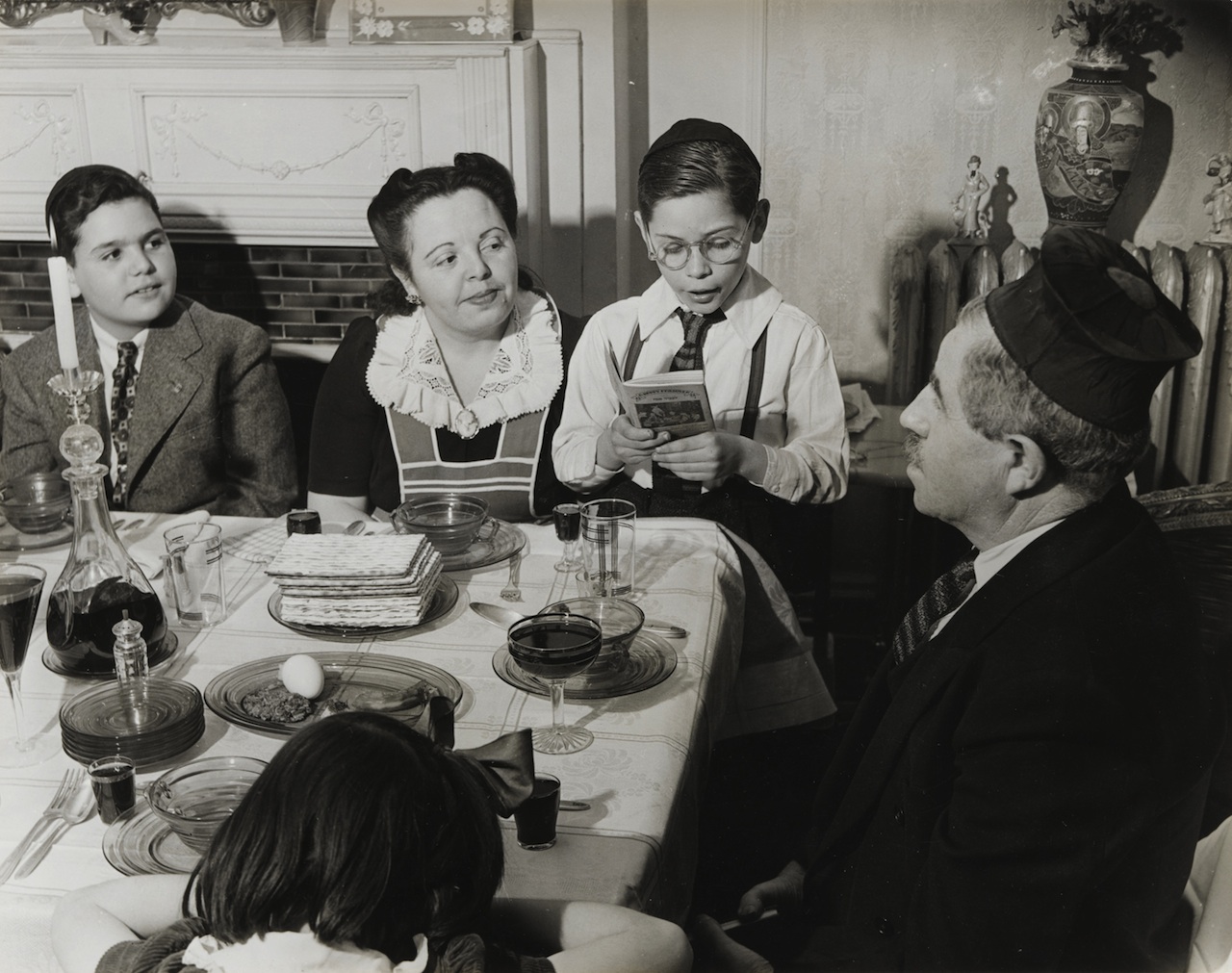
Arnold Eagle, “Passover Seder” from ‘Asking the Four Questions’ (1934–35)
+ A visible sign – “On the seventh day you must explain to your children, ‘I am celebrating what the Lord did for me when I left Egypt.’ This annual festival will be a visible sign to you, like a mark branded on your hand or your forehead. Let it remind you always to recite this teaching of the Lord: ‘With a strong hand, the Lord rescued you from Egypt.’ So observe the decree of this festival at the appointed time each year.
+ Presentation of first-born sons – “This is what you must do when the Lord fulfills the promise he swore to you and to your ancestors. When he gives you the land where the Canaanites now live, you must present all firstborn sons and firstborn male animals to the Lord, for they belong to him. A firstborn donkey may be bought back from the Lord by presenting a lamb or young goat in its place. But if you do not buy it back, you must break its neck. However, you must buy back every firstborn son.
+ A reminder of God’s power – “And in the future, your children will ask you, ‘What does all this mean?’ Then you will tell them, ‘With the power of his mighty hand, the Lord brought us out of Egypt, the place of our slavery. Pharaoh stubbornly refused to let us go, so the Lord killed all the firstborn males throughout the land of Egypt, both people and animals. That is why I now sacrifice all the firstborn males to the Lord—except that the firstborn sons are always bought back.’ This ceremony will be like a mark branded on your hand or your forehead. It is a reminder that the power of the Lord’s mighty hand brought us out of Egypt.”
Israel’s Wilderness Detour
+ God’s roundabout – When Pharaoh finally let the people go, God did not lead them along the main road that runs through Philistine territory, even though that was the shortest route to the Promised Land. God said, “If the people are faced with a battle, they might change their minds and return to Egypt.” So God led them in a roundabout way through the wilderness toward the Red Sea. Thus the Israelites left Egypt like an army ready for battle.
Moses took the bones of Joseph with him, for Joseph had made the sons of Israel swear to do this. He said, “God will certainly come to help you. When he does, you must take my bones with you from this place.”
+ God’s guidance – The Israelites left Succoth and camped at Etham on the edge of the wilderness. The Lord went ahead of them. He guided them during the day with a pillar of cloud, and he provided light at night with a pillar of fire. This allowed them to travel by day or by night. And the Lord did not remove the pillar of cloud or pillar of fire from its place in front of the people.
Exodus 14 (NLT)
+ God’s trap – Then the Lord gave these instructions to Moses: “Order the Israelites to turn back and camp by Pi-hahiroth between Migdol and the sea. Camp there along the shore, across from Baal-zephon. Then Pharaoh will think, ‘The Israelites are confused. They are trapped in the wilderness!’ And once again I will harden Pharaoh’s heart, and he will chase after you. I have planned this in order to display my glory through Pharaoh and his whole army. After this the Egyptians will know that I am the Lord!” So the Israelites camped there as they were told.
The Egyptians Pursue Israel
+ Pharaoh pursues – When word reached the king of Egypt that the Israelites had fled, Pharaoh and his officials changed their minds. “What have we done, letting all those Israelite slaves get away?” they asked. So Pharaoh harnessed his chariot and called up his troops. He took with him 600 of Egypt’s best chariots, along with the rest of the chariots of Egypt, each with its commander. The Lord hardened the heart of Pharaoh, the king of Egypt, so he chased after the people of Israel, who had left with fists raised in defiance. The Egyptians chased after them with all the forces in Pharaoh’s army—all his horses and chariots, his charioteers, and his troops. The Egyptians caught up with the people of Israel as they were camped beside the shore near Pi-hahiroth, across from Baal-zephon.
+ Israelites panic – Pharaoh approached, the people of Israel looked up and panicked when they saw the Egyptians overtaking them. They cried out to the Lord, and they said to Moses, “Why did you bring us out here to die in the wilderness? Weren’t there enough graves for us in Egypt? What have you done to us? Why did you make us leave Egypt? Didn’t we tell you this would happen while we were still in Egypt? We said, ‘Leave us alone! Let us be slaves to the Egyptians. It’s better to be a slave in Egypt than a corpse in the wilderness!’”
+ Moses reassures – But Moses told the people, “Don’t be afraid. Just stand still and watch the Lord rescue you today. The Egyptians you see today will never be seen again. The Lord himself will fight for you. Just stay calm.”
Escape through the Red Sea
+ Get going– Then the Lord said to Moses, “Why are you crying out to me? Tell the people to get moving! Pick up your staff and raise your hand over the sea. Divide the water so the Israelites can walk through the middle of the sea on dry ground. And I will harden the hearts of the Egyptians, and they will charge in after the Israelites. My great glory will be displayed through Pharaoh and his troops, his chariots, and his charioteers. When my glory is displayed through them, all Egypt will see my glory and know that I am the Lord!”
+ Blocking movement – Then the angel of God, who had been leading the people of Israel, moved to the rear of the camp. The pillar of cloud also moved from the front and stood behind them. The cloud settled between the Egyptian and Israelite camps. As darkness fell, the cloud turned to fire, lighting up the night. But the Egyptians and Israelites did not approach each other all night.
+ Waters divided – Then Moses raised his hand over the sea, and the Lord opened up a path through the water with a strong east wind. The wind blew all that night, turning the seabed into dry land. So the people of Israel walked through the middle of the sea on dry ground, with walls of water on each side!
+ Total confusion – Then the Egyptians—all of Pharaoh’s horses, chariots, and charioteers—chased them into the middle of the sea. But just before dawn the Lord looked down on the Egyptian army from the pillar of fire and cloud, and he threw their forces into total confusion. He twisted their chariot wheels, making their chariots difficult to drive. “Let’s get out of here—away from these Israelites!” the Egyptians shouted. “The Lord is fighting for them against Egypt!”
+ Waters return – When all the Israelites had reached the other side, the Lord said to Moses, “Raise your hand over the sea again. Then the waters will rush back and cover the Egyptians and their chariots and charioteers.” So as the sun began to rise, Moses raised his hand over the sea, and the water rushed back into its usual place. The Egyptians tried to escape, but the Lord swept them into the sea. Then the waters returned and covered all the chariots and charioteers—the entire army of Pharaoh. Of all the Egyptians who had chased the Israelites into the sea, not a single one survived.
+ Israelites rescued – But the people of Israel had walked through the middle of the sea on dry ground, as the water stood up like a wall on both sides. That is how the Lord rescued Israel from the hand of the Egyptians that day. And the Israelites saw the bodies of the Egyptians washed up on the seashore. When the people of Israel saw the mighty power that the Lord had unleashed against the Egyptians, they were filled with awe before him. They put their faith in the Lord and in his servant Moses.
A Song of Deliverance
Exodus 15 (NLT)
Then Moses and the people of Israel sang this song to the Lord:
“I will sing to the Lord, for he has triumphed gloriously; he has hurled both horse and rider into the sea. The Lord is my strength and my song; he has given me victory. This is my God, and I will praise him—my father’s God, and I will exalt him! The Lord is a warrior; Yahweh is his name! Pharaoh’s chariots and army he has hurled into the sea. The finest of Pharaoh’s officers are drowned in the Red Sea. The deep waters gushed over them; they sank to the bottom like a stone.
“Your right hand, O Lord, is glorious in power. Your right hand, O Lord, smashes the enemy. In the greatness of your majesty, you overthrow those who rise against you. You unleash your blazing fury; it consumes them like straw. At the blast of your breath, the waters piled up! The surging waters stood straight like a wall; in the heart of the sea the deep waters became hard.
“The enemy boasted, ‘I will chase them and catch up with them. I will plunder them and consume them. I will flash my sword; my powerful hand will destroy them.’ But you blew with your breath, and the sea covered them. They sank like lead in the mighty waters.
“Who is like you among the gods, O Lord—glorious in holiness, awesome in splendor, performing great wonders? You raised your right hand, and the earth swallowed our enemies.
“With your unfailing love you lead the people you have redeemed. In your might, you guide them to your sacred home. The peoples hear and tremble; anguish grips those who live in Philistia. The leaders of Edom are terrified; the nobles of Moab tremble. All who live in Canaan melt away; terror and dread fall upon them. The power of your arm makes them lifeless as stone until your people pass by, O Lord, until the people you purchased pass by. You will bring them in and plant them on your own mountain—the place, O Lord, reserved for your own dwelling, the sanctuary, O Lord, that your hands have established. The Lord will reign forever and ever!”
When Pharaoh’s horses, chariots, and charioteers rushed into the sea, the Lord brought the water crashing down on them. But the people of Israel had walked through the middle of the sea on dry ground!
Then Miriam the prophet, Aaron’s sister, took a tambourine and led all the women as they played their tambourines and danced. And Miriam sang this song:
“Sing to the Lord, for he has triumphed gloriously; he has hurled both horse and rider into the sea.”
Bitter Water at Marah
Then Moses led the people of Israel away from the Red Sea, and they moved out into the desert of Shur. They traveled in this desert for three days without finding any water. When they came to the oasis of Marah, the water was too bitter to drink. So they called the place Marah (which means “bitter”).
+ Israelites turn against Moses – Then the people complained and turned against Moses. “What are we going to drink?” they demanded. So Moses cried out to the Lord for help, and the Lord showed him a piece of wood. Moses threw it into the water, and this made the water good to drink.
+ God requires obedience – It was there at Marah that the Lord set before them the following decree as a standard to test their faithfulness to him. He said, “If you will listen carefully to the voice of the Lord your God and do what is right in his sight, obeying his commands and keeping all his decrees, then I will not make you suffer any of the diseases I sent on the Egyptians; for I am the Lord who heals you.”
After leaving Marah, the Israelites traveled on to the oasis of Elim, where they found twelve springs and seventy palm trees. They camped there beside the water.
Manna and Quail from Heaven
Exodus 16 (NLT)
Then the whole community of Israel set out from Elim and journeyed into the wilderness of Sin, between Elim and Mount Sinai. They arrived there on the fifteenth day of the second month, one month after leaving the land of Egypt. There, too, the whole community of Israel complained about Moses and Aaron.
+ Complaint against Moses – “If only the Lord had killed us back in Egypt,” they moaned. “There we sat around pots filled with meat and ate all the bread we wanted. But now you have brought us into this wilderness to starve us all to death.”
+ Test of obedience – Then the Lord said to Moses, “Look, I’m going to rain down food from heaven for you. Each day the people can go out and pick up as much food as they need for that day. I will test them in this to see whether or not they will follow my instructions. On the sixth day they will gather food, and when they prepare it, there will be twice as much as usual.”
+ Complaint against God – So Moses and Aaron said to all the people of Israel, “By evening you will realize it was the Lord who brought you out of the land of Egypt. In the morning you will see the glory of the Lord, because he has heard your complaints, which are against him, not against us. What have we done that you should complain about us?” Then Moses added, “The Lord will give you meat to eat in the evening and bread to satisfy you in the morning, for he has heard all your complaints against him. What have we done? Yes, your complaints are against the Lord, not against us.”
+ God’s cloud of glory – Then Moses said to Aaron, “Announce this to the entire community of Israel: ‘Present yourselves before the Lord, for he has heard your complaining.’” And as Aaron spoke to the whole community of Israel, they looked out toward the wilderness. There they could see the awesome glory of the Lord in the cloud.
+ God provides – Then the Lord said to Moses, “I have heard the Israelites’ complaints. Now tell them, ‘In the evening you will have meat to eat, and in the morning you will have all the bread you want. Then you will know that I am the Lord your God.’”
That evening vast numbers of quail flew in and covered the camp. And the next morning the area around the camp was wet with dew. When the dew evaporated, a flaky substance as fine as frost blanketed the ground. The Israelites were puzzled when they saw it. “What is it?” they asked each other. They had no idea what it was.
+ Food from heaven – And Moses told them, “It is the food the Lord has given you to eat. These are the Lord’s instructions: Each household should gather as much as it needs. Pick up two quarts for each person in your tent.”
+ Daily provision – So the people of Israel did as they were told. Some gathered a lot, some only a little. But when they measured it out, everyone had just enough. Those who gathered a lot had nothing left over, and those who gathered only a little had enough. Each family had just what it needed.
Then Moses told them, “Do not keep any of it until morning.” But some of them didn’t listen and kept some of it until morning. But by then it was full of maggots and had a terrible smell. Moses was very angry with them.
+ Sabbath provision – After this the people gathered the food morning by morning, each family according to its need. And as the sun became hot, the flakes they had not picked up melted and disappeared. On the sixth day, they gathered twice as much as usual—four quarts for each person instead of two. Then all the leaders of the community came and asked Moses for an explanation. He told them, “This is what the Lord commanded: Tomorrow will be a day of complete rest, a holy Sabbath day set apart for the Lord. So bake or boil as much as you want today, and set aside what is left for tomorrow.”
So they put some aside until morning, just as Moses had commanded. And in the morning the leftover food was wholesome and good, without maggots or odor. Moses said, “Eat this food today, for today is a Sabbath day dedicated to the Lord. There will be no food on the ground today. You may gather the food for six days, but the seventh day is the Sabbath. There will be no food on the ground that day.”
+ Sabbath rest is a gift – Some of the people went out anyway on the seventh day, but they found no food. The Lord asked Moses, “How long will these people refuse to obey my commands and instructions? They must realize that the Sabbath is the Lord’s gift to you. That is why he gives you a two-day supply on the sixth day, so there will be enough for two days. On the Sabbath day you must each stay in your place. Do not go out to pick up food on the seventh day.” So the people did not gather any food on the seventh day.
+ Manna – The Israelites called the food manna. It was white like coriander seed, and it tasted like honey wafers.
Then Moses said, “This is what the Lord has commanded: Fill a two-quart container with manna to preserve it for your descendants. Then later generations will be able to see the food I gave you in the wilderness when I set you free from Egypt.”
+ Manna preserved – Moses said to Aaron, “Get a jar and fill it with two quarts of manna. Then put it in a sacred place before the Lord to preserve it for all future generations.” Aaron did just as the Lord had commanded Moses. He eventually placed it in the Ark of the Covenant—in front of the stone tablets inscribed with the terms of the covenant. So the people of Israel ate manna for forty years until they arrived at the land where they would settle. They ate manna until they came to the border of the land of Canaan.
The container used to measure the manna was an omer, which was one-tenth of an ephah; it held about two quarts.
__________
May the peace of the Lord Christ go with you, wherever He may send you. May He guide you through the wilderness, protect you through the storm. May He bring you home rejoicing at the wonders He has shown you. May He bring you home rejoicing once again into our doors.
__________
+ In the name of the Father, and the Son, and the Holy Spirit. Amen!
+ In the name of the Father, and the Son, and the Holy Spirit. Amen!
Opening Prayer
God of everlasting love, fulfill your plan of salvation to gather into one fold the peoples of the whole world. Let everyone on earth recognize your Son, Jesus Christ, as the Good Shepherd – who freely lays down his life for all to take it up again in power. Grant this through Christ our Savior, the resurrection and the life, who lives and reigns with you in the unity of the Holy Spirit, God for ever and ever. Amen.
__________
“Shepherd of Love” – George Beverly Shea
__________
Gospel Reading: John 10:11-18 (NLT)
“I am the good shepherd. The good shepherd sacrifices his life for the sheep. A hired hand will run when he sees a wolf coming. He will abandon the sheep because they don’t belong to him and he isn’t their shepherd. And so the wolf attacks them and scatters the flock. The hired hand runs away because he’s working only for the money and doesn’t really care about the sheep.
“I am the good shepherd; I know my own sheep, and they know me, just as my Father knows me and I know the Father. So I sacrifice my life for the sheep. I have other sheep, too, that are not in this sheepfold. I must bring them also. They will listen to my voice, and there will be one flock with one shepherd.
“The Father loves me because I sacrifice my life so I may take it back again. No one can take my life from me. I sacrifice it voluntarily. For I have the authority to lay it down when I want to and also to take it up again. For this is what my Father has commanded.”
__________
Prayers of Intercession:
Gracious God: Your loving-kindness is endless. Hear our prayers for our needs and the needs of the whole world –
+ For all who serve your people, that they may follow the example of Christ, the good shepherd.…
+ For all your people, that we may love each other with tenderness and forgiveness.…
+ For all your young people around the world, that they may consider serving your people.…
+ For all your caring professionals, that the your compassion may be visible in them….
+ For all your people who work the land, that they may respect your creation….
+ For all who call your name in their sufferings, that they may experience your healing power….
+ For all who have gone before us in faith, that they may see you, face to face….
God of beauty and compassion: You love us as a shepherd loves all the flock: continue to support your people with your grace and mercy, we pray, through Christ our Lord. Amen.
__________
Good Shepherd (Lead On) – David Ruis
__________
Blessing – 1 John 2:1-2 (NLT)
See how very much our Father loves us, for he calls us his children, and that is what we are! …But he has not yet shown us what we will be like when Christ appears. But we do know that we will be like him, for we will see him as he really is.
__________
+ In the name of the Father, and the Son, and the Holy Spirit. Amen!
One thing I have asked of the Lord, this is what I seek: that I may dwell in the house of the Lord all the days of my life; to behold the beauty of the Lord and to seek Him in His temple.
Praise to You, Lord Jesus Christ, King of endless glory.
Reading: 1 Corinthians 15-16 (NLT)
The Resurrection of Christ
1 Corinthians 15 (NLT)
Let me now remind you, dear brothers and sisters, of the Good News I preached to you before. You welcomed it then, and you still stand firm in it. It is this Good News that saves you if you continue to believe the message I told you—unless, of course, you believed something that was never true in the first place.
+ The Good News – I passed on to you what was most important and what had also been passed on to me. Christ died for our sins, just as the Scriptures said. He was buried, and he was raised from the dead on the third day, just as the Scriptures said. He was seen by Peter and then by the Twelve. After that, he was seen by more than 500 of his followers at one time, most of whom are still alive, though some have died. Then he was seen by James and later by all the apostles. Last of all, as though I had been born at the wrong time, I also saw him. For I am the least of all the apostles. In fact, I’m not even worthy to be called an apostle after the way I persecuted God’s church.
+ An apostle by grace – But whatever I am now, it is all because God poured out his special favor on me—and not without results. For I have worked harder than any of the other apostles; yet it was not I but God who was working through me by his grace. So it makes no difference whether I preach or they preach, for we all preach the same message you have already believed.
The Resurrection of the Dead
+ No resurrection / no faith – But tell me this—since we preach that Christ rose from the dead, why are some of you saying there will be no resurrection of the dead? For if there is no resurrection of the dead, then Christ has not been raised either. And if Christ has not been raised, then all our preaching is useless, and your faith is useless. And we apostles would all be lying about God—for we have said that God raised Christ from the grave. But that can’t be true if there is no resurrection of the dead. And if there is no resurrection of the dead, then Christ has not been raised. And if Christ has not been raised, then your faith is useless and you are still guilty of your sins. In that case, all who have died believing in Christ are lost! And if our hope in Christ is only for this life, we are more to be pitied than anyone in the world.
But in fact, Christ has been raised from the dead. He is the first of a great harvest of all who have died.
+ Christ is risen – So you see, just as death came into the world through a man, now the resurrection from the dead has begun through another man. Just as everyone dies because we all belong to Adam, everyone who belongs to Christ will be given new life. But there is an order to this resurrection: Christ was raised as the first of the harvest; then all who belong to Christ will be raised when he comes back.
+ Christ will reign – After that the end will come, when he will turn the Kingdom over to God the Father, having destroyed every ruler and authority and power. For Christ must reign until he humbles all his enemies beneath his feet. And the last enemy to be destroyed is death. For the Scriptures say, “God has put all things under his authority.” (Of course, when it says “all things are under his authority,” that does not include God himself, who gave Christ his authority.) Then, when all things are under his authority, the Son will put himself under God’s authority, so that God, who gave his Son authority over all things, will be utterly supreme over everything everywhere.
If the dead will not be raised, what point is there in people being baptized for those who are dead? Why do it unless the dead will someday rise again?
+ No resurrection / no future – And why should we ourselves risk our lives hour by hour? For I swear, dear brothers and sisters, that I face death daily. This is as certain as my pride in what Christ Jesus our Lord has done in you. And what value was there in fighting wild beasts—those people of Ephesus—if there will be no resurrection from the dead? And if there is no resurrection, “Let’s feast and drink, for tomorrow we die!” Don’t be fooled by those who say such things, for “bad company corrupts good character.” Think carefully about what is right, and stop sinning. For to your shame I say that some of you don’t know God at all.
The Resurrection Body
+ A new body – But someone may ask, “How will the dead be raised? What kind of bodies will they have?” What a foolish question! When you put a seed into the ground, it doesn’t grow into a plant unless it dies first. And what you put in the ground is not the plant that will grow, but only a bare seed of wheat or whatever you are planting. Then God gives it the new body he wants it to have. A different plant grows from each kind of seed. Similarly there are different kinds of flesh—one kind for humans, another for animals, another for birds, and another for fish.
+ A glorious body – There are also bodies in the heavens and bodies on the earth. The glory of the heavenly bodies is different from the glory of the earthly bodies. The sun has one kind of glory, while the moon and stars each have another kind. And even the stars differ from each other in their glory.
+ A spiritual body – It is the same way with the resurrection of the dead. Our earthly bodies are planted in the ground when we die, but they will be raised to live forever. Our bodies are buried in brokenness, but they will be raised in glory. They are buried in weakness, but they will be raised in strength. They are buried as natural human bodies, but they will be raised as spiritual bodies. For just as there are natural bodies, there are also spiritual bodies.
+ A Christ-like body – The Scriptures tell us, “The first man, Adam, became a living person.” But the last Adam—that is, Christ—is a life-giving Spirit. What comes first is the natural body, then the spiritual body comes later. Adam, the first man, was made from the dust of the earth, while Christ, the second man, came from heaven. Earthly people are like the earthly man, and heavenly people are like the heavenly man. Just as we are now like the earthly man, we will someday be like the heavenly man.
What I am saying, dear brothers and sisters, is that our physical bodies cannot inherit the Kingdom of God. These dying bodies cannot inherit what will last forever.
+ A transformed body – But let me reveal to you a wonderful secret. We will not all die, but we will all be transformed! It will happen in a moment, in the blink of an eye, when the last trumpet is blown. For when the trumpet sounds, those who have died will be raised to live forever. And we who are living will also be transformed. For our dying bodies must be transformed into bodies that will never die; our mortal bodies must be transformed into immortal bodies.
+ An immortal body – Then, when our dying bodies have been transformed into bodies that will never die, this Scripture will be fulfilled:
“Death is swallowed up in victory. O death, where is your victory? O death, where is your sting?”
For sin is the sting that results in death, and the law gives sin its power. But thank God! He gives us victory over sin and death through our Lord Jesus Christ.
So, my dear brothers and sisters, be strong and immovable. Always work enthusiastically for the Lord, for you know that nothing you do for the Lord is ever useless.
The Collection for Jerusalem
1 Corinthians 16 (NLT)
+ Systematic giving – Now regarding your question about the money being collected for God’s people in Jerusalem. You should follow the same procedure I gave to the churches in Galatia. On the first day of each week, you should each put aside a portion of the money you have earned. Don’t wait until I get there and then try to collect it all at once. When I come, I will write letters of recommendation for the messengers you choose to deliver your gift to Jerusalem. And if it seems appropriate for me to go along, they can travel with me.
Paul’s Final Instructions
+ Travel itinerary – I am coming to visit you after I have been to Macedonia, for I am planning to travel through Macedonia. Perhaps I will stay awhile with you, possibly all winter, and then you can send me on my way to my next destination. This time I don’t want to make just a short visit and then go right on. I want to come and stay awhile, if the Lord will let me. In the meantime, I will be staying here at Ephesus until the Festival of Pentecost. There is a wide-open door for a great work here, although many oppose me.
+ Bless Timothy – When Timothy comes, don’t intimidate him. He is doing the Lord’s work, just as I am. Don’t let anyone treat him with contempt. Send him on his way with your blessing when he returns to me. I expect him to come with the other believers.
Now about our brother Apollos—I urged him to visit you with the other believers, but he was not willing to go right now. He will see you later when he has the opportunity.
+ Stand firm – Be on guard. Stand firm in the faith. Be courageous. Be strong. And do everything with love.
+ Submit to Stephanas – You know that Stephanas and his household were the first of the harvest of believers in Greece, and they are spending their lives in service to God’s people. I urge you, dear brothers and sisters, to submit to them and others like them who serve with such devotion. I am very glad that Stephanas, Fortunatus, and Achaicus have come here. They have been providing the help you weren’t here to give me. They have been a wonderful encouragement to me, as they have been to you. You must show your appreciation to all who serve so well.
Paul’s Final Greetings
The churches here in the province of Asia send greetings in the Lord, as do Aquila and Priscilla and all the others who gather in their home for church meetings. All the brothers and sisters here send greetings to you. Greet each other with a sacred kiss.
HERE IS MY GREETING IN MY OWN HANDWRITING—PAUL.
If anyone does not love the Lord, that person is cursed. Our Lord, come!
May the peace of the Lord Christ go with you, wherever He may send you. May He guide you through the wilderness, protect you through the storm. May He bring you home rejoicing at the wonders He has shown you. May He bring you home rejoicing once again into our doors.
__________
+ In the name of the Father, and the Son, and the Holy Spirit. Amen!


 “Look, God is all-powerful. Who is a teacher like him? No one can tell him what to do, or say to him, ‘You have done wrong.’ Instead, glorify his mighty works, singing songs of praise. Everyone has seen these things, though only from a distance.







 The Peanut Gallery