+ In the name of the Father, and the Son, and the Holy Spirit. Amen!
Opening Prayer
Lord Jesus, send Your Spirit to open my heart and mind to all the Father has for me through the reading of the Scriptures. Help me to recognize Your presence in the disturbing events surrounding me. And reveal to me the way of the cross as my source of life and of resurrection. Quiet my heart that I may experience the power of Your resurrection and bear witness to Your living presence here around me. I ask this of You, Jesus, who revealed the Father and sent Your Spirit. Amen.
__________
Gospel Reading: Matthew 6:1-6, 16-18 (NLT)
+ on giving – “Watch out! Don’t do your good deeds publicly, to be admired by others, for you will lose the reward from your Father in heaven. When you give to someone in need, don’t do as the hypocrites do—blowing trumpets in the synagogues and streets to call attention to their acts of charity! I tell you the truth, they have received all the reward they will ever get. But when you give to someone in need, don’t let your left hand know what your right hand is doing. Give your gifts in private, and your Father, who sees everything, will reward you.
+ on prayer – “When you pray, don’t be like the hypocrites who love to pray publicly on street corners and in the synagogues where everyone can see them. I tell you the truth, that is all the reward they will ever get. But when you pray, go away by yourself, shut the door behind you, and pray to your Father in private. Then your Father, who sees everything, will reward you.
_____
+ on fasting – “And when you fast, don’t make it obvious, as the hypocrites do, for they try to look miserable and disheveled so people will admire them for their fasting. I tell you the truth, that is the only reward they will ever get. But when you fast, comb your hair and wash your face. Then no one will notice that you are fasting, except your Father, who knows what you do in private. And your Father, who sees everything, will reward you.
__________
Prayers of Petition:
Heavenly Father: Pour out Your Spirit on me that I may have the heart, mind and strength of Jesus, especially during this season of Lent.
+ Give me Your heart, that I may respond with compassion and generosity to the needy people around me….
Lord, lead me to those in need.
+ Give me Your mind, that in the quiet of Your presence I may change the way I think about the world around me….
Lord, show me where I’m wrong.
+ Give me Your strength, that I may become more like You through the small sacrifices I make during this season….
Lord, make me a cheerful witness.
Heavenly Father: You know my heart and everything about me. Use this season to make me more like Your Son, Jesus Christ; that will be reward enough. I ask this in His name. Amen
__________
“More Like Jesus Would I Be” – Phoebe and Albert Chen (William H. Doane / Fanny Crosby)
__________
Closing
Lord God, thank You for Your Word that has enabled me to better understand Your will. May Your Spirit enlighten my actions and grant me the strength to practice what Your Word has revealed. I ask this through my Lord Jesus Christ, who lives and reigns with You in the unity of the Holy Spirit, one God forever and ever. Amen.
__________
+ In the name of the Father, and the Son, and the Holy Spirit. Amen!
One thing I have asked of the Lord, this is what I seek: that I may dwell in the house of the Lord all the days of my life; to behold the beauty of the Lord and to seek Him in His temple.
Praise to You, Lord Jesus Christ, King of endless glory.
Reading: Judges 7-11 (NLT)
Gideon Defeats the Midianites
Judges 7 (NLT)
+ Too many warriors – So Jerub-baal (that is, Gideon) and his army got up early and went as far as the spring of Harod. The armies of Midian were camped north of them in the valley near the hill of Moreh. The Lord said to Gideon, “You have too many warriors with you. If I let all of you fight the Midianites, the Israelites will boast to me that they saved themselves by their own strength. Therefore, tell the people, ‘Whoever is timid or afraid may leave this mountain and go home.’” So 22,000 of them went home, leaving only 10,000 who were willing to fight.
But the Lord told Gideon, “There are still too many! Bring them down to the spring, and I will test them to determine who will go with you and who will not.” When Gideon took his warriors down to the water, the Lord told him, “Divide the men into two groups. In one group put all those who cup water in their hands and lap it up with their tongues like dogs. In the other group put all those who kneel down and drink with their mouths in the stream.” Only 300 of the men drank from their hands. All the others got down on their knees and drank with their mouths in the stream.
+ The chosen few – The Lord told Gideon, “With these 300 men I will rescue you and give you victory over the Midianites. Send all the others home.” So Gideon collected the provisions and rams’ horns of the other warriors and sent them home. But he kept the 300 men with him.
The Midianite camp was in the valley just below Gideon. That night the Lord said, “Get up! Go down into the Midianite camp, for I have given you victory over them! But if you are afraid to attack, go down to the camp with your servant Purah. Listen to what the Midianites are saying, and you will be greatly encouraged. Then you will be eager to attack.”
+ Gideon gathers intelligence – So Gideon took Purah and went down to the edge of the enemy camp. The armies of Midian, Amalek, and the people of the east had settled in the valley like a swarm of locusts. Their camels were like grains of sand on the seashore—too many to count! Gideon crept up just as a man was telling his companion about a dream. The man said, “I had this dream, and in my dream a loaf of barley bread came tumbling down into the Midianite camp. It hit a tent, turned it over, and knocked it flat!”
His companion answered, “Your dream can mean only one thing—God has given Gideon son of Joash, the Israelite, victory over Midian and all its allies!”
+ The battle plan – When Gideon heard the dream and its interpretation, he bowed in worship before the Lord. Then he returned to the Israelite camp and shouted, “Get up! For the Lord has given you victory over the Midianite hordes!” He divided the 300 men into three groups and gave each man a ram’s horn and a clay jar with a torch in it.
Then he said to them, “Keep your eyes on me. When I come to the edge of the camp, do just as I do. As soon as I and those with me blow the rams’ horns, blow your horns, too, all around the entire camp, and shout, ‘For the Lord and for Gideon!’”
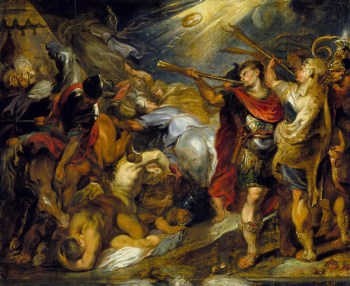
+ The panic attack – It was just after midnight, after the changing of the guard, when Gideon and the 100 men with him reached the edge of the Midianite camp. Suddenly, they blew the rams’ horns and broke their clay jars. Then all three groups blew their horns and broke their jars. They held the blazing torches in their left hands and the horns in their right hands, and they all shouted, “A sword for the Lord and for Gideon!”
Each man stood at his position around the camp and watched as all the Midianites rushed around in a panic, shouting as they ran to escape. When the 300 Israelites blew their rams’ horns, the Lord caused the warriors in the camp to fight against each other with their swords. Those who were not killed fled to places as far away as Beth-shittah near Zererah and to the border of Abel-meholah near Tabbath.
+ The chase – Then Gideon sent for the warriors of Naphtali, Asher, and Manasseh, who joined in chasing the army of Midian. Gideon also sent messengers throughout the hill country of Ephraim, saying, “Come down to attack the Midianites. Cut them off at the shallow crossings of the Jordan River at Beth-barah.”
So all the men of Ephraim did as they were told. They captured Oreb and Zeeb, the two Midianite commanders, killing Oreb at the rock of Oreb, and Zeeb at the winepress of Zeeb. And they continued to chase the Midianites. Afterward the Israelites brought the heads of Oreb and Zeeb to Gideon, who was by the Jordan River.
Gideon Kills the Midianite Kings
Judges 8 (NLT)
Then the people of Ephraim asked Gideon, “Why have you treated us this way? Why didn’t you send for us when you first went out to fight the Midianites?” And they argued heatedly with Gideon.
But Gideon replied, “What have I accomplished compared to you? Aren’t even the leftover grapes of Ephraim’s harvest better than the entire crop of my little clan of Abiezer? God gave you victory over Oreb and Zeeb, the commanders of the Midianite army. What have I accomplished compared to that?” When the men of Ephraim heard Gideon’s answer, their anger subsided.
+ Succoth’s rebuff – Gideon then crossed the Jordan River with his 300 men, and though exhausted, they continued to chase the enemy. When they reached Succoth, Gideon asked the leaders of the town, “Please give my warriors some food. They are very tired. I am chasing Zebah and Zalmunna, the kings of Midian.”
But the officials of Succoth replied, “Catch Zebah and Zalmunna first, and then we will feed your army.”
So Gideon said, “After the Lord gives me victory over Zebah and Zalmunna, I will return and tear your flesh with the thorns and briers from the wilderness.”
+ Peniel’s rebuff – From there Gideon went up to Peniel and again asked for food, but he got the same answer. So he said to the people of Peniel, “After I return in victory, I will tear down this tower.”
+ Gideon defeats remaining Midianites – By this time Zebah and Zalmunna were in Karkor with about 15,000 warriors—all that remained of the allied armies of the east, for 120,000 had already been killed. Gideon circled around by the caravan route east of Nobah and Jogbehah, taking the Midianite army by surprise. Zebah and Zalmunna, the two Midianite kings, fled, but Gideon chased them down and captured all their warriors.
+ Gideon punishes Succoth and Peniel – After this, Gideon returned from the battle by way of Heres Pass. There he captured a young man from Succoth and demanded that he write down the names of all the seventy-seven officials and elders in the town. Gideon then returned to Succoth and said to the leaders, “Here are Zebah and Zalmunna. When we were here before, you taunted me, saying, ‘Catch Zebah and Zalmunna first, and then we will feed your exhausted army.’” Then Gideon took the elders of the town and taught them a lesson, punishing them with thorns and briers from the wilderness. He also tore down the tower of Peniel and killed all the men in the town.
+ Gideon executes Zebah and Zalmunna – Then Gideon asked Zebah and Zalmunna, “The men you killed at Tabor—what were they like?”
“Like you,” they replied. “They all had the look of a king’s son.”
“They were my brothers, the sons of my own mother!” Gideon exclaimed. “As surely as the Lord lives, I wouldn’t kill you if you hadn’t killed them.”
Turning to Jether, his oldest son, he said, “Kill them!” But Jether did not draw his sword, for he was only a boy and was afraid.
Then Zebah and Zalmunna said to Gideon, “Be a man! Kill us yourself!” So Gideon killed them both and took the royal ornaments from the necks of their camels.
Gideon’s Sacred Ephod
Then the Israelites said to Gideon, “Be our ruler! You and your son and your grandson will be our rulers, for you have rescued us from Midian.”
+ The Lord will rule over you – But Gideon replied, “I will not rule over you, nor will my son. The Lord will rule over you! However, I do have one request—that each of you give me an earring from the plunder you collected from your fallen enemies.” (The enemies, being Ishmaelites, all wore gold earrings.)
“Gladly!” they replied. They spread out a cloak, and each one threw in a gold earring he had gathered from the plunder. The weight of the gold earrings was forty-three pounds, not including the royal ornaments and pendants, the purple clothing worn by the kings of Midian, or the chains around the necks of their camels.
+ But the sacred became a trap – Gideon made a sacred ephod from the gold and put it in Ophrah, his hometown. But soon all the Israelites prostituted themselves by worshiping it, and it became a trap for Gideon and his family.
That is the story of how the people of Israel defeated Midian, which never recovered. Throughout the rest of Gideon’s lifetime—about forty years—there was peace in the land.
+ Gideon’s death – Then Gideon son of Joash returned home. He had seventy sons born to him, for he had many wives. He also had a concubine in Shechem, who gave birth to a son, whom he named Abimelech. Gideon died when he was very old, and he was buried in the grave of his father, Joash, at Ophrah in the land of the clan of Abiezer.
+ Israel’s relapse – As soon as Gideon died, the Israelites prostituted themselves by worshiping the images of Baal, making Baal-berith their god. They forgot the Lord their God, who had rescued them from all their enemies surrounding them. Nor did they show any loyalty to the family of Jerub-baal (that is, Gideon), despite all the good he had done for Israel.
Abimelech Made King Over Shechem
Judges 9 (NLT)
One day Gideon’s son Abimelech went to Shechem to visit his uncles—his mother’s brothers. He said to them and to the rest of his mother’s family, “Ask the leading citizens of Shechem whether they want to be ruled by all seventy of Gideon’s sons or by one man. And remember that I am your own flesh and blood!”
+ Abimelech’s treachery – So Abimelech’s uncles gave his message to all the citizens of Shechem on his behalf. And after listening to this proposal, the people of Shechem decided in favor of Abimelech because he was their relative. They gave him seventy silver coins from the temple of Baal-berith, which he used to hire some reckless troublemakers who agreed to follow him. He went to his father’s home at Ophrah, and there, on one stone, they killed all seventy of his half brothers, the sons of Gideon. But the youngest brother, Jotham, escaped and hid.
Then all the leading citizens of Shechem and Beth-millo called a meeting under the oak beside the pillar at Shechem and made Abimelech their king.
+ Jotham’s parable: the thornbush made king – When Jotham heard about this, he climbed to the top of Mount Gerizim and shouted,
“Listen to me, citizens of Shechem! Listen to me if you want God to listen to you! Once upon a time the trees decided to choose a king. First they said to the olive tree, ‘Be our king!’ But the olive tree refused, saying, ‘Should I quit producing the olive oil that blesses both God and people, just to wave back and forth over the trees?’
“Then they said to the fig tree, ‘You be our king!’ But the fig tree also refused, saying, ‘Should I quit producing my sweet fruit just to wave back and forth over the trees?’
“Then they said to the grapevine, ‘You be our king!’ But the grapevine also refused, saying, ‘Should I quit producing the wine that cheers both God and people, just to wave back and forth over the trees?’
“Then all the trees finally turned to the thornbush and said, ‘Come, you be our king!’ And the thornbush replied to the trees, ‘If you truly want to make me your king, come and take shelter in my shade. If not, let fire come out from me and devour the cedars of Lebanon.’”
+ Jotham confronts Shechem – Jotham continued, “Now make sure you have acted honorably and in good faith by making Abimelech your king, and that you have done right by Gideon and all of his descendants. Have you treated him with the honor he deserves for all he accomplished? For he fought for you and risked his life when he rescued you from the Midianites. But today you have revolted against my father and his descendants, killing his seventy sons on one stone. And you have chosen his slave woman’s son, Abimelech, to be your king just because he is your relative.
+ Jotham’s curse – “If you have acted honorably and in good faith toward Gideon and his descendants today, then may you find joy in Abimelech, and may he find joy in you. But if you have not acted in good faith, then may fire come out from Abimelech and devour the leading citizens of Shechem and Beth-millo; and may fire come out from the citizens of Shechem and Beth-millo and devour Abimelech!”
Then Jotham escaped and lived in Beer because he was afraid of his brother Abimelech.
Shechem Rebels against Abimelech
+ God stirs up trouble – After Abimelech had ruled over Israel for three years, God sent a spirit that stirred up trouble between Abimelech and the leading citizens of Shechem, and they revolted. God was punishing Abimelech for murdering Gideon’s seventy sons, and the citizens of Shechem for supporting him in this treachery of murdering his brothers. The citizens of Shechem set an ambush for Abimelech on the hilltops and robbed everyone who passed that way. But someone warned Abimelech about their plot.
+ Gaal incites rebellion – One day Gaal son of Ebed moved to Shechem with his brothers and gained the confidence of the leading citizens of Shechem. During the annual harvest festival at Shechem, held in the temple of the local god, the wine flowed freely, and everyone began cursing Abimelech. “Who is Abimelech?” Gaal shouted. “He’s not a true son of Shechem, so why should we be his servants? He’s merely the son of Gideon, and this Zebul is merely his deputy. Serve the true sons of Hamor, the founder of Shechem. Why should we serve Abimelech? If I were in charge here, I would get rid of Abimelech. I would say to him, ‘Get some soldiers, and come out and fight!’”
+ Zebul reports to Abimelech – But when Zebul, the leader of the city, heard what Gaal was saying, he was furious. He sent messengers to Abimelech in Arumah, telling him, “Gaal son of Ebed and his brothers have come to live in Shechem, and now they are inciting the city to rebel against you. Come by night with an army and hide out in the fields. In the morning, as soon as it is daylight, attack the city. When Gaal and those who are with him come out against you, you can do with them as you wish.”
+ Abimelech descends on Shechem – So Abimelech and all his men went by night and split into four groups, stationing themselves around Shechem. Gaal was standing at the city gates when Abimelech and his army came out of hiding. When Gaal saw them, he said to Zebul, “Look, there are people coming down from the hilltops!”
Zebul replied, “It’s just the shadows on the hills that look like men.”
But again Gaal said, “No, people are coming down from the hills. And another group is coming down the road past the Diviners’ Oak.”
Then Zebul turned on him and asked, “Now where is that big mouth of yours? Wasn’t it you that said, ‘Who is Abimelech, and why should we be his servants?’ The men you mocked are right outside the city! Go out and fight them!”
+ Abimelech humiliates Gaal – So Gaal led the leading citizens of Shechem into battle against Abimelech. But Abimelech chased him, and many of Shechem’s men were wounded and fell along the road as they retreated to the city gate. Abimelech returned to Arumah, and Zebul drove Gaal and his brothers out of Shechem.
+ Abimelech destroys Shechem – The next day the people of Shechem went out into the fields to battle. When Abimelech heard about it, he divided his men into three groups and set an ambush in the fields. When Abimelech saw the people coming out of the city, he and his men jumped up from their hiding places and attacked them. Abimelech and his group stormed the city gate to keep the men of Shechem from getting back in, while Abimelech’s other two groups cut them down in the fields. The battle went on all day before Abimelech finally captured the city. He killed the people, leveled the city, and scattered salt all over the ground.
+ Abimelech destroys Shechem’s elite – When the leading citizens who lived in the tower of Shechem heard what had happened, they ran and hid in the temple of Baal-berith. Someone reported to Abimelech that the citizens had gathered in the temple, so he led his forces to Mount Zalmon. He took an ax and chopped some branches from a tree, then put them on his shoulder. “Quick, do as I have done!” he told his men. So each of them cut down some branches, following Abimelech’s example. They piled the branches against the walls of the temple and set them on fire. So all the people who had lived in the tower of Shechem died—about 1,000 men and women.
God Punishes Abimelech
Then Abimelech attacked the town of Thebez and captured it. But there was a strong tower inside the town, and all the men and women—the entire population—fled to it. They barricaded themselves in and climbed up to the roof of the tower. Abimelech followed them to attack the tower. But as he prepared to set fire to the entrance, a woman on the roof dropped a millstone that landed on Abimelech’s head and crushed his skull.
He quickly said to his young armor bearer, “Draw your sword and kill me! Don’t let it be said that a woman killed Abimelech!” So the young man ran him through with his sword, and he died. When Abimelech’s men saw that he was dead, they disbanded and returned to their homes.
In this way, God punished Abimelech for the evil he had done against his father by murdering his seventy brothers. God also punished the men of Shechem for all their evil. So the curse of Jotham son of Gideon was fulfilled.
Tola Becomes Israel’s Judge
Judges 10 (NLT)
After Abimelech died, Tola son of Puah, son of Dodo, was the next person to rescue Israel. He was from the tribe of Issachar but lived in the town of Shamir in the hill country of Ephraim. He judged Israel for twenty-three years. When he died, he was buried in Shamir.
Jair Becomes Israel’s Judge
After Tola died, Jair from Gilead judged Israel for twenty-two years. His thirty sons rode around on thirty donkeys, and they owned thirty towns in the land of Gilead, which are still called the Towns of Jair. When Jair died, he was buried in Kamon.
The Ammonites Oppress Israel
+ Israel abandons God – Again the Israelites did evil in the Lord’s sight. They served the images of Baal and Ashtoreth, and the gods of Aram, Sidon, Moab, Ammon, and Philistia. They abandoned the Lord and no longer served him at all. So the Lord burned with anger against Israel, and he turned them over to the Philistines and the Ammonites, who began to oppress them that year. For eighteen years they oppressed all the Israelites east of the Jordan River in the land of the Amorites (that is, in Gilead). The Ammonites also crossed to the west side of the Jordan and attacked Judah, Benjamin, and Ephraim.
+ Israel repents – The Israelites were in great distress. Finally, they cried out to the Lord for help, saying, “We have sinned against you because we have abandoned you as our God and have served the images of Baal.”
The Lord replied, “Did I not rescue you from the Egyptians, the Amorites, the Ammonites, the Philistines, the Sidonians, the Amalekites, and the Maonites? When they oppressed you, you cried out to me for help, and I rescued you. Yet you have abandoned me and served other gods. So I will not rescue you anymore. Go and cry out to the gods you have chosen! Let them rescue you in your hour of distress!”
+ God is grieved – But the Israelites pleaded with the Lord and said, “We have sinned. Punish us as you see fit, only rescue us today from our enemies.” Then the Israelites put aside their foreign gods and served the Lord. And he was grieved by their misery.
At that time the armies of Ammon had gathered for war and were camped in Gilead, and the people of Israel assembled and camped at Mizpah. The leaders of Gilead said to each other, “Whoever attacks the Ammonites first will become ruler over all the people of Gilead.”
Jephthah Becomes Israel’s Judge
Judges 11 (NLT)
Now Jephthah of Gilead was a great warrior. He was the son of Gilead, but his mother was a prostitute. Gilead’s wife also had several sons, and when these half brothers grew up, they chased Jephthah off the land. “You will not get any of our father’s inheritance,” they said, “for you are the son of a prostitute.” So Jephthah fled from his brothers and lived in the land of Tob. Soon he had a band of worthless rebels following him.
+ Gilead recruits Jephthah – At about this time, the Ammonites began their war against Israel. When the Ammonites attacked, the elders of Gilead sent for Jephthah in the land of Tob. The elders said, “Come and be our commander! Help us fight the Ammonites!”
But Jephthah said to them, “Aren’t you the ones who hated me and drove me from my father’s house? Why do you come to me now when you’re in trouble?”
“Because we need you,” the elders replied. “If you lead us in battle against the Ammonites, we will make you ruler over all the people of Gilead.”
+ Jephthah promised kingship – Jephthah said to the elders, “Let me get this straight. If I come with you and if the Lord gives me victory over the Ammonites, will you really make me ruler over all the people?”
“The Lord is our witness,” the elders replied. “We promise to do whatever you say.”
So Jephthah went with the elders of Gilead, and the people made him their ruler and commander of the army. At Mizpah, in the presence of the Lord, Jephthah repeated what he had said to the elders.
+ Jephthah confronts Ammonites – Then Jephthah sent messengers to the king of Ammon, asking, “Why have you come out to fight against my land?”
The king of Ammon answered Jephthah’s messengers, “When the Israelites came out of Egypt, they stole my land from the Arnon River to the Jabbok River and all the way to the Jordan. Now then, give back the land peaceably.”
+ Jephthah clarifies the record – Jephthah sent this message back to the Ammonite king:
“This is what Jephthah says: Israel did not steal any land from Moab or Ammon. When the people of Israel arrived at Kadesh on their journey from Egypt after crossing the Red Sea, they sent messengers to the king of Edom asking for permission to pass through his land. But their request was denied. Then they asked the king of Moab for similar permission, but he wouldn’t let them pass through either. So the people of Israel stayed in Kadesh.
“Finally, they went around Edom and Moab through the wilderness. They traveled along Moab’s eastern border and camped on the other side of the Arnon River. But they never once crossed the Arnon River into Moab, for the Arnon was the border of Moab.
“Then Israel sent messengers to King Sihon of the Amorites, who ruled from Heshbon, asking for permission to cross through his land to get to their destination. But King Sihon didn’t trust Israel to pass through his land. Instead, he mobilized his army at Jahaz and attacked them. But the Lord, the God of Israel, gave his people victory over King Sihon. So Israel took control of all the land of the Amorites, who lived in that region, from the Arnon River to the Jabbok River, and from the eastern wilderness to the Jordan.
+ God gave us your land – “So you see, it was the Lord, the God of Israel, who took away the land from the Amorites and gave it to Israel. Why, then, should we give it back to you? You keep whatever your god Chemosh gives you, and we will keep whatever the Lord our God gives us. Are you any better than Balak son of Zippor, king of Moab? Did he try to make a case against Israel for disputed land? Did he go to war against them?
“Israel has been living here for 300 years, inhabiting Heshbon and its surrounding settlements, all the way to Aroer and its settlements, and in all the towns along the Arnon River. Why have you made no effort to recover it before now? Therefore, I have not sinned against you. Rather, you have wronged me by attacking me. Let the Lord, who is judge, decide today which of us is right—Israel or Ammon.”
But the king of Ammon paid no attention to Jephthah’s message.
Jephthah’s Vow
+ God’s Spirit comes upon Jephthah – At that time the Spirit of the Lord came upon Jephthah, and he went throughout the land of Gilead and Manasseh, including Mizpah in Gilead, and from there he led an army against the Ammonites. And Jephthah made a vow to the Lord. He said, “If you give me victory over the Ammonites, I will give to the Lord whatever comes out of my house to meet me when I return in triumph. I will sacrifice it as a burnt offering.”
+ Jephthah crushes the Ammonites – So Jephthah led his army against the Ammonites, and the Lord gave him victory. He crushed the Ammonites, devastating about twenty towns from Aroer to an area near Minnith and as far away as Abel-keramim. In this way Israel defeated the Ammonites.
When Jephthah returned home to Mizpah, his daughter came out to meet him, playing on a tambourine and dancing for joy. She was his one and only child; he had no other sons or daughters. When he saw her, he tore his clothes in anguish. “Oh, my daughter!” he cried out. “You have completely destroyed me! You’ve brought disaster on me! For I have made a vow to the Lord, and I cannot take it back.”
And she said, “Father, if you have made a vow to the Lord, you must do to me what you have vowed, for the Lord has given you a great victory over your enemies, the Ammonites. But first let me do this one thing: Let me go up and roam in the hills and weep with my friends for two months, because I will die a virgin.”
“You may go,” Jephthah said. And he sent her away for two months. She and her friends went into the hills and wept because she would never have children. When she returned home, her father kept the vow he had made, and she died a virgin.
So it has become a custom in Israel for young Israelite women to go away for four days each year to lament the fate of Jephthah’s daughter.
__________
“Lament for a Lost Child” – Freedom High School Patriot Singers (Orlando) performing Lament for a Lost Child by Jere Hutcheson at the 2012 Spring Concert. (St. Luke’s Cathedral)
May the peace of the Lord Christ go with you, wherever He may send you. May He guide you through the wilderness, protect you through the storm. May He bring you home rejoicing at the wonders He has shown you. May He bring you home rejoicing once again into our doors.
__________
+ In the name of the Father, and the Son, and the Holy Spirit. Amen!
One thing I have asked of the Lord, this is what I seek: that I may dwell in the house of the Lord all the days of my life; to behold the beauty of the Lord and to seek Him in His temple.
Praise to You, Lord Jesus Christ, King of endless glory.
Reading: Genesis 24-27 (NLT)
A Wife for Isaac
Genesis 24 (NLT)
Abraham’s Concern
Abraham was now a very old man, and the Lord had blessed him in every way. One day Abraham said to his oldest servant, the man in charge of his household, “Take an oath by putting your hand under my thigh. Swear by the Lord, the God of heaven and earth, that you will not allow my son to marry one of these local Canaanite women. Go instead to my homeland, to my relatives, and find a wife there for my son Isaac.”
The servant asked, “But what if I can’t find a young woman who is willing to travel so far from home? Should I then take Isaac there to live among your relatives in the land you came from?”
+ God promised this land to us – “No!” Abraham responded. “Be careful never to take my son there. For the Lord, the God of heaven, who took me from my father’s house and my native land, solemnly promised to give this land to my descendants. He will send his angel ahead of you, and he will see to it that you find a wife there for my son. If she is unwilling to come back with you, then you are free from this oath of mine. But under no circumstances are you to take my son there.”
Servant Sent to Find a Wife
So the servant took an oath by putting his hand under the thigh of his master, Abraham. He swore to follow Abraham’s instructions. Then he loaded ten of Abraham’s camels with all kinds of expensive gifts from his master, and he traveled to distant Aram-naharaim. There he went to the town where Abraham’s brother Nahor had settled. He made the camels kneel beside a well just outside the town. It was evening, and the women were coming out to draw water.
+ God gives a sign – “O Lord, God of my master, Abraham,” he prayed. “Please give me success today, and show unfailing love to my master, Abraham. See, I am standing here beside this spring, and the young women of the town are coming out to draw water. This is my request. I will ask one of them, ‘Please give me a drink from your jug.’ If she says, ‘Yes, have a drink, and I will water your camels, too!’—let her be the one you have selected as Isaac’s wife. This is how I will know that you have shown unfailing love to my master.”
Before he had finished praying, he saw a young woman named Rebekah coming out with her water jug on her shoulder. She was the daughter of Bethuel, who was the son of Abraham’s brother Nahor and his wife, Milcah. Rebekah was very beautiful and old enough to be married, but she was still a virgin. She went down to the spring, filled her jug, and came up again. Running over to her, the servant said, “Please give me a little drink of water from your jug.”
“Yes, my lord,” she answered, “have a drink.” And she quickly lowered her jug from her shoulder and gave him a drink. When she had given him a drink, she said, “I’ll draw water for your camels, too, until they have had enough to drink.” So she quickly emptied her jug into the watering trough and ran back to the well to draw water for all his camels.
+ God gives success – The servant watched her in silence, wondering whether or not the Lord had given him success in his mission. Then at last, when the camels had finished drinking, he took out a gold ring for her nose and two large gold bracelets for her wrists.
“Whose daughter are you?” he asked. “And please tell me, would your father have any room to put us up for the night?”
“I am the daughter of Bethuel,” she replied. “My grandparents are Nahor and Milcah. Yes, we have plenty of straw and feed for the camels, and we have room for guests.”
The man bowed low and worshiped the Lord. “Praise the Lord, the God of my master, Abraham,” he said. “The Lord has shown unfailing love and faithfulness to my master, for he has led me straight to my master’s relatives.”
Servant Meets Rebekah’s Family
+ Rebekah’s family – The young woman ran home to tell her family everything that had happened. Now Rebekah had a brother named Laban, who ran out to meet the man at the spring. He had seen the nose-ring and the bracelets on his sister’s wrists, and had heard Rebekah tell what the man had said. So he rushed out to the spring, where the man was still standing beside his camels. Laban said to him, “Come and stay with us, you who are blessed by the Lord! Why are you standing here outside the town when I have a room all ready for you and a place prepared for the camels?”
So the man went home with Laban, and Laban unloaded the camels, gave him straw for their bedding, fed them, and provided water for the man and the camel drivers to wash their feet. Then food was served. But Abraham’s servant said, “I don’t want to eat until I have told you why I have come.”
“All right,” Laban said, “tell us.”
+ Servant’s purpose explained – “I am Abraham’s servant,” he explained. “And the Lord has greatly blessed my master; he has become a wealthy man. The Lord has given him flocks of sheep and goats, herds of cattle, a fortune in silver and gold, and many male and female servants and camels and donkeys.
+ All in the family – “When Sarah, my master’s wife, was very old, she gave birth to my master’s son, and my master has given him everything he owns. And my master made me take an oath. He said, ‘Do not allow my son to marry one of these local Canaanite women. Go instead to my father’s house, to my relatives, and find a wife there for my son.’
“But I said to my master, ‘What if I can’t find a young woman who is willing to go back with me?’ He responded, ‘The Lord, in whose presence I have lived, will send his angel with you and will make your mission successful. Yes, you must find a wife for my son from among my relatives, from my father’s family. Then you will have fulfilled your obligation. But if you go to my relatives and they refuse to let her go with you, you will be free from my oath.’
+ The sign at the well – “So today when I came to the spring, I prayed this prayer: ‘O Lord, God of my master, Abraham, please give me success on this mission. See, I am standing here beside this spring. This is my request. When a young woman comes to draw water, I will say to her, “Please give me a little drink of water from your jug.” If she says, “Yes, have a drink, and I will draw water for your camels, too,” let her be the one you have selected to be the wife of my master’s son.’
+ Rebekah was the answer – “Before I had finished praying in my heart, I saw Rebekah coming out with her water jug on her shoulder. She went down to the spring and drew water. So I said to her, ‘Please give me a drink.’ She quickly lowered her jug from her shoulder and said, ‘Yes, have a drink, and I will water your camels, too!’ So I drank, and then she watered the camels.
“Then I asked, ‘Whose daughter are you?’ She replied, ‘I am the daughter of Bethuel, and my grandparents are Nahor and Milcah.’ So I put the ring on her nose, and the bracelets on her wrists.
+ Tell me yes or no – “Then I bowed low and worshiped the Lord. I praised the Lord, the God of my master, Abraham, because he had led me straight to my master’s niece to be his son’s wife. So tell me—will you or won’t you show unfailing love and faithfulness to my master? Please tell me yes or no, and then I’ll know what to do next.”
Servant returns with Rebekah
+ Take her and go – Then Laban and Bethuel replied, “The Lord has obviously brought you here, so there is nothing we can say. Here is Rebekah; take her and go. Yes, let her be the wife of your master’s son, as the Lord has directed.”
When Abraham’s servant heard their answer, he bowed down to the ground and worshiped the Lord. Then he brought out silver and gold jewelry and clothing and presented them to Rebekah. He also gave expensive presents to her brother and mother. Then they ate their meal, and the servant and the men with him stayed there overnight.
But early the next morning, Abraham’s servant said, “Send me back to my master.”
“But we want Rebekah to stay with us at least ten days,” her brother and mother said. “Then she can go.”
But he said, “Don’t delay me. The Lord has made my mission successful; now send me back so I can return to my master.”
“Well,” they said, “we’ll call Rebekah and ask her what she thinks.” So they called Rebekah. “Are you willing to go with this man?” they asked her.
And she replied, “Yes, I will go.”
+ Rebekah sent with blessing – So they said good-bye to Rebekah and sent her away with Abraham’s servant and his men. The woman who had been Rebekah’s childhood nurse went along with her. They gave her this blessing as she parted:
“Our sister, may you become the mother of many millions! May your descendants be strong and conquer the cities of their enemies.”
Then Rebekah and her servant girls mounted the camels and followed the man. So Abraham’s servant took Rebekah and went on his way.
+ Isaac and Rebekah are wed – Meanwhile, Isaac, whose home was in the Negev, had returned from Beer-lahai-roi. One evening as he was walking and meditating in the fields, he looked up and saw the camels coming. When Rebekah looked up and saw Isaac, she quickly dismounted from her camel. “Who is that man walking through the fields to meet us?” she asked the servant.
And he replied, “It is my master.” So Rebekah covered her face with her veil. Then the servant told Isaac everything he had done.
And Isaac brought Rebekah into his mother Sarah’s tent, and she became his wife. He loved her deeply, and she was a special comfort to him after the death of his mother.
The Death of Abraham
Genesis 25 (NLT)
Abraham married another wife, whose name was Keturah. She gave birth to Zimran, Jokshan, Medan, Midian, Ishbak, and Shuah. Jokshan was the father of Sheba and Dedan. Dedan’s descendants were the Asshurites, Letushites, and Leummites. Midian’s sons were Ephah, Epher, Hanoch, Abida, and Eldaah. These were all descendants of Abraham through Keturah.
+ Isaac is Abraham’s heir – Abraham gave everything he owned to his son Isaac. But before he died, he gave gifts to the sons of his concubines and sent them off to a land in the east, away from Isaac.
+ God blessed Isaac – Abraham lived for 175 years, and he died at a ripe old age, having lived a long and satisfying life. He breathed his last and joined his ancestors in death. His sons Isaac and Ishmael buried him in the cave of Machpelah, near Mamre, in the field of Ephron son of Zohar the Hittite. This was the field Abraham had purchased from the Hittites and where he had buried his wife Sarah. After Abraham’s death, God blessed his son Isaac, who settled near Beer-lahai-roi in the Negev.
Ishmael’s Descendants
+ Openly hostile – This is the account of the family of Ishmael, the son of Abraham through Hagar, Sarah’s Egyptian servant. Here is a list, by their names and clans, of Ishmael’s descendants: The oldest was Nebaioth, followed by Kedar, Adbeel, Mibsam, Mishma, Dumah, Massa, Hadad, Tema, Jetur, Naphish, and Kedemah. These twelve sons of Ishmael became the founders of twelve tribes named after them, listed according to the places they settled and camped. Ishmael lived for 137 years. Then he breathed his last and joined his ancestors in death. Ishmael’s descendants occupied the region from Havilah to Shur, which is east of Egypt in the direction of Asshur. There they lived in open hostility toward all their relatives.
The Births of Esau and Jacob
This is the account of the family of Isaac, the son of Abraham. When Isaac was forty years old, he married Rebekah, the daughter of Bethuel the Aramean from Paddan-aram and the sister of Laban the Aramean.
+ Twins – Isaac pleaded with the Lord on behalf of his wife, because she was unable to have children. The Lord answered Isaac’s prayer, and Rebekah became pregnant with twins. But the two children struggled with each other in her womb. So she went to ask the Lord about it. “Why is this happening to me?” she asked.
+ Rival nations – And the Lord told her, “The sons in your womb will become two nations. From the very beginning, the two nations will be rivals. One nation will be stronger than the other; and your older son will serve your younger son.”
And when the time came to give birth, Rebekah discovered that she did indeed have twins! The first one was very red at birth and covered with thick hair like a fur coat. So they named him Esau. Then the other twin was born with his hand grasping Esau’s heel. So they named him Jacob. Isaac was sixty years old when the twins were born.
Esau Sells His Birthright
+ Family favorites – As the boys grew up, Esau became a skillful hunter. He was an outdoorsman, but Jacob had a quiet temperament, preferring to stay at home. Isaac loved Esau because he enjoyed eating the wild game Esau brought home, but Rebekah loved Jacob.
One day when Jacob was cooking some stew, Esau arrived home from the wilderness exhausted and hungry. Esau said to Jacob, “I’m starved! Give me some of that red stew!” (This is how Esau got his other name, Edom, which means “red.”)
“All right,” Jacob replied, “but trade me your rights as the firstborn son.”
“Look, I’m dying of starvation!” said Esau. “What good is my birthright to me now?”
+ Esau’s foolish bargain – But Jacob said, “First you must swear that your birthright is mine.” So Esau swore an oath, thereby selling all his rights as the firstborn to his brother, Jacob.
Then Jacob gave Esau some bread and lentil stew. Esau ate the meal, then got up and left. He showed contempt for his rights as the firstborn.
Isaac Deceives Abimelech
Genesis 26 (NLT)
A severe famine now struck the land, as had happened before in Abraham’s time. So Isaac moved to Gerar, where Abimelech, king of the Philistines, lived.
+ God’s blessing confirmed – The Lord appeared to Isaac and said, “Do not go down to Egypt, but do as I tell you. Live here as a foreigner in this land, and I will be with you and bless you. I hereby confirm that I will give all these lands to you and your descendants, just as I solemnly promised Abraham, your father. I will cause your descendants to become as numerous as the stars of the sky, and I will give them all these lands. And through your descendants all the nations of the earth will be blessed. I will do this because Abraham listened to me and obeyed all my requirements, commands, decrees, and instructions.” So Isaac stayed in Gerar.
+ Isaac repeats the sister scam – When the men who lived there asked Isaac about his wife, Rebekah, he said, “She is my sister.” He was afraid to say, “She is my wife.” He thought, “They will kill me to get her, because she is so beautiful.” But some time later, Abimelech, king of the Philistines, looked out his window and saw Isaac caressing Rebekah.
Immediately, Abimelech called for Isaac and exclaimed, “She is obviously your wife! Why did you say, ‘She is my sister’?”
“Because I was afraid someone would kill me to get her from me,” Isaac replied.
+ Abimelech appalled – “How could you do this to us?” Abimelech exclaimed. “One of my people might easily have taken your wife and slept with her, and you would have made us guilty of great sin.”
Then Abimelech issued a public proclamation: “Anyone who touches this man or his wife will be put to death!”
Conflict over Water Rights
When Isaac planted his crops that year, he harvested a hundred times more grain than he planted, for the Lord blessed him. He became a very rich man, and his wealth continued to grow. He acquired so many flocks of sheep and goats, herds of cattle, and servants that the Philistines became jealous of him. So the Philistines filled up all of Isaac’s wells with dirt. These were the wells that had been dug by the servants of his father, Abraham.
+ Go somewhere else – Finally, Abimelech ordered Isaac to leave the country. “Go somewhere else,” he said, “for you have become too powerful for us.”
So Isaac moved away to the Gerar Valley, where he set up their tents and settled down. He reopened the wells his father had dug, which the Philistines had filled in after Abraham’s death. Isaac also restored the names Abraham had given them.
+ Wells named Esek, Sitnah and Rehoboth – Isaac’s servants also dug in the Gerar Valley and discovered a well of fresh water. But then the shepherds from Gerar came and claimed the spring. “This is our water,” they said, and they argued over it with Isaac’s herdsmen. So Isaac named the well Esek (which means “argument”). Isaac’s men then dug another well, but again there was a dispute over it. So Isaac named it Sitnah (which means “hostility”). Abandoning that one, Isaac moved on and dug another well. This time there was no dispute over it, so Isaac named the place Rehoboth (which means “open space”), for he said, “At last the Lord has created enough space for us to prosper in this land.”
+ God’s covenant confirmed at Beersheba – From there Isaac moved to Beersheba, where the Lord appeared to him on the night of his arrival. “I am the God of your father, Abraham,” he said. “Do not be afraid, for I am with you and will bless you. I will multiply your descendants, and they will become a great nation. I will do this because of my promise to Abraham, my servant.” Then Isaac built an altar there and worshiped the Lord. He set up his camp at that place, and his servants dug another well.
Isaac’s Covenant with Abimelech
One day King Abimelech came from Gerar with his adviser, Ahuzzath, and also Phicol, his army commander. “Why have you come here?” Isaac asked. “You obviously hate me, since you kicked me off your land.”
They replied, “We can plainly see that the Lord is with you. So we want to enter into a sworn treaty with you. Let’s make a covenant. Swear that you will not harm us, just as we have never troubled you. We have always treated you well, and we sent you away from us in peace. And now look how the Lord has blessed you!”
+ Isaac’s peace treaty – So Isaac prepared a covenant feast to celebrate the treaty, and they ate and drank together. Early the next morning, they each took a solemn oath not to interfere with each other. Then Isaac sent them home again, and they left him in peace.
That very day Isaac’s servants came and told him about a new well they had dug. “We’ve found water!” they exclaimed. So Isaac named the well Shibah (which means “oath”). And to this day the town that grew up there is called Beersheba (which means “well of the oath”).
+ Esau’s disobedience – At the age of forty, Esau married two Hittite wives: Judith, the daughter of Beeri, and Basemath, the daughter of Elon. But Esau’s wives made life miserable for Isaac and Rebekah.
Jacob Steals Esau’s Blessing
Genesis 27 (NLT)
+ Abraham’s intention – One day when Isaac was old and turning blind, he called for Esau, his older son, and said, “My son.”
“Yes, Father?” Esau replied.
“I am an old man now,” Isaac said, “and I don’t know when I may die. Take your bow and a quiver full of arrows, and go out into the open country to hunt some wild game for me. Prepare my favorite dish, and bring it here for me to eat. Then I will pronounce the blessing that belongs to you, my firstborn son, before I die.”
+ Rebekah’s intervention – But Rebekah overheard what Isaac had said to his son Esau. So when Esau left to hunt for the wild game, she said to her son Jacob, “Listen. I overheard your father say to Esau, ‘Bring me some wild game and prepare me a delicious meal. Then I will bless you in the Lord’s presence before I die.’ Now, my son, listen to me. Do exactly as I tell you. Go out to the flocks, and bring me two fine young goats. I’ll use them to prepare your father’s favorite dish. Then take the food to your father so he can eat it and bless you before he dies.”
“But look,” Jacob replied to Rebekah, “my brother, Esau, is a hairy man, and my skin is smooth. What if my father touches me? He’ll see that I’m trying to trick him, and then he’ll curse me instead of blessing me.”
But his mother replied, “Then let the curse fall on me, my son! Just do what I tell you. Go out and get the goats for me!”
+ Jacob’s deception – So Jacob went out and got the young goats for his mother. Rebekah took them and prepared a delicious meal, just the way Isaac liked it. Then she took Esau’s favorite clothes, which were there in the house, and gave them to her younger son, Jacob. She covered his arms and the smooth part of his neck with the skin of the young goats. Then she gave Jacob the delicious meal, including freshly baked bread.
So Jacob took the food to his father. “My father?” he said.
“Yes, my son,” Isaac answered. “Who are you—Esau or Jacob?”
Jacob replied, “It’s Esau, your firstborn son. I’ve done as you told me. Here is the wild game. Now sit up and eat it so you can give me your blessing.”
Isaac asked, “How did you find it so quickly, my son?”
“The Lord your God put it in my path!” Jacob replied.
Then Isaac said to Jacob, “Come closer so I can touch you and make sure that you really are Esau.” So Jacob went closer to his father, and Isaac touched him. “The voice is Jacob’s, but the hands are Esau’s,” Isaac said. But he did not recognize Jacob, because Jacob’s hands felt hairy just like Esau’s. So Isaac prepared to bless Jacob. “But are you really my son Esau?” he asked.
“Yes, I am,” Jacob replied.
Then Isaac said, “Now, my son, bring me the wild game. Let me eat it, and then I will give you my blessing.” So Jacob took the food to his father, and Isaac ate it. He also drank the wine that Jacob served him. Then Isaac said to Jacob, “Please come a little closer and kiss me, my son.”
+ Isaac’s blesses Jacob – So Jacob went over and kissed him. And when Isaac caught the smell of his clothes, he was finally convinced, and he blessed his son. He said, “Ah! The smell of my son is like the smell of the outdoors, which the Lord has blessed!
“From the dew of heaven and the richness of the earth, may God always give you abundant harvests of grain and bountiful new wine. May many nations become your servants, and may they bow down to you. May you be the master over your brothers, and may your mother’s sons bow down to you. All who curse you will be cursed, and all who bless you will be blessed.”
+ Esau returns – As soon as Isaac had finished blessing Jacob, and almost before Jacob had left his father, Esau returned from his hunt. Esau prepared a delicious meal and brought it to his father. Then he said, “Sit up, my father, and eat my wild game so you can give me your blessing.”
But Isaac asked him, “Who are you?”
Esau replied, “It’s your son, your firstborn son, Esau.”
+ That blessing must stand – Isaac began to tremble uncontrollably and said, “Then who just served me wild game? I have already eaten it, and I blessed him just before you came. And yes, that blessing must stand!”
When Esau heard his father’s words, he let out a loud and bitter cry. “Oh my father, what about me? Bless me, too!” he begged.
But Isaac said, “Your brother was here, and he tricked me. He has taken away your blessing.”
+ Jacob cheated me twice – Esau exclaimed, “No wonder his name is Jacob, for now he has cheated me twice. First he took my rights as the firstborn, and now he has stolen my blessing. Oh, haven’t you saved even one blessing for me?”
Isaac said to Esau, “I have made Jacob your master and have declared that all his brothers will be his servants. I have guaranteed him an abundance of grain and wine—what is left for me to give you, my son?”
+ Father bless me too – Esau pleaded, “But do you have only one blessing? Oh my father, bless me, too!” Then Esau broke down and wept.
Finally, his father, Isaac, said to him, “You will live away from the richness of the earth, and away from the dew of the heaven above. You will live by your sword, and you will serve your brother. But when you decide to break free, you will shake his yoke from your neck.”
Jacob Flees to Paddan-Aram
+ Esau’s plot – From that time on, Esau hated Jacob because their father had given Jacob the blessing. And Esau began to scheme: “I will soon be mourning my father’s death. Then I will kill my brother, Jacob.”
+ Jacob’s escape – But Rebekah heard about Esau’s plans. So she sent for Jacob and told him, “Listen, Esau is consoling himself by plotting to kill you. So listen carefully, my son. Get ready and flee to my brother, Laban, in Haran. Stay there with him until your brother cools off. When he calms down and forgets what you have done to him, I will send for you to come back. Why should I lose both of you in one day?”
Then Rebekah said to Isaac, “I’m sick and tired of these local Hittite women! I would rather die than see Jacob marry one of them.”
__________
May the peace of the Lord Christ go with you, wherever He may send you. May He guide you through the wilderness, protect you through the storm. May He bring you home rejoicing at the wonders He has shown you. May He bring you home rejoicing once again into our doors.
__________
+ In the name of the Father, and the Son, and the Holy Spirit. Amen!
+ In the name of the Father, and the Son, and the Holy Spirit. Amen!
Opening Prayer
We come before you, O God, confident in Christ’s victory over sickness and death. Heal us again from sin, which divides us, and from prejudice, which isolates us. Bring us to wholeness of life through the pardon you grant your people. We ask this through our Lord Jesus Christ, your Son, who lives and reigns with you in the unity of the Holy Spirit, God for ever and ever. Amen.
__________
“Jesus, Only Jesus” – Praise And Harmony Singers
Who has the power to raise the dead? Who can save us from our sin? He is our hope, our righteousness – Jesus, only Jesus
Who can make the blind to see? Who holds the keys that set us free? He paid it all to bring us peace – Jesus, only Jesus
Holy, King almighty Lord | Saints and angels all adore | I join with them and bow before | Jesus, only Jesus
Who can command the highest praise? Who has the name above all names? You stand alone, I stand amazed – Jesus, only Jesus
Holy, King almighty Lord | Saints and angels all adore | I join with them and bow before | Jesus, only Jesus
You will command the highest praise | Yours is the name above all names | You stand alone, I stand amazed – Jesus, only Jesus
__________
Gospel Reading: Mark 1:40-45 (NLT)
A man with leprosy came and knelt in front of Jesus, begging to be healed. “If you are willing, you can heal me and make me clean,” he said.
Moved with compassion, Jesus reached out and touched him. “I am willing,” he said. “Be healed!” Instantly the leprosy disappeared, and the man was healed. Then Jesus sent him on his way with a stern warning: “Don’t tell anyone about this. Instead, go to the priest and let him examine you. Take along the offering required in the law of Moses for those who have been healed of leprosy. This will be a public testimony that you have been cleansed.”
But the man went and spread the word, proclaiming to everyone what had happened. As a result, large crowds soon surrounded Jesus, and he couldn’t publicly enter a town anywhere. He had to stay out in the secluded places, but people from everywhere kept coming to him.
Prayers of Intercession:
Faithful God, your loving-kindness and compassion are unending: hear our prayers, and respond according to your good purpose –
+ For all who gather for worship today, that we may live for God’s glory this week….
+ For all who suffer in body, mind and spirit, that they may be healed….
+ For all who are doctors, nurses and caregivers, that they may show kindness and love….
+ For all who suffer from leprosy, that this terrible disease may be eliminated….
+ For all who are lonely and isolated, that they may be shown compassion….
+ For all who suffer because of addiction, that they may have courage and hope….
+ For all who have died in Christ, that they may share the joy of everlasting life….
Faithful God, we rejoice in the mercy you show your people: hear our prayers, that we may always give you glory, through Jesus Christ our Lord. Amen.
__________
“Just As I Am – I Come Broken” – Praise and Harmony
__________
Blessing
May the God of all consolation bless you in every way;
May God grant you hope all the days of your life;
May God restore you to health and be merciful to you; and
May God fill your heart with peace and lead you to eternal life.
__________
+ In the name of the Father, and the Son, and the Holy Spirit. Amen!
One thing I have asked of the Lord, this is what I seek: that I may dwell in the house of the Lord all the days of my life; to behold the beauty of the Lord and to seek Him in His temple.
Praise to You, Lord Jesus Christ, King of endless glory.
Reading: Romans 11-12 (NLT)
God’s Mercy on Israel
Romans 11 (NLT)
I ask, then, has God rejected his own people, the nation of Israel? Of course not! I myself am an Israelite, a descendant of Abraham and a member of the tribe of Benjamin.
+ God’s response to Elijah – No, God has not rejected his own people, whom he chose from the very beginning. Do you realize what the Scriptures say about this? Elijah the prophet complained to God about the people of Israel and said, “Lord, they have killed your prophets and torn down your altars. I am the only one left, and now they are trying to kill me, too.”
And do you remember God’s reply? He said, “No, I have 7,000 others who have never bowed down to Baal!”
+ God’s grace to a faithful few – It is the same today, for a few of the people of Israel have remained faithful because of God’s grace—his undeserved kindness in choosing them. And since it is through God’s kindness, then it is not by their good works. For in that case, God’s grace would not be what it really is—free and undeserved.
+ Most have hardened hearts – So this is the situation: Most of the people of Israel have not found the favor of God they are looking for so earnestly. A few have—the ones God has chosen—but the hearts of the rest were hardened.
As the Scriptures say, “God has put them into a deep sleep. To this day he has shut their eyes so they do not see, and closed their ears so they do not hear.”
Likewise, David said, “Let their bountiful table become a snare, a trap that makes them think all is well. Let their blessings cause them to stumble, and let them get what they deserve. Let their eyes go blind so they cannot see, and let their backs be bent forever.”
+ Making Israel jealous – Did God’s people stumble and fall beyond recovery? Of course not! They were disobedient, so God made salvation available to the Gentiles. But he wanted his own people to become jealous and claim it for themselves. Now if the Gentiles were enriched because the people of Israel turned down God’s offer of salvation, think how much greater a blessing the world will share when they finally accept it.
+ Israel, the holy root – I am saying all this especially for you Gentiles. God has appointed me as the apostle to the Gentiles. I stress this, for I want somehow to make the people of Israel jealous of what you Gentiles have, so I might save some of them. For since their rejection meant that God offered salvation to the rest of the world, their acceptance will be even more wonderful. It will be life for those who were dead! And since Abraham and the other patriarchs were holy, their descendants will also be holy—just as the entire batch of dough is holy because the portion given as an offering is holy. For if the roots of the tree are holy, the branches will be, too.
+ Gentiles, an engrafted branch – But some of these branches from Abraham’s tree—some of the people of Israel—have been broken off. And you Gentiles, who were branches from a wild olive tree, have been grafted in. So now you also receive the blessing God has promised Abraham and his children, sharing in the rich nourishment from the root of God’s special olive tree. But you must not brag about being grafted in to replace the branches that were broken off. You are just a branch, not the root.
“Well,” you may say, “those branches were broken off to make room for me.” Yes, but remember—those branches were broken off because they didn’t believe in Christ, and you are there because you do believe. So don’t think highly of yourself, but fear what could happen. For if God did not spare the original branches, he won’t spare you either.
+ God’s kindness and severity – Notice how God is both kind and severe. He is severe toward those who disobeyed, but kind to you if you continue to trust in his kindness. But if you stop trusting, you also will be cut off. And if the people of Israel turn from their unbelief, they will be grafted in again, for God has the power to graft them back into the tree. You, by nature, were a branch cut from a wild olive tree. So if God was willing to do something contrary to nature by grafting you into his cultivated tree, he will be far more eager to graft the original branches back into the tree where they belong.
God’s Mercy Is for Everyone
+ Israel will be saved – I want you to understand this mystery, dear brothers and sisters, so that you will not feel proud about yourselves. Some of the people of Israel have hard hearts, but this will last only until the full number of Gentiles comes to Christ. And so all Israel will be saved.
As the Scriptures say, “The one who rescues will come from Jerusalem, and he will turn Israel away from ungodliness. And this is my covenant with them, that I will take away their sins.”
+ Israel will share in God’s mercy – Many of the people of Israel are now enemies of the Good News, and this benefits you Gentiles. Yet they are still the people he loves because he chose their ancestors Abraham, Isaac, and Jacob. For God’s gifts and his call can never be withdrawn. Once, you Gentiles were rebels against God, but when the people of Israel rebelled against him, God was merciful to you instead. Now they are the rebels, and God’s mercy has come to you so that they, too, will share in God’s mercy. For God has imprisoned everyone in disobedience so he could have mercy on everyone.
+ All glory to God – Oh, how great are God’s riches and wisdom and knowledge! How impossible it is for us to understand his decisions and his ways! For who can know the Lord’s thoughts? Who knows enough to give him advice? And who has given him so much that he needs to pay it back? For everything comes from him and exists by his power and is intended for his glory. All glory to him forever! Amen.
A Living Sacrifice to God
Romans 12 (NLT)
+ Let God transform you – And so, dear brothers and sisters, I plead with you to give your bodies to God because of all he has done for you. Let them be a living and holy sacrifice—the kind he will find acceptable. This is truly the way to worship him. Don’t copy the behavior and customs of this world, but let God transform you into a new person by changing the way you think. Then you will learn to know God’s will for you, which is good and pleasing and perfect.
+ Look at yourself honestly – Because of the privilege and authority God has given me, I give each of you this warning: Don’t think you are better than you really are. Be honest in your evaluation of yourselves, measuring yourselves by the faith God has given us. Just as our bodies have many parts and each part has a special function, so it is with Christ’s body. We are many parts of one body, and we all belong to each other.
+ Different gifts and abilities – In his grace, God has given us different gifts for doing certain things well. So if God has given you the ability to prophesy, speak out with as much faith as God has given you. If your gift is serving others, serve them well. If you are a teacher, teach well. If your gift is to encourage others, be encouraging. If it is giving, give generously. If God has given you leadership ability, take the responsibility seriously. And if you have a gift for showing kindness to others, do it gladly.
+ Love genuinely – Don’t just pretend to love others. Really love them. Hate what is wrong. Hold tightly to what is good. Love each other with genuine affection, and take delight in honoring each other. Never be lazy, but work hard and serve the Lord enthusiastically. Rejoice in our confident hope. Be patient in trouble, and keep on praying. When God’s people are in need, be ready to help them. Always be eager to practice hospitality.
Bless those who persecute you. Don’t curse them; pray that God will bless them. Be happy with those who are happy, and weep with those who weep. Live in harmony with each other. Don’t be too proud to enjoy the company of ordinary people. And don’t think you know it all!
+ Live honorably – Never pay back evil with more evil. Do things in such a way that everyone can see you are honorable. Do all that you can to live in peace with everyone.
Dear friends, never take revenge. Leave that to the righteous anger of God.
For the Scriptures say, “I will take revenge; I will pay them back,” says the Lord. Instead, “If your enemies are hungry, feed them. If they are thirsty, give them something to drink. In doing this, you will heap burning coals of shame on their heads.”
Don’t let evil conquer you, but conquer evil by doing good.
__________
May the peace of the Lord Christ go with you, wherever He may send you. May He guide you through the wilderness, protect you through the storm. May He bring you home rejoicing at the wonders He has shown you. May He bring you home rejoicing once again into our doors.
__________
+ In the name of the Father, and the Son, and the Holy Spirit. Amen!











 The Peanut Gallery