
9 Things You Should Know About Independence Day and The Declaration of Independence – Reblog

Re-Blog: The Gospel CoalitionJoe Carter

July 4, 2014 [is] America’s 238th Independence Day, the day Americans celebrate our Declaration of Independence from Great Britain. Here are nine things you should know about America’s founding document and the day set aside for its commemoration.
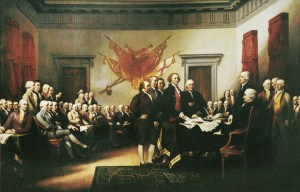
John Trumbull's famous painting is often identified as a depiction of the signing of the Declaration, but it actually shows the drafting committee presenting its work to the Congress.
John Trumbull’s famous painting is often identified as a depiction of the signing of the Declaration, but it actually shows the drafting committee presenting its work to the Congress.

1. July 4, 1776 is the day that we celebrate Independence Day even though it wasn’t the day the Continental Congress decided to declare independence (they did that on July 2, 1776), the day we started the American Revolution (that had happened back in April 1775), the date on which the Declaration was delivered to Great Britain (that didn’t happen until November 1776), or the date it was signed (that was August 2, 1776).

2. The first Independence Day was celebrated on July 8, 1776 (although the Declaration was approved on July 4, 1776, it was not made public until July 8), but for the first two decades after the Declaration was written, people didn’t celebrate it much on any date. One party, the Democratic-Republicans, admired Jefferson and the Declaration. But the other party, the Federalists, thought the Declaration was too French and too anti-British, which went against their current policies.

3. After the War of 1812, the Federalist party began to come apart and the new parties of the 1820s and 1830s all considered themselves inheritors of Jefferson and the Democratic-Republicans. Printed copies of the Declaration began to circulate again, all with the date July 4, 1776, listed at the top. Celebrations of the Fourth of July became more common as the years went on and in 1870, almost a hundred years after the Declaration was written, Congress first declared July 4 to be a national holiday as part of a bill to officially recognize several holidays, including Christmas. Further legislation about national holidays, including July 4, was passed in 1938 and 1941.

4. Benjamin Franklin, John Adams, Thomas Jefferson, Roger Sherman, and Robert R. Livingston comprised the Committee of Five that drafted the Declaration. Jefferson, regarded as the strongest and most eloquent writer, wrote most of the document. After Jefferson wrote his first draft, the other members of the Declaration committee and the Continental Congress made 86 changes, including shortening the overall length by more than a fourth and removing language condemning the British promotion of the slave trade (which Jefferson had included even though he himself was a slave owner).

5. The signed copy of the Declaration is the official, but not the original, document. The approved Declaration was printed on July 5th and a copy was attached to the “rough journal of the Continental Congress for July 4th.” These printed copies, bearing only the names of John Hancock, President, and Charles Thomson, secretary, were distributed to state assemblies, conventions, committees of safety, and commanding officers of the Continental troops. On July 19th, Congress ordered that the Declaration be engrossed on parchment with a new title, “the unanimous declaration of the thirteen united states of America,” and “that the same, when engrossed, be signed by every member of Congress.” Engrossing is the process of copying an official document in a large hand.

6. Thomas Jefferson and John Adams, the only two presidents to sign the document, both died on the Fourth of July in 1826, the fiftieth anniversary of the adoption of the Declaration. Adam’s last words have been reported as “Thomas Jefferson survives.” He did not know that Jefferson had died only a few hours before. James Monroe, the last president who was a Founding Father, also died on July 4 in 1831. Calvin Coolidge, the 30th President, was born on July 4, 1872, and, so far, is the only President to have been born on Independence Day.

7. John Hancock, the President of the Continental Congress at the time, was the first and only person to sign the Declaration on July 4, 1776 (he signed it in the presence of just one man, Charles Thomson, the secretary of Congress). According to legend, the founding father signed his name bigger than everyone else’s because he wanted to make sure “fat old King George” could read it without his spectacles. But the truth is that Hancock had a large blank space and didn’t realize the other men would write their names smaller. Today, the term “John Hancock” has become synonymous with a person’s signature.

8. The 56 signers of the Declaration did not sign on July 4, 1776, nor were they in the same room at the same time on the original Independence Day. The official signing event took place on August 2, 1776 when 50 men signed the document. Several months passed before all 56 signatures were in place. The last man to sign, Thomas McKean, did so in January of 1777, seven months after the document was approved by Congress. Robert R. Livingston, one of the five original drafters, never signed it at all since he believed it was too soon to declare independence.

9. Unlike the U.S. Constitution, which makes no reference to God, the Declaration has three references to a deity. The document also makes two references that tie natural law to God. (Although Thomas Jefferson was a Deist, as a young apprentice lawyer he had studied the work of Henry de Bracton, an English jurist and natural law proponent. Bracton has been referred to as the “father of common law” and is said to have “succeeded in formulating a truly Christian philosophy of law”).
Morning Prayer: 04 July – Psalm 121:1-3; Habakkuk 3:16-19; John 10:14-26 ~ on treading upon the heights

Morning Prayer

+ In the name of the Father, and of the Son, and of the Holy Spirit. Amen

Opening sentences

One thing I have asked of the Lord, this is what I seek: that I may dwell in the house of the Lord all the days of my life; to behold the beauty of the Lord and to seek Him in His temple.

Praise to You, Lord Jesus Christ, King of endless glory.

Pilgrimage

Psalm 121:1-3 NLT

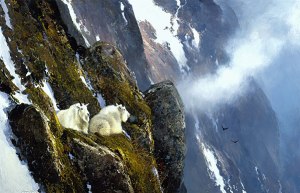
Rocky Mountain Goats—B.C. Michael Coleman (1989) National Museum of Wildlife Art Collection
Rocky Mountain Goats—B.C.
Michael Coleman (1989)
National Museum of Wildlife Art Collection

I look up to the mountains — does my help come from there?

My help comes from the Lord, who made heaven and earth! He will not let you stumble; the one who watches over you will not slumber.

Habakkuk 3:16-19 NLT

I trembled inside when I heard this; my lips quivered with fear. My legs gave way beneath me, and I shook in terror. I will wait quietly for the coming day when disaster will strike the people who invade us.

Even though the fig trees have no blossoms, and there are no grapes on the vines; even though the olive crop fails, and the fields lie empty and barren; even though the flocks die in the fields, and the cattle barns are empty, yet I will rejoice in the Lord! I will be joyful in the God of my salvation!

The Sovereign Lord is my strength! He makes me as surefooted as a deer, able to tread upon the heights.

John 10:14-26 NLT

“I am the good shepherd; I know my own sheep, and they know me, just as my Father knows me and I know the Father. So I sacrifice my life for the sheep. I have other sheep, too, that are not in this sheepfold. I must bring them also. They will listen to my voice, and there will be one flock with one shepherd.

“The Father loves me because I sacrifice my life so I may take it back again. No one can take my life from me. I sacrifice it voluntarily. For I have the authority to lay it down when I want to and also to take it up again. For this is what my Father has commanded.”

When he said these things, the people were again divided in their opinions about him. Some said, “He’s demon possessed and out of his mind. Why listen to a man like that?” Others said, “This doesn’t sound like a man possessed by a demon! Can a demon open the eyes of the blind?”

It was now winter, and Jesus was in Jerusalem at the time of Hanukkah, the Festival of Dedication. He was in the Temple, walking through the section known as Solomon’s Colonnade. The people surrounded him and asked, “How long are you going to keep us in suspense? If you are the Messiah, tell us plainly.”

Jesus replied, “I have already told you, and you don’t believe me. The proof is the work I do in my Father’s name. But you don’t believe me because you are not my sheep.”

Reflections

THE HIGH PLACES

The life of the praying person is a journey farther up and farther in, to places God Himself has spoken about to the attentive heart. On one such occasion the Shepherd said to Much-Afraid,

When you continue your journey there may be much mist and cloud. Perhaps it may even seem as though everything you have seen here of the high places was just a dream, or the work of your imagination… But you have seen reality, and the mist which seems to swallow it up is an illusion. Believe steadfastly in what you have seen. Even if the way up to the high places appears to be obscured and you are led to doubt whether you are following the right path, remember the promise, ‘Thine ears shall hear a word behind thee, saying, This is the way, walk ye in it, when ye turn to the right hand and when ye turn to the left.’ Always go forward along the path of obedience as far as you know it until I intervene, even if it seems to be leading you where you fear I could never mean you to go.

Hannah Hurnard, Hind’s Feet on High Places

Aidan ReadingsAidan of Lindisfarne
__________


__________

Canticle:

Christ, as a light… illumine and guide me. Christ, as a shield… overshadow me. Christ under me; Christ over me; Christ beside me on my left and my right. This day be within and without me, lowly and meek, yet all-powerful. Be in the heart of each to whom I speak; in the mouth of each who speaks unto me. This day be within and without me, lowly and meek, yet all-powerful. Christ as a light; Christ as a shield; Christ beside me on my left and my right.

Blessing

May the peace of the Lord Christ go with you, wherever He may send you. May He guide you through the wilderness, protect you through the storm. May He bring you home rejoicing at the wonders He has shown you. May He bring you home rejoicing once again into our doors.

+ In the name of the Father, and of the Son, and of the Holy Spirit. Amen

_____________________________________

Peanut Gallery: The general format for Morning Prayer is adapted from the Northumbrian Community‘s Daily Office, as found in Celtic Daily Prayer (see online resources here.) Our Scripture readings and reflections will be taken from the Aidan Daily Readings (Celtic Daily Prayer) during the month of July. On Sundays, we’ll return to the USCCB readings (see online resources here) and various liturgical resources in order to reflect the Church’s worship and concerns throughout the world. Photo illustrations and music videos, available online, are included as they illustrate or illuminate the readings. I will try to give credit and link to sources as best I can.