Morning Prayer, 07 Mar – John 12:12-19 ~ Save us!

Morning Prayer

+ In the name of the Father, and of the Son, and of the Holy Spirit. Amen

Opening sentences – Cuthbert of Northumbria (635-87)

Do not reject me or forsake me, O God my Saviour.

Though my father and mother forsake me, the Lord will receive me.

Teach me Your way, O Lord; lead me in a straight path. Amen.

Morning readings

John 12:12-19 ESV:

Entry into Jerusalem (Palm Sunday) - 20th c.
Entry into Jerusalem
(Palm Sunday) – 20th c.

The next day the large crowd that had come to the feast heard that Jesus was coming to Jerusalem. So they took branches of palm trees and went out to meet him, crying out, “Hosanna! Blessed is he who comes in the name of the Lord, even the King of Israel!”

And Jesus found a young donkey and sat on it, just as it is written,

“Fear not, daughter of Zion; behold, your king is coming, sitting on a donkey’s colt!”

His disciples did not understand these things at first, but when Jesus was glorified, then they remembered that these things had been written about him and had been done to him. The crowd that had been with him when he called Lazarus out of the tomb and raised him from the dead continued to bear witness. The reason why the crowd went to meet him was that they heard he had done this sign.

So the Pharisees said to one another, “You see that you are gaining nothing. Look, the world has gone after him.”

Reflections:

King of Israel

The crowd welcomes Jesus as the answer to their nationalistic, messianic hopes. Earlier a crowd had wanted to make Jesus king, and now this crowd is recognizing him as king in the city of the great King. Here is the great dream of a Davidic ruler who would come and liberate Israel, establishing peace and subduing the Gentiles.

Jesus responds by finding a young donkey to sit on – undercuting their nationalism and pointing in a different direction. He is indeed king, but not the sort of king they have in mind.

on reflection

The meaning of what takes place is conveyed through both the Scripture shouted by the crowd at the time and the Scripture that occurred to the disciples later. The crowd shouted, “Help!” and “Save!” and Jesus has come precisely to help and save them, though it will not be through the political liberation the crowd expects. It is, however, uniquely true that Jesus comes in the name of the Lord. This expression is one way of summarizing his whole mission.

Jesus is indeed King of Israel. His kingdom, however, far transcends Israel’s boundaries. “The Lord, the King of Israel, is with you; never again will you fear any harm” (Zeph 3:15). The context in Zephaniah is of the future time of peace when Jerusalem is no longer at war — the lame and the scattered have been brought home, and even the Gentiles have been purified so that they might call on the name of the Lord. The hallmark of this time is the Lord’s own presence.

If they had eyes to see what Jesus was doing and ears to hear what he was saying they would find in him the fulfillment of their desires, though without the nationalistic element. The fulfillment of Zephaniah’s prophecy of peace without fear is taking place right before the eyes of this crowd, though they do not know it.

The IVP New Testament Commentary Series

__________

__________

Canticle:

Christ, as a light… illumine and guide me. Christ, as a shield… overshadow me. Christ under me; Christ over me; Christ beside me on my left and my right.

This day be within and without me, lowly and meek, yet all-powerful. Be in the heart of each to whom I speak; in the mouth of each who speaks unto me. This day be within and without me, lowly and meek, yet all-powerful.

Christ as a light; Christ as a shield; Christ beside me on my left and my right.

Blessing

May the peace of the Lord Christ go with you, wherever He may send you. May He guide you through the wilderness, protect you through the storm. May He bring you home rejoicing at the wonders He has shown you. May He bring you home rejoicing once again into our doors.

+ In the name of the Father, and of the Son, and of the Holy Spirit. Amen

_____________________________________

Peanut Gallery: A brief word of explanation – the general format for Morning Prayer is adapted from the Northumbrian Community‘s Daily Office, as found in Celtic Daily Prayer (see online resources here.) The Scripture readings are primarily from the Gospel of John, with the intent to complete the reading by Easter. Other Scriptures which illuminate the Gospel of John will be included along the way.

Reflections from various saints will be included as their memorial days occur during the calendar year.

On Sundays, I’ll return to the USCCB readings (see online resources here) and various liturgical resources in order to reflect the Church’s worship and concerns throughout the world.

Photo illustrations and music videos, available online, are included as they illustrate or illuminate the readings. I will try to give credit and link to sources as best I can.

Report: The Bible in American Life – Reblog (The Gospel Coalition)

Report: The Bible in American Life

by Scotty Smith, thegospelcoalition.org ~ March 6th 2014

image

The Story: Surveys have found that nearly eight  in ten Americans regard the Bible as either the literal word of God or as inspired by God. At the same time, other surveys have revealed—and recent books have analyzed—surprising gaps in Americans’ biblical literacy. These discrepancies reveal American Christians’ complex relationship to their scripture, a subject that is widely acknowledged but rarely investigated. To understand that paradox, the Center for the Study of Religion and American Culture conducted the first large-scale investigation of the Bible in American life.

The Background: “The Bible in American Life” is a national study by the Center for the Study of Religion and American Culture. The purpose of the study is to understand better how Americans use the Bible in their personal daily lives and how other influences, including religious communities and the Internet, shape individuals’ use of scripture. The project, according to its researchers, was driven by the recognition that, though the Bible has been central to Christian practice throughout American history, many important questions remain unanswered in scholarship, including how people have read the Bible for themselves outside of worship, how denominational and parachurch publications have influenced interpretation and application, and how clergy and congregations have influenced individual understandings of scripture.

The Takeaways: Some of the more interesting findings from the report include:

• There is a 50/50 split among Americans who read any form of scripture in the past year and those who did not. Among those who did, women outnumber men, older people outnumber younger people, and Southerners exceed those from other regions of the
country.

• Among those who read any form of scripture in the past year, 95% named the Bible as the scripture they read. All told, this means that 48% of Americans read the Bible at some point in the past year. Most of those people read at least monthly, and a substantial number — 9% of all Americans — read the Bible daily.

• Despite the proliferation of Bible translations, the King James Version is the top choice — and by a wide margin—of Bible readers.

• The strongest correlation with Bible reading is race, with African Americans reading the Bible at considerably higher rates than others.

• Half of those who read the Bible in the past year also committed scripture to memory. About two-thirds of congregations in America hold events for children to memorize verses from the Bible.

• Among Bible readers, about half had a favorite book, verse, or story. Psalm 23, which begins, “The Lord is my shepherd…” was cited most often, followed by John 3:16.

• Bible readers consult scripture for personal prayer and devotion three times more than to learn about culture war issues such as abortion, homosexuality, war, or poverty.

• There are clear differences among Bible readers consulting scripture for specific reasons. Age, income, and education are key factors.

• Those reading the Bible frequently consult it on culture war issues more than two times the rate as those who read it less frequently.

• Less than half of those who read the Bible in the past year sought help in understanding it. Among those who did, clergy were their top source; the Internet was the least cited source.

• Among Bible readers, 31% read it on the Internet and 22% use e-devices.

• Bible reading differences among religious traditions followed predictably the historic divides between Protestants and Catholics, and between white conservative and white moderate/liberal Protestants. However, reading practices defy some stereotypes about certain groups.
__________
For the full report: click here.

Morning Prayer, 06 Mar – John 12:1-11 ~ extravagant worship

Morning Prayer

+ In the name of the Father, and of the Son, and of the Holy Spirit. Amen

Opening sentences – Cuthbert of Northumbria (635-87)

Hear my voice when I call, O Lord; be merciful to me and answer me.

My heart says of You, “Seek His face!”

Your face, Lord, I will seek.

Do not hide Your face from me, do not turn Your servant away in anger;
You have been my helper.

Morning readings

John 12:1-11 ESV:

mary-anoints-the-feet-of-jesus

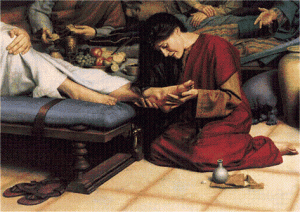
Six days before the Passover, Jesus therefore came to Bethany, where Lazarus was, whom Jesus had raised from the dead. So they gave a dinner for him there. Martha served, and Lazarus was one of those reclining with him at table. Mary therefore took a pound of expensive ointment made from pure nard, and anointed the feet of Jesus and wiped his feet with her hair. The house was filled with the fragrance of the perfume.

But Judas Iscariot, one of his disciples (he who was about to betray him), said, “Why was this ointment not sold for three hundred denarii and given to the poor?” He said this, not because he cared about the poor, but because he was a thief, and having charge of the moneybag he used to help himself to what was put into it.

Jesus said, “Leave her alone, so that she may keep it for the day of my burial. For the poor you always have with you, but you do not always have me.”

When the large crowd of the Jews learned that Jesus was there, they came, not only on account of him but also to see Lazarus, whom he had raised from the dead. So the chief priests made plans to put Lazarus to death as well, because on account of him many of the Jews were going away and believing in Jesus.

Reflections:

extravagant gratitude

The pure nard Mary uses was worth a year’s wages – a rough equivalent would be around $15,000, the gross pay for someone working at minimum wage for a year. There is no indication of why Mary expressed her devotion this way. The most obvious possibility was her sheer gratitude for what Jesus had done for her brother and the revelation it brought to her of Jesus’ identity, power, authority and grace.

John’s focus on her anointing Jesus’ feet points to Mary’s great humility. As she has come to realize a bit more of the one who has been a friend to her and her brother and sister, her faith deepens and she recognizes her unworthiness.

treacherous unbelief

At one level, Judas is simply expressing what others were also thinking. But with hindsight John knows there was more motivating him – embezzlement. Such embezzlement reveals a heart in love with self and in love with money, neither of which have a place in the life of a disciple. But beyond even this, the deepest sin was Judas’ betrayal of the Lord.

Judas’ heart is fundamentally different from the heart of Mary – the contrast between a true disciple, Mary, and one of the Twelve, shows that privilege of position is no substitute for faith and obedience.

charitable works

Care for the poor is a sacred duty because it is the concern of God’s own heart. Those who share in his life will share in his concern for the poor and will act appropriately as he guides. This diversion of funds from the poor for the sake of Jesus’ burial implies that there are times for such exceptional use of funds. But it also implies that the funds would usually go to the poor and that this is the proper thing to do. John’s “suggestion that Judas did not care about the poor has implied in passing that Christians should care” (Michaels).

The IVP New Testament Commentary Series

__________

Doesn’t matter what people say / I forget their watching eyes / I just want to bring to You / My most costly, my most priceless, my most precious Sacrifice

Extravagant worship / Total surrender / Reckless abandon / I pour out my love, pour out myself / Saviour

Breaking open my thankful heart / I release its praise perfume / Here I’ll linger lifting to You / Songs of wonder, songs of worship / songs of deepest gratitude
__________

Canticle:

Christ, as a light… illumine and guide me. Christ, as a shield… overshadow me. Christ under me; Christ over me; Christ beside me on my left and my right.

This day be within and without me, lowly and meek, yet all-powerful. Be in the heart of each to whom I speak; in the mouth of each who speaks unto me. This day be within and without me, lowly and meek, yet all-powerful.

Christ as a light; Christ as a shield; Christ beside me on my left and my right.

Blessing

May the peace of the Lord Christ go with you, wherever He may send you. May He guide you through the wilderness, protect you through the storm. May He bring you home rejoicing at the wonders He has shown you. May He bring you home rejoicing once again into our doors.

+ In the name of the Father, and of the Son, and of the Holy Spirit. Amen

_____________________________________

Peanut Gallery: A brief word of explanation – the general format for Morning Prayer is adapted from the Northumbrian Community‘s Daily Office, as found in Celtic Daily Prayer (see online resources here.) The Scripture readings are primarily from the Gospel of John, with the intent to complete the reading by Easter. Other Scriptures which illuminate the Gospel of John will be included along the way.

Reflections from various saints will be included as their memorial days occur during the calendar year.

On Sundays, I’ll return to the USCCB readings (see online resources here) and various liturgical resources in order to reflect the Church’s worship and concerns throughout the world.

Photo illustrations and music videos, available online, are included as they illustrate or illuminate the readings. I will try to give credit and link to sources as best I can.

Ash Wednesday: Joel 2:12-18; Psalm 51:3-6, 12-14, 17; 2 Corinthians 5:20-6:2; Matthew 6:1-6, 16-18 ~ Father, forgive me

Ash Wednesday

+ In the Name of the Father, and the Son, and the Holy Spirit. Amen

Opening prayer:

Today begins the season of Lent – a journey of reflection and repentance that will bring us to the celebration of the passion, death and resurrection of Jesus at Easter time.
__________

Gracious and merciful God, You look with love upon a sinful people and desire only our return to You. I beg of you the grace to live this holy season, to persevere in prayer, self-denial, and almsgiving. Through the disciplines of Lent, purify my heart of all pretension, bring me back to You, and make the whole Church ready to celebrate the mysteries of Easter.

Grant this through Christ, our liberator from sin, who lives and reigns with You in the unity of the Holy Spirit, holy and mighty God for ever and ever. Amen.

A Reading from the Old Testament: Joel 2:12-18 (NLT)

Kori Dirks, Kolton DirksThe Lord says,

“Turn to me now, while there is time. Give me your hearts. Come with fasting, weeping, and mourning. Don’t tear your clothing in your grief, but tear your hearts instead.”

Return to the Lord your God, for he is merciful and compassionate, slow to get angry and filled with unfailing love. He is eager to relent and not punish. Who knows? Perhaps he will give you a reprieve, sending you a blessing instead of this curse. Perhaps you will be able to offer grain and wine to the Lord your God as before.

Blow the ram’s horn in Jerusalem! Announce a time of fasting; call the people together for a solemn meeting. Gather all the people — the elders, the children, and even the babies. Call the bridegroom from his quarters and the bride from her private room. Let the priests, who minister in the Lord’s presence, stand and weep between the entry room to the Temple and the altar.

Let them pray, “Spare your people, Lord! Don’t let your special possession become an object of mockery. Don’t let them become a joke for unbelieving foreigners who say, ‘Has the God of Israel left them?’”

Then the Lord will pity his people and jealously guard the honor of his land.

A Reading from the Psalms: Psalm 51:3-6, 12-14, 17 (NLT)

For I recognize my rebellion; it haunts me day and night. Against you, and you alone, have I sinned; I have done what is evil in your sight. You will be proved right in what you say, and your judgment against me is just. For I was born a sinner — yes, from the moment my mother conceived me. But you desire honesty from the womb, teaching me wisdom even there.
__________

Restore to me the joy of your salvation, and make me willing to obey you. Then I will teach your ways to rebels, and they will return to you.
__________

Forgive me for shedding blood, O God who saves; then I will joyfully sing of your forgiveness.
__________

The sacrifice you desire is a broken spirit. You will not reject a broken and repentant heart, O God.
__________

__________

A Reading from the Letters: 2 Corinthians 5:20-6:2 (NLT)

So we are Christ’s ambassadors; God is making his appeal through us. We speak for Christ when we plead, “Come back to God!” For God made Christ, who never sinned, to be the offering for our sin, so that we could be made right with God through Christ.

As God’s partners, we beg you not to accept this marvelous gift of God’s kindness and then ignore it. For God says, “At just the right time, I heard you. On the day of salvation, I helped you.”

Indeed, the “right time” is now. Today is the day of salvation.

A Reading from the Gospels: Matthew 6:1-6, 16-18 (NLT)

“Watch out! Don’t do your good deeds publicly, to be admired by others, for you will lose the reward from your Father in heaven. When you give to someone in need, don’t do as the hypocrites do — blowing trumpets in the synagogues and streets to call attention to their acts of charity! I tell you the truth, they have received all the reward they will ever get. But when you give to someone in need, don’t let your left hand know what your right hand is doing. Give your gifts in private, and your Father, who sees everything, will reward you.

“When you pray, don’t be like the hypocrites who love to pray publicly on street corners and in the synagogues where everyone can see them. I tell you the truth, that is all the reward they will ever get. But when you pray, go away by yourself, shut the door behind you, and pray to your Father in private. Then your Father, who sees everything, will reward you.”
__________

“And when you fast, don’t make it obvious, as the hypocrites do, for they try to look miserable and disheveled so people will admire them for their fasting. I tell you the truth, that is the only reward they will ever get. But when you fast, comb your hair and wash your face. Then no one will notice that you are fasting, except your Father, who knows what you do in private. And your Father, who sees everything, will reward you.”

Intercessions:

Our God is full of mercy and compassion – Lord help us:

+ That God’s people scattered throughout the world – particularly those who are signed with ashes today – may turn back to God during this Lenten season…. Lord, hear my prayer.
+ That those who have grown lukewarm, or drifted far away, may return to God and find new enthusiasm in their faith…. Lord, hear my prayer.
+ That people in need throughout the world may benefit from our Lenten sacrifices of prayer, of self, of generosity…. Lord, hear my prayer.
+ That, during this Lenten season, we may learn to set our own interests aside and work for the good of others…. Lord, hear my prayer.

God of mercy and compassion, you cleanse us and give us your help: hear my prayers made in faith, through Christ our Lord. Amen.

Hymn: God of Mercy and Compassion

+ In the Name of the Father, and the Son, and the Holy Spirit. Amen
__________

LENT (wikipedia) is a solemn religious observance in the liturgical calendar of many Christian denominations that begins on Ash Wednesday and covers a period of approximately six weeks before Easter Day.

The traditional purpose of Lent is the preparation of the believer – through prayer, penance, repentance of sins, almsgiving, atonement and self-denial – for the annual commemoration of Holy Week, marking the death, burial and resurrection of Jesus, which recalls the tradition and events of the New Testament beginning on Friday of Sorrows, further climaxing on Jesus’ crucifixion on Good Friday, which ultimately culminates in the joyful celebration on Easter Sunday of the Resurrection of Jesus Christ.

The English word “Lent” was adopted for the season in the middle ages and simply referred, at that time, to the coming of spring with its lengthening days.

Lenten Culture | First Things – Reblog

Lenten Culture | First Thoughts | Blogs | First Things.

LENTEN CULTURE

“The historical development of Lent corresponded to the construction of a Christian culture and thus the redemption of cultural life. It formed part of the message that upon entering the faith, the individual entered into an alternative way of existing in the world in which time was understood differently. The patterns of one’s existence now corresponded to a new narrative about the history of the world as one of creation and redemption in and through Jesus Christ.”

ON LENT, GLOBAL CULTURE, AND COSMIC SALVATION by Dale M. Coulter

lent

As my wife and I pulled up to a fast-food restaurant one year during Lent, our daughter quickly noticed a sign advertising vegetarian options. Given that she had decided to join the millions of Christians fasting during Lent, she was all too happy to know that market forces were at work acknowledging this aspect of Christian culture. At that moment her young faith became more than a private commitment. It became a public expression as she identified with a practice that Christians have engaged in for well over a thousand years.

The approach of Lent serves as a reminder to Christians of a common culture that they share. It reminds Christians that, in the language of the Martyrdom of Polycarp, they are members of a “God-fearing and God-loving race.” Of course, the actual practice of Lent varies, being adapted differently by diverse forms of Christianity with elements being added or subtracted given time and place. The Sunday before Lent has been called Transfiguration Sunday, Shrove Sunday, and Forgiveness or Cheesefare Sunday, to name a few. Such diversity attests to the rich local expression in Christianity, setting a precedent for the need to honor local culture in the celebration of a global inheritance.

The historical development of Lent corresponded to the construction of a Christian culture and thus the redemption of cultural life. It formed part of the message that upon entering the faith, the individual entered into an alternative way of existing in the world in which time was understood differently. The patterns of one’s existence now corresponded to a new narrative about the history of the world as one of creation and redemption in and through Jesus Christ. This is the link between the fasting and prayer that catechumens engaged in prior to undergoing baptism, confirmation, and first Eucharist and the incorporation of those practices into a Lenten season as part of the movement toward Easter.

As a cultural practice, then, Lent concerns the ongoing mission of the churches. Sometimes pastors or priests will talk about Lent as part of an individual’s ongoing conversion, because the person enters a prolonged period of heightened spiritual awareness in which acts of repentance and acts of mercy form the preparation for Easter celebration. While this may personalize Lent, the global culture that it communicates relates more to cosmic salvation and the mission to bring all of life under the authority of Christ. It may be that the importance of Lent resides in its reminder of the continuing mission to transform culture by the creation of new cultural forms of life that attest to the arrival of a new race of people.

It is for this reason that I have a strong sympathy for the first act of reform by Ulrich Zwingli in 1522, when he bore witness as priest to the eating of sausages during Lent. It was important to say at that time that the church’s rituals could not be linked in such a direct fashion to the salvation of the soul without putting a weight on the individual that was more than he or she could bear. The yoke of Christ resists such connections, which is why Zwingli referred to these practices as “matters of indifference” with respect to conscience.

Zwingli and his compatriots, however, went too far in their zeal to place as much distance as possible between personal salvation and ritual. The effect was an iconoclasm that destroyed a culture. It would have been better to shift the theological location of these rituals from the salvation of the person to the culture of the church and the way that culture is a manifestation of cosmic redemption. In other words, a shift from soteriology to eschatology.

The nature of the Lenten season in relation to Easter fits well within an eschatological framework since Christians relive a movement from the dust of creation to the deifying nature of resurrection. It is indeed within this cosmic setting that Christians bear witness to the drama of creation, fall, and redemption. Lent is a cultural inheritance that reminds Christians they are part of a great “race” composed of many tribes and tongues. It is also about redeeming cultures by catching them up in a drama that sets the local within a cosmic story.

This may also be a way to resolve the tension over a “matter of indifference” in early Christianity: the eating of food sacrificed to idols. There is a question about how to resolve Paul’s more lax approach to eating food sacrificed to idols and the Book of Revelation’s and the Didache’s more strident interpretation. The difference lies between a pre-Neronian period when the Temple remained and a post-Neronian period in which Christians and Jews were compelled by events to understand just how hostile Rome could be. In the face of such hostility, Christian participation in civic life threatened the integrity of Christian identity. Thus the need to bear witness to the dawn of a new age and new way of living.

Paul’s point that this testimony to Christian identity should be kept out of issues surrounding salvation and firmly planted in the soil of creation harmonizes with the emphasis on the renewal of creation in the Book of Revelation. Christians should not abstain from eating food sacrificed to idols as a means of securing their personal union with Christ, but they should abstain as a matter of bearing witness to the life to come and its renewal of creation. This is a Christian way of affirming a deeply Jewish principle: all food is a gift from God. Since it is God’s gift food should not be used as a weapon either by Christians to destroy the weaker consciences of their fellow believers or by the state to compel Christians to engage in certain cultural activities deemed to be necessary for citizenship.

Just like Lent, the practice of eating or not eating food sacrificed to idols was a way of reminding Christians about their identity as a new people and the continuing mission to bear witness to a cosmic event, the dawning of a new age. It also spoke powerfully to the transformation of Roman civic life, for Christians decided that they were unwilling to pay the cultural price of admission into the global economy at the time. They were happy to transact business and live moral lives as citizens, but not at the expense of their new identity. Receiving the sign of the cross with ash on Ash Wednesday marks Christians as belonging to a people with a cultural identity that honors the local without sacrificing the global—indeed, catholic—nature of that identity.