
Tim Scott: Meet the New Senator From South Carolina
By Steven Moore, online.wsj.com
December 22, 2012
Washington
Republicans in need of encouraging signs for the new year need look no further than Tim Scott. He was appointed by Gov. Nikki Haley on Monday to succeed Jim DeMint as U.S. senator from South Carolina. Mr. Scott is a charismatic and principled economic and social conservative from the Deep South. He owes his rapid political rise in part to the tea party movement. Oh, and he is black.
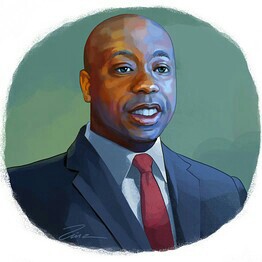
In a few weeks, when the new Congress convenes, Mr. Scott, 47, will take his place as the first black senator from a former Confederate state since Reconstruction. This will make it exceedingly difficult for liberals to maintain their stereotype of the South as a land teeming with white racists. “If that were true,” he says, “how could I have been elected to Congress in a district that is 70% white?” He adds: “I have campaigned all over the state of South Carolina. It is the friendliest state in the country. And truly here people judge you by the content of your character not the color of your skin.”
Though he would clearly prefer to discuss substantive matters other than race—”I try to steer away from these issues,” Mr. Scott says—he recognizes that he has been thrust into the spotlight as a groundbreaking black politician. With some prodding, he reluctantly addresses the subject.
He says that he is fully aware of the challenge that he presents to the GOP’s traditional liberal critics. “I think one of the most threatening places to be in politics is a black conservative,” Mr. Scott says, “because there are so many liberals who want to continue to reinforce a stereotype that doesn’t exist about America.” What stereotype is that? “That somehow, some way, if you’re a Republican you’re a racist and if you’re black, there’s no chance for you in society.
“We have serious challenges in this nation. Some are racial. But in my life, the vast majority of people that have really afforded me the opportunity to succeed were white folks. Is there a better way to say that?”
Mr. Scott’s own story exemplifies the change in attitudes taking hold in the New South. When he first ran for office 18 years ago, for county council, even his friends were shocked. “People said, ‘Son, you’re running in the wrong party.’ They had never even heard of a black Republican. I ran against a white guy, who was a very popular Democrat at the time. I won, not because I was black and a Republican. I won because they liked my values.”
Mr. Scott is sitting down with me in the Cannon House Office Building a few days after his appointment. Chairs and desks are stacked in the halls, ready to be moved to the Senate.
Most conservatives and Republicans in South Carolina and around the country were delighted by Ms. Haley’s choice. But the left wasted no time pouncing on the appointee. Adolph Reed, a professor at the University of Pennsylvania, took to the op-ed page of the New York Times with an indignant piece entitled “The Puzzle of Black Republicans.” Mr. Reed sneered that Mr. Scott holds positions “utterly at odds with the preferences of most black Americans” and that his rise fits “a morality play that dramatizes how far [blacks] have come. It obscures the fact that modern black Republicans have been more tokens than signs of progress.”
To the left, Mr. Scott is dangerous because he has challenged liberal orthodoxy his whole career.
When he was Charleston County Council chairman in 1997, he decided to post the Ten Commandments outside the building—a move ruled unconstitutional in a lawsuit brought by the ACLU. Mr. Scott believes the free-enterprise system holds the most promise for allowing the poor to escape poverty. He blames liberals for an attitude instilled in minorities that they can’t succeed in America because of racial barriers, “which becomes a self-fulfilling prophecy.”
He thinks racial-preference programs and racial quotas are “mostly unnecessary,” because while he supports goals to promote minority hiring, “you can’t force people into relationships.” He adds: “It’s the same as when I asked the same girl out 10 times, and she just didn’t want to go.”
Growing up in North Charleston, he attended a mostly white but desegregated high school and was elected president of the senior class. After graduating from Charleston Southern University in 1988, he went into the insurance business and shortly thereafter hung out his own shingle as Tim Scott Allstate, which grew to 3,000 customers. He was elected to state offices beginning in 1995, then in 2010—the year of the tea party—he ran for Congress and defeated Strom Thurmond’s son. In the House, his first act was to sponsor a bill to overturn ObamaCare.
Despite his storybook rise—”I never even imagined being in the United States Senate, it was never part of the plan”—Mr. Scott has felt the personal sting of racism and has had doors shut on him. In high school and college he was bullied and “sometimes I got hate-filled notes with racial slurs attached to my locker.”
It was made worse, he recalls, because “I was a kind of an oddball. Had three pair of pants and two pair of shoes. And you know, you rotate them and you got made fun of. I had buck teeth, they were going in two different directions. It was a challenging time.” The barriers, he is convinced, “only made my will to succeed even stronger.”
The two guiding influences of his life have been his mother, who always worked two jobs (“I’m living her American dream,” he says proudly) and the man he calls “my mentor,” John Moniz, a white Christian and one of the first franchise owners of Chick-fil-A restaurants. “He took me under his wing and for three or four years he was telling me that as a poor kid in North Charleston, that I could think my way out of poverty. I didn’t have to play football. I didn’t have to become an entertainer.”
One of the people who got him interested in politics, surprisingly enough, was Jesse Jackson. Mr. Scott didn’t necessarily agree with Rev. Jackson’s politics but was struck that a black man could run for president—which back in the 1980s seemed a revolutionary concept.
Another influence was the late, legendary Sen. Strom Thurmond. “In 1992, I was the vice chairman of his last re-election,” Mr. Scott says. Really? He worked for the formerly staunch segregationist? “He was a complicated man,” Mr. Scott says, “but people change their minds. They embrace truth. In the end he received around 30% of the black vote. I’d like to get there. If Strom Thurmond could get 30% of the black vote, any Republican can.”
Mr. Scott has also been active in the tea party, and he bristles at the suggestion that its influence is waning. “No. I think almost every American is a part philosophically with the tea party.” How so? Because of what the tea party stands for, he says: “Limited government, free markets, entrepreneurship, capitalism, and making the government smaller, less intrusive and keeping it out of your pockets.” Those are enduring American principles, he says. As for charges that the tea party is racist, he laughs. “I was warmly embraced by the tea party. They openly seek more minorities.”
If conservative ideas work better, how does he explain the re-election of Barack Obama, the most liberal president in a century? “People like Barack Obama. He’s a warm person.” By contrast, Republicans have failed miserably to get their message across. “Most of our problems this year,” Mr. Scott says, come down to violating his first rule of politics: “People don’t care how much you know until they know how much you care,” reciting an old line from the late Jack Kemp, another Republican he admired.
Then he tells a story: “I put together a group of mostly black pastors and thinkers in the new part of my district, near Hilton Head. I told them, ‘I don’t expect you to vote for me in November. I don’t know that you will vote for me ever. But we’re going to start a relationship today. And it’s not about the election. It’s about life. It’s about changing the course of history for kids who are coming behind us.’ ” He notes that one of the pastors in the meeting called him after his appointment to the Senate to celebrate the news.
Mr. Scott seems to have a talent for reaching out to voters who might be expected to be skeptical of a Republican. The first step, he says, is simply to convey your interest. When he recently addressed a gathering of Mexican residents of Charleston, he did his best to read his speech in Spanish. “Think about the fact that I flunked Spanish in high school. I am not bilingual, I’m bi-ignorant. But they were chuckling. It broke the ice.”
He says he is frustrated that Republicans seem to be no better at communicating during the fiscal-cliff negotiations than they were during the campaign season. Somehow, the GOP has allowed the focus of the talks to center on taxes for the rich: “We need a spending conversation, but you cannot have that in the middle of a revenue argument, so we can’t win. The American people want less spending and less debt, but we aren’t talking about that.”
Once he has taken up his place in the Senate, he says, he will try to spur more conversation about spending, but he will also address tax reform. He will introduce the “Rising Tide Tax Reform Act,” which would lower corporate taxes to 23% and allow for permanent repatriation of foreign earnings back into the U.S. “On the personal tax code,” he says, “I like the plan of lowering the tax rate so that we can increase the revenue.”
A major influence on his thinking about tax matters is economist Arthur Laffer—”one of my closest advisers.” Raising tax rates, especially on capital gains, Mr. Scott says, will result in less revenue.
If he succeeds in his mission on tax reform, he predicts: “Once we get to lower tax rates, and we execute more revenue coming in, our economy will start growing at a faster pace, and we’re going to like the results.”
In the Senate the man he most wants to emulate is Marco Rubio of Florida because “he has the warmth and communication skills that I like.” Can he fill the shoes of Jim DeMint, who is leaving to become the president of the Heritage Foundation? “I doubt it because there is only one Jim DeMint, not two. But I have a desire to make sure that his consistent conservatism continues.”
Mr. Moore is a member of the Journal’s editorial board.


 The Peanut Gallery