
WASHINGTON — One-hundred percent of Christians in 21 countries around the world experience persecution for their faith in Christ as over 215 million Christians faced “high levels” of persecution in the last year, a leading human rights watchdog group reports. Continue reading “100% of Christians Face Persecution in These 21 Countries | re-blog CP World by Samuel Smith”
Tag: Syria
02 Nov, International Day of Prayer: The Persecuted Church (Voice of the Martyrs)
The International Day of Prayer for the Persecuted Church / 2014

PLEASE PRAY: The most common request of persecuted Christians is “PRAY FOR US.” One of the ways we answer their request is through participation in the International Day of Prayer for the Persecuted Church (IDOP), which we observe on the first Sunday of each November. Our goal is simple: We want EVERY CHURCH to “Remember them that are in bonds …” on IDOP Sunday (Heb. 13:3).
Watch VOM’s IDOP videos – click here … share with your friends … and pray for the persecuted.
Liena and her family turned down offers of asylum in Western countries after civil war broke out in Syria. They knew the cost that might be required, but they chose to remain as witnesses to their Muslim neighbors and as an encouragement to other Christians.
Liena was a dedicated Christian, faithful wife and mother of two. In her prayers, she asked God to use her to reach more people. And then God asked her to make one more commitment.
Watch the dramatic testimony of Liena’s Prayer, as she struggles with the difficult decision of how much she can offer God.
You may never pray the same again.
IRAQ: PRAYER FOR IRAQ
VOM received these prayer points from a church in the Kurdistan region of Iraq, with whom VOM is partnering to help Christians in Iraq. Please join with your brothers and sisters in the Middle East to pray for the region. For security reasons, we have removed the name of the church.
- That we would reach the community and meet its spiritual as well as physical needs.
- That the Church would experience an unprecedented presence of the Holy Spirit throughout this crisis to change the region, country and Middle East.
- That individuals and the Church would experience our Almighty God’s unity and power, open heavens, and rivers flowing from the Holy Spirit to give us one shared Vision.
- That God would grant us favor in the government’s eyes, to acquire permission for establishing a school.
- That God would send workers for his Kingdom, as many of our services and relief deliveries have been delayed due to a shortage of workers.
- That God would grant us wisdom in handling the Internally Displaced People (IDP) projects, and strength to those who work with them directly.
- That God would send confusion and disagreement to those in the IS group, to stop them from inflicting more violence to the region, and that their hidden cells would be uncovered by local authorities.
- That God would save misled young people from IS and judge the leaders who are aware and yet still misleading youth with their evil desires and ideologies.
- That all ISIS’ financial resources would be cut off.
- That God would comfort and encourage the Yezidi people amidst their heartbreaking genocide; that the Lord would reveal Himself to them with dreams and visions; that he would burden missionaries to serve among the remaining Yezidis.
- That God would encourage the believers who fled from Mosul, that they’d be strong in Him, be bold to witness and never lose hope in Him.
- That God would raise up faithful leaders in the Central Government who fear God rather than men of power and use their authority for justice.
- That God would give wisdom to the Kurdistan Regional Government, to manage the crisis, to defend the region faithfully, and that they would realize that God raised them up to serve Him at this time – that He would reveal Himself to them.
- That the church would pray with one heart: “Thy Kingdom come, thy will be done, in Heaven as well as in Kurdistan.”
- That God would send visitations to the Shi’a in central and south Iraq, to heal their hearts and release them from idolatry.
Thank you for reading this far… and for praying for persecuted Christians around the world. May God bless you.
“Silence and Solidarity” – ReBlog: Timothy George First Things
By Timothy George, http://www.firstthings.com
View Original
__________
“It would indeed be awful to think,” Rabbi Jonathan Sacks said, “that the West might remain silent as violence rages purely out of a failure to recognize that Christians can be victimized, or out of a reluctance to cast aspersions on certain brands of Islam. It would make this the first genocide in history to be tolerated out of social awkwardness.”
__________

Many colleges and universities open the new academic year with a special assembly or convocation that is generally an upbeat occasion of welcome and new beginnings. The Catholic University of America held such an event several days ago, and it included, appropriately enough, a beautiful mass led by Washington’s Cardinal Donald W. Wuerl. The music was sublime and the liturgy well ordered. Dr. John Garvey, the president of CUA, was presented with an award by the Archdiocese of Washington. It was an altogether appropriate and uplifting event. But just before the dismissal, the tone was changed as Cardinal Wuerl, speaking without notes, delivered this admonition with a sense of urgency:
We hear so much today of the word solidarity. It has become a part of our vocabulary in the past twenty or thirty years. Today our solidarity with brothers and sisters of our faith, and of other faiths, in a part of the world where there is clearly an effort to eliminate them is something that we simply cannot in conscience ignore. Often we are asked: “How was it possible that in human history atrocities occur?” They occur for two reasons: because there are those prepared to commit them, and then there are those who remain silent. And the actions in Iraq and in Syria today are happening to women, children, men—their displacement not the least. Things happening to them is something that we really are not free to ignore, and sometimes all we have to raise is our voice. . . .
I ask myself: Where are these voices? Where the voices of parliaments and congresses? Where are the voices of campuses? Where are the voices of community leaders? . . . Why a silence?

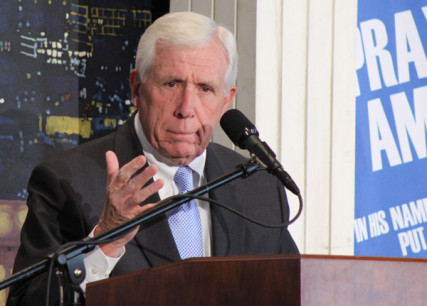
Until quite recently, there were a few—though just a few—who did speak out about the atrocities against Christians and other religious minorities carried out by the Islamic State of Iraq and Syria (ISIS). Back in July, columnist Kirsten Powers referred to the religicide of Christianity in the Middle East: “Iraq’s Christians are begging the world for help. Is anybody listening?” she asked. And there was the estimable Frank Wolf, a member of the House of Representatives from Virginia, who came to the House floor on seven consecutive legislative days to protest the “convert or be killed” policy of Muslim militants in the Middle East. He called on President Obama to take five steps that could have made a difference in that dire situation, none of them involving additional funding or American “boots on the ground.” The response from the leader of the free world, seemingly oblivious to the problem, was an ungolden silence.
Two events in August prompted a growing number of religious and political leaders to begin to speak. One was the onslaught against the Yazidi people, including the abduction and rape of hundreds of Yazidi women and girls, and the stranding of tens of thousands of others on the craggy heights of Mount Sinjar—a humanitarian crisis that prompted limited U. S. airstrikes against ISIS. The other event was a 4-minute, 40-second video depicting the beheading of American journalist James Foley, a devout Catholic, who was brutally put to death at the hands of a jihadist-export from Great Britain. This gruesome video was flashed around the world on YouTube before it was taken down. Last week the serial beheadings continued with the taped execution of 31-year-old Steven Sotloff, a Jewish journalist from Miami and the grandson of Holocaust survivors. Today, we live with another ISIS threat: This time, the promised murder of a British hostage.

“Crimes against humanity” is a euphemism for the wanton killing and horrendous acts of evil being committed in the name of God in the region of the world that gave birth to Judaism, Christianity, and Islam. And yet it is not difficult to see why many thoughtful people are reluctant to encourage yet another military occupation in the region. Twenty-five years of the off-and-on Bush-Obama land wars in Asia have not made the streets of Baghdad safe, nor brought peace between Israel and her neighbors, nor eradicated the virulence of religious violence. ISIS itself was spawned in part through America’s ambivalent connivance in the recent (and ongoing) sectarian wars in Syria where some 200,000 people have been killed and more than 6.5 million others internally displaced or exiled. Libya is yet another country where the quick-fix use of force without a sustainable strategy has not alleviated but rather increased human suffering.
And yet—and yet—there are times in human history when persons of faith cannot play neutral or simply stand by on the sidelines. There are times when they are compelled by conscience to call evil by name and speak out against it with conviction. And they must do this not merely out of a concern for their own personal or national self-protection but precisely as persons of faith—in the name of decency and love and of all that is human and humane. Today is such a time.

The sentiments expressed by Cardinal Wuerl have been taken up in recent days by many of the world’s religious leaders. Pope Francis has offered to undertake a personal peace mission to northern Iraq. Pastor Rick Warren spoke to the crisis from Rwanda, a country where, in the course of just three months in 1994, genocide left one million Rwandans dead and one million children orphaned—while most of the world looked the other way. Warren said that there were lessons from Rwanda for the crisis in the Middle East. He encouraged African pastors to pray for the persecuted Christians in Iraq and Syria.
Rabbi Jonathan Sacks has called radical political Islam the “face of tyranny” today and has compared the suffering of Christians in the Middle East with violence against Jews in the past. “It would indeed be awful to think,” he said, “that the West might remain silent as violence rages purely out of a failure to recognize that Christians can be victimized, or out of a reluctance to cast aspersions on certain brands of Islam. It would make this the first genocide in history to be tolerated out of social awkwardness.” Some Muslim leaders have also felt it their duty to speak out, including Shawki Ibrahim Abdel-Karim Allam, the Grand Mufti of Egypt. He has said that ISIS is a danger to Islam and has accused it of violating “all the Islamic values, the higher objectives of Islamic law as well as universal values shared by all mankind.”

Justin Welby, the Archbishop of Canterbury, has called for “solidarity of prayer and love” with the Christians in Iraq. “Ever since the war to end all wars ended in 1918, humankind has been saying ‘never again,’ then we wring our hands as genocide unfolds in some distant corner. But what is happening right now in northern Iraq is off the scale of human horror. In a globalized world where even distant nations are our ‘neighbor,’ we cannot allow these atrocities to be unleashed with impunity. . . . We cry to God for peace and justice and security throughout the world, and especially for Christians and other minority groups suffering so deeply in northern Iraq.”
Perhaps no one has done more to alert the world of the atrocities carried out in Iraq and Syria than Canon Andrew White, the Vicar of St. George’s Cathedral in Baghdad. In his 2013 book, Father, Forgive, he wrote:
The sad fact is, religion is very much tied up with violence. As Archbishop William Temple said during the II World War, ‘When religion goes wrong, it goes very wrong.’ The apostle John, recording the words of Jesus in his gospel wrote, ‘the time is coming when anyone who kills you will think they are offering a service to God. They will do such things because they have not known the Father or me’ (John 16:2-3). This is what we have witnessed in our time.
In the midst of such distress, Canon White carries on a ministry of reconciliation and hope among the dwindling number of Christians who still remain in the region. “Here our people have nothing, most have lost everything, yet the presence of Jesus is so real. We talk about love all the time and in love we see the beginning of reconciliation.”
Cardinal Wuerl was right: Atrocities happen because there are those who commit them, and those who simply remain silent. Dietrich Bonhoeffer, whose own life ended on the gallows, knew this very well. “Silence in the face of evil,” he said, “is evil itself. God will not hold us guiltless. Not to speak is to speak. Not to act is to act.”
Timothy George is dean of Beeson Divinity School of Samford University and general editor of the Reformation Commentary on Scripture. His email address is tfgeorge@samford.edu.
Christian “martyr” deaths double in 2013 – reported by Open Doors (Reblog)
Reuters
8:12 am, January 8, 2014

* Syria tops “martyr count” with more than 2012 global total
* North Korea still most dangerous state for Christians
* Violence against Christians rising in Africa
By Tom Heneghan, Religion Editor (click on link for original article)
LONDON, Jan 8 (Reuters) – Reported cases of Christians killed for their faith around the world doubled in 2013 from the year before, with Syria accounting for more than the whole global total in 2012, according to an annual survey.
Open Doors, a non-denominational group supporting persecuted Christians worldwide, said on Wednesday it had documented 2,123 “martyr” killings, compared with 1,201 in 2012. There were 1,213 such deaths in Syria alone last year, it said.
“This is a very minimal count based on what has been reported in the media and we can confirm,” said Frans Veerman, head of research for Open Doors. Estimates by other Christian groups put the annual figure as high as 8,000.
The Open Doors report placed North Korea at the top of its list of 50 most dangerous countries for Christians, a position it has held since the annual survey began 12 years ago. Somalia, Syria, Iraq and Afghanistan were the next four in line.
The United States-based group reported increasing violence against Christians in Africa and said radical Muslims were the main source of persecution in 36 countries on its list.
“Islamist extremism is the worst persecutor of the worldwide church,” it said.
WAR AGAINST THE CHURCH
Christianity is the largest and most widely spread faith in the world, with 2.2 billion followers, or 32 percent of the world population, according to a survey by the U.S.-based Pew Forum on religion and Public Life.
It faces restrictions and hostility in 111 countries, ahead of the 90 countries limiting or harassing the second-largest faith, Islam, another Pew survey has reported.
Michel Varton, head of Open Doors France, told journalists in Strasbourg that failing states with civil wars or persistent internal tensions were often the most dangerous for Christians.
“In Syria, another war is thriving in the shadow of the civil war — the war against the church,” he said while presenting the Open Doors report there.
About 10 percent of Syrians are Christians. Many have become targets for Islamist rebels who see them as supporters of President Bashar al-Assad.
Nine of the 10 countries listed as dangerous for Christians are Muslim-majority states, many of them torn by conflicts with radical Islamists. Saudi Arabia is an exception but ranked sixth because of its total ban on practicing faiths other than Islam.
In the list of killings, Syria was followed by Nigeria with 612 cases last year after 791 in 2012. Pakistan was third with 88, up from 15 in 2012. Egypt ranked fourth with 83 deaths after 19 the previous year.
The report spoke of “horrific violence often directed at Christians” in the Central African Republic but said only nine deaths were confirmed last year because “most analysts still fail to recognise the religious dimension of the conflict.”
NORTH KOREA
The report had no figures for killings in North Korea but said Christians there faced “the highest imaginable pressure” and some 50,000 to 70,000 lived in political prison camps.
“The God-like worship of the rulers leaves no room for any other religion,” it said.
There was now “a strong drive to purge Christianity from Somalia,” the report added, and Islamist attacks on Iraqi Christians have been increasing in the semi-autonomous Kurdish north, formerly a relatively safe area for them.
Veerman, based near Utrecht in the Netherlands, said that killings were only the most extreme examples of persecutions. Christians also face attacks on churches and schools, discrimination, threats, sexual assaults and expulsion from countries.
Open Doors, which began in the 1950s smuggling Bibles into communist states and now works in more than 60 countries, estimated last year that about 100 million Christians around the world suffered persecution for their faith.
9 Things You Should Know About Persecution of Christians in 2013 – Reblog Gospel Coalition
JOE CARTER | 12:05 AM CT (Original)

Christians are the single most widely persecuted religious group in the world today. As we pray for the persecuted church, here are nine things you should know about the plight of believers around the globe:
1. Christian churches around the world have set apart the month of November to remember and pray for the persecuted church, through the International Day of Prayer for the Persecuted Church (IDOP).
2. According to the U.S. Department of State, Christians in more than 60 countries face persecution from their governments or surrounding neighbors simply because of their belief in Christ.
3. With the exception of four official state-controlled churches in Pyongyang, Christians in North Korea face the risk of detention in the prison camps, severe torture and, in some cases, execution for practicing their religious beliefs. North Koreans suspected of having contact with South Korean or other foreign missionaries in China, and those caught in possession of a Bible, have been known to be executed.
4. In Syria, Christians are increasingly becoming the target of violent attacks. Catholic and Orthodox groups in Syria say the anti-government rebels have committed “awful acts” against Christians, including beheadings, rapes and murders of pregnant women. A special ‘Vulnerability Assessment of Syria’s Christians’ conducted by the World Watch unit of Open Doors International from June 2013 warned that Syrian Christians are the victims of “disproportionate violence and abuse.” They warned further that Christian women in Syria are particularly vulnerable to sexual abuse.
5. In August 2013, Egypt faced what has been called the worst anti-Christian violence in seven centuries: 38 churches were destroyed, 23 vandalized; 58 homes were burned and looted and 85 shops, 16 pharmacies and 3 hotels were demolished; 6 Christians were killed in the violence and 7 were kidnapped.
6. The bloodiest attack on Christians in Pakistan’s history occurred in September 2013. Two suicide bombers exploded shrapnel laden vests outside All Saints’ Church in the old city of Peshawar. Choir members and children attending Sunday school were among 81 people killed. The attack left 120 people wounded, with 10 of them in critical condition.
7. During an attack on a shopping mall in Nairobi in September, Islamic terrorists asked people for the name of Muhammad’s mother or to recite a verse from the Quran in order to identify non-Muslims. One of the terrorists announced, “We have come to kill you Christians and Kenyans because you have been killing our women and children in Somalia. Any Muslims can go.”
8. Four Christians in Iran will get 80 lashes each this month for drinking wine during a communion service. Ahmed Shaheed, UN special rapporteur on human rights in Iran, said that it is common practice for Christians to be punished for violating theocratic laws. In the UN report Shaheed wrote: ‘At least 20 Christians were in custody in July 2013. In addition, violations of the rights of Christians, particularly those belonging to evangelical Protestant groups, many of whom are converts, who proselytize to and serve Iranian Christians of Muslim background, continue to be reported.’
9. An average of 100 Christians around the world are killed each month for their faith. (Note: There are several sources that claim the numbers are as high as 100,000+ a year. In the absence of solid evidence for those numbers, though, I chose to go with the more empirically verifiable estimate.)
 The Peanut Gallery