Light into Darkness – Reblog Kathleen Nielson (TGC)

Light into Darkness
by Kathleen Nielson
December 29

See original here: thegospelcoalition.org

fall_road

Good news of great joy—that’s what the angels sang. That’s what we have been celebrating. The greatest news of the greatest joy, for all people: a Savior has come, Christ the Lord. Every Christmas season the joy of this good news flows into believers’ hearts afresh—and mixes with the current set of this world’s sorrows.

It’s a recurring “sync.” Every sorrow gets updated. In light of joy, first of all sorrow’s colors show more dark and deep.
It can jar our souls to take in the juxtapositions of the biblical story: the joy of a child’s birth surrounded by the agony of many deaths . . . Mary’s song echoing round mothers’ weeping for the baby boys Herod killed . . . farther back, Moses’s birth in the midst of the babies Pharaoh killed—and then deliverance from Egypt and through the Red Sea with all those corpses little and big left behind. In our own time we know the joy of births among family and friends and famous people celebrated against the shadowy backdrop of all those babies extracted from safe warm wombs and killed, by the millions. Unrelenting updates add deeper shadows to the landscape, as our family celebrations are lit up in part by news flashes of whole families slaughtered, of other people’s family members beheaded, of whole schools of children kidnapped, abused, or murdered, of men and boys shooting each other in the cities where we live.

Joy makes sorrow stand out starkly. This is surely meant to be; we must not let the sorrow and brokenness slide by without fierce recognition. I have one sibling, an older sister, who for years has taken great joy in training and directing children’s choirs in her church—especially at Christmas time. This year as the choirs sang she sat quietly with her walker, next to her husband who lovingly cares for her as she suffers the degenerative effects of a rare brain disease. My picture of this season’s joyful celebration includes this grievous part of the scene—and the grief of it seems accentuated by the joyful songs circling round my sister in that church.

All kinds of sorrow and death, public and private, get exposed by the joy. You who are reading know. You who lost your loved one. You who lost your baby. You with dreams deferred. You whose spouse broke the vows of marriage. You who are caught in sin you hate and can’t seem to free yourself from. We all know, in one way or another.

This is why Jesus came: to shine in the darkness. This world’s been dark with sin and sorrow since the fall. We must not close our eyes and pretend it’s light, or assume that we can make it light. Joy comes in, and sorrow heaves up to meet it. Light comes in—the light of life—and death gets exposed.

But that’s not all. Of course that’s not all. “The light shines in the darkness, and the darkness has not overcome it” (John 1:5). No, the light overcomes the dark. Joy doesn’t just expose the sorrow; it pierces it through. This is the good news of great joy: the Savior of the world came to bring the light of life, and his light will dispel all the darkness forever.

How did Jesus pierce the sin and sorrow through? This is what we need to know, to think on, in order to suffer the death all around us now on the way to life and light. How? Jesus took our sin and sorrow, man of sorrows that he was, and he was pierced himself, on the cross, in our place. Light of the world by darkness slain.

It was that piercing that pierced sin and sorrow and death, finally and fatally—because the light of the world could not be overcome. The remnants of death and darkness all around us are the violent death-throes of death, a writhing for just a little while until the full light of the risen Savior appears and banishes all the darkness finally and forever. That will be the final update. The fate of death itself is written down: it will be thrown with Satan into the lake of fire for eternity (Rev. 20:7-15).

Right now, especially with Christmas light still shining, joy shows sorrow’s colors dark and deep. Let’s not close our eyes; let’s look deep and sorrow deeply, fiercely hating and battling the sin and brokenness that started with that serpent in Eden. And then let’s look at the Savior and see how bright is the light. Let’s keep singing songs of joy about the light—let’s sing loud and all together, so that our songs enfold all the present sorrow with the hope of the full light of day. Come on, children, sing of the Savior at the top of your voices, and let your songs swirl their joy all around my sister who knows that joy deep in her. Around all of us.

The light has come, and conquered. This is the good news of great joy in the midst of present sorrow and death: Jesus came, he died, he rose, he reigns, and he is coming again.
__________

Kathleen Nielson serves as director of women’s initiatives for The Gospel Coalition.

Morning Prayer, 2 Apr – John 16:5-15 ~ eucatastrophe

Morning Prayer

+ In the name of the Father, and of the Son, and of the Holy Spirit. Amen

Opening sentences – Invocation of the Holy Spirit

Most powerful Holy Spirit, come down upon us and subdue us.

From heaven, where the ordinary is made glorious, and glory seems but ordinary, bathe us with the brilliance of Your light like dew.

Morning reading

John 16:5-15 ESV:

eucatastrophe

“A little while, and you will see me no longer; and again a little while, and you will see me.” So some of his disciples said to one another, “What is this that he says to us, ‘A little while, and you will not see me, and again a little while, and you will see me’; and, ‘because I am going to the Father’?” So they were saying, “What does he mean by ‘a little while’? We do not know what he is talking about.”

Jesus knew that they wanted to ask him, so he said to them, “Is this what you are asking yourselves, what I meant by saying, ‘A little while and you will not see me, and again a little while and you will see me’? Truly, truly, I say to you, you will weep and lament, but the world will rejoice. You will be sorrowful, but your sorrow will turn into joy. When a woman is giving birth, she has sorrow because her hour has come, but when she has delivered the baby, she no longer remembers the anguish, for joy that a human being has been born into the world.”

Reflections:

confusion

His focus on his going to the Father, combined with his statement that in a little while you will see me no more, and then after a little while you will see me, confuses them, especially the phrase a little while. This phrase is repeated seven times in these four verses, giving it great emphasis – adding to the disciples’ anxiety because they do not know what he is talking about, but it is clear that whatever he is speaking of is imminent. All they know is that something very big is about to happen that involves Jesus’ departure from them.

impending grief

Jesus is referring to the grief they suffer at his death. The world thinks it has conquered its enemy and rejoices. The disciples’ grief will only last a little while and then will be turned to joy. The world and the disciples are utterly opposed, which means one will be grieved and the other filled with joy. These responses clarify which “coming” Jesus is referring to. Both the joy of the world and the grief-turned-joy of the disciples are in response to Jesus’ death and resurrection.

ultimate joy

The pain a woman experiences at childbirth is predictable, brief (though it may not feel that way at the time) and followed by joy. It is predictable because it is following an established order. Jesus refers to the time of birth and its pains as her “hour” coming upon her. Jesus has spoken throughout this Gospel of his own hour, meaning his death and the resurrection and new life that follows. So the theme of birth pangs and of new life entering the world speaks powerfully of the significance of what is now taking place in him and his disciples.

new paradigm

Jesus’ imagery and language speak of God’s climactic act of salvation. He is providing an interpretive framework in which the disciples can make sense out of what he and they are about to experience. They are in the midst of the event for which so many within Judaism were longing. The pain will be intense but limited. It will be what J. R. R. Tolkien labeled a “eucatastrophe,” “the sudden joyous `turn'” in the midst of catastrophe, which is at the heart of the Gospel story.

The IVP New Testament Commentary Series

__________

__________

Canticle:

Christ, as a light… illumine and guide me. Christ, as a shield… overshadow me. Christ under me; Christ over me; Christ beside me on my left and my right.

This day be within and without me, lowly and meek, yet all-powerful. Be in the heart of each to whom I speak; in the mouth of each who speaks unto me. This day be within and without me, lowly and meek, yet all-powerful.

Christ as a light; Christ as a shield; Christ beside me on my left and my right.

Blessing

May the peace of the Lord Christ go with you, wherever He may send you. May He guide you through the wilderness, protect you through the storm. May He bring you home rejoicing at the wonders He has shown you. May He bring you home rejoicing once again into our doors.

+ In the name of the Father, and of the Son, and of the Holy Spirit. Amen

_____________________________________

Peanut Gallery: A brief word of explanation – the general format for Morning Prayer is adapted from the Northumbrian Community‘s Daily Office, as found in Celtic Daily Prayer (see online resources here.) The Scripture readings are primarily from the Gospel of John, with the intent to complete the reading by Easter. Other Scriptures which illuminate the Gospel of John will be included along the way.

Reflections from various saints will be included as their memorial days occur during the calendar year.

On Sundays, I’ll return to the USCCB readings (see online resources here) and various liturgical resources in order to reflect the Church’s worship and concerns throughout the world.

Photo illustrations and music videos, available online, are included as they illustrate or illuminate the readings. I will try to give credit and link to sources as best I can.

Morning Reading: Luke 11.37-54 (NLT) – six sorrows

Reading: Luke 11.37-54 (NLT)

As Jesus was speaking, one of the Pharisees invited him home for a meal. So he went in and took his place at the table. His host was amazed to see that he sat down to eat without first performing the hand-washing ceremony required by Jewish custom. Then the Lord said to him, “You Pharisees are so careful to clean the outside of the cup and the dish, but inside you are filthy — full of greed and wickedness! Fools! Didn’t God make the inside as well as the outside? So clean the inside by giving gifts to the poor, and you will be clean all over.

“What sorrow awaits you Pharisees! For you are careful to tithe even the tiniest income from your herb gardens, but you ignore justice and the love of God. You should tithe, yes, but do not neglect the more important things.

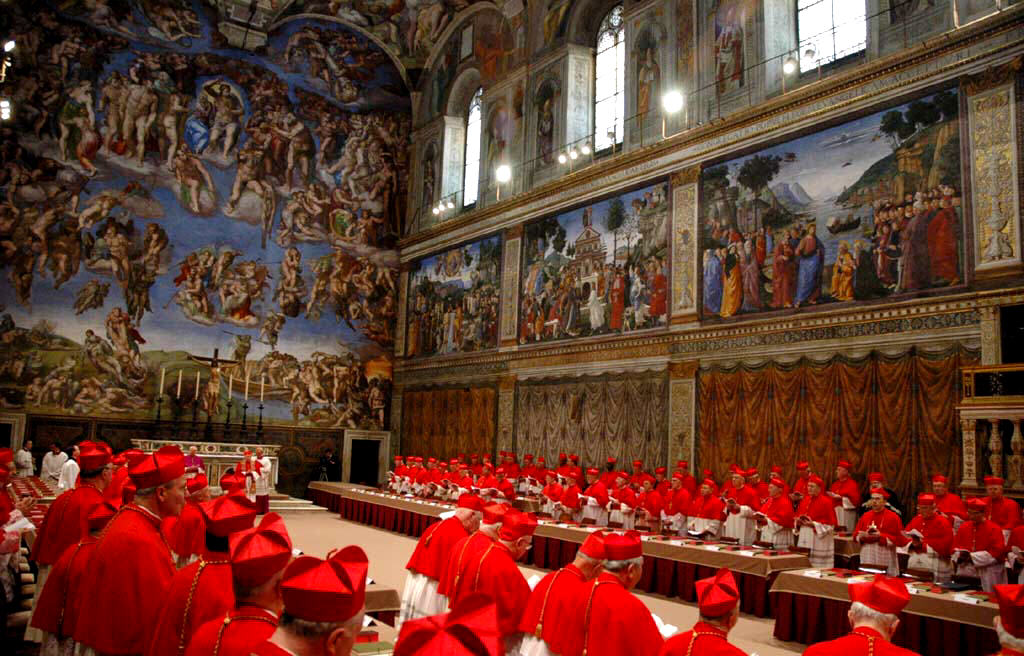
papal-conclave-005“What sorrow awaits you Pharisees! For you love to sit in the seats of honor in the synagogues and receive respectful greetings as you walk in the marketplaces. Yes, what sorrow awaits you! For you are like hidden graves in a field. People walk over them without knowing the corruption they are stepping on.”

“Teacher,” said an expert in religious law, “you have insulted us, too, in what you just said.”

“Yes,” said Jesus, “what sorrow also awaits you experts in religious law! For you crush people with unbearable religious demands, and you never lift a finger to ease the burden. What sorrow awaits you! For you build monuments for the prophets your own ancestors killed long ago. But in fact, you stand as witnesses who agree with what your ancestors did. They killed the prophets, and you join in their crime by building the monuments! This is what God in his wisdom said about you: ‘I will send prophets and apostles to them, but they will kill some and persecute the others.’

“As a result, this generation will be held responsible for the murder of all God’s prophets from the creation of the world — from the murder of Abel to the murder of Zechariah, who was killed between the altar and the sanctuary. Yes, it will certainly be charged against this generation.

“What sorrow awaits you experts in religious law! For you remove the key to knowledge from the people. You don’t enter the Kingdom yourselves, and you prevent others from entering.”

As Jesus was leaving, the teachers of religious law and the Pharisees became hostile and tried to provoke him with many questions. They wanted to trap him into saying something they could use against him.

Prayer: “Search me, O God, and know my heart; test me and know my anxious thoughts. Point out anything in me that offends you, and lead me along the path of everlasting life.” (Psalm 139.23-24) I ask it in Jesus’ name. Amen.

Spiritual Song: “Search me, O God”J. Edwin Orr (1936)

Search me, O God, and know my heart today; Try me, O Savior, know my thoughts, I pray. See if there be some wicked way in me; Cleanse me from ev’ry sin and set me free.

I praise You, Lord, for cleansing me from sin; Fulfill Your Word and make me pure within. Fill me with fire where once I burned with shame; Grant my desire to magnify Your name.

Lord, take my life, for I would live for You; Fill my poor heart with Your great love so true. Take all my will, my passion, self, and pride; I now surrender; Lord, in me abide.

O Holy Spirit, revival comes from You; Send a revival, my own heart renew. Your Word declares You will supply our need; For blessings now, O Lord, I humbly plead.