
Morning Prayer, 17 Apr – John 18:33-40 ~ are you a king

Morning Prayer

+ In the name of the Father, and of the Son, and of the Holy Spirit. Amen

Opening sentences — Puritan Prayers

Sovereign God, Thy cause, not my own, engages my heart, and I appeal to thee with greatest freedom to set up thy kingdom in every place where Satan reigns; Glorify thyself and I shall rejoice, for to bring honour to thy name is my sole desire….

Lord, use me as thou wilt, do with me what thou wilt; but, O, promote thy cause, let thy kingdom come, let thy blessed interest be advanced in this world! O do thou bring in great numbers to Jesus! Let me see that glorious day…. It is thy cause and kingdom I long for, not my own.

O, answer thou my request!

Morning reading

John 18:33-40 ESV
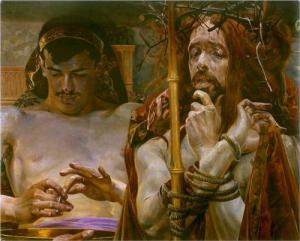
"Christ before Pilate" Jacek Malczewski, 1910 Lviv State Picture Gallery, Lviv, Ukraine
“Christ before Pilate”
Jacek Malczewski, 1910
Lviv State Picture Gallery, Lviv, Ukraine

Pilate then went back inside the palace, summoned Jesus and asked him, “Are you the king of the Jews?”

“Is that your own idea,” Jesus asked, “or did others talk to you about me?”

“Am I a Jew?” Pilate replied. “Your own people and chief priests handed you over to me. What is it you have done?”

Jesus said, “My kingdom is not of this world. If it were, my servants would fight to prevent my arrest by the Jewish leaders. But now my kingdom is from another place.”

“You are a king, then!” said Pilate.

Jesus answered, “You say that I am a king. In fact, the reason I was born and came into the world is to testify to the truth. Everyone on the side of truth listens to me.”

“What is truth?” retorted Pilate. With this he went out again to the Jews gathered there and said, “I find no basis for a charge against him. But it is your custom for me to release to you one prisoner at the time of the Passover. Do you want me to release ‘the king of the Jews’?”

They shouted back, “No, not him! Give us Barabbas!” Now Barabbas had taken part in an uprising.

Reflections:

Jesus’ kingdom

Jesus’ kingdom is otherworldly because he himself is not of this world and neither are his followers. He and his disciples have their source in God and reflect God’s own life and character. “Jesus’ kingdom is based on something other than . . . power or protection. It is based on his self-surrender, on his offering of himself for the sin of the world” (Ridderbos).

Jesus is working on a different level, one not of this world. His kingdom is quite distinct from other kingdoms, but he does indeed have a kingdom. Jesus’ explanation reveals that he is king in a sense that transcends all other kings: for this reason I was born, and for this I came into the world. If Pilate thought about what Jesus said at all, he would probably hear it only on a human level, that Jesus was claiming to be like any other child who was born a prince, in line to become king. But Pilate may not have gotten that far in his thinking, for Jesus says that he came into the world not to be king of the Jews, but to testify to the truth.

revealer of truth

“He is the king of Truth, and He manifests His royal power not by force, but by the witness He bears to the Truth” (Hoskyn). The truth he refers to is the truth of God.

Pilate thinks of Jesus as a defendant, but Jesus is taking the part of a witness, who “has come to testify against the rule of the lie and for `the truth,’ that is, for God and for God’s claim on the world” (Ridderbos). So Jesus is asking for Pilate to pass judgment not on him as king of the Jews, but on him as the revealer of truth. And he puts pressure on Pilate, for if he does not decide in favor of Jesus, he will judge himself as not being on the side of truth – more literally, “of the truth”; it refers to one’s inner disposition as tuned to the truth, able to hear the voice of truth. “Absolute truth is a very uncomfortable thing when we come in contact with it” (Ward).

Pilate does not listen to Jesus, so, according to what Jesus has just said, he is not of the truth. The judge has been judged and found self-condemned through his response to Jesus. The Jewish opponents had come to this same place during the course of Jesus’ ministry. So now both Jew and Gentile have been given a chance to respond to the one come from God, and they have rejected him.

liberation choice

There is a stark contrast between Barabbas, a violent man concerned with this world’s politics, albeit religious politics, and Jesus, whose kingdom is not of this world, though it is active in this world. There is also irony in the name Barabbas itself, since it means “son of Abba” — the word Abba, “father,” was used as a proper name (Brown), but, especially in John’s Gospel, Jesus is known as the Son of the Father. The crowd was choosing between two different approaches to liberation as represented by two men identified, in different ways, as “son of Abba.”

Here is the deceptiveness of sin that has been evident since the Garden of Eden. There is a path that looks right and seems to be of God, yet it is actually against him and his ways. The people choose their own path of liberation rather than God’s, and they therefore choose “not the Savior, but the murderer; not the Giver of life, but the destroyer” (Augustine). Every time we choose sin we do the same, whether the sin is blatant or deceptive.

The IVP New Testament Commentary Series
__________

__________

Canticle:

Christ, as a light… illumine and guide me. Christ, as a shield… overshadow me. Christ under me; Christ over me; Christ beside me on my left and my right.

This day be within and without me, lowly and meek, yet all-powerful. Be in the heart of each to whom I speak; in the mouth of each who speaks unto me. This day be within and without me, lowly and meek, yet all-powerful.

Christ as a light; Christ as a shield; Christ beside me on my left and my right.

Blessing

May the peace of the Lord Christ go with you, wherever He may send you. May He guide you through the wilderness, protect you through the storm. May He bring you home rejoicing at the wonders He has shown you. May He bring you home rejoicing once again into our doors.

+ In the name of the Father, and of the Son, and of the Holy Spirit. Amen

_____________________________________

Peanut Gallery: A brief word of explanation – the general format for Morning Prayer is adapted from the Northumbrian Community‘s Daily Office, as found in Celtic Daily Prayer (see online resources here.) The Scripture readings are primarily from the Gospel of John, with the intent to complete the reading by Easter. Other Scriptures which illuminate the Gospel of John will be included along the way.

Reflections from various saints will be included as their memorial days occur during the calendar year.

On Sundays, I’ll return to the USCCB readings (see online resources here) and various liturgical resources in order to reflect the Church’s worship and concerns throughout the world.

Photo illustrations and music videos, available online, are included as they illustrate or illuminate the readings. I will try to give credit and link to sources as best I can.

Morning Prayer, 16 Apr – John 18:28-32 ~ you do it

Morning Prayer

+ In the name of the Father, and of the Son, and of the Holy Spirit. Amen

Opening sentences — Puritan Prayers

O Lord, I marvel that thou shouldst become incarnate, be crucified, dead, and buried…. Give me to die with thee that I may rise to new life, for I wish to be as dead and buried to sin, to selfishness, to the world…. Purge me from selfishness, the fear of man, the love of approbation, the shame of being thought old-fashioned, the desire to be cultivated or modern…. Grant me to stand with my dying Saviour – resolute and Christ-contained.

Morning reading

"Christ before Pilate" Duccio di Buoninsegna, c.1311 Museo dell Opera del Duomo, Florence
“Christ before Pilate”
Duccio di Buoninsegna, c.1311
Museo dell Opera del Duomo, Florence

John 18:28-32 ESV

Then they led Jesus from the house of Caiaphas to the governor’s headquarters. It was early morning. They themselves did not enter the governor’s headquarters, so that they would not be defiled, but could eat the Passover.

So Pilate went outside to them and said, “What accusation do you bring against this man?”

They answered him, “If this man were not doing evil, we would not have delivered him over to you.”

Pilate said to them, “Take him yourselves and judge him by your own law.”

The Jews said to him, “It is not lawful for us to put anyone to death.”

This was to fulfill the word that Jesus had spoken to show by what kind of death he was going to die.

Reflections:

defilement

The irony of the opponents’ concern for defilement is evident. They wish to remain ritually pure even while seeking to kill someone by the agency of the Romans. They avoid defilement while bringing about the death of the Lamb of God who takes away the sin of the world, the root defilement that prevents one from intimacy with God and sharing in his life. Perhaps most ironic is the fact that their very act is a sin that defiles in this deep sense yet contributes to the cleansing of their sin and the sin of the whole world.

evil intent

Long before now Jesus’ opponents had come to the conclusion that he had to be eliminated…. Presumably they could request permission to kill Jesus themselves – they seem set, however, on having Rome execute Jesus, for then it would be by crucifixion. They probably want him crucified not only because it was a particularly brutal and painful form of death, but also because it would signify that Jesus is accursed by God (Robinson; Beasley-Murray). In John’s Gospel the focus is on Jesus as the revealer of God. His opponents have rejected that claim and desire his death in order to vindicate their conclusion.

witness to glory

John, however, sees this desire as a fulfillment of Jesus’ statement that he would die by being lifted up from the earth. “Both Jewish accusers and Roman judge are actors in a drama scripted by a divine planner” (Brown). John’s note reminds us both of Jesus’ identity as the Word whose words are God’s words, which will be fulfilled, and of the significance of this death: “I, when I am lifted up from the earth, will draw all men to myself”. Even the actions of his enemies are used to bear witness to the glory of his identity and of what he is in the process of accomplishing.

The IVP New Testament Commentary Series
__________

__________

Canticle:

Christ, as a light… illumine and guide me. Christ, as a shield… overshadow me. Christ under me; Christ over me; Christ beside me on my left and my right.

This day be within and without me, lowly and meek, yet all-powerful. Be in the heart of each to whom I speak; in the mouth of each who speaks unto me. This day be within and without me, lowly and meek, yet all-powerful.

Christ as a light; Christ as a shield; Christ beside me on my left and my right.

Blessing

May the peace of the Lord Christ go with you, wherever He may send you. May He guide you through the wilderness, protect you through the storm. May He bring you home rejoicing at the wonders He has shown you. May He bring you home rejoicing once again into our doors.

+ In the name of the Father, and of the Son, and of the Holy Spirit. Amen

_____________________________________

Peanut Gallery: A brief word of explanation – the general format for Morning Prayer is adapted from the Northumbrian Community‘s Daily Office, as found in Celtic Daily Prayer (see online resources here.) The Scripture readings are primarily from the Gospel of John, with the intent to complete the reading by Easter. Other Scriptures which illuminate the Gospel of John will be included along the way.

Reflections from various saints will be included as their memorial days occur during the calendar year.

On Sundays, I’ll return to the USCCB readings (see online resources here) and various liturgical resources in order to reflect the Church’s worship and concerns throughout the world.

Photo illustrations and music videos, available online, are included as they illustrate or illuminate the readings. I will try to give credit and link to sources as best I can.

Morning Reading : Luke 23: 50-56 NLT – buried

Reading: Luke 23:50-56 NLT

Now there was a good and righteous man named Joseph. He was a member of the Jewish high council, but he had not agreed with the decision and actions of the other religious leaders. He was from the town of Arimathea in Judea, and he was waiting for the Kingdom of God to come. He went to Pilate and asked for Jesus’ body.

image
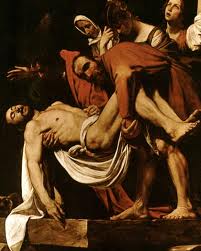
The Entombment of Christ by Carravagio, 1602-1603

Then he took the body down from the cross and wrapped it in a long sheet of linen cloth and laid it in a new tomb that had been carved out of rock. This was done late on Friday afternoon, the day of preparation, as the Sabbath was about to begin.

As his body was taken away, the women from Galilee followed and saw the tomb where his body was placed. Then they went home and prepared spices and ointments to anoint his body. But by the time they were finished the Sabbath had begun, so they rested as required by the law.

Creed: I believe in one Lord, Jesus Christ, the only Son of God, eternally begotten of the Father, God from God, Light from Light, true God from true God, begotten, not made, of one Being with the Father. Through him all things were made.

For us and for our salvation he came down from heaven: by the power of the Holy Spirit he became incarnate from the Virgin Mary, and was made man. For our sake he was crucified under Pontius Pilate; he suffered death and was buried.

On the third day he rose again in accordance with the Scriptures; he ascended into heaven and is seated at the right hand of the Father.

He will come again in glory to judge the living and the dead, and his kingdom will have no end.

Spiritual Song: “Creed”Third Day

Morning Reading: Luke 23.13-25 NLT – mob rule

https://www.youtube.com/watch?v=K7ijNGxMWUI&feature=youtube_gdata_playerReading: Luke 23:13-16, 18-25 NLT

Then Pilate called together the leading priests and other religious leaders, along with the people, and he announced his verdict.

image

“You brought this man to me, accusing him of leading a revolt. I have examined him thoroughly on this point in your presence and find him innocent. Herod came to the same conclusion and sent him back to us. Nothing this man has done calls for the death penalty. So I will have him flogged, and then I will release him.”

Then a mighty roar rose from the crowd, and with one voice they shouted, “Kill him, and release Barabbas to us!” (Barabbas was in prison for taking part in an insurrection in Jerusalem against the government, and for murder.)

Pilate argued with them, because he wanted to release Jesus. But they kept shouting, “Crucify him! Crucify him!”

For the third time he demanded, “Why? What crime has he committed? I have found no reason to sentence him to death. So I will have him flogged, and then I will release him.”

But the mob shouted louder and louder, demanding that Jesus be crucified, and their voices prevailed. So Pilate sentenced Jesus to die as they demanded. As they had requested, he released Barabbas, the man in prison for insurrection and murder. But he turned Jesus over to them to do as they wished.

Prayer: Lord God – It’s all so wrong… an unprincipled politician, self-serving religious leaders, and a rent-a-mob! Innocence declared but justice denied. Forbid it Lord that I should follow in these wretched footsteps. Help me to do the right thing – and take full responsibility for my decisions – regardless of the consequences. For Jesus’ sake! Amen.

Hymn: “Jesus, Lover of my Soul” Charles Wesley, 1740

Morning Reading: Luke 23:8-12 NLT – partners in crime

Reading: Luke 23:8-12 NLT

image

Herod was delighted at the opportunity to see Jesus, because he had heard about him and had been hoping for a long time to see him perform a miracle. He asked Jesus question after question, but Jesus refused to answer.

Meanwhile, the leading priests and the teachers of religious law stood there shouting their accusations. Then Herod and his soldiers began mocking and ridiculing Jesus.

Finally, they put a royal robe on him and sent him back to Pilate. (Herod and Pilate, who had been enemies before, became friends that day.)

Hymn: “What wondrous love is this, O my soul, O my soul”Annie Moses Band

What wondrous love is this, O my soul, O my soul,
What wondrous love is this, O my soul!
What wondrous love is this, that caused the Lord of bliss
To bear the dreadful curse for my soul, for my soul,
To bear the dreadful curse for my soul.

When I was sinking down, sinking down, sinking down,
When I was sinking down, sinking down.
When I was sinking down beneath God’s righteous frown,
Christ laid aside His crown for my soul, for my soul,
Christ laid aside His crown for my soul.

To God and to the Lamb, I will sing, I will sing;
To God and to the Lamb, I will sing.
To God and to the Lamb, Who is the great “I Am,”
While millions join the theme, I will sing, I will sing,
While millions join the theme, I will sing.

And when from death I’m free, I’ll sing on, I’ll sing on,
And when from death I’m free, I’ll sing on.
And when from death I’m free, I’ll sing and joyful be.
And thru eternity, I’ll sing on, I’ll sing on,
And thru eternity I’ll sing on.

What wondrous love, O my soul!