Peanut Gallery: Millions of Egyptians cheer in the streets. Christians stand with military and opposition leaders.
__________________________
Click on video link: Military tells Morsi he is no longer president, http://fxn.ws/15gz9T9 – Sent via the FOX News Android App.
__________________________
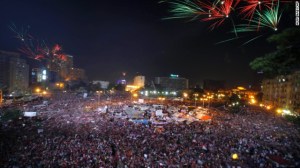
Fireworks light the sky as opponents of Mohamed Morsy celebrate in Tahrir Square in Cairo on Wednesday, July 3. Egypt’s military deposed Morsy, the country’s first democratically elected president, installing the head of the country’s highest court as an interim leader, the country’s top general announced Wednesday. Click on picture for photo gallery to see how the protests and subsequent coup unfolded:
Is it really a Spring at all, or a frightening return of an worse Winter?
As the one year anniversary of the election of Egypt’s President Mohamed Morsi approaches, tensions are high. Tens of thousands of Islamists have begun pouring into Cairo in anticipation of anti-Morsi demonstrations planned for June 30, 2013, by opponents of the new government.
KNOXVILLE, TN (Catholic Online) – As the one year anniversary of the election of Egypt’s President Mohamed Morsi approaches, tensions are high. Tens of thousands of Islamists have begun pouring into Cairo in anticipation of anti-Morsi demonstrations planned for June 30, 2013, by opponents of the new government.
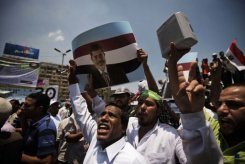
Egyptian Islamists led by the ruling Muslim Brotherhood shout slogans during a demonstration on June 21, 2013 in Cairo to mark the upcoming one year anniversary since President Mohamed Morsi's election. Tens of thousands of Islamists gathered for a show of strength ahead of planned opposition protests against Morsi, highlighting the tense political divide in the Arab world's most populous state.
According to France 24, an international news site, Islamists carrying Egyptian flags and pictures of Morsi held a demonstration on Friday, June 21. It was led by the Muslim Brotherhood, and its aim was to show that Morsi and his government had the support of the Egyptian people. But the Egyptian people are clearly divided.
Morsi was elected one year ago, after the fall of President Hosni Mubarak in February of 2011. Morsi promised to be the President of all Egyptians, including the Coptic Christian community. He said the Copts would be given full equal rights. At one point Morsi said, “I will not be biased against any son of Egypt.” But this is not what has happened.
Instead, it appears that Morsi has used every opportunity to turn Egypt into an Islamist state since he became president. This past November, President Morsi issued a declaration giving himself sweeping dictatorial-style power over the drafting of Egypt’s new constitution. The President’s actions unleashed a firestorm.
A group of judges said, “The state of law is at stake.” The Vice-President of the Supreme Constitutional Court, Tahani al-Gebali, said that Morsi was now an “illegitimate president.” And Mohamed ElBaradei, a Nobel Peace Prize winner, said, “Morsi today usurped all state powers and appointed himself Egypt’s new pharaoh.”
Protestors marched on the presidential palace in Cairo and clashed with supporters of the Muslim Brotherhood. At one point, an estimated 200,000 anti-Morsi protestors flooded into Cairo’s famous Tahrir Square.
President Morsi seemingly backed down, but the final Constitution was drafted by a committee dominated by Islamists who used the Constitution to strengthen sharia law. Sharia law highly discriminates against non-Muslims and women.
Since taking office, Morsi has also had run-ins with the national judiciary, the media and the police. More recently, Morsi appointed seven members of the Muslim Brotherhood as provincial governors. He also gave the Luxor governorship to a member of the militant Islamist group responsible for the massacre of 58 foreign tourists in 1997. These appointments led to several clashes between Morsi’s supporters and his opponents.
According to his opponents, Morsi is “giving the Islamists a monopoly over public institutions.” However, the president’s supporters claim he is merely cleaning up corrupt institutions from the days of Mubarak.
Yet, organizers of the June 30 demonstration say they have collected 15 million signatures on a petition which demands the resignation of Morsi. Nevertheless, Ahmed Aqila, a representative of the Muslim Brotherhood Freedom and Justice Party, does not believe it can happen. He said, “Those who say ‘President Morsi will be toppled on June 30’ live in an illusion they must give up.”
The Coptic Christian community has been concerned that the Morsi government is allowing Islamists to act more aggressively toward non-Muslims. Heba Morayef, a director for Regional Human Rights Watch, says that some Muslims are using more discriminatory language on television. He says, “It’s very scary because of the sudden uptick in violence, compounded by the fact that the Muslim Brotherhood has in no way tried to reign it back and has at times participated.”
For instance, a member of the Muslim Brotherhood, Safwat Hegazi, recalling demonstrations last December which turned violent, told the Copts, “You share this country with us, but there are red lines, and one red line is the legitimacy of Dr. Morsi. Whoever splashes water on that, we will spill his blood.” Hegazi has since been appointed to the National Council on Human Rights in Egypt.
Consequently, some people are nervous about the upcoming demonstration scheduled at the end of this month and with good reason. There is much at stake. Coptic Christians and women have the most to lose, but so too do all Muslims, especially more moderate and secular Muslims.
While spokesmen from both sides are rightly calling for calm, they also realize that people have a right to address the Morsi government. Although he did not officially endorse the upcoming demonstration, according to one source, Pope Tawadros II of the Coptic Orthodox Church said, “Members of Egypt’s Christian minority are free to express their opinions on the streets, just as they were to vote for whomever candidate they supported in the past presidential elections.”
That is the way it should be in a true democracy, and President Morsi knows it. After one of the demonstrations last year, he said, “I will protect for my brothers in the opposition all their rights so they can exercise their role.” Now Morsi needs to prove it. Is Egypt a true democracy or not? Will Egypt’s Coptic Christians ever share in the Arab Spring, or was it a lie? We shall find out at the end of the month.
Let us pray for the safety of our brave brethren who will be demonstrating on June 30, and for a free Egypt where all Egyptians can live in peace. They are not alone. They are merely on the front lines of a battle that is threatening to engulf Christians throughout the world.
________________
Michael Terheyden was born into a Catholic family, but that is not why he is a Catholic. He is a Catholic because he believes that truth is real, that it is beautiful and good, and that the fullness of truth is in the Catholic Church. However, he knows that God’s grace operating throughout his life is the main reason he is a Catholic. He is greatly blessed to share his faith and his life with his beautiful wife, Dorothy. They have four grown children and three grandchildren.
Peanut Gallery: Egypt is in turmoil… it has been for a long time. But now, the world is watching. The news is filled with stories of political unrest, violence, persecution and international forces jockeying for position and influence. But what about ordinary Egyptian people (mostly muslim)… the poor people who do not make news headlines and are just trying to get a life – such as it is.
Robert Johnson, in this photo essay gives us a rare insight into the lives of these ordinary people. For more of Johnson’s photo-journal insights on Egypt – click here.
___________________________________
When a man I met on Friday invited me to his family’s home for Sunday dinner, it was an uncommon offer. When the invitation turned out to be in Dar el-Salam, one of Egypt’s most poverty stricken areas, Easter afternoon turned into a once-in-lifetime affair.
The road to Dar el-Salam is dirt and a crest of smoldering refuse lines the middle of it, picked over by cats, dogs, burros, kids, and collectors trying to bring home any money they can. It took four attempts to find a cab driver willing to take us. When we arrived, the man who invited me, Hani, sat with a group of 10 or so other men at an outdoor cafe. A small part of the local mafia family, he said he’d grown up beside them and they specialized in “whatever makes them money.”
From what I could tell their enterprise includes drugs and theft, but whatever it is offers them neighborhood wide-respect. They took me to a place I couldn’t have imagined and perhaps no one from the outside could have gone without a personal escort from them, definitely not an American with two big noisy cameras.
Back through the dusty, narrow alleys, past broken-down billiard tables shoved into mud brick rooms, haphazard grocery stores, and untold apartments, we came to a dead end.
A massive bed of gravel and rock led to a sheer cliff wall and the skeletal remains of apartments destroyed by the last rock slide.
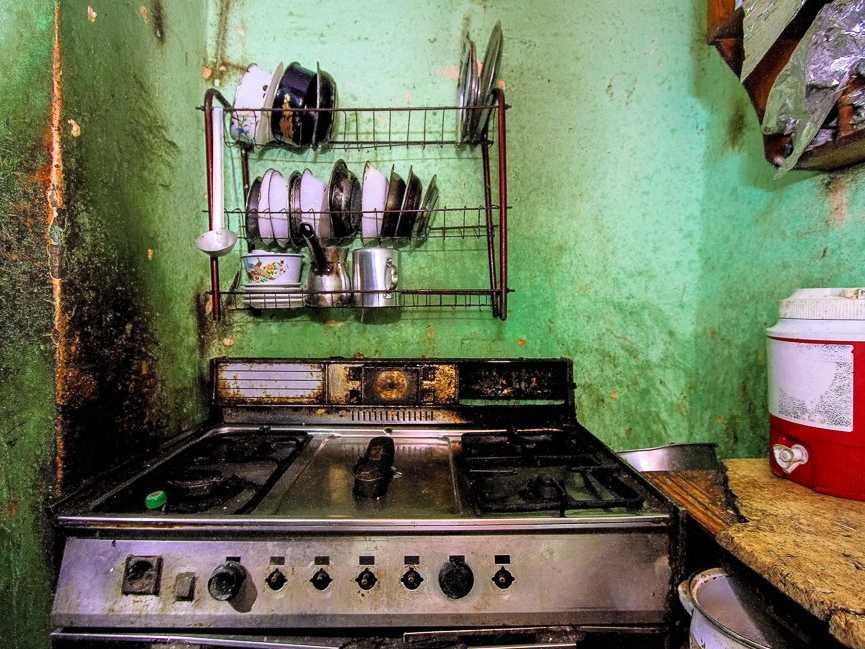
The families whose homes they took me into were unlike anything I’d ever seen, and far from hiding the situation they were in, the residents let me stomp into their home because they wanted to let the world know how they lived. They’d appreciate a bit of help from the new government, just picking up the trash would be a nice start, they said.
I’ve yet to meet someone happy with the results of the revolution and these people were no different. Their neighborhood started to slide about eight years ago, and has gotten dramatically worse in the past couple of years. Water bills have nearly doubled, rents have gone up and incomes way down.
One Muslim family of seven sleeping in a subterranean room invited us to stay for Easter dinner. An incredibly gracious offer we had to decline, as we made our way to Hani’s father’s apartment.
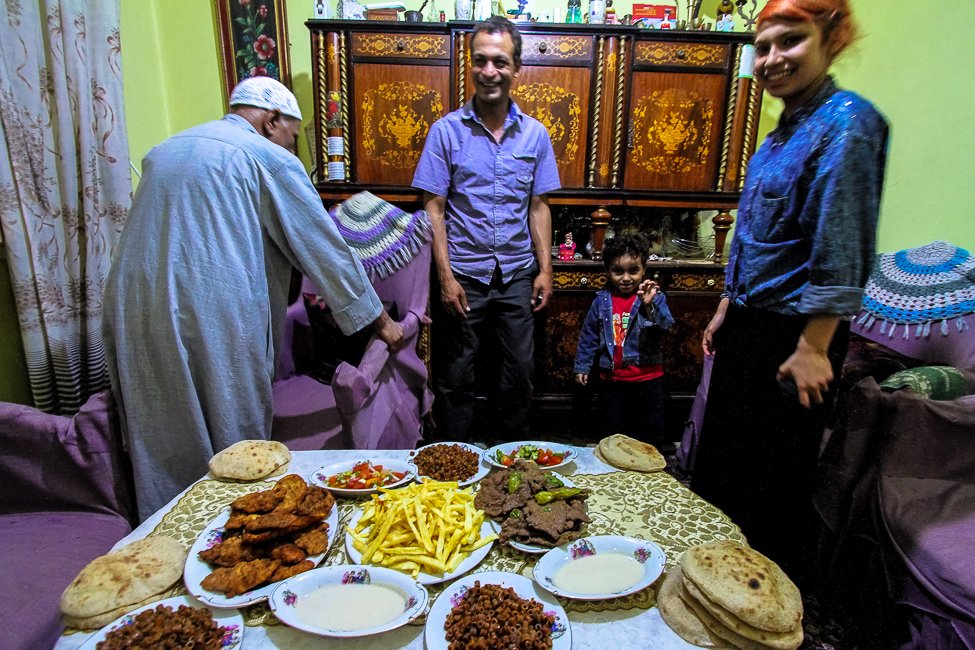
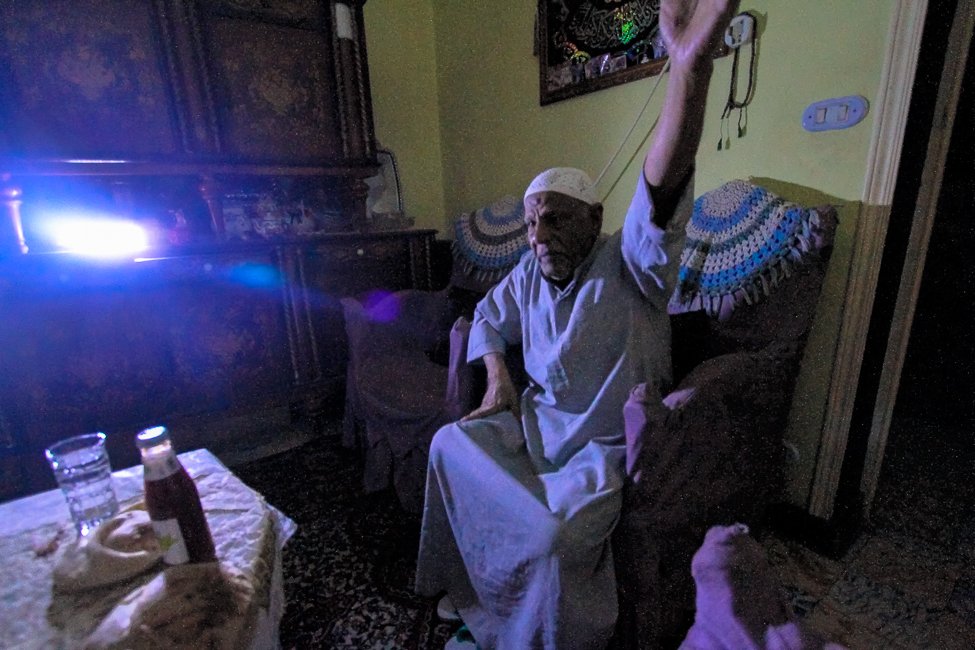
Dinner was on the table when we arrived. A big plate of French fries and a new bottle of Ketchup sat before the seat of honor, the middle of the couch where I was directed.
There’s just enough to get by on now, barely. When people like this can no longer feed their kids, they’ll have nothing to lose. Already they pine for the days of former president Mubarak.
Here are a few pictures from the visit. I’ll post a longer feature on the experience next week.
Robert Johnson/Business Insider
They did not have much, but they were all smiles and offering to share.
Robert Johnson/Business Insider
Washroom off the kitchen
Robert Johnson/Business Insider
Stairs
Robert Johnson/Business Insider
Without enough money, women are forced to share the same space as the men
Robert Johnson/Business Insider
Easter dinner, with French fries and Ketchup for the first American they’ve met
Robert Johnson/Business Insider
And then power went off, my host said it’s because president Morsi is selling electricity to Gaza. And charging 30 percent more than it cost under the former president.
Peanut Gallery: As events unfold in the Middle East, “dhimmitude” is a word you should understand- it directly affects Christians living in Islamic countries and explains why they are so often mistreated (see earlier post “Muslim Persecution of Christians”).
“dhimmitude […] represents a behavior dictated by fear (terrorism), pacifism when aggressed, rather than resistance, servility because of cowardice and vulnerability. […] By their peaceful surrender to the Islamic army, they obtained the security for their life, belongings and religion, but they had to accept a condition of inferiority, spoliation (plundering) and humiliation. As they were forbidden to possess weapons and give testimony against a Muslim, they were put in a position of vulnerability and humility.”[9] (Wikipedia)
To put it simply, non-muslims (dhimmis) living in Islamic countries are second-class citizens with little, or no, protection under Sharia law. They are essentially at the mercy of the enforcing religious authority.
If you read the entire Wikipedia article you will find that my characterization of “dhimmitude” and “dhimmis” is disputed by some scholars as “past history” and could be described as Islamophobic. But disputed or not, there is growing evidence that Western observers of Islamic countries have turned a blind eye to the current wide-spread reality of “dhimmitude,” particularly in rural, or lawless, areas that are outside normal Western scrutiny. (I refer you again to “Muslim Persecuton of Christians.”)
The answer lies in the willful denial of the historic realities (past and present) of “dhimmitude.” Jew-hatred (and Christian persecution) are intrinsic to Muhammad Morsi’s Sharia inspired worldview. But it simply doesn’t fit the Western pundits’ “Arab Spring” narrative.
The victory in the referendum on the Constitution is the fourth straight Muslim Brotherhood success—including the overthrow of President Husni Mubarak’s regime with army assistance, the parliamentary election and the presidential election–in the process of taking over Egypt for the long-term and fundamentally transforming it into a radical Islamist state. This last one should be sufficient to go all the way. This event is also producing a new stage of Western rationalizations that whitewash the Muslim Brotherhood and rationalize support for Islamists being in power.
__________________
There are three factors involved here in setting Western policy: ignorance, a desire to avoid crises, and a foolish belief that having a radical regime in Egypt will moderate the extremists.
__________________
It isn’t that the constitution, as many Salafists would have liked, explicitly mandates a revolutionary Sharia state. Rather, the constitution sets up a framework that will allow the Brotherhood to do so. Between the president and the constitution, the Brotherhood will now march through every institution and remake it. Judges will be appointed; school curricula rewritten; army generals appointed; and so on. As the Brotherhood shows patience in carrying out this process of gaining total, permanent control, many in the West will interpret that as moderation.
“The problem with [President] Morsi isn’t whether he is Islamist or not, it is whether he is authoritarian,” said a Western diplomat in Cairo. Wow, talk about Western misunderstanding of the importance of ideology. Continue reading “Egypt Votes: Islamic Dictatorship Wins”→




 The Peanut Gallery