
Morning Prayer, 14 Apr – John 18:19-24 ~ no witnesses

Morning Prayer

+ In the name of the Father, and of the Son, and of the Holy Spirit. Amen

Opening sentences — Puritan Prayers

O Lord, I marvel that thou shouldst become incarnate, be crucified, dead, and buried.

Grant me to stand with my dying Saviour, to be content to be rejected, to be willing to take up unpopular truths, and to hold fast despised teachings until death. Help me to be resolute and Christ-contained.

Morning reading

Christ before the High Priest Gerrit van Honthorst, c. 1617 Oil on canvas National Gallery, London
Christ before the High Priest
Gerrit van Honthorst, c. 1617
Oil on canvas
National Gallery, London

John 18:19-24 ESV

The high priest then questioned Jesus about his disciples and his teaching.

Jesus answered him, “I have spoken openly to the world. I have always taught in synagogues and in the temple, where all Jews come together. I have said nothing in secret. Why do you ask me? Ask those who have heard me what I said to them; they know what I said.”

When he had said these things, one of the officers standing by struck Jesus with his hand, saying, “Is that how you answer the high priest?”

Jesus answered him, “If what I said is wrong, bear witness about the wrong; but if what I said is right, why do you strike me?”

Annas then sent him bound to Caiaphas the high priest.

Reflections:

disciples and teaching

This is not an actual trial – there are no witnesses, no jury and no sentence. This is more like “a police interrogation of a newly arrested criminal before any formal trial procedures are begun” (Brown; Robinson). Annas asks Jesus about his disciples, reflecting the Sanhedrin’s earlier concern over Jesus’ popularity. Annas also asks Jesus about his teaching. He seems to want Jesus to incriminate himself as a false prophet (Beasley-Murray) or at least as a false teacher (Robinson; Brown). But Jesus will not be trapped in this way.

Jesus tells Annas to check with those who have heard him, since he has taught quite openly. In this way he heightens Annas’ anxiety. The very fact that Jesus has spoken openly and that there are plenty of people who are familiar with his teaching is what concerns Annas. That Jesus does nothing to assure Annas that his teaching is kosher would also increase the high priest’s fears.

appeal to witnesses

Jesus’ appeal to the witness of those who had heard him is essentially a demand for a fair trial (Brown), since in Jewish law the witnesses are questioned, not the accused. Jesus has completed his witness by word. There remains only the climax of all his ministry as he witnesses to the Father through his death, resurrection and ascension. It is now up to those who have heard him to bear witness to him.

Such remains the case today. His abiding presence remains with believers, but those who abide in him are to bear witness to him before the world. “The author insists that the teaching of Jesus must be known through attention to His disciples, who by the guidance of the Spirit preserve and interpret His words. A true judgement of the world upon the Christ depends upon the fidelity of His disciples” (Hoskyns).

The IVP New Testament Commentary Series
__________

“Jesus, Keep Me Near the Cross” – Fanny J. Crosby, 1820-1915

Jesus, keep me near the cross; there a precious fountain, free to all, a healing stream, flows from Calvary’s mountain.

In the cross, in the cross, be my glory ever, till my raptured soul shall find rest beyond the river.

Near the cross, a trembling soul, love and mercy found me; there the bright and morning star sheds its beams around me.

Near the cross! O Lamb of God, bring its scenes before me; help me walk from day to day with its shadow o’er me.

Near the cross I’ll watch and wait, hoping, trusting ever, till I reach the golden strand just beyond the river.

__________

Canticle:

Christ, as a light… illumine and guide me. Christ, as a shield… overshadow me. Christ under me; Christ over me; Christ beside me on my left and my right.

This day be within and without me, lowly and meek, yet all-powerful. Be in the heart of each to whom I speak; in the mouth of each who speaks unto me. This day be within and without me, lowly and meek, yet all-powerful.

Christ as a light; Christ as a shield; Christ beside me on my left and my right.

Blessing

May the peace of the Lord Christ go with you, wherever He may send you. May He guide you through the wilderness, protect you through the storm. May He bring you home rejoicing at the wonders He has shown you. May He bring you home rejoicing once again into our doors.

+ In the name of the Father, and of the Son, and of the Holy Spirit. Amen

_____________________________________

Peanut Gallery: A brief word of explanation – the general format for Morning Prayer is adapted from the Northumbrian Community‘s Daily Office, as found in Celtic Daily Prayer (see online resources here.) The Scripture readings are primarily from the Gospel of John, with the intent to complete the reading by Easter. Other Scriptures which illuminate the Gospel of John will be included along the way.

Reflections from various saints will be included as their memorial days occur during the calendar year.

On Sundays, I’ll return to the USCCB readings (see online resources here) and various liturgical resources in order to reflect the Church’s worship and concerns throughout the world.

Photo illustrations and music videos, available online, are included as they illustrate or illuminate the readings. I will try to give credit and link to sources as best I can.

Morning Prayer, 12 Apr – John 18:15-18 ~ not me (1)

Mornng Prayer

+ In the name of the Father, and of the Son, and of the Holy Spirit. Amen

Opening sentences — John Knox, Scottish reformer (1510 – 1572)

Let your mighty hand and outstretched arm, O Lord, be our defense; Your mercy and loving-kindness in Jesus Christ, your dear Son, our salvation; Your true and holy word our instruction; Your grace and Holy Spirit our comfort and consolation, Until the end and in the end.

Morning reading

"Jesus before Annas, and Peter's first denial of Jesus" Duccio di Buoninsegna, 1308-11 Museo dell'Opera del Duomo, Siena
“Jesus before Annas, and Peter’s first denial of Jesus”
Duccio di Buoninsegna, 1308-11
Museo dell’Opera del Duomo, Siena

John 18:15-18 ESV

Simon Peter followed Jesus, and so did another disciple. Since that disciple was known to the high priest, he entered with Jesus into the courtyard of the high priest, but Peter stood outside at the door. So the other disciple, who was known to the high priest, went out and spoke to the servant girl who kept watch at the door, and brought Peter in.

The servant girl at the door said to Peter, “You also are not one of this man’s disciples, are you?”

He said, “I am not.”

Now the servants and officers had made a charcoal fire, because it was cold, and they were standing and warming themselves. Peter also was with them, standing and warming himself.

Reflections:

John as faithful friend

Peter and John follow as Jesus is brought before Annas. John’s familiarity with the high priest, or at least with his household, enables him to enter with Jesus and to get Peter admitted also. The one who reclined next to Jesus a few hours earlier at the meal continues to be close to him. But his going back out to bring Peter in shows that he, like his master, is also concerned for others, in particular this fellow believer. The love evident in this gesture reveals John’s character as a true disciple and as one to whose care Jesus can entrust other disciples, indeed even his mother.

Peter’s disassociation

It seems to be Peter’s association with John, the unnamed disciple, that draws attention to his relation to Jesus. John himself shows no concern about her feelings regarding his discipleship, for he not only was admitted by her, but also came back to get Peter in. While Peter’s attack with the sword may have made him fearful of being recognized, he is not in a position of legal difficulty, since there is no warrant for his arrest. Nor is there indication that he was physically threatened by this woman or the others. He has no such excuses for his denial. He who a few hours earlier had said he would die for Jesus now denies any association with him purely out of fear of what people would think.

inside or outside

The darkness of the courtyard may have a symbolic significance, for it means Peter is outside in the half-light while John is inside with the Light of the World. Peter is not denigrated in this Gospel, but he does “serve as a foil for the behavior of another disciple who is never deflected from his following of Jesus” (Brown). In the half-light, separated from Jesus, Peter encounters temptation for which he does not have the resources to resist. The only hope for any of us in the time of temptation is to remain close to Jesus.

The IVP New Testament Commentary Series
__________

__________

Canticle:

Christ, as a light… illumine and guide me. Christ, as a shield… overshadow me. Christ under me; Christ over me; Christ beside me on my left and my right.

This day be within and without me, lowly and meek, yet all-powerful. Be in the heart of each to whom I speak; in the mouth of each who speaks unto me. This day be within and without me, lowly and meek, yet all-powerful.

Christ as a light; Christ as a shield; Christ beside me on my left and my right.

Blessing

May the peace of the Lord Christ go with you, wherever He may send you. May He guide you through the wilderness, protect you through the storm. May He bring you home rejoicing at the wonders He has shown you. May He bring you home rejoicing once again into our doors.

+ In the name of the Father, and of the Son, and of the Holy Spirit. Amen

_____________________________________

Peanut Gallery: A brief word of explanation – the general format for Morning Prayer is adapted from the Northumbrian Community‘s Daily Office, as found in Celtic Daily Prayer (see online resources here.) The Scripture readings are primarily from the Gospel of John, with the intent to complete the reading by Easter. Other Scriptures which illuminate the Gospel of John will be included along the way.

Reflections from various saints will be included as their memorial days occur during the calendar year.

On Sundays, I’ll return to the USCCB readings (see online resources here) and various liturgical resources in order to reflect the Church’s worship and concerns throughout the world.

Photo illustrations and music videos, available online, are included as they illustrate or illuminate the readings. I will try to give credit and link to sources as best I can.
Morning Prayer, 11 Apr – John 18:12-14 ~ interrogation

Mornng Prayer

+ In the name of the Father, and of the Son, and of the Holy Spirit. Amen

Opening sentences

I am no longer my own, but Yours. Use me as You choose; put me to doing, put me to suffering; let me be employed for You, or laid aside for You, raised up for You, or brought low for you; let me be full, let me be empty; let me have all things, let me have nothing; with my whole heart I freely choose to yield all things to Your ordering and approval.

So now, God of glory, Father, Son and Holy Spirit, You are mine, and I am Your own.

Morning reading

Jesus Before Annas Duccio di Buoninsegna, 1308-11  Tempera on wood panel Museo dell'Opera del Duomo, Siena, Italy
Jesus Before Annas
Duccio di Buoninsegna, 1308-11
Tempera on wood panel
Museo dell’Opera del Duomo, Siena, Italy

John 18:12-14 ESV

So the band of soldiers and their captain and the officers of the Jews arrested Jesus and bound him. First they led him to Annas, for he was the father-in-law of Caiaphas, who was high priest that year. It was Caiaphas who had advised the Jews that it would be expedient that one man should die for the people.

Reflections:

religious dynasty

They took Jesus first to Annas, probably the most respected and powerful of the Jewish authorities at that time. He had held the office of high priest earlier (A.D. 6-15), and his influence continued through his son-in-law Caiaphas, the current high priest and through his five sons, who had also been high priest for various lengths of time. Annas was the head of a dynasty, which probably accounts for John’s reference to him as high priest, even though John is clear that Caiaphas is the one holding that office at the time.

John as witness

John had other contacts with Annas later when he himself was on trial (Acts 4:6). John had to bear witness before this man, and his bearing witness is the main theme that comes through in this story. He can bear witness to the Passion because he was there (cf. Ridderbos).

John was separated from Jesus during his interrogation, but we now discover it was only for a brief time. He and Peter recover and return to see what transpires. In this way, John has not missed much of the action and thus is able to bear witness to the whole story. Unlike Peter, he is inside the high priest’s palace and witnesses the whole of the Passion. This theme of witness is also the focal point of Jesus’ exchange with Annas (vv. 20-23). Thus this particular story is important for John, both personally and for the theme it brings out.

Caiaphas’ prophecy

John refers back to Caiaphas’ prophetic statement that it would be good if one man died for the people (v. 14). This allusion reminds the reader of the reason for Jesus’ death. John uses Caiaphas’ own statement as a caption under this picture of the Passion, providing the interpretation of the cross as surely as does the title that Pilate will require to be nailed above the head of Jesus. This death is for the sake of the very people who are causing it.

The IVP New Testament Commentary Series
__________


__________

Canticle:

Christ, as a light… illumine and guide me. Christ, as a shield… overshadow me. Christ under me; Christ over me; Christ beside me on my left and my right.

This day be within and without me, lowly and meek, yet all-powerful. Be in the heart of each to whom I speak; in the mouth of each who speaks unto me. This day be within and without me, lowly and meek, yet all-powerful.

Christ as a light; Christ as a shield; Christ beside me on my left and my right.

Blessing

May the peace of the Lord Christ go with you, wherever He may send you. May He guide you through the wilderness, protect you through the storm. May He bring you home rejoicing at the wonders He has shown you. May He bring you home rejoicing once again into our doors.

+ In the name of the Father, and of the Son, and of the Holy Spirit. Amen

_____________________________________

Peanut Gallery: A brief word of explanation – the general format for Morning Prayer is adapted from the Northumbrian Community‘s Daily Office, as found in Celtic Daily Prayer (see online resources here.) The Scripture readings are primarily from the Gospel of John, with the intent to complete the reading by Easter. Other Scriptures which illuminate the Gospel of John will be included along the way.

Reflections from various saints will be included as their memorial days occur during the calendar year.

On Sundays, I’ll return to the USCCB readings (see online resources here) and various liturgical resources in order to reflect the Church’s worship and concerns throughout the world.

Photo illustrations and music videos, available online, are included as they illustrate or illuminate the readings. I will try to give credit and link to sources as best I can.
Morning Prayer, 10 Apr – John 18:1-11 ~ arrested

Mornng Prayer

+ In the name of the Father, and of the Son, and of the Holy Spirit. Amen

Opening sentences 

O God, make clear to us each road. O God, make safe to us each step; when we stumble, hold us; when we fall, lift us up. When we are hard-pressed with evil, deliver us; and bring us at last to Your glory.

Morning reading

John 18:1-11 ESV

When Jesus had spoken these words, he went out with his disciples across the brook Kidron, where there was a garden, which he and his disciples entered. Now Judas, who betrayed him, also knew the place, for Jesus often met there with his disciples. So Judas, having procured a band of soldiers and some officers from the chief priests and the Pharisees, went there with lanterns and torches and weapons.

Then Jesus, knowing all that would happen to him, came forward and said to them, “Whom do you seek?”

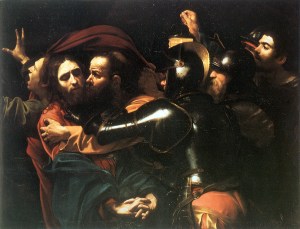
The Taking of Christ  by Caravaggio, ca. 1602.
The Taking of Christ
by Caravaggio, ca. 1602.

They answered him, “Jesus of Nazareth.”

Jesus said to them, “I am he.” Judas, who betrayed him, was standing with them. When Jesus said to them, “I am he,” they drew back and fell to the ground. So he asked them again, “Whom do you seek?”

And they said, “Jesus of Nazareth.”

Jesus answered, “I told you that I am he. So, if you seek me, let these men go.” This was to fulfill the word that he had spoken: “Of those whom you gave me I have lost not one.”

Then Simon Peter, having a sword, drew it and struck the high priest’s servant and cut off his right ear. (The servant’s name was Malchus.) So Jesus said to Peter, “Put your sword into its sheath; shall I not drink the cup that the Father has given me?”

Reflections:

partners in crime

The group that came to arrest Jesus was composed of Roman soldiers, Jewish servants and an apostate apostle – making it clear that both Jew and Gentile are guilty of the death of the Son of God. Jesus is about to die for the life of the world, and the whole world needs it. They bring torches and lanterns to search for the Light of the World; they bring weapons against the Prince of Peace (Hendriksen).

Jesus knows what is coming upon him and asks, “Who is it you want?” This is not a question from ignorance, seeking an answer. Rather, it is like other questions asked by God that are intended to reveal a situation and bring people to action.

I am he

They say they are looking for Jesus of Nazareth, and Jesus responds, “I am he” (ego eimi). Here the most humble and human of Jesus’ names is juxtaposed with the most exalted and divine. The two together are the cross hairs that target Jesus’ identity: he is the human being from an insignificant, small town in Galilee who is also God. Jesus’ self-identification has been at the heart of this Gospel, and this public act of identification produces dramatic effects – they drew back and fell to the ground.

This reaction is a reflection not of their hearts, but of Jesus’ majesty. Here is a little preview of the moment in the future when every knee will bow to Jesus and all things be brought into subjection to him, even those who do not own allegiance to him and thus for whom this submission is hell.

word of protection

The protection Jesus spoke of earlier referred to eternal salvation, and now we see that such protection includes occasions of temptation that threaten to overwhelm the disciples’ faith. Here is Jesus as the Good Shepherd caring for his flock, a glimpse of the grace that is at work throughout the Passion as it has been throughout the ministry. The temptation the disciples face here is an extreme case of what all temptation represents. And the Lord’s protection is as necessary in the day to day assaults as it is in this great test. It is not without reason that our Lord commanded us to pray daily not to be led into temptation.

The IVP New Testament Commentary Series

__________


__________

Canticle:

Christ, as a light… illumine and guide me. Christ, as a shield… overshadow me. Christ under me; Christ over me; Christ beside me on my left and my right.

This day be within and without me, lowly and meek, yet all-powerful. Be in the heart of each to whom I speak; in the mouth of each who speaks unto me. This day be within and without me, lowly and meek, yet all-powerful.

Christ as a light; Christ as a shield; Christ beside me on my left and my right.

Blessing

May the peace of the Lord Christ go with you, wherever He may send you. May He guide you through the wilderness, protect you through the storm. May He bring you home rejoicing at the wonders He has shown you. May He bring you home rejoicing once again into our doors.

+ In the name of the Father, and of the Son, and of the Holy Spirit. Amen

_____________________________________

Peanut Gallery: A brief word of explanation – the general format for Morning Prayer is adapted from the Northumbrian Community‘s Daily Office, as found in Celtic Daily Prayer (see online resources here.) The Scripture readings are primarily from the Gospel of John, with the intent to complete the reading by Easter. Other Scriptures which illuminate the Gospel of John will be included along the way.

Reflections from various saints will be included as their memorial days occur during the calendar year.

On Sundays, I’ll return to the USCCB readings (see online resources here) and various liturgical resources in order to reflect the Church’s worship and concerns throughout the world.

Photo illustrations and music videos, available online, are included as they illustrate or illuminate the readings. I will try to give credit and link to sources as best I can.

Morning Prayer, 9 Apr – John 17:25-26 ~ mediated intimacy

Mornng Prayer

+ In the name of the Father, and of the Son, and of the Holy Spirit. Amen

Opening sentences – Cuthbert of Northumbria (635-87)

My eyes, my eyes have seen the King. The vision of His beauty has pierced me deep within. To whom else can I go?

My heart, my heart desires Him. He’s touched somerthing inside of me that’s now reaching out for Him. And I know that I must go.

My God is my love, my guard, my healing one; my bright love is my merciful Lord; my sweet love is Christ; His heart is my delight; all my love are You, O King of glory.

Morning reading

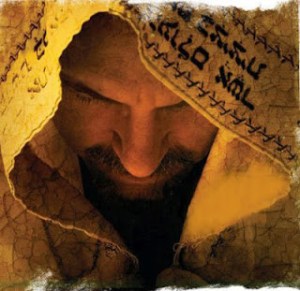
jesus-praying

John 17:25-26 ESV

“O righteous Father, even though the world does not know you, I know you, and these know that you have sent me. I made known to them your name, and I will continue to make it known, that the love with which you have loved me may be in them, and I in them.”

Reflections:

bad news / good news

Jesus begins with the bad news: the world did not know, or recognize, the Father. In contrast, the good news is Jesus knew the Father and his disciples knew that the Father sent the Son. In contrast with the world’s ignorance of the Father is not the disciples’ knowledge of the Father, but their knowledge of the Son as sent by the Father. Again we see the primacy of Jesus’ role. It is precisely in and through the Son that they know the Father, for the Son has made known to them the Father’s name. Earlier in the prayer the name was an expression for the revelation brought by the Son that actually brings contact with God and not just information about him.

Jesus’ contimued presence

Jesus then pledges to continue to make the Father’s name known to his disciples in the future. On one important level he refers here to his imminent Passion and resurrection, for these events are the climax of his revelation of the Father, which shows most clearly the love of God. On another level he is speaking of his continued presence among the believers and his continued revelation of the Father to them after his ascension. He is repeating his promise to be with them in his resurrection appearances and beyond. His continued revelation parallels the activity of the Paraclete.

mediated intimacy

The purpose of Jesus’ making God’s name known to them is that they would have intimacy in order that the love you have for me may be in them and that I myself may be in them. In his ministry Jesus revealed the Father’s love for them, and in the future he will continue to help his disciples actually receive this love within each of them and amongst them as a community. Jesus himself is the point of contact. It is precisely by his being in them that they will receive the love of the Father, for it is the Father’s love for the Son that they are enabled to share.

The Son’s coming to earth brought the presence of God’s love, and his coming into the lives of believers also brings that love, for God is love. Our relationship with the Father will always be mediated through the Son, even in eternity. Meditation on such truths begins to give us a faint glimpse of the Father’s glorifying the Son and the Son’s glorifying the Father. It also helps us understand why, in this final section of the prayer, Jesus addresses his Father as righteous. All that Jesus has done and all that he will continue to do are in response to God’s righteous will. He is righteous because he is truth itself and does only what is right. His purposes are perfect, reflecting his own characteristic life and light and love.

The IVP New Testament Commentary Series

__________

__________

Canticle:

Christ, as a light… illumine and guide me. Christ, as a shield… overshadow me. Christ under me; Christ over me; Christ beside me on my left and my right.

This day be within and without me, lowly and meek, yet all-powerful. Be in the heart of each to whom I speak; in the mouth of each who speaks unto me. This day be within and without me, lowly and meek, yet all-powerful.

Christ as a light; Christ as a shield; Christ beside me on my left and my right.

Blessing

May the peace of the Lord Christ go with you, wherever He may send you. May He guide you through the wilderness, protect you through the storm. May He bring you home rejoicing at the wonders He has shown you. May He bring you home rejoicing once again into our doors.

+ In the name of the Father, and of the Son, and of the Holy Spirit. Amen

_____________________________________

Peanut Gallery: A brief word of explanation – the general format for Morning Prayer is adapted from the Northumbrian Community‘s Daily Office, as found in Celtic Daily Prayer (see online resources here.) The Scripture readings are primarily from the Gospel of John, with the intent to complete the reading by Easter. Other Scriptures which illuminate the Gospel of John will be included along the way.

Reflections from various saints will be included as their memorial days occur during the calendar year.

On Sundays, I’ll return to the USCCB readings (see online resources here) and various liturgical resources in order to reflect the Church’s worship and concerns throughout the world.

Photo illustrations and music videos, available online, are included as they illustrate or illuminate the readings. I will try to give credit and link to sources as best I can.