
Time to Get Some Perspective on Israel – American Thinker Re-Blog

Even putting aside Israel’s own legitimate legal, cultural, and historical claims to disputed territories, Israeli withdrawal to those lines won’t happen now due to Israeli aversion to existential vulnerability.

by Abraham Katsman
americanthinker.com / June 17th 2013

Syria spirals out of control. Iran marches toward nuclear Islamageddon. So, naturally, Secretary of State John Kerry schedules yet another trip to “solve” the region’s relatively stable, if not ideal, Israel-Palestinian dispute.

Like so many in foreign policy circles, Kerry and the Obama administration know — absolutely know — the key to peace in Israel’s neighborhood: Israel’s withdrawal, with perhaps minor adjustments, from all West Bank territory conquered in 1967.

Yet history indicates that withdrawal to the pre-1967 lines, absent major changes, is arguably the single most counterproductive act imaginable for long-lasting peace. There is no greater obstacle to peace than the perpetual temptation to launch another war against Israel from such lopsided lines.

What is so sacred about the pre-1967 lines, anyway? In 1967, there was neither peace nor an independent Palestinian entity. Similar lines were part of the 1947 Partition Plan and were overrun by invading Arab armies. The pre-1967 lines were never an internationally recognized border — thanks to Arab insistence that they not be. They were merely the armistice lines of 1949, an armistice honored mostly in the breach. In 1967, Arab armies finally shredded the armistice by attacking across those lines, in spite of Israeli pleas to Jordan’s King Hussein not to do so. With new ceasefire lines in 1967 and 1973, the pre-1967 lines were rendered meaningless, having lasted all of 18 years: 1949-1967. RIP.

Even putting aside Israel’s own legitimate legal, cultural, and historical claims to disputed territories, Israeli withdrawal to those lines won’t happen now due to Israeli aversion to existential vulnerability.

We all know Israel is small, but we rarely appreciate just how tiny and exposed it is. Pre-1967 Israel is about one tenth the size of Kansas, roughly the size of New Hampshire. But even that exaggerates the practical reality of Israel’s size, as about 57% of pre-1967 Israel is made up of the sparsely inhabited Negev Desert.

Most of Israel’s population, business, industry, and technology reside in the narrow central Coastal Plain. That is a strip of land between the West Bank and the Mediterranean Sea which varies between 9 and 11 miles wide. “Start-Up Nation” Israel squeezes into that Rhode Island-sized area.

Think about that. An entire country, nine miles wide. A bicycle could easily cross it in 30 minutes — and a rocket in a matter of seconds. Nine miles is less than the distance from Barack Obama’s Chicago home to Wrigley Field. It’s the distance between Manhattan’s George Washington Bridge and Holland Tunnel. It is one and a half times around the Central Park loop.

Still hard to grasp? This photo might help:

image

This is the view from the West Bank hilltop settlement of Peduel, about three miles over the Green Line. In the foreground is the West Bank Arab village of Dayr Balut. In the middle ground are Tel Aviv and its surrounding neighborhoods. Behind Tel Aviv is the Mediterranean. That’s it.

The next time some radical speaks of “driving the Jews into the sea,” keep in mind how short a drive that is.

When controlled by Israel’s enemies, vulnerable, lowland Israel consistently proved too tempting to resist attacking, whether in exterminationist wars of 1948 and 1967 or in numerous cross-border terror acts in between. Yet, in 1973, when Israel was teetering in the early days of the Yom Kippur War, Jordan — no longer in control of the West Bank and its commanding heights — refrained from attacking. The “Occupation” — Israel’s administration of the West Bank — saved Israel (and countless Jordanian soldiers), whereas the past absence of occupation had invited attack. Rather than simply an “obstacle to peace,” the Occupation also serves as an obstacle to war.

To withdraw to pre-1967 borders is to risk suicide. All the diplomatic condemnations in the world won’t make Israel act so recklessly, especially when based on murky claims of “international law” invoked only in the Israel context — never, of course, involving occupations and human rights abominations by Turkey (Cyprus), Russia (Georgia, Chechnya), China (Tibet), India (Kashmir), or Syria (Lebanon).

Tellingly, even “moderate” Palestinian leaders have rejected any material adjustments to those lines, unless demanding that those lines be adjusted in the other direction — i.e., into pre-1967 Israel.

Just this week, Palestinian negotiator Saeb Erakat demanded the strategic high ground of Latrun, which overlooks Israel’s all-important Tel Aviv-Jerusalem Highway. Dare we ask why?

From Israel’s perspective, having frequently faced eradication at the hands of Arab neighbors, the peace process is like a sheep trying to make peace with a wolf: it can be done, as long as the sheep stays alert and armed and takes ample precautions. But when the wolf insists that the sheep leave its pre-1967 neck exposed, it is fair to question the wolf’s motives and decline the wolf’s terms for “peace.”

John Kerry can afford to be wrong about what he “knows” will bring Israeli-Palestinian peace. Israel can’t.

Abraham Katsman is an American attorney and political commentator living in Israel. He serves as Counsel to Republicans Abroad Israel. More of his work is available at AbeKatsman.com.
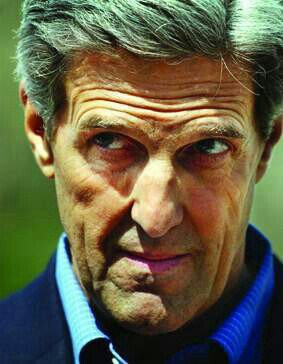
Noxious Nominations: The Four Horsemen of the American Foreign Policy Apocalypse – by Barry Rubin – Re-blog

image

Peanut Gallery: When I first heard that John Kerry would be our next Secretary of State, I thought, “It’s time to start learning French.” I really didn’t know whether to laugh or cry. Now I do… get out the Kleenex.

Barry Rubin explains why:

1. Their ideas and views are horrible.
2. They are all stupid people.

For the next four years, at least, clueless people supporting radical Islamists will be steering American foreign policy. This can’t be good for personal or religious freedom as we know it. It will only get tougher for Christians around the world… because America will sit on the sidelines. The surrender-monkeys are in charge.

Please visit pjmedia.com for more comments.
____________________________________

Noxious Nominations: The Four Horsemen of the American Foreign Policy Apocalypse

I did a lot of soul-searching before writing my latest article, “After the Fall: What Do You Do When You Conclude America is (Temporarily or Permanently) Kaput?” Of course, I believed every word of it and have done so for a while. But would it depress readers too much? Would it just be too grim?

Maybe U.S. policy will just muddle through the next four years and beyond without any disasters. Perhaps the world will be spared big crises. Possibly the fact that there isn’t some single big superpower enemy seeking world domination will keep things contained.

Perhaps that is true. Yet within hours after its publication I concluded that I hadn’t been too pessimistic. The cause of that reaction is the breaking story that not only will Senator John Kerry be the new secretary of state; that not only will the equally reprehensible former Senator Chuck Hagel be secretary of defense; but that John Brennan, the president’s counterterrorism advisor, will become CIA chief.

About two years ago I joked that if Kerry were to become secretary of state it would be time to think about heading for that fallout shelter in New Zealand. This trio in power — which along with Obama himself could be called the four horseman of the Apocalypse for U.S. foreign policy — might require an interstellar journey.

Let me stress that this is not really about Israel. At the end of Obama’s second term, U.S.-Israel relations will probably be roughly where they are now. Palestinian strategy — both by the Palestinian Authority and Hamas — has left the United States no diplomatic or “peace process” option on that front. The problem is one of eroding U.S. interests, especially the American position in the Middle East but also in other parts of the world.

image

You can read elsewhere details about these three guys. Here, I will merely summarize the two basic problems:

–Their ideas and views are horrible. This is especially so on Middle Eastern issues, but how good are they on anything else? True, they are all hostile to Israel, but this isn’t the first time people who think that way have held high office. Far worse is that they are pro-Islamist as well as dim-witted about U.S. interests in a way no foreign policy team has been in the century since America walked onto the world stage.

Brennan is no less than the father of the pro-Islamist policy. What Obama is saying is this: My policy of backing Islamists has worked so well, including in Egypt, that we need to do even more! All those analogies to 1930s appeasement are an understatement. Nobody in the British leadership said, “I have a great idea. Let’s help fascist regimes take power and then they’ll be our friends and become more moderate!” That’s the equivalent of what Brennan does.

–They are all stupid people. Some friends said I shouldn’t write this because it is a subjective judgment and sounds mean-spirited. But honest, it’s true. Nobody would ever say that their predecessors — Hillary Clinton, Robert Gates, and David Petraeus — were not intelligent and accomplished. But these guys are simply not in that category. Smart people can make bad judgments; regular people with common sense often make bad judgments less often. But stupid, arrogant people with terrible ideas are a disaster.

Brennan’s only life accomplishment has been to propose backing radical Islamists. As a reward, he isn’t just being made head of intelligence for the Middle East but for the whole world! Has Brennan any proven administrative skill? Any knowledge of other parts of the world? No. All he has is a proximity to Obama and a very bad policy concept. What’s especially ironic here is that by now, the Islamist policy has clearly failed and a lot of people are having second thoughts.

With Brennan running the CIA, though, do you think there will be critical intelligence evaluations of the Muslim Brotherhood, Hizballah, or even Hamas? Is the CIA going to warn U.S. leaders about the repression against women, Christians, and moderates? Will there be warnings that Islamists are taking over Syria or reports on Islamist involvement in killing Americans in Benghazi? Can we have confidence about U.S. policy toward Iran?

To get some insight into his thinking, consider the incident in which a left-wing reporter, forgetting there were people listening, reminded Brennan that in an earlier private conversation he admitted favoring engagement not only with the Lebanese terrorist group Hizballah, but also the Palestinian terrorist group Hamas. Ask yourself this question: when an American intelligence chief told Congress that the Muslim Brotherhood was a moderate, secular group, who approved that line of argument?