
Peanut Gallery:
Christmas and Epiphany are celebrations of Life and Light – the birth of Jesus brought Life and Light to everyone. That’s why it’s a joyful season of peace on earth to all people of goodwill. The Apostle John says:
“The Word (Jesus Christ) gave life to everything that was created, and his life brought light to everyone. The light shines in the darkness, and the darkness can never extinguish it.” (John 1:4-5)
But it’s that last phrase that jolts me back to the reality of this present age – where the forces of darkness futilely attempt to extinguish the Light of Christ. No where is this more brutally apparent than in the evil wrought by the Islamic State. They will not prevail, and there will be a day of Judgement – John makes that point:
“There is no judgment against anyone who believes in him. But anyone who does not believe in him has already been judged for not believing in God’s one and only Son. And the judgment is based on this fact: God’s light came into the world, but people loved the darkness more than the light, for their actions were evil. All who do evil hate the light and refuse to go near it for fear their sins will be exposed. But those who do what is right come to the light so others can see that they are doing what God wants.” (John 3:18-21)
The following article by Joe Carter (The Gospel Coalition) was written shortly after the Paris attacks in November, 2015. I would draw your attention to points #6, #7 & #8 which address the “rape culture” of ISIS. We are beginning to discover what that means for the women captured and held prisoner by ISIS.
As we shine Light on this embodiment of Evil, never forget that they cannot “win”: one day their “sins will be exposed” and they will receive justice appropriate to their crimes. Count on it!
__________
via 9 Things You Should Know About Islamic State (click on link for original article)
__________
Here are nine things you should know about this Islamic terrorist group.
1. Islamic State is the current name of an Islamic militant group that was established in Iraq in 2004 and pledged allegiance to “Al-Qaeda in Iraq.” They later broke away from Al-Qaeda because of differences in doctrine and objectives and formed a distinct organization. From late 2006 to mid 2013, the group called itself the Islamic State of Iraq (ISI). From 2013 to mid 2014, when they expanded into Syria, they called themselves the Islamic State of Iraq and the Levant (ISIL). (Most Western media translate “Levant” as “Syria,” hence ISIS.) Since 2014, they have expanded their ambitions to be a global organization and today simply refer to themselves as “Islamic State.”
2. The stated long-term goal of Islamic State is to establish a “caliphate” to rule over the entire Muslim world, under a single leader and in line with Sharia (Islamic law). A caliphate is a form of Islamic government led by a caliph, a person considered a political and religious successor to the Islamic prophet, Muhammad.
3. The religious-political ideology of Islamic State is Salafi-jihadism (sometimes referred to simply as “jihadism”), a distinct strand of militant Sunni Islamism. Salafi-jihadist groups like Islamic State emphasize the importance of returning to a “pure” Islam, that of the Salaf, the pious ancestors. Such groups also maintain that violent jihad is a personal religious duty of all Muslim believers. Former Islamic State leader Abu ‘Umar al-Baghdadi once emphasized the importance of “offensive jihad,” which he defined as “going after the apostate unbelievers by attacking [them] in their home territory, in order to make God’s word most high and until there is no persecution.” (Under their doctrine, “persecution” is understood to mean idolatry.)
4. The most prominent elements of Islamic State’s religious-political doctrine require that: all Muslims must associate exclusively with fellow “true” Muslims and dissociate from anyone not fitting this narrow definition; failure to rule in accordance with God’s law constitutes unbelief; fighting the Islamic State is tantamount to apostasy; all Shi‘a Muslims are apostates deserving of death; and the Muslim Brotherhood and Hamas are traitors against Islam because they compromise with the non-caliphate political process (e.g., democracy).
5. The focus on personal jihad makes Salafi-jihadist groups like Islamic State considerably different than most terrorist groups throughout history. For example, in the 1970s most Marxist and pan-Arabic terrorist groups killed people or committed other acts of terrorism in order to bring attention to their cause. For Salafi-jihadists, though, killing large number of “apostates” is itself a worthy religious objective.
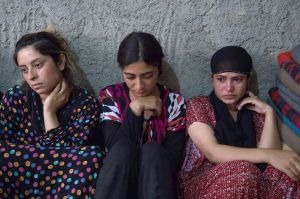
6. Islamic State enshrines a theology of rape that justifies the practice of sexual slavery. Islamic State publishes a glossy propaganda magazine called Dabiq. In the October 2014 issue, IS included an article titled “The Revival Of Slavery Before The Hour,” which explains the justification for sex slavery. In Islamic terminology the “hour” refers to the Day of Judgment, a time of reckoning either for an individual upon death or on mankind. According to the article, Islamic State asked its own sharia scholars to render a verdict on whether the Yazidis (a religious minority group in Iraq) could be enslaved. They determined that “enslavement of the apostate women” was not only justified by the Quran but was a sign prefiguring the Day of Judgment.
7. Islamic State condones the rape of young girls. Last fall the Research and Fatwa Department of the Islamic State (ISIS) released a pamphlet on the topic of female captives and slaves:
Question 13: Is it permissible to have intercourse with a female slave who has not reached puberty?
It is permissible to have intercourse with the female slave who hasn’t reached puberty if she is fit for intercourse; however if she is not fit for intercourse, then it is enough to enjoy her without intercourse.
8. Islamic State’s theology of rape also serves as a recruiting tool. As the New York Times has noted, the practice of slavery has become an established recruiting tool to lure men from deeply conservative Muslim societies, where casual sex is taboo and dating is forbidden. Capturing sex slaves has become nearly as important for Islamic State’s objectives as capturing territory.
9. The Islamic State has ordered that all able Muslims around the world must emigrate to the territory under its control. As the group’s leader, Abu Bakr al-Baghdadi, stated in an audio address in 2014: “O Muslims in all places. Whoso is able to emigrate to the Islamic State, let him emigrate. For emigration to the Abode of Islam is obligatory.”

 The Peanut Gallery