
9 Things You Should Know About Independence Day and The Declaration of Independence – Reblog

Re-Blog: The Gospel CoalitionJoe Carter

July 4, 2014 [is] America’s 238th Independence Day, the day Americans celebrate our Declaration of Independence from Great Britain. Here are nine things you should know about America’s founding document and the day set aside for its commemoration.
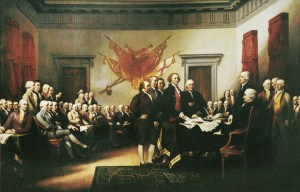
John Trumbull's famous painting is often identified as a depiction of the signing of the Declaration, but it actually shows the drafting committee presenting its work to the Congress.
John Trumbull’s famous painting is often identified as a depiction of the signing of the Declaration, but it actually shows the drafting committee presenting its work to the Congress.

1. July 4, 1776 is the day that we celebrate Independence Day even though it wasn’t the day the Continental Congress decided to declare independence (they did that on July 2, 1776), the day we started the American Revolution (that had happened back in April 1775), the date on which the Declaration was delivered to Great Britain (that didn’t happen until November 1776), or the date it was signed (that was August 2, 1776).

2. The first Independence Day was celebrated on July 8, 1776 (although the Declaration was approved on July 4, 1776, it was not made public until July 8), but for the first two decades after the Declaration was written, people didn’t celebrate it much on any date. One party, the Democratic-Republicans, admired Jefferson and the Declaration. But the other party, the Federalists, thought the Declaration was too French and too anti-British, which went against their current policies.

3. After the War of 1812, the Federalist party began to come apart and the new parties of the 1820s and 1830s all considered themselves inheritors of Jefferson and the Democratic-Republicans. Printed copies of the Declaration began to circulate again, all with the date July 4, 1776, listed at the top. Celebrations of the Fourth of July became more common as the years went on and in 1870, almost a hundred years after the Declaration was written, Congress first declared July 4 to be a national holiday as part of a bill to officially recognize several holidays, including Christmas. Further legislation about national holidays, including July 4, was passed in 1938 and 1941.

4. Benjamin Franklin, John Adams, Thomas Jefferson, Roger Sherman, and Robert R. Livingston comprised the Committee of Five that drafted the Declaration. Jefferson, regarded as the strongest and most eloquent writer, wrote most of the document. After Jefferson wrote his first draft, the other members of the Declaration committee and the Continental Congress made 86 changes, including shortening the overall length by more than a fourth and removing language condemning the British promotion of the slave trade (which Jefferson had included even though he himself was a slave owner).

5. The signed copy of the Declaration is the official, but not the original, document. The approved Declaration was printed on July 5th and a copy was attached to the “rough journal of the Continental Congress for July 4th.” These printed copies, bearing only the names of John Hancock, President, and Charles Thomson, secretary, were distributed to state assemblies, conventions, committees of safety, and commanding officers of the Continental troops. On July 19th, Congress ordered that the Declaration be engrossed on parchment with a new title, “the unanimous declaration of the thirteen united states of America,” and “that the same, when engrossed, be signed by every member of Congress.” Engrossing is the process of copying an official document in a large hand.

6. Thomas Jefferson and John Adams, the only two presidents to sign the document, both died on the Fourth of July in 1826, the fiftieth anniversary of the adoption of the Declaration. Adam’s last words have been reported as “Thomas Jefferson survives.” He did not know that Jefferson had died only a few hours before. James Monroe, the last president who was a Founding Father, also died on July 4 in 1831. Calvin Coolidge, the 30th President, was born on July 4, 1872, and, so far, is the only President to have been born on Independence Day.

7. John Hancock, the President of the Continental Congress at the time, was the first and only person to sign the Declaration on July 4, 1776 (he signed it in the presence of just one man, Charles Thomson, the secretary of Congress). According to legend, the founding father signed his name bigger than everyone else’s because he wanted to make sure “fat old King George” could read it without his spectacles. But the truth is that Hancock had a large blank space and didn’t realize the other men would write their names smaller. Today, the term “John Hancock” has become synonymous with a person’s signature.

8. The 56 signers of the Declaration did not sign on July 4, 1776, nor were they in the same room at the same time on the original Independence Day. The official signing event took place on August 2, 1776 when 50 men signed the document. Several months passed before all 56 signatures were in place. The last man to sign, Thomas McKean, did so in January of 1777, seven months after the document was approved by Congress. Robert R. Livingston, one of the five original drafters, never signed it at all since he believed it was too soon to declare independence.

9. Unlike the U.S. Constitution, which makes no reference to God, the Declaration has three references to a deity. The document also makes two references that tie natural law to God. (Although Thomas Jefferson was a Deist, as a young apprentice lawyer he had studied the work of Henry de Bracton, an English jurist and natural law proponent. Bracton has been referred to as the “father of common law” and is said to have “succeeded in formulating a truly Christian philosophy of law”).

The character of independence – John Hayward (Human Events)

By John Hayward, humanevents.com / July 4th 2013 8:30 AM

What has been missing from all the revolutions that didn’t work out as well as ours?  What have we lost, to bring the American revolution to such a perilous hour, in which the restraints upon government decay into first theory, and then fiction?

It all boils down to a question of character.


image

It was easy for American observers to sympathize with the “Arab Spring” revolutionaries in Egypt.  They risked hardship, injury, and death to pack Tahrir Square in a massive demonstration against a corrupt government, presided over by strongman Hosni Mubarak for decades.  They spoke of freedom and democracy.  The cold geopolitical reality was that Mubarak was a reliable U.S. ally, and what replaced him was not.  But all those who risk everything in the name of democracy are singing the first few bars of the American song, and we can’t help but tap our feet to the fife and drum, and wish them well.

An even larger demonstration just overthrew the Arab Spring Egyptian government.  Those hard-won post-Mubarak elections installed a regime of Islamist blockheads whose primary “qualification” for government was the ability to recite Koranic verses from memory.  Their efforts to consolidate power left other Egyptians wondering if they had leaped from the kleptocrat frying pan into the theocrat fire.

The Egyptian people will try again.  They’re none to happy with the United States after our support for the deposed Morsi regime.  Some observers offer hope that it’s more of a personal distaste for Barack Obama and his Administration.  The anti-Obama banners carried through the streets of Cairo support that impression.  Maybe the jubilant Egyptians will still be willing to consider the American revolutionary example and learn something from it.

That would be wise of the Egyptians, because America still offers the paramount example of revolutionary success against tyranny.  In fact, it’s distressingly difficult to point to another example that turned out nearly as well, in either the short or long term.  We Americans have a romantic conviction that all the people of the world yearn to breathe free, with liberty and representative government ready to blossom in every corner of the world, once the hard frost of tyranny is cleared away from the soil of individual dignity.  It’s long past time for us to consider the melancholy reverse of this schoolboy optimism: liberty and representative government are remarkably difficult to nourish, and centuries of effort have produced many failures, measured against few great and enduring successes.

One reason for this uncertain track record is that liberty and representative government are two very different things.  Americans tend to assume the former flows from the latter – plant a seed of democracy, and the tree of liberty takes root.  That’s not true, and the authors of the America’s founding documents knew it wasn’t true.  They wrote with great wisdom and foresight about the necessity of restraining even the most frequently ratified, freely elected government.  Democracy (if we may take that term to include the process of electing representation in a republic) without a vigorous defense of liberty brings mob rule, or installs a set of well-organized and charismatic tyrants whose first order of business is ensuring they will never be voted out of office.  It transforms citizens into warring parties of bitter enemies whose votes determine, not the course of government, but the course of their daily lives.

What has been missing from all the revolutions that didn’t work out as well as ours?  What have we lost, to bring the American revolution to such a perilous hour, in which the restraints upon government decay into first theory, and then fiction?

It all boils down to a question of character.  Modern Americans may not fully appreciate how extraordinarily blessed with leaders of remarkable character our early government was.  James Madison, John Jay, Alexander Hamilton, Thomas Jefferson… they, and their colleagues, were among the most brilliant and expressive men of their day.  Read any portion of the Federalist Papers, the Declaration of Independence, or the Constitution if you seek proof.  The trove of wisdom held by our Founders was piled high with riches.

Presiding over the government they created was George Washington, among the most admired men in the world at the time, and perhaps in all of time.  For too many Americans, our first President has been reduced to a cartoon abstraction of integrity, the lad who could not lie about chopping down a cherry tree.  (Do today’s schoolchildren even learn that, or do I date myself by mentioning it?)  This does not capture the astounding dimensions of Washington’s esteem.

Reporting on a 2012 poll conducted by the British National Army Museum that named George Washington the greatest military enemy of Britain, and the American Revolution her worst defeat, U.S. News said it was “no surprise that the architect of that defeat is still one of Britain’s most despised historical figures.”  Perhaps so, but he wasn’t personally “despised” by his enemies at the time.  There was quite a difference between the glowing accounts of Washington in the British press during the war, and the contemptuous coverage of the rebel nation he fought for.  If the British had managed to kill him, they would have wept honest tears at his funeral.  (Let it be duly noted that not even George Washington’s esteem was universal or perpetual.  The American press took to calling him a “tyrant” for a while, after the Whiskey Rebellion.)

Can a revolution be consolidated into lasting peace, prosperity, and justice without such a leader?  When we think of great historical forces coming together to shape the destiny of a nation, we don’t always account for the importance of a few extraordinary men and women to lead their nation through the aftermath.  Great hours are often squandered by petty men.  Such hours call for more than intelligence and managerial skill.  Towering personal character and morality are required as well.  It’s no longer a fashionable notion, but in times past it was believed that clear, valuable thought was impossible without great character, because the serenity brought by a strong moral sense was essential to careful and honest deliberation.

Who can doubt that the turbulent sea of power released in the aftermath of a revolution, when jubilant people look with love and gratitude upon their liberators, is easily abused?  It’s a time of great temptation for those who find themselves in control of vast resources, with their self-regard inflated by the energetic regard of countless others, their appetite for vengeance against deposed loyalists keen, and their differences with revolutionary rivals sharpened by the defeat of the hated common enemy.  Personal character is the only reliable armor against such temptation, in the days before firm laws to restrain the power of the newborn State have been ratified.

The character of the people is crucial as well.  All of us, everywhere, get the government we deserve.  If we authorize abuse against our fellow citizens, it occurs, and then inevitably grows.  If we demand little character from our leaders, little is supplied.  If we grant our government the power to do whatever “most people” want, it quickly grows until it has little difficulty rounding up enough people to claim majority support for whatever the ruling class wants to do.  If dissent is not cherished, freedom withers.  You will find no intersection between the “tyranny of the majority” and the “consent of the governed,” for the authors of the Declaration of Independence didn’t say a just government should settle for the consent of some of the governed, or even most of them.

We hold the truths enshrined by the American Revolution to be self-evident, not just for us, but for all of mankind.  However, our Founders never said those truths would be easy to embrace.  On the contrary, they wrote often of the urgent need for people of character, both in the halls of government and the great open fields of citizenship.  Those modern readers who are dismayed by the religious language they used are foolishly discounting priceless wisdom, and failing to appreciate the value of humility as a republican virtue.  The truly great leaders of a free people are humble men and women.  Those are really hard to come by.  Intelligence, passion, and charisma are in greater supply, and they are far more easily demonstrated.  Revolutions are more common than Washingtons.

This Independence Day, let us wish the Egyptians well in their search for humble and capable leadership.  Let us join them.