
Morning Prayer: 23 Apr – John 20:24-29 ~ believing is seeing

Morning Prayer

+ In the name of the Father, and of the Son, and of the Holy Spirit. Amen

Opening sentences — The Way of the Cross

Let all creation give thanks to the Risen Lord.
Give thanks to the Risen Lord!

Filled with His praises, give thanks to the Risen Lord.
Give thanks to the Risen Lord!

Stepping out boldly, we claim resurrection.
Give thanks to the Risen Lord!

Morning reading

"The Incredulity of Saint Thomas" Caravaggio, 1601–1602 Sanssouci Palace, Potsdam, Berlin
“The Incredulity of Saint Thomas”
Caravaggio, 1601–1602
Sanssouci Palace, Potsdam, Berlin

John 20:24-29 ESV

Now Thomas, one of the Twelve, called the Twin, was not with them when Jesus came. So the other disciples told him, “We have seen the Lord.” But he said to them, “Unless I see in his hands the mark of the nails, and place my finger into the mark of the nails, and place my hand into his side, I will never believe.”

Eight days later, his disciples were inside again, and Thomas was with them. Although the doors were locked, Jesus came and stood among them and said, “Peace be with you.” Then he said to Thomas, “Put your finger here, and see my hands; and put out your hand, and place it in my side. Do not disbelieve, but believe.” Thomas answered him, “My Lord and my God!” Jesus said to him, “Have you believed because you have seen me? Blessed are those who have not seen and yet have believed.”

Reflections:

progession of faith

Faith throughout the Gospel is depicted as progressive, renewed in the face of each new revelation of Jesus. The other disciples have moved on to the next stage, but Thomas has not been able to. To not move on when Jesus calls us to do so is to shift into reverse and move away. Both believing and unbelieving are dynamic — we are growing in one direction or the other. Thus, when Jesus appears in their midst he challenges Thomas to move on ahead in the life of faith, to stop doubting and believe.

The actual expression used may capture the dynamic quality – translated woodenly it reads, “Stop becoming unbelieving and get on with becoming believing.” To get Thomas moving in the right direction again Jesus offers him the chance to feel his wounds.

confession of faith

Thomas’ confession of Jesus as my Lord and my God is yet another climax in this Gospel. Jesus has invited him to catch up with the others in their new stage of faith, and he shoots past them and heads to the top of the class. His confession is… an expression of the core of John’s witness to Jesus in this Gospel. Thomas confesses Jesus as God when he sees that the crucified one is alive. It is in the crucifixion that God himself is made known, for he is love, and love is the laying down of one’s life. But God is also life. In John, this God is revealed perfectly in the death of the Son, but this death would be nothing without the life. When Thomas finds death and life juxtaposed in Jesus he realizes who the one standing before him really is.

blessedness of faith

This beatitude, like others Jesus had spoken, is a shocking reversal of common expectations. It suggests that if seeing is believing, as it was for Thomas, believing is also seeing. What matters is the relationship established by faith. But this faith is openness and acceptance and trust directed toward God in Jesus.

In John, the concern is with events in history that demand an interpretation and a response. Thomas’ confession was such a judgment, and now Jesus challenges all who come after to venture a judgment upon this history, that is, upon his person, his presence through the Spirit in this particular community and through the life he offers. Peter later describes such believers: “Though you have not seen him, you love him; and even though you do not see him now, you believe in him and are filled with an inexpressible and glorious joy, for you are receiving the goal of your faith, the salvation of your souls” (1 Pet 1:8-9).

The IVP New Testament Commentary Series
__________


__________

Canticle:

Christ, as a light… illumine and guide me. Christ, as a shield… overshadow me. Christ under me; Christ over me; Christ beside me on my left and my right.

This day be within and without me, lowly and meek, yet all-powerful. Be in the heart of each to whom I speak; in the mouth of each who speaks unto me. This day be within and without me, lowly and meek, yet all-powerful.

Christ as a light; Christ as a shield; Christ beside me on my left and my right.

Blessing

May the peace of the Lord Christ go with you, wherever He may send you. May He guide you through the wilderness, protect you through the storm. May He bring you home rejoicing at the wonders He has shown you. May He bring you home rejoicing once again into our doors.

+ In the name of the Father, and of the Son, and of the Holy Spirit. Amen

_____________________________________

Peanut Gallery: A brief word of explanation – the general format for Morning Prayer is adapted from the Northumbrian Community‘s Daily Office, as found in Celtic Daily Prayer (see online resources here.) The Scripture readings are primarily from the Gospel of John, with the intent to complete the reading by Easter. Other Scriptures which illuminate the Gospel of John will be included along the way.

Reflections from various saints will be included as their memorial days occur during the calendar year.

On Sundays, I’ll return to the USCCB readings (see online resources here) and various liturgical resources in order to reflect the Church’s worship and concerns throughout the world.

Photo illustrations and music videos, available online, are included as they illustrate or illuminate the readings. I will try to give credit and link to sources as best I can.

Morning Prayer: 22 Apr – John 20:19-23 ~ receive the Holy Spirit

Morning Prayer

+ In the name of the Father, and of the Son, and of the Holy Spirit. Amen

Opening sentences — The Way of the Cross

Let all creation give thanks to the Risen Lord.
Give thanks to the Risen Lord!

Filled with His praises, give thanks to the Risen Lord.
Give thanks to the Risen Lord!

Stepping out boldly, we claim resurrection.
Give thanks to the Risen Lord!

Morning reading

John 20:19-23 ESV

receive the Holy Spirit

On the evening of that day, the first day of the week, the doors being locked where the disciples were for fear of the Jews, Jesus came and stood among them and said to them, “Peace be with you.” When he had said this, he showed them his hands and his side. Then the disciples were glad when they saw the Lord.

Jesus said to them again, “Peace be with you. the Father has sent me, even so I am sending you.” And when he had said this, he breathed on them and said to them, “Receive the Holy Spirit. If you forgive the sins of any, they are forgiven them; if you withhold forgiveness from any, it is withheld.”

Reflections:

commission

Over forty times throughout the Gospel, Jesus is said to have been sent by God, and now that will become the characteristic of his disciples also. The Son has a role in the sending of the Paraclete, and he plays a role in the sending of the disciples. The Son, like the Father, sends. Mission is at the heart of discipleship.

The sending of Jesus by God meant that in the words, works, and person of Jesus men were veritably confronted… by God himself. It follows that in the apostolic mission of the church . . . the world is veritably confronted not merely by a human institution but by Jesus the Son of God. It follows further that as Jesus in his ministry was entirely dependent upon and obedient to God the Father, who sealed and sanctified him, and acted in the power of the Spirit who rested upon him, so the church is the apostolic church, commissioned by Christ, only in virtue of the fact that Jesus sanctified it and breathed the Spirit into it, and only so far as it maintains an attitude of perfect obedience to Jesus (it is here, of course, that the parallelism between the relation of Jesus to the Father and the relation of the church to Jesus breaks down). The life and mission of the church are meaningless if they are detached from this historical and theological context. (Barrett 1978:569)

empowerment

Human beings in themselves are not capable of manifesting God’s presence and doing God’s will as Jesus did. Indeed, without the Spirit there is no spiritual life. But Jesus now has been glorified, so the Spirit can be given. At this point the life that has been in Jesus in his union with God is now shared with the disciples. The new state of affairs begins to take effect among the disciples. They have been reunited with Jesus and now are given his very life by the Spirit.

John’s account describes a preliminary stage of preparation for ministry. The breathing of the Spirit was not simply directed at the individuals present, as if one had to be hit by the molecules coming from Jesus’ mouth or nose in order to receive the Spirit. Rather, the Spirit is now unleashed into the world in a new way and begins to bring about new life where he finds faith. The disciples enter into a new phase in their life with God, but it is not yet the time of their active witness, as it will be from Pentecost on. Thus, it would seem John is describing the conception of the church, and Luke (in Acts), the birth.

authority

Through the disciples’ witness to Jesus by word and by the life and love of the community, the world will be forced to choose for or against Jesus, just as they were during Jesus’ own ministry. Those who repent and believe in Jesus can be assured of forgiveness, and those who refuse to repent can be assured that their sins are not forgiven. Such is the consequence of rejecting the Lamb of God who has taken away the sin of the world. This is how judgment takes place as people come in contact with the light.

+ The ancient church understood this forgiveness and non-forgiveness as referring to admission to baptism (cf. Brown). Since baptism is associated with the forgiveness of sins (for example, Acts 2:38) this is certainly an important way in which this commission has been fulfilled, though it does not exhaust the commission.

+ The text has also been applied to the matter of discipline within the community. Accordingly, the text has served to ground the sacrament of penance (cf. Brown). Such discipline was indeed necessary. The issue of cleansing and forgiveness among the disciples is of concern in the Gospel (Hoskyns). John’s later reference to the sin unto death and the sin not unto death (1 Jn 5:16) seems to deal with matters that preclude membership in the community (Whitacre).

Both of these matters—entering into the community and maintaining the health of the community and its members — are a significant part of the missionary part of this commission. For the life of the community itself is a major aspect of the witness to the world. It is through the disciples’ unity with God and with one another that the world will be confronted with the truth about the Father and the Son. Such unity in God cannot include error and evil, for they are not of God, hence the need for discipline for the sake of the mission itself.

The IVP New Testament Commentary Series
__________


__________

Canticle:

Christ, as a light… illumine and guide me. Christ, as a shield… overshadow me. Christ under me; Christ over me; Christ beside me on my left and my right.

This day be within and without me, lowly and meek, yet all-powerful. Be in the heart of each to whom I speak; in the mouth of each who speaks unto me. This day be within and without me, lowly and meek, yet all-powerful.

Christ as a light; Christ as a shield; Christ beside me on my left and my right.

Blessing

May the peace of the Lord Christ go with you, wherever He may send you. May He guide you through the wilderness, protect you through the storm. May He bring you home rejoicing at the wonders He has shown you. May He bring you home rejoicing once again into our doors.

+ In the name of the Father, and of the Son, and of the Holy Spirit. Amen

_____________________________________

Peanut Gallery: A brief word of explanation – the general format for Morning Prayer is adapted from the Northumbrian Community‘s Daily Office, as found in Celtic Daily Prayer (see online resources here.) The Scripture readings are primarily from the Gospel of John, with the intent to complete the reading by Easter. Other Scriptures which illuminate the Gospel of John will be included along the way.

Reflections from various saints will be included as their memorial days occur during the calendar year.

On Sundays, I’ll return to the USCCB readings (see online resources here) and various liturgical resources in order to reflect the Church’s worship and concerns throughout the world.

Photo illustrations and music videos, available online, are included as they illustrate or illuminate the readings. I will try to give credit and link to sources as best I can.
Morning Prayer: 21 Apr – John 20:11-18 ~ “I have seen the Lord”

Morning Prayer

+ In the name of the Father, and of the Son, and of the Holy Spirit. Amen

Opening sentences — The Way of the Cross

Let all creation give thanks to the Risen Lord.
Give thanks to the Risen Lord!

Filled with His praises, give thanks to the Risen Lord.
Give thanks to the Risen Lord!

Stepping out boldly, we claim resurrection.
Give thanks to the Risen Lord!

Morning reading

John 20:11-18 ESV

Magdalena Gheorghe Tattarescu (1820-1894) Muzeul Municipiului Bucureşti, Română
Magdalena
Gheorghe Tattarescu (1820-1894)
Muzeul Municipiului Bucureşti, Română

Mary stood weeping outside the tomb, and as she wept she stooped to look into the tomb. And she saw two angels in white, sitting where the body of Jesus had lain, one at the head and one at the feet. They said to her, “Woman, why are you weeping?”

She said to them, “They have taken away my Lord, and I do not know where they have laid him.”

Having said this, she turned around and saw Jesus standing, but she did not know that it was Jesus. Jesus said to her, “Woman, why are you weeping? Whom are you seeking?”

Supposing him to be the gardener, she said to him, “Sir, if you have carried him away, tell me where you have laid him, and I will take him away.”

Jesus said to her, “Mary.”

She turned and said to him in Aramaic, “Rabboni!” (which means Teacher).

Jesus said to her, “Do not cling to me, for I have not yet ascended to the Father; but go to my brothers and say to them, ‘I am ascending to my Father and your Father, to my God and your God.’”

Mary Magdalene went and announced to the disciples, “I have seen the Lord” — and that he had said these things to her.

Reflections:

heavenly messengers

John picks up the story with Mary at the tomb; the emphasis is on her crying. Her great love is poured out in her grief. She thinks she is alone, though “like other sorrowful disciples since” (H. C. G. Moule), she actually has angels in front of her and the Lord behind her. When she bends down to look in the tomb she sees the angels. Such heavenly messengers appear at many of the significant points in salvation history. Like the grave clothes, their presence witnesses “that the powers of heaven have been at work here” (Beasley-Murray).

There is no indication that Mary recognizes the messengers as angels, presumably due to the depth of her grief. The angels speak to her with great compassion: “Woman, why are you crying?”. In the face of this grief the angels do not bombard her with good news but rather ask the question that can lead to the healing word.

Jesus’ appearance

Jesus comes to Mary with great love and gentleness. The good news is not just that Jesus arose but that the character of God is revealed in Jesus. He is life, and he is also love. When Jesus calls her name she knows his voice. Mary naturally assumes that their relationship could pick up where it left off and continue on as before. Jesus’ response, however, lets her know there has been a radical change in him and consequently in his relationship with his followers.

Jesus says he is still on the move, and he also sets Mary in motion to bear the news to the disciples. She has just found him, and now she is sent away, but she is sent with a commission. As the ancient church put it, she becomes an apostle to the apostles.

new family

The new community Jesus founded during his ministry became a new family at the cross, and now the disciples are to enter into this new form of relationship. Jesus’ returning to the Father is also good news for the disciples, not just because they share in his joy, but also for their own condition. For when Jesus returns to the Father he will send the Paraclete, who will teach them all things and complete their union with the Father and the Son. The Father is the Father of the disciples in this new intimacy precisely because he is Jesus’ Father, for the disciples are now Jesus’ brothers.

new witness

Mary Magdalene goes off and announces to the disciples what she has seen and heard. John does not mention the poor reception that was given to her message (Mk 16:11; Lk 24:11), though the fearful, doubting state of the disciples in the next section implies as much. All a witness can do is share what he or she knows to be true. Christian witness should not attempt to share an experience; it should direct people to Jesus so people can encounter him for themselves. Mary’s message could alert the disciples to the fact that Jesus was alive, but they had to come to faith for themselves. Jesus met Mary in a way that was best for her. Now he will do the same for the disciples as a group.

The IVP New Testament Commentary Series
__________


__________

Canticle:

Christ, as a light… illumine and guide me. Christ, as a shield… overshadow me. Christ under me; Christ over me; Christ beside me on my left and my right.

This day be within and without me, lowly and meek, yet all-powerful. Be in the heart of each to whom I speak; in the mouth of each who speaks unto me. This day be within and without me, lowly and meek, yet all-powerful.

Christ as a light; Christ as a shield; Christ beside me on my left and my right.

Blessing

May the peace of the Lord Christ go with you, wherever He may send you. May He guide you through the wilderness, protect you through the storm. May He bring you home rejoicing at the wonders He has shown you. May He bring you home rejoicing once again into our doors.

+ In the name of the Father, and of the Son, and of the Holy Spirit. Amen

_____________________________________

Peanut Gallery: A brief word of explanation – the general format for Morning Prayer is adapted from the Northumbrian Community‘s Daily Office, as found in Celtic Daily Prayer (see online resources here.) The Scripture readings are primarily from the Gospel of John, with the intent to complete the reading by Easter. Other Scriptures which illuminate the Gospel of John will be included along the way.

Reflections from various saints will be included as their memorial days occur during the calendar year.

On Sundays, I’ll return to the USCCB readings (see online resources here) and various liturgical resources in order to reflect the Church’s worship and concerns throughout the world.

Photo illustrations and music videos, available online, are included as they illustrate or illuminate the readings. I will try to give credit and link to sources as best I can.

Morning Prayer, 17 Apr – John 18:33-40 ~ are you a king

Morning Prayer

+ In the name of the Father, and of the Son, and of the Holy Spirit. Amen

Opening sentences — Puritan Prayers

Sovereign God, Thy cause, not my own, engages my heart, and I appeal to thee with greatest freedom to set up thy kingdom in every place where Satan reigns; Glorify thyself and I shall rejoice, for to bring honour to thy name is my sole desire….

Lord, use me as thou wilt, do with me what thou wilt; but, O, promote thy cause, let thy kingdom come, let thy blessed interest be advanced in this world! O do thou bring in great numbers to Jesus! Let me see that glorious day…. It is thy cause and kingdom I long for, not my own.

O, answer thou my request!

Morning reading

John 18:33-40 ESV

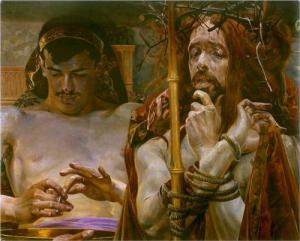
"Christ before Pilate" Jacek Malczewski, 1910 Lviv State Picture Gallery, Lviv, Ukraine
“Christ before Pilate”
Jacek Malczewski, 1910
Lviv State Picture Gallery, Lviv, Ukraine

Pilate then went back inside the palace, summoned Jesus and asked him, “Are you the king of the Jews?”

“Is that your own idea,” Jesus asked, “or did others talk to you about me?”

“Am I a Jew?” Pilate replied. “Your own people and chief priests handed you over to me. What is it you have done?”

Jesus said, “My kingdom is not of this world. If it were, my servants would fight to prevent my arrest by the Jewish leaders. But now my kingdom is from another place.”

“You are a king, then!” said Pilate.

Jesus answered, “You say that I am a king. In fact, the reason I was born and came into the world is to testify to the truth. Everyone on the side of truth listens to me.”

“What is truth?” retorted Pilate. With this he went out again to the Jews gathered there and said, “I find no basis for a charge against him. But it is your custom for me to release to you one prisoner at the time of the Passover. Do you want me to release ‘the king of the Jews’?”

They shouted back, “No, not him! Give us Barabbas!” Now Barabbas had taken part in an uprising.

Reflections:

Jesus’ kingdom

Jesus’ kingdom is otherworldly because he himself is not of this world and neither are his followers. He and his disciples have their source in God and reflect God’s own life and character. “Jesus’ kingdom is based on something other than . . . power or protection. It is based on his self-surrender, on his offering of himself for the sin of the world” (Ridderbos).

Jesus is working on a different level, one not of this world. His kingdom is quite distinct from other kingdoms, but he does indeed have a kingdom. Jesus’ explanation reveals that he is king in a sense that transcends all other kings: for this reason I was born, and for this I came into the world. If Pilate thought about what Jesus said at all, he would probably hear it only on a human level, that Jesus was claiming to be like any other child who was born a prince, in line to become king. But Pilate may not have gotten that far in his thinking, for Jesus says that he came into the world not to be king of the Jews, but to testify to the truth.

revealer of truth

“He is the king of Truth, and He manifests His royal power not by force, but by the witness He bears to the Truth” (Hoskyn). The truth he refers to is the truth of God.

Pilate thinks of Jesus as a defendant, but Jesus is taking the part of a witness, who “has come to testify against the rule of the lie and for `the truth,’ that is, for God and for God’s claim on the world” (Ridderbos). So Jesus is asking for Pilate to pass judgment not on him as king of the Jews, but on him as the revealer of truth. And he puts pressure on Pilate, for if he does not decide in favor of Jesus, he will judge himself as not being on the side of truth – more literally, “of the truth”; it refers to one’s inner disposition as tuned to the truth, able to hear the voice of truth. “Absolute truth is a very uncomfortable thing when we come in contact with it” (Ward).

Pilate does not listen to Jesus, so, according to what Jesus has just said, he is not of the truth. The judge has been judged and found self-condemned through his response to Jesus. The Jewish opponents had come to this same place during the course of Jesus’ ministry. So now both Jew and Gentile have been given a chance to respond to the one come from God, and they have rejected him.

liberation choice

There is a stark contrast between Barabbas, a violent man concerned with this world’s politics, albeit religious politics, and Jesus, whose kingdom is not of this world, though it is active in this world. There is also irony in the name Barabbas itself, since it means “son of Abba” — the word Abba, “father,” was used as a proper name (Brown), but, especially in John’s Gospel, Jesus is known as the Son of the Father. The crowd was choosing between two different approaches to liberation as represented by two men identified, in different ways, as “son of Abba.”

Here is the deceptiveness of sin that has been evident since the Garden of Eden. There is a path that looks right and seems to be of God, yet it is actually against him and his ways. The people choose their own path of liberation rather than God’s, and they therefore choose “not the Savior, but the murderer; not the Giver of life, but the destroyer” (Augustine). Every time we choose sin we do the same, whether the sin is blatant or deceptive.

The IVP New Testament Commentary Series
__________

__________

Canticle:

Christ, as a light… illumine and guide me. Christ, as a shield… overshadow me. Christ under me; Christ over me; Christ beside me on my left and my right.

This day be within and without me, lowly and meek, yet all-powerful. Be in the heart of each to whom I speak; in the mouth of each who speaks unto me. This day be within and without me, lowly and meek, yet all-powerful.

Christ as a light; Christ as a shield; Christ beside me on my left and my right.

Blessing

May the peace of the Lord Christ go with you, wherever He may send you. May He guide you through the wilderness, protect you through the storm. May He bring you home rejoicing at the wonders He has shown you. May He bring you home rejoicing once again into our doors.

+ In the name of the Father, and of the Son, and of the Holy Spirit. Amen

_____________________________________

Peanut Gallery: A brief word of explanation – the general format for Morning Prayer is adapted from the Northumbrian Community‘s Daily Office, as found in Celtic Daily Prayer (see online resources here.) The Scripture readings are primarily from the Gospel of John, with the intent to complete the reading by Easter. Other Scriptures which illuminate the Gospel of John will be included along the way.

Reflections from various saints will be included as their memorial days occur during the calendar year.

On Sundays, I’ll return to the USCCB readings (see online resources here) and various liturgical resources in order to reflect the Church’s worship and concerns throughout the world.

Photo illustrations and music videos, available online, are included as they illustrate or illuminate the readings. I will try to give credit and link to sources as best I can.

Morning Prayer, 16 Apr – John 18:28-32 ~ you do it

Morning Prayer

+ In the name of the Father, and of the Son, and of the Holy Spirit. Amen

Opening sentences — Puritan Prayers

O Lord, I marvel that thou shouldst become incarnate, be crucified, dead, and buried…. Give me to die with thee that I may rise to new life, for I wish to be as dead and buried to sin, to selfishness, to the world…. Purge me from selfishness, the fear of man, the love of approbation, the shame of being thought old-fashioned, the desire to be cultivated or modern…. Grant me to stand with my dying Saviour – resolute and Christ-contained.

Morning reading

"Christ before Pilate" Duccio di Buoninsegna, c.1311 Museo dell Opera del Duomo, Florence
“Christ before Pilate”
Duccio di Buoninsegna, c.1311
Museo dell Opera del Duomo, Florence

John 18:28-32 ESV

Then they led Jesus from the house of Caiaphas to the governor’s headquarters. It was early morning. They themselves did not enter the governor’s headquarters, so that they would not be defiled, but could eat the Passover.

So Pilate went outside to them and said, “What accusation do you bring against this man?”

They answered him, “If this man were not doing evil, we would not have delivered him over to you.”

Pilate said to them, “Take him yourselves and judge him by your own law.”

The Jews said to him, “It is not lawful for us to put anyone to death.”

This was to fulfill the word that Jesus had spoken to show by what kind of death he was going to die.

Reflections:

defilement

The irony of the opponents’ concern for defilement is evident. They wish to remain ritually pure even while seeking to kill someone by the agency of the Romans. They avoid defilement while bringing about the death of the Lamb of God who takes away the sin of the world, the root defilement that prevents one from intimacy with God and sharing in his life. Perhaps most ironic is the fact that their very act is a sin that defiles in this deep sense yet contributes to the cleansing of their sin and the sin of the whole world.

evil intent

Long before now Jesus’ opponents had come to the conclusion that he had to be eliminated…. Presumably they could request permission to kill Jesus themselves – they seem set, however, on having Rome execute Jesus, for then it would be by crucifixion. They probably want him crucified not only because it was a particularly brutal and painful form of death, but also because it would signify that Jesus is accursed by God (Robinson; Beasley-Murray). In John’s Gospel the focus is on Jesus as the revealer of God. His opponents have rejected that claim and desire his death in order to vindicate their conclusion.

witness to glory

John, however, sees this desire as a fulfillment of Jesus’ statement that he would die by being lifted up from the earth. “Both Jewish accusers and Roman judge are actors in a drama scripted by a divine planner” (Brown). John’s note reminds us both of Jesus’ identity as the Word whose words are God’s words, which will be fulfilled, and of the significance of this death: “I, when I am lifted up from the earth, will draw all men to myself”. Even the actions of his enemies are used to bear witness to the glory of his identity and of what he is in the process of accomplishing.

The IVP New Testament Commentary Series
__________

__________

Canticle:

Christ, as a light… illumine and guide me. Christ, as a shield… overshadow me. Christ under me; Christ over me; Christ beside me on my left and my right.

This day be within and without me, lowly and meek, yet all-powerful. Be in the heart of each to whom I speak; in the mouth of each who speaks unto me. This day be within and without me, lowly and meek, yet all-powerful.

Christ as a light; Christ as a shield; Christ beside me on my left and my right.

Blessing

May the peace of the Lord Christ go with you, wherever He may send you. May He guide you through the wilderness, protect you through the storm. May He bring you home rejoicing at the wonders He has shown you. May He bring you home rejoicing once again into our doors.

+ In the name of the Father, and of the Son, and of the Holy Spirit. Amen

_____________________________________

Peanut Gallery: A brief word of explanation – the general format for Morning Prayer is adapted from the Northumbrian Community‘s Daily Office, as found in Celtic Daily Prayer (see online resources here.) The Scripture readings are primarily from the Gospel of John, with the intent to complete the reading by Easter. Other Scriptures which illuminate the Gospel of John will be included along the way.

Reflections from various saints will be included as their memorial days occur during the calendar year.

On Sundays, I’ll return to the USCCB readings (see online resources here) and various liturgical resources in order to reflect the Church’s worship and concerns throughout the world.

Photo illustrations and music videos, available online, are included as they illustrate or illuminate the readings. I will try to give credit and link to sources as best I can.