 Jesus replied, “I am the bread of life. Whoever comes to me will never be hungry again. Whoever believes in me will never be thirsty…. For I have come down from heaven to do the will of God who sent me, not to do my own will. And this is the will of God, that I should not lose even one of all those he has given me, but that I should raise them up at the last day. For it is my Father’s will that all who see his Son and believe in him should have eternal life. I will raise them up at the last day.” John 6.35, 38-40 NLT
Tag: christianity
More on: Choosing a New Coptic Pope » First Thoughts | A First Things Blog
Peanut Gallery: I confess, I’m fascinated by the papal selection process of the Coptic Orthodox Church. It’s not so much the candidate vetting to narrow the final choices down to three. It’s the God-directed final selection by lot at the hand of a random child that I find both amazing and inspiring.
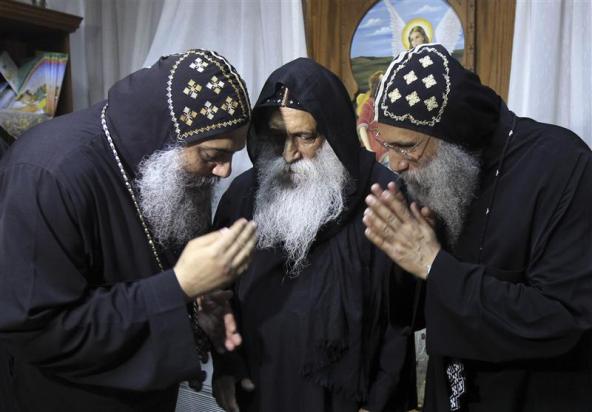 It’s so unlike the political lobbying and manuevering that I’ve witnessed in the church over the years. And this selection is so much more important in the total scheme of things… given the tenuous position of Christians in an emerging Islamic Egypt.
That’s why I’ve re-posted this article from First Things… to add additional information… and to encourage you to pray for the Coptic Church and their soon-to-be-revealed new Pope.
Thy Kingdom come, Thy will be done
On earth, as it is in heaven!
See full article below –
Choosing a New Pope
Thursday, November 1, 2012
Mark Movsesian
In Egypt this weekend, the Coptic Orthodox Church will select its 118th pope. The new pope will succeed the late Shenouda III, who led the Coptic Church—a venerable and long-suffering communion, and the largest Christian church in the Middle East today—for forty years. The selection process, which is codified in Egyptian civil law, tracks ancient custom and is quite fascinating.
According to Eastern Christian practice, only monks—that is, celibate priests attached to a monastic brotherhood—may become pope. Continue reading “More on: Choosing a New Coptic Pope » First Thoughts | A First Things Blog”
All Saints Day – “For all the Saints who from their labors rest….”
Peanut Gallery: Please remember today the “saints” who have gone before us.
And I heard a voice from heaven saying, “Write this down: Blessed are those who die in the Lord from now on. Yes, says the Spirit, they are blessed indeed, for they will rest from their hard work; for their good deeds follow them!” Revelation 14.7 NLT
Reformation Day | First Things
Reformation Day – October 31, 2012
Timothy George
“We confess together: By grace alone, in faith in Christ’s saving work and not because of any merit on our part, we are accepted by God and receive the Holy Spirit, who renews our hearts while equipping and calling us to good works.”
 It was around two o’clock in the afternoon on the eve of the Day of All Saints, October 31, 1517, when Martin Luther, hammer in hand, approached the main north door of the Schlosskirche (Castle Church) in Wittenberg and nailed up his Ninety-Five Theses protesting the abuse of indulgences in the teaching and practice of the church of his day. In remembrance of this event, millions of Christians still celebrate this day as the symbolic beginning of the Protestant Reformation. At Beeson Divinity School, for example, we do not celebrate Halloween on October 31. Instead we have a Reformation party.
But did this event really happen? Erwin Iserloh, a Catholic Reformation scholar, attributed the story of the theses-posting to later myth-making. He pointed to the fact that the story was first told by Philip Melanchthon long after Luther’s death. Other Luther scholars rushed to defend the historicity of the hammer blows of Wittenberg. In fact, the door of the Castle Church did serve as the official university bulletin board and was regularly used for exactly the kind of announcement Luther made when he called for a public disputation on indulgences.
But whether the event happened at two o’clock in the afternoon, or at all, is not the point. Copies of Luther’s theses were soon distributed by humanist scholars all over Europe. Within just a few weeks, an obscure Augustinian monk in a backwater university town had become a household name and was the subject of chatter from Lisbon to Lithuania.
It was not Luther’s intention to divide the Church, much less to start a brand new church. To the end of his life, he considered himself to be a faithful and obedient servant of the one, holy, catholic, and apostolic church. Though Luther renounced his monastic vows and married a former nun, Katarina von Bora, he never forgot that he had received a doctorate in Holy Scripture. His vocation was to teach the written Word of God and to point men and women to the Lord of Scripture, Jesus Christ.
On this Reformation Day, it is good to remember that Martin Luther belongs to the entire Church, not only to Lutherans and Protestants, just as Thomas Aquinas Continue reading “Reformation Day | First Things”
Morning Reading: Ephesians 6.1-4 NLT
 Children, obey your parents because you belong to the Lord, for this is the right thing to do.
“Honor your father and mother.” This is the first commandment with a promise: If you honor your father and mother, “things will go well for you, and you will have a long life on the earth.”
Fathers, do not provoke your children to anger by the way you treat them. Rather, bring them up with the discipline and instruction that comes from the Lord.
Ephesians 6.1-4 NLT
 The Peanut Gallery