
Morning Prayer, 12 Mar – John 13:1-20 ~ love on display

Morning Prayer

+ In the name of the Father, and of the Son, and of the Holy Spirit. Amen

Opening sentences – Cuthbert of Northumbria (635-87)

God’s will would I do, my own will bridle; God’s due would I give, my own due yield; God’s path would I travel, my own path refuse.

Morning reading

John 13:1-20 ESV:

Now before the Feast of the Passover, when Jesus knew that his hour had come to depart out of this world to the Father, having loved his own who were in the world, he loved them to the end.
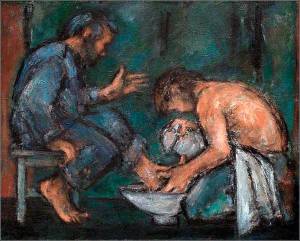
Jesus Washing Peter’s Feet Ghislane Howard (2004)
Jesus Washing Peter’s Feet
Ghislane Howard (2004)

During supper, when the devil had already put it into the heart of Judas Iscariot, Simon’s son, to betray him, Jesus, knowing that the Father had given all things into his hands, and that he had come from God and was going back to God, rose from supper. He laid aside his outer garments, and taking a towel, tied it around his waist. Then he poured water into a basin and began to wash the disciples’ feet and to wipe them with the towel that was wrapped around him.

He came to Simon Peter, who said to him, “Lord, do you wash my feet?” Jesus answered him, “What I am doing you do not understand now, but afterward you will understand.” Peter said to him, “You shall never wash my feet.” Jesus answered him, “If I do not wash you, you have no share with me.” Simon Peter said to him, “Lord, not my feet only but also my hands and my head!” Jesus said to him, “The one who has bathed does not need to wash, except for his feet, but is completely clean. And you are clean, but not every one of you.” For he knew who was to betray him; that was why he said, “Not all of you are clean.”

When he had washed their feet and put on his outer garments and resumed his place, he said to them, “Do you understand what I have done to you? You call me Teacher and Lord, and you are right, for so I am. If I then, your Lord and Teacher, have washed your feet, you also ought to wash one another’s feet. For I have given you an example, that you also should do just as I have done to you. Truly, truly, I say to you, a servant is not greater than his master, nor is a messenger greater than the one who sent him. If you know these things, blessed are you if you do them. I am not speaking of all of you; I know whom I have chosen. But the Scripture will be fulfilled, ‘He who ate my bread has lifted his heel against me.’ I am telling you this now, before it takes place, that when it does take place you may believe that I am he. Truly, truly, I say to you, whoever receives the one I send receives me, and whoever receives me receives the one who sent me.”

Reflections:

footwashing and betrayal

It is extremely important to realize that Jesus is going to wash the feet of one who is considering betraying him. Judas has not yet given in to the temptation, but the devil has prompted him. This is the first step in a sequence that temptation follows – “the provocation,” the initial idea. It is wise to reject the thought at this point because the temptation is at its weakest and one is not yet guilty of sin.

Jesus’ own awareness is also an important part of the context of the footwashing. He knew that the Father had put all things under his power and that he had come from God and was returning to God. This knowledge does not simply give Jesus the security to wash the disciples feet — his sharing in the divine essence is what leads him to wash their feet. This is what God himself is like — he washes feet, even the feet of the one who will betray him!

footwashing and humility

Footwashing is something slaves did for their masters, wives did for their husbands, children for their parents, and disciples for their teachers. In Jesus’ case, there is an obvious reversal of roles with his disciples. The one into whose hands the Father had given all now takes his disciples’ feet into his hands to wash them (Augustine).

Peter cannot stand the thought of his teacher doing the work of a slave. It would have been appropriate for one of the disciples to have washed Jesus’ feet, but the reverse is intolerable. This response expresses Peter’s love, but his love lacks humility. Indeed, humility is the very thing illustrated in Jesus’ present action. In Peter’s response we see the pride and self-will that is at the heart of all sin and that is the very thing for which the cross will atone and bring healing.

footwshing and leadership

The community Jesus has brought into being is to manifest the love of God that he has revealed through serving one another with no vestige of pride or position. There will be recognized positions of leadership within the new community, but the exercize of leadership is to follow this model of servanthood – demonstrating in word and deed the selfless love of God.

The pattern of life exemplified in the footwashing is true blessedness, contrary to what the world, which is centered in pride and selfishness, thinks. Accordingly, Jesus says, Now that you know these things, you will be blessed if you do them. The Gospel is a life to be lived and not just an ideal to be contemplated.

footwashing and mission

Jesus gives his own mission and that of his followers “an absolute theological significance; in both the world is confronted by God himself” (Barrett). Seen in the context of the footwashing, this statement of the dignity of the Christian witnesses is not an expression of power and authority in any worldly sense. The one who represents Christ by bearing the same self-sacrificing love of God will meet with the same response Jesus met but will also be the agent of the same eternal life that comes through knowledge of the Father in the Son by the Spirit.

The IVP New Testament Commentary Series

__________

__________

Canticle:

Christ, as a light… illumine and guide me. Christ, as a shield… overshadow me. Christ under me; Christ over me; Christ beside me on my left and my right.

This day be within and without me, lowly and meek, yet all-powerful. Be in the heart of each to whom I speak; in the mouth of each who speaks unto me. This day be within and without me, lowly and meek, yet all-powerful.

Christ as a light; Christ as a shield; Christ beside me on my left and my right.

Blessing

May the peace of the Lord Christ go with you, wherever He may send you. May He guide you through the wilderness, protect you through the storm. May He bring you home rejoicing at the wonders He has shown you. May He bring you home rejoicing once again into our doors.

+ In the name of the Father, and of the Son, and of the Holy Spirit. Amen

_____________________________________

Peanut Gallery: A brief word of explanation – the general format for Morning Prayer is adapted from the Northumbrian Community‘s Daily Office, as found in Celtic Daily Prayer (see online resources here.) The Scripture readings are primarily from the Gospel of John, with the intent to complete the reading by Easter. Other Scriptures which illuminate the Gospel of John will be included along the way.

Reflections from various saints will be included as their memorial days occur during the calendar year.

On Sundays, I’ll return to the USCCB readings (see online resources here) and various liturgical resources in order to reflect the Church’s worship and concerns throughout the world.

Photo illustrations and music videos, available online, are included as they illustrate or illuminate the readings. I will try to give credit and link to sources as best I can.


Morning Prayer, 11 Mar – John 12:44-50 ~ Saviour of the world

Morning Prayer

+ In the name of the Father, and of the Son, and of the Holy Spirit. Amen

Opening sentences – Cuthbert of Northumbria (635-87)

Softly as the dew-fall of heaven, may the Holy Spirit come upon me to aid me and to raise me, to bind my prayer firmly at the throne of the King of life.

Morning reading

John 12:44-50 ESV:

Salvator Mundi Andrea Previtali (1519)
Salvator Mundi
Andrea Previtali (1519)

And Jesus cried out and said, “Whoever believes in me, believes not in me but in him who sent me. And whoever sees me sees him who sent me. I have come into the world as light, so that whoever believes in me may not remain in darkness. If anyone hears my words and does not keep them, I do not judge him; for I did not come to judge the world but to save the world. The one who rejects me and does not receive my words has a judge; the word that I have spoken will judge him on the last day. For I have not spoken on my own authority, but the Father who sent me has himself given me a commandment — what to say and what to speak. And I know that his commandment is eternal life. What I say, therefore, I say as the Father has told me.”

Reflections:

faith and oneness

Faith is not just in Jesus but in the Father who sent him. Likewise, to see Jesus is to see the Father who sent him. Because faith in Jesus is faith in God the cowardice of the would-be believers in the previous section is heinous. This unity between Jesus and the Father who sent him grounds the whole Gospel.

light in darkness

Jesus has come into the world as the light. The world is dark precisely because it is alienated from God, who is light. Because Jesus has brought the light of God everyone who believes in him no longer remains in the darkness.

unbelief

+ as disobedience – Hearing without doing, ie they will not take the teaching into their life and live according to it. Jesus says he will not judge such a person since he came to save the world, not condemn it. However, his very presence as the light, revealing God, is an exposure and thus condemnation of the darkness. So in fact judgment does take place through him.

Although judgment takes place it is still of the utmost importance to understand that God’s intent is salvific, ie to save the world.

+ as rejection – To refuse to receive Jesus’ word is to reject Jesus himself, just as to refuse to receive the Father’s Word, Jesus, is to reject the Father himself. Jesus says, that very word which I spoke will condemn him at the last day. Condemnation begins with the rejection and, if one persists in rejecting him, it will lead to condemnation at the last day.

eternal life

The teaching that unbelievers reject comes from the Father and offers eternal life – “his command is eternal life.” The command has to do with a relationship with God himself and a sharing in his life. It is not just a description of a pattern of life and a demand to conform to it. It is a life that expresses the pattern of God’s own character. Since Jesus’ teachings come from God and offer eternal life, a rejection of these teachings is itself condemnation, for it is a rejection of God and his offer of life.

The IVP New Testament Commentary Series

__________

__________

Canticle:

Christ, as a light… illumine and guide me. Christ, as a shield… overshadow me. Christ under me; Christ over me; Christ beside me on my left and my right.

This day be within and without me, lowly and meek, yet all-powerful. Be in the heart of each to whom I speak; in the mouth of each who speaks unto me. This day be within and without me, lowly and meek, yet all-powerful.

Christ as a light; Christ as a shield; Christ beside me on my left and my right.

Blessing

May the peace of the Lord Christ go with you, wherever He may send you. May He guide you through the wilderness, protect you through the storm. May He bring you home rejoicing at the wonders He has shown you. May He bring you home rejoicing once again into our doors.

+ In the name of the Father, and of the Son, and of the Holy Spirit. Amen

_____________________________________

Peanut Gallery: A brief word of explanation – the general format for Morning Prayer is adapted from the Northumbrian Community‘s Daily Office, as found in Celtic Daily Prayer (see online resources here.) The Scripture readings are primarily from the Gospel of John, with the intent to complete the reading by Easter. Other Scriptures which illuminate the Gospel of John will be included along the way.

Reflections from various saints will be included as their memorial days occur during the calendar year.

On Sundays, I’ll return to the USCCB readings (see online resources here) and various liturgical resources in order to reflect the Church’s worship and concerns throughout the world.

Photo illustrations and music videos, available online, are included as they illustrate or illuminate the readings. I will try to give credit and link to sources as best I can.
Morning Prayer, 10 Mar – John 12:37-43 ~ prefer human glory

Morning Prayer

+ In the name of the Father, and of the Son, and of the Holy Spirit. Amen

Opening sentences – Cuthbert of Northumbria (635-87)

Lord, I have heard Your voice calling at a distance. Keep my heart for You, Lord, keep my heart for You. Lord, I have heard Your voice. Amen.

Morning reading

John 12:37-43 ESV:

oscar-statue-oscars-2014

When Jesus had said these things, he departed and hid himself from them. Though he had done so many signs before them, they still did not believe in him, so that the word spoken by the prophet Isaiah might be fulfilled:

“Lord, who has believed what he heard from us, and to whom has the arm of the Lord been revealed?”

Therefore they could not believe. For again Isaiah said,

“He has blinded their eyes and hardened their heart, lest they see with their eyes, and understand with their heart, and turn, and I would heal them.”

Isaiah said these things because he saw his glory and spoke of him. Nevertheless, many even of the authorities believed in him, but for fear of the Pharisees they did not confess it, so that they would not be put out of the synagogue; for they loved the glory that comes from man more than the glory that comes from God.

Reflections:

Isaiah’s prophecy

+ “the arm of the Lord” – a figure of speech for the strength of God, seen especially in great acts of deliverance such as the exodus. But now this strength has been revealed in one who is despised, stricken and crushed. Finding God’s strength in one who is crushed is such a reversal of normal thinking that those who hear it can only stand mute in disbelief. Thus, the same pattern is repeated in the ministry of Jesus. God’s strength, his “arm,” has been revealed in ways that defy normal religious sensibilities and has been met with shocked disbelief.

+ “blind and hard-hearted” – the glory of God revealed in Jesus is the self-sacrificing love evident in the Suffering Servant… corresponding to the scandal of the love of God revealed in Jesus. God’s revelation of his glory has caused the blindness and the hardness. The same sun that melts wax, hardens clay (Origen). The hardness of heart found in these opponents is that which rejects God’s offer of mercy. Specifically, it is his offer of healing that they reject. This offer of healing, which has blinded and hardened, has come from God through Christ.

false faith

As with other forms of false faith, the problem goes back to the condition of their hearts, for they loved praise from men more than praise from God. The word translated praise is the same word translated glory in verse 41. Isaiah saw God’s glory and proclaimed it despite its scandalous nature, but these would-be believers prefer human glory for God’s glory. The issue is a matter of the heart, for the problem is in their love. They have received the revelation of the Son but are not willing to live in the light of the truth they have seen.

faith and works

We are saved by grace and not works. But we are not saved without works because salvation is a matter of life and relationship, which means it is more than an intellectual assent or an emotional experience. These would-be believers are a prime example of the fact that faith without works is dead, for such faith is only a thought or an emotion and not a relationship of love in a true sense on the level of the heart. At the end of the day what matters is where our love is placed, for where our treasure is, there will our heart be also. And the love of our heart is evident not just from our thoughts and emotions, though these are involved, but from the commitments of our lives.

The IVP New Testament Commentary Series

__________

__________

Canticle:

Christ, as a light… illumine and guide me. Christ, as a shield… overshadow me. Christ under me; Christ over me; Christ beside me on my left and my right.

This day be within and without me, lowly and meek, yet all-powerful. Be in the heart of each to whom I speak; in the mouth of each who speaks unto me. This day be within and without me, lowly and meek, yet all-powerful.

Christ as a light; Christ as a shield; Christ beside me on my left and my right.

Blessing

May the peace of the Lord Christ go with you, wherever He may send you. May He guide you through the wilderness, protect you through the storm. May He bring you home rejoicing at the wonders He has shown you. May He bring you home rejoicing once again into our doors.

+ In the name of the Father, and of the Son, and of the Holy Spirit. Amen

_____________________________________

Peanut Gallery: A brief word of explanation – the general format for Morning Prayer is adapted from the Northumbrian Community‘s Daily Office, as found in Celtic Daily Prayer (see online resources here.) The Scripture readings are primarily from the Gospel of John, with the intent to complete the reading by Easter. Other Scriptures which illuminate the Gospel of John will be included along the way.

Reflections from various saints will be included as their memorial days occur during the calendar year.

On Sundays, I’ll return to the USCCB readings (see online resources here) and various liturgical resources in order to reflect the Church’s worship and concerns throughout the world.

Photo illustrations and music videos, available online, are included as they illustrate or illuminate the readings. I will try to give credit and link to sources as best I can.

Morning Prayer, 08 Mar – John 12:20-36 ~ the hour has come

Morning Prayer

+ In the name of the Father, and of the Son, and of the Holy Spirit. Amen

Opening sentences – Cuthbert of Northumbria (635-87)

Lord, I have heard Your voice calling at a distance. Guide my steps to You, Lord, guide my steps to You.

Lord, I have heard Your voice calling at a distance. Guard my way to You, Lord, guard my way to You.

Morning readings

John 12:20-36 ESV:

Jesus glory

Now there were some Greeks among those who went up to worship at the festival. They came to Philip, who was from Bethsaida in Galilee, with a request. “Sir,” they said, “we would like to see Jesus.” Philip went to tell Andrew; Andrew and Philip in turn told Jesus.

Jesus replied, “The hour has come for the Son of Man to be glorified. Very truly I tell you, unless a kernel of wheat falls to the ground and dies, it remains only a single seed. But if it dies, it produces many seeds. Anyone who loves their life will lose it, while anyone who hates their life in this world will keep it for eternal life. Whoever serves me must follow me; and where I am, my servant also will be. My Father will honor the one who serves me.

“Now my soul is troubled, and what shall I say? ‘Father, save me from this hour’? No, it was for this very reason I came to this hour. Father, glorify your name!”

Then a voice came from heaven, “I have glorified it, and will glorify it again.” The crowd that was there and heard it said it had thundered; others said an angel had spoken to him.

Jesus said, “This voice was for your benefit, not mine. Now is the time for judgment on this world; now the prince of this world will be driven out. And I, when I am lifted up from the earth, will draw all people to myself.” He said this to show the kind of death he was going to die.

The crowd spoke up, “We have heard from the Law that the Messiah will remain forever, so how can you say, ‘The Son of Man must be lifted up’? Who is this ‘Son of Man’?”

Then Jesus told them, “You are going to have the light just a little while longer. Walk while you have the light, before darkness overtakes you. Whoever walks in the dark does not know where they are going. Believe in the light while you have the light, so that you may become children of light.”

When he had finished speaking, Jesus left and hid himself from them.

Reflections:

glorification

It may seem strange to refer to Jesus’ death as a glorification. But death is at the heart of the Son’s revelation of the Father, for God is love and love is the laying down of one’s life. So in the cross the heart of God is revealed most clearly. Selflessness and humble self-sacrifice are seen to be divine attributes.

life

Jesus proceeds to speak of the mystery of life coming through death. He uses the image of a seed that must fall into the ground and die in order to produce “much fruit”.

Jesus begins speaking in general terms: The man who loves his life will lose it, while the man who hates his life in this world will keep it for eternal life. Here is the call to radical discipleship – the self was not created to be an autonomous center of being, but rather to be in union with God and receive life from him. The love of this self as such is at the heart of all sin, beginning with the rebellion in the Garden of Eden. That rebellion brought death and continues to bring death. When Jesus says the one who loves this self will lose it he does not mean “misplace” it but rather “destroy” it.

detachment

Jesus is speaking about choices and attachments. He means the devotion and obedience to himself must be so thorough that nothing else is distracting. Jesus calls us to reject the way of rebellion and live in the light of eternity. At the heart of discipleship is love, and at the heart of love is sacrifice. Such denial of self opens one to receive the divine life that never dies, which comes through union with Christ by the Spirit.

The reward of such obedience, even through death, is twofold: to be with Jesus and to be honored by the Father. Jesus has been living in the presence of God and is returning to the presence of God, so this is a promise of being with Christ in the presence of God. The honor we receive from the Father comes from our union with Christ, the one whom the Father honors throughout. Such union with God in Christ and such honor from the Father are what we were created for and what we rejected in the rebellion in the Garden of Eden. It is only through a death to the false, rebellious self that we can receive such life and return to our true humanity in union with God.

difficulty

Jesus is under no delusion that hating yourself is easy. After saying what is necessary for his servants to follow him, he reveals the agony he himself is experiencing: Now my heart is troubled, and what shall I say? “Father, save me from this hour”? No, it was for this very reason I came to this hour.

In Jesus’ struggle we see that temptation itself is not a sin. We also see the real agony involved in dying to self. But there is a great difference between what we face and what Jesus faced. The actual form this death to self takes for us is the exact opposite from what Jesus faced here.

In our case, we must die to our false self, which is in rebellion against God. We must detach from “all the vain things that charm me most.” Many of these may even be good in themselves, but they are idols we worship. They are attachments and addictions that give us pleasure; they are centered in self and disruptive of relationship with God and our fellow human beings.

In Jesus’ case, this dying to self is the reverse: he is living in union with God and must give that up to fulfill the role of Lamb of God, “who takes away the sin of the world”. He must die by taking upon himself our alienation and the effects of our rebellion. His agony is the agony of a death to self, and so it is like ours, but it is far more profound and painful. Yet it is precisely his union with God as the Son that enables him to go through with it, for in that union he shares in the divine love that leads inexorably to such a sacrifice.

In the cross the heart of God is revealed more clearly than anywhere else, and those who grasp what the cross reveals about God cannot help but be awestruck.

The IVP New Testament Commentary Series

__________

__________

Canticle:

Christ, as a light… illumine and guide me. Christ, as a shield… overshadow me. Christ under me; Christ over me; Christ beside me on my left and my right.

This day be within and without me, lowly and meek, yet all-powerful. Be in the heart of each to whom I speak; in the mouth of each who speaks unto me. This day be within and without me, lowly and meek, yet all-powerful.

Christ as a light; Christ as a shield; Christ beside me on my left and my right.

Blessing

May the peace of the Lord Christ go with you, wherever He may send you. May He guide you through the wilderness, protect you through the storm. May He bring you home rejoicing at the wonders He has shown you. May He bring you home rejoicing once again into our doors.

+ In the name of the Father, and of the Son, and of the Holy Spirit. Amen

_____________________________________

Peanut Gallery: A brief word of explanation – the general format for Morning Prayer is adapted from the Northumbrian Community‘s Daily Office, as found in Celtic Daily Prayer (see online resources here.) The Scripture readings are primarily from the Gospel of John, with the intent to complete the reading by Easter. Other Scriptures which illuminate the Gospel of John will be included along the way.

Reflections from various saints will be included as their memorial days occur during the calendar year.

On Sundays, I’ll return to the USCCB readings (see online resources here) and various liturgical resources in order to reflect the Church’s worship and concerns throughout the world.

Photo illustrations and music videos, available online, are included as they illustrate or illuminate the readings. I will try to give credit and link to sources as best I can.

Morning Prayer, 07 Mar – John 12:12-19 ~ Save us!

Morning Prayer

+ In the name of the Father, and of the Son, and of the Holy Spirit. Amen

Opening sentences – Cuthbert of Northumbria (635-87)

Do not reject me or forsake me, O God my Saviour.

Though my father and mother forsake me, the Lord will receive me.

Teach me Your way, O Lord; lead me in a straight path. Amen.

Morning readings

John 12:12-19 ESV:

Entry into Jerusalem (Palm Sunday) - 20th c.
Entry into Jerusalem
(Palm Sunday) – 20th c.

The next day the large crowd that had come to the feast heard that Jesus was coming to Jerusalem. So they took branches of palm trees and went out to meet him, crying out, “Hosanna! Blessed is he who comes in the name of the Lord, even the King of Israel!”

And Jesus found a young donkey and sat on it, just as it is written,

“Fear not, daughter of Zion; behold, your king is coming, sitting on a donkey’s colt!”

His disciples did not understand these things at first, but when Jesus was glorified, then they remembered that these things had been written about him and had been done to him. The crowd that had been with him when he called Lazarus out of the tomb and raised him from the dead continued to bear witness. The reason why the crowd went to meet him was that they heard he had done this sign.

So the Pharisees said to one another, “You see that you are gaining nothing. Look, the world has gone after him.”

Reflections:

King of Israel

The crowd welcomes Jesus as the answer to their nationalistic, messianic hopes. Earlier a crowd had wanted to make Jesus king, and now this crowd is recognizing him as king in the city of the great King. Here is the great dream of a Davidic ruler who would come and liberate Israel, establishing peace and subduing the Gentiles.

Jesus responds by finding a young donkey to sit on – undercuting their nationalism and pointing in a different direction. He is indeed king, but not the sort of king they have in mind.

on reflection

The meaning of what takes place is conveyed through both the Scripture shouted by the crowd at the time and the Scripture that occurred to the disciples later. The crowd shouted, “Help!” and “Save!” and Jesus has come precisely to help and save them, though it will not be through the political liberation the crowd expects. It is, however, uniquely true that Jesus comes in the name of the Lord. This expression is one way of summarizing his whole mission.

Jesus is indeed King of Israel. His kingdom, however, far transcends Israel’s boundaries. “The Lord, the King of Israel, is with you; never again will you fear any harm” (Zeph 3:15). The context in Zephaniah is of the future time of peace when Jerusalem is no longer at war — the lame and the scattered have been brought home, and even the Gentiles have been purified so that they might call on the name of the Lord. The hallmark of this time is the Lord’s own presence.

If they had eyes to see what Jesus was doing and ears to hear what he was saying they would find in him the fulfillment of their desires, though without the nationalistic element. The fulfillment of Zephaniah’s prophecy of peace without fear is taking place right before the eyes of this crowd, though they do not know it.

The IVP New Testament Commentary Series

__________

__________

Canticle:

Christ, as a light… illumine and guide me. Christ, as a shield… overshadow me. Christ under me; Christ over me; Christ beside me on my left and my right.

This day be within and without me, lowly and meek, yet all-powerful. Be in the heart of each to whom I speak; in the mouth of each who speaks unto me. This day be within and without me, lowly and meek, yet all-powerful.

Christ as a light; Christ as a shield; Christ beside me on my left and my right.

Blessing

May the peace of the Lord Christ go with you, wherever He may send you. May He guide you through the wilderness, protect you through the storm. May He bring you home rejoicing at the wonders He has shown you. May He bring you home rejoicing once again into our doors.

+ In the name of the Father, and of the Son, and of the Holy Spirit. Amen

_____________________________________

Peanut Gallery: A brief word of explanation – the general format for Morning Prayer is adapted from the Northumbrian Community‘s Daily Office, as found in Celtic Daily Prayer (see online resources here.) The Scripture readings are primarily from the Gospel of John, with the intent to complete the reading by Easter. Other Scriptures which illuminate the Gospel of John will be included along the way.

Reflections from various saints will be included as their memorial days occur during the calendar year.

On Sundays, I’ll return to the USCCB readings (see online resources here) and various liturgical resources in order to reflect the Church’s worship and concerns throughout the world.

Photo illustrations and music videos, available online, are included as they illustrate or illuminate the readings. I will try to give credit and link to sources as best I can.