2nd Sunday of Easter: Acts 2:42-47; Psalm 118:2-4, 13-15, 22-24; 1 Peter 1:3-9; John 20:19-31 ~ inexpressible joy

SECOND SUNDAY OF EASTER 

In the Name of the Father, and the Son, and the Holy Spirit. Amen

Opening sentence and prayer:

Jesus says, “Blessed are those who have not seen and yet believe.”

God of everlasting mercy, rekindle the faith of the people you have made your own, increase the grace you have bestowed, that all may grasp and rightly understand in what font they have been washed, by whose Spirit they have been reborn, by whose Blood they have been redeemed. Through our Lord Jesus Christ, your Son, who lives and reigns with you in the unity of the Holy Spirit, one God, for ever and ever. Amen.

A Reading from the Book of Acts: Acts 2:42-47 (NLT)

All the believers devoted themselves to the apostles’ teaching, and to fellowship, and to sharing in meals (including the Lord’s Supper), and to prayer.

A deep sense of awe came over them all, and the apostles performed many miraculous signs and wonders. And all the believers met together in one place and shared everything they had. They sold their property and possessions and shared the money with those in need. They worshiped together at the Temple each day, met in homes for the Lord’s Supper, and shared their meals with great joy and generosity — all the while praising God and enjoying the goodwill of all the people. And each day the Lord added to their fellowship those who were being saved.
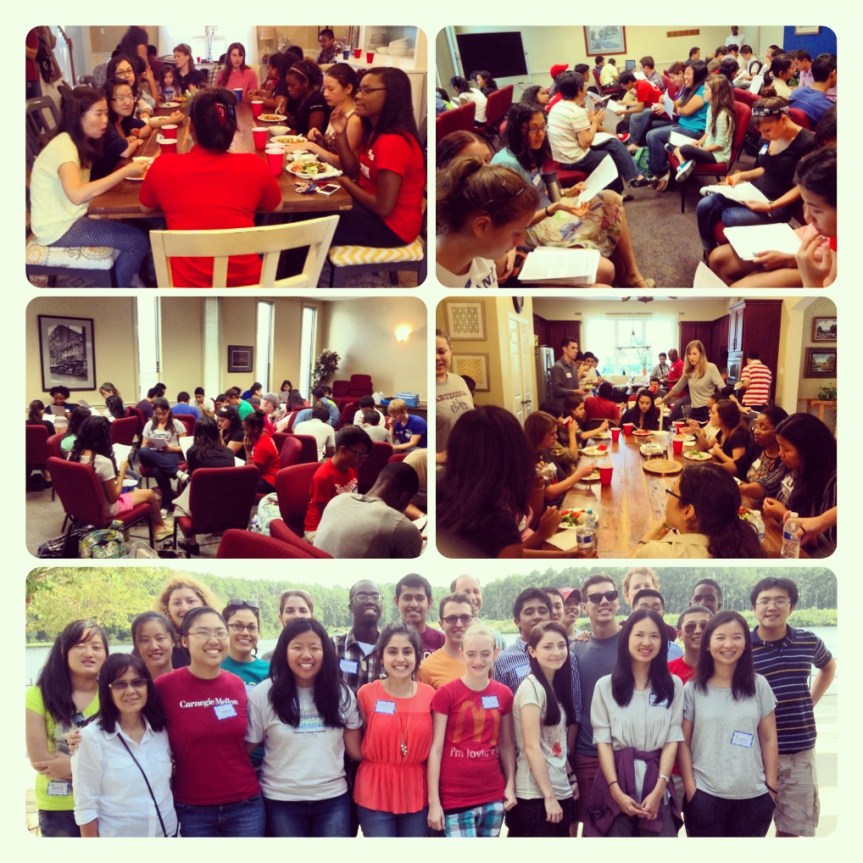
House to House
House to House Christians on Campus University of Houston

A Reading from the Psalms: Psalm 118:2-4, 13-15, 22-24 (NLT)

Let all Israel repeat: “His faithful love endures forever.”
Let Aaron’s descendants, the priests, repeat: “His faithful love endures forever.”
Let all who fear the Lord repeat: “His faithful love endures forever.”

_____

My enemies did their best to kill me, but the Lord rescued me. The Lord is my strength and my song; he has given me victory. Songs of joy and victory are sung in the camp of the godly. The strong right arm of the Lord has done glorious things!
_____

The stone that the builders rejected has now become the cornerstone. This is the Lord’s doing, and it is wonderful to see. This is the day the Lord has made. We will rejoice and be glad in it.
__________


__________

A Reading from the Letters: 1 Peter 1:3-9 (NLT)

All praise to God, the Father of our Lord Jesus Christ. It is by his great mercy that we have been born again, because God raised Jesus Christ from the dead. Now we live with great expectation, and we have a priceless inheritance — an inheritance that is kept in heaven for you, pure and undefiled, beyond the reach of change and decay. And through your faith, God is protecting you by his power until you receive this salvation, which is ready to be revealed on the last day for all to see.

So be truly glad. There is wonderful joy ahead, even though you have to endure many trials for a little while. These trials will show that your faith is genuine. It is being tested as fire tests and purifies gold — though your faith is far more precious than mere gold. So when your faith remains strong through many trials, it will bring you much praise and glory and honor on the day when Jesus Christ is revealed to the whole world.

You love him even though you have never seen him. Though you do not see him now, you trust him; and you rejoice with a glorious, inexpressible joy. The reward for trusting him will be the salvation of your souls.

A Reading from the Gospels: John 20:19-31 (NLT)

Jesus Appears to His Disciples

That Sunday evening the disciples were meeting behind locked doors because they were afraid of the Jewish leaders. Suddenly, Jesus was standing there among them! “Peace be with you,” he said. As he spoke, he showed them the wounds in his hands and his side. They were filled with joy when they saw the Lord! Again he said, “Peace be with you. As the Father has sent me, so I am sending you.” Then he breathed on them and said, “Receive the Holy Spirit. If you forgive anyone’s sins, they are forgiven. If you do not forgive them, they are not forgiven.”

Jesus Appears to Thomas

One of the twelve disciples, Thomas (nicknamed the Twin), was not with the others when Jesus came. They told him, “We have seen the Lord!”

But he replied, “I won’t believe it unless I see the nail wounds in his hands, put my fingers into them, and place my hand into the wound in his side.”

Eight days later the disciples were together again, and this time Thomas was with them. The doors were locked; but suddenly, as before, Jesus was standing among them. “Peace be with you,” he said. Then he said to Thomas, “Put your finger here, and look at my hands. Put your hand into the wound in my side. Don’t be faithless any longer. Believe!”

“My Lord and my God!” Thomas exclaimed.

Then Jesus told him, “You believe because you have seen me. Blessed are those who believe without seeing me.”

"The Doubting Thomas" Carl Heinrich Bloch, (1834 - 1890)
“The Doubting Thomas”
Carl Heinrich Bloch, (1834 – 1890)

Purpose of the Book

The disciples saw Jesus do many other miraculous signs in addition to the ones recorded in this book. But these are written so that you may continue to believe that Jesus is the Messiah, the Son of God, and that by believing in him you will have life by the power of his name.

Intercessions:

Give thanks to the Lord, for he is good, his love has no end! He answered the prayers of his Beloved Son: I trust he will help us in our time of need as well –

+ That those who have been baptised around the world during this Easter Season may always walk in the light of Christ….
Lord, hear my prayer.

+ That all Christians who celebrate Christ’s resurrection at Easter may live lives full of faith, hope and love all year round….
Lord, hear my prayer.

+ That Christian leaders around the world may continue to inspire their faith communities and lift the hearts of Your people….
Lord, hear my prayer.

+ That those for whom faith is irrelvant may believe the Good News of the life, death and resurrection of our Saviour….
Lord, hear my prayer.

+ That people in need of support and love may experience God’s care through the Christians around them….
Lord, hear my prayer.

+ That those who have died may share the glory of the resurrection – especially those who died recently, those whose anniversaries occur and all those who passed away since last Easter….
Lord, hear my prayer.

O God our saviour and redeemer, You lead Your people from defeat to triumph: Hear and grant my prayers, through Christ our risen Lord. Amen.

Spiritual Song: Let It Be Known

+ In the Name of the Father, and the Son, and the Holy Spirit. Amen
Morning Prayer: 26 Apr – John 21:15-19 ~ do you love me

Morning Prayer

+ In the name of the Father, and of the Son, and of the Holy Spirit. Amen

Opening sentences — The Way of the Cross

Let all creation give thanks to the Risen Lord.
Give thanks to the Risen Lord!

Filled with His praises, give thanks to the Risen Lord.
Give thanks to the Risen Lord!

He is our Shepherd, and we are His sheep.
Give thanks to the Risen Lord!

Stepping out boldly, we claim resurrection.
Give thanks to the Risen Lord!

Morning reading

John 21:15-19 ESV

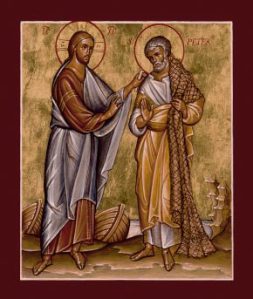
jesus-peter-reconciliation1

When they had finished breakfast, Jesus said to Simon Peter, “Simon, son of John, do you love me more than these?” He said to him, “Yes, Lord; you know that I love you.” He said to him, “Feed my lambs.”

[Jesus] said to him a second time, “Simon, son of John, do you love me?” He said to him, “Yes, Lord; you know that I love you.” He said to him, “Tend my sheep.”

[Jesus] said to him the third time, “Simon, son of John, do you love me?” Peter was grieved because he said to him the third time, “Do you love me?” and he said to him, “Lord, you know everything; you know that I love you.” Jesus said to him, “Feed my sheep. Truly, truly, I say to you, when you were young, you used to dress yourself and walk wherever you wanted, but when you are old, you will stretch out your hands, and another will dress you and carry you where you do not want to go.” (This he said to show by what kind of death he was to glorify God.) And after saying this he said to him, “Follow me.”

Reflections:

ultimate question

Jesus’ question is extremely searching, indeed, it is the ultimate question in life: do you truly love me more than these? (v. 15). What does these refer to? If it is the net and boat, then this question gets at the central point of discipleship and reveals a person’s heart. What do we love the most? Have we abandoned all to follow Jesus? Every time we are faced with a temptation this question is raised. Every time we become preoccupied with even the good things God gives us this question is raised.

question of pride

But, while all of this is true, it is probably not the specific point here. By these Jesus probably means “these other disciples.” According to the other Gospels, Peter had boasted that though all the others fall away, he would not (Mt 26:33 par. Mk 14:29; cf. Lk 22:33; Jn 13:37). John does not record this boast, but Peter’s actions in swimming to shore and hauling up the net by himself reveal the same attitude. Jesus’ question, therefore, goes even deeper than the issue of false attachments. He gets at the root of all sin, namely, pride.

humility and healing

Peter does not claim to love Jesus more than the others do, which suggests he has benefited from having reflected on his shameful denials of the Lord. His response is typical of true discipleship, for it is humble and focuses on the Lord’s own knowledge.

Peter was not boastful when Jesus gave him the opportunity to be, but by the third time Jesus asks whether he loves him, Peter is hurt, that is, deeply grieved. Jesus’ asking three times recalls the three denials, and Peter’s pride is cut to the quick. Here we see the Great Physician performing painful but necessary surgery. The light is shining in the darkness of Peter’s heart, bringing life. For this is what John of the Ladder (c. A.D. 570-649) refers to as “joy-producing sorrow” – the repentance that enables one to experience the Lord’s love and salvation. Without such brokenness we are full of self and unable to hear and receive the guidance of the Chief Shepherd. Peter is dying to self and finding his confidence only in the Lord. It is the Lord who knows. Despite the appearances, Peter does love Jesus.

shepherds of His flock

Jesus himself is the Good Shepherd, and now he commissions Peter to care for the flock that belongs to Jesus, for they are my lambs . . . my sheep. The community has already been established, and now Peter is given authority, though of a particular kind.

The key qualification for this task, is a love for Jesus that is characterized by humility, dependence and obedience. Peter already had a devotion to Jesus, but he was still full of self will and was thrusting himself to the front. Such a proud attitude of heart would spell disaster for the community, as had already been evident in Israel’s history right up to the opponents who had just had Jesus crucified and as has sadly been just as evident in the history of the church. But Peter himself learned his lesson, as is clear from his first letter. When he addresses the elders of the communities he does so as a “fellow elder” and encourages them to “be shepherds of God’s flock that is under your care, serving as overseers . . . not lording it over those entrusted to you, but being examples to the flock. And when the Chief Shepherd appears, you will receive the crown of glory that will never fade away” (1 Pet 5:1-4). Here is authority exercised in humility and conscious of the Chief Shepherd. Such are marks of a true shepherd.

follow Me

After Peter professes his obedient love, Jesus spells out the cost of that love. He contrasts Peter’s youth, his life up to this point, with what is coming. He has been able to go wherever he wanted, but when he is old, Jesus tells him, you will stretch out your hands, and someone else will dress you and lead you where you do not want to go. Here is an explicit contrast between Peter’s life of self will and his coming under the will of another. He has just submitted to Jesus and his will, and now Jesus says such submission is going to include being taken where he does not want to go.

The Good Shepherd laid down his life for the sheep, and this shepherd will have to do likewise, though his death will not, of course, take away the sins of the world. He has submitted his will to God, and his death, like Jesus’ death, will be in accordance with God’s will and thereby glorify him (Moloney).

Having spelled out his will for Peter, Jesus calls him to follow him. Peter had answered such a call at the outset of the ministry, but now he understands much more about who Jesus is and what following him entails. He has also received a commission from the Lord for leadership in the community. So this is a call to recommit himself. Just as this Gospel shows that faith must be exercised in the face of each new revelation, so one’s commitment to Jesus must be renewed as one learns more of Christ and his call.

The IVP New Testament Commentary Series
__________


__________

Canticle:

Christ, as a light… illumine and guide me. Christ, as a shield… overshadow me. Christ under me; Christ over me; Christ beside me on my left and my right.

This day be within and without me, lowly and meek, yet all-powerful. Be in the heart of each to whom I speak; in the mouth of each who speaks unto me. This day be within and without me, lowly and meek, yet all-powerful.

Christ as a light; Christ as a shield; Christ beside me on my left and my right.

Blessing

May the peace of the Lord Christ go with you, wherever He may send you. May He guide you through the wilderness, protect you through the storm. May He bring you home rejoicing at the wonders He has shown you. May He bring you home rejoicing once again into our doors.

+ In the name of the Father, and of the Son, and of the Holy Spirit. Amen

_____________________________________

Peanut Gallery: A brief word of explanation – the general format for Morning Prayer is adapted from the Northumbrian Community‘s Daily Office, as found in Celtic Daily Prayer (see online resources here.) The Scripture readings are primarily from the Gospel of John, with the intent to complete the reading by Easter. Other Scriptures which illuminate the Gospel of John will be included along the way.

Reflections from various saints will be included as their memorial days occur during the calendar year.

On Sundays, I’ll return to the USCCB readings (see online resources here) and various liturgical resources in order to reflect the Church’s worship and concerns throughout the world.

Photo illustrations and music videos, available online, are included as they illustrate or illuminate the readings. I will try to give credit and link to sources as best I can.

Morning Prayer: 25 Apr – John 21:1-14 ~ the last breakfast

Morning Prayer

+ In the name of the Father, and of the Son, and of the Holy Spirit. Amen

Opening sentences — The Way of the Cross

Let all creation give thanks to the Risen Lord.
Give thanks to the Risen Lord!

Filled with His praises, give thanks to the Risen Lord.
Give thanks to the Risen Lord!

Stepping out boldly, we claim resurrection.
Give thanks to the Risen Lord!

Morning reading

John 21:1-14 ESV

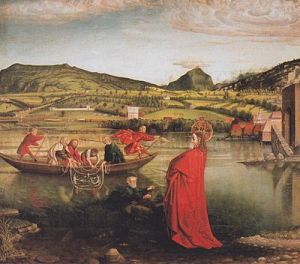
"The Miraculous Draft of Fishes" Konrad Witz, 1444  Musée d'Art et d'Histoire, Geneva
“The Miraculous Draft of Fishes”
Konrad Witz, 1444
Musée d’Art et d’Histoire, Geneva

After this Jesus revealed himself again to the disciples by the Sea of Tiberias, and he revealed himself in this way. Simon Peter, Thomas (called the Twin), Nathanael of Cana in Galilee, the sons of Zebedee, and two others of his disciples were together. Simon Peter said to them, “I am going fishing.” They said to him, “We will go with you.” They went out and got into the boat, but that night they caught nothing.

Just as day was breaking, Jesus stood on the shore; yet the disciples did not know that it was Jesus. Jesus said to them, “Children, do you have any fish?” They answered him, “No.” He said to them, “Cast the net on the right side of the boat, and you will find some.” So they cast it, and now they were not able to haul it in, because of the quantity of fish. That disciple whom Jesus loved therefore said to Peter, “It is the Lord!” When Simon Peter heard that it was the Lord, he put on his outer garment, for he was stripped for work, and threw himself into the sea. The other disciples came in the boat, dragging the net full of fish, for they were not far from the land, but about a hundred yards off.

When they got out on land, they saw a charcoal fire in place, with fish laid out on it, and bread. Jesus said to them, “Bring some of the fish that you have just caught.” So Simon Peter went aboard and hauled the net ashore, full of large fish, 153 of them. And although there were so many, the net was not torn. Jesus said to them, “Come and have breakfast.” Now none of the disciples dared ask him, “Who are you?” They knew it was the Lord. Jesus came and took the bread and gave it to them, and so with the fish. This was now the third time that Jesus was revealed to the disciples after he was raised from the dead.

Reflections:

necessity and lordship

The stories in this chapter reveal Jesus’ bringing his disciples, especially Peter, more completely under his lordship. The disciples do not know what to do, so they do that which is necessary, and in taking this initiative they put themselves in a place where Christ meets them. Here is the simple truth, attested to by the saints, that when we are uncertain what to do we should simply do our duty and God will guide.

obedience and abundance

That night they catch nothing, a graphic portrayal of barrenness. They have done what they thought was the right thing but experience utter failure. This prepares them to learn one of the central lessons of discipleship — apart from Jesus they can do nothing (15:5). Jesus has taught this lesson before, for “never in the Gospels do the disciples catch a fish without Jesus’ help” (Brown)! But they need the lesson repeated, as we often do as well.

The primary point seems to be Jesus’ lordship and the need to be obedient to him for any labor to be fruitful. Earlier, Mary recognized Jesus when he called her name, and the disciples recognized him through his wounds. Now he is recognized through the abundance that comes through obedience to his word.

appearance and recognition

The Lord has breakfast ready for the disciples, another sign of his grace and provision, like the catch they have just taken. There is no indication of where Jesus got the bread and fish; the appearance of the food is as mysterious as his own.

The first one to speak is Jesus, and he tells them to bring some of the fish they have caught. Throughout this encounter with Jesus the disciples have not said anything. The scene is one of great awe, with none of them daring to ask him, Who are you? There was something different about him, yet they were able to recognize him. The Lord Jesus is the focus of this story.

the last breakfast

After inviting them to come and eat, he himself comes to the fire. He took the bread and gave it to them, and did the same with the fish. This description echoes his action at the feeding of the five thousand and provides the climax of this story. It answers their unasked questions — he is recognized in this breaking of the bread (cf. Lk 24:30-31). The master who commands them also serves them, continuing a theme found during the ministry.

This association, as well as the tie in with the feeding of the five thousand, brings echoes of the Eucharist (cf. Brown). This meal itself is not a Eucharist, but it embodies a central aspect of what Eucharist itself is about — communion with the risen Lord in the midst of his people.

The IVP New Testament Commentary Series
__________


__________

Canticle:

Christ, as a light… illumine and guide me. Christ, as a shield… overshadow me. Christ under me; Christ over me; Christ beside me on my left and my right.

This day be within and without me, lowly and meek, yet all-powerful. Be in the heart of each to whom I speak; in the mouth of each who speaks unto me. This day be within and without me, lowly and meek, yet all-powerful.

Christ as a light; Christ as a shield; Christ beside me on my left and my right.

Blessing

May the peace of the Lord Christ go with you, wherever He may send you. May He guide you through the wilderness, protect you through the storm. May He bring you home rejoicing at the wonders He has shown you. May He bring you home rejoicing once again into our doors.

+ In the name of the Father, and of the Son, and of the Holy Spirit. Amen

_____________________________________

Peanut Gallery: A brief word of explanation – the general format for Morning Prayer is adapted from the Northumbrian Community‘s Daily Office, as found in Celtic Daily Prayer (see online resources here.) The Scripture readings are primarily from the Gospel of John, with the intent to complete the reading by Easter. Other Scriptures which illuminate the Gospel of John will be included along the way.

Reflections from various saints will be included as their memorial days occur during the calendar year.

On Sundays, I’ll return to the USCCB readings (see online resources here) and various liturgical resources in order to reflect the Church’s worship and concerns throughout the world.

Photo illustrations and music videos, available online, are included as they illustrate or illuminate the readings. I will try to give credit and link to sources as best I can.

Morning Prayer: 24 Apr – John 20:30-31 ~ that believing you may have…

Morning Prayer

+ In the name of the Father, and of the Son, and of the Holy Spirit. Amen

Opening sentences — The Way of the Cross

Let all creation give thanks to the Risen Lord.
Give thanks to the Risen Lord!

Filled with His praises, give thanks to the Risen Lord.
Give thanks to the Risen Lord!

Stepping out boldly, we claim resurrection.
Give thanks to the Risen Lord!

Morning reading

life in His name

John 20:30-31 ESV

Now Jesus did many other signs in the presence of the disciples, which are not written in this book; but these are written so that you may believe that Jesus is the Christ, the Son of God, and that by believing you may have life in his name.

Reflections:

purpose

John’s statement of purpose is directly linked with Jesus’ blessing upon those who have not seen and yet have believed. While many of Jesus’ signs were done in the presence of others, the presence of his disciples is the crucial fact, for it is they who have believed and been enabled to, by the Spirit, understand their significance and bear witness to Jesus and Jesus’ witness to the Father.

John’s purpose is precisely to enable others to experience the blessedness that Jesus has just spoken of, which comes through faith. The two central titles for Jesus are Christ and Son of God, representing in this Gospel both the fulfillment of Jewish expectation and much more — the personal presence of God himself in our midst. The purpose of this believing is to have life in his name.

life

Jesus has brought life, but this life is not a gift separate from himself. Rather, it is a life in himself who, like the Father, is life itself (Chrysostom). To live in his name is to live his own life, with its source in the Father, and therefore to live his pattern of life. This means to love as he loved, obedient to God, totally trusting him and interpreting all the events in our own lives in the light of his divine presence.

John expresses this same call — to share in God’s life — at the beginning of his first letter. “The life appeared; we have seen it and testify to it, and we proclaim to you the eternal life, which was with the Father and has appeared to us. We proclaim to you what we have seen and heard, so that you also may have fellowship with us. And our fellowship is with the Father and with his Son, Jesus Christ” (1 Jn 1:2-3).

The IVP New Testament Commentary Series
__________

__________

Canticle:

Christ, as a light… illumine and guide me. Christ, as a shield… overshadow me. Christ under me; Christ over me; Christ beside me on my left and my right.

This day be within and without me, lowly and meek, yet all-powerful. Be in the heart of each to whom I speak; in the mouth of each who speaks unto me. This day be within and without me, lowly and meek, yet all-powerful.

Christ as a light; Christ as a shield; Christ beside me on my left and my right.

Blessing

May the peace of the Lord Christ go with you, wherever He may send you. May He guide you through the wilderness, protect you through the storm. May He bring you home rejoicing at the wonders He has shown you. May He bring you home rejoicing once again into our doors.

+ In the name of the Father, and of the Son, and of the Holy Spirit. Amen

_____________________________________

Peanut Gallery: A brief word of explanation – the general format for Morning Prayer is adapted from the Northumbrian Community‘s Daily Office, as found in Celtic Daily Prayer (see online resources here.) The Scripture readings are primarily from the Gospel of John, with the intent to complete the reading by Easter. Other Scriptures which illuminate the Gospel of John will be included along the way.

Reflections from various saints will be included as their memorial days occur during the calendar year.

On Sundays, I’ll return to the USCCB readings (see online resources here) and various liturgical resources in order to reflect the Church’s worship and concerns throughout the world.

Photo illustrations and music videos, available online, are included as they illustrate or illuminate the readings. I will try to give credit and link to sources as best I can.

Morning Prayer: 23 Apr – John 20:24-29 ~ believing is seeing

Morning Prayer

+ In the name of the Father, and of the Son, and of the Holy Spirit. Amen

Opening sentences — The Way of the Cross

Let all creation give thanks to the Risen Lord.
Give thanks to the Risen Lord!

Filled with His praises, give thanks to the Risen Lord.
Give thanks to the Risen Lord!

Stepping out boldly, we claim resurrection.
Give thanks to the Risen Lord!

Morning reading

"The Incredulity of Saint Thomas" Caravaggio, 1601–1602 Sanssouci Palace, Potsdam, Berlin
“The Incredulity of Saint Thomas”
Caravaggio, 1601–1602
Sanssouci Palace, Potsdam, Berlin

John 20:24-29 ESV

Now Thomas, one of the Twelve, called the Twin, was not with them when Jesus came. So the other disciples told him, “We have seen the Lord.” But he said to them, “Unless I see in his hands the mark of the nails, and place my finger into the mark of the nails, and place my hand into his side, I will never believe.”

Eight days later, his disciples were inside again, and Thomas was with them. Although the doors were locked, Jesus came and stood among them and said, “Peace be with you.” Then he said to Thomas, “Put your finger here, and see my hands; and put out your hand, and place it in my side. Do not disbelieve, but believe.” Thomas answered him, “My Lord and my God!” Jesus said to him, “Have you believed because you have seen me? Blessed are those who have not seen and yet have believed.”

Reflections:

progession of faith

Faith throughout the Gospel is depicted as progressive, renewed in the face of each new revelation of Jesus. The other disciples have moved on to the next stage, but Thomas has not been able to. To not move on when Jesus calls us to do so is to shift into reverse and move away. Both believing and unbelieving are dynamic — we are growing in one direction or the other. Thus, when Jesus appears in their midst he challenges Thomas to move on ahead in the life of faith, to stop doubting and believe.

The actual expression used may capture the dynamic quality – translated woodenly it reads, “Stop becoming unbelieving and get on with becoming believing.” To get Thomas moving in the right direction again Jesus offers him the chance to feel his wounds.

confession of faith

Thomas’ confession of Jesus as my Lord and my God is yet another climax in this Gospel. Jesus has invited him to catch up with the others in their new stage of faith, and he shoots past them and heads to the top of the class. His confession is… an expression of the core of John’s witness to Jesus in this Gospel. Thomas confesses Jesus as God when he sees that the crucified one is alive. It is in the crucifixion that God himself is made known, for he is love, and love is the laying down of one’s life. But God is also life. In John, this God is revealed perfectly in the death of the Son, but this death would be nothing without the life. When Thomas finds death and life juxtaposed in Jesus he realizes who the one standing before him really is.

blessedness of faith

This beatitude, like others Jesus had spoken, is a shocking reversal of common expectations. It suggests that if seeing is believing, as it was for Thomas, believing is also seeing. What matters is the relationship established by faith. But this faith is openness and acceptance and trust directed toward God in Jesus.

In John, the concern is with events in history that demand an interpretation and a response. Thomas’ confession was such a judgment, and now Jesus challenges all who come after to venture a judgment upon this history, that is, upon his person, his presence through the Spirit in this particular community and through the life he offers. Peter later describes such believers: “Though you have not seen him, you love him; and even though you do not see him now, you believe in him and are filled with an inexpressible and glorious joy, for you are receiving the goal of your faith, the salvation of your souls” (1 Pet 1:8-9).

The IVP New Testament Commentary Series
__________


__________

Canticle:

Christ, as a light… illumine and guide me. Christ, as a shield… overshadow me. Christ under me; Christ over me; Christ beside me on my left and my right.

This day be within and without me, lowly and meek, yet all-powerful. Be in the heart of each to whom I speak; in the mouth of each who speaks unto me. This day be within and without me, lowly and meek, yet all-powerful.

Christ as a light; Christ as a shield; Christ beside me on my left and my right.

Blessing

May the peace of the Lord Christ go with you, wherever He may send you. May He guide you through the wilderness, protect you through the storm. May He bring you home rejoicing at the wonders He has shown you. May He bring you home rejoicing once again into our doors.

+ In the name of the Father, and of the Son, and of the Holy Spirit. Amen

_____________________________________

Peanut Gallery: A brief word of explanation – the general format for Morning Prayer is adapted from the Northumbrian Community‘s Daily Office, as found in Celtic Daily Prayer (see online resources here.) The Scripture readings are primarily from the Gospel of John, with the intent to complete the reading by Easter. Other Scriptures which illuminate the Gospel of John will be included along the way.

Reflections from various saints will be included as their memorial days occur during the calendar year.

On Sundays, I’ll return to the USCCB readings (see online resources here) and various liturgical resources in order to reflect the Church’s worship and concerns throughout the world.

Photo illustrations and music videos, available online, are included as they illustrate or illuminate the readings. I will try to give credit and link to sources as best I can.