The Case Against Unauthorized Syria Intervention – Andrew C. McCarthy Re-Blog

Peanut Gallery: Should we intervene in Syria? I don’t think so… and neither does Andrew C. McCarthy. In the following article, McCarthy presents his case for staying out of Syria, along with extensive background links that are well worth the read.

Going to war is serious business that requires public debate and congressional authorization. Our current administration has neither and Senator Rand Paul wants to hold them accountable. Good for him and his bipartisan coalition.

To understand why should we stay out of Syria, you need to look no further than the debacle in Libya. Please take the time to read McCarthy ‘s article posted below. We are way beyond 30 second sound bites on this issue.
______________________________________

Paul and Lee Lead Bipartisan Effort Against Obama’s Unauthorized Syria Intervention

by Andrew C. McCarthy
pjmedia.com / June 22nd 2013

image

Thanks to Republican Senators Rand Paul (of Kentucky) and Mike Lee (of Utah), we might finally get on Syria what we were denied on Libya: a real debate among the American people’s representatives over congressional authorization of President Obama’s unilateral war-making in the Middle East.

The Washington Examiner reports that Senators Paul and Lee have joined with two counterparts, Democrats Chris Murphy (of Connecticut) and Tom Udall (of New Mexico), in offering legislation that would block direct or indirect aid for military or paramilitary operations in Syria. The bill, which is posted on Paul’s website, is called the “Protecting Americans from the Proliferation of Weapons to Terrorists Act of 2013.”

The proposal would not affect or prohibit humanitarian aid, but it forthrightly addresses the issue Syria intervention supporters willfully ignore: the factions President Obama is abetting – egged on by the GOP’s McCain wing and their fellow transnational progressives on the Democratic side of the aisle – are Islamic supremacists dominated by the Muslim Brotherhood and closely connected to violent jihadists, including al Qaeda-affiliated groups.

Not to be a broken record (see, e.g., here, here and here), but the Syrian civil war pits implacable enemies of the United States against each other. And as night follows day, they are using their barbaric jihadist tactics against each other. The situation is reminiscent of the central flaw in our  Libyan misadventure – which led directly to the massacre of Americans in the “rebel” stronghold of Benghazi on September 11, 2012.

As John Rosenthal acutely observes in his short but essential book The Jihadist Plot: The Untold Story of Al-Qaeda and the Libyan Rebellion, while there are many problems with using the label “war on terror” to describe our ongoing hostilities, “at least the term had the advantage of making clear that the US and its allies abhorred the tactic in question.” Yet, in Libya, and now in Syria, we have turned a blind eye to the fact that terrorism is used by the jihadists our government has chosen to side with.

We try to obscure this fact by referring to the opposition forces as “rebels,” the better to avoid noticing that they consider themselvesmujahideen (jihad warriors), and by pretending we favor only the “secular” “moderates,” though it is laughable to suggest there are enough of them to topple the regimes in question without allying with the more numerous and formidable Islamic-supremacists factions.

This is a disgraceful state of affairs. For many years after their enactment in 1996, the material-support-to-terrorism laws, which prohibit and severely punish any abetting of terrorist organizations and their savage methods, were foundational to American counterterrorism. They have been a staple of anti-terrorism prosecutions and of the policy shift designed to prevent terrorist attacks from happening (by starving jihadist cells of resources) rather than content ourselves to prosecute only after suffering attacks.

At least as importantly, material support statutes also proclaimed our moral position: any organization that resorted to terrorism is the enemy of humanity, regardless of its cause and regardless of what humanitarian activities the organization purports to carry out.

Now, no matter how much government officials deny it, our government is endorsing what we went to war to defeat. Our government is materially supporting terrorists – the very conduct it prosecutes and imprisons American citizens for committing.

The intervention is also making a mockery of the international order that Obama purports to care so much about. There are international law restrictions against arming the jihadist-ridden Syrian opposition.
The Obama administration looked the other way while encouraging Islamic-supremacist governments in Qatar, Saudi Arabia, and Turkey to supply weapons. Now, entirely predictably, those weapons are in the hands of terrorists – exactly what the international law restrictions were designed to prevent. So we are both materially supporting jihadists and undermining the laws on which, according to progressives, global stability depends.

And don’t tell me about “red lines” and the Syrian regime’s use of chemical weapons. The sharia-supremacists our government is supporting include factions that have been seeking chemical weapons for decades – and unlike Assad, they want them in order to use them against the United States.

This is not to carry Assad’s water; he is incontestably a monster – unlike the Obama administration, which hailed him as a “reformer” and strengthened him by re-establishing diplomatic ties with Syria at a time when Assad was reeling, I have never been under any illusions to the contrary.

But our interventionist rah-rah squad is gradually giving us a Middle East in which weapons of mass destruction will be in the hands of Islamic-supremacist regimes heavily influenced by jihadists (did you see that Morsi’s Egypt just appointed a governor (since resigned) from the blind sheikh’s terrorist organization?).

Already, the US/NATO intervention in Libya has opened Qaddafi’s arsenal to the jihadists who are terrorizing North Africa. Would Assad give his WMD to Hezbollah? He might, but as both he and Hezbollah are supplied by Iran, it would be silly to imagine that Hezbollah does not already have access to WMD.

The point is that our intervention stands to land such weapons in the hands of Sunni jihadists. How is that better? How is it in America’s vital interests?

The fact is, we have no vital interests in the outcome of Syria’s civil war. Both sides are our enemies. Assad has neither attacked nor threatened to attack the United States. Consequently, waging war against the Syrian regime is wholly a matter of choice. That is a choice that, in our constitutional system, cries out for congressional authorization.

Without congressional authorization – without a demonstration that the American people’s representatives are satisfied that American interests call for waging an unprovoked war against the Assad regime – there should be no American intervention.

For what it’s worth, during the Libya intervention debate, I dilated on what I believe our law requires for the use of military force in the absence of an attack or threatened attack against our country:

Transnational progressives and national-security conservatives may hotly debate whether any endorsement from some international body (in particular, the U.N. Security Council) is necessary before the United States may legitimately take military action. But there should be no debating that absent a hostile invasion of our country, a forcible attack against our interests, or a clear threat against us so imminent that Americans may be harmed unless prompt action is taken, the United States should not launch combat operations without congressional approval.That is especially true in Libya. There is no realistic prospect of harm to the United States from Qaddafi’s regime.

Concededly, I do not believe there is sufficient justification to use U.S. military force — I don’t even think it’s a close case, and I think proponents are seriously discounting the net harm using force could cause. But I am talking now about propriety, not policy.

In his remarks Friday, committing to what he promised would be a limited military engagement (with no ground forces, basically just air power), [President Obama] never even hinted that he might seek Congress’s imprimatur. To the contrary, he asserted that the “use of force” was “authorized” by the “strong resolution” of the “U.N. Security Council,” which was acting “in response to a call for action by the Libyan people and the Arab League.”

Many of the Libyan people, to say nothing of the Arab League, do not mean the United States well. But even if they were strong allies, that would make no difference. Only the American people and their representatives in the United States Congress get to make the “call for action” that involves enmeshing our armed forces and our country in a war.

Continue reading “The Case Against Unauthorized Syria Intervention – Andrew C. McCarthy Re-Blog”

Time to Get Some Perspective on Israel – American Thinker Re-Blog

Even putting aside Israel’s own legitimate legal, cultural, and historical claims to disputed territories, Israeli withdrawal to those lines won’t happen now due to Israeli aversion to existential vulnerability.

by Abraham Katsman
americanthinker.com / June 17th 2013

Syria spirals out of control. Iran marches toward nuclear Islamageddon. So, naturally, Secretary of State John Kerry schedules yet another trip to “solve” the region’s relatively stable, if not ideal, Israel-Palestinian dispute.

Like so many in foreign policy circles, Kerry and the Obama administration know — absolutely know — the key to peace in Israel’s neighborhood: Israel’s withdrawal, with perhaps minor adjustments, from all West Bank territory conquered in 1967.

Yet history indicates that withdrawal to the pre-1967 lines, absent major changes, is arguably the single most counterproductive act imaginable for long-lasting peace. There is no greater obstacle to peace than the perpetual temptation to launch another war against Israel from such lopsided lines.

What is so sacred about the pre-1967 lines, anyway? In 1967, there was neither peace nor an independent Palestinian entity. Similar lines were part of the 1947 Partition Plan and were overrun by invading Arab armies. The pre-1967 lines were never an internationally recognized border — thanks to Arab insistence that they not be. They were merely the armistice lines of 1949, an armistice honored mostly in the breach. In 1967, Arab armies finally shredded the armistice by attacking across those lines, in spite of Israeli pleas to Jordan’s King Hussein not to do so. With new ceasefire lines in 1967 and 1973, the pre-1967 lines were rendered meaningless, having lasted all of 18 years: 1949-1967. RIP.

Even putting aside Israel’s own legitimate legal, cultural, and historical claims to disputed territories, Israeli withdrawal to those lines won’t happen now due to Israeli aversion to existential vulnerability.

We all know Israel is small, but we rarely appreciate just how tiny and exposed it is. Pre-1967 Israel is about one tenth the size of Kansas, roughly the size of New Hampshire. But even that exaggerates the practical reality of Israel’s size, as about 57% of pre-1967 Israel is made up of the sparsely inhabited Negev Desert.

Most of Israel’s population, business, industry, and technology reside in the narrow central Coastal Plain. That is a strip of land between the West Bank and the Mediterranean Sea which varies between 9 and 11 miles wide. “Start-Up Nation” Israel squeezes into that Rhode Island-sized area.

Think about that. An entire country, nine miles wide. A bicycle could easily cross it in 30 minutes — and a rocket in a matter of seconds. Nine miles is less than the distance from Barack Obama’s Chicago home to Wrigley Field. It’s the distance between Manhattan’s George Washington Bridge and Holland Tunnel. It is one and a half times around the Central Park loop.

Still hard to grasp? This photo might help:

image

This is the view from the West Bank hilltop settlement of Peduel, about three miles over the Green Line. In the foreground is the West Bank Arab village of Dayr Balut. In the middle ground are Tel Aviv and its surrounding neighborhoods. Behind Tel Aviv is the Mediterranean. That’s it.

The next time some radical speaks of “driving the Jews into the sea,” keep in mind how short a drive that is.

When controlled by Israel’s enemies, vulnerable, lowland Israel consistently proved too tempting to resist attacking, whether in exterminationist wars of 1948 and 1967 or in numerous cross-border terror acts in between. Yet, in 1973, when Israel was teetering in the early days of the Yom Kippur War, Jordan — no longer in control of the West Bank and its commanding heights — refrained from attacking. The “Occupation” — Israel’s administration of the West Bank — saved Israel (and countless Jordanian soldiers), whereas the past absence of occupation had invited attack. Rather than simply an “obstacle to peace,” the Occupation also serves as an obstacle to war.

To withdraw to pre-1967 borders is to risk suicide. All the diplomatic condemnations in the world won’t make Israel act so recklessly, especially when based on murky claims of “international law” invoked only in the Israel context — never, of course, involving occupations and human rights abominations by Turkey (Cyprus), Russia (Georgia, Chechnya), China (Tibet), India (Kashmir), or Syria (Lebanon).

Tellingly, even “moderate” Palestinian leaders have rejected any material adjustments to those lines, unless demanding that those lines be adjusted in the other direction — i.e., into pre-1967 Israel.

Just this week, Palestinian negotiator Saeb Erakat demanded the strategic high ground of Latrun, which overlooks Israel’s all-important Tel Aviv-Jerusalem Highway. Dare we ask why?

From Israel’s perspective, having frequently faced eradication at the hands of Arab neighbors, the peace process is like a sheep trying to make peace with a wolf: it can be done, as long as the sheep stays alert and armed and takes ample precautions. But when the wolf insists that the sheep leave its pre-1967 neck exposed, it is fair to question the wolf’s motives and decline the wolf’s terms for “peace.”

John Kerry can afford to be wrong about what he “knows” will bring Israeli-Palestinian peace. Israel can’t.

Abraham Katsman is an American attorney and political commentator living in Israel. He serves as Counsel to Republicans Abroad Israel. More of his work is available at AbeKatsman.com.

Career Opportunities: Naval Academy Launches Cyber Ops Major – Business Insider Re-Blog

Peanut Gallery: The U.S. Naval Academy is giving new meaning to the slogan – “Join the Navy and see the world!” 

New careers for the new world order. See the full and related articles at businessinsider.com
_____________________________________

Mike HoffmanMilitary.com / Jun 11th 2013 9:44 AM

Photo by: AP/Brennan Linsley

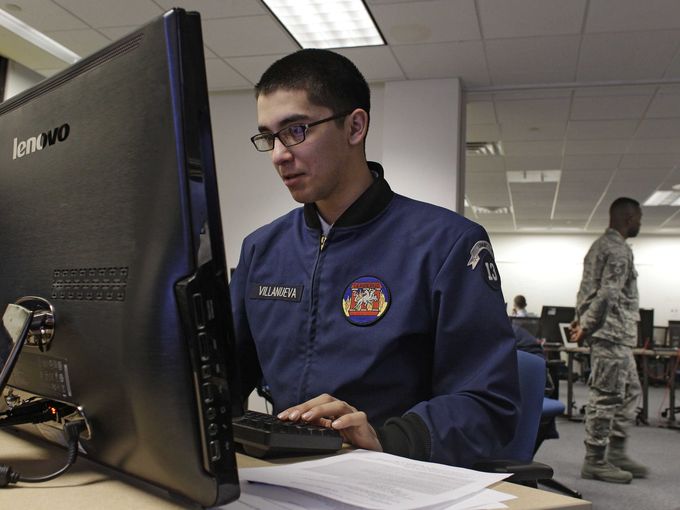
ANNAPOLIS, Md. — This fall, the Naval Academy will become the first service academy — or university for that matter — to offer their undergraduate students the chance to major in Cyber Operations.

Pentagon leaders have established cyber security as an urgent priority to develop within the military with a focus on training leaders. The Defense Department is quick to admit it’s still trying to determine its place in protecting the nation from cyber attacks.

However, military brass has said repeatedly that the officers who will define the Pentagon’s future within cyber security will likely be the youngest set of officers to include those still in training. Cue the Naval Academy’s Class of 2016, which will be the first to have graduates with a Cyber Operations degree.

Leaders at the Naval Academy have spent five years developing the cyber classes since former Commandant Adm. Gary Roughead, who later became the chief of naval operations, challenged the academy to provide cyber classes beyond its computer science offerings.

The academy started by establishing a mandatory class that all midshipmen must take their plebe (freshman) year called Cyber 1. In their third year, midshipmen must take another mandatory course called Cyber 2, which provides more in depth instruction to include cyber policy and economics.

Naval Academy Dean and Provost Andrew T. Phillips said the goal has always been to offer a Cyber Security Studies program that went beyond writing code.“We wanted to make sure we covered the basics as well as the policies, law and economics that are associated with cyber,” Phillips said.

The Naval Academy faced a challenge in creating its Cyber Operations major at the same time the Defense Department has struggled to define its role within the realm, Phillips said.

“The services are still trying to figure out where they fit in right now so that it did make it a little harder,” Phillips said.

The service researched the many graduate-level cyber security programs that exist at university such as the University of Maryland. However, the Naval Academy’s program will be the first major at the undergraduate level.

Naval Academy leaders designed the major to continue to adapt over time much like the technology will develop and dictate changes. Many fundamentals will remain the same, but the program is also designed to ensure students stay up to date with the latest technologies, Phillips said.

“We know 30 years from now that the technology will likely be completely different but our hope is that the fundamentals remain the same and these midshipmen can fall back on those,” he said.

Students majoring in Cyber Operations will have the opportunity to complete internships over the summer with civilian software and internet companies as well as the federal agencies such as the National Security Agency, which is a 30-minute drive from the Naval Academy.

So far, about 30 students have signed up for the major. Midshipman 4th Class Molly McNamara is one such student who chose the major after taking Cyber 1 her plebe year.

McNamaara didn’t arrive at the Naval Academy completing a host of computer science classes in high school. Instead she planned to major in chemistry or pre-med.

Her familiarity with computers didn’t go too far beyond Microsoft and Facebook, she admitted. However, McNamara chose to major in Cyber Operations after learning about the wide ranging impact cyber can have on networks throughout the military and society.

Midshipman 4th Class Zachary Dannelly has a more traditional background for a student you’d expect to pick Cyber Operations as a major. He took Advanced Placement computer science in high school as well as web design classes.

He chose the major because he wants to be a part of a military field that is still being defined.

“It’s exciting to be a part of a new field. It’s almost like being the first people on submarines,” Dannelly said.

Noxious Nominations: The Four Horsemen of the American Foreign Policy Apocalypse – by Barry Rubin – Re-blog

image

Peanut Gallery: When I first heard that John Kerry would be our next Secretary of State, I thought, “It’s time to start learning French.” I really didn’t know whether to laugh or cry. Now I do… get out the Kleenex.

Barry Rubin explains why:

1. Their ideas and views are horrible.
2. They are all stupid people.

For the next four years, at least, clueless people supporting radical Islamists will be steering American foreign policy. This can’t be good for personal or religious freedom as we know it. It will only get tougher for Christians around the world… because America will sit on the sidelines. The surrender-monkeys are in charge.

Please visit pjmedia.com for more comments.
____________________________________

Noxious Nominations: The Four Horsemen of the American Foreign Policy Apocalypse

I did a lot of soul-searching before writing my latest article, “After the Fall: What Do You Do When You Conclude America is (Temporarily or Permanently) Kaput?” Of course, I believed every word of it and have done so for a while. But would it depress readers too much? Would it just be too grim?

Maybe U.S. policy will just muddle through the next four years and beyond without any disasters. Perhaps the world will be spared big crises. Possibly the fact that there isn’t some single big superpower enemy seeking world domination will keep things contained.

Perhaps that is true. Yet within hours after its publication I concluded that I hadn’t been too pessimistic. The cause of that reaction is the breaking story that not only will Senator John Kerry be the new secretary of state; that not only will the equally reprehensible former Senator Chuck Hagel be secretary of defense; but that John Brennan, the president’s counterterrorism advisor, will become CIA chief.

About two years ago I joked that if Kerry were to become secretary of state it would be time to think about heading for that fallout shelter in New Zealand. This trio in power — which along with Obama himself could be called the four horseman of the Apocalypse for U.S. foreign policy — might require an interstellar journey.

Let me stress that this is not really about Israel. At the end of Obama’s second term, U.S.-Israel relations will probably be roughly where they are now. Palestinian strategy — both by the Palestinian Authority and Hamas — has left the United States no diplomatic or “peace process” option on that front. The problem is one of eroding U.S. interests, especially the American position in the Middle East but also in other parts of the world.

image

You can read elsewhere details about these three guys. Here, I will merely summarize the two basic problems:

–Their ideas and views are horrible. This is especially so on Middle Eastern issues, but how good are they on anything else? True, they are all hostile to Israel, but this isn’t the first time people who think that way have held high office. Far worse is that they are pro-Islamist as well as dim-witted about U.S. interests in a way no foreign policy team has been in the century since America walked onto the world stage.

Brennan is no less than the father of the pro-Islamist policy. What Obama is saying is this: My policy of backing Islamists has worked so well, including in Egypt, that we need to do even more! All those analogies to 1930s appeasement are an understatement. Nobody in the British leadership said, “I have a great idea. Let’s help fascist regimes take power and then they’ll be our friends and become more moderate!” That’s the equivalent of what Brennan does.

–They are all stupid people. Some friends said I shouldn’t write this because it is a subjective judgment and sounds mean-spirited. But honest, it’s true. Nobody would ever say that their predecessors — Hillary Clinton, Robert Gates, and David Petraeus — were not intelligent and accomplished. But these guys are simply not in that category. Smart people can make bad judgments; regular people with common sense often make bad judgments less often. But stupid, arrogant people with terrible ideas are a disaster.

Brennan’s only life accomplishment has been to propose backing radical Islamists. As a reward, he isn’t just being made head of intelligence for the Middle East but for the whole world! Has Brennan any proven administrative skill? Any knowledge of other parts of the world? No. All he has is a proximity to Obama and a very bad policy concept. What’s especially ironic here is that by now, the Islamist policy has clearly failed and a lot of people are having second thoughts.

With Brennan running the CIA, though, do you think there will be critical intelligence evaluations of the Muslim Brotherhood, Hizballah, or even Hamas? Is the CIA going to warn U.S. leaders about the repression against women, Christians, and moderates? Will there be warnings that Islamists are taking over Syria or reports on Islamist involvement in killing Americans in Benghazi? Can we have confidence about U.S. policy toward Iran?

To get some insight into his thinking, consider the incident in which a left-wing reporter, forgetting there were people listening, reminded Brennan that in an earlier private conversation he admitted favoring engagement not only with the Lebanese terrorist group Hizballah, but also the Palestinian terrorist group Hamas. Ask yourself this question: when an American intelligence chief told Congress that the Muslim Brotherhood was a moderate, secular group, who approved that line of argument?