
9 Things You Should Know About Independence Day and The Declaration of Independence – Reblog

Re-Blog: The Gospel CoalitionJoe Carter

July 4, 2014 [is] America’s 238th Independence Day, the day Americans celebrate our Declaration of Independence from Great Britain. Here are nine things you should know about America’s founding document and the day set aside for its commemoration.
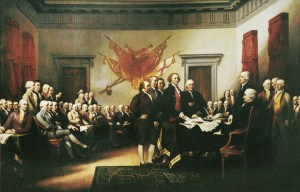
John Trumbull's famous painting is often identified as a depiction of the signing of the Declaration, but it actually shows the drafting committee presenting its work to the Congress.
John Trumbull’s famous painting is often identified as a depiction of the signing of the Declaration, but it actually shows the drafting committee presenting its work to the Congress.

1. July 4, 1776 is the day that we celebrate Independence Day even though it wasn’t the day the Continental Congress decided to declare independence (they did that on July 2, 1776), the day we started the American Revolution (that had happened back in April 1775), the date on which the Declaration was delivered to Great Britain (that didn’t happen until November 1776), or the date it was signed (that was August 2, 1776).

2. The first Independence Day was celebrated on July 8, 1776 (although the Declaration was approved on July 4, 1776, it was not made public until July 8), but for the first two decades after the Declaration was written, people didn’t celebrate it much on any date. One party, the Democratic-Republicans, admired Jefferson and the Declaration. But the other party, the Federalists, thought the Declaration was too French and too anti-British, which went against their current policies.

3. After the War of 1812, the Federalist party began to come apart and the new parties of the 1820s and 1830s all considered themselves inheritors of Jefferson and the Democratic-Republicans. Printed copies of the Declaration began to circulate again, all with the date July 4, 1776, listed at the top. Celebrations of the Fourth of July became more common as the years went on and in 1870, almost a hundred years after the Declaration was written, Congress first declared July 4 to be a national holiday as part of a bill to officially recognize several holidays, including Christmas. Further legislation about national holidays, including July 4, was passed in 1938 and 1941.

4. Benjamin Franklin, John Adams, Thomas Jefferson, Roger Sherman, and Robert R. Livingston comprised the Committee of Five that drafted the Declaration. Jefferson, regarded as the strongest and most eloquent writer, wrote most of the document. After Jefferson wrote his first draft, the other members of the Declaration committee and the Continental Congress made 86 changes, including shortening the overall length by more than a fourth and removing language condemning the British promotion of the slave trade (which Jefferson had included even though he himself was a slave owner).

5. The signed copy of the Declaration is the official, but not the original, document. The approved Declaration was printed on July 5th and a copy was attached to the “rough journal of the Continental Congress for July 4th.” These printed copies, bearing only the names of John Hancock, President, and Charles Thomson, secretary, were distributed to state assemblies, conventions, committees of safety, and commanding officers of the Continental troops. On July 19th, Congress ordered that the Declaration be engrossed on parchment with a new title, “the unanimous declaration of the thirteen united states of America,” and “that the same, when engrossed, be signed by every member of Congress.” Engrossing is the process of copying an official document in a large hand.

6. Thomas Jefferson and John Adams, the only two presidents to sign the document, both died on the Fourth of July in 1826, the fiftieth anniversary of the adoption of the Declaration. Adam’s last words have been reported as “Thomas Jefferson survives.” He did not know that Jefferson had died only a few hours before. James Monroe, the last president who was a Founding Father, also died on July 4 in 1831. Calvin Coolidge, the 30th President, was born on July 4, 1872, and, so far, is the only President to have been born on Independence Day.

7. John Hancock, the President of the Continental Congress at the time, was the first and only person to sign the Declaration on July 4, 1776 (he signed it in the presence of just one man, Charles Thomson, the secretary of Congress). According to legend, the founding father signed his name bigger than everyone else’s because he wanted to make sure “fat old King George” could read it without his spectacles. But the truth is that Hancock had a large blank space and didn’t realize the other men would write their names smaller. Today, the term “John Hancock” has become synonymous with a person’s signature.

8. The 56 signers of the Declaration did not sign on July 4, 1776, nor were they in the same room at the same time on the original Independence Day. The official signing event took place on August 2, 1776 when 50 men signed the document. Several months passed before all 56 signatures were in place. The last man to sign, Thomas McKean, did so in January of 1777, seven months after the document was approved by Congress. Robert R. Livingston, one of the five original drafters, never signed it at all since he believed it was too soon to declare independence.

9. Unlike the U.S. Constitution, which makes no reference to God, the Declaration has three references to a deity. The document also makes two references that tie natural law to God. (Although Thomas Jefferson was a Deist, as a young apprentice lawyer he had studied the work of Henry de Bracton, an English jurist and natural law proponent. Bracton has been referred to as the “father of common law” and is said to have “succeeded in formulating a truly Christian philosophy of law”).

Real Americans Don’t Trust the Government – American Thinker reblog

One cannot be a real conservative, or even a real American, without recognizing the danger that government decisions cannot be trusted and that government needs to be viewed with skepticism, and with public scrutiny. Distrust of government is baked in to the cake of America’s governmental institutions and traditions.

by Jonathon Moseley, americanthinker.com / July 6th 2013

“Question Authority” was a dominant political theme in the ’60s and 70s We’re talking about the 1760s and the 1770s, of course — the American Revolution. Well, sure, the 1960s and the 1970s, too. But our country was founded on the idea “Question Authority” while opposing the King of England in the 1760s and 1770s.

Over this July 4th long weekend, we are called to remember how good cheeseburgers and hot dogs taste when grilled outdoors in the backyard. Oh, wait. That’s not it. Don’t tell me; it will come to me! Hearty cheers to the family Grill Master, always. But there is more to July 4th than potato salad, chips, and sizzling hamburgers.

The Fourth of July — more than any other holiday — is supposed to be a celebration. From the very first July 4th celebration in 1776, it was meant to be a party. Our Founding Fathers wanted it that way, and said so explicitly. Unlike any other holiday, it was established to be a community-wide blast celebrating America’s independence and creation as a new nation.

But what is the real meaning of America? Should you love and trust your government? Should you respect our leaders? Not “do you”. Should you? An enormous cultural divide has developed, from ignorance of American history, on whether it is right or wrong to trust our governments (local, state, and national) in the United States of America.

Many who imagine themselves to be conservative equate loving America with loving our government. If you love your country, you have to love and trust our government leaders, they subconsciously assume. They are offended by talk of not trusting our leaders and bureaucracies.

Newt Gingrich explained it like this: last week you thought your brother-in-law wasn’t too smart. This week he gets a job working for the government. Now he is all-wise and can make decisions for everyone else in society… because he is a government employee. This author wonders: if that government employee quits his job, does he then lose intelligence and wisdom when he re-enters the private sector?

Your neighbor on one side works in the private sector. Your neighbor on the other side works for the government. The first neighbor is only a mere mortal. The other neighbor is an all-wise, perfect, noble, pure philosopher king… because he works for the government. Of course, when he quits and gets a private sector job, he will magically transform back into an ordinary human being.

The very meaning of America is that imperfect men must both be restrained from potential misdeeds by government, yet those same imperfect and untrustworthy men also populate the government. The same nature of people who make government a necessity also fills that government and makes it also dangerous and suspect itself.

Therefore, we must always suspect, distrust, supervise, and suspect government. Always. It is in the DNA of America that we tolerate a limited government because people are capable of evil. But those same fallen people (capable of evil) also work in the government and run the government. So we cannot trust the government any more than we would trust a society without a government.

In The Federalist Papers, No. 51, first published February 6, 1788, James Madison explained:

It may be a reflection on human nature, that such devices should be necessary to control the abuses of government. But what is government itself, but the greatest of all reflections on human nature? If men were angels, no government would be necessary. If angels were to govern men, neither external nor internal controls on government would be necessary. In framing a government which is to be administered by men over men, the great difficulty lies in this: you must first enable the government to control the governed; and in the next place oblige it to control itself. A dependence on the people is, no doubt, the primary control on the government; but experience has taught mankind the necessity of auxiliary precautions.

image
James Madison

This is the problem: “If angels were to govern men, neither external nor internal controls on government would be necessary.” James Madison understood that government is not run by angels. Yet, the government being made up of perfect, noble, demi-gods who are all-wise and morally pure is the vision of liberals, moderates (but I repeat myself), liberal-tarians (nasty liberals trying to hijack and abuse the noble libertarian tradition), and the like.

But how dare we assume evil motive by government leaders? Well then, why do we need a government at all if you believe that people are fundamentally good?

Conservatives fight for precautions to make sure that dangers do not materialize. Even if you have never been robbed, do you lock your door? Do you leave your keys in the car? You’ve never had a fire, so go ahead and smoke in bed or put candles next to the curtains on the window sill. The entire concept of America’s political tradition is to prevent problems by assuming the worst, and creating structures that minimize the risks. The goal is to make sure that bad things almost never happen.

When conservatives fight for safeguards, checks and balances, restraints on government, protections, and precautions, they are scoffed at and ridiculed, on two themes: First, that conservatives are paranoid and worried about nonexistent or minimal threats. Second, that it is offensive to suggest that our American government could ever misbehave or trample on our rights.

From the other side, a tea party sign “Dissent is The Highest Form of Patriotism” headlines the political website “Delaware Politics.” One cannot be a real conservative, or even a real American, without recognizing the danger that government decisions cannot be trusted and that government needs to be viewed with skepticism, and with public scrutiny. Distrust of government is baked in to the cake of America’s governmental institutions and traditions.

A real American believes nothing the government says — but remains open to seeing proof. We know that the government lies. But more than that, we know that everyone lies more the more often they see they can get away with it.

If the government ever declares martial law, it will be done in the name of some good purpose like saving the children. A law that suspends the U.S. Constitution will be labeled “the child protection and defense of women act of 2017.” And naïve and gullible people will fall for it, and believe the label, without looking at the substance.

So, this 4th of July weekend, let us celebrate our unique, strange and wonderful American invention: we live with a government we must never trust. And that is not so unusual, really. The government should be applauded when it does well and criticized when it does wrong. But government leaders and bureaucrats must realize that we are watching and we will know the difference.

The Federalist Papers, available in paperback.

Don’t tell me you are a conservative if you haven’t read them. Don’t tell me you love America if you haven’t read what those who wrote the Constitution said about the Constitution to explain it. Remember that the creators of our U.S. Constitution explained why the States should ratify the Constitution in a series of articles published in newspapers around the country. These newspaper articles explaining the Constitution were collected and republished as The Federalist Papers.