Meanwhile, Peter traveled from place to place, and he came down to visit the believers in the town of Lydda.
There he met a man named Aeneas, who had been paralyzed and bedridden for eight years. Peter said to him, “Aeneas, Jesus Christ heals you! Get up, and roll up your sleeping mat!” And he was healed instantly. Then the whole population of Lydda and Sharon saw Aeneas walking around, and they turned to the Lord.
There was a believer in Joppa named Tabitha (which in Greek is Dorcas ). She was always doing kind things for others and helping the poor. About this time she became ill and died. Her body was washed for burial and laid in an upstairs room.
But the believers had heard that Peter was nearby at Lydda, so they sent two men to beg him, “Please come as soon as possible!”
So Peter returned with them; and as soon as he arrived, they took him to the upstairs room. The room was filled with widows who were weeping and showing him the coats and other clothes Dorcas had made for them.
But Peter asked them all to leave the room; then he knelt and prayed. Turning to the body he said, “Get up, Tabitha.” And she opened her eyes! When she saw Peter, she sat up! He gave her his hand and helped her up. Then he called in the widows and all the believers, and he presented her to them alive.
The news spread through the whole town, and many believed in the Lord. And Peter stayed a long time in Joppa, living with Simon, a tanner of hides.
Prayer:Heavenly Father – In my fast paced, on-the-go life… help me to slow down to “smell the flowers” as it were. Give me an openness to the people and events taking place around me. Holy Spirit – Speak your word of wisdom or knowledge to me so that I can understand what you want me to do. Lord Jesus – Give life and healing to those who come to you through faith. Hear their cries of desperation and distress… and grant them the desires of their hearts. For your name’s sake, amen.
Spiritual Song:“Sing to Jesus” – Fernando Ortega
______________________
When Saul arrived in Jerusalem, he tried to meet with the believers, but they were all afraid of him. They did not believe he had truly become a believer!
Then Barnabas brought him to the apostles and told them how Saul had seen the Lord on the way to Damascus and how the Lord had spoken to Saul. He also told them that Saul had preached boldly in the name of Jesus in Damascus.
So Saul stayed with the apostles and went all around Jerusalem with them, preaching boldly in the name of the Lord. He debated with some Greek-speaking Jews, but they tried to murder him.
When the believers heard about this, they took him down to Caesarea and sent him away to Tarsus, his hometown.
The church then had peace throughout Judea, Galilee, and Samaria, and it became stronger as the believers lived in the fear of the Lord. And with the encouragement of the Holy Spirit, it also grew in numbers.
Prayer:Holy Spirit – Encourage believers in Jesus Christ all around the world. Heavenly Father – Drive out our fears with an overwhelming sense of your perfect love for us. Lord Jesus – Give us your heart… a heart of service and sacrifice. In all things, may we honor you. Amen.
Spiritual Song:“This Is Our God” – Hillsong
_______________________
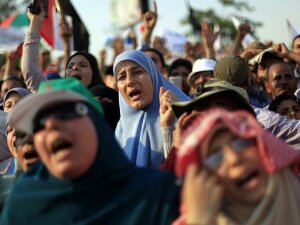
As Egyptians of all factions prepare to demonstrate in mass against the Muslim Brotherhood and President Morsi’s rule on June 30, the latter has been trying to reduce their numbers, which some predict will be in the millions and eclipse the Tahrir protests that earlier ousted Mubarak.
Egypt's Coptic Pope Tawadros II
Among other influential Egyptians, Morsi recently called on Coptic Christian Pope Tawadros II to urge his flock, Egypt’s millions of Christians, not to join the June 30 protests.
While that may be expected, more troubling is that the U.S. ambassador to Egypt is also trying to prevent Egyptians from protesting—including the Copts. The June 18th edition of Sadi al-Balad reports that lawyer Ramses Naggar, the Coptic Church’s legal counsel, said that during Patterson’s June 17 meeting with Pope Tawadros, she “asked him to urge the Copts not to participate” in the demonstrations against Morsi and the Brotherhood.
The Pope politely informed her that his spiritual authority over the Copts does not extend to political matters.
US Ambassador Anne Patterson
Regardless, many Egyptian activists are condemning Patterson for flagrantly behaving like the Muslim Brotherhood’s stooge. Leading opposition activist Shady el-Ghazali Harb said Patterson showed “blatant bias” in favor of Morsi and the Brotherhood, adding that her remarks had earned the U.S. administration “the enmity of the Egyptian people.” Coptic activists like George Ishaq openly told Patterson to “shut up and mind your own business.” And Christian business tycoon Naguib Sawiris—no stranger to Islamist hostility—posted a message on his Twitter account addressed to the ambassador saying “Bless us with your silence.”
Indeed, the U.S. ambassador’s position as the Brotherhood’s lackey is disturbing—and revealing—on several levels. First, all throughout the Middle East, the U.S. has been supporting anyone and everyone opposing their leaders—in Libya against Gaddafi, in Egypt itself against 30-year U.S. ally Mubarak, and now in Syria against Assad. In all these cases, the U.S. has presented its support in the name of the human rights and freedoms of the people against dictatorial leaders.
So why is the Obama administration now asking Christians not to oppose their rulers—in this case, Islamists—who have daily proven themselves corrupt and worse, to the point that millions of Egyptians, most of them Muslims, are trying to oust them?
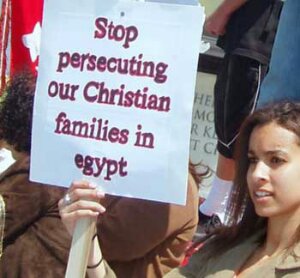
Egyptian Christians face increasing persecution from the Islamists in control of the state.
What’s worse is that the human rights abuses Egypt’s Coptic Christians have been suffering under Muslim Brotherhood rule are significantly worse than the human rights abuses that the average Egyptian suffered under Mubarak—making the Copts’ right to protest even more legitimate, and, if anything, more worthy of U.S support.
Among other things, under Morsi’s rule, the persecution of Copts has practically been legalized, as unprecedented numbers of Christians—men, women, and children—have been arrested, often receiving more than double the maximum prison sentence, under the accusation that they “blasphemed” Islam and/or its prophet.
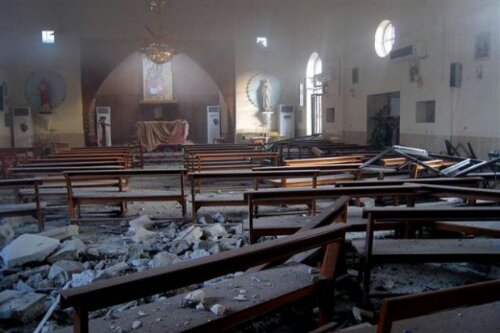
It was also under Morsi’s reign that another unprecedented scandal occurred: the St. Mark Cathedral—holiest site of Coptic Christianity and headquarters to the Pope Tawadros himself—was besieged in broad daylight by Islamic rioters. When security came, they too joined in the attack on the cathedral. And the targeting of Christian children—for abduction, ransom, rape, and/or forced conversion—has also reached unprecedented levels under Morsi.
Yet despite the fact that if anyone in Egypt has a legitimate human rights concern against the current Egyptian government, it most certainly is the Christian Copts, here is the U.S., in the person of Ms. Patterson, asking them not to join the planned protests.
In other words, and consistent with Obama administration’s doctrine, when Islamists—including rapists and cannibals—wage jihad on secular leaders, the U.S. supports them; when Christians protest Islamist rulers who are making their lives a living hell, the administration asks them to “know their place” and behave like dhimmis, Islam’s appellation for non-Muslim “infidels” who must live as third class “citizens” and never complain about their inferior status.
Afterward he ate some food and regained his strength.
Saul stayed with the believers in Damascus for a few days. And immediately he began preaching about Jesus in the synagogues, saying, “He is indeed the Son of God!”
All who heard him were amazed. “Isn’t this the same man who caused such devastation among Jesus’ followers in Jerusalem?” they asked. “And didn’t he come here to arrest them and take them in chains to the leading priests?”
Saul’s preaching became more and more powerful, and the Jews in Damascus couldn’t refute his proofs that Jesus was indeed the Messiah.
After a while some of the Jews plotted together to kill him. They were watching for him day and night at the city gate so they could murder him, but Saul was told about their plot. So during the night, some of the other believers lowered him in a large basket through an opening in the city wall.
Prayer: Lord Jesus – Give your servants the courage and power to proclaim you as the Son of God, the Messiah… our Savior and Lord. In season, or out of season, may we be ready to give a persuasive and passionate account of the hope that we have found in you. Amen.
Spiritual Song:“Come to Jesus for Salvation” – Cornerstone Church
Sarah Lynch, Special for USA TODAY / June 23, 2013
CAIRO – Women here say it crosses class barriers, generations and faiths. It prevails in public buses, trains, streets and homes. It exists online, on university campuses, and in parks, markets, at work and in cafes.
(Photo: Khalil Hamra, AP)
STORY HIGHLIGHTS
+ Men pay few penalties for grabbing and groping women in a violent manner
+ 99.3% of Egyptian women surveyed reported experiencing some form of sexual harassment
+ Islamists have blamed victims for their harassment
Sexual harassment of women is epidemic in Egypt, where men pay few penalties for grabbing and groping women in a violent manner.
In the film, Cairio 678, one of the lead characters, played by actress Bushra, is repeatedly harassed on bus
The harassment appears to permeate the nation’s every pore, academics say. After decades of such behavior, a growing number of groups and initiatives are working to do something about it.
“For many women who have to rely on walking, public transportation or the metro, it’s a grinding thing that happens every day,” said Helen Rizzo, associate professor of sociology at the American University in Cairo.
“For some women, it’s been very serious: grabbing, touching, trying to pull women into cars, and the whole phenomena of attacking protests,” she said.
A recent report by U.N. Women said 99.3% of Egyptian women surveyed in a recent study reported experiencing some form of sexual harassment — everything from inappropriate sexual jokes, to whistling, touching, groping and rape.
“Through this study we are able to confirm the spread of sexual harassment in Egypt to unprecedented levels,” stated the U.N. report.
Some believe the problem has grown worse since the 2011 revolution that ousted dictator Hosni Mubarak and led to a government under Muslim Brotherhood rule, perhaps due to a drop in effective security.
“Certainly sexual harassment and sexual assault and violent attacks are something not new in Egypt,” said Diana Eltahawy, Amnesty International’s Egypt researcher, noting that under Mubarak they were used as tools to repress women.
The survey is striking for the sheer range of places where women feel they can be victimized.
Almost 83% of surveyed women said they don’t feel safe in the street and 79% don’t feel safe in a taxi. Sixty-seven percent said girls are subject to harassment regardless of what they wear, how they look, their manner of speech or their gait. Female workers and students are most exposed to harassment.
Brutality in the public space now has symbolic value for the nation too, Eltahawy said. Vicious mob attacks and assault happen often in Tahrir Square, the heart of that nation’s uprising where men and women joined and camped out for days to demand democratic freedoms and a fair justice system.
An organization called HarassMap founded in 2010, allows women to report locations of abuse using technology. Through advertising on television, radio, in music and print the group seeks to change perceptions associated with harassment and remind the public it is a punishable offense.
While the law doesn’t explicitly criminalize sexual harassment, three laws that address rape, public indecency and assault can be applied to harassment cases.
“It’s all about culture and misconceptions,” said Dina Samir, communications manager at HarassMap, who says harassment has worsened over the last decade. “If the culture changes it would put pressure on the government to enforce laws.”
“We believe we can play a big role in changing perceptions,” she said.
Men are also getting involved because “it’s not just a women’s issue,” said Ayman Nagy, who founded the Anti-Harassment Movement. “It’s a humanity issue.”
Nagy and a group of 73 full-time volunteers hold workshops in universities and even in the streets among other places to talk about issues that include sexual abuse.
“We need to solve the problem from its roots,” Nagy said. “We’re going to work on the harasser himself, because we think he is a sick person and needs help, and that we can help him.”
Other groups such as Operation Anti-Sexual Harassment seek to end mob harassment and assault, and Tahrir Bodyguard has a team of volunteers in bright green vests who intervene when they see sexual violence taking place during protests.
In March, President Mohammed Morsi launched an effort to help identify challenges facing women through workshops, fieldwork and discussions. Last month, local press reported that the government created an all-female unit of police to battle sexual harassment.
“Time will tell whether or not these are serious attempts, and also whether or not they are going to bring about real changes and results the way grass-roots movements have been able to do,” said Soraya Bahgat, who founded Tahrir Bodyguard and is now working more generally on women’s issues.
Not all groups, however, are on board with efforts to empower women and Islamists have blamed victims for their harassment.
Earlier this year the powerful Muslim Brotherhood condemned a United Nations report meant to reduce violence against women. The Brotherhood criticized articles in the document that gave judges, rather than husbands, authority in cases of divorce and granted women full rights to file legal complaints against their husbands for rape or sexual harassment.
“The document includes articles that contradict established principles of Islam, undermine Islamic ethics and destroy the family,” the Muslim Brotherhood said in a statement.
Despite challenges, activists persist, although their efforts have not led to a measurable drop in harassment.
“We cannot say it has decreased because of our work but the positive side is that it has become less of a taboo and so many activists and initiatives are working on the topic,” HarassMap’s Samir said. “These are the only glimmers of hope.”