Why Christians Must Stand Against Anti-Semitism | reblog Joe Carter

by Joe Carter, thegospelcoalition.org
February 22, 2017

[Original Article]

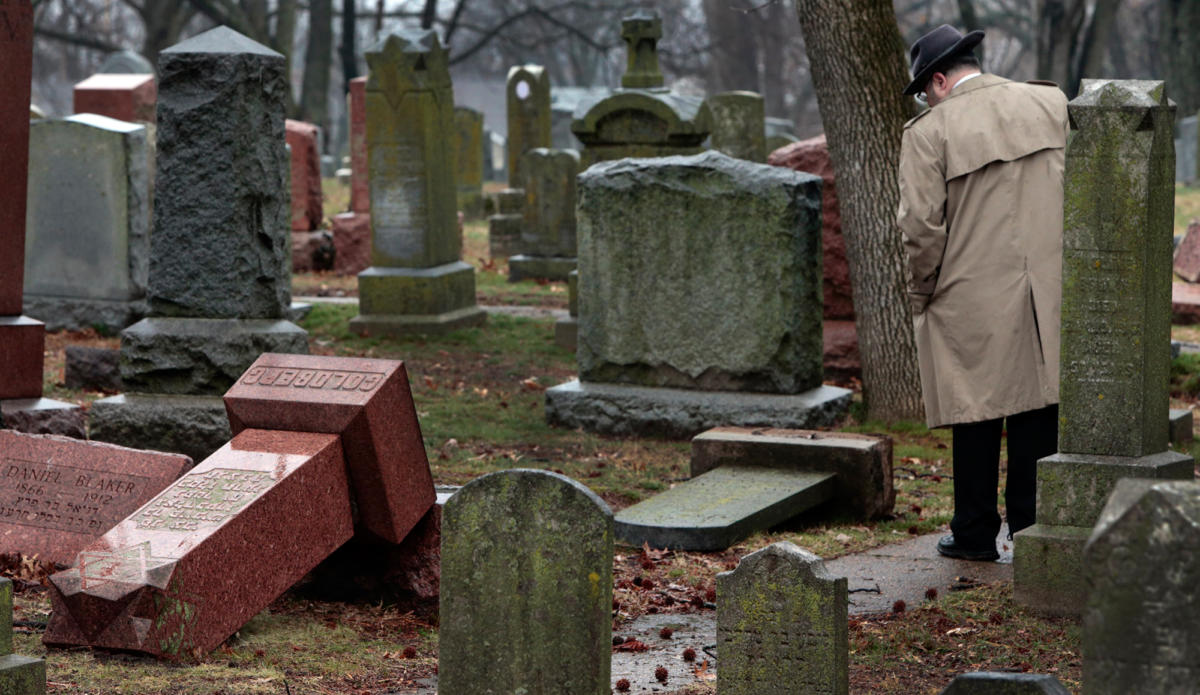
The Story: Several dozens anti-Semitic threats and acts of vandalism have occurred over the past few weeks, causing Jewish Americans throughout the country to fear for their safety.

gross-stlouisrespondstoariseinanti-semitism-1200

The Background: Over the weekend vandals toppled about 170 headstones at a Jewish cemetery in St. Louis, Missouri. The FBI and Department of Justice are also investigating a rash of bomb threats to Jewish centers across the United States. Since January 54 Jewish Community Centers (JCCs) in 27 states and one Canadian province have received 69 bomb threats, including 11 on Monday.

According to ABC News, David Posner, director of strategic performance at JCC Association of North America, said that while the JCCs that received the threats have all resumed operations “with a heightened level of security,” he added, “we will not be cowed by threats intended to disrupt people’s lives.”

“While we are relieved that all such threats have proven to be hoaxes and that not a single person was harmed, we are concerned about the anti-Semitism behind these threats, and the repetition of threats intended to interfere with day-to-day life,” said Posner. “Local JCCs serve not just the Jewish community but the entire community. Participants from all different backgrounds come to their local JCCs.”

These incidents follow a rise over the past few years in anti-Semitic violence. As Matthew Hawkins of the Ethics and Religious Liberty Commission notes,

Lest we think this is only a European problem, violent anti-Semitic assaults in the U.S. saw an increase of over 50 percent in 2015. Anti-Semitic incidents on American college campuses alone doubled in 2015. Those numbers eclipse 2014, which was already a disturbingly high year for such incidents. That was the year the FBI reported that 56 percent of all anti-religious hate crimes were anti-Semitic in nature, though Jews make up a mere 1.8 percent of the population. That year also included the murder of three people by a white-supremacist gunman who opened fire at two Jewish institutions in Kansas, a day before Passover.

Why It Matters: The German journalist Wilhelm Marr, founder of the Antisemiten-Liga (Anti-Semitic League), coined the term “anti-Semitism” in an 1879 pamphlet opposing the influence of Jews on German culture. Marr was an instigator of anti-Jewish sentiment in 19th century Germany who became to regret his animus. Toward the end of his life, he published another pamphlet, Testament of an Antisemite, renounced his own hatred of the Jewish people, and expressed concern that anti-Semitism in Germany was becoming entangled with mysticism and nationalism.

Marr had reason to be worried. Over the next 66 years, the German people showed the world how Judenhass (“Jew-hatred”) could lead to Auschwitz and Nazi extermination camps. But the problem was not just with Marr and other Germans. The road to the Holocaust was paved by centuries of anti-Semitism, and crosses through a large swath of the history of Christianity. Even after the scandal of Shoah it took until the end of the 20th century for the Christian community to finally and forcefully repudiate anti-Semitism and repent of our sinful disdain, prejudice, and hatred toward the Jewish people.

Unfortunately, while the “longest hatred” has been significantly quelled in the United States it has not been eradicated from within the hearts of men. We may not be able to directly stop the violence and harassment ourselves but Christians can, as a community of believers, calm some of the concerns of Jewish Americans by showing we are in solidarity with them. We can say, as the Southern Baptist Convention did in 2003, that we “denounce all forms of anti-Semitism as contrary to the teachings of our Messiah and an assault on the revelation of Holy Scripture” and that “we affirm to Jewish people around the world that we stand with them against any harassment that violates our historic commitments to religious liberty and human dignity.” We can send them the message that we Americans who worship the King of the Jews will no longer tolerate anti-Semitism in our country.

Conservatives Want Obamacare Repeal, and They Want It Now

by Niels Lesniewski, rollcall.comFebruary 23, 2017 12:21 PM

20170224_091055

Jim DeMint president of the Heritage Foundation, told conservatives at CPAC to keep the charge going to repeal the 2010 health care law.

OXON HILL, Md. — Conservatives rallying here are calling for their congressional brethren to keep the faith and quickly gut the 2010 health care law, dismissing concerns about lost health coverage and motivated voters at town halls.

Reported remarks by former Speaker John A. Boehner, R-Ohio, far away from the conservatives gathered at the convention hotel provided the latest cause for alarm. Boehner had said that repeal and replace was “not going to happen,” according to Politico.

“The last I checked, Boehner doesn’t have a vote anymore,” Sen. Ted Cruz of Texas told Roll Call just as a cacophony of barking came from nearby police canines.

“This is a test. It’s a test for Republicans in the executive and both Houses of Congress. Do we honor the promises we made? This election was a referendum on repealing Obamacare,” Cruz said in a brief interview. “I think failure is not an option.”

“We’ve got to keep that promise, and I believe we will,” Cruz said.

Cruz, who has been among the loudest voices for rolling back as much of the 2010 law as possible, was one of few lawmakers appearing at CPAC during the February congressional recess, flying back from Texas for the occasion. He got a heroes welcome from the conservative activists and media assembled at the hotel just outside D.C.

Heritage Foundation President Jim DeMint, the former South Carolina Republican senator, called on activists attending the Conservative Political Action Conference to push their members of Congress to send to President Donald Trump the same legislation that dismantled the law and was vetoed by President Barack Obama with all due haste.

“We must and we can repeal Obamacare now,” DeMint said. “They should send that same bill to President Trump right now.”

DeMint called the idea that there needs to be a replacement on the front end, “absolutely ludicrous.”

He also said that doctors, hospitals and insurance companies would still exist after repealing the law and that, “no one loses their insurance” under the repeal bill envisioned. That ignores analyses that show millions of people losing their health insurance under scenarios that simply repeal the law.

The nonpartisan Congressional Budget Office, for instance, released a report last month that estimated as many as 18 million would lose their insurance within a year and premiums would spike. As many as 32 million would lose insurance in the coming years, the report said.

Such concerns have been echoed in town halls across the country where Republicans have been challenged to explain how to cover people in the absence of the health care law.

Still, DeMint echoed other conservatives in Congress who have advocated for swift action on repealing the law. Cruz, for instance, previously said Congress should repeal before details can be worked out on a replacement plan.

‘Harry Reid: Thank You for Attorney General Jeff Sessions,’ Cruz Says at CPAC

The House Freedom Caucus, a key bloc of conservatives, voted to formally take the position that the House should pass the same repeal measure that Obama vetoed, a position DeMint mirrored.

The caucus has not formally taken a position on timing of a replacement plan, but conservatives have rallied around a health care plan sponsored by Rep. Mark Sanford of South Carolina and Sen. Rand Paul of Kentucky. Paul has advocated for Congress simultaneously repealing and replacing the law.

Former Freedom Caucus Chairman Jim Jordan said last month that he’d like to see some acceleration of the repeal measure and that the effective date of the repeal provisions should be sometime this Congress.

“I start from the premise that health care will be better and cost less when Obamacare is gone,” he said. That sentiment is not reflected in analyses like the CBO’s.

“Heck yes,” the Ohio Republican said when asked if he would vote for a repeal measure without seeing a replacement plan. However, he qualified that it must be a full repeal.

Jordan said that ideally Republicans would offer a free market-based replacement at the same time. “But if it doesn’t [happen] of course I’m going to vote to repeal it,” he said.

Freedom Caucus member Raul Labrador of Idaho said he would like to see a specific replacement plan that has been vetted through the committee process before a repeal vote.

While lawmakers attempt to find consensus on a path forward, DeMint’s comments signal the pressure conservatives are placing on congressional Republicans to act quickly to undo the health care law.

But GOP lawmakers are still developing their repeal and replacement plans. House Republican leadership presented a blueprint of a plan last week, though questions remain as to what final plan can garner support form both conservative and moderate Republicans in the Senate.

Bridget Bowman contributed to this report.

Get breaking news alerts and more from Roll Call on your iPhone or your Android.

Get the latest updates from Roll Call in your inbox. Sign up for our free newsletters today.
Did this article have a great quote? Highlight it, then tap Recommend and share it with others.
Recommend

http://www.rollcall.com/news/politics/demint-to-congress-repeal-obamacare-now

“Making Jefferson Proud” – reblog Daniel John Sobieski | American Thinker

Church, State, and Melania Trump

By Daniel John Sobieski, http://www.americanthinker.com
View Original
February 22nd, 2017

Those who have made a career of trying to drive all vestiges of religion from the public square, from manger scenes at Christmas to mentioning God in the Pledge of Allegiance, were not happy when First Lady Melania Trump recited the Lord’s Prayer at her husband’s rally in Florida. The tolerant left mocked the accent of a woman and an immigrant who speaks five languages. They moaned that it was an affront to those who are not Christian. And they brought out that old canard about the separation of church and state.

melania-trump-lords-prayer-democrats-attack-florida-rally-933x445

We have not seen such outrage since former Denver Broncos quarterback Tim Tebow took a knee in thanksgiving on the football field, scorned by a liberal elite that applauds the ungrateful Colin Kaepernick refusing to stand during the national anthem. Neither Tim Tebow or Melania Trump by their actions are violating the First Amendment, which guarantees freedom of religion, not freedom from it. As Investor’s Business Daily editorialized those opposed to the free expression of religion and free speech get the establishment clause and church and state thing all wrong:

Even before George Washington is said to have taken a knee in prayer at Valley Forge, men and women of faith and courage endowed by their Creator with inalienable rights have guided this nation to greatness.

Some 45 million people watched Denver Broncos quarterback Tim Tebow complete that 80-yard touchdown pass play to Demaryius Thomas on the first play from scrimmage in overtime to lead his team over the Pittsburgh Steelers in Sunday’s wild card playoff game.

They also saw him take a knee and give thanks to the God he believes in, an act that’s been dubbed “Tebow-ing.”….

The phrase “separation of church and state” in fact appears nowhere in the Constitution but in a letter Thomas Jefferson wrote in 1802 to a group of Danbury Baptists assuring them that the First Amendment prohibited Congress from establishing a national church, such as the Church of England.

Of course, Jefferson also said in a letter written to his friend Dr. Benjamin Rush dated Sept. 23, 1800, the words that are carved into the Jefferson Memorial:

“I have sworn upon the altar of god, eternal hostility against every form of tyranny over the mind of man.”

Imposing political correctness upon Tim Tebow or Melania Trump is just that kind of tyranny. Liberals ignore the history of this nation in which Thomas Jefferson also wrote in the Declaration of Independence that our unalienable rights come from our Creator, not government or liberal busybodies. He feared what the British Crown tried to do, impose a state church on all the American people. The fact is that in Jefferson’s time, the state and the church were in fact inextricably linked.

The Founding Fathers did fear the possible establishment of a national church like the Church of England and to prevent it they wrote the First Amendment to say that “Congress” shall make no laws regarding the establishment of religion, meaning any particular religion. But it says nothing about the states and also says that Congress shall make no laws restricting the free exercise thereof.

Anyone who wants to know what the Founding Fathers intended with their words should analyze their actions. As Yale professor Jon Butler writes:

…the 1780 Massachusetts constitution authorized ‘towns, parishes, precincts and other bodies politic to levy taxes ‘for the institution of public worship of God, and for the support and maintenance of public Protestant teachers of piety, religion and morality.’…

Connecticut and New Hampshire had similar laws. Virginia, on the other hand, moved rapidly after the Revolutionary War to disestablish the Anglican church and separate the state from formal religious institutions. Curiously, no framer of the Constitution ever declared that Massachusetts, with its state-supported religious education, or Virginia, with its official secularism, were guilty of violating the 1st Amendment or any other fundamental constitutional principle.

The Constitution mandates government’s neutrality to religion, but its alleged desire to avoid any endorsement of religion has mutated into an unmistakable hostility. Perhaps the most egregious example occurred in April, 1995, when the Murrah Federal Building was bombed and attorneys for the Clinton administration were ready to deny churches the same disaster assistance that every other building with collateral damage received because of the alleged separation of church and state. It took special congressional action to prevent this absurdity. I don’t think this is what Thomas Jefferson had in mind.

We have drifted a long way from the Founding Fathers’ clear intent about the relationship between the free exercise of religion and government. People are no longer free to apply their religious beliefs to their businesses, as the vendetta against Hobby Lobby demonstrates. The Obama administration went to court to force the Little Sister of the Poor to provide contraceptive coverage to their workers. Bakers were forced to bake cakes for gay weddings in violation of their religious beliefs.

As the late Francis Cardinal George of Chicago, former head of the U.S. Council of Catholic Bishops, once observed, President Obama’s idea of religious liberty, an idea shared by many liberals, differs little from Josef Stalin’s:

Freedom of worship was guaranteed in the Constitution of the former Soviet Union,” Chicago’s Francis Cardinal George recently wrote.

“You could go to church, if you could find one. The church, however, could do nothing except conduct religious rites in places of worship — no schools, religious publications, health care institutions, organized charity, ministry for justice and works of mercy that flow naturally from a living faith. We fought a long Cold War to defeat that vision of society.”

Indeed we did. Our country was founded by those seeking freedom of religion and the free speech and free exercise that comes with it. When Melania Trump recited the Lord’s Prayer at a public event in the public square, she was making Thomas Jefferson proud.

“Seven Days in February” – by Victor Davis Hanson ~ reblog | National Review

SEVEN DAYS IN FEBRUARY – [original article here]

Trumps’ critics, left and right, aim to bring about the cataclysm they predicted.

By Victor Davis Hanson — February 20, 2017

A 1964 political melodrama, Seven Days in May, envisioned a futuristic (1970s) failed military cabal that sought to sideline the president of the United States over his proposed nuclear-disarmament treaty with the Soviets.

Something far less dramatic but perhaps as disturbing as Hollywood fiction played out this February.

3d65727300000578-4238426-president_donald_trump_and_melania_trump_arrive_for_a_campaign_r-a-63_1487463282246

The Teeth-Gnashing of Deep Government

Currently, the political and media opponents of Donald Trump are seeking to subvert his presidency in a manner unprecedented in the recent history of American politics. The so-called resistance among EPA federal employees is trying to disrupt Trump administration reform; immigration activists promise to flood the judiciary to render executive orders inoperative.

Intelligence agencies had earlier leaked fake news briefings about the purported escapades of President-elect Trump in Moscow — stories that were quickly exposed as politically driven concoctions. Nearly one-third of House Democrats boycotted the Inauguration. Celebrities such as Ashley Judd and Madonna shouted obscenities to crowds of protesters; Madonna voiced her dreams of Trump’s death by saying she’d been thinking a lot about blowing up the White House.

But all that pushback was merely the clownish preliminary to the full-fledged assault in mid February.

Career intelligence officers leaked their own transcripts of a phone call that National Security Advisor–designate Michael Flynn had made to a Russian official.

The media charge against Flynn was that he had nefariously talked to higher-ups in Russia before he took office. Obama-administration officials did much the same, before Inauguration Day 2009, and spoke with Syrian, Iranian, and Russian counterparts. But they faced no interference from the outgoing Bush administration.

No doubt the designated security officials of most incoming administrations do not wait until being sworn in to sound out foreign officials. Most plan to reset the policies of their predecessors. The question, then, arises: Why were former Obama-administration appointees or careerist officials tapping the phone calls of an incoming Trump designate (and Trump himself?) and then leaking the tapes to their pets in the press? For what purpose?

Indeed, Trump’s own proposed outreach to Russia so far is not quite of the magnitude of Obama’s in 2009, when the State Department staged the red-reset-button event to appease Putin; at the time, Russia was getting set to swallow the Crimea and all but absorb Eastern Ukraine. Trump certainly did not approve the sale of some 20 percent of North American uranium holdings to Russian interests, in the quid pro quo fashion that Secretary of State Hillary Clinton did, apparently in concert with Bill Clinton and the Clinton Foundation — and to general indifference of both the press and the intelligence community.

In addition, the Wall Street Journal reported last week that career intelligence officers have decided to withhold information from the president, on the apparent premise that he is unfit, in their view, to receive it. If true, that disclosure would mean that elements of the federal government are now actively opposing the duly elected president of the United States. That chilling assessment gains credence from the likelihood that the president’s private calls to Mexican and Australian heads of state were likewise recorded, and selected segments were leaked to suggest that Trump was either trigger-happy or a buffoon.

Oddly, in early January, Senator Charles Schumer had essentially warned Trump that he would pay for his criticism of career intelligence officials. In an astounding shot across his bow, which was followed up by an onslaught in February, Schumer said: “Let me tell you, you take on the intelligence community, they have six ways from Sunday at getting back at you. . . . So even for a practical, supposedly hard-nosed businessman, he’s being really dumb to do this.”

Schumer was evidently not disturbed about rogue intelligence agencies conspiring to destroy a shared political enemy — the president of the United States. What surprised him was how naïve Trump was in not assessing the anti-constitutional forces arrayed against him.

Trump-Removal Chic

The elite efforts to emasculate the president have sometimes taken on an eerie turn. The publisher-editor of the German weekly magazine Zeit raised the topic on German television of killing Trump to end the “Trump catastrophe.” So did British Sunday Times columnist India Knight, who tweeted, “The assassination is taking such a long time.” A former Obama Pentagon official, Rosa Brooks, recently mused about theoretical ways to remove Trump, including a military coup, should other avenues such as impeachment or medically forced removal fail: “The fourth possibility is one that until recently I would have said was unthinkable in the United States of America: a military coup, or at least a refusal by military leaders to obey certain orders.”

The Atlantic now darkly warns that Trump is trying to create an autocracy. Former Weekly Standard editor in chief Bill Kristol suggested in a tweet that if he faced a choice (and under what surreal circumstances would that happen?) between the constitutionally, democratically elected president and career government officials’ efforts to thwart or remove him, he would come down on the side of the revolutionary, anti-democratic “deep state”: “Obviously strongly prefer normal democratic and constitutional politics. But if it comes to it [emphasis added], prefer the deep state to the Trump state.” No doubt some readers interpreted that as a call to side with anti-constitutional forces against an elected U.S. president.

Hollywood stars such as Meryl Streep equate the president with brownshirts and assorted fascists. A CNN reporter announced that Trump was Hitlerian; another mused about his plane’s crashing. Prominent conservative legal scholar Richard Epstein recently called for Trump to resign after less than a month in office, largely on grounds that Trump’s rhetoric is unbridled and indiscreet — although Epstein cited no indictable or impeachable offenses that would justify the dispatch of a constitutionally elected president. Earlier, Republican columnists David Frum and Jennifer Rubin had theorized that the 25th Amendment might provide a way to remove Trump from office as unfit to serve. The New Republic published an unfounded theory, based on no empirical evidence, alleging that Trump suffers from neurosyphilis and thus is mentally not up to his office.

Former president Barack Obama — quite unlike prior presidents Gerald Ford, Ronald Reagan, George H. W. Bush, and George W. Bush, who all refrained from attacking their successors — is now reportedly ready to join the efforts of a well-funded political action committee to undermine the Trump presidency.

The Police Need Policing

Fake news proliferates. House minority leader Nancy Pelosi and Representative Elijah Cummings recently attacked departing national-security advisor Michael Flynn by reading a supposed Flynn tweet that was a pure invention. Nor did Trump, as reported, have a serious plan to mobilize “100,000” National Guard troops to enforce deportations.

Other false stories claimed that Trump had pondered invading Mexico, that his lawyer had gone to Prague to meet with the Russians, and that he had removed from the Oval Office a bust of Martin Luther King Jr. — sure proof of Trump’s racism. Journalists — including even “fact-checker” Glenn Kessler of the Washington Post — reposted fake news reports that Trump’s father had run a campaign for the New York mayorship during which he’d aired racist TV ads.

Nor is the Trump family immune from constant attack. Daughter Ivanka Trump was recently cornered on an airline flight, while traveling with her three young children three days before Christmas, and bullied by a screaming activist passenger. Her private fashion business is the target of a national progressive-orchestrated boycott. Celebrities and writers have attacked Trump’s eleven-year-old son Barron as a sociopath-to-be or as a boy trapped in an autistic bubble. First Lady Melania Trump sued the Daily Mail after it trafficked in reports that she had once been a paid escort — a lie that was recently recirculated by a New York Times reporter.

Trump advisers Steve Bannon and Sebastian Gorka are routinely smeared as anti-Semites and fascists. One Trump critic berated Gorka as a Nazi sympathizer for wearing a commemorative medal once awarded his father for his role in the resistance to the Communist takeover of Hungary.

What has the often boisterous Trump done in his first month to earn calls for his death, forced removal, or resignation?

Dangerous Style or Substance?

The stock market is reaching all-time highs. Polls show business optimism rising. The Rasmussen poll puts Trump’s approval rating at 55 percent.

Compared with Obama in 2009, at the same point in his young administration, Trump has issued about the same number of executive orders. For all his war on the press, Trump has so far not ordered wiretaps on any reporter on the grounds that he is a “criminal co-conspirator,” nor has he gone after the phone records of the Associated Press — Barack Obama’s Justice Department did both, to little notice in the media.

Trump’s edicts are mostly common-sense and non-controversial: green-lighting the Keystone and Dakota pipelines, freezing federal hiring, resuming work on a previously approved wall along the Mexican border, prohibiting retiring federal officials from lobbying activity for five years, and pruning away regulations.

His promises to deport illegal aliens with past records of criminal activity or gang affiliation have, by design, sidestepped so-called dreamers and the illegal aliens who are currently working, without criminal backgrounds, and with some record of lengthy residence.

In his executive order to temporarily suspend immigration from seven war-torn Middle East states, Trump channeled Barack Obama’s prior targeting of immigration trouble spots. At first, Trump’s order was poorly worded and clumsily ushered in; then it was reformulated. It is supported by the public but nonetheless earned a hysterical response from federal judges who seemed to invent new jurisprudence stating that foreign nationals abroad enjoy U.S. constitutional protections.

On more substantive reforms, such as repealing Obamacare, reforming the tax code, and rebuilding infrastructure, Trump awaits proposed legislation from the Republican congressional majority. By all accounts, Trump’s initial meetings or phone calls with British, Israeli, Japanese, and Russian heads of states have gone well.

Trump has had fewer Cabinet appointees bow out than did Barack Obama. Most believe that the vast majority of his selections are inspired. The nomination of Judge Neil Gorsuch was a widely praised move. The defense secretary, retired general James Mattis has echoed Trump’s earlier calls for European NATO members to step up and meet their contracted obligations to the alliance.

__________

Clearly in empirical terms, nothing that Trump in his first month in office has done seems to have justified calls for violence against his person or his removal from office. What then accounts for the unprecedented venom?

__________

1) As we saw from his recent free-wheeling press conference, Trump’s loud, take-no-prisoners style is certainly anti-Washington, anti-media, anti-elite, and anti-liberal. He often unsettles reporters with bombast and invective, when most are accustomed to dealing with career politicians or fellow liberal officeholders who share their same beliefs. As part of Trump’s art-of-the-deal tactics, he often blusters, rails, and asks for three times what he might eventually settle for, on the expectation that critics of his style will be soon silenced by the undeniable upside of his eventual achievements. This is a long-term strategy that in the short term allows journalists to fault the present means rather than the future ends. Trump’s unconventional bluster, not his record so far, fuels the animosity of elites who seek to delegitimize him and fear that their reputations and careers can be rendered irrelevant by his roughshod populism. He also has reminded the country that some of the mainstream media and Washington–New York elite are often mediocre and boring.

2) The Democratic party has been absorbed by its left wing and is beginning to resemble the impotent British Labour party. Certainly it no longer is a national party. Mostly it’s a local and municipal coastal force, galvanized to promote a race and gender agenda and opposed to conservatism yet without a pragmatic alternative vision. Its dilemma is largely due to the personal success but presidential failure of Barack Obama, who moved the party leftward and yet bequeathed an electoral matrix that will deprive future national candidates of swing-state constituencies without compensating for that downside with massive minority turnouts, which were unique to Obama’s candidacy. The Democratic party bites its tail in endless paroxysms of electoral frustration — given that the medicine of broadening support to win back the white poor and working classes is deemed worse than the disease of losing the state governorships and legislatures, the Congress, the presidency, and the Supreme Court.

3) Usually conservative pundits and journalists would push back against this extraordinary effort to delegitimize a Republican president. But due to a year of Never Trump politicking and opposition, and Trump’s own in-your-face, unorthodox style and grating temperament, hundreds of Republican intellectuals and journalists, former officeholders and current politicians — who shared a common belief that Trump had no chance of winning and thus could be safely written off — find themselves without influence in either the White House or indeed in their own party, over 90 percent of which voted for Trump. In other words, the Right ruling class is still in a civil war of sorts.

For some, the best pathway to redemption is apparently to criticize Trump to such an extent that their prior prophecies of his preordained failure in the election will be partially redeemed by an imploding presidency. It is no accident that many of those calling for his resignation or removal are frustrated that, for the first time in a generation, they will have no influence in a Republican administration or indeed among most Republicans. Yet, in private, they accept that Trump’s actual appointments, executive orders, and announced policies are mostly orthodox conservative — a fact that was supposed to have been impossible.

4) Since 2000, what might have been seen as irrational and abnormal has become institutionalized and commonplace: record U.S. debt approaching $20 trillion, chronic trade deficits, an often destructive globalization, Hoover-era anemic economic growth, polarizing racial identity politics, open borders, steady growth in the size of government, sanctuary cities, unmet NATO obligations abroad, crumbling faith that the European Union is sustainable and democratic, and a gradual symbiosis between the two parties, both of which ignored the working classes as either demographically doomed or as a spent force of deplorables and irredeemables (or both).

Trump’s efforts to return politics to the center — enforce existing laws, complete previously approved projects, rein in government regulations and growth, recalibrate U.S. alliances to reflect current realities, unapologetically side with friends and punish enemies — were viewed as revolutionary rather than as a return to conventionality, in part because they threatened status quo careers and commerce. Trumpism is more or less akin to the Gingrich-Clinton compromises of the early 1990s or to what Reagan often did rather than what he sometimes said. But what was then bipartisan and centrist today appears revolutionary and nihilistic.

For now, chic Trump hatred and sick talks of coups — or worse — hinge on economic growth. If Trump’s agenda hits 3 percent GDP growth or above by 2018, then his critics — progressive shock troops, Democratic grandees, mainstream media, Never Trump Republicans — will either shift strategies or face prolonged irrelevance.

But for now, ending Trump one way or another is apparently the tortured pathway his critics are taking to exit their self-created labyrinth of irrelevance.

— NRO contributor Victor Davis Hanson is a senior fellow at the Hoover Institution and the author, most recently, of The Savior Generals.

The Iran Nuclear Deal: How bad is it? Dennis Prager explains…

Peanut Gallery: In September, 2015, the U.S. Congress upheld the Iran Nuclear Deal under Obama/Reid leadership – even though they had no idea what was in it. Sound familiar?

Dennis Prager appealed to Congress for its defeat in this video published in Aug, 2015. They didn’t, so here we are now stuck with a deal Donald Trump has labeled one of the worst ever negotiated, not only for America, but for the entire Middle East.

How bad is it? Dennis Prager explains: [See here… ]