
Morning Prayer
+ In the name of the Father, and of the Son, and of the Holy Spirit. Amen
Opening sentences — The Way of the Cross
Let all creation give thanks to the Risen Lord.
Give thanks to the Risen Lord!
Filled with His praises, give thanks to the Risen Lord.
Give thanks to the Risen Lord!
He is our Shepherd, and we are His sheep.
Give thanks to the Risen Lord!
Stepping out boldly, we claim resurrection.
Give thanks to the Risen Lord!
Morning reading
John 21:15-19 ESV
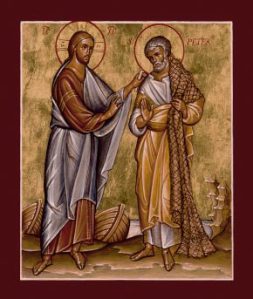
When they had finished breakfast, Jesus said to Simon Peter, “Simon, son of John, do you love me more than these?” He said to him, “Yes, Lord; you know that I love you.” He said to him, “Feed my lambs.”
[Jesus] said to him a second time, “Simon, son of John, do you love me?” He said to him, “Yes, Lord; you know that I love you.” He said to him, “Tend my sheep.”
[Jesus] said to him the third time, “Simon, son of John, do you love me?” Peter was grieved because he said to him the third time, “Do you love me?” and he said to him, “Lord, you know everything; you know that I love you.” Jesus said to him, “Feed my sheep. Truly, truly, I say to you, when you were young, you used to dress yourself and walk wherever you wanted, but when you are old, you will stretch out your hands, and another will dress you and carry you where you do not want to go.” (This he said to show by what kind of death he was to glorify God.) And after saying this he said to him, “Follow me.”
Reflections:
ultimate question
Jesus’ question is extremely searching, indeed, it is the ultimate question in life: do you truly love me more than these? (v. 15). What does these refer to? If it is the net and boat, then this question gets at the central point of discipleship and reveals a person’s heart. What do we love the most? Have we abandoned all to follow Jesus? Every time we are faced with a temptation this question is raised. Every time we become preoccupied with even the good things God gives us this question is raised.
question of pride
But, while all of this is true, it is probably not the specific point here. By these Jesus probably means “these other disciples.” According to the other Gospels, Peter had boasted that though all the others fall away, he would not (Mt 26:33 par. Mk 14:29; cf. Lk 22:33; Jn 13:37). John does not record this boast, but Peter’s actions in swimming to shore and hauling up the net by himself reveal the same attitude. Jesus’ question, therefore, goes even deeper than the issue of false attachments. He gets at the root of all sin, namely, pride.
humility and healing
Peter does not claim to love Jesus more than the others do, which suggests he has benefited from having reflected on his shameful denials of the Lord. His response is typical of true discipleship, for it is humble and focuses on the Lord’s own knowledge.
Peter was not boastful when Jesus gave him the opportunity to be, but by the third time Jesus asks whether he loves him, Peter is hurt, that is, deeply grieved. Jesus’ asking three times recalls the three denials, and Peter’s pride is cut to the quick. Here we see the Great Physician performing painful but necessary surgery. The light is shining in the darkness of Peter’s heart, bringing life. For this is what John of the Ladder (c. A.D. 570-649) refers to as “joy-producing sorrow” – the repentance that enables one to experience the Lord’s love and salvation. Without such brokenness we are full of self and unable to hear and receive the guidance of the Chief Shepherd. Peter is dying to self and finding his confidence only in the Lord. It is the Lord who knows. Despite the appearances, Peter does love Jesus.
shepherds of His flock
Jesus himself is the Good Shepherd, and now he commissions Peter to care for the flock that belongs to Jesus, for they are my lambs . . . my sheep. The community has already been established, and now Peter is given authority, though of a particular kind.
The key qualification for this task, is a love for Jesus that is characterized by humility, dependence and obedience. Peter already had a devotion to Jesus, but he was still full of self will and was thrusting himself to the front. Such a proud attitude of heart would spell disaster for the community, as had already been evident in Israel’s history right up to the opponents who had just had Jesus crucified and as has sadly been just as evident in the history of the church. But Peter himself learned his lesson, as is clear from his first letter. When he addresses the elders of the communities he does so as a “fellow elder” and encourages them to “be shepherds of God’s flock that is under your care, serving as overseers . . . not lording it over those entrusted to you, but being examples to the flock. And when the Chief Shepherd appears, you will receive the crown of glory that will never fade away” (1 Pet 5:1-4). Here is authority exercised in humility and conscious of the Chief Shepherd. Such are marks of a true shepherd.
follow Me
After Peter professes his obedient love, Jesus spells out the cost of that love. He contrasts Peter’s youth, his life up to this point, with what is coming. He has been able to go wherever he wanted, but when he is old, Jesus tells him, you will stretch out your hands, and someone else will dress you and lead you where you do not want to go. Here is an explicit contrast between Peter’s life of self will and his coming under the will of another. He has just submitted to Jesus and his will, and now Jesus says such submission is going to include being taken where he does not want to go.
The Good Shepherd laid down his life for the sheep, and this shepherd will have to do likewise, though his death will not, of course, take away the sins of the world. He has submitted his will to God, and his death, like Jesus’ death, will be in accordance with God’s will and thereby glorify him (Moloney).
Having spelled out his will for Peter, Jesus calls him to follow him. Peter had answered such a call at the outset of the ministry, but now he understands much more about who Jesus is and what following him entails. He has also received a commission from the Lord for leadership in the community. So this is a call to recommit himself. Just as this Gospel shows that faith must be exercised in the face of each new revelation, so one’s commitment to Jesus must be renewed as one learns more of Christ and his call.
The IVP New Testament Commentary Series
__________
__________
Canticle:
Christ, as a light… illumine and guide me. Christ, as a shield… overshadow me. Christ under me; Christ over me; Christ beside me on my left and my right.
This day be within and without me, lowly and meek, yet all-powerful. Be in the heart of each to whom I speak; in the mouth of each who speaks unto me. This day be within and without me, lowly and meek, yet all-powerful.
Christ as a light; Christ as a shield; Christ beside me on my left and my right.
Blessing
May the peace of the Lord Christ go with you, wherever He may send you. May He guide you through the wilderness, protect you through the storm. May He bring you home rejoicing at the wonders He has shown you. May He bring you home rejoicing once again into our doors.
+ In the name of the Father, and of the Son, and of the Holy Spirit. Amen
_____________________________________
Peanut Gallery: A brief word of explanation – the general format for Morning Prayer is adapted from the Northumbrian Community‘s Daily Office, as found in Celtic Daily Prayer (see online resources here.) The Scripture readings are primarily from the Gospel of John, with the intent to complete the reading by Easter. Other Scriptures which illuminate the Gospel of John will be included along the way.
Reflections from various saints will be included as their memorial days occur during the calendar year.
On Sundays, I’ll return to the USCCB readings (see online resources here) and various liturgical resources in order to reflect the Church’s worship and concerns throughout the world.
Photo illustrations and music videos, available online, are included as they illustrate or illuminate the readings. I will try to give credit and link to sources as best I can.
 The Peanut Gallery