10 Things Every Christian Should Know About Islam – reblog

thegospelcoalition.org / Jul 5th 2013

Islam is a fast-growing religion, especially in the Western world. Christians increasingly need to be aware of Islam and, most importantly, how to engage its adherents with the gospel of Jesus Christ. Here are 10 things I learned about Islam during my 20 years as a missionary in a Muslim-majority country.

1. “Muslim” and “Arab” are not the same thing.

“Muslim” is a religious term. A Muslim is someone who adheres to the religion of Islam. “Arab,” on the contrary, is an ethno-linguistic term. An Arab is a member of the people group who speak the Arabic language. It is true that Islam originated among the Arabs, and the Qur’an was written in Arabic. However, some Arabs have historically been part of the ancient orthodox Christian churches. On the other hand, Islam spread far beyond the Arab world, and today most Muslims are not Arabs. This includes the Turks, the Kurds, the Iranians, the Pakistanis, other South Asian Muslims, the Malaysians and the Indonesians, almost all of whom are Muslim but none of whom is Arab.

2. The word “Islam” means submission.

A Muslim is someone who submits to God. The Islamic conception of who God is, and how he is to be worshiped and served, is based on the teaching of Muhammad. Thus the Islamic creed is: “There is no God but God, and Muhammad is his prophet.”

3. There are two major denominations of Muslims.

The two major denominations of Muslims are Sunni and Shi’a. Sunnis are the vast majority, at 85 percent of all Muslims. The split occurred in the first generation after Muhammad’s death and was based on a dispute over who should succeed him as leader of the Islamic community.

4. Islamic theology could be summarized as belief in one God, his prophets, his books, his angels, his decrees, and the final judgment.

Islam teaches that humans are born spiritually neutral, perfectly capable of obeying God’s requirements completely, and that they remain this way even after they’ve personally sinned. The need of humanity, therefore, is not salvation but instruction; hence Islam has prophets, but no savior.

5. Islam teaches that Jesus was a great prophet.

Islam affirms that Jesus was born of a virgin, that he lived a sinless life, that he performed mighty miracles, and that he will come again at the end of history. It even calls him a word from God. However, it explicitly denies the deity of Christ and repudiates the title “Son of God” as blasphemous. It also (according to the majority view) denies he died on the cross, claiming that Jesus’ visage was imposed on someone else, who was then crucified, and that Jesus was taken up into heaven without tasting death. Islam explicitly denies the possibility of substitutionary atonement.

image
Kaaba Shrine in Mecca, Saudi Arabia

6. Islamic practice can be summarized by the Five Pillars of Islam.

These are composed of the confession of faith (“There is no God but God, and Muhammad is his prophet”), prayer (the ritual prayers said in Arabic five times a day while facing Mecca and performing the prescribed set of bowings, kneeling, and prostrations), alms (taken as a tax in some officially Islamic countries), fasting (the lunar month of Ramadan, during which Muslim believers fast during daylight hours but can eat while it’s dark), and pilgrimage (the Hajj, or pilgrimage to Mecca, which every Muslim believer should make once in his or her lifetime).

7. The vast majority of Muslims are not terrorists.

In fact, normal Islamic religious law forbids the intentional killing of non-combatants in battle. It also forbids suicide. It’s a small minority view that allows these things, and it’s a small minority who engage in terrorist activities.

8. Muslims can be some of the friendliest, most hospitable people on earth.

They make great neighbors and great friends. No Christian should be afraid to build a relationship with a Muslim.

9. Muslims need salvation through Jesus Christ.

They are lost exactly like any other non-Christian—neither more nor less than anyone else. Furthermore, Muslims do come to faith in Jesus Christ. It usually takes time, and extended exposure to the Word of God and the lives of Christians, but more Muslims are coming to faith today than at any other point in history.

10. God loves Muslims, and so should we—even those few who are our enemies.

We should love them enough to befriend them, love them enough to make them welcome in our homes, and love them enough to share the gospel with them.

This article originally appeared in the Summer 2013 issue of Southern Seminary Magazine.
Morning Reading: Acts 12.6-19 NLT – prison break

Reading: Acts 12:6-19 NLT

The night before Peter was to be placed on trial, he was asleep, fastened with two chains between two soldiers. Others stood guard at the prison gate.

image
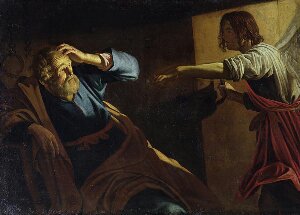
St Peter Being Freed from Prison
Gerrit van Honthorst (1616-1618)

Suddenly, there was a bright light in the cell, and an angel of the Lord stood before Peter. The angel struck him on the side to awaken him and said, “Quick! Get up!” And the chains fell off his wrists. Then the angel told him, “Get dressed and put on your sandals.” And he did. “Now put on your coat and follow me,” the angel ordered.

So Peter left the cell, following the angel. But all the time he thought it was a vision. He didn’t realize it was actually happening.

They passed the first and second guard posts and came to the iron gate leading to the city, and this opened for them all by itself. So they passed through and started walking down the street, and then the angel suddenly left him.

Peter finally came to his senses. “It’s really true!” he said. “The Lord has sent his angel and saved me from Herod and from what the Jewish leaders had planned to do to me!”

When he realized this, he went to the home of Mary, the mother of John Mark, where many were gathered for prayer. He knocked at the door in the gate, and a servant girl named Rhoda came to open it.

When she recognized Peter’s voice, she was so overjoyed that, instead of opening the door, she ran back inside and told everyone, “Peter is standing at the door!”

“You’re out of your mind!” they said. When she insisted, they decided, “It must be his angel.”

Meanwhile, Peter continued knocking. When they finally opened the door and saw him, they were amazed.

He motioned for them to quiet down and told them how the Lord had led him out of prison. “Tell James and the other brothers what happened,” he said. And then he went to another place.

At dawn there was a great commotion among the soldiers about what had happened to Peter. Herod Agrippa ordered a thorough search for him. When he couldn’t be found, Herod interrogated the guards and sentenced them to death. Afterward Herod left Judea to stay in Caesarea for a while.

Prayer: Heavenly Father – Why is it that we pray for divine intervention, but never really expect it. Forgive our unbelief and small faith. Lord Jesus – Align us with your Kingdom purposes so that we might pray with boldness and conviction. Holy Spirit – Open our hearts and minds to all the miraculous possibilities that you work among us. Make us faithful in prayer and humble in spirit… trusting you for outcomes befitting your perfect will. Amen.

Hymn: “Sweet Hour of Prayer”W.W. Walford (1772-1850)

_______________________

Sweet hour of prayer! sweet hour of prayer! That calls me from a world of care, and bids me at my Father’s throne make all my wants and wishes known.  In seasons of distress and grief, my soul has often found relief, and oft escaped the tempter’s snare by thy return, sweet hour of prayer!

Sweet hour of prayer! sweet hour of prayer! The joys I feel, the bliss I share of those whose anxious spirits burn with strong desires for thy return! With such I hasten to the place where God my Savior shows his face, and gladly take my station there, and wait for thee, sweet hour of prayer!

Sweet hour of prayer! sweet hour of prayer! Thy wings shall my petition bear to him whose truth and faithfulness engage the waiting soul to bless. And since he bids me seek his face, believe his word, and trust his grace, I’ll cast on him my every care, and wait for thee, sweet hour of prayer!

It works! – “Netanyahu: Egypt border fence halted flow of migrants”

Prime minister says the nearly finished barrier is essential to prevention of terror attacks from lawless Sinai

By GAVRIEL FISKE July 7, 2013 The Times of Israel http://www.timesofisrael.com/writers/gavriel-fiske/

image
A new fence is being built between Israel and Egypt (photo credit: Yuval Nadal/Flash90)

Israel’s new security fence along the Israel-Egypt border has stemmed the tide of illegal immigration to Israel and has been protecting Israel from terrorists operating in the Sinai Peninsula, Prime Minister Benjamin Netanyahu said Sunday.

“The fence that we built is making a significant contribution to blocking illegal migration to Israel,” Netanyahu said ahead of the weekly cabinet meeting, noting that the fence has blocked 99 percent of African migrants from reaching Israel.

The border fence has taken several years to construct, at an estimated cost of NIS 1.4 billion ($377 million).

“In practice, nobody has entered and the few who have arrived did not reach Israel’s cities,” he continued. “The fence has completely stopped illegal migration to Israel, but it also has an additional function — namely counterterrorism.”

Every day that passes “underscores how correct and how important the decision was to build the fence in the south,” the prime minister said. “You must remember that this fence is equipped with very advanced means… to protect the State of Israel against the double threat of illegal migration and terrorism from Sinai.”

The fence, which is yet to be fully completed, was originally planned just as a barrier to keep out migrants, but was upgraded to include motion sensors, cameras and heightened security after multiple cross-border incidents that occurred in the wake of the 2011 Egyptian revolution, which resulted in a drastic decline in law and order in the Sinai.

14th Sunday of Ordinary Time: Galatians 6.14-18 NLT – transformed

Morning Reading: Galatians 6:14-18 NLT

image

As for me, may I never boast about anything except the cross of our Lord Jesus Christ. Because of that cross, my interest in this world has been crucified, and the world’s interest in me has also died.

It doesn’t matter whether we have been circumcised or not. What counts is whether we have been transformed into a new creation.

May God’s peace and mercy be upon all who live by this principle; they are the new people of God. From now on, don’t let anyone trouble me with these things. For I bear on my body the scars that show I belong to Jesus.

Dear brothers and sisters, may the grace of our Lord Jesus Christ be with your spirit. Amen.

Prayer: Lord Jesus – Fill me with your gracious Spirit. Keep my focus on you… on your cross. And change me from the inside out… to become more like you. Amen.

Spiritual Song: “From the inside Out”Hillsong
_________________________________

Real Americans Don’t Trust the Government – American Thinker reblog

One cannot be a real conservative, or even a real American, without recognizing the danger that government decisions cannot be trusted and that government needs to be viewed with skepticism, and with public scrutiny. Distrust of government is baked in to the cake of America’s governmental institutions and traditions.

by Jonathon Moseley, americanthinker.com / July 6th 2013

“Question Authority” was a dominant political theme in the ’60s and 70s We’re talking about the 1760s and the 1770s, of course — the American Revolution. Well, sure, the 1960s and the 1970s, too. But our country was founded on the idea “Question Authority” while opposing the King of England in the 1760s and 1770s.

Over this July 4th long weekend, we are called to remember how good cheeseburgers and hot dogs taste when grilled outdoors in the backyard. Oh, wait. That’s not it. Don’t tell me; it will come to me! Hearty cheers to the family Grill Master, always. But there is more to July 4th than potato salad, chips, and sizzling hamburgers.

The Fourth of July — more than any other holiday — is supposed to be a celebration. From the very first July 4th celebration in 1776, it was meant to be a party. Our Founding Fathers wanted it that way, and said so explicitly. Unlike any other holiday, it was established to be a community-wide blast celebrating America’s independence and creation as a new nation.

But what is the real meaning of America? Should you love and trust your government? Should you respect our leaders? Not “do you”. Should you? An enormous cultural divide has developed, from ignorance of American history, on whether it is right or wrong to trust our governments (local, state, and national) in the United States of America.

Many who imagine themselves to be conservative equate loving America with loving our government. If you love your country, you have to love and trust our government leaders, they subconsciously assume. They are offended by talk of not trusting our leaders and bureaucracies.

Newt Gingrich explained it like this: last week you thought your brother-in-law wasn’t too smart. This week he gets a job working for the government. Now he is all-wise and can make decisions for everyone else in society… because he is a government employee. This author wonders: if that government employee quits his job, does he then lose intelligence and wisdom when he re-enters the private sector?

Your neighbor on one side works in the private sector. Your neighbor on the other side works for the government. The first neighbor is only a mere mortal. The other neighbor is an all-wise, perfect, noble, pure philosopher king… because he works for the government. Of course, when he quits and gets a private sector job, he will magically transform back into an ordinary human being.

The very meaning of America is that imperfect men must both be restrained from potential misdeeds by government, yet those same imperfect and untrustworthy men also populate the government. The same nature of people who make government a necessity also fills that government and makes it also dangerous and suspect itself.

Therefore, we must always suspect, distrust, supervise, and suspect government. Always. It is in the DNA of America that we tolerate a limited government because people are capable of evil. But those same fallen people (capable of evil) also work in the government and run the government. So we cannot trust the government any more than we would trust a society without a government.

In The Federalist Papers, No. 51, first published February 6, 1788, James Madison explained:

It may be a reflection on human nature, that such devices should be necessary to control the abuses of government. But what is government itself, but the greatest of all reflections on human nature? If men were angels, no government would be necessary. If angels were to govern men, neither external nor internal controls on government would be necessary. In framing a government which is to be administered by men over men, the great difficulty lies in this: you must first enable the government to control the governed; and in the next place oblige it to control itself. A dependence on the people is, no doubt, the primary control on the government; but experience has taught mankind the necessity of auxiliary precautions.

image
James Madison

This is the problem: “If angels were to govern men, neither external nor internal controls on government would be necessary.” James Madison understood that government is not run by angels. Yet, the government being made up of perfect, noble, demi-gods who are all-wise and morally pure is the vision of liberals, moderates (but I repeat myself), liberal-tarians (nasty liberals trying to hijack and abuse the noble libertarian tradition), and the like.

But how dare we assume evil motive by government leaders? Well then, why do we need a government at all if you believe that people are fundamentally good?

Conservatives fight for precautions to make sure that dangers do not materialize. Even if you have never been robbed, do you lock your door? Do you leave your keys in the car? You’ve never had a fire, so go ahead and smoke in bed or put candles next to the curtains on the window sill. The entire concept of America’s political tradition is to prevent problems by assuming the worst, and creating structures that minimize the risks. The goal is to make sure that bad things almost never happen.

When conservatives fight for safeguards, checks and balances, restraints on government, protections, and precautions, they are scoffed at and ridiculed, on two themes: First, that conservatives are paranoid and worried about nonexistent or minimal threats. Second, that it is offensive to suggest that our American government could ever misbehave or trample on our rights.

From the other side, a tea party sign “Dissent is The Highest Form of Patriotism” headlines the political website “Delaware Politics.” One cannot be a real conservative, or even a real American, without recognizing the danger that government decisions cannot be trusted and that government needs to be viewed with skepticism, and with public scrutiny. Distrust of government is baked in to the cake of America’s governmental institutions and traditions.

A real American believes nothing the government says — but remains open to seeing proof. We know that the government lies. But more than that, we know that everyone lies more the more often they see they can get away with it.

If the government ever declares martial law, it will be done in the name of some good purpose like saving the children. A law that suspends the U.S. Constitution will be labeled “the child protection and defense of women act of 2017.” And naïve and gullible people will fall for it, and believe the label, without looking at the substance.

So, this 4th of July weekend, let us celebrate our unique, strange and wonderful American invention: we live with a government we must never trust. And that is not so unusual, really. The government should be applauded when it does well and criticized when it does wrong. But government leaders and bureaucrats must realize that we are watching and we will know the difference.

The Federalist Papers, available in paperback.

Don’t tell me you are a conservative if you haven’t read them. Don’t tell me you love America if you haven’t read what those who wrote the Constitution said about the Constitution to explain it. Remember that the creators of our U.S. Constitution explained why the States should ratify the Constitution in a series of articles published in newspapers around the country. These newspaper articles explaining the Constitution were collected and republished as The Federalist Papers.