But as the believers rapidly multiplied, there were rumblings of discontent.
The Greek-speaking believers complained about the Hebrew-speaking believers, saying that their widows were being discriminated against in the daily distribution of food.
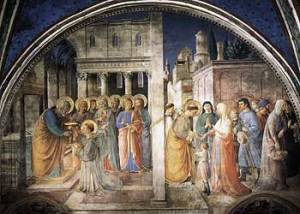
“Ordination of St. Stephen by St. Peter” Fra Angelico, 1449 Capella Nicolina, Vaticano, Rome
So the Twelve called a meeting of all the believers.
They said, “We apostles should spend our time teaching the word of God, not running a food program. And so, brothers, select seven men who are well respected and are full of the Spirit and wisdom. We will give them this responsibility. Then we apostles can spend our time in prayer and teaching the word.”
Everyone liked this idea, and they chose the following: Stephen (a man full of faith and the Holy Spirit), Philip, Procorus, Nicanor, Timon, Parmenas, and Nicolas of Antioch (an earlier convert to the Jewish faith). These seven were presented to the apostles, who prayed for them as they laid their hands on them.
So God’s message continued to spread. The number of believers greatly increased in Jerusalem, and many of the Jewish priests were converted, too.
Prayer:Heavenly Father – You have made us all different – different talents, abilities, personalities and spiritual gifts. And all of us have a purpose and place to serve you – to build up the Church and reach out to the people around us. Lord Jesus – Renew, remold, remake us into people who bring honor to you – “well respected and full of the Holy Spirit and wisdom.” Holy Spirit – Empower us to serve others after the example of Jesus. In His name I ask it. Amen.
Hymn:“Ye Servants of God” – Charles Wesley (1744)
_________________________________________
When they heard this, the high council was furious and decided to kill them.
But one member, a Pharisee named Gamaliel, who was an expert in religious law and respected by all the people, stood up and ordered that the men be sent outside the council chamber for a while.
Then he said to his colleagues, “Men of Israel, take care what you are planning to do to these men! Some time ago there was that fellow Theudas, who pretended to be someone great. About 400 others joined him, but he was killed, and all his followers went their various ways. The whole movement came to nothing. After him, at the time of the census, there was Judas of Galilee. He got people to follow him, but he was killed, too, and all his followers were scattered.
“So my advice is, leave these men alone. Let them go. If they are planning and doing these things merely on their own, it will soon be overthrown. But if it is from God, you will not be able to overthrow them. You may even find yourselves fighting against God!”
The others accepted his advice. They called in the apostles and had them flogged. Then they ordered them never again to speak in the name of Jesus, and they let them go.
The apostles left the high council rejoicing that God had counted them worthy to suffer disgrace for the name of Jesus. And every day, in the Temple and from house to house, they continued to teach and preach this message: “Jesus is the Messiah.”
Prayer: Lord Jesus – Help me to discern what is right and true. May I be obedient to the leading of your Spirit… and may I be faithful to your Word. To the end that, one day, every knee shall bow and every tongue confess – “Jesus is Lord!” Amen.
Spiritual Song: “None But Jesus” – Brooke Fraser
_____________________________
In the first video, Dr. Darrell Bock interviews Rev. Fikret Bocek and “Anna” about their experiences living and ministering in the Middle East, including their experiences with coming to Christ out of a Muslim context, religious persecution and cultural engagement.
The secular powers that be are putting pressure on pastors to limit their practice of the Christian faith to just the four walls of the local church.
That’s why the current administration has emphasized a restricted “freedom of worship” rather than the First Amendment’s robust guarantee of Freedom of Religion; it’s why believers concerned about the redefinition of marriage are being told to shut up and go along, and why organizations such as Catholic Charities face crushing fines if they don’t provide contraceptives to their employees.
Now of course, we all know that some churches and ministers have been accused of becoming too involved in partisan politics. Even when we’ve been right to enter the political arena for good causes, too often we have been self-righteous, a tad arrogant, and sometimes beholden to this party or that.
But just because sometimes we get it wrong doesn’t mean we should stop altogether. As G. K. Chesterton observed, “If a thing is worth doing, it is worth doing badly.”
Fortunately, we have plenty of good examples of how pastors can be effectively and biblically engaged in the issues of the day-pastors who stood tall as our Republic was being founded.
The Colson Center‘s T. M. Moore points to certain men in black. “The British,” T.M. says, “referred to colonial pastors as the ‘Black Brigade,’ men in robes who fought against them by the words of their mouths as effectively as the colonial militia did with their weapons. To show their disdain of the American clergy, the British quartered their horses in the churches when they could.”
That harassment did not deter the clergy, however. “Many sermons urging the revolutionary cause,” T.M. says, “were printed as broadsides and circulated up and down the eastern seaboard, where they were read and discussed in what were called Committees of Correspondence. These ‘small groups’ were highly effective in preparing the ground for the Revolution.”
Now T.M. isn’t advocating a revolution-except, perhaps, in our thinking about the role of ministers in the American experiment. “Ministers helped to lead the way to a new country,” he says. “Their preaching was bold, visionary, and soundly biblical, and many of their sermons worked to rally their people to the patriotic cause, but within the framework of a Kingdom vision.”
That kind of preaching-and thinking-is rare in our churches today. And that’s why as we approach the Fourth of July, T. M.’s “Pastor to Pastor” e-newsletter is focusing on classic sermons from the revolutionary era: to encourage today’s pastors to rethink their own callings as preachers, especially in the light of our nation’s great need for revival, renewal, and awakening.
You-and your pastor-can get “Pastor to Pastor” in your inbox each day. Please come to BreakPoint.org, click on this commentary, and sign up.
Just to whet your appetite, here are the words of John Witherspoon, from his sermon, “The Dominion of Providence over the Passions of Men:” “There is not a greater evidence either of the reality or the power of religion than a firm belief of God’s universal presence, and a constant attention to the influence and operation of his providence. It is by this means that Christians may be said, in the emphatic scripture language, ‘to walk with God, and to endure as seeing him who is invisible.’ ”
T. M. says, “What our nation needs today is ‘greater evidence of the reality and the power of religion.’ Why is there so little evidence of these among the members of the Christian community today?”
For the answer, and for inspiration, please come toBreakPoint.organd sign up for “Pastor to Pastor” today!



 The Peanut Gallery