‘Extremely Shocking’ Detention of North Carolina Pastor by Turkey Drags On ~ reblog PJ Media

‘Extremely Shocking’ Detention of North Carolina Pastor by Turkey Drags On

Andrew Brunson (Photo courtesy of ACLJ)

A North Carolina pastor who made Turkey his home for more than two decades has been sitting behind bars since last year, held for unclear reasons but apparently swept up in President Recep Tayyip Erdoğan’s engulfing purge of perceived enemies.

Since the failed July coup attempt, Erdoğan’s Islamist government has detained 93,248 people, arrested 46,274, fired 128,625 people of varying professions via government decree, shut down 2,099 schools, fired 7,316 academics, dismissed 4,070 judges and prosecutors, closed 149 media outlets, and imprisoned 162 journalists, as of Feb. 28.

Turkey is officially a secular republic, and about 150,000 Christians live in the country including Armenian and Greek Orthodox, Syriac Christians, Jehovah’s Witnesses, Protestants, Maronites, Chaldeans and Roman Catholics.

For the past 23 years, Rev. Andrew Brunson and his wife Norine have made Turkey their home, raising a family and ministering through the Protestant Izmir Resurrection Church in the Aegean coast city. In October, they found a note on their door telling them to report to the migration management office for what they thought would be a visit connected to their visa renewal. Instead, officials detained the couple.

Norine was eventually released and allowed to stay in the country. The pastor, though, was sent to jail in December on a hazy accusation of “membership in an armed terrorist organization.”

The Turkish government refers to exiled cleric Fethullah Gülen, who lives in Pennsylvania, as a terrorist and has, with often no evidence, linked perceived Erdoğan opponents arrested or fired since the coup attempt to Gülen’s “terrorist” movement. Erdoğan has also demanded the extradition of his former ally Gülen.

CeCe Heil, senior counsel for the American Center for Law and Justice, told PJM today that Brunson was not allowed visits from U.S. consular officials in the first 30 days of his detention and was only given a lawyer at the Dec. 9 hearing in which he was ordered held behind bars. Files are still sealed in the case and there’s “very little” documentation, including any evidence, accessible to lawyers.

Heil said they’re “absolutely” concerned that the pastor was swept up in Erdoğan’s fervent purge.

“Why him? Why now, after 23 years of being there peacefully?” she asked, noting that she was not aware of any other members of the church taken into custody. Brunson was attacked in 2011 by a lone man who was later charged and acquitted of being a member of al-Qaeda, but Heil said the family had not been subject to any government harassment over the years — making the pastor’s detention “extremely shocking” to friends and family.

Heil said Brunson has not been tortured while in custody, though his living conditions are concerning especially with warm weather approaching. He’s being kept with as many as 20 men at a time in a cell built for eight people, with “very spotty” access to water, no air conditioning and no other Christians.

“It’s disconcerting to have a U.S. pastor from North Carolina siting in a Turkish prison, of a NATO ally,” the attorney said.

Last month, 78 lawmakers signed a letter calling for Brunson’s release, led by Sens. Bob Corker (R-Tenn.) and Ben Cardin (D-Md.), the chairman and ranking member of the Senate Foreign Relations Committee, and Reps. Ed Royce (R-Calif.) and Eliot Engel (D-N.Y.), the chairman and ranking member of the House Foreign Affairs Committee.

“There appears to be no evidence to substantiate the charges against him for membership in an armed terrorist organization. Moreover, your government has repeatedly denied regular and appropriate access to legal counsel and American consular services,” the lawmakers wrote to Erdoğan.

“Mr. Brunson’s imprisonment has been raised repeatedly by U.S. Government officials with officials of the Government of Turkey,” they added. “Unfortunately, high-level efforts to secure Mr. Brunson’s release have been unsuccessful. We have closely followed developments with this case, and are deeply disappointed.”

The Congress members asked the Turkish leader to consider Brunson’s case in the “spirit of partnership” and think of “how the recent treatment of Mr. Brunson places significant strain not only on him and his family, but also on the robust bilateral relationship between the United States and Turkey.”

“We appeal to you to inquire as to the options for promptly deporting Mr. Brunson and to act on them expeditiously.”

While the depleted judiciary and Erdoğan’s persistent state of emergency slow the progression of Brunson’s case in Turkey, the administration transition in the United States has proven “a little problematic,” Heil said, as the pastor’s advocates were working with the last administration to secure his release and now are “in a little bit of a holding pattern” waiting for key State Department positions to be filled.

U.S. Ambassador to Turkey John Bass, appointed by President Obama in 2014, is still in his role and has been “actively working” on the case, Heil confirmed. “We do know that the State Department is very aware of the situation,” she added.

“We’re waiting for the current administration to take some action, whether that would be through Secretary Tillerson or President Trump himself taking action, that’s where we are,” Heil said. “We keep pushing the matter up the ladder.”

The ACLJ is also gathering petition signatures demanding the pastor’s release.
Christendom’s Greatest Cathedral to Become a Mosque

Christendom’s Greatest Cathedral to Become a Mosque

Turkey is reclaiming its jihadi past, while Europe is simultaneously erasing its own Christian heritage.

pjmedia.com / Jun 18th 2013 / by Raymond Ibrahim

The desire to turn Hagia Sophia into a mosque is not about Muslims wanting a place to pray — as of 2010, there were 3,000 active mosques in Istanbul alone. Rather, it’s about their reveling, and trying to revivify, the glory days of Islamic jihad and conquest….

image
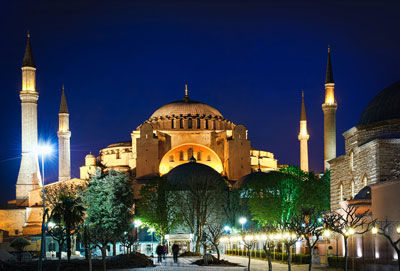
The Hagia Sophia at night.

While unrest in Turkey continues to capture attention, more subtle and more telling events concerning the Islamification of Turkey — and not just at the hands of Prime Minister Erdogan but majorities of Turks — are quietly transpiring. These include the fact that Turkey’s Hagia Sophia museum is on its way to becoming a mosque.

Why does the fate of an old building matter?

Because Hagia Sophia — Greek for “Holy Wisdom” — was for some thousand years Christianity’s greatest cathedral. Built in 537 A.D. in Constantinople, the heart of the Christian empire, it was also a stalwart symbol of defiance against an ever encroaching Islam from the east.

After parrying centuries of jihadi thrusts, Constantinople was finally sacked by Ottoman Turks in 1453. Its crosses desecrated and icons defaced, Hagia Sophia — as well as thousands of other churches — was immediately converted into a mosque, the tall minarets of Islam surrounding it in triumph.

Then, after the dissolution of the Ottoman Empire, as part of several reforms, secularist Ataturk transformed Hagia Sophia into a “neutral” museum in 1934 — a gesture of goodwill to a then-triumphant West from a then-crestfallen Turkey.

Thus the fate of this ancient building is full of portents. And according to Hurriyet Daily News, “A parliamentary commission is considering an application by citizens to turn the Hagia Sophia in Istanbul into a mosque…. A survey conducted with 401 people was attached to the application, in which more than 97 percent of interviewees requested the transformation of the ancient building into a mosque and afterwards for it to be reopened for Muslim worship.”

Even lesser known is the fact that other historic churches are currently being transformed into mosques, such as a 13th century church building — portentously also named Hagia Sophia — in Trabzon. After the Islamic conquest, it was turned into a mosque. But because of its “great historical and cultural significance” for Christians, it too, during Turkey’s secular age, was turned into a museum and its frescoes restored. Yet local authorities recently decreed that its Christian frescoes would again be covered and the church/museum turned into a mosque.

Similarly, the 5th century Studios Monastery, dedicated to St. John the Baptist, is set to become an active mosque. And the existence of the oldest functioning Christian monastery in the world, 5th century Mor Gabriel Monastery, is at risk. Inhabited today by only a few dozen Christians dedicated to learning the monastery’s teachings, the ancient Aramaic language spoken by Jesus, and the Orthodox Syriac tradition, neighboring Muslims filed a lawsuit accusing the monks of practicing “anti-Turkish activities” and of illegally occupying land which belongs to Muslim villagers. The highest appeals court in Ankara ruled in favor of the Muslim villagers, saying the land that had been part of the monastery for 1,600 years is not its property, absurdly claiming that the monastery was built over the ruins of a mosque — even though Muhammad was born 170 years after the monastery was built.

Turkey’s Christian minority, including the Orthodox Patriarch, are naturally protesting this renewed Islamic onslaught against what remains of their cultural heritage — to deaf ears.

The Muslim populace’s role in transforming once Christian sites into mosques is a reminder of all those other Turks not protesting the Islamization of Turkey, and who if anything consider Erdogan’s government too “secular.”

Their numbers are telling. In May 2012, Reuters reported that:

Thousands of devout Muslims prayed outside Turkey’s historic Hagia Sophia museum on Saturday [May 23] to protest a 1934 law that bars religious services at the former church and mosque. Worshippers shouted, “Break the chains, let Hagia Sophia Mosque open,” and “God is great” [the notorious “Allahu Akbar”] before kneeling in prayer as tourists looked on.

Turkey’s secular laws prevent Muslims and Christians from formal worship within the 6th-century monument, the world’s greatest cathedral for almost a millennium before invading Ottomans converted it into a mosque in the 15th century.

The desire to turn Hagia Sophia into a mosque is not about Muslims wanting a place to pray — as of 2010, there were 3,000 active mosques in Istanbul alone. Rather, it’s about their reveling, and trying to revivify, the glory days of Islamic jihad and conquest: Reuters added that Muslims “staged the prayers ahead of celebrations next week marking the 559th anniversary of the Ottoman Sultan Mehmet’s conquest of Byzantine Constantinople.” According to Salih Turhan, a spokesman quoted by Reuters, “As the grandchildren of Mehmet the Conqueror, seeking the re-opening Hagia Sophia as a mosque is our legitimate right.”

Sultan Mehmet was the scourge of European Christendom, whose Islamic hordes seized and ravished Constantinople, forcibly turning it Islamic. Openly idolizing him, as many Turks do, is tantamount to their saying, “We are proud of our ancestors who killed and stole the lands of European Christians.” And yet, despite such militant overtones, Turhan, whose position is echoed by many Turks, still manages to blame the West: “Keeping Hagia Sophia Mosque closed is an insult to our mostly Muslim population of 75 million. It symbolizes our ill-treatment by the West.”

So keeping a historically Christian/Western building — that was stolen by Islamic jihad — as a neutral museum is seen as “ill-treatment by the West,” even as Turks continue destroying the nation’s original Christian heritage.

And the historical revisions continue. Last May 29th, when Turks celebrated the Fall of Constantinople, Erdogan himself declared that the jihadi invasion — which saw countless Christians enslaved, raped, or slaughtered — was the true “time of enlightenment.” After showing how Erdogan got it upside down, Ralph Sidway, an Orthodox Christian author, wrote:

Erdogan and Turkey celebrate the Fall of Constantinople, and the West congratulates them. “We are continuing to write history today,” says Erdogan, and write it – or re-write it – they do, under the somnambulant gaze of craven Western leaders too ignorant, or too fearful, to challenge Islam’s claim to moral superiority, historical righteousness and eventual world domination. By their policies, posture and pronouncements, Western European nations, and the United States, are conceding the future to a rapidly re-Islamicizing Turkey, and are aiding in Islam’s stated goal of a new, global caliphate determined to conquer us, just as it conquered Constantinople 560 years ago. Every Turkish celebration of 29 May 1453 is a gauntlet flung down in challenge to the West. Each such event which goes unanswered and unchallenged by the West is another nail in the coffin of Christian culture, human rights, and free people everywhere.

Indeed, at a time when Turkey is openly reclaiming its jihadi heritage, Europeans are actively erasing their Christian heritage which for centuries kept the Islamic jihad at bay. Among other capitulations, Europeans are currently betraying church buildings to Muslims to convert to mosques and scrubbing references of the historic Turkish jihads against Europe from classroom textbooks, lest Muslim students be offended.

Meanwhile, here are neighboring Turkey’s Muslims openly praising the same jihadi warlords who brutally conquered a portion of Europe centuries ago, converting thousands of churches into mosques, even as they openly prepare to finish the job — which may not even require force, as Europe actively sells its own soul.

Turkish man inspires hundreds with silent vigil in Taksim Square

Peanut Gallery: Can one man’s civil disobedience stop Erdogan’s drive toward the Islamization of Turkey? Not today… but perhaps tomorrow.

m.guardiannews.com / Jun 18th 2013

image
Erdem Gunduz stands in Taksim Square during a 'duranadam' or standing man protest in Istanbul, Turkey, early 18 June 2013.

A Turkish man has staged an eight-hour silent vigil in Istanbul’s Taksim Square, the scene of violent clashes between police and anti-government protesters in recent weeks, inspiring hundreds of others to follow his lead.

Erdem Gunduz said he wanted to take a stand against police stopping demonstrations near the square, the Dogan news agency reported.He stood silently, facing the Ataturk Cultural Centre which was draped in Turkish flags and a portrait of Turkey’s founder Mustafa Kemal Ataturk, from 6pm on Monday.

By 2am on Tuesday, when the police moved in, about 300 people had joined him. Ten people, who refused to be moved on by police, were detained.Gunduz, swiftly dubbed “standing man” on social media in Turkey, inspired similar protests elsewhere in Istanbul, as well as in the capital, Ankara, and the city of Izmir on the Aegean coast.

The silent protests were in stark contrast to demonstrations at the weekend, which saw some of the fiercest clashes so far when police fired teargas and water cannons to clear thousands from Taksim Square.

What began in May as a protest by environmentalists upset over plans to build on a park adjoining Taksim Square has grown into a movement against the prime minister, Recep Tayyip Erdoğan, presenting the greatest public challenge to his 10-year leadership.

In Istanbul’s Heart, Leader’s Obsession, Perhaps Achilles’ Heel – NY Times Re-Blog

Peanut Gallery: This NY Times article overviews the current popular resistance to the Islamization of Turkey. It is truly a clash of world views – secularist Ataturk vs Islamist Erdoğan.

Taksim is the latest reminder of the power of public space. The square has become an arena for clashing worldviews: an unyielding leader’s top-down, neo-Ottoman, conservative vision of the nation as a regional power versus a bottom-up, pluralist, disordered, primarily young, less Islamist vision of the country as a modern democracy.

Ataturk brought Turkey kicking and screaming into the modern Western world.  Erdoğan is trying to reverse the process – taking Turkey kicking and screaming back into the 17th century world of the Ottomans.

This article is well worth the read.
___________________________

by MICHAEL KIMMELMANnytimes.com / June 7th 2013

image

More Photos »Photo by: Kitra Cahana for The New York Times

ISTANBUL — On a normal day, Taksim Square is a mess of buses and crowds, a tangle of plazas, streets, shops and taxi horns. Turkey’s prime minister, Recep Tayyip Erdogan, is determined to clean it up and make it into a pedestrian zone, with a new mall, mosque and tunnels for traffic to move underground.

The outrage in response has filled the square with noisy, angry, determined protesters. At midday, the muezzin’s call to prayer now mixes with the chants of union workers and bullhorn speeches from the Anti-Capitalist Muslims. At night, drummers and singers agitate the throngs until dawn.

After Tahrir Square in Egypt and Zuccotti Park in New York, Taksim is the latest reminder of the power of public space. The square has become an arena for clashing worldviews: an unyielding leader’s top-down, neo-Ottoman, conservative vision of the nation as a regional power versus a bottom-up, pluralist, disordered, primarily young, less Islamist vision of the country as a modern democracy.

“Taksim is where everybody expresses freely their happiness, sorrow, their political and social views,” said Esin, 41, in a head scarf, sitting with relatives on a bench watching the protest in the square. She declined to give her surname, fearing disapproval from conservative neighbors. “The government wants to sanitize this place, without consulting the people.”

So public space, even a modest and chaotic swath of it like Taksim, again reveals itself as fundamentally more powerful than social media, which produce virtual communities. Revolutions happen in the flesh. In Taksim, strangers have discovered one another, their common concerns and collective voice. The power of bodies coming together, at least for the moment, has produced a democratic moment, and given the leadership a dangerous political crisis.

“We have found ourselves,” is how Omer Kanipak, a 41-year-old Turkish architect, put it to me, about the diverse gathering at Gezi Park on the north end of Taksim, where the crowds are concentrated in tent encampments and other makeshift architecture after Mr. Erdogan’s government ordered bulldozers to make way for the mall.

And there’s the hitch. The prime minister has emerged as the strongest leader Turkey has had since Mustafa Kemal Ataturk founded the republic — but he remains not much of an architect or urban planner.

Like other longtime rulers, he has assumed the mantle of designer in chief, fiddling over details for giant mosques, planning a massive bridge and canal, devising gated communities in the name of civic renewal and economic development. The goal is a scripted public realm. Taksim, the lively heart of modern Istanbul, has become Mr. Erdogan’s obsession, and perhaps his Achilles’ heel.

And it’s no wonder. Taksim’s very urban fabric — fluid, irregular, open and unpredictable — reflects the area’s historic identity as the heart of modern, multicultural Turkey. This was where poor European immigrants settled during the 19th century. It was a honky-tonk quarter into the 1980s, a haven to gays and lesbians, a locus of nightclubs, foreign movie palaces and French-style covered arcades. Gravestones from an Armenian cemetery at Taksim demolished in 1939 were used to construct stairs at Gezi Park, a republican-era project by the French planner Henri Prost that is like the jumble of high-rise hotels, traffic circles and the now-shuttered opera house on the square, named after Ataturk. It is a symbol of modernity.

The prime minister’s vision of a big pedestrian plaza, with buried traffic, is intended to smooth out the square — to remake it into a neo-Ottoman theme park. Mr. Erdogan has lately backed away from installing a mall in the faux Ottoman barracks that will go where Gezi is now. But he intends to raze a poor neighborhood nearby called Tarlabasi and build high-end condominiums. Yet another of his projects envisions a hygienic parade ground on the southern outskirts of the city, designed for mass gatherings as if to quarantine protests: the anti-Taksim. The real Taksim is an unruly commons in the middle of the city. Mr. Erdogan has already demolished a beloved cinema and old chocolate pudding shop on Istiklal (Independence) Avenue, the main street and neighborhood backbone into Taksim.

This is why it has come as little surprise to many Turks that Gezi Park was the last straw. “We need free places,” Pelin Tan, a sociologist and protester, explained.

“Public space equals an urban, cosmopolitan identity,” is how Gokhan Karakus, an architecture critic here, phrased it. “That’s exactly what the prime minister doesn’t like. Turkish people who have taken over Gezi Park in protest feel it is truly theirs, not something awarded to them by their leaders, so in that sense the move to destroy it has backfired on him.”

Maybe.

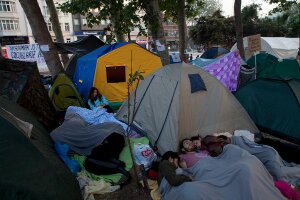
Mr. Erdogan has doubled down on demolishing the park, saying he regretted only that police brutality escalated the protests. “These actions that turned into vandalism and lawlessness must stop immediately,” he warned, as thousands of his supporters cheered him. Gezi has meanwhile evolved into a festive village with tent settlements, general stores distributing free food and clothing, a day care center, a library and an infirmary, even a veterinary clinic and community garden, nasturtiums where the bulldozers ripped out the first trees. The architecture is tactical urbanism: bare-bones and opportunistic, tin lean-tos, and spare concrete bollards and crates used to make picnic tables. The park has spawned its own pop-up economy as well, street vendors hawking Turkish meatballs, vinegar (for the tear gas) and Guy Fawkes masks.

A poll published in the Hurriyet Daily News on Thursday revealed that 70 percent of the protesters insisted they did not “feel close” to any political party. Politics in the 21st century is about private freedoms and public space. Esin, watching the protest in the square, added that her conservative parents think Mr. Erdogan goes too far by banning alcohol and scolding couples for kissing on subways.

Near the statue of Ataturk in the middle of Taksim Square, now festooned with protesters’ banners and flags, I found a 24-year-old photography student who identified herself as Kader, from northern Turkey. “I come to hang out here because there are all kinds of people and it’s fun,” she told me. As she spoke, a Turkish couple, arm in arm, the woman in head scarf, passed by. “The prime minister is treating the place as his private property,” Kader wanted to make clear.

Mr. Erdogan’s plan for removing buses and taxis and installing a single, vast pedestrian zone at Taksim, stripped of its gritty and unpredictable energy, turned into a polite shopping area, will sap the square of its pedestrian vitality, not make it pedestrian-friendlier. After several days with few cars or buses getting into Taksim because of the barricades, the illogic of Mr. Erdogan’s tunnel is obvious. There has been no great traffic crisis.

“We know from the 1960s that pedestrianizing everything doesn’t work,” agreed Hashim Sarkis, who teaches architecture and urbanism at Harvard. “Managing the balance is better. There is much to be said for loose, indeterminate places like Taksim. Its changeability is its strength, which is the threat perceived by authorities. It’s too loose and open.”

I hailed a taxi to check out the Dolmabahce Tunnel, another of Mr. Erdogan’s renewal projects, which is akin to the tunnel now being devised under Taksim, where people would descend for buses and taxis. It was no place for pedestrians to go. My driver, Erdal Bas, 42, volunteered that it had also done nothing to reduce traffic jams. “It just adds another road into them,” he said.

We drove on to Sulukule, a neighborhood hard by the ancient city walls, where the Roma have lived for more than a thousand years. Mr. Erdogan’s government forced many of them out a few years ago to clear land for a condo complex, which opens shortly. I found what is left of the old streets alive with families and children playing. The new buildings next to them, sterile three – and four-story concrete, glass and wood townhouses with duplex and triplex apartments, had all the charm of a suburban office park.

Back at Gezi, a placard quotes an old poem by Nazim Hikmet:I am a walnut tree in Gulhane Parkneither you are aware of this, nor the police.Mr. Kanipak, the architect, told me that the threat of Mr. Erdogan’s architectural intervention at Taksim “has for the first time helped to break down the walls of fear about opposing an autocratic state.” That said, tensions are swiftly rising after Mr. Erdogan’s latest speeches.

The conflict over public space is always about control versus freedom, segregation versus diversity.

What’s at stake is more than a square.It’s the soul of a nation.

Culture Clash (Ataturk vs Erdogan) – Britons warned to steer clear of Turkey – Daily Mail Re-Blog

Britons warned to steer clear of Turkey as 1,700 protesters arrested after riots rock the country for a third day

  • Protests erupted again today against Turkey’s conservative government
  • Thousands took to the streets in rallies and demonstrations in three cities
  • Britons warned to avoid all but essential travel to parts of Turkey

By SUZANNAH HILLS

PUBLISHED: 11:24 EST, 2 June 2013 | UPDATED: 05:36 EST, 3 June 2013

Tens of thousands took to the streets in the country’s four biggest cities yesterday – the third day of anti-government protests – with demonstrators clashing with riot police, who repelled them with tear gas.

The unrest initially erupted on Friday when trees were torn down at a park in Istanbul’s main Taksim Square under government plans to redevelop the area. But they have widened into a broad show of defiance against the Islamist-rooted Justice and Development Party (AKP).

Scroll down for video

Blaze: An anti-government protester holds Turkey's national flag with a portrait of Mustafa Kemal Ataturk on it Blaze: An anti-government protester holds Turkey’s national flag with a portrait of Mustafa Kemal Ataturk on it
Gas: Police use water cannon as protesters run to avoid tear gas during the third day Gas: Police use water cannon as protesters run to avoid tear gas during the third day
Choke: Turkey's prime minister Recep Tayyip Erdogan rejected claims that he is a 'dictator,' dismissing protesters as an extremist fringeChoke: Turkey’s prime minister Recep Tayyip Erdogan rejected claims that he is a ‘dictator,’ dismissing protesters as an extremist fringe
Riot: A protester falls down as he tries to throw back at police a tear gas canister Riot: A protester falls down as he tries to throw back at police a tear gas canister

Prime minister Recep Tayyip Erdogan blamed the main secular opposition party for inciting the crowds, and said the protests were aimed at depriving his ruling AK Party of votes as elections begin next year.

Erdogan said the plans to remake the square, long an iconic rallying point for mass demonstrations, would go ahead, including the construction of a new mosque and the rebuilding of a replica Ottoman-era barracks.

TURKEY: Mangled vehicles on the streets following two nights of…

And he said the protests – which were started by a small group of environmental campaigners but mushroomed when police used force to eject them from the park on Taksim Square – had nothing to do with the plans. Continue reading “Culture Clash (Ataturk vs Erdogan) – Britons warned to steer clear of Turkey – Daily Mail Re-Blog”