Peanut Gallery: This NY Times article overviews the current popular resistance to the Islamization of Turkey. It is truly a clash of world views – secularist Ataturk vs Islamist Erdoğan.
Taksim is the latest reminder of the power of public space. The square has become an arena for clashing worldviews: an unyielding leader’s top-down, neo-Ottoman, conservative vision of the nation as a regional power versus a bottom-up, pluralist, disordered, primarily young, less Islamist vision of the country as a modern democracy.
Ataturk brought Turkey kicking and screaming into the modern Western world. Erdoğan is trying to reverse the process – taking Turkey kicking and screaming back into the 17th century world of the Ottomans.
This article is well worth the read.
___________________________
by MICHAEL KIMMELMAN, nytimes.com / June 7th 2013
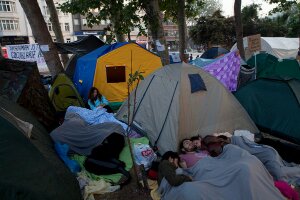
More Photos »Photo by: Kitra Cahana for The New York Times
ISTANBUL — On a normal day, Taksim Square is a mess of buses and crowds, a tangle of plazas, streets, shops and taxi horns. Turkey’s prime minister, Recep Tayyip Erdogan, is determined to clean it up and make it into a pedestrian zone, with a new mall, mosque and tunnels for traffic to move underground.
The outrage in response has filled the square with noisy, angry, determined protesters. At midday, the muezzin’s call to prayer now mixes with the chants of union workers and bullhorn speeches from the Anti-Capitalist Muslims. At night, drummers and singers agitate the throngs until dawn.
After Tahrir Square in Egypt and Zuccotti Park in New York, Taksim is the latest reminder of the power of public space. The square has become an arena for clashing worldviews: an unyielding leader’s top-down, neo-Ottoman, conservative vision of the nation as a regional power versus a bottom-up, pluralist, disordered, primarily young, less Islamist vision of the country as a modern democracy.
“Taksim is where everybody expresses freely their happiness, sorrow, their political and social views,” said Esin, 41, in a head scarf, sitting with relatives on a bench watching the protest in the square. She declined to give her surname, fearing disapproval from conservative neighbors. “The government wants to sanitize this place, without consulting the people.”
So public space, even a modest and chaotic swath of it like Taksim, again reveals itself as fundamentally more powerful than social media, which produce virtual communities. Revolutions happen in the flesh. In Taksim, strangers have discovered one another, their common concerns and collective voice. The power of bodies coming together, at least for the moment, has produced a democratic moment, and given the leadership a dangerous political crisis.
“We have found ourselves,” is how Omer Kanipak, a 41-year-old Turkish architect, put it to me, about the diverse gathering at Gezi Park on the north end of Taksim, where the crowds are concentrated in tent encampments and other makeshift architecture after Mr. Erdogan’s government ordered bulldozers to make way for the mall.
And there’s the hitch. The prime minister has emerged as the strongest leader Turkey has had since Mustafa Kemal Ataturk founded the republic — but he remains not much of an architect or urban planner.
Like other longtime rulers, he has assumed the mantle of designer in chief, fiddling over details for giant mosques, planning a massive bridge and canal, devising gated communities in the name of civic renewal and economic development. The goal is a scripted public realm. Taksim, the lively heart of modern Istanbul, has become Mr. Erdogan’s obsession, and perhaps his Achilles’ heel.
And it’s no wonder. Taksim’s very urban fabric — fluid, irregular, open and unpredictable — reflects the area’s historic identity as the heart of modern, multicultural Turkey. This was where poor European immigrants settled during the 19th century. It was a honky-tonk quarter into the 1980s, a haven to gays and lesbians, a locus of nightclubs, foreign movie palaces and French-style covered arcades. Gravestones from an Armenian cemetery at Taksim demolished in 1939 were used to construct stairs at Gezi Park, a republican-era project by the French planner Henri Prost that is like the jumble of high-rise hotels, traffic circles and the now-shuttered opera house on the square, named after Ataturk. It is a symbol of modernity.
The prime minister’s vision of a big pedestrian plaza, with buried traffic, is intended to smooth out the square — to remake it into a neo-Ottoman theme park. Mr. Erdogan has lately backed away from installing a mall in the faux Ottoman barracks that will go where Gezi is now. But he intends to raze a poor neighborhood nearby called Tarlabasi and build high-end condominiums. Yet another of his projects envisions a hygienic parade ground on the southern outskirts of the city, designed for mass gatherings as if to quarantine protests: the anti-Taksim. The real Taksim is an unruly commons in the middle of the city. Mr. Erdogan has already demolished a beloved cinema and old chocolate pudding shop on Istiklal (Independence) Avenue, the main street and neighborhood backbone into Taksim.
This is why it has come as little surprise to many Turks that Gezi Park was the last straw. “We need free places,” Pelin Tan, a sociologist and protester, explained.
“Public space equals an urban, cosmopolitan identity,” is how Gokhan Karakus, an architecture critic here, phrased it. “That’s exactly what the prime minister doesn’t like. Turkish people who have taken over Gezi Park in protest feel it is truly theirs, not something awarded to them by their leaders, so in that sense the move to destroy it has backfired on him.”
Maybe.
Mr. Erdogan has doubled down on demolishing the park, saying he regretted only that police brutality escalated the protests. “These actions that turned into vandalism and lawlessness must stop immediately,” he warned, as thousands of his supporters cheered him. Gezi has meanwhile evolved into a festive village with tent settlements, general stores distributing free food and clothing, a day care center, a library and an infirmary, even a veterinary clinic and community garden, nasturtiums where the bulldozers ripped out the first trees. The architecture is tactical urbanism: bare-bones and opportunistic, tin lean-tos, and spare concrete bollards and crates used to make picnic tables. The park has spawned its own pop-up economy as well, street vendors hawking Turkish meatballs, vinegar (for the tear gas) and Guy Fawkes masks.
A poll published in the Hurriyet Daily News on Thursday revealed that 70 percent of the protesters insisted they did not “feel close” to any political party. Politics in the 21st century is about private freedoms and public space. Esin, watching the protest in the square, added that her conservative parents think Mr. Erdogan goes too far by banning alcohol and scolding couples for kissing on subways.
Near the statue of Ataturk in the middle of Taksim Square, now festooned with protesters’ banners and flags, I found a 24-year-old photography student who identified herself as Kader, from northern Turkey. “I come to hang out here because there are all kinds of people and it’s fun,” she told me. As she spoke, a Turkish couple, arm in arm, the woman in head scarf, passed by. “The prime minister is treating the place as his private property,” Kader wanted to make clear.
Mr. Erdogan’s plan for removing buses and taxis and installing a single, vast pedestrian zone at Taksim, stripped of its gritty and unpredictable energy, turned into a polite shopping area, will sap the square of its pedestrian vitality, not make it pedestrian-friendlier. After several days with few cars or buses getting into Taksim because of the barricades, the illogic of Mr. Erdogan’s tunnel is obvious. There has been no great traffic crisis.
“We know from the 1960s that pedestrianizing everything doesn’t work,” agreed Hashim Sarkis, who teaches architecture and urbanism at Harvard. “Managing the balance is better. There is much to be said for loose, indeterminate places like Taksim. Its changeability is its strength, which is the threat perceived by authorities. It’s too loose and open.”
I hailed a taxi to check out the Dolmabahce Tunnel, another of Mr. Erdogan’s renewal projects, which is akin to the tunnel now being devised under Taksim, where people would descend for buses and taxis. It was no place for pedestrians to go. My driver, Erdal Bas, 42, volunteered that it had also done nothing to reduce traffic jams. “It just adds another road into them,” he said.
We drove on to Sulukule, a neighborhood hard by the ancient city walls, where the Roma have lived for more than a thousand years. Mr. Erdogan’s government forced many of them out a few years ago to clear land for a condo complex, which opens shortly. I found what is left of the old streets alive with families and children playing. The new buildings next to them, sterile three – and four-story concrete, glass and wood townhouses with duplex and triplex apartments, had all the charm of a suburban office park.
Back at Gezi, a placard quotes an old poem by Nazim Hikmet:I am a walnut tree in Gulhane Parkneither you are aware of this, nor the police.Mr. Kanipak, the architect, told me that the threat of Mr. Erdogan’s architectural intervention at Taksim “has for the first time helped to break down the walls of fear about opposing an autocratic state.” That said, tensions are swiftly rising after Mr. Erdogan’s latest speeches.
The conflict over public space is always about control versus freedom, segregation versus diversity.
What’s at stake is more than a square.It’s the soul of a nation.

 Blaze: An anti-government protester holds Turkey’s national flag with a portrait of Mustafa Kemal Ataturk on it
 Gas: Police use water cannon as protesters run to avoid tear gas during the third day
 Choke: Turkey’s prime minister Recep Tayyip Erdogan rejected claims that he is a ‘dictator,’ dismissing protesters as an extremist fringe
 Riot: A protester falls down as he tries to throw back at police a tear gas canister
 The Peanut Gallery