Egypt’s Christians vs “the Lions” – Raymond Ibrahim Re-Blog

U.S. ASKS EGYPT’S CHRISTIANS NOT TO OPPOSE MORSI

By: Raymond Ibrahim 6/26/2013
image

As Egyptians of all factions prepare to demonstrate in mass against the Muslim Brotherhood and President Morsi’s rule on June 30, the latter has been trying to reduce their numbers, which some predict will be in the millions and eclipse the Tahrir protests that earlier ousted Mubarak.

image
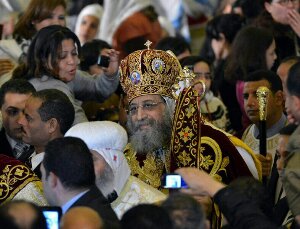
Egypt's Coptic Pope Tawadros II

Among other influential Egyptians, Morsi recently called on Coptic Christian Pope Tawadros II to urge his flock, Egypt’s millions of Christians, not to join the June 30 protests.

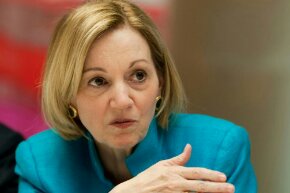
While that may be expected, more troubling is that the U.S. ambassador to Egypt is also trying to prevent Egyptians from protesting—including the Copts. The June 18th edition of Sadi al-Balad reports that lawyer Ramses Naggar, the Coptic Church’s legal counsel, said that during Patterson’s June 17 meeting with Pope Tawadros, she “asked him to urge the Copts not to participate” in the demonstrations against Morsi and the Brotherhood.

The Pope politely informed her that his spiritual authority over the Copts does not extend to political matters.
image
US Ambassador Anne Patterson

Regardless, many Egyptian activists are condemning Patterson for flagrantly behaving like the Muslim Brotherhood’s stooge. Leading opposition activist Shady el-Ghazali Harb said Patterson showed “blatant bias” in favor of Morsi and the Brotherhood, adding that her remarks had earned the U.S. administration “the enmity of the Egyptian people.” Coptic activists like George Ishaq openly told Patterson to “shut up and mind your own business.” And Christian business tycoon Naguib Sawiris—no stranger to Islamist hostility—posted a message on his Twitter account addressed to the ambassador saying “Bless us with your silence.”

Indeed, the U.S. ambassador’s position as the Brotherhood’s lackey is disturbing—and revealing—on several levels. First, all throughout the Middle East, the U.S. has been supporting anyone and everyone opposing their leaders—in Libya against Gaddafi, in Egypt itself against 30-year U.S. ally Mubarak, and now in Syria against Assad. In all these cases, the U.S. has presented its support in the name of the human rights and freedoms of the people against dictatorial leaders.

So why is the Obama administration now asking Christians not to oppose their rulers—in this case, Islamists—who have daily proven themselves corrupt and worse, to the point that millions of Egyptians, most of them Muslims, are trying to oust them?
image
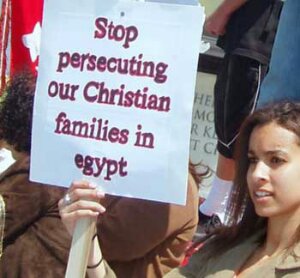
Egyptian Christians face increasing persecution from the Islamists in control of the state.

What’s worse is that the human rights abuses Egypt’s Coptic Christians have been suffering under Muslim Brotherhood rule are significantly worse than the human rights abuses that the average Egyptian suffered under Mubarak—making the Copts’ right to protest even more legitimate, and, if anything, more worthy of U.S support.

Among other things, under Morsi’s rule, the persecution of Copts has practically been legalized, as unprecedented numbers of Christians—men, women, and children—have been arrested, often receiving more than double the maximum prison sentence, under the accusation that they “blasphemed” Islam and/or its prophet.

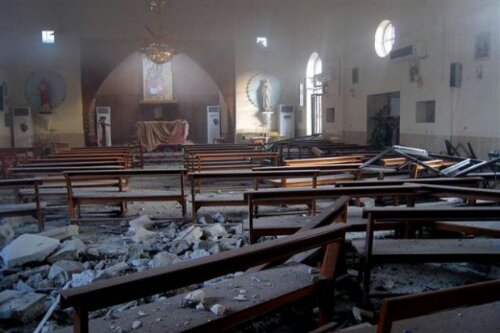
It was also under Morsi’s reign that another unprecedented scandal occurred: the St. Mark Cathedral—holiest site of Coptic Christianity and headquarters to the Pope Tawadros himself—was besieged in broad daylight by Islamic rioters. When security came, they too joined in the attack on the cathedral. And the targeting of Christian children—for abduction, ransom, rape, and/or forced conversion—has also reached unprecedented levels under Morsi.

(For more on the plight of the Copts under Morsi’s rule, see my new book Crucified Again: Exposing Islam’s New War on Christians.)

Yet despite the fact that if anyone in Egypt has a legitimate human rights concern against the current Egyptian government, it most certainly is the Christian Copts, here is the U.S., in the person of Ms. Patterson, asking them not to join the planned protests.

In other words, and consistent with Obama administration’s doctrine, when Islamists—including rapists and cannibals—wage jihad on secular leaders, the U.S. supports them; when Christians protest Islamist rulers who are making their lives a living hell, the administration asks them to “know their place” and behave like dhimmis, Islam’s appellation for non-Muslim “infidels” who must live as third class “citizens” and never complain about their inferior status.

Raymond Ibrahim is author of Crucified Again: Exposing Islam’s New War on Christians. He is a Shillman Fellow at the David Horowitz Freedom Center and an Associate Fellow at the Middle East Forum.
Will Coptic Christians Share in the Arab Spring While Morsi Is President of Egypt? – Re-Blog

By Michael Terheyden / 6/22/2013
Catholic Online (www.catholic.org)

Is it really a Spring at all, or a frightening return of an worse Winter?

https://www.youtube.com/watch?v=Rnhh9Vt2xwE&feature=youtube_gdata_player

As the one year anniversary of the election of Egypt’s President Mohamed Morsi approaches, tensions are high. Tens of thousands of Islamists have begun pouring into Cairo in anticipation of anti-Morsi demonstrations planned for June 30, 2013, by opponents of the new government.

image

KNOXVILLE, TN (Catholic Online) – As the one year anniversary of the election of Egypt’s President Mohamed Morsi approaches, tensions are high. Tens of thousands of Islamists have begun pouring into Cairo in anticipation of anti-Morsi demonstrations planned for June 30, 2013, by opponents of the new government.

image
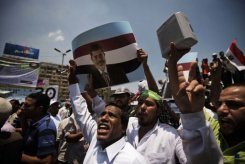
Egyptian Islamists led by the ruling Muslim Brotherhood shout slogans during a demonstration on June 21, 2013 in Cairo to mark the upcoming one year anniversary since President Mohamed Morsi's election. Tens of thousands of Islamists gathered for a show of strength ahead of planned opposition protests against Morsi, highlighting the tense political divide in the Arab world's most populous state.

According to France 24, an international news site, Islamists carrying Egyptian flags and pictures of Morsi held a demonstration on Friday, June 21. It was led by the Muslim Brotherhood, and its aim was to show that Morsi and his government had the support of the Egyptian people. But the Egyptian people are clearly divided.

Morsi was elected one year ago, after the fall of President Hosni Mubarak in February of 2011. Morsi promised to be the President of all Egyptians, including the Coptic Christian community. He said the Copts would be given full equal rights. At one point Morsi said,  “I will not be biased against any son of Egypt.” But this is not what has happened.

Instead, it appears that Morsi has used every opportunity to turn Egypt into an Islamist state since he became president. This past November, President Morsi issued a declaration giving himself sweeping dictatorial-style power over the drafting of Egypt’s new constitution. The President’s actions unleashed a firestorm.

A group of judges said, “The state of law is at stake.” The Vice-President of the Supreme Constitutional Court, Tahani al-Gebali, said that Morsi was now an “illegitimate president.” And Mohamed ElBaradei, a Nobel Peace Prize winner, said, “Morsi today usurped all state powers and appointed himself Egypt’s new pharaoh.”

Protestors marched on the presidential palace in Cairo and clashed with supporters of the Muslim Brotherhood. At one point, an estimated 200,000 anti-Morsi protestors flooded into Cairo’s famous Tahrir Square.

President Morsi seemingly backed down, but the final Constitution was drafted by a committee dominated by Islamists who used the Constitution to strengthen sharia law. Sharia law highly discriminates against non-Muslims and women.

Since taking office, Morsi has also had run-ins with the national judiciary, the media and the police. More recently, Morsi appointed seven members of the Muslim Brotherhood as provincial governors. He also gave the Luxor governorship to a member of the militant Islamist group responsible for the massacre of 58 foreign tourists in 1997. These appointments led to several clashes between Morsi’s supporters and his opponents.

According to his opponents, Morsi is “giving the Islamists a monopoly over public institutions.” However, the president’s supporters claim he is merely cleaning up corrupt institutions from the days of Mubarak.

Yet, organizers of the June 30 demonstration say they have collected 15 million signatures on a petition which demands the resignation of Morsi. Nevertheless, Ahmed Aqila, a representative of the Muslim Brotherhood Freedom and Justice Party, does not believe it can happen. He said, “Those who say ‘President Morsi will be toppled on June 30’ live in an illusion they must give up.”

The Coptic Christian community has been concerned that the Morsi government is allowing Islamists to act more aggressively toward non-Muslims. Heba Morayef, a director for Regional Human Rights Watch, says that some Muslims are using more discriminatory language on television. He says, “It’s very scary because of the sudden uptick in violence, compounded by the fact that the Muslim Brotherhood has in no way tried to reign it back and has at times participated.”

For instance, a member of the Muslim Brotherhood, Safwat Hegazi, recalling demonstrations last December which turned violent, told the Copts, “You share this country with us, but there are red lines, and one red line is the legitimacy of Dr. Morsi. Whoever splashes water on that, we will spill his blood.” Hegazi has since been appointed to the National Council on Human Rights in Egypt.

Consequently, some people are nervous about the upcoming demonstration scheduled at the end of this month and with good reason. There is much at stake. Coptic Christians and women have the most to lose, but so too do all Muslims, especially more moderate and secular Muslims.

While spokesmen from both sides are rightly calling for calm, they also realize that people have a right to address the Morsi government. Although he did not officially endorse the upcoming demonstration, according to one source, Pope Tawadros II of the Coptic Orthodox Church said, “Members of Egypt’s Christian minority are free to express their opinions on the streets, just as they were to vote for whomever candidate they supported in the past presidential elections.”

That is the way it should be in a true democracy, and President Morsi knows it. After one of the demonstrations last year, he said, “I will protect for my brothers in the opposition all their rights so they can exercise their role.” Now Morsi needs to prove it. Is Egypt a true democracy or not? Will Egypt’s Coptic Christians ever share in the Arab Spring, or was it a lie? We shall find out at the end of the month.
Let us pray for the safety of our brave brethren who will be demonstrating on June 30, and for a free Egypt where all Egyptians can live in peace. They are not alone. They are merely on the front lines of a battle that is threatening to engulf Christians throughout the world.
________________

Michael Terheyden was born into a Catholic family, but that is not why he is a Catholic. He is a Catholic because he believes that truth is real, that it is beautiful and good, and that the fullness of truth is in the Catholic Church. However, he knows that God’s grace operating throughout his life is the main reason he is a Catholic. He is greatly blessed to share his faith and his life with his beautiful wife, Dorothy. They have four grown children and three grandchildren.

Pain and Victory for the Church in Egypt – Open Doors Re-Blog

Pain and Victory for the Church in EgyptOpen Doors

image

“The powerful presence of the Holy Spirit could not be mistaken. At one end of the building several people saw white pigeons flying over! Could this be a special sign of affirmation of His presence? While stories of healing from sicknesses were shared around, it was undeniable, the Holy Spirit was there.” – an Egyptian Church Leader

The nightly news often shows crowds of angry, desperate Egyptians protesting in the streets of Cairo.

Lacking the most essential needs of life – jobs, shelter, security – Egyptians are lining up for bread for their table, gasoline for their cars, and more. Many experience water and electricity cuts. Police forces appear to focus most of their efforts on guarding people and  places related to the Muslim Brotherhood, while doing very little to secure or protect citizens.

“We hear frequent reports about car hijacking, armed robberies, kidnapping for ransom, buildings set on fire, protestors blocking rail lines and major highways,” says an Egyptian church leader. “I stand back in pain and wonder; is this really my country, Egypt!?!”

What makes the situation even gloomier are the attacks on churches and Christians. Recently, in Khusus Village, while mourners carried the remains of their dead, the procession was attacked by a mob. Police arrived too late. The attacks resulted in not only 7 deaths and dozens of injuries, but also added to the escalating tension rising throughout Egypt.

“Where do we take our pains,” adds the leader. “Is God still in control? Is there a reason why He allows these attacks to come on His children? We may not have an answer, yet, what is clearly evident is that He is preparing His children in Egypt to a big victory and a grand harvest.”

In a historical meeting held on Feburary 18, church leaders from various denominations, came together and launched “The Council of Egyptian Churches.” Sponsored by Pope Tawadros II, the 118th Pope of Alexandria and Patrarch of the See of St. Mark, is someone who sees this as a turning point in church unity.

Then, forty days later, on March 29, an evangelical church hosted a prayer meeting at a large conference facility in the desert, located 160 miles north of Cairo. Approximately 7,000 Christians, from various denominations including the Orthodox and Catholic churches, showed up for the three-day event. Continue reading “Pain and Victory for the Church in Egypt – Open Doors Re-Blog”

Christmas in Egypt: “Exclusive: Coptic pope speaks to Al Jazeera” on YouTube

image
Pope Tawadros II celebrated midnight Christmas Mass on January 6, 2013

Peanut Gallery: The Coptic Church is celebrating its 1st Christmas under the leadership of its new Pope – Tawadros II. Coptic Christmas is celebrated with midnight mass on January 6… Christmas Day falling on January 7 by the Julian calender.

The celebrations are marred by bombing threats to churches, street protests and clashes with Egyptian security forces.

In this environment, Pope Tawadros II was interviewed by Al Jazeera TV. Please pray for Egypt and its minority Coptic people.