
Morning Reading: Acts 27:1-12 NLT ~ Rome-ward bound

Reading: Acts 27:1-12 NLT

When the time came, we set sail for Italy. Paul and several other prisoners were placed in the custody of a Roman officer named Julius, a captain of the Imperial Regiment. Aristarchus, a Macedonian from Thessalonica, was also with us. We left on a ship whose home port was Adramyttium on the northwest coast of the province of Asia; it was scheduled to make several stops at ports along the coast of the province.

Pauls-Voyage-to-Rome-Map
Apostle Paul’s Journey to Rome

The next day when we docked at Sidon, Julius was very kind to Paul and let him go ashore to visit with friends so they could provide for his needs. Putting out to sea from there, we encountered strong headwinds that made it difficult to keep the ship on course, so we sailed north of Cyprus between the island and the mainland. Keeping to the open sea, we passed along the coast of Cilicia and Pamphylia, landing at Myra, in the province of Lycia. There the commanding officer found an Egyptian ship from Alexandria that was bound for Italy, and he put us on board.

We had several days of slow sailing, and after great difficulty we finally neared Cnidus. But the wind was against us, so we sailed across to Crete and along the sheltered coast of the island, past the cape of Salmone. We struggled along the coast with great difficulty and finally arrived at Fair Havens, near the town of Lasea. We had lost a lot of time. The weather was becoming dangerous for sea travel because it was so late in the fall, and Paul spoke to the ship’s officers about it.

“Men,” he said, “I believe there is trouble ahead if we go on — shipwreck, loss of cargo, and danger to our lives as well.” But the officer in charge of the prisoners listened more to the ship’s captain and the owner than to Paul. And since Fair Havens was an exposed harbor — a poor place to spend the winter—most of the crew wanted to go on to Phoenix, farther up the coast of Crete, and spend the winter there. Phoenix was a good harbor with only a southwest and northwest exposure.

Prayer: Heavenly Father – You made the winds and the sea… and you made me – charting my course through the journey of life. Thank you for those who perform acts of grace and kindness to me along the way… who provided comfort and encouragement… who offered correction when I veered off the narrow way. Thank you for the safe harbors where I found can rest during stormy seasons. And through it all, may I never lose sight of my destination… your upward call in Christ Jesus. Amen.

Hymn: “In a Little While We’re Going Home” – Eliza E. Hewitt, 1899.
Morning Reading: Acts 13:16-43 NLT – words of encouragement

Reading: Acts 13:16-43 NLT

Paul and his companions then left Paphos by ship for Pamphylia, landing at the port town of Perga. There John Mark left them and returned to Jerusalem. But Paul and Barnabas traveled inland to Antioch of Pisidia.

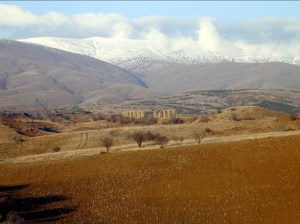
Looking toward the site of Pisidian Antioch. Atop the ridge in the center of the photo is the aqueduct that supplied water to the city.
Looking toward the site of Pisidian Antioch.
Atop the ridge in the center of the photo is the aqueduct that supplied water to the city.

On the Sabbath they went to the synagogue for the services. After the usual readings from the books of Moses and the prophets, those in charge of the service sent them this message: “Brothers, if you have any word of encouragement for the people, come and give it.”

So Paul stood, lifted his hand to quiet them, and started speaking. “Men of Israel,” he said, “and you God-fearing Gentiles, listen to me.

“The God of this nation of Israel chose our ancestors and made them multiply and grow strong during their stay in Egypt. Then with a powerful arm he led them out of their slavery. He put up with them through forty years of wandering in the wilderness. Then he destroyed seven nations in Canaan and gave their land to Israel as an inheritance. All this took about 450 years.

“After that, God gave them judges to rule until the time of Samuel the prophet. Then the people begged for a king, and God gave them Saul son of Kish, a man of the tribe of Benjamin, who reigned for forty years. But God removed Saul and replaced him with David, a man about whom God said,

‘I have found David son of Jesse, a man after my own heart. He will do everything I want him to do.’

“And it is one of King David’s descendants, Jesus, who is God’s promised Savior of Israel! Before he came, John the Baptist preached that all the people of Israel needed to repent of their sins and turn to God and be baptized. As John was finishing his ministry he asked,

‘Do you think I am the Messiah? No, I am not! But he is coming soon—and I’m not even worthy to be his slave and untie the sandals on his feet.’

“Brothers—you sons of Abraham, and also you God-fearing Gentiles—this message of salvation has been sent to us! The people in Jerusalem and their leaders did not recognize Jesus as the one the prophets had spoken about. Instead, they condemned him, and in doing this they fulfilled the prophets’ words that are read every Sabbath. They found no legal reason to execute him, but they asked Pilate to have him killed anyway.

“When they had done all that the prophecies said about him, they took him down from the cross and placed him in a tomb. But God raised him from the dead! And over a period of many days he appeared to those who had gone with him from Galilee to Jerusalem. They are now his witnesses to the people of Israel.

“And now we are here to bring you this Good News. The promise was made to our ancestors, and God has now fulfilled it for us, their descendants, by raising Jesus. This is what the second psalm says about Jesus:

‘You are my Son.  Today I have become your Father.’

For God had promised to raise him from the dead, not leaving him to rot in the grave. He said,

‘I will give you the sacred blessings I promised to David.’

Another psalm explains it more fully:

‘You will not allow your Holy One to rot in the grave.’

This is not a reference to David, for after David had done the will of God in his own generation, he died and was buried with his ancestors, and his body decayed. No, it was a reference to someone else—someone whom God raised and whose body did not decay.

“Brothers, listen! We are here to proclaim that through this man Jesus there is forgiveness for your sins. Everyone who believes in him is declared right with God—something the law of Moses could never do. Be careful! Don’t let the prophets’ words apply to you. For they said,

‘Look, you mockers, be amazed and die! For I am doing something in your own day, something you wouldn’t believe even if someone told you about it.’”

As Paul and Barnabas left the synagogue that day, the people begged them to speak about these things again the next week. Many Jews and devout converts to Judaism followed Paul and Barnabas, and the two men urged them to continue to rely on the grace of God.

Prayer: Holy God – Blessed is he who comes in the name of the Lord… who brings the Good News of forgiveness, reconciliation and eternal life! Fill us with your Spirit, power and grace… that all might know Jesus is Lord. Amen.

Spiritual Song: “Grace Alone” – Scott Wesley Brown /Jeff Nelson
_________________________